Brookston Beer Bulletin

Jay R. Brooks on Beer

  • Home
  • About
  • Editorial
  • Birthdays
  • Art & Beer

Socialize

  • Dribbble
  • Email
  • Facebook
  • Flickr
  • GitHub
  • Instagram
  • LinkedIn
  • Pinterest
  • RSS
  • Twitter
  • YouTube

Powered by Genesis

Iron City May Can In Latrobe

May 26, 2009 By Jay Brooks

I saw this last week in the Pittsburgh Tribune-Review.

Then & Now.

You may recall that in January of this year, Iron City announced temporary layoffs of approximately 25% of their workforce while they shut down the canning line for evaluation.

New evidence is now pointing to their moving their canning business to the nearby Latrobe Brewery, the former home of Rolling Rock beer. They’ve been producing their cans at High Falls Brewing, which is in Rochester, New York. But fueled by the Latrobe workers’ recent approval of an 18-month labor contract, it’s looking more likely that Iron City may find a home closer to Pittsburgh, and Iron City is, after all, “The Official beer of the Pittsburgh Nation.” Read all about it here.


Filed Under: Uncategorized Tagged With: Cans

Camping In A Beer Can

May 22, 2009 By Jay Brooks

beer-generic-can
By the time you read this, I’ll be in the mountains above Gualala, a few hours north of home, sprawled out in a rustic cabin for a much-needed battery recharge. But going camping again reminded me of something very, very cool that I saw in Boston at the Craft Brewers Conference last month. Something I so want to buy and put in my backyard, especially if I could customize it however I wanted. Anyway, at the trade show was this giant two-story beer can from Denmark (though the company now making them is from Norway) that was created as a camping vessel, originally for an annual five-day music festival, the Skanderborg Music Festival in Denmark.


A Norwegian company, NewCom, licensed the the camping cans from the music festival and now owns the “exclusive rights to produce and market CAN SLEEP. [They’ve] developed a new construction solution that makes it possible to dismount the cans after use and stack them on a transport ramp to make the logistics easier. CAN SLEEP will be ready for production and shipment in 2009.” They weigh 350 kilos, or about 770 lbs.

Here’s the basic information from their website:

CAN SLEEP is an innovative accommodation concept for festivals, events etc. It can also be used as fantastic billboards along the roads, at happenings, at exhibitions or or other suitable places with many people. It will in any case guaranteed draw a lot of attention.

CAN SLEEP is an identical copy of a soda/beer can in aluminum, enlarged to 2.2m [7 1/4 ft.] in diameter and 3.8m [12 1/2 ft.] in height. It can be decorated according to the owners/sponsors wish, and it can be redecorated at any time. Each can has 2 floors where (the first) floor is a small living room, and (the second) floor is a big round bed. At the festival camp they are assembled in 6-packs. The cans are extremely popular among festival participants. In 2007 the Skanderborg Music Festival got 11,000 postcards from participants that wanted to participate in a lottery where the price was a chance to rent one of the 114 cans. In 2006 the festival got over 3,000 e-mails within 30 seconds after the ordering process started.


Downstairs is a small living room with chairs, lamps and space for storage.

Upstairs there’s room enough for at least two people to sleep comfortably, with plenty of space to stretch out.

 
I so wanted to buy one on the spot and put it in my backyard. Deciding whose can design to put on it was the hardest problem I thought I’d be facing. I was thinking “sponsorship!” Alas, I was wrong. When I talked to the company rep., he told me they’re not yet in the states and when they do start selling here, the minimum will be a six-pack. Personally, I think they’re making a huge mistake. They’re missing out on a lot of sales by not selling them singly. Maybe they don’t understand the American market and its appetite for novelty.

So it’s a dead idea, dammit all. Unless, of course, I can find five other people in the Bay Area and we can all go in on a six-pack? Anybody interested? Sadly, I don’t have any idea about the actual cost, but that’s a bridge I’m willing to cross once we get there. I thought perhaps that my wife might put the kibosh on having a twelve-foot beer can in our back yard, but she immediately saw the appeal of it and was almost as excited as I was. That’s why I love her. All I need now is five more like-minded people. I took a bunch more photos of it in Boston, and you can see them here.
 

gallery

For many more photos of the Can Sleep camping beer can, including a promotional video, visit the photo gallery.
 

Filed Under: Just For Fun, Related Pleasures Tagged With: Cans

21A Smackdown: Putting Trash In Cans

May 3, 2009 By Jay Brooks

I’m still going through all the photos from Boontstock this weekend, but one cries out to be posted immediately, It’s too hilarious to wait. When I arrived at the Boonville Beer Festival grounds on Saturday while brewers were setting up, one of the first people I ran into was Brian Hunt, from Moonlight Brewing. “Look at this,” he beckoned, pointing out to me a sign affixed to the end of the wooden booths in the center of the festival, though this one was on the back. “Shaun O’Sullivan [from 21st Amendment Brewing] needs to see this,” or words to that effect.” So I took a photo using Brian’s camera phone so he could send it directly to Sully. But I took one, too, so you could see it, too.

“Hey Shaun, at least you’re not helping them! You’re not “putting trash in cans!” Hilarious.


Filed Under: Uncategorized Tagged With: Cans

Beer Can House Makes The List

February 21, 2009 By Jay Brooks

I’m having trouble concentrating on work again today, which is bad because I have three articles due. In passing the time unproductively, I happened upon a list of 100 of the World’s Strangest Buildings, displayed in two parts of 50 each. The Beer Can House, in Houston, Texas, made number 23 on the second list, making it the 73rd strangest building.

I visited the house after CBC in 2007 and took a bunch of photos. The house was the hobby of its owner, John Milkovisch, who began working on it in 1968 and kept adding to it for the next eighteen years, using an estimated 50,000 beer cans. Today it is owned by a local arts foundation, The Orange House Center For Visionary Art. They recently renovated it, inside and out, and now it’s open to the public. I visited it before the renovations were complete, so my photos look a little different than the one at the bottom, which is presumably more recent. They even have a new website up, which is new since my visit, too.

But the other strange houses that made the list are cool, too, in fact many are pretty amazing, especially if you’re a fan of architecture. If you love cool and/or unusual buildings, check them out. The beer can house is in Part 2, but Part 1 has some awesome architecture, too. The crooked house in Poland was their choice for number one. Worth a look, in my opinion.

The beer can house at night, presumably after renovation. Photo by J. Smallwood.


Filed Under: Uncategorized Tagged With: Cans

First Beer Can On The History Channel

January 24, 2009 By Jay Brooks

The History Channel today for their Lead Story has an article and short video honoring the anniversary of the first beer can, which debuted today in 1935. It’s worth a quick look.


Filed Under: Uncategorized Tagged With: Cans

Blue Is the Most Drinkable Color

December 23, 2008 By Jay Brooks

Blue is the most drinkable color. That will be $100,000 for services rendered, thank you very much. Ah, such is the life of a marketeer. Given that life-sustaining water, which accounts for about 60% of our bodies, 70% of our brains and 90% of our lungs, is literally the stuff we’re made of, it’s quite remarkable that you’d need an expert to tell you that anything that associates consumers with water will perceived quite positively, especially if you’re selling a beverage that’s made mostly of water.

But last week, Anheuser-Busch unveiled plans to upgrade their packaging on Bud Light to give it a shot in the arm. I wasn’t going to write about this one. I really wasn’t. All of the big beer companies do this from time to time. They revamp their packaging, releasing press releases that all but tout it as the second coming. It’s frustrating, and doubly so because it usually works. I know good packaging is a must in our consumerist world, and that you must continually tweak it to keep it “fresh” otherwise people stop looking if it’s always the same. But I can’t help by being continually dumbfounded at how absolutely predictable and easily manipulated we all are. Look, shiny object … must touch … must buy. Sheesh, how pathetic. We all pride ourselves on our individuality but at the end of the day we’re more alike than we care to admit, myself included. And boy do marketers have our number. Pick up any recent book on the science of marketing and you’ll be astounded at the level of detail by which marketers can accurately predict our behavior. (For two good places to start, try Paco Underhill’s Why We Buy: The Science of Shopping or Douglas Rushkoff’s Coercion: Why We Listen To What “They” Say.) So, as I said, I was going to leave this latest one go, as I’ve beaten this dead horse time and time again.

What changed my mind was a surprisingly hilarious column in the St. Louis Post-Dispatch by Kevin Horrigan entitled New! Improved! Drinkable!. Given that it was written in St. Louis, it’s delightfully snarky, but perhaps now that the new regime is in perhaps it’s finally possible to criticize the local 100-lb. gorilla and get away with it in a way not possible a month ago. Jeremiah McWilliams, the Post-Dispatch’s usual man on the job when it comes to beer wrote about it earlier, but just related the facts with little commentary or asides.

And naturally, the AP towed the party line as well, with Emily Fredrix’s article passing along such wisdom as these choice nuggets:

The change comes as analysts say more people are buying beer instead of higher-priced wine and spirits.

“As the choices continue to grow for consumers, you also have to tell them what is it about this brand in the bottle,” Keith Levy, vice president of marketing, said recently.

The plastic label on Bud Light’s new bottles is 27 percent larger than the current label and touts “drinkability.” The cans, which are nearly all blue, feature the word “refreshment.”

Levy said the shift to blue came after extensive research showed the color helped drive home the message of refreshment.

And that’s where Horrigan picks up the story, taking the idea of “drinkability” (a 17th century word A-B recently appropriated as its own, it wold be interesting to see how fast the lawsuits fly if someone else tried to use the word now) and his article shows how ridiculous A-B’s marketing department’s use of the word really is. Here’s a sample of what he writes:

Literature fanbase, are you tired of reading ordinary newspaper columns? Why not try our new column, with superior readability?

Ordinary columns go down harsh. Our new column goes down smooth, with no bitter aftertaste. That’s what we call readability, a concept pioneered by our German wordmeisters.

They came to this country with but one thing on their minds: producing a newspaper column that would have superior readability. What’s that mean? Simply put, it means we don’t string words together like the Germans do, like schicklegruberhofmeistergesselschaft (literally, the “guy with the razor who grubs in the barn company”). No, we use short words. English words. Easily digestible words.

Readable words.

As cannily effective as that is, it was this next line that really got me back in the game, writing about this nonsense. After spending millions promoting the concept of “drinkability,” the next phase is to change the color of Bud Light’s packaging: the labels, the cans, the six-pack carriers and the mother cartons, all redone with a “fresh” new color scheme favoring blue. Why blue, you may rightly ask? Here’s how Horrigan puts it. “Because expensive marketing studies indicate that the color blue suggests ‘refreshment.'”

If you’re drinking something, now would be the perfect time to involuntarily spray/spit it out in surprise and horror. Really, people will associate the color of water, which is refreshing, with refreshment? How many advanced degrees, consumer focus groups and surveys and polls with appropriate statistical number crunching do you think led them to make so bold a proclamation as “the color blue suggests refreshment?”

What’s more amazing, is that armed with that insight, they’ve made the decision to make the packaging blue, wth the fir belief that this change will therefore make it sell better, too. If that were really so, wouldn’t every package of any sort of drinkable liquid for sale, alcoholic or not, be blue by now to tap into our subconscious desires for something refreshingly blue? Pepsi is blue. Foster’s is blue. Why aren’t they the number one brands in their categories. Coca-Cola seems to be doing reasonably well with their red packaging. Doesn’t red suggest heat. Why would anyone looking for refreshment choose Coke?

I hope you already know the answers to those questions. Marketing is all about manipulation. It’s the practical application of propaganda for business purposes pioneered during World War I by our government to “persuade” us that going to war was not only a good idea, but necessary for our own safety. Ever since, it’s been the same story before every war our politicians have dragged us into. Hitler was so impressed by how effective our World War I government propaganda was that it inspired him to create an entire department devoted to propaganda headed by Joseph Goebbels after he came to power and created Nazi Germany. It was called The Ministry for Public Enlightenment and Propaganda. Isn’t it comforting to know that advertising and marketing has such an impressive heritage and lineage? Modern day P.R. (a phrase coined specifically to avoid the negative connotations that propaganda took on during World War II) and marketing is a direct result of what was learned in the early part of the last century about how to manipulate people in such a way that they would not only do what you wanted, but think it was their idea. If you think that’s no longer going on or that we’re all too smart to fall for such tactics then you’re really not paying attention to the realities of the world. If anything, it has gotten much more sophisticated. Marketing really can make you see white but think its black.

But let’s return to the concept of “drinkability,” a term A-B has toyed with for a number of years before deciding to make it the cornerstone of their latest marketing assault. It’s sure sounds like something you’d want in a drink. But does is have any intrinsic meaning? None whatsoever. It merely means “suitable for drinking,” which fairly defines any liquid that won’t kill you or make you sick if you drink it. It’s hardly some magic idea that any particular drink will have more suitability than another. It’s subterfuge, a gimmick, a deception. But what’s perhaps most chilling about propaganda, is that despite all the science and literature that’s available about it, along with the research and science that forms its basis, it continues to work so effectively. If anything, it works better now than it did a century ago because it is understood today so much more fully and it is generally implemented in such as way that most people have no idea it’s even happening or that they are being manipulated.

Have another look at how the concept of “drinkability” is being sold, as quoted in the AP article:

“Bud Light’s new look will reflect the key attributes of the brand we are touting in all our marketing – drinkability and refreshment,” said Keith Levy, vice president of Marketing, Anheuser-Busch. “Drinkability offers a unique way to express a range of product benefits through a single term. It’s that just right taste – not too heavy or light – that sets Bud Light apart from other light beers.”

Not to put too fine a point on it, but really, nothing sets one light beer apart from any other light beer. That’s what makes them light beers, in a sense. If it weren’t for marketing and advertising, they almost would be interchangeable commodities. I have judged “American-style Light Lagers” at the Great American Beer Festival, and there are precious little differences in the taste of the these beers as made by the large breweries. I’ve been training my palette almost continually for nearly twenty years and it was one of the hardest categories I’ve ever judged, simply because of how alike they were. And it discussing them with my fellow judges, I was not alone in this. It was the general consensus. You end up searching more intensely for any defects, no matter how slight, just as a way to distinguish them from one another. There are slight variations in taste that can be perceived, but they are so superficial that they’re almost meaningless.

That’s where marketing comes in. Millions are spent to convince us that one light beer is different from another. And everybody falls for it, brand loyalty is created and money is made. But blue is also the color of sadness, a cold and lonely blue. That’s how this makes me feel. Blue. Sigh.
 

Filed Under: Uncategorized Tagged With: Cans

Porcelain Beer Cans

November 21, 2008 By Jay Brooks

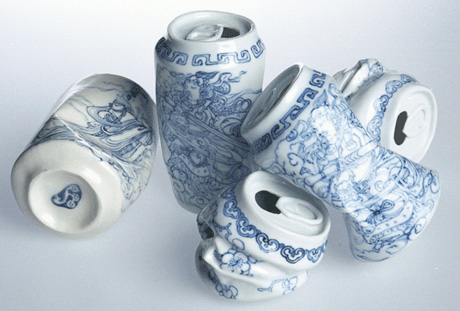
Another interesting find while searching for images. There’s a contemporary Chinese artist, Lei Xue, who’s making art out of handmade bone china. He’s taking ordinary objects and creating porcelain versions of them. Lately, he’s been making beer cans that are hand-painted and resemble Ming Dynasty vases.

porcelain-cans

The title of this piece is “Teetrinken.” It’s amazing how he’s captured the crumpled, flattened look of them.

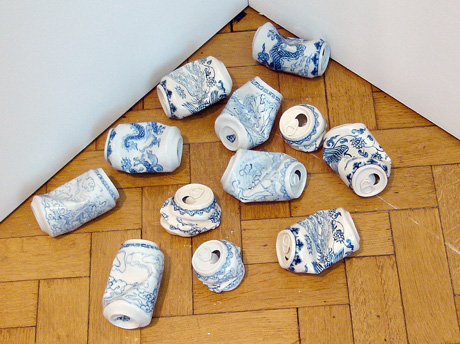
porcelain-cans2

These porcelain beer cans littered in the corner were for an exhibition in Germany. I imagine they’re heavier than they look.


Filed Under: Art & Beer Tagged With: Cans

Beer in Art #2: Jasper Johns’ Painted Bronze

November 16, 2008 By Jay Brooks

art-beer
Our second installment of “Beer in Art” is another favorite of mine, and one I’ve seen the original of at a Jasper Johns exhibition at Berkeley I saw in the late 980s with an artist friend of mine. It’s official title is “Painted Bronze,” though most people refer to by what it represents, Ballantine Ale cans. Johns actually cast two beer cans in bronze and then painted them to look precisely like ordinary beer cans. The work stems from 1960, and gave the same treatment to other ordinary objects, such a Savarin coffee can filled with used paint brushes.

One analysis of the work, from US History Companion:

Johns’s views were undoubtedly influenced by the iconoclasm of the earlier dada movement and particularly by his idol, Marcel Duchamp, whom he sought out in 1960. After their initial meeting, Johns made a gesture worthy of Duchamp when he cast two beer cans in bronze and then painted them to look precisely like ordinary beer cans. This triple entendre clearly indicated how deeply Johns was engaged in the criticism of orthodox aesthetics, particularly the aesthetics of gestural painting, which he often parodied.

In an interview from 1974, Johns explains a little bit about the point of Painted Bronze.

Painted Bronze, two cans of Ballantine Ale cast in bronze, was one in a series of sculptures that came to define Johns’ theories of reality; like the pop art that followed it, his experiments with context sought to reconstitute “ordinary” objects in such a way as to highlight the power of the perceptual over the physical world. In 1964 he explained, as fulsomely as he ever would, what it was he was trying to do: “I am concerned with a thing’s not being what it was, with its becoming something other than what it is, with any moment in which one identifies a thing precisely and with the slipping away of that moment.”

Although there’s nothing about this work, Wikipedia has a good overview of Jasper johns, as does Answers.com. Also, the overview at Area of Design includes a few of his representative works throughout his career.

Filed Under: Art & Beer Tagged With: Cans

Halloween Beer Costumes, Pt. 6: Beer Cans

October 30, 2008 By Jay Brooks

This is part six of seven days of beer-themed Halloween costumes. Today’s theme is beer cans, of which there are surprisingly few. Enjoy

 
Chugalaug


Buzzed Nice


Buzzed Lite


Budd Light


Filed Under: Uncategorized Tagged With: Cans, Holidays

Happy Hops

September 11, 2008 By Jay Brooks

At a beer dinner the other night at Hopmonk Tavern I had a chance to try Russian River’s newest beer, Happy Hops, whose name has an interesting story.

In talking about it with Vinnie, he declared that it was his new favorite beer, which is essentially a well-hopped blonde ale. Russian River’s website refers to the new beer as a:

Hopped-Up Blonde Ale, 5.4% ABV
Not really a Blonde Ale, not a Pale Ale, not an IPA. Happy Hops is a light colored refreshing ale with a pronouced hop character.

You may also see a special version of this beer once a year called Happy Hops Harvest, which is brewed with fresh “wet” hops grown locally.

It’s light and nicely refreshing with a nose reminiscent of hops’ cousin, Mary Jane. Although it’s over 5% and thus not truly so, it does feel like a hoppy session beer. Maybe that’s a relative thing, but a hoppy beer that’s also clean, light and refreshing I think is a great addition to Russian River’s lineup.

Its name comes from a historical Santa Rosa brewery, Grace Brothers, which operated on 2nd Street under that name from 1897-1969. The hops business runs in cycles and so, just like today, there was a hop shortage in the late 1940s and hops were rationed for a time. To get around the allotments imposed, Grace Brothers Brewing created another beer company, North Bay Brewing Co., which operated from 1946-52, so they could get two allotments of hops. That brewery’s lineup included a beer called Happy Hops, which, according to the information on the can, was a lager.

I love that era’s graphic design. They’d put a face on anything and personify it. The hop man serving up himself for your enjoyment just cracks me up. In case you can’t read the red banner at the bottom of the can, it reads “We grow our own hops, we make our own malt.”


Filed Under: Uncategorized Tagged With: Cans

« Previous Page
Next Page »

Find Something

Northern California Breweries

Please consider purchasing my latest book, California Breweries North, available from Amazon, or ask for it at your local bookstore.

Recent Comments

  • Bob Paolino on Beer Birthday: Grant Johnston
  • Gambrinus on Historic Beer Birthday: A.J. Houghton
  • Ernie Dewing on Historic Beer Birthday: Charles William Bergner 
  • Steve 'Pudgy' De Rose on Historic Beer Birthday: Jacob Schmidt
  • Jay Brooks on Beer Birthday: Bill Owens

Recent Posts

  • Historic Beer Birthday: Anthony J. McGowan March 14, 2026
  • Beer In Ads #5163: It’s Here Genuine New Jersey Bock Beer March 14, 2026
  • Beer In Ads #5162: Bock Beer Time Is Here gain March 13-18 March 13, 2026
  • Beer Birthday: Joe Tucker March 13, 2026
  • Historic Beer Birthday: John Taylor March 13, 2026

BBB Archives

Feedback

Head Quarter
This site is hosted and maintained by H25Q.dev. Any questions or comments for the webmaster can be directed here.