
BBC News had an article Thursday about beer in Belgium entitled “Belgian beer gets the travel bug.” The story begins with “For Belgians, beer is not merely a drink, but something of a national symbol.” Wouldn’t it be great if we could get to that point here?
If You Happen to Be in Belgium …
If you happen to be in Belgium next week, you should do whatever you have to to do to get to Essen for the 12th annual Kerstbierfestival. They’ll be tasting over 100 holiday and winter beers over the two-day festival.
And please note they use a cartoon on the poster. You know what would happen here in the U.S. if they did that, right? Neo-prohibitionists and state agencies would be falling over themselves to stop them from “appealing to kids.”
12.16-17
Kerstbierfestival (12th annual)
Heuvelhal, Kapelstraat 7, B-2910 Essen, Belgium
[ website ] [ in English ] [ Directions ]
Duvel Buys Achouffe
This is somewhat old news, it happened about two weeks ago. But it’s been a very busy couple of week and I’m a little behind. My wife and I are buying a new house and we’re moving December 20 and I’m trying to put the finishing touches on my second novel and my third successful NaNoWriMo last month. So please forgive the next few posts if you already know this news. I’m just trying to catch up.
So brewery Duvel Moortgat, which has been around since 1871, bought the Achouffe brewery, which was started by two brothers-in-law, Pierre Gobron and Chris Bauweraerts, as a hobby in 1982. Duvel the beer was born in 1923 though it’s original name was Victory Ale. Supposedly one of the brewery workers tasting it for the first time remarked. “Da’s nen echten duvel” which translates as “Damn, that’s a devil of a beer.” The name stuck and over eighty years later it’s a world class beer.
Achouffe, on the other hand, in their two decade run have also managed to create some of the most unique, tasty beers anywhere in the world. It should be a good arrangement for both of them.
The Achouffe brewery viewed from the nearby lake.
McFarland Nabs Second Writing Award
British writer Ben McFarland won the coveted “Beer Writer of the Year” award from the British Guild of Beer Writers for 2006. This is the second time he’s won this award, having also been given the honor in 2004. McFarland writes for various trade and national press in the UK, including the Publican, the Guardian and the Independent. Congratulations to Ben.
Here’s a fun piece he did for the Publican that includes a quiz to determine what kind of beer snob you are.
Braille Beer
Duesseldorf’s famous Uerige Obergärige Hausbrauerei, known more simply as Zum Uerige, makes one of the finest Altbiers in the world. And now they’re the first with another beer milestone.
Imagine if you couldn’t see the beer you were drinking. You’d have to take the word of whoever put the beer in front of you as to what it was. But now Uerige’s alt beer label will be printed in braille, allowing the blind to know exactly what bttle of beer they’ve got. In a short item by Ananova, Joanna Zimmer, an activist for the blind, was thrilled by the news. “For blind people every drink is actually a lucky dip. You often have no idea what’s about to go in your mouth. But with this bottle you are clearly told what it is — and that’s fabulous.”
As far as I know, this is the first beer for the blind. B. United imports several Uriege beers into the U.S. No word yet as to when or if the braille labels will be here in the United States.
Champagne vs. Beer
When many people think of champagne and beer, they might conjure up the image of Miller High Life, which used to call itself “the champagne of bottled beer.” But many American craft and Belgian brewers are increasingly putting their high end beers in champagne bottles, with cork, cage and foil, just like the sparkling wine. It was an easy shorthand to convey that what’s inside the bottle is as fine in its own way as any wine and the size and seal and make them ideal for bottle conditioned beers which continue to ferment in the bottle. The small Belgian brewery, Malheur, has taken this idea one step farther and released three beers that evoke champagne in their very names: Malheur Bière Brut, Dark Brut, and Cuvée Royale. All three use what owner Emanuel De Landtsheer calls “à la méthode originale.”
De Landtsheer’s family had been in brewing for generations and he recently took up the family calling when he opened the Malheur brewery in 1997. Michael Jackson has a delightful story about the brewery’s origins at his online Beer Hunter. When he first debuted the Brut line, he also used the phrase, the “Veuve-Clicquot of the beer world” in his marketing of the beers. Veuve-Clicquot sued to stop Malheur from using their name in the advertising, along with the more general terms, “method traditional”, “brut” and “reserve.” The lower court ruled for the champagne maker but on appeal to the European Court of Justice, it appears that they will rule for Malheur. Malheur voluntarily stopped using specific reference to Veuve-Clicquot for their beer, and the high court will likely rule that the other three terms do not imply a specific product or competitor and as such are legal to use for beer. The official ruling has not yet been handed down, but Reuters is reporting that this is now the expected outcome because their rulings generally follow the advocate general’s opinion.
Craft Beer at Salone del Gusto
If you’re not familiar with the Slow Food organization or its American counterpart, Slow Food USA, you should be. The idea started in Italy but has spread around the world. Essentially, they celebrate food in its more traditional guise, using natural and local ingredients, taking time to both prepare and enjoy the meal, paired with the finest beverages, whether it’s beer, wine or something else that compliments the meal perfectly. Their three guiding principles are good, clean and fair.
It’s also a perfect fit for the craft beer industry and the Brewers Association has been sending a team of representatives armed with some of our best beers to the Salone del Gusto in Torino (a.k.a. Turin), Italy for the last four times the event has been held, which is every two years. This year’s event was the sixth biennial festival and celebrates all manner of great food and drink from around the world. The five-day event includes opportunities to taste hundreds of flavors, taste workshops, full dinner experiences, lectures, education along with much more.
In addition, another event was taking place the same week nearby, called Terra Madre, that is a world meetup of people and organizations that produce good, clean and fair food with an emphasis on sustainable farming and food. The city of Santa Rosa selected Vinne and Natalie Cilurzo from Russian River Brewing to be their representatives at Terra Madre. The whole experience sounds fantastic and hopefully I’ll be able to attend one of these years. The pictures below are courtesy of Shaun O’Sullivan from 21st Amendment Brewery. Thanks Shaun.
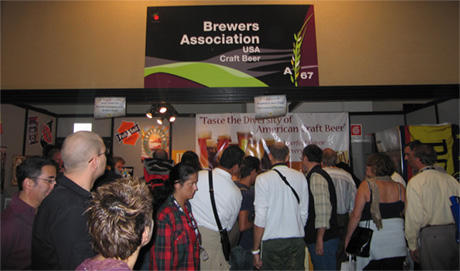
The Brewers Association booth at Salone del Gusto in Torino, Italy

Eric Wallace from Left Hand Brewing works the booth. It was very popular with the Italians, Expats, students and visitors from the U.S. You could get a taster of three beers for 3 Euros. Half the proceeds from the booth were donated to the Slow Food Movement. You could also purchase beer which was very popular with the Americans living abroad.

Shaun O’Sullivan from 21st Amendment in San Francisco, California poses with Charlie Papazian and a fuzzy Nancy Johnson of the Brewers Association.
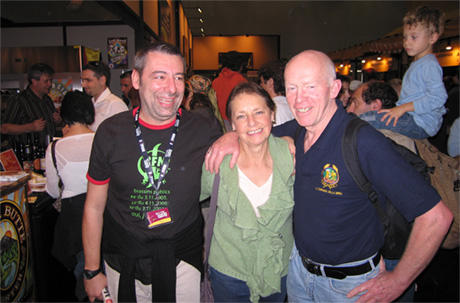
Lorenzo Dabove, the “Michael Jackson” of Italy, along with Cantillon owners Claude and Jean-Pierre Van Roy.
Beer Goes Wireless
Heineken and IBM, along with a few other companies, have partnered together to test wireless tracking of beer shipments. Dubbed “The Living Beer Lab,” the scheme will allow Heineken to know the exact location of any shipment of its beer, even in the middle of the ocean, using “triangulation techniques of both satellites and cellular base stations to locate exactly where the cargo is.”
The first test is currently underway, with ten containers of Heineken in the water and in transit from both the Netherlands and Great Britain en route to the United States.
According to ZDNet UK, “Integration has been completed with IBM WebSphere service oriented architecture (SOA) to maintain a paperless trail of the beer’s journey from customs in Europe through US customers and into the distribution centre on the other side of the Atlantic. The process will eliminate the need to fill in up to 30 documents on each journey, and could vastly decrease the amount of time the beer spends in transit.”
Here’s a more thorough explanation of how it all works, complete with impenetrable business jargon from The Retail Bulletin:
IBM’s Secure Trade Lane solution will provide real-time visibility and interoperability through an advanced wireless sensor platform and Services Oriented Architecture (SOA), based on IBM’s WebSphere platform. The project’s SOA, called the Shipment Information Services, leverages the EPCglobal network and EPCIS (Electronic Product Code Information Services) standards, so rather than build and maintain a large central database with huge amounts of information, distributed data sources are linked, allowing data to be shared in real time between Heineken, Safmarine and customs authorities in the Netherlands, England and The United States.
In this project, Safmarine will ship ten containers of Heineken beer from locations in both Netherlands and England, through their Customs Authorities, to the Heineken distribution center in United States. Vrije Universiteit Amsterdam will coordinate the project and provide best practices documentation to share across the European Union.
“The Beer Living Lab is setting a roadmap for the next generation e-Customs solutions. We test innovative solutions, based on IBM’s Tamper Resistant Embedded Controller (TREC) and SOA developed by IBM that could revolutionize customs,” said Dr. Yao-Hua Tan, professor of Electronic Business, Vrije Universiteit Amsterdam. “Companies using these solutions could benefit greatly due to less physical inspections by customs; thus these e-customs solutions greatly facilitate international trade.”
According to the Organisation for Economic Co-operation and Development, more than 30 different documents are associated with one single container crossing a border, which equals roughly five billion documents annually. The findings of the project will provide a viable alternative to manufacturers, shippers, retailers and customs administrations as they look to move to a paperless trade environment. Once accepted and implemented widely, paperless trade will support initiatives such as Green Lane, which will eliminate most inspections on arrival, thus significantly speeding up ocean fright shipments and improving the profit margins for shippers.
“Because efficient collaboration is a paramount requirement to making this work, IBM built the Shipment Information Services to address interoperability. If governments around the world are serious about electronic customs and paperless trade, they need to encourage each country to adopt open standards environments to enable collaboration and data sharing throughout the trade lane,” said Stefan Reidy, Manager, Secure Trade Lane, IBM. “The Beer Living Lab project is the first step in building the Intranet of Trade, which will help to substantially improve efficiency and security in the global supply chain.”
Now if only they’d stop using those green bottles that result in Heineken being such a skunked beer most of the time.
U.K. Shows Perspective in Rejecting Increasing Beer Tax
Patricia Hewitt, the Health Secretary for the U.K.’s Department of Health, during an interview Friday in youth newspaper First News told them that she would ask the British government to increase the tax on alcohol, and especially alcopops, as a way of combating underage binge drinking. And not just increase them, but “really increase taxes on alcohol.”
The Treasury Department quickly rejected her call for the increase, suggesting that it was her job to combat binge drinking and raising taxes on all alcohol would “punish responsible drinkers in an attempt to change the behaviour of a small minority.” Amen.
And according to the Daily Express, another “Treasury source said the idea was misguided because the main consumers of alcopops were no longer youngsters, while the move also risked driving whisky producers out of business.”
Now if only our government could find its spine to stand up to the neo-prohibitionist agenda in similar fashion. Ah, dare to dream …
Giving the Bishop the Finger
Did you know sex sells? Yeah, me neither. The late comedian and social critic Bill Hicks used to say that the advertisement that big business wants to run is simply a photograph of an attractive woman fully naked and the text “Drink Coke” (or any other company’s slogan). Unlike me, he made it sound funny, of course, but the point is that it’s not really a secret that sex is used to sell almost every imaginable kind of product or service. I had a whole semester on this subject in college, where we were even shown the word s-e-x spelled out in an older version of KFC’s Colonel Sanders logo, along with much else.
Among beer advertisements, especially those of the big breweries, sex is a frequent sales tool from the Coors Twins to St. Pauli Girl. A review of older beer ads will quickly reveal that this is not a new phenomenon, either. Many early breweries used attractive women in their advertising. I’m not necessarily opposed to seeing an attractive woman per se, but when it’s used merely to pander to base instincts and outmoded stereotypes then it’s bad for the beer industry, at least in my opinion. Most of the worst examples of this — Miller’s mud wrestling “cat fight” ad was a particularly bad one — essentially take the position that their target audience is all but exclusively male or certainly male enough that they can safely alienate half the total population. And not just any male, but a certain kind of unenlightened male, the ones for whom Jackass, Beavis and Butthead, Dumb and Dumber, and Beerfest are all high art. Does that make me elitist? Maybe, but I’d rather that than see beer’s image continue to be so unceasingly tarnished.
Not surprisingly, that is outmoded thinking, because the demographics of beer are changing and beer drinking among women is on the rise. Some recent studies show that of the total beer consumed in America, women drank 25% of it. And while it may be no surprise that the age group with the most women beer drinkers is 21-30, the number of women drinking beer who are over age 50 is growing significantly.
But I wouldn’t argue that sexual imagery should never be used in advertising (or art or anywhere else). I don’t think that’s the right solution and frankly I don’t think it possible. Despite fundamentalist attempts globally to suppress sexual awareness and expression, it is a potent part of human nature. Without the sexual urge, we might never procreate and continue as a species so it certainly fills a very vital role in the life cycle.
I would suggest, however, that common sense and a sense of perspective and context might be employed in how sexual images are used, not least of which because we’ll never evolve if advertising continues to keep us wallowing (and literally wrestling) in the mud of our basest primal instincts. The people whose products are being advertised in these ways should have a bit more respect for themselves and their product. Why the big beer companies want to associate themselves with mud wrestling, talking frogs, man law, flatulent horses, etc. is beyond me because it does nothing to elevate the image of their product. Interestingly, when Miller tried to change that carefully created image by using the tagline “Beer: Grown Up,” hardly anyone was buying it. USA Today polls showed a majority of people didn’t like the ads and didn’t think they were effective. Despite Terry Haley, the brand manager for Miller Genuine Draft, saying “[w]e believe in what we’re doing, [w]e’re tapping into a true social trend, and we’re going to stay the course,” Miller quickly dropped the ads, and switched ad agencies, who presumably will return to the puerile.
But the other side of this debate is one of easy offense and our willingness to censor should even only a sole complaint be lodged. Advertisers, advertising and the media generally beat a very hasty retreat when faced with criticism, which is a powerful wedge for organizations and individuals with agendas and an axe to grind. (The media, of course, is paid for by advertising — you may think that you are TV, the magazine and the newspaper’s customer but you are not. Their customer is the advertiser.) For years, organizations with a small, minority membership have caused havoc for the rest of us when they cried offense at one imagined slight after the other. The media landscape for a time was (and probably still is) rife with stories of letter writing campaigns from citizen’s groups in which television shows (and other media) were deemed by these yahoos to be too provocative, too sexy, used too much bad language, showed different morals then their own, and on and on. Basically, much like neo-prohibitionist groups, some people cannot rest until the world is remade in their own image, indeed they cannot tolerate any difference of opinion or alternative (to their own) lifestyle being on display, especially if their children might furtively glance longingly at such imagined hedonism. Worse still, entire entertainment programs have been altered, changed or canceled, books have been banned, and songs have been censored all on the basis of a few complaints or even a single complaint. That 299,999,999 people in the U.S. do not complain seems to carry no weight, or at least far less weight than the single whiner who does. This is literally the very opposite of a democracy, in which the desires of the many are circumvented and denied by a tiny handful of individuals, or in some cases a single person.
This is, of course, true of advertising as well. The hue and cry against much advertising is loud and shrill and seems never to cease. And while I may not disagree with all of it — I’m no fan of a lot of advertising — I find truly reprehensible the impulse to inflict one’s beliefs on the rest of society, as if any person could be certain of the one, true moral compass and way to live one’s life. That anyone pays attention to these nutjobs is a sad commentary indeed on the way our world is heading, but that’s a debate for another day and another forum.
What prompted all of what preceded, is an item reported yesterday by the BBC News in an article titled ‘Provocative’ beer ad criticized. According to the report, a complaint was filed with the UK’s Advertising Standards Authority, an organization that is paid for by the advertising industry and which acts essentially as an ombudsman. That means that people offended by advertising may file complaints and have their cases adjudicated by the ASA. In this instance, a print ad for Bishop’s Finger, a popular beer brewed by the Shepherd Neame Brewery of Kent, England had a complaint filed against it. The ad that prompted the complaint has been removed from Bishop’s Finger’s website, but here is a similar one:
In the offending one, which apparently ran in the magazine Time Out, the woman was seated on a bale of hay and the text read, “I love a good session on the Bishops Finger.” And here are all seven print ads, after the offending one was quickly removed. The name “Bishop’s Finger” has it’s origin in the “ancient finger-shaped signposts that showed the Pilgrims the way to Canterbury Cathedral” that are unique to the Kent area of southeastern England.
It is overtly sexual? Sure. Is it offensive? Not to me, I find it mildly amusing. It does play on the origin of the beer’s name and hearkens back to Chaucer’s time. It uses a pretty obvious double entendre, of course, but it is in context. According to the BBC article, Bishop’s Finger is known for running humorous ads. At least it’s not a scantily clad bikini gal holding a beer for no discernible reason other than to titillate.
The ASA examined the ad for four breaches of the UK’s advertising guidelines and only found that they had violated one, and ruled as follows:
We considered that the text “I love a good session on the Bishops Finger” played on the connotations of drinking and sexual activity. We considered that the woman’s pose was suggestive and concluded that, in combination with the headline text, it was likely to be seen as linking alcohol with seduction and sexual activity.
On this point, the ad breached CAP Code clause 56.9 (Alcoholic drinks).
Here’s 56.9 in its entirety:
Marketing communications must neither link alcohol with seduction, sexual activity or sexual success nor imply that alcohol can enhance attractiveness, masculinity or femininity.
Based on their ruling, the the “Advertising Standards Agency told the beer maker in future to adopt an approach that did not link alcohol with sexual activity.” Okay, I’m sure they’ll get right on that. And given that alcohol and sexual activity are, in fact, linked insofar as sexual activity can be linked with practically anything, I’m not even sure how you could possibly enforce such a perniciously vague standard. Right or wrong, alcohol has been called a “social lubricant” for centuries. That’s one of its roles in society, to pretend otherwise seems dishonest.
But here’s the thing, and perhaps the point of all this — finally — only ONE person in all of England complained about this ad. Only One. Out of a population of more than 60 million people, only ONE person was offended enough to complain. That one person being offended by the ad prompted a full-scale investigation involving who knows how many people, a news article in the BBC, and a major brewer to withdraw an ad from the market. Does that seem reasonable? It sure doesn’t seem so to me. Like many issues of censorship, the person who lodged this complaint could have asked a few friends before starting this ball rolling. Perhaps some friend’s support or non-support might have changed or strengthened their resolve. But even if a 100 people had complained, a hundredfold increase, I would still be skeptical that justice had been served. Perspective has to play in role in looking at issues of censorship and people being offended. I’m sorry this person felt as badly as she (or possibly he, I suppose) claims to have, but that doesn’t mean the whole of England should have to sit up and take notice. Is there anything published in the world today that you couldn’t argue might be offensive to somebody? It’s one thing to be sensitive to the views of others, but quite another to insist the world be inoffensive to all. Every time we pander to such an extreme minority view, however well-intentioned, we fan the flames of intolerance and make it harder for all of us to co-exist. Why can’t we all just have a beer and get along?