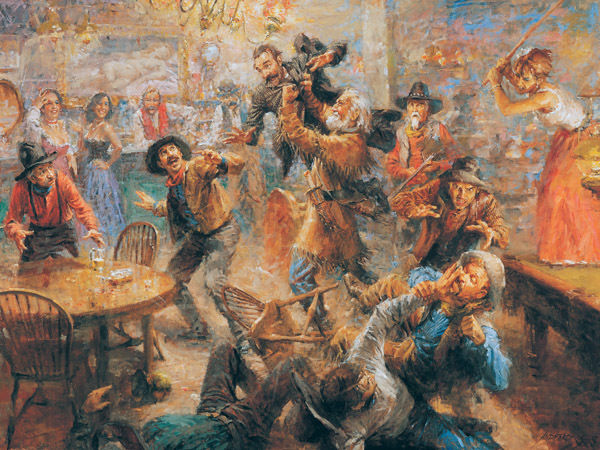
You’ve undoubtedly seen a belligerent drunk at some point in your life. Perhaps you’ve even been one. There are some people who seemingly turn angry when they drink. Some of them get into fights, maybe start one in a bar, the classic mythical bar fight where chairs start flying and everybody joins in because everyone who drinks is looking for a fight, right? Watch almost any western movie to see this in action. It’s so taken for granted, it’s a cliche. I’m sure bar fights occur, but honestly I’ve never seen a full on fight like you see in the movies. And I’ve been to more bars in my lifetime than the average person, I’d warrant. There are apparently people who become angry after a few too many drinks. And some of them probably do start a fight. There are certainly people like this, and I’ve always thought of them simply as “bad drunks.”
My stepfather was one. He turned mean on a bender, and he was violent and very, very scary, especially to a young sheltered suburban punk like me, ages 5 to 15 or so. But I quickly figured out all on my own that it wasn’t the alcohol that made him so belligerent. He was already that way, thanks to his own trials and tribulations growing up. Not to mention he was raised in a place/culture/family/time when/where not only weren’t men supposed to show their feelings, they weren’t supposed to actually have any. That’s not an excuse, just a fact. He walked around seething, all bottled up, and used alcohol to release his demons. It seemed to help him, of course, but it was devastating to anyone around him, especially me and my mother, who was too co-dependent to do anything about it. But the next morning, the relief he’d felt was all too brief, and the pressure would start building again to its next inevitable violent conclusion; a day, a week or even a month later.
You’d think after such unpleasant experiences that I might have sworn off alcohol entirely. But as I said, I knew it wasn’t the alcohol that made him that way. It was people and society who were convinced and believed that alcohol made him angry that allowed him to continue to be a nasty drunk, and not have to take any responsibility for his actions. It was just the alcohol, they’d say. Prohibitionists today continue this lie, and it’s one of things I so hate about them, by claiming it’s the alcohol that causes harm. But it’s not. And every time they spout that meme I wonder how many more kids are made to suffer by spouses and family and a community who listen to them, and do honestly believe that were it not for the drinking, Dad would be fine, a model citizen.
But look around you. Not everybody who drinks turns angry. In fact, most don’t. That’s how I know it’s not the alcohol. Because I can get rip-roaring drunk, and never become angry. Believe me I’ve tried, but it never happens. I get more talkative, if that’s possible, and more philosophical and sleepy. And most people I know react similarly, at least insofar as they don’t start a bar fight every time they take a drink. That’s also my biggest problem with AA and similar programs that preach that people are powerless, in effect not responsible. They often claim otherwise, but turning the superhero credo on its head; with great powerless comes a great ability to shirk responsibility for one’s actions. And so it’s the alcohol that ends up with the blame, not the person who abused it. Why society allows that is apparently complicated and is something I frankly don’t completely understand.
A German study published late last year in Deutsches Ärzteblatt International, entitled Alcohol-Related Aggression — Social and Neurobiological Factors sought to examine “Alcohol-related aggression and violence” and begins by noting that “nearly one in three violent acts in Germany was committed under the influence of alcohol (31.8%).” But that also means that over two-thirds of violent acts are committed by people who were not drinking or drunk. Maybe there are other factors we should be looking at as to why people are violent? And it also doesn’t answer the question of how many violent acts were prevented because someone had a drink after a tough day and that relaxed and calmed them.
Curiously, when reported on here in the U.S., the reference to this being a German statistic was removed, making it a much broader, universal statement. For example, the Robert Wood Johnson Foundation Center for Health Policy at the University of New Mexico, Science Daily and Medical News Today (MNT) all begin their coverage with the same sentence. “One-third of all acts of violence are perpetrated under the influence of alcohol.” So first of all, it was actually less than one-third and secondly, that statistic was confined to Germany. Not exactly an auspicious beginning for there to be two errors in the very first sentence. The MNT headline itself is misleading, stating that “Social and neurobiological factors linked to alcohol-related aggression,” while the study didn’t confirm a link so much as examine the “causes of alcohol-related aggression.” But by using that headline, it changes the tone of how you read the entire article.
But that just seems like prohibitionist interests bending it to their purposes, because the study itself is interesting, and worth a read. The whole article is online, and there’s also a pdf you can download. It’s not so much a scientific study but a survey, or review, of all of the previous studies and literature about alcohol-induced aggression. In the abstract, they describe their process as follows.
In this review, based on a selective search for pertinent literature in PubMed, we analyze and summarize information from original articles, reviews, and book chapters about alcohol and aggression and discuss the neurobiological basis of aggressive behavior.
What they found was that “[o]nly a minority of persons who drink alcohol become aggressive,” which is what we all know. There appears to be evidence that “neurobiological factors” can account for the aggression, but that possibly more importantly, so can “personal expectations of the effects of alcohol, on prior experience of violent conflicts, and on the environmental conditions of early childhood, especially social exclusion and discrimination.”
They cite the World Health Organization and several other studies, and meta-studies, that indicate how many crimes, many of them violent, are committed by drunk people. But for many, if not most, of these, they specifically cite “acute alcohol intoxication” which is not the same thing as having a few beers, drinking responsibly in moderation. In addition, it’s also worse for people with “chronic alcohol consumption and alcohol dependence” issues. So again, this is a subset of all drinkers. But most American prohibitionist groups lump everybody who drinks together into one group, insisting all drinking is bad and leads to all sorts of trouble and mischief, taking a simplistic approach that treats all drinkers the same. But the Germans found things aren’t so simple.
Both clinical observations and scientific data have shown that the manifestation of alcohol-related aggression is by no means uniform. Rather, it is becoming clear that individual differences play a key role. In addition, more recent models are moving away from single-factor causes and towards multifactorial sets of conditions.
So what are the various factors that contribute to someone drinking and turning violent? They identify four.
- Executive functions such as the control and inhibition of ongoing behavior
- Information processing
- Attentional control
- Individual differences in expectation of the effect of alcohol consumption (e.g. “Alcohol makes me aggressive.”)
They also add to that list, Social learning, described as “experiences with friends or relatives who exhibit aggressive behavior under the influence of alcohol, [and] play a key role in the onset of alcohol-related aggression.”
But looking through the entire survey, what seems clear is that it’s the “expectations of effect” that has the most influence. And that brings us back to everyday experience. People believe that they can act differently under the influence of alcohol, and so they do. Society also expects that people will act differently under the influence of alcohol and so they don’t impose social penalties or ostracize that behavior. In many cases, it’s not just tolerated and excused but forgiven, and therefore enabled. By letting drunks essentially get away with bad behavior, it leads to a society that creates incentives for acting badly. That’s why I hate bad drunks so much. They ruin it for the rest of us. Bad drunks are what prohibitionists believe we all become when we have a beer, any amount of beer, despite the massive evidence to the contrary.
Other “individual factors” they identified “with an increased probability of alcohol-induced aggression” include:
- Sex (men have a higher risk of reacting aggressively following acute alcohol consumption)
- Personality traits such as sensation-seeking
- High underlying irritability
- Lack of empathy
They add. “Maladaptive reasons for drinking, such as drinking as a coping mechanism, and the assumption that aggression is an acceptable form of social interaction, also play a major role.”
So essentially, they’re saying it’s personality-driven, which has been my experience, as well. If you have a propensity to act aggressively toward women, alcohol will give you the excuse to act that out. If you’re seeking sensational experiences, alcohol will give you the excuse to act that out. If you’re already irritable or angry, alcohol will give you the excuse to act more violently and aggressive. If you already lack empathy, alcohol will give you the excuse to care about other people even less than you normally do. And as long as that’s “an acceptable form of social interaction,” then people will continue to do so because they can use getting drunk as an excuse to be a douchebag.
In the conclusion they sum this up. “Individuals who find it difficult to inhibit their behavior and delay gratification and who have problems enduring unpleasant feelings seem to become aggressive more frequently after consuming alcohol.” And this happens even more often to people who are “alcohol-dependent” but curiously is “not associated with alcohol dependence, including chronic alcohol dependence, per se.” I can’t help but think that’s because in such cases being drunk is used as the excuse to act badly, knowing that society — friends, family, etc. — will let them get away with it because they too have the expectation that the alcohol is causing them to behave badly, and that they shouldn’t, or can’t, be held responsible for their actions.
As this article makes clear, while there are genetic and neurobiological factors that in some people can lead to abusing alcohol, the majority of the problem stems from social conventions. Because the neurobiological causes can be identified, dealt with and treated. The social structures that allow people to use getting drunk as an excuse for bad behavior is a lot harder to change, because it’s so well-rooted in how our society functions. And it doesn’t help that addiction organizations and medical groups that treat this problem also enable this behavior by accepting it as dogma. And it doesn’t help that prohibitionist groups believe it, too, insisting that it’s the alcohol that’s causing the harm, not the individuals using, or abusing, it. By targeting the product that some people are abusing, instead of those people, they’re essentially allowing and even making the conditions more attractive to anyone using alcohol to continue using that as their excuse. After all, they must think, “I can’t be responsible for acting like an asshole, I was drunk. The booze made me do it, I couldn’t help myself.” And that, I think, is why some drunks fight. Because we as a society let them.
We don’t need tougher laws, or more police, or roadside checkpoints, or more prohibitionist propaganda. If everybody with a friend or family member who’s a bad drunk stopped letting them get away with it, this problem would be substantially reduced, whittled down to the people physically unable to control themselves. And we could then get those people the help they need. I say don’t tolerate bad drunks, let them know you don’t accept alcohol as an excuse for their bad behavior. They’ll either stop, or they’ll figure out they really do have a health problem that needs addressing. Social pressure and the threat of ostracization are usually a much more effective method of changing behaviors.
Drinking should be about the enjoyment of life, and responsible, moderate consumption should enhance what’s good in our lives already. Whether it’s improving a meal, conversation with friends at a pub, or celebrating a holiday or personal achievement, beer can heighten and complement those experiences, from the ordinary to the very special. That’s the goal of beer with flavor, that people drink less, but better. Who could fight with that?