Brookston Beer Bulletin

Jay R. Brooks on Beer

  • Home
  • About
  • Editorial
  • Birthdays
  • Art & Beer

Socialize

  • Dribbble
  • Email
  • Facebook
  • Flickr
  • GitHub
  • Instagram
  • LinkedIn
  • Pinterest
  • RSS
  • Twitter
  • YouTube

Powered by Genesis

Patent No. 3047190A: Beer Fermenting Tank

July 31, 2016 By Jay Brooks

patent-logo
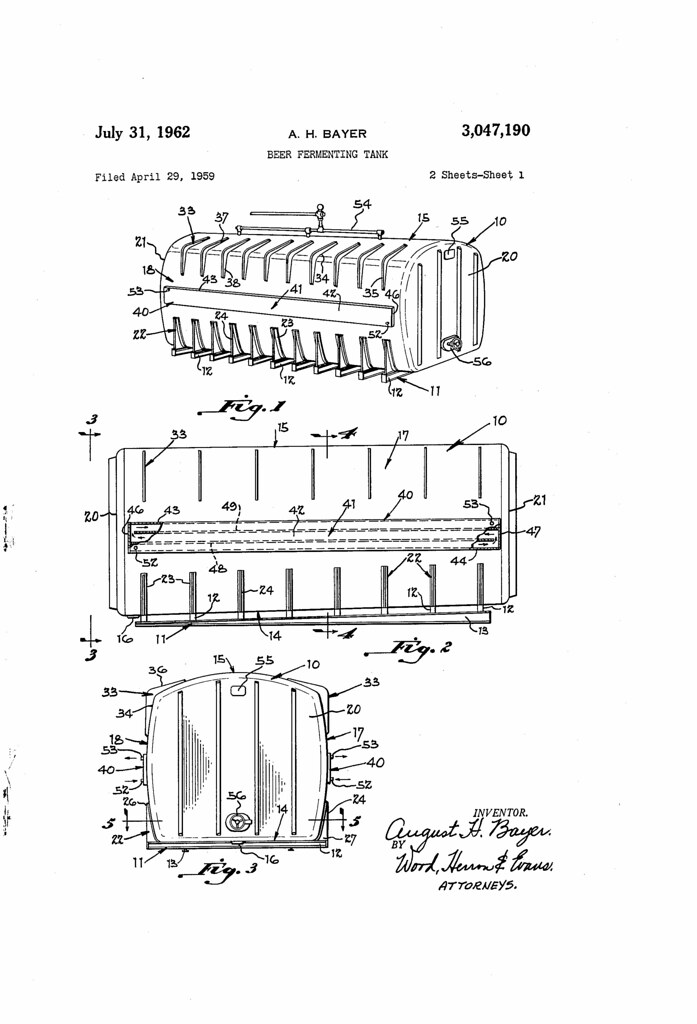
Today in 1962, US Patent 3047190 A was issued, an invention of August H. Bayer, for his “Beer Fermenting Tank.” There’s no Abstract, although in the description it includes these claims:

This invention relates to storage tanks and is particularly directed to a novel closed fermenting tank for use in the brewing industry.

It is common practice in breweries to use fermenting tanks in which beer is fermented for an appreciable length of time under controlled pressure and temperature conditions. While the size of these tanks varies, a typical fermenting tank is adapted to contain 1300 barrels of beer. The tank is substantially filled with beer except for an air space at the top of the tank to permit collection of gases produced during the fermentation process. It will readily be appreciated that the walls of the fermentation tank are thus subjected not only to the hydrostatic loads caused by the contained liquid, but in addition are subjected to stresses induced by the resultant gas pressure.

In the past, it has been conventional in breweries to construct fermentation tanks of rectangular cross-section and to provide a plurality of spaced reinforcing ribs which extend completely around the tank; i.e., across the top and bottom Walls and upwardly along the side walls of the tank. While tanks of this type have proved to be satisfactory from a strength standpoint, they utilize an excessive amount of floor space for a given capacity because of the reinforcing members on the sides of the tank.

It is an important object of the present invention to provide a fermenting tank in which a maximum usable capacity is obtained for the door space occupied by the tank. Thus, a tank constructed in accordance with the principles of the present invention provides approximately eight percent more capacity than a tank having the same overall dimensions of the conventional type referred to above.

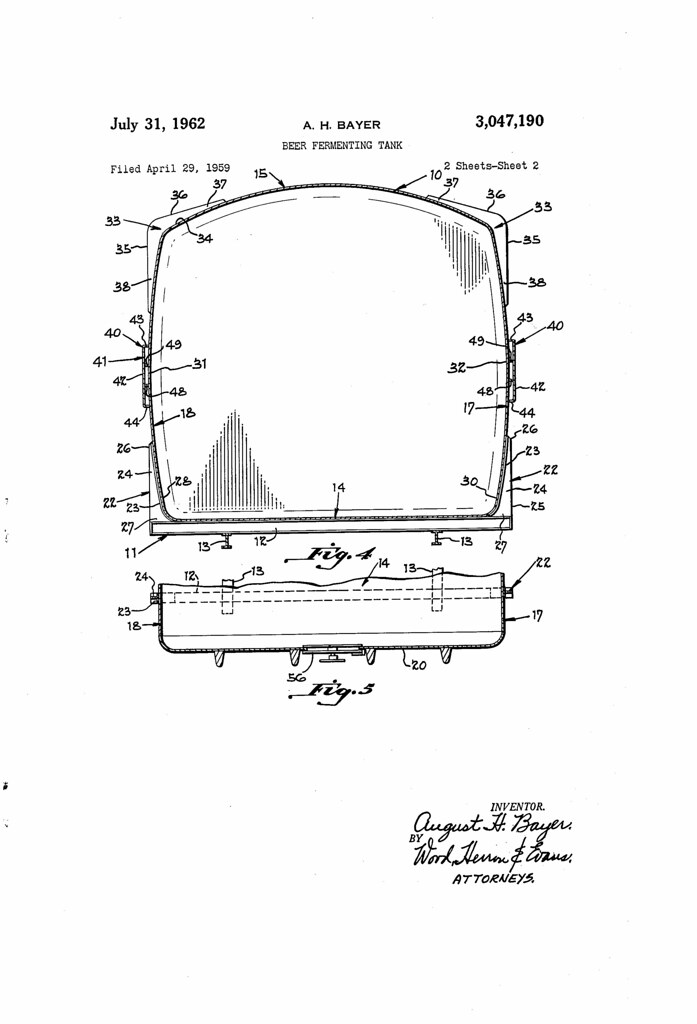
The present invention is predicated in part upon the concept of providing a tank structure in which only the upper and lower portions of the side walls are reinforced to resist stresses as a beam, while the center portions of the side walls are intentionally left unreinforced, are slightly curved, and are made of a relatively thin material so that these walls undergo large deflections and thus function as membranes.

More particularly, one preferred form of tank constructed in accordance with the principles of the present invention comprises a bottom member which is supported on a plurality of spaced transverse beams, or box type sections. Two arcuate side walls are welded to the bottom, and to a top, and end members to form a closed tank. The side walls are reinforced by a plurality of spaced upper and lower stiffener members which extend upwardly approximately of the height of the tank from the bottom of the tank and downwardly approximately of the height of the tank from the top. Thus, the upper and lower portions of the side walls of the tank adjacent to these stiffeners function as a beam; i.e., members adapted to resist sizable bending stresses. The center portions of the tank side walls, however, are completely unreinforced and these portions of the side walls, which are curved outwardly and are thinner than the side walls of conventional tanks, are adapted to deflect outwardly an appreciable amount; for example, more than one inch for a of an inch side wall. This portion of each side wall thus functions mechanically as a membrane; that is, a member which may be subjected to ant liquid is circulated to remove excess heat and main large tensile stresses (which the side walls can readily resist without yield), but is not subjected to sizable bending stresses (which the side walls could not resist without yield).

Additionally, in accordance with the present invention, the lower stiffener members are of tapered configuration having a wide base adjacent to the bottom portion of the tank and a narrow upper end. Thus, these reinforcing members function as cantilever beams having a greater outward deflection adjacent at their upper ends than at their lower ends so that the reinforcing members help to provide a smooth transition in the side walls between the areas of the side walls which function as a beam and those areas of the side wall which function as a membrane. 7

in further accord with this invention, each of the upper stiffener members is of double tapered configuration including one arm extending downwardly along the upper portion of the side walls, and a second arm extending particularly, it is well known that during the fermenting process a certain amount of heat is developed which tends to raise the temperature of the beer above the optimum temperature for fermentation. Accordingly, it is conventional to provide on the interior of a fermentation tank an elongated at temperator coil through which a cool train the beer at a predetermined temperature. One of the obvious difficulties with interior coils of this type is that of cleaning the surface of the coil to keep it in a sanitary condition.
US3047190-0
US3047190-1

Filed Under: Beers, Breweries, Just For Fun, Politics & Law, Related Pleasures Tagged With: Brewing Equipment, History, Law, Patent, Science of Brewing

Patent No. 129938A: Improvement In Beer Faucets

July 30, 2016 By Jay Brooks

patent-logo
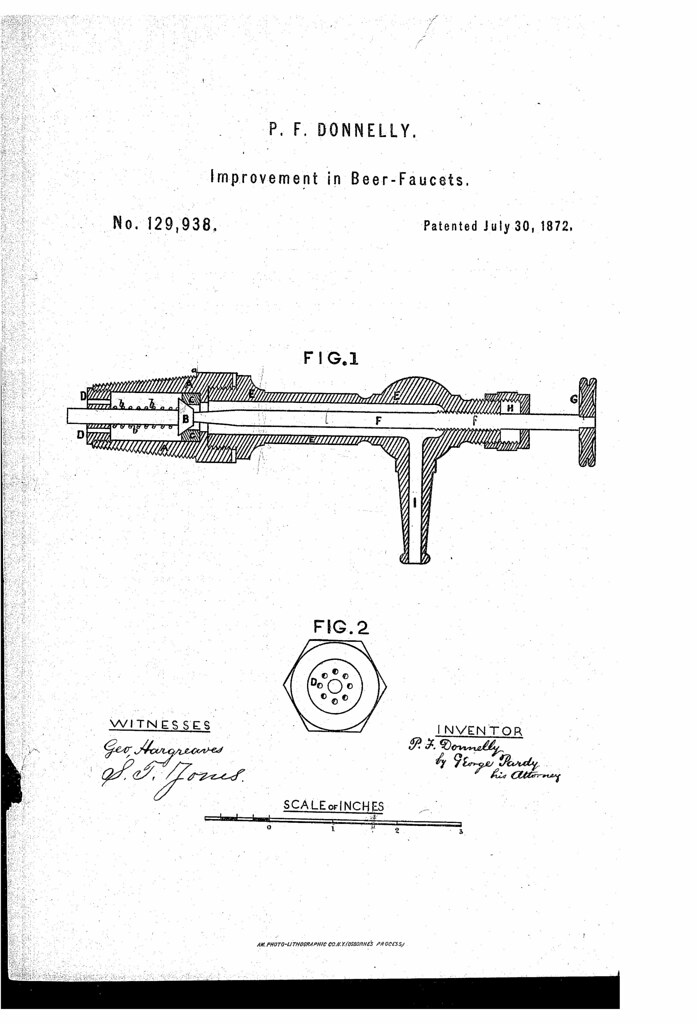
Today in 1872, US Patent 129938 A was issued, an invention of Patrick Francis Donnelly, for his “Improvement in Beer Faucets.” There’s no Abstract, although in the description it includes these claims:

Referring to the drawing, A is a bush or socket-piece, which tapers slightly from the shoulder ato the end. From the shoulder a to the end a fine-threaded screw is cut. This piece accommodates the valve B, which controls the flow of the liquid, and is screwed into the head of the barrel. The valve B rests against a rubber seat, C, being held, when closed, against this seat by the spiral spring b wound round the stem of the valve. D is a plug having several holes through it to permit the liquid to pass through. This plug is screwed into the end of the bush-piece, which projects into the barrel. At the outer end of the bush-piece, which projects outside of the barrel, there is an internal screw cut, and into this the conduit-stem E of the faucet is screwed. F is the operating-rod, which terminates, after passing beyond the conduit stem, in a little wheel, G. This rod F has a double-threaded screw at f, which screws into a corresponding thread cut in the interior of the conduit-stem. H is a packing-box of usual form, supplied, where the rod F passes out of the conduit-stem, to prevent leakage. I is the exit-passage for the liquid.

The operation is as follows: The bushpiece is inserted in the barrel-head, and may remain there until the barrel is worn out. The stem’ part of the faucet is applied when the liquid is to be drawn off, the flow being regulated by screwing the rod F against the valve B.

Instead of the double-threaded screw being supplied on the rod F, this rod may be pushed forward and drawn back by other suitable mechanism not necessary to describe.

US129938-0

Filed Under: Beers, Breweries, Just For Fun, Politics & Law, Related Pleasures Tagged With: Brewing Equipment, History, Law, Patent, Science of Brewing

Patent No. 3394647A: Apparatus For The Production Of Wort

July 30, 2016 By Jay Brooks

patent-logo
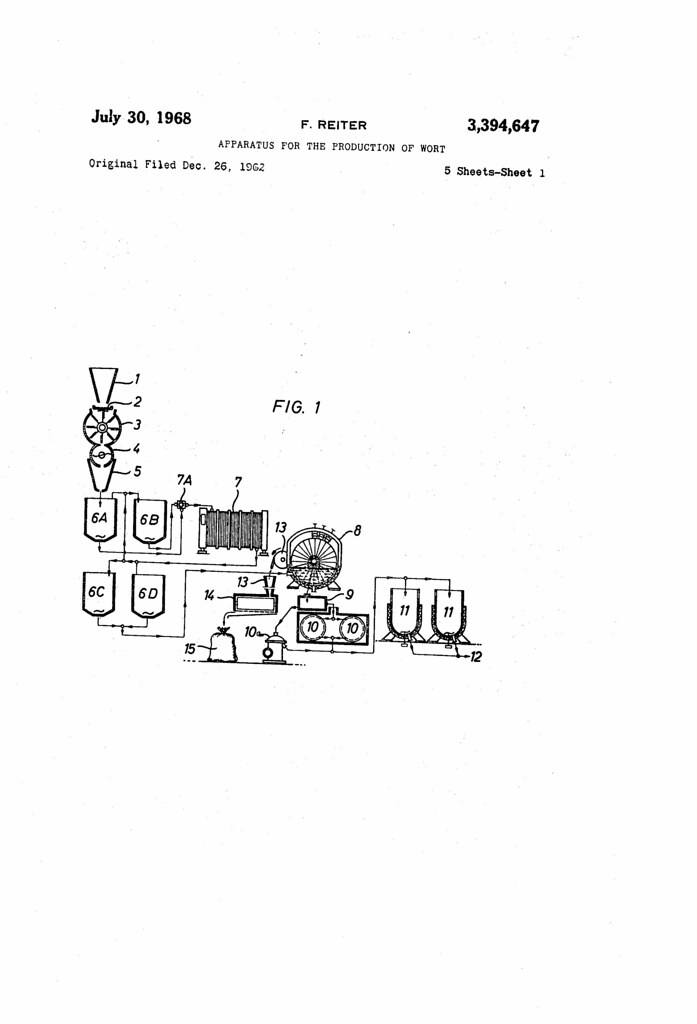
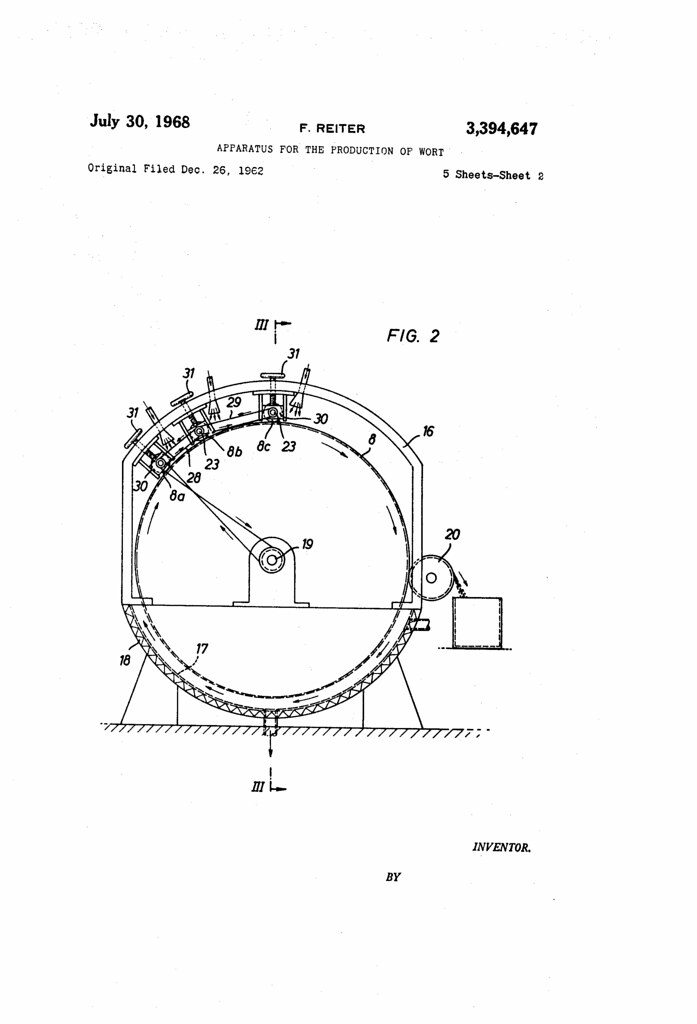
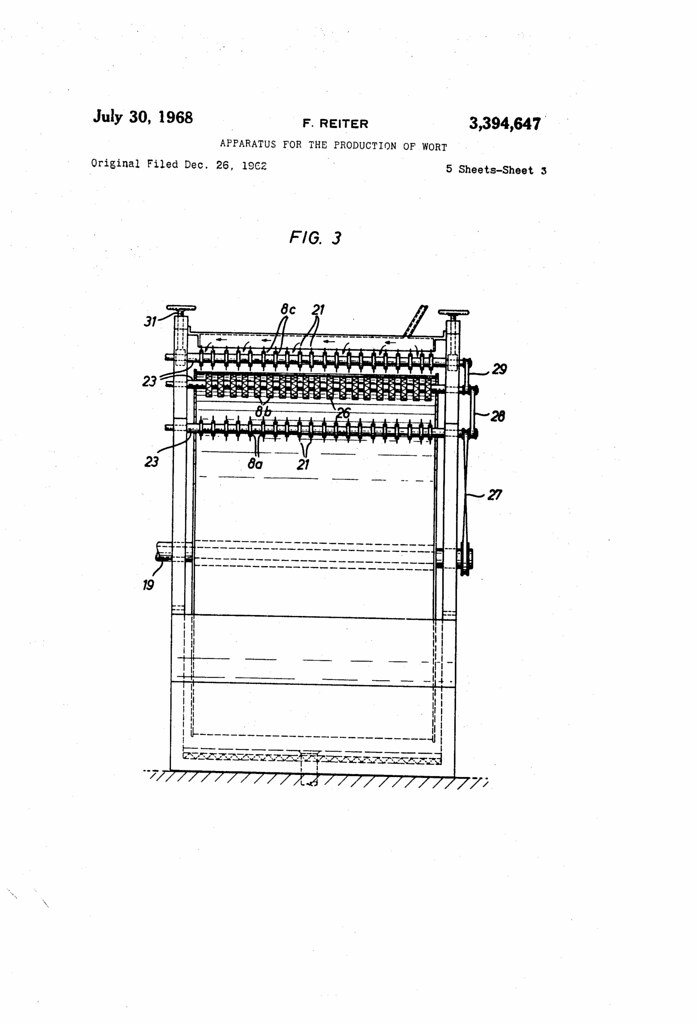
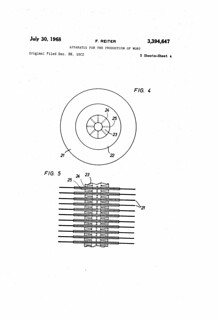
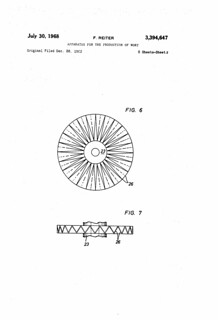
Today in 1968, US Patent 3394647 A was issued, an invention of Fritz Reiter, for his “Apparatus For the Production of Wort.” There’s no Abstract, although in the description it includes these claims:

In an apparatus for the production of wort, a filter drum for the separation of the wort from the spent grains comprises suction means to draw the wort into the drum and means cutting the cake of spent grains accumulating on the periphery of the drum, while it is being sparged, into small readily extracted pieces.

US3394647-0
US3394647-1
US3394647-2

US3394647-3 US3394647-4

Filed Under: Beers, Breweries, Just For Fun, Politics & Law, Related Pleasures Tagged With: Brewing Equipment, History, Law, Patent, Science of Brewing, Wort

Patent No. 2009382A: Beer Filter

July 30, 2016 By Jay Brooks

patent-logo
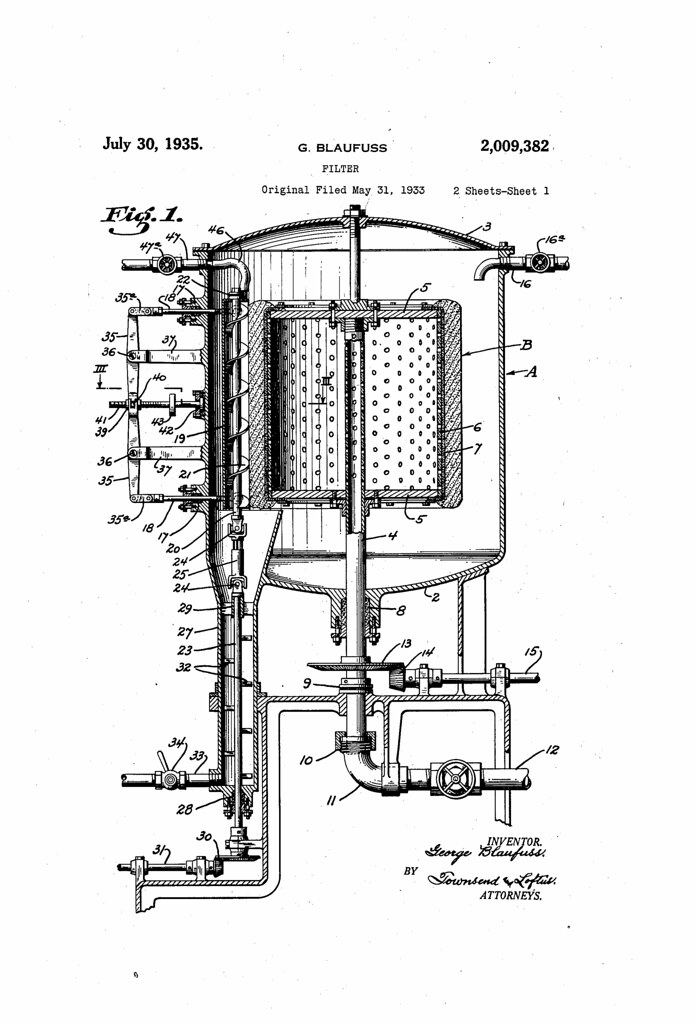
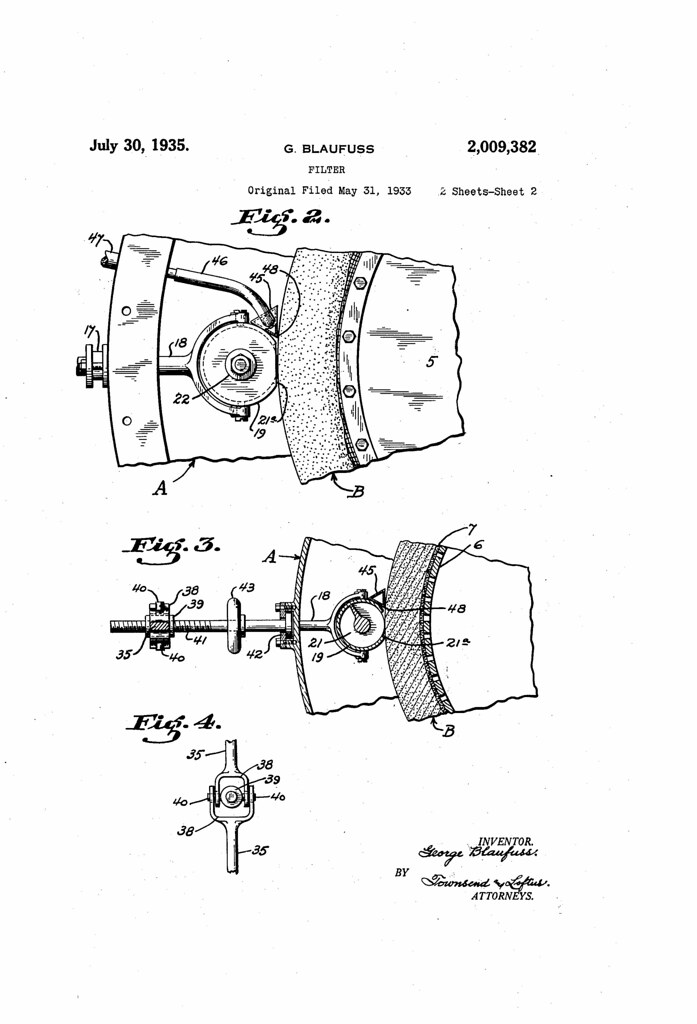
Today in 1935, US Patent 2009382 A was issued, an invention of George Blaufuss, for his beer “Filter.” There’s no Abstract, although in the description it includes these claims:

The object of the present invention is to generally improve and simplify the construction and operation of filters of the character described; to provide a filter in which a filtering medium such as diatomaceous earth, or the like, is used and applied to the surface of a cylinder to form a thick filter cake through which the liquid to be filtered must pass; to provide means for continuously removing impurities collected on the surface of the filter cake and also a portion of the filter cake so as to gradually decrease the thickness of the cake; and further, to provide means for continuously discharging the impurities and material removed from the surface of the filter cake.

US2009382-0
US2009382-1

Filed Under: Beers, Breweries, Just For Fun, Politics & Law, Related Pleasures Tagged With: Brewing Equipment, History, Law, Patent, Science of Brewing

Patent No. 3897569A: Malting

July 29, 2016 By Jay Brooks

patent-logo
Today in 1975, US Patent 3897569 A was issued, an invention of Ronald Horgan, for his “Malting.” Here’s the Abstract:

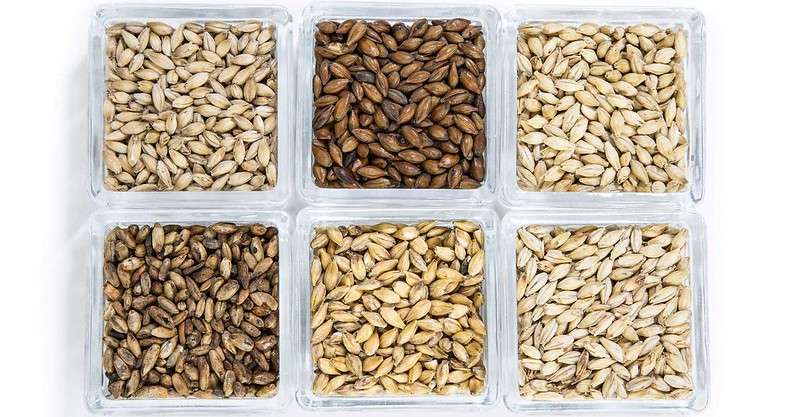
An improved malting process comprises the steps of steeping barley or other cereal grain to initiate germination thereof, subjecting the germinated grain to a treatment to restrict further growth and respiration of the grain, and malting the grain in a relatively short period. The treatment may be a mechanical treatment such as pumping the grain in water, or it may be a temperature or chemical treatment. The subsequent malting may be carried out at a temperature between 20 DEG and 40 DEG C and the malting period is less than 48 hours.

malt-shots

Filed Under: Beers, Just For Fun, Politics & Law, Related Pleasures Tagged With: barley, Law, Malt, Patent

Patent No. 2845196A: Bottle Crates

July 29, 2016 By Jay Brooks

patent-logo
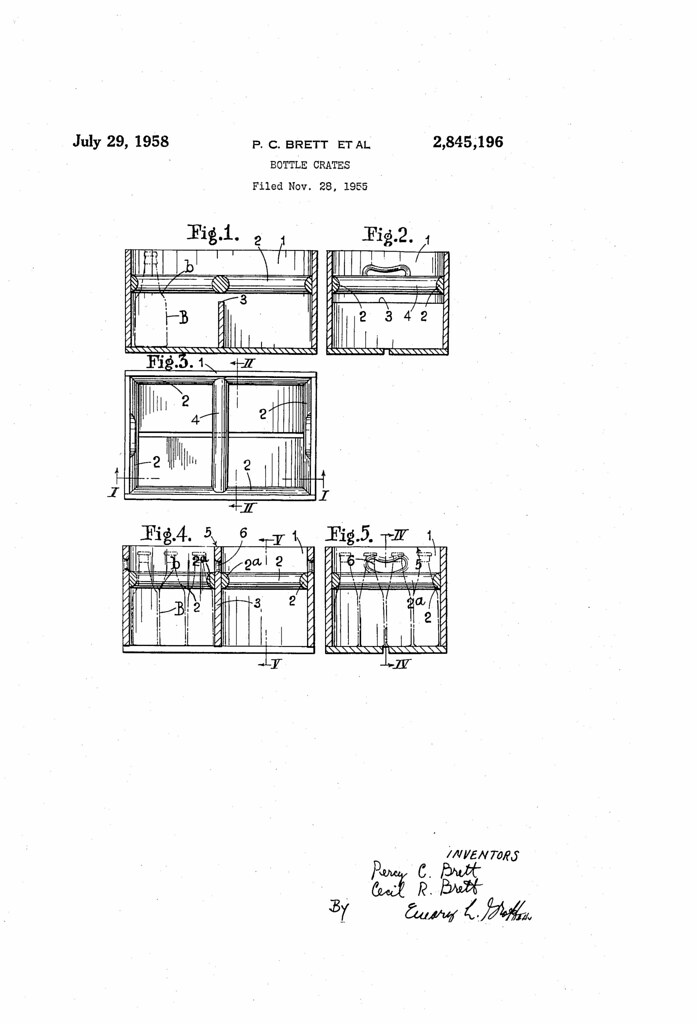
Today in 1958, US Patent 2845196 A was issued, an invention of Percy Charles Brett and Cecil Roy Brett, for their “Bottle Crates.” There’s no Abstract, although in the description it includes these claims:

This invention relates to bottle crates such as crates for beer bottles, .and has for its object to provide a crate without criss-cross partitions which divide the box into individual bottle compartments, but one which nevertheless will retain the bottles snugly in position and will prevent the bottles accidentally falling out should the crate assume an inclined position. By obviating the partitions a crate can be made much smaller in overall dimensions as compared with a partitioned crate for the same number of bottles, and expense is reduced while the space occupied during storage and transit is also considerably reduced.

According to the invention a crate comprises an open topped rectangular box having no compartments for individual bottles and having a main elongated retaining ledge on the respective inside faces of the walls and extending from end to end thereof, said retaining ledge lying parallel to the bottom and open top of the crate and located at the height of the shoulder of the bottles for which the crate is designed. A central partition may be provided spanning opposite walls in combination with retaining ledges also parallel to the bottom and open top of the crate at the same height as the main retaining ledge. For example the central partition in one form terminates upwardly above the level of the retaining ledges and is provided with a hand-grip hole above said level, and the central retaining ledges are strip-s secured respectively to the faces of the partition. The ledges may be formed by strips of half-round section wood or the like secured by their fiat faces to their respective walls.

US2845196-0

Filed Under: Beers, Just For Fun, Politics & Law, Related Pleasures Tagged With: Bottles, History, Law, Packaging, Patent

Patent No. 433015A: Vent Bung And Bushing

July 29, 2016 By Jay Brooks

patent-logo
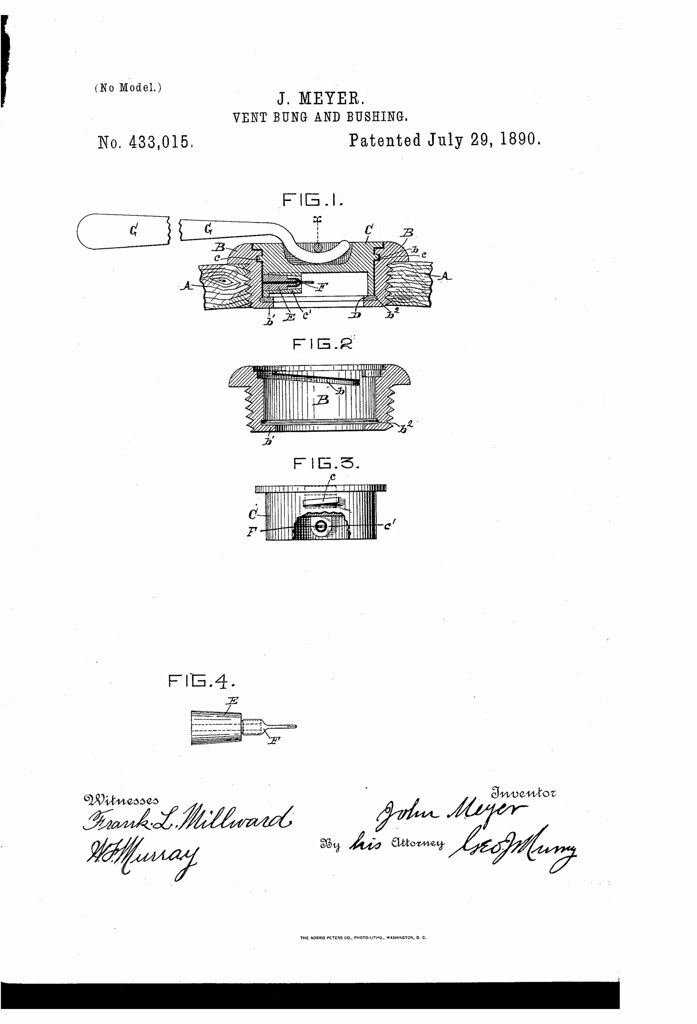
Today in 1890, US Patent 433015 A was issued, an invention of John Meyer, for his “Vent Bung and Bushing.” There’s no Abstract, although in the description it includes these claims:

My invention relates to bungs and vents, and is particularly intended for kegs and casks for beer, ale, and similar liquors, but is of course applicable to all vessels for storing liquids. Its object is to provide a vent-bung, which will at all times prevent the escape of gases from the vessel and preclude the admission of air, except when it is necessary to induce a flow of the liquid from the faucet of the vessel, which Vent will require no attention after the keg is filled and vent-bung inserted until it again be necessary to fill the vessel.

US433015-0

Filed Under: Beers, Just For Fun, Politics & Law, Related Pleasures Tagged With: History, Kegs, Law, Patent

Patent No. 2291367A: Device For Warming And Reconditioning Beer

July 28, 2016 By Jay Brooks

patent-logo
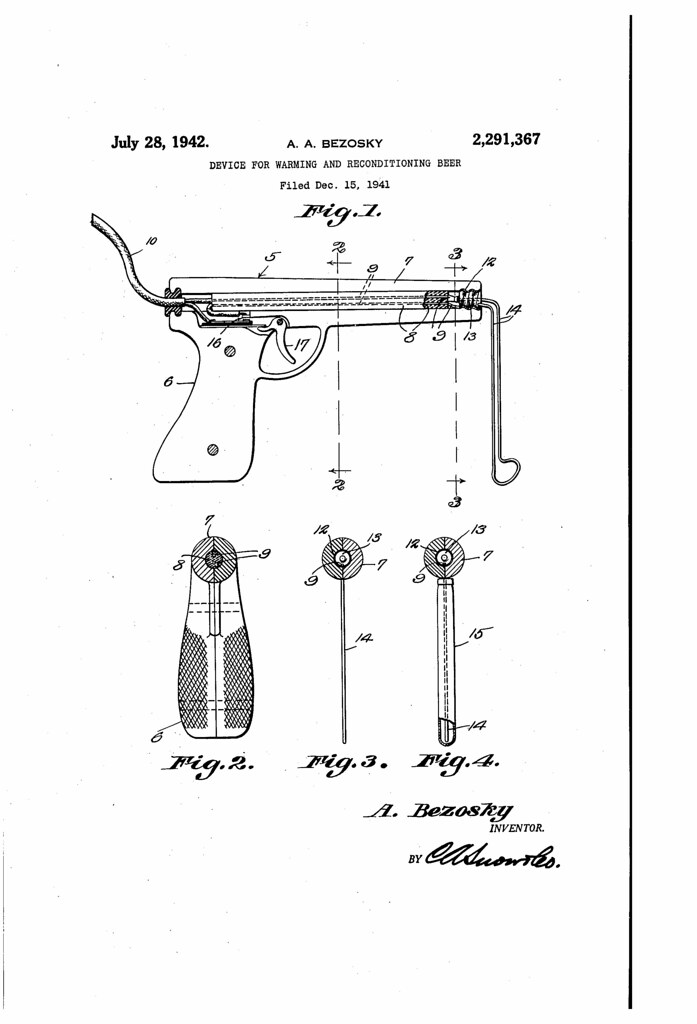
Today in 1942, US Patent 2291367 A was issued, an invention of Albert A. Bezosky, for his “Device For Warming and Reconditioning Beer.” There’s no Abstract, although in the description it includes these claims:

This invention relates to a device designed for reconditioning stale beer, or beer which has become flat or too cold for immediate consumption.

An important object of the invention is to provide a device of this character which may be used primarily by bartenders, and one which is of the electrical portable type which may be readily and easily immersed in a glass of beer, by the bartender, thereby replacing the head on the beer, or tempering it to render the beer exceptionally palatable.

An apparatus for treating liquid by submersion, comprising a body of pistol-like construction, electric wires extending through the body and terminating in a socket at one end of the body, said body including a handle extended at right angles with respect to the body, an electric plug adapted to be fitted in the socket, resistance wires extending from the plug and disposed in parallel relation with the handle, said resistance wires being in circuit with the wires extending through the body, and said resistance wires being formed into a loop at the free end thereof.

US2291367-0

Filed Under: Beers, Just For Fun, Politics & Law, Related Pleasures Tagged With: History, Law, Oddities, Patent

Patent No. 456872A: Process Of Manufacturing Malt

July 28, 2016 By Jay Brooks

patent-logo
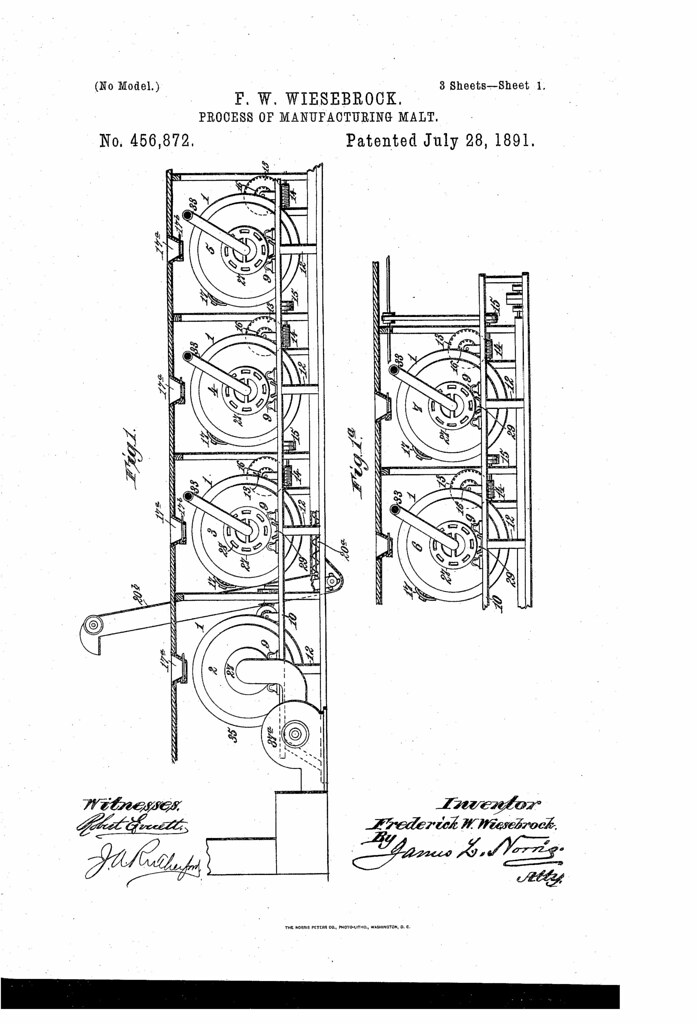
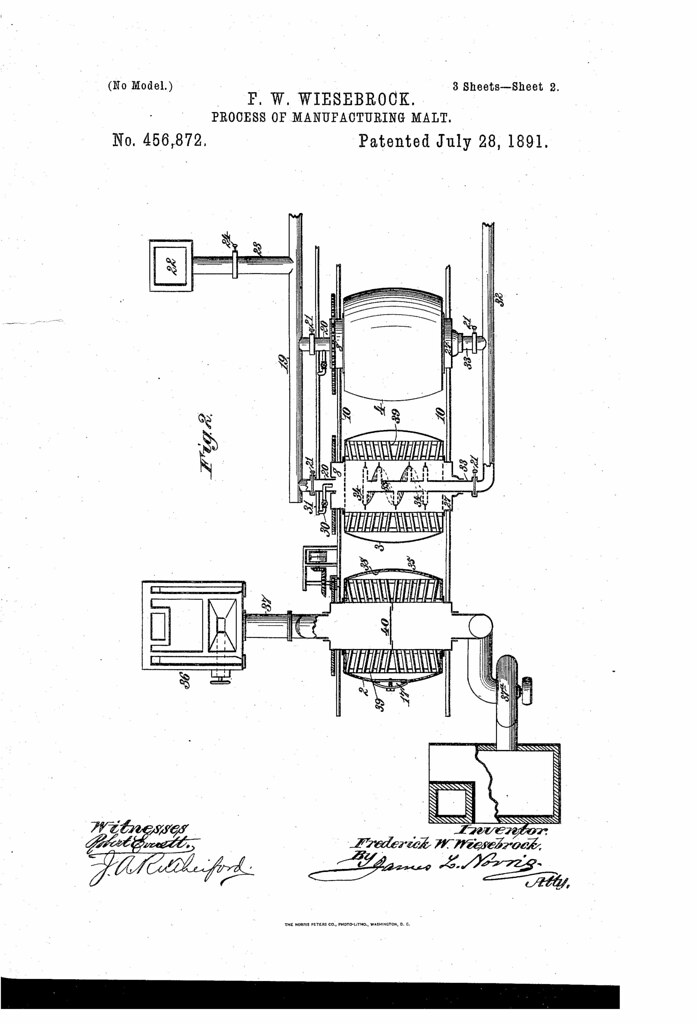
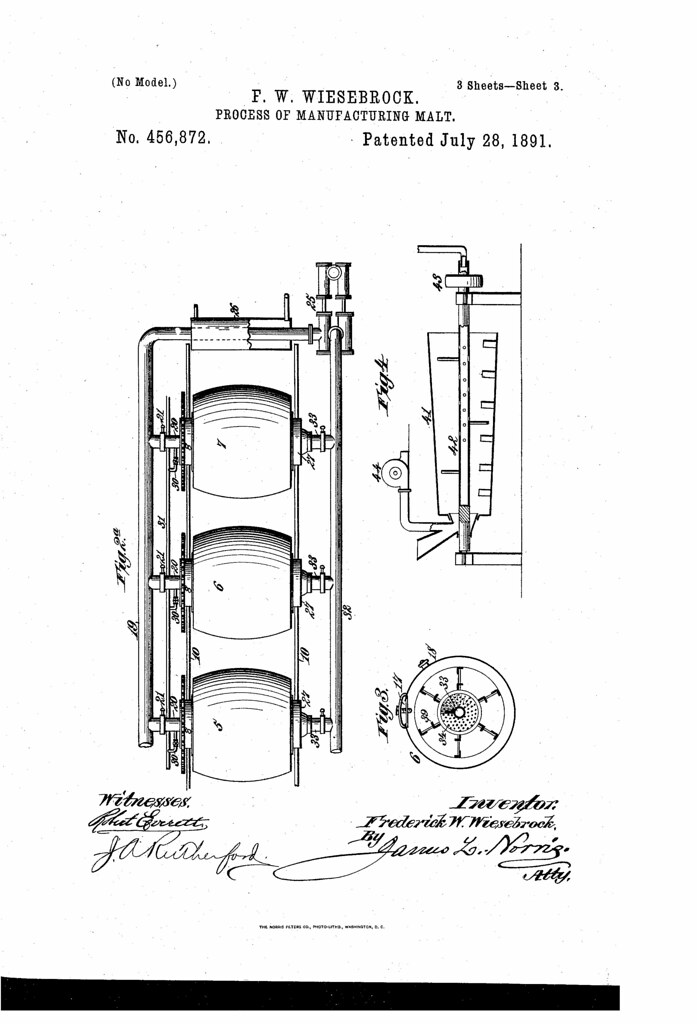
Today in 1891, US Patent 456872 A was issued, an invention of Frederick W. Wiesebrock, for his “Process of Manufacturing Malt.” There’s no Abstract, although in the description it includes these claims:

It is the purpose of my invention to provide a novel process for the manufacture of malt to be used in the production of fermented liquors, said process being of such a character that it may be practiced at all seasons of the year. It is my purpose, also, to materially cheapen the production of malt, to render the same independent of skilled labor, and to produce more uniform and better results than have been attainable heretofore.

US456872-0
US456872-1
US456872-2

Filed Under: Beers Tagged With: barley, History, Law, Malt, Patent

Patent No. 2325309A: Process Of Capping Bottles

July 27, 2016 By Jay Brooks

patent-logo
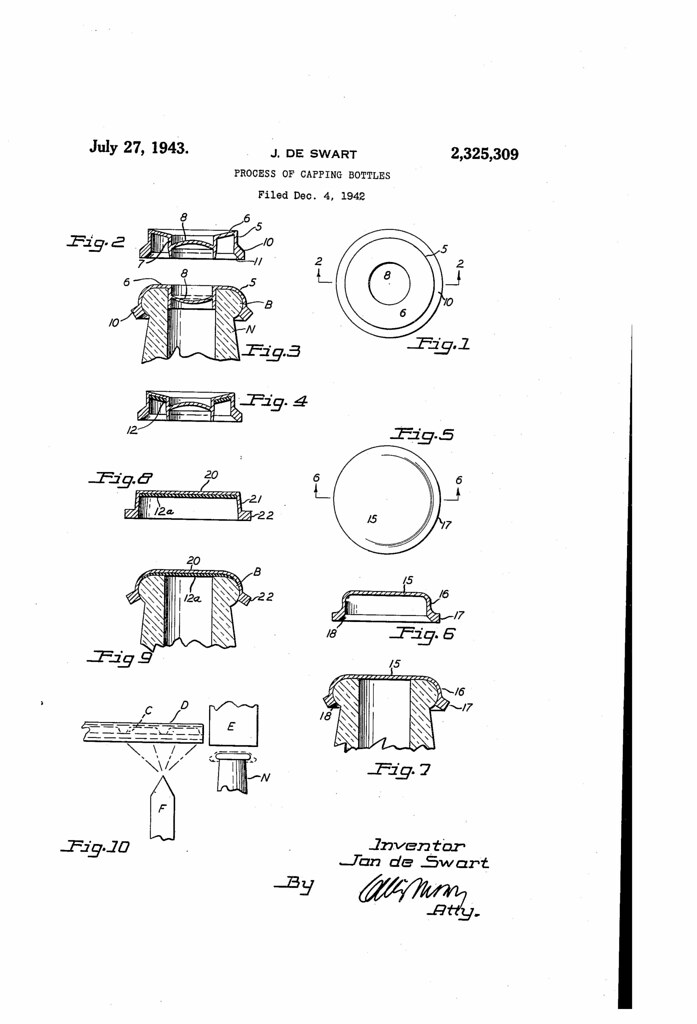
Today in 1943, US Patent 2325309 A was issued, an invention of Jan De Swart, for his “Process of Capping Bottles.” There’s no Abstract, although in the description it includes these claims:

This invention has to do with sealing caps for bottles and the like, as well as bottle sealing methods.

In its more particular contemplates a hard and substantially non-flexible plastic cap which is so constructed, of a plastic capable of being rendered temporarily pliable and remolded, as to be applied in sealing relationship to a bottle without injury to the cap and which not only is capable of sealing the bottle against substantial pressures but which also compensates for the cold flow characteristics prevalent in most plastics.

I am aware that attempts have been made to produce a successful thermoplastic bottle cap but so far as I am aware, no such cap has been produced which is capable of general use to cap bottles containing fluids such as carbonated beverages, beer or the like. Such prior caps have been incapable of maintaining an effective seal where substantial pressures are generated in the bottle; and have been incapable of withstanding the temperatures incident to pasteurization processes. For instance, pasteurization processes commonly utilize temperatures of the order of 160 produced do not maintain a seal under such conditions. Another shortcoming of prior caps has been the fact that they fail to maintain an effective seal after the plastics of which the caps are made have undergone the normal cold flow.

It is among the aims of my invention to overcome those shortcomings and, generally speaking, I accomplish this by providing a cap preformed of a cold-setting plastic capable of being rendered temporarily pliable and then reformed and re-hardened about the neck of a bottle. An important characteristic of my improved cap resides in the fact that its side Wall presents a peripheral bead of relatively thick cross-section and having a. relatively low setting rate which, after being temporarily softened, is remolded to aspects, my invention the contour of the external marginal bead forming a part of the conventional beer or carbonated beverage bottle. This bead portion undergoes cap into sealing relationship with the neck or more and thermoplastic caps heretofore l the provision of a plastic cap having a construction which provides a double seal.

Another object is the provision of a cap having a guiding formation to guide it onto a bottle during capping.

US2325309-0

Filed Under: Beers, Breweries, Just For Fun, Politics & Law, Related Pleasures Tagged With: Bottles, Brewing Equipment, History, Law, Packaging, Patent

« Previous Page
Next Page »

Find Something

Northern California Breweries

Please consider purchasing my latest book, California Breweries North, available from Amazon, or ask for it at your local bookstore.

Recent Comments

  • Steve 'Pudgy' De Rose on Historic Beer Birthday: Jacob Schmidt
  • Jay Brooks on Beer Birthday: Bill Owens
  • Steve 'Pudgy' De Rose on Beer Birthday: Charles Finkel
  • Steve 'Pudgy' De Rose on Beer Birthday: Bill Owens
  • Steve "Pudgy" De Rose on Beer Birthday: Pete Slosberg

Recent Posts

  • Beer In Ads #5130: Bishop And Smitty Says Bock Beer December 2, 2025
  • Beer Birthday: Bob Pease December 2, 2025
  • Beer In Ads #5129: Call For Gem Bock Beer December 1, 2025
  • Beer Birthday: Susan Boyle December 1, 2025
  • Historic Beer Birthday: William Krug December 1, 2025

BBB Archives

Feedback

Head Quarter
This site is hosted and maintained by H25Q.dev. Any questions or comments for the webmaster can be directed here.