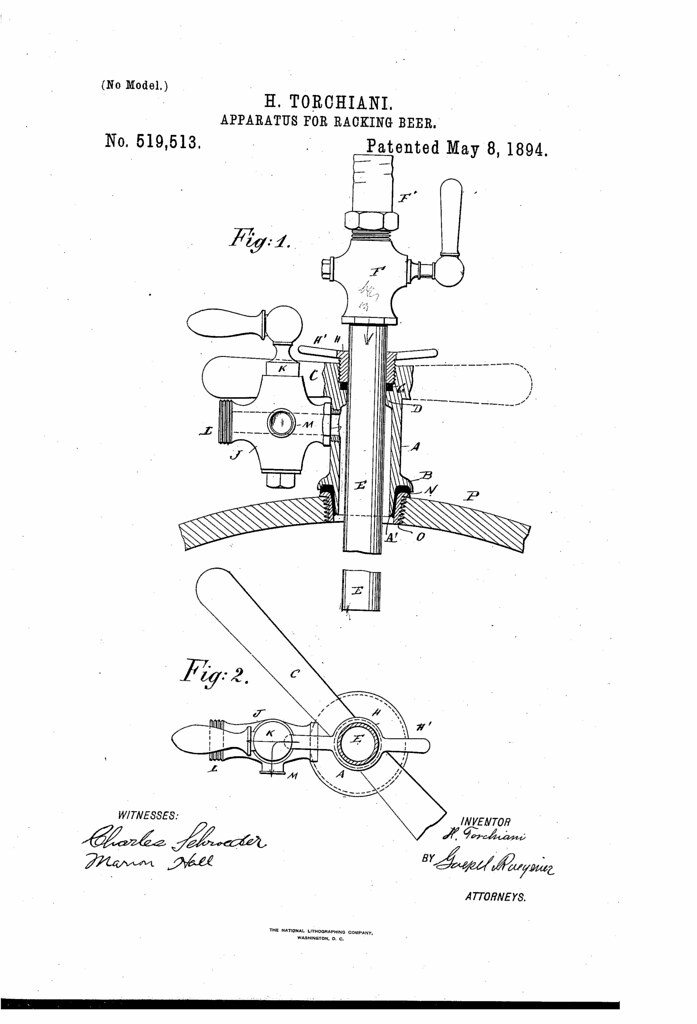
Today in 1894, US Patent 519513 A was issued, an invention of Harry Torchiani, for his “Apparatus For Racking Beer.” There’s no Abstract, but in the description it’s stated that the “invention relates to that class of. devices that are used in drawing or filling beer from casks into the barrels, half-barrels, kegs, etc.,” adding this. “The object of my invention is to provide an apparatus of this kind, which can readily be adjusted for barrels or kegs of different sizes, and which prevents the spurting of the beer from the apparatus or keg when the apparatus is withdrawn from the keg.”
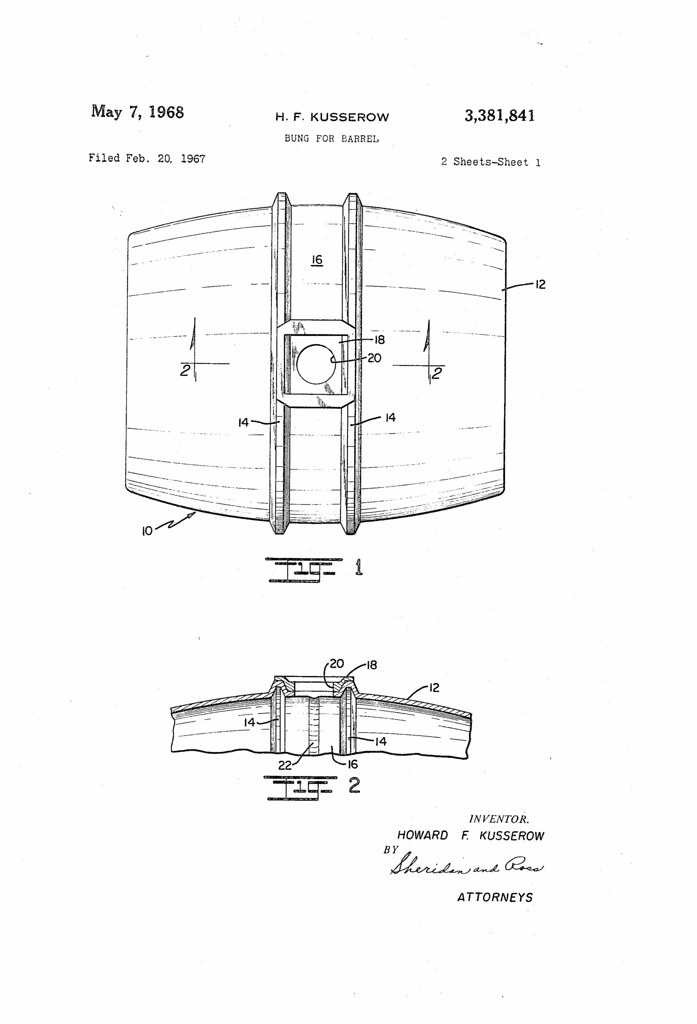
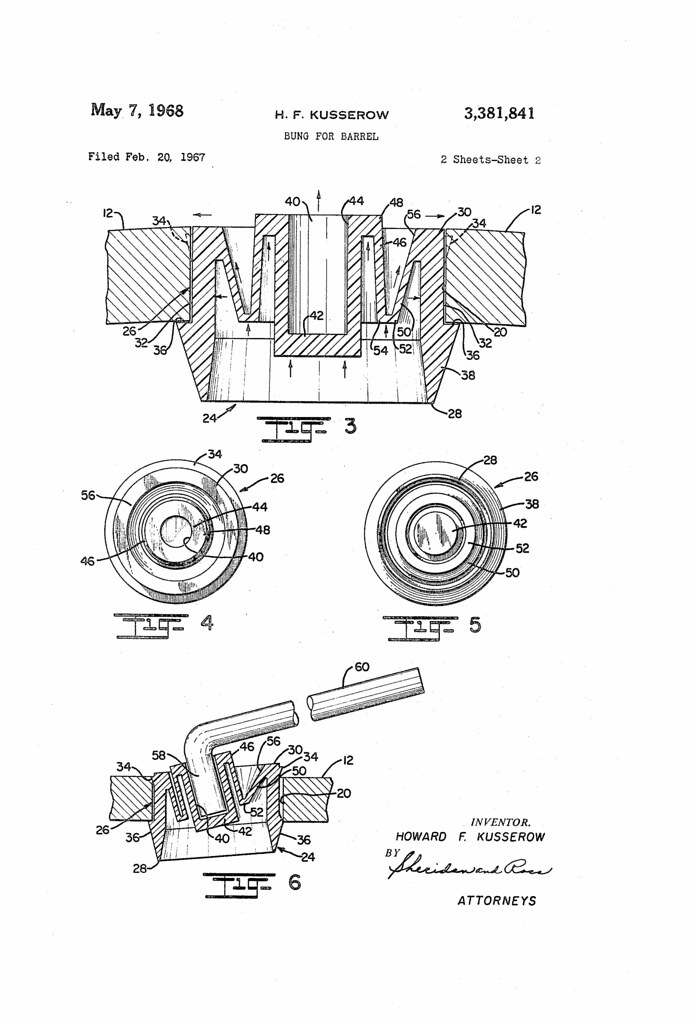
Patent No. 3381841A: Bung For Barrel
Today in 1968, US Patent 3381841 A was issued, an invention of Howard F. Kusserow, for his “Bung For Barrel.” There’s no Abstract, but in the description it’s claimed that the “invention lies in the general field of container closures. It is directed to re-usable closures which may be readily applied and removed, and more particularly to bungs for beer barrels, although it is not limited to such use.” Apparently, the new bung was to replace wooden ones with a bung made from polyethylene, a “resiliently yieldabie material.”
Patent No. 1302549A: Process For Brewing Beer
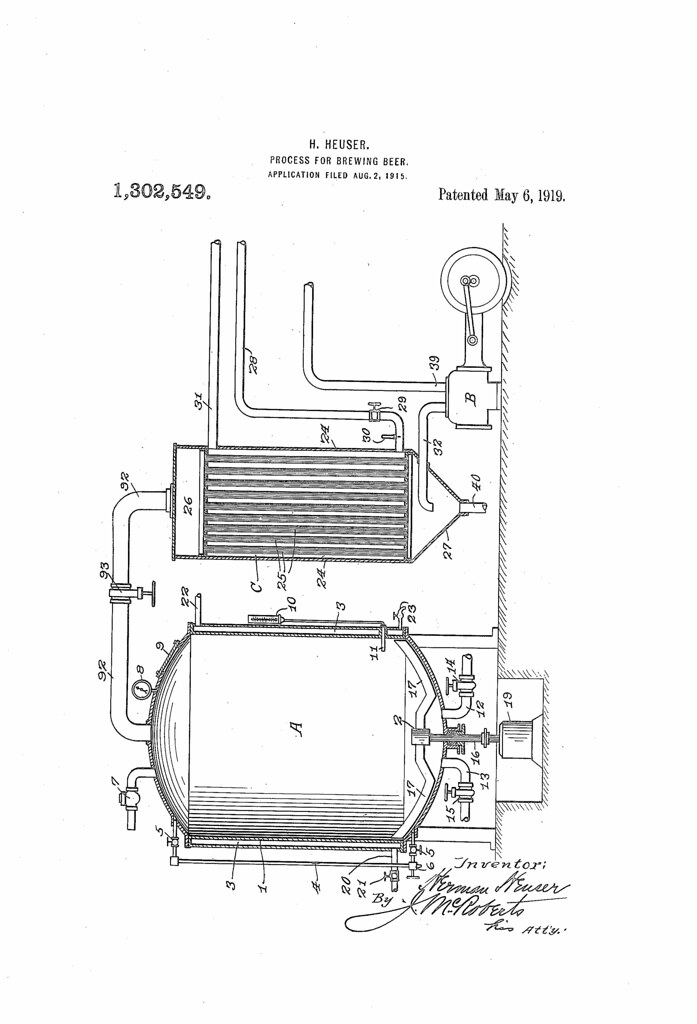
Today in 1919, US Patent 1302549 A was issued, an invention of Herman Hausen, for his “Process For Brewing Beer.” There’s no Abstract, but as Prohibition began, the invention was specifically for non-alcoholic beer to satisfy demand for at least the taste of beer once the regular kind was outlawed. Here’s a fuller explanation.
My invention relates to the manufacture of non-alcoholic beer, of beer containing less than one-half of one percent of alcohol, and of temperance beer. In the processes heretofore employed for making such beverages, the de-alcoholizing occurs by distillation of the alcohol after the liquid vis fermented or the beer brewed. These old processes involve certain disadvantages which are obviated by my invention, which, generally speaking, consists in simultaneously boiling and fermenting the beer wort in a vacuum and within the range of beer fermentation temperatures at which the activity of the yeast is not destroyed to evaporate the alcohol and preserve live yeast in In the accompanying drawing I show more or less diagrammatically and mostly in sectional view all the apparatus required to carry out my new process.
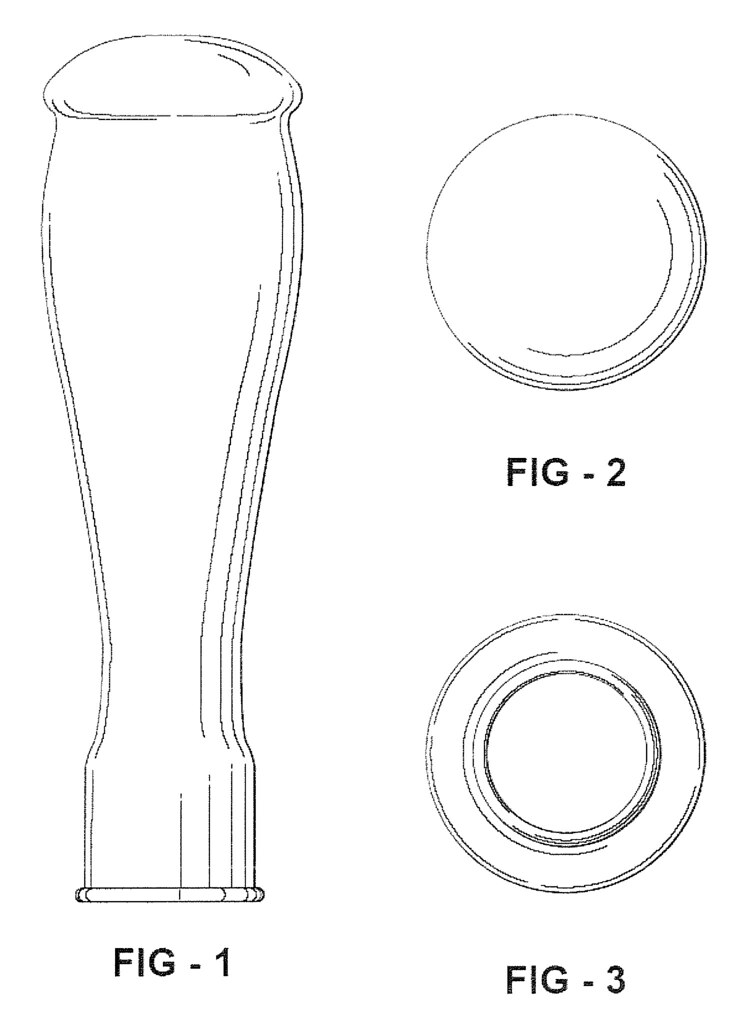
Patent No. D591850S1: Filled Beer Glass Shaped Condom
Today in 2009, US Patent D591850 S1 was issued, an invention of Brian Osterberg, for his “Filled Beer Glass Shaped Condom.” There’s no Abstract, and there’s not much to say about it, other than his invention is the “ornamental design for a filled beer glass shaped condom.” I probably should have waited until after dark to post this one. Seeing it reminded me of a passage from a book I read when I was a kid: Summer of ’42, by Herman Raucher. There’s a scene in the book where the 15-year old protagonist, Hermie, goes to the drug store to buy condoms. Looking over the packaging, in his head he’s imagining that the color of the box matches the condom itself, and thinks to himself. “Plaid, that’s enough to send a young girl screaming into the night!” I can’t imagine one that look like a full glass of beer, that just seems weird.
Patent No. 2039564A: Beer Dispensing Apparatus
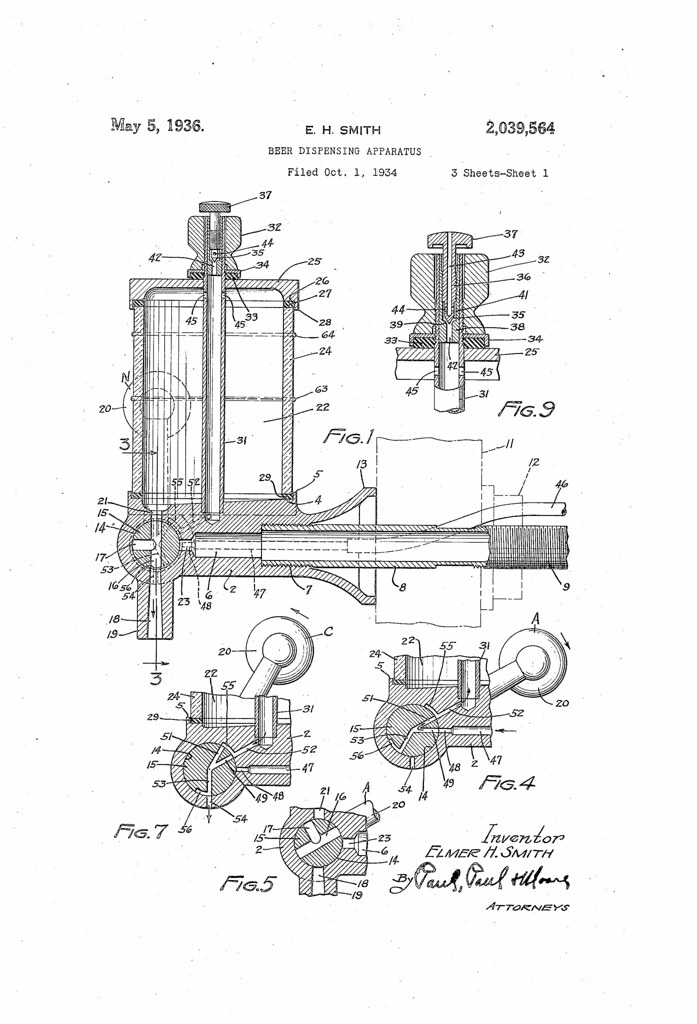
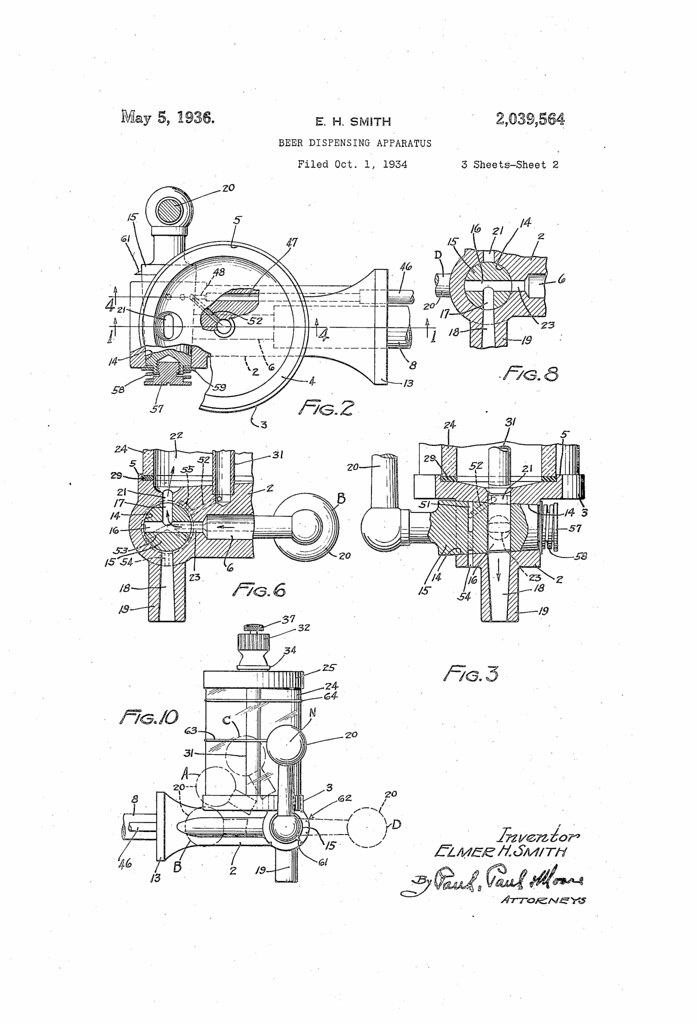
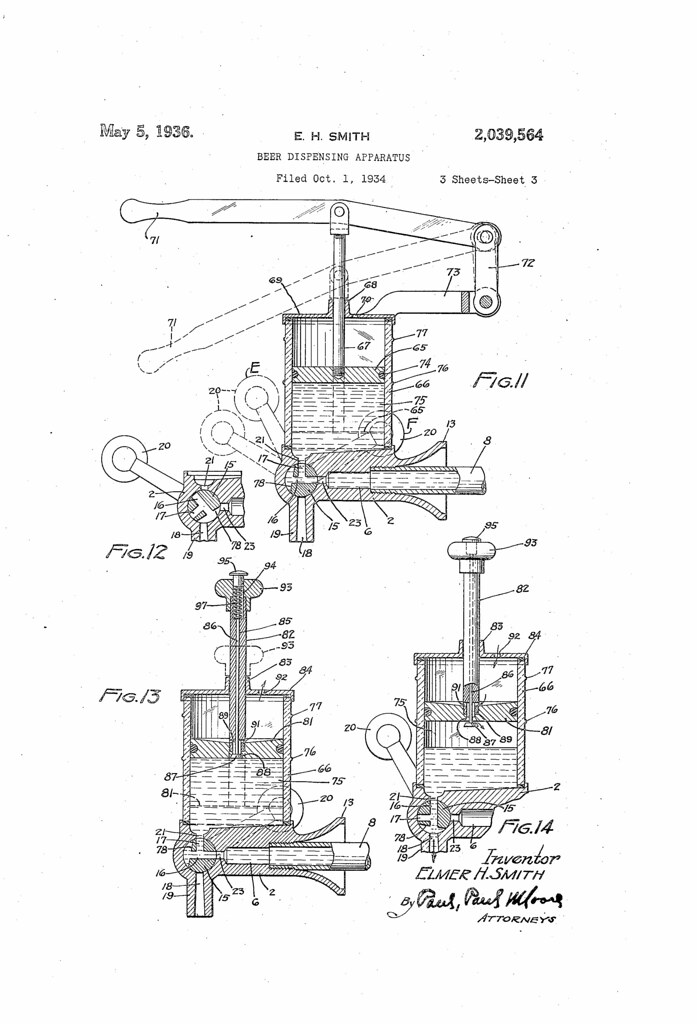
Today in 1936, US Patent 2039564 A was issued, an invention of Elmer H. Smith, for his “Beer Dispensing Apparatus.” There’s no Abstract, but in the description it states that his “invention relates to new and useful improvements in beer dispensing apparatus, and more particularly to a beer dispensing faucet having means embodied in the construction thereof, whereby the beer, regardless of the pressure on, the beer at its source, may be dispensed into, a glass or suitable container without excessive foam.”
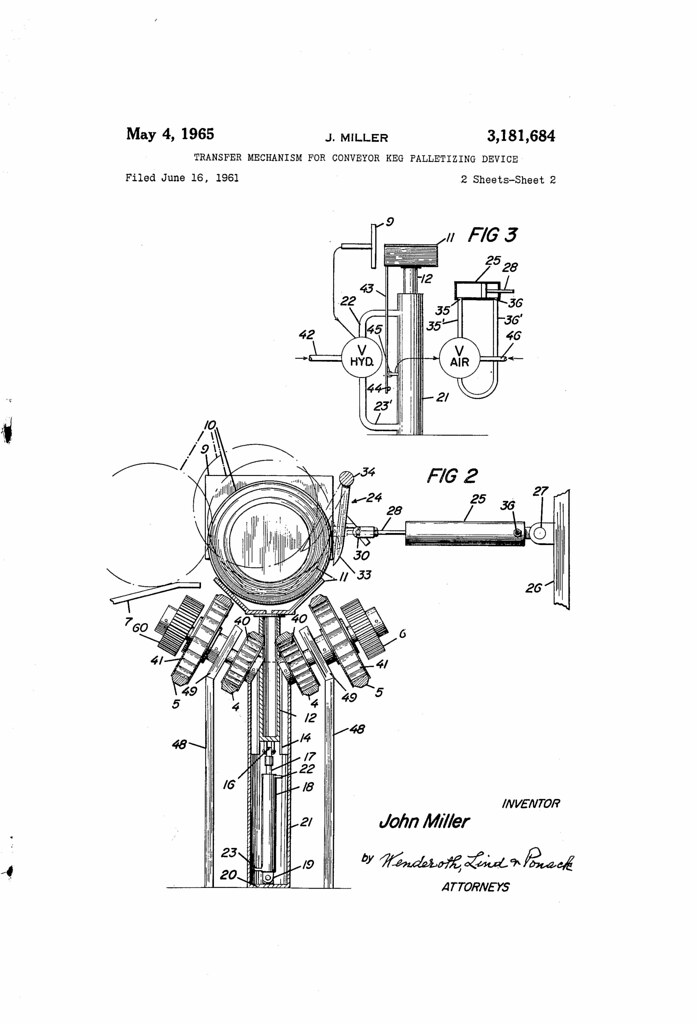
Patent No. 3181684A: Transfer Mechanism For Conveyor Keg Palletizing Device
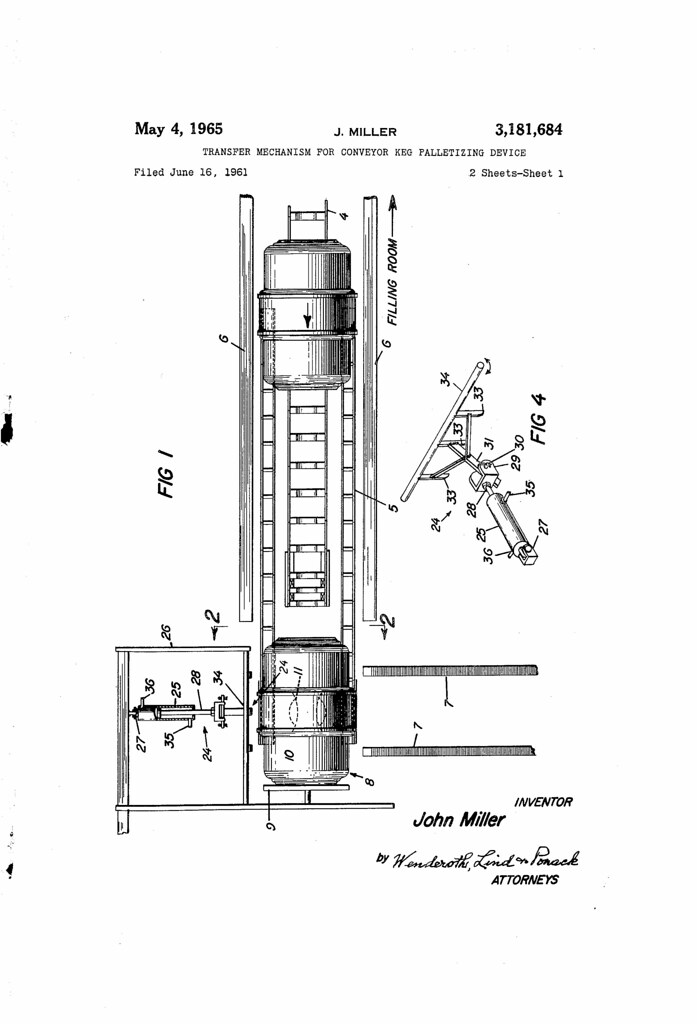
Today in 1965, US Patent 3181684 A was issued, an invention of John Miller, assigned to Schaefer Brewing Co., for his “Transfer Mechanism For Conveyor Keg Palletizing Device.” There’s no Abstract, but in the description it states that his “invention is to provide a more efficient transfer mechanism for the barrels or kegs and particularly such a transfer mechanism which is more reliable and sure in operation in transferring the barrels or kegs from the conveyor to the skids which convey such barrels or kegs to the palletizing position.”
Patent No. 2677378A: Method And Apparatus For Picking Hops
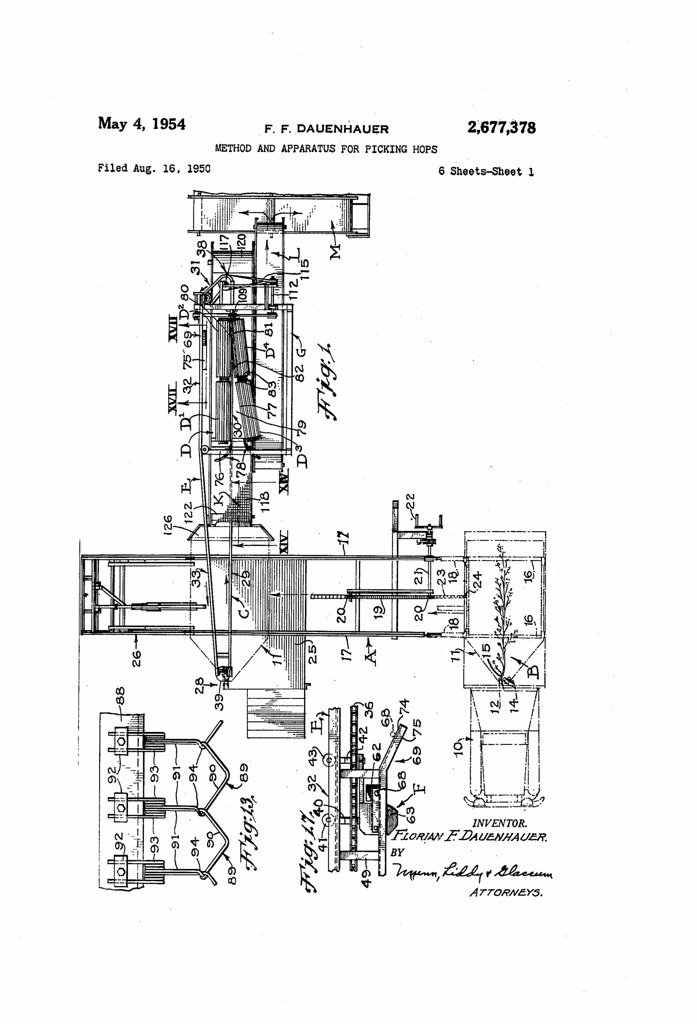
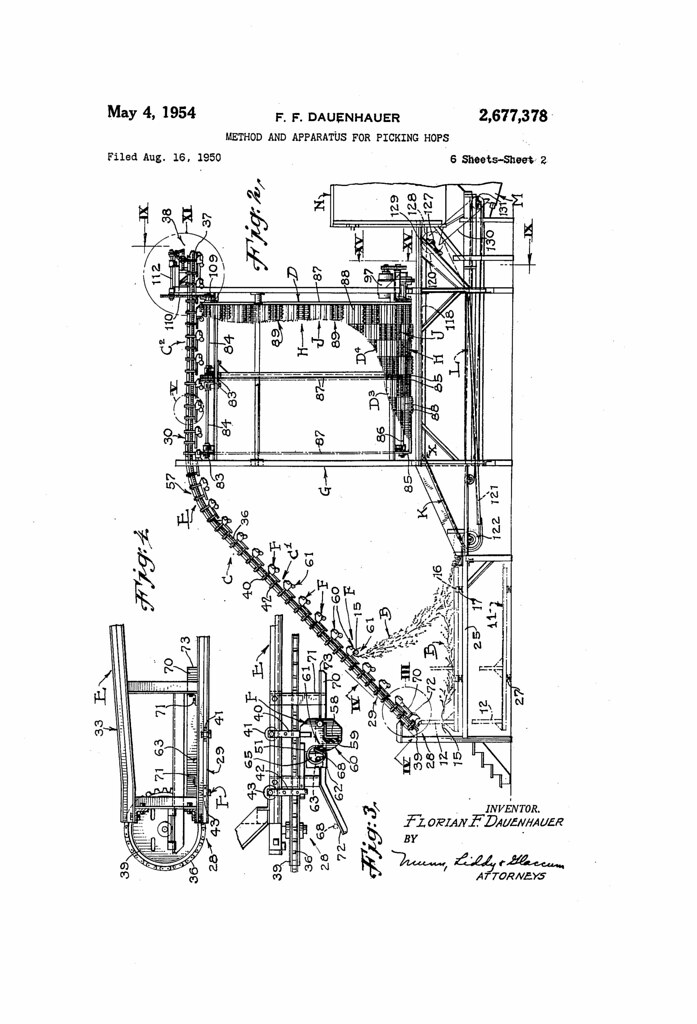
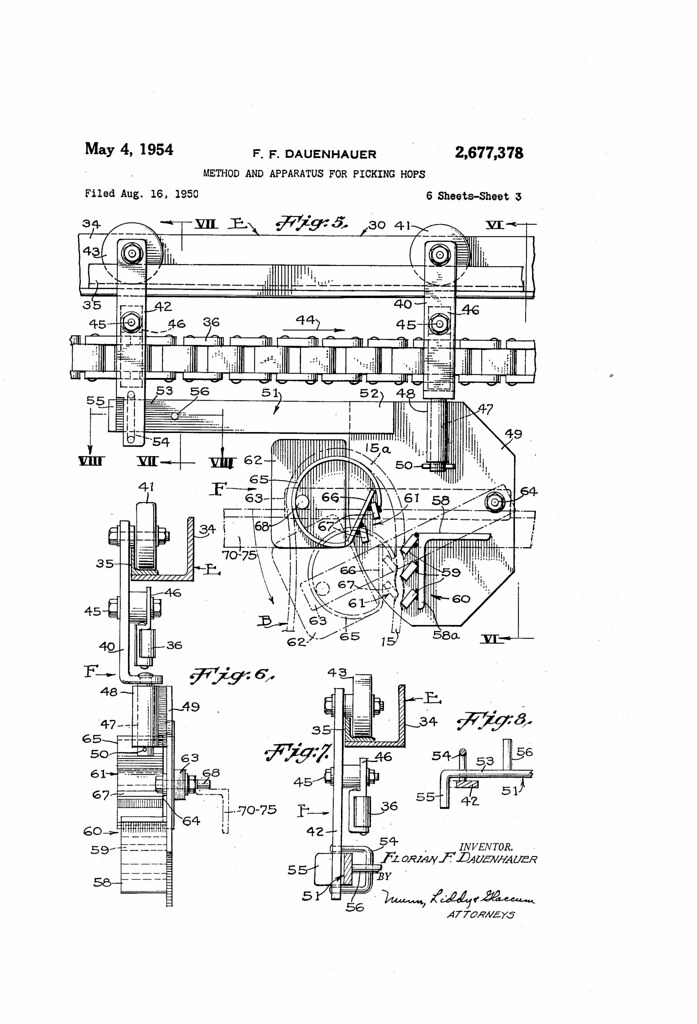
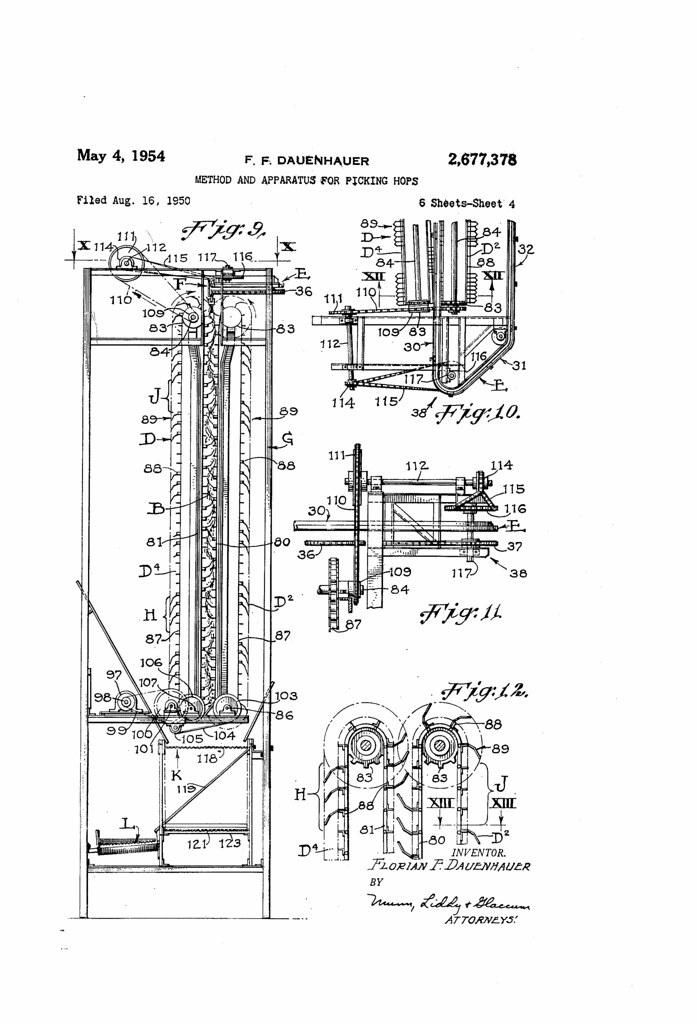
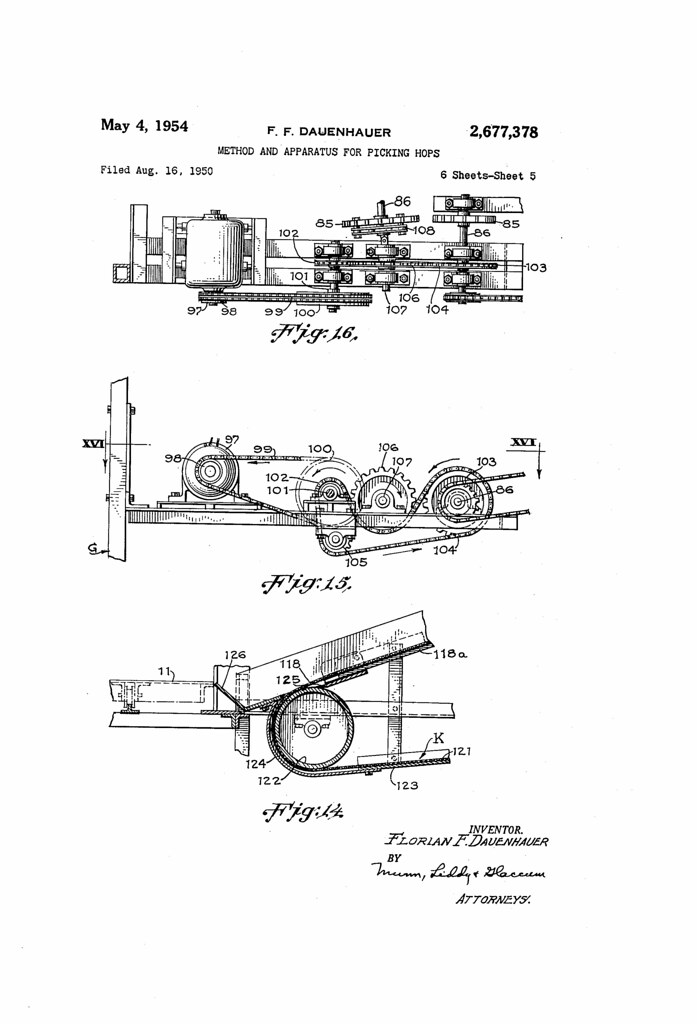
Today in 1954, US Patent 2677378 A was issued, an invention of Florian F. Dauenhauer, for his “Method and Apparatus for Picking Hops.” There’s no Abstract, but in the description it states that his “present invention relates to improvements in a method and apparatus for picking hops.”
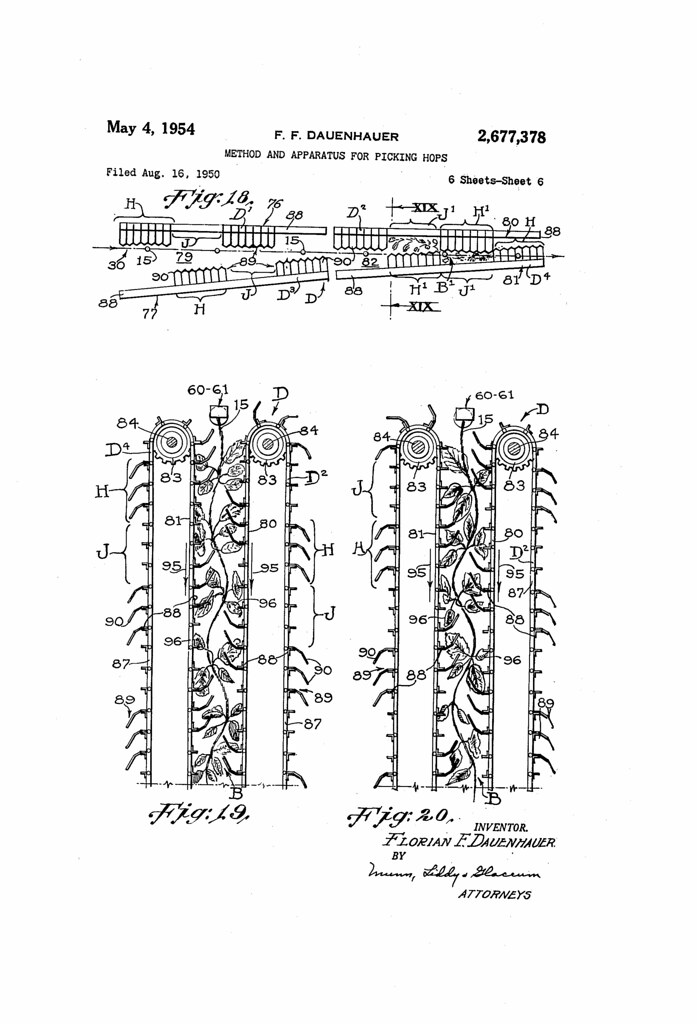
An object of this invention is to provide an improved method of picking hops from vines, assuring a thorough removal of the hops, with out damaging the hops. More specifically stated, the vines are formed into wave-like configurations, defining alternate crests and valleys extending lengthwise of the vines.
The waves thus formed are advanced lengthwise of the vines to continually replace crests by valleys and vice versa, thereby undulating the vines in first one direction and then the other for causing pendulum-like movements and exposure of the hops by the continual weaving of the vines. The hops are removed during the undulating of the vines.
Moreover, the method employs the progressive increasing of the amplitudes of the waves as the hops are picked. Also, crests and valleys of the waves are interchanged abruptly as the picking of the hops continue, and the branches of the vines are spread out laterally to expose hops and preclude the vines from matting.
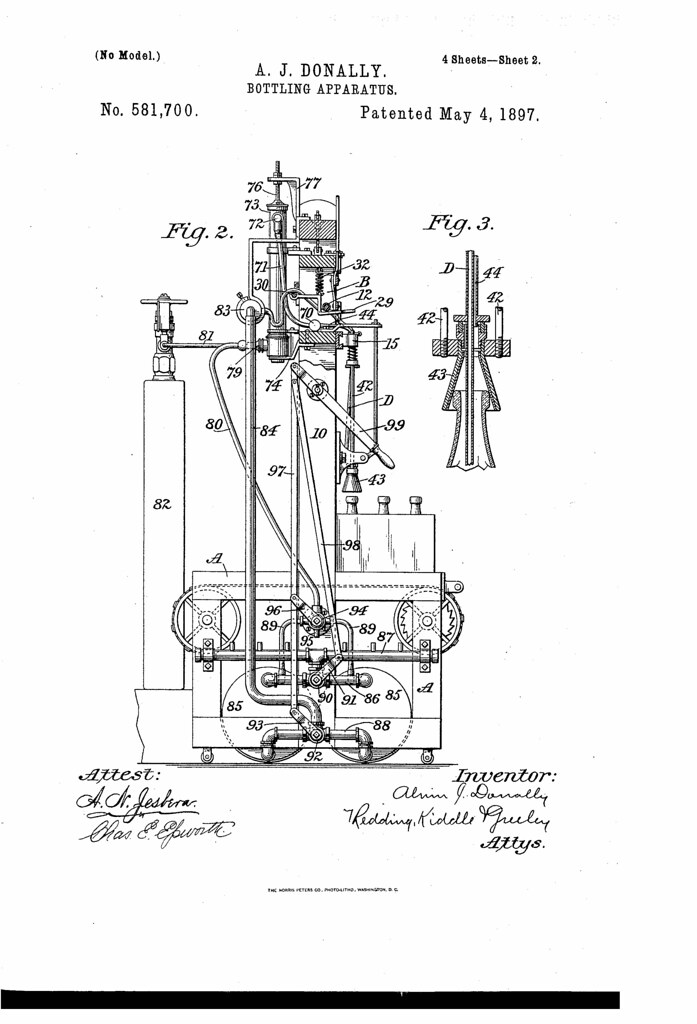
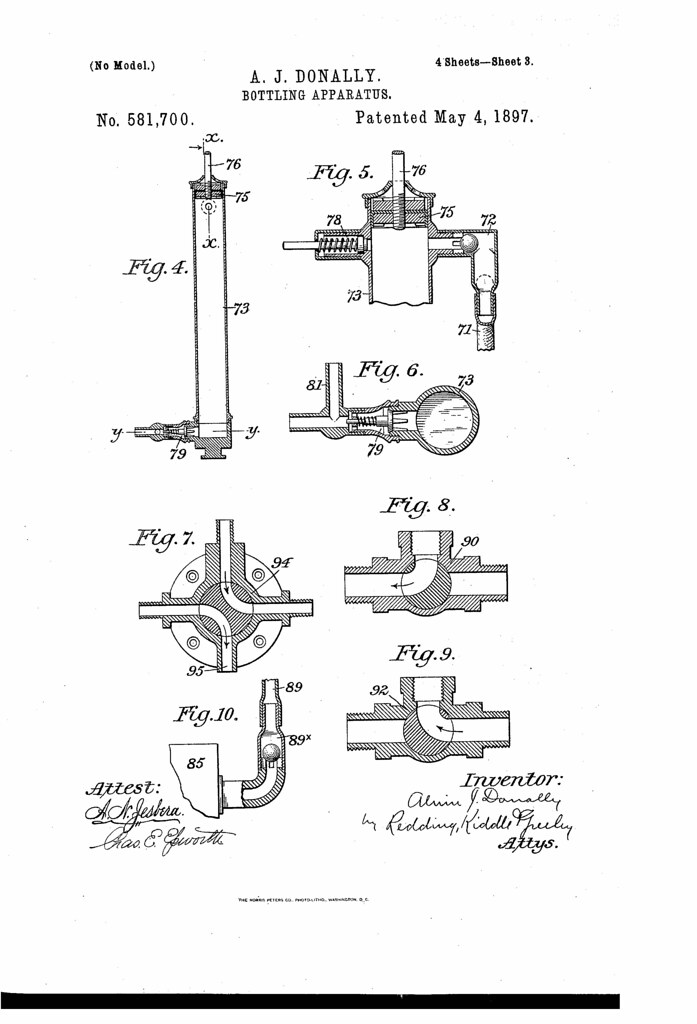
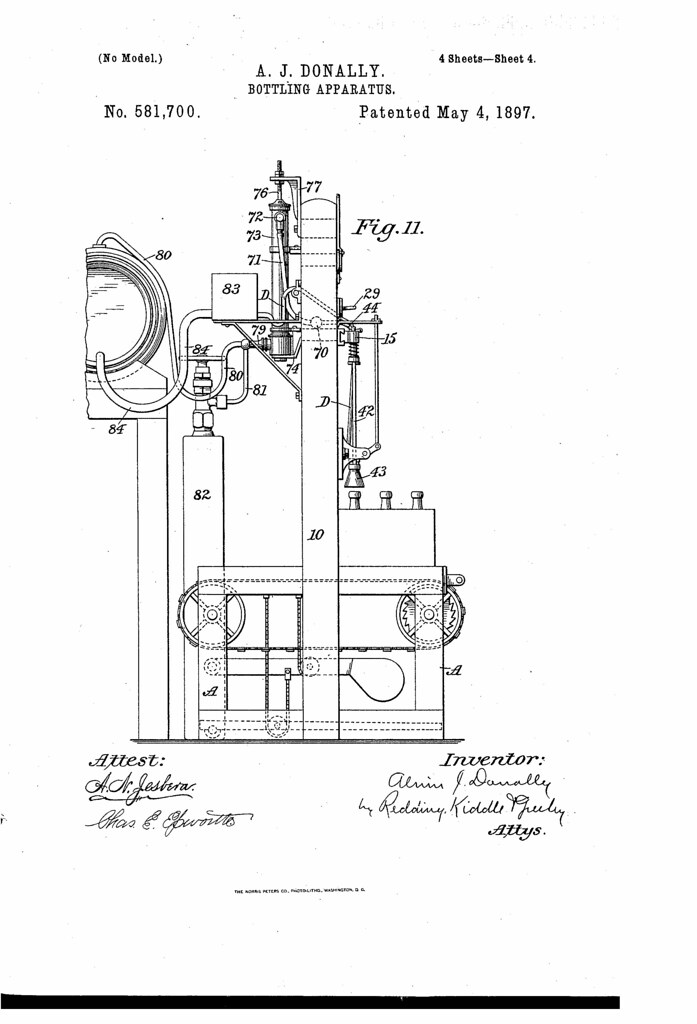
Patent No. 581700A: Bottling Apparatus
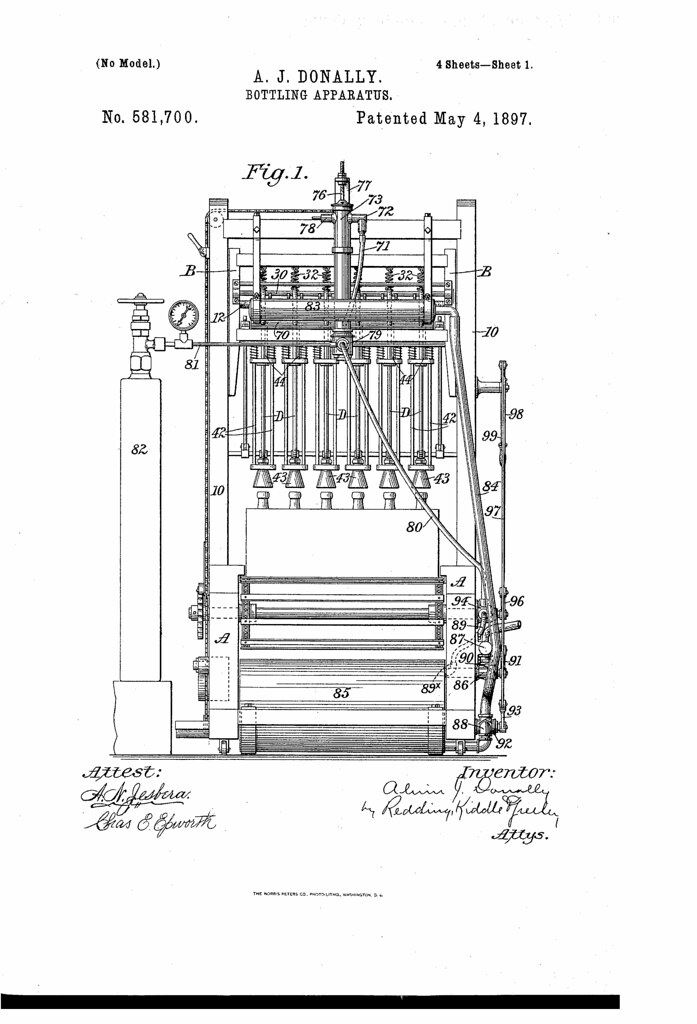
Today in 1897, US Patent 581700 A was issued, an invention of Alvin James Donally, for his “Bottling Apparatus.” There’s no Abstract, but in the description it states that he’s “invented certain new and useful Improvements in Bottling Apparatus.” While he never summarizes what those are in a short, concise sentence, he does offer this.
It is highly desirable in the bottling of various liquids, and more especially in the bottling of ale and beer, to maintain gas or air pressure on the liquid both for the purpose of retaining the gas of the liquid in solution and for the purpose of effecting the delivery of the liquid into the bottles under a steady pressure, so that there may not be any material variation in the rate of flow, and it is also desirable to keep the liquid as far as possible from exposure to the air of the place where the bottling is carried on. It is of course desirable also to prevent the waste of the liquid which frequently occurs through the filling of the bottles to overflowing. Some of these objects have been attained in part hitherto; but so far as I am aware no apparatus has been devised as yet which will enable all of these objects to be attained in a satisfactory manner. Thus it has been sought to maintain the pressure on the liquid and to prevent the waste of liquid by providing in addition to the filling-tube a second tube, which returns or conducts to the barrel or other supply vessel the air displaced from the bottle, but this alone is not altogether satisfactory. It has also been proposed to maintain the required pressure of carbonic acid gas in the keg or barrel in which the liquid is delivered to the bottler. This is possible sometimes; but in some cases it happens that the keg or barrel is not capable of standing the gas-pressure which is necessary to force the liquid into the bottles. I have sought to provide in the first place for the separation in large part of the air displaced in the bottles from whatever overflow of liquid there may be, and for the escape of the air from the apparatus, and the return of the liquid to the supply vessel. I have sought also to provide for the admission of gas to the supply vessel without interference with the escape of the air and the return of the overflow. Furthermore, I have sought to provide for the handling of the liquid under gas pressure, in the manner already referred to, in cases where the original keg or barrel is not calculated to withstand gas pressure and the liquid can be drawn therefrom only by gravity.
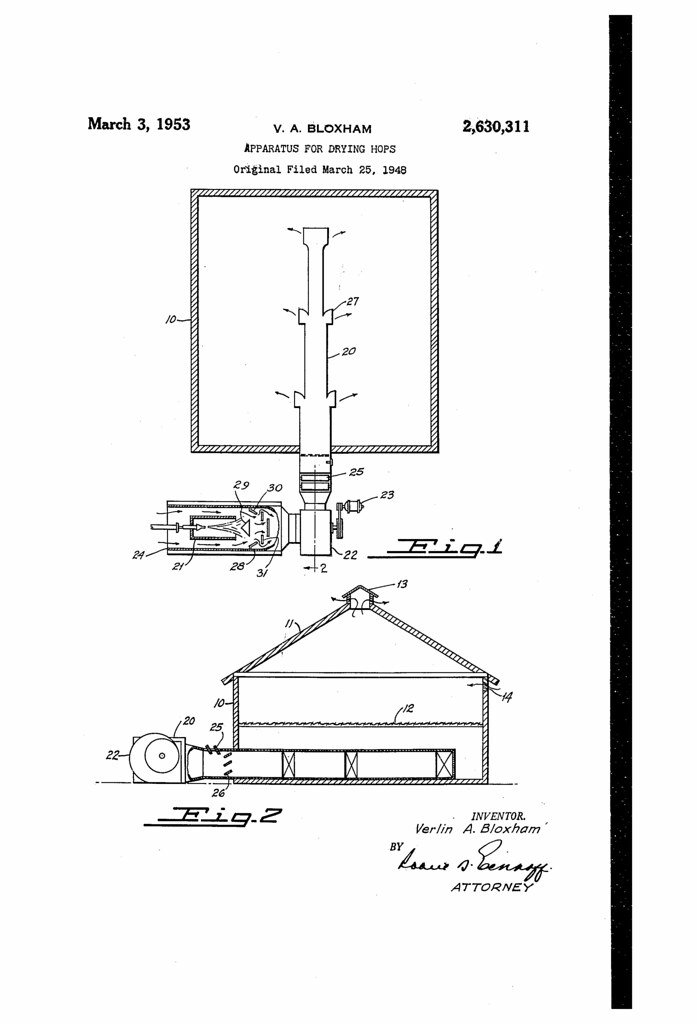
Patent No. 2630311A: Apparatus For Drying Hops
Today in 1953, US Patent 2630311 A was issued, an invention of Verlin A. Bloxham, for his “Apparatus For Drying Hops.” There’s no Abstract, but in the description it states that the “invention relates to an apparatus for drying hops. The apparatus commonly employed heretofore for drying hops includes a house-like structure having a reticulated floor upon which the hops are loaded. This floor may be some 20 feet above the ground. Beneath the floor is disposed a heater burning fuel of one sort or another. The products of combustion from the heater usually pass through a zig-Zag or similar arrangement of pipes. located perhaps 8 feet beneath the floor on the way to the chimney. Forced draft of air is not provided, but the house is built tall enough, compared to its section, to provide a stack effect.”
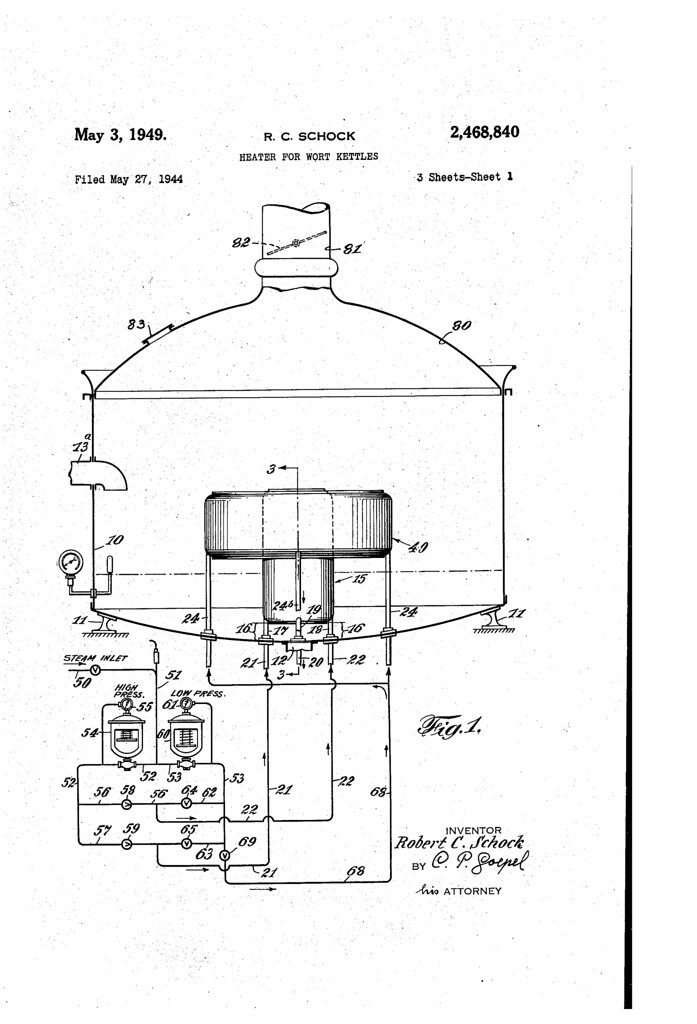
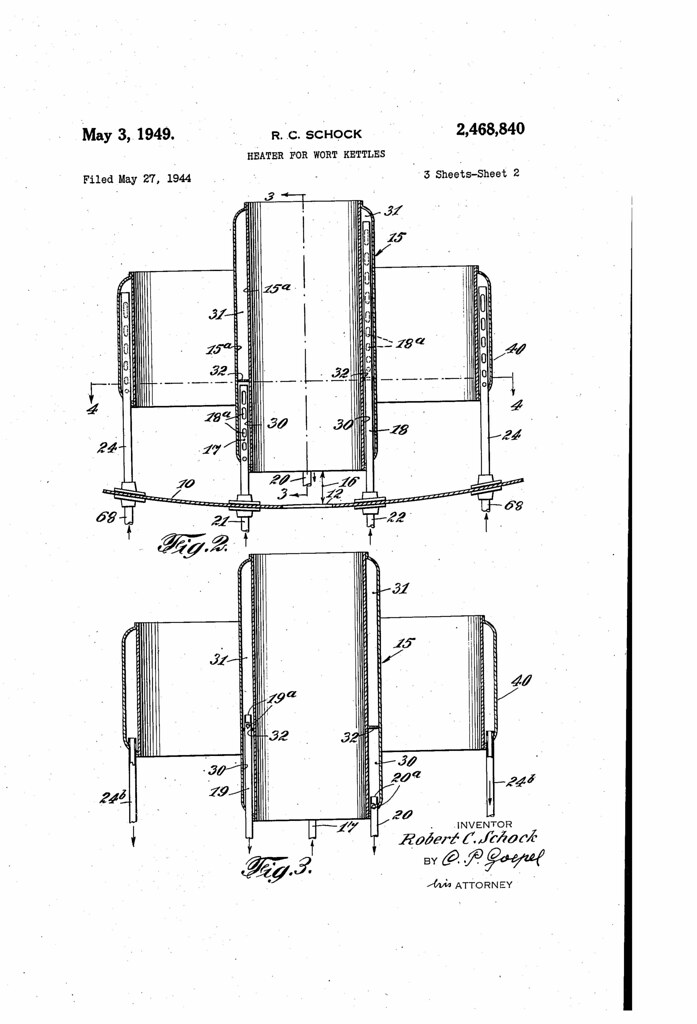
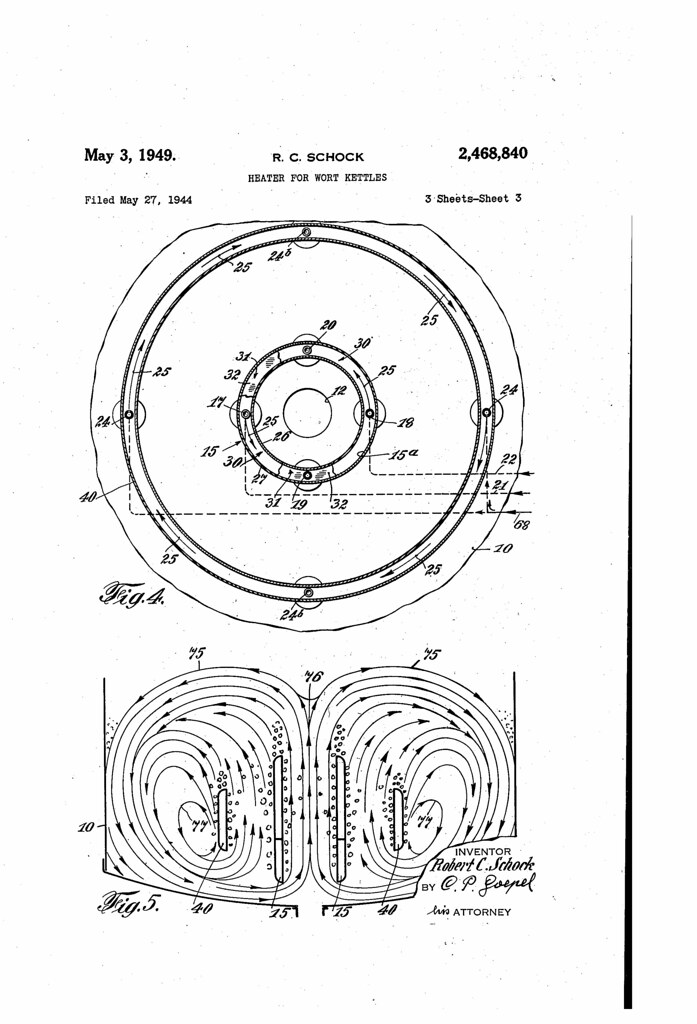
Patent No. 2468840A: Heater For Wort Kettles
Today in 1949, US Patent 2468840 A was issued, an invention of Robert C. Schock, for his “Heater For Wort Kettles.” There’s no Abstract, but in the description it states that the “invention relates to means and methods of heating wort prior to its use in the making of beer.” A little later on, they add that the “invention comprises a heating unit having varying heat units supplied to it for their exchange with a mass to be heated, and to keep said mass heated, such exchange taking place at relatively lower temperatures, then at relatively higher temperatures, and then again at lower temperatures, the latter if desired.”