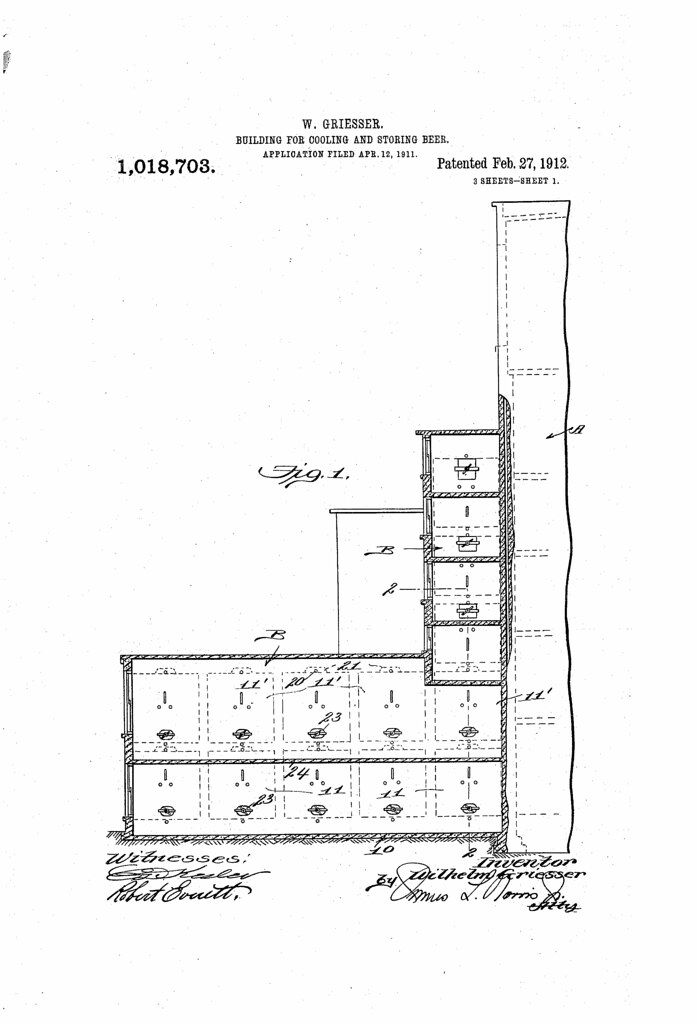
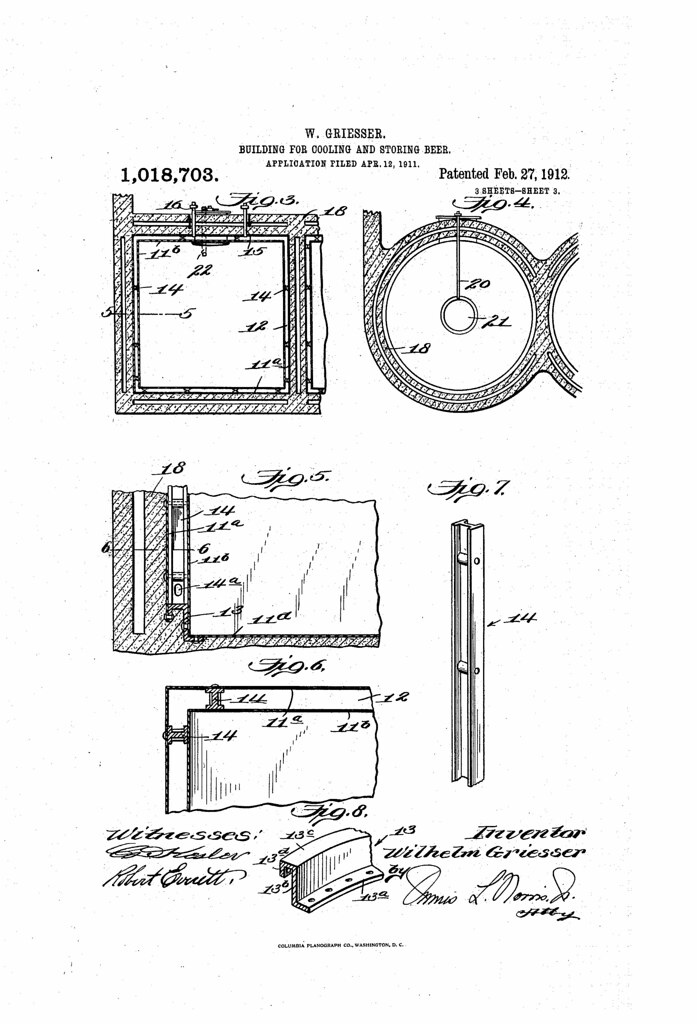
Today in 1912, US Patent 1018703 A was issued, an invention of Wilhelm Griesser, for his “Building for Cooling and Storing Beer.” This one seems crazy, an entire building being patented. There’s no Abstract, but the description states that the “present invention has reference to storage buildings, and it comprehends generally a structure which is adapted primarily for cooling and storing beer and is designed to be built up floor by floor as the tanks are arranged in position one above another, so as to produce, in effect, at its completion, a tower or the like wherein the tanks are inclosed and supported by a homogeneous monolithic casing of cementitious material, the tanks being built into the casing, during the actual construction of the latter, in such a manner that their metal walls and the walls of the casing mutually reinforce each other.”

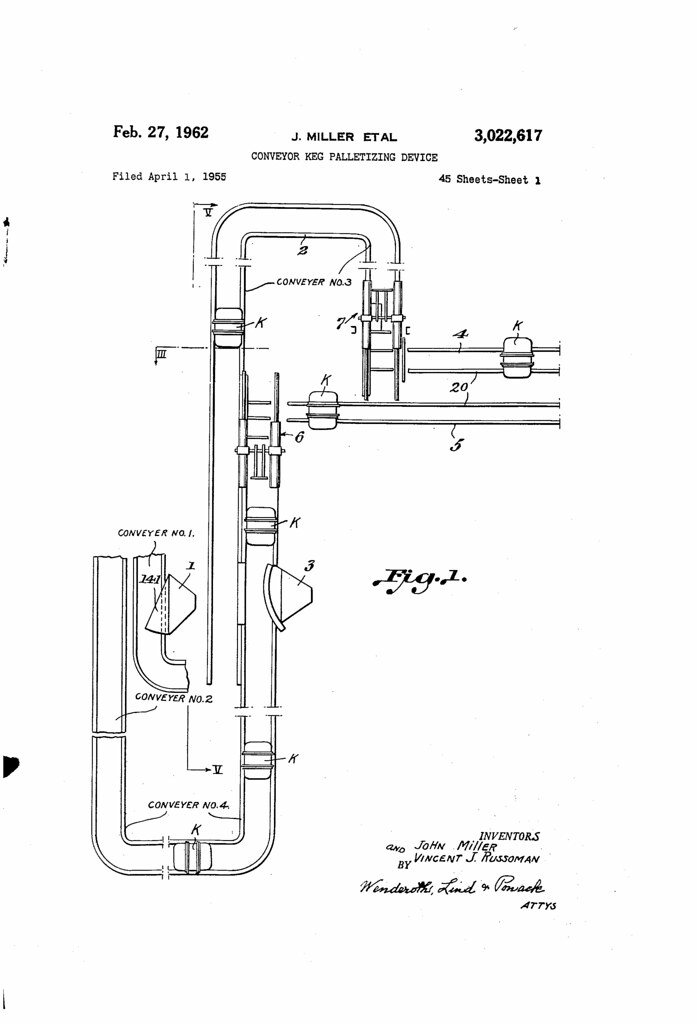
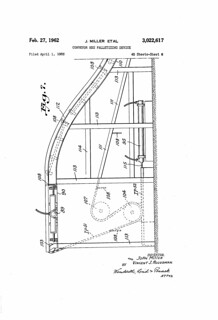
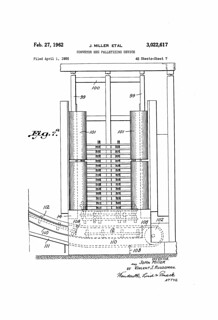
Patent No. 3022617A: Conveyor Keg Palletizing Device
Today in 1962, US Patent 3022617 A was issued, an invention of John Miller and Vincent J. Russoman, assigned to Schaefer Brewing Co., for their “Attachment for Conveyor Keg Palletizing Device.” There’s no Abstract, and given that there are a record (for me at least) 45 drawings showing the patented device, there’s precious little by way of description, so I guess just look at the pretty pictures.


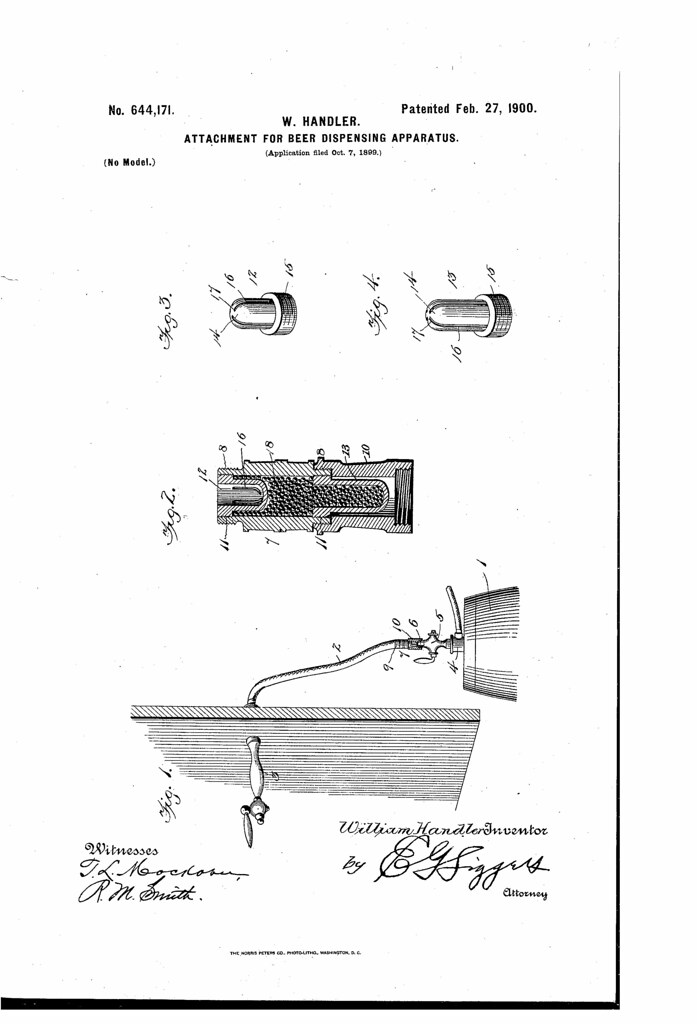
Patent No. 644171A: Attachment For Beer-Dispensing Apparatus
Today in 1900, US Patent 644171 A was issued, an invention of William Handler, for his “Attachment for Beer-Dispensing Apparatus.” There’s no Abstract, but in the description Handler explains that his “invention relates to an attachment for beer-dispensing apparatus,” adding that the “object of this invention is to produce what may be termed an anti-froth device, which may be applied at any point between the barrel, keg, or vessel and the discharge outlet of the dispensing-faucet, the said device operating to retard or hold back the froth,while permitting a ready outflow of the liquid, and thereby equalizing the amount of froth delivered with the liquid from the first to the last glass of liquid drawn from the vessel.”
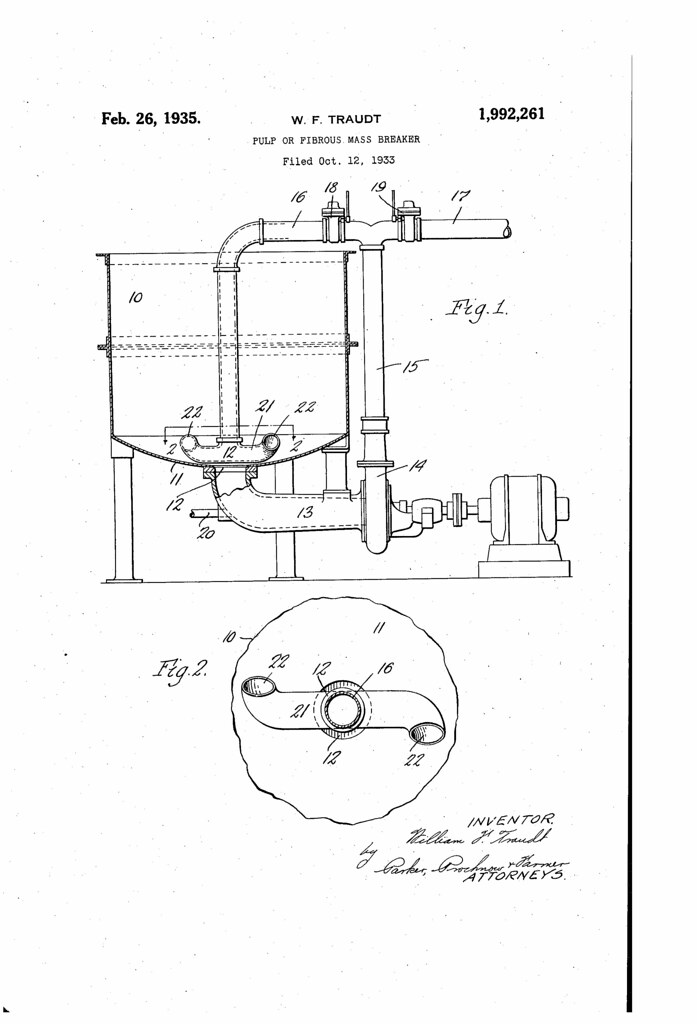
Patent No. 1992261A: Pulp Or Fibrous-Mass Breaker
Today in 1935, US Patent 1992261 A was issued, an invention of William F. Traudt, for his “Pulp or Fibrous-Mass Breaker.” There’s no Abstract, but in the description Traudt explains that his “invention relates to improvements ‘in breakers or disintegrators for fibrous material, such as the filter-mass employed in breweries for filtering beer, the breaker of this application being primarily intended for breaking up the soiled or used filter-mass coming from the beer filters preparatory to washing or reclaiming it for reuse.”
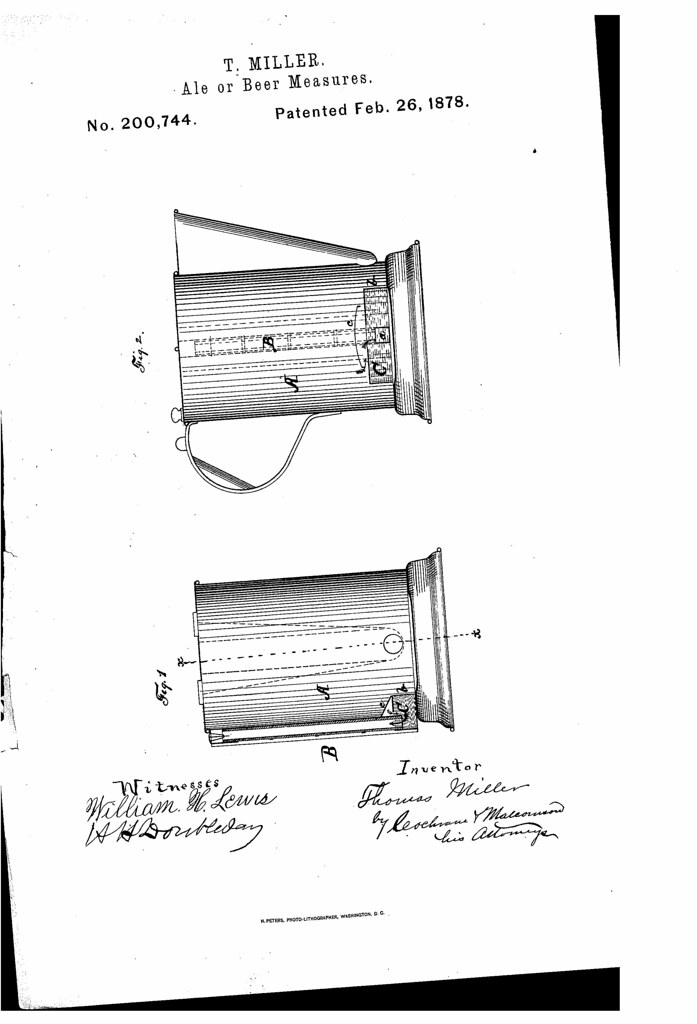
Patent No. 200744A: Improvement In Ale Or Beer Measures
Today in 1878, US Patent 200744 A was issued, an invention of Thomas Millee, for his “Improvement in Ale or Beer Measures.” There’s no Abstract, but in the description Millee explains that the “object of my invention is to provide a ready and convenient means of ascertaining the quantity of liquor in the measure, including that portion which is contained in the form of froth or foam; and in order to accomplish this object I cover or inclose the outlet from the interior of the measure to the measuring tube, by soldering strips of metal to the side and bottom of the measure at the point where the tube connects therewith, so as to form a separate compartment at the base of such tube on the inside of the measure above the bottom, which compartment has small apertures leading’ into it, arranged so that the foam or froth will not be driven against or through them into this compartment when the liquor is drawn or poured into the measure, all of which will more clearly appear by the drawings and description of the different parts.”
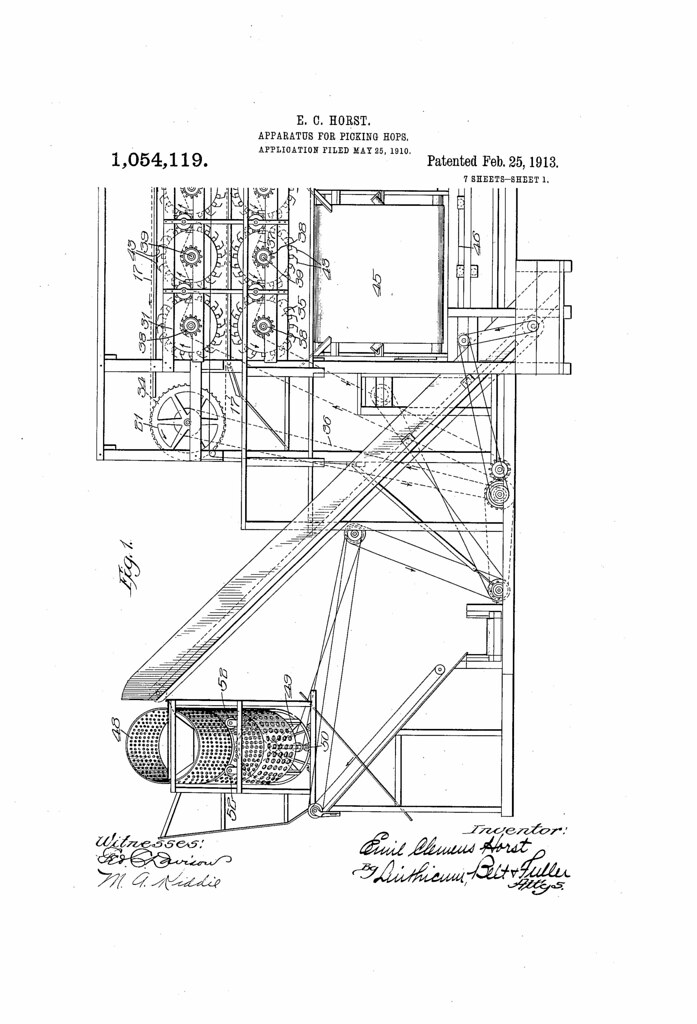
Patent No. 1054119A: Apparatus For Picking Hops
Today in 1913, US Patent 1054551 A was issued, an invention of Emil Clemens Horst, for his “Apparatus For Picking Hops,” and his second patent to be issued today. There’s no Abstract, but the description states he’s “devised a complete system for mechanically picking hops from the vines and separating them from the leaves and stems, with which they are co-mingled and delivering them to dryers by machinery.”
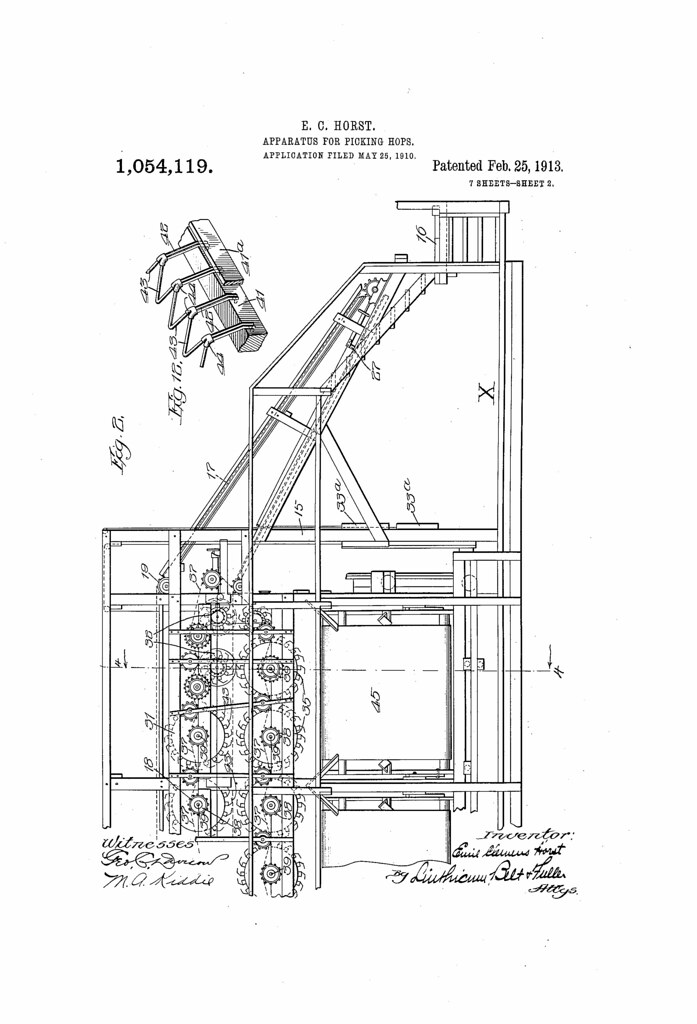

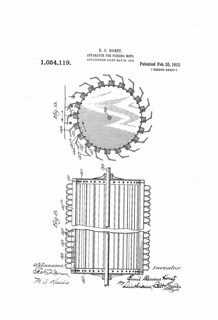
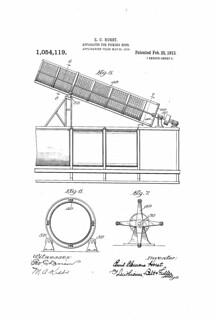

Patent No. 1054551A: Method Of Picking Hops
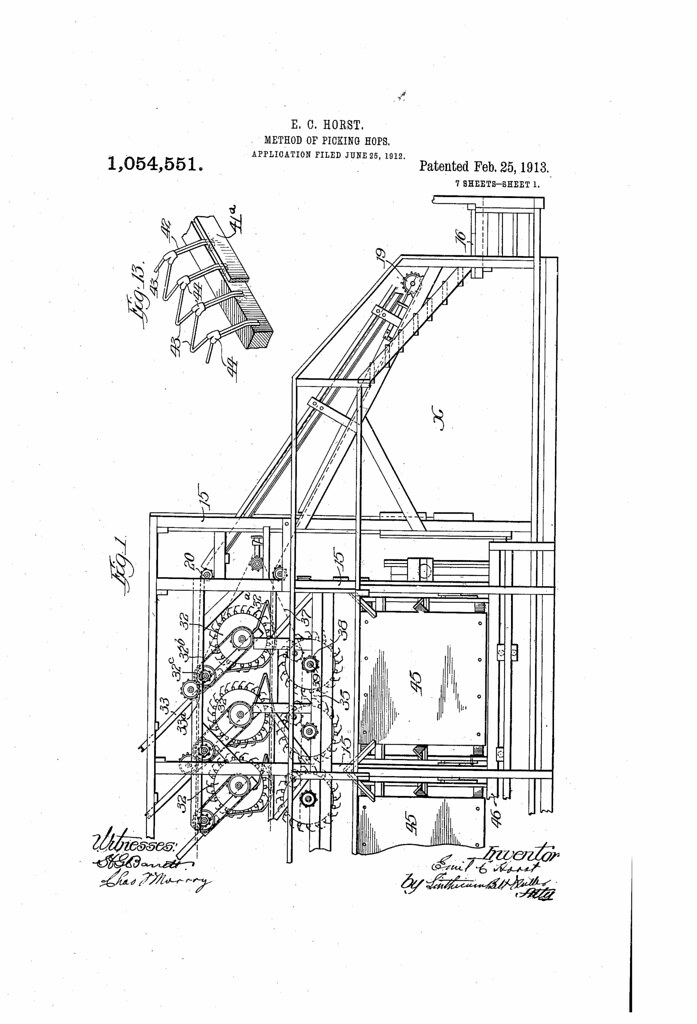
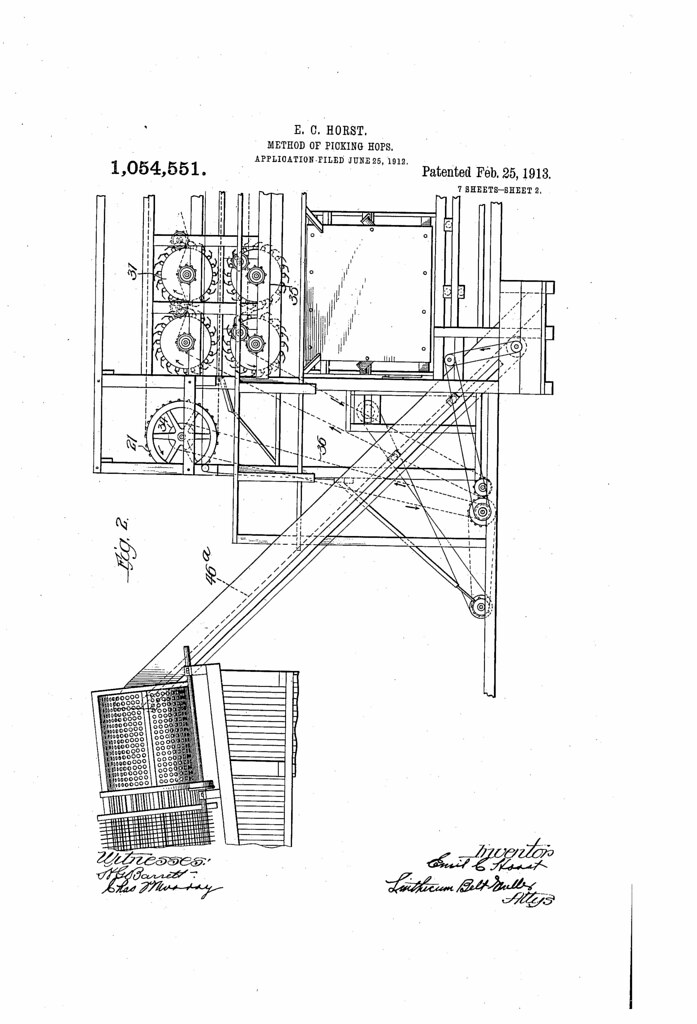
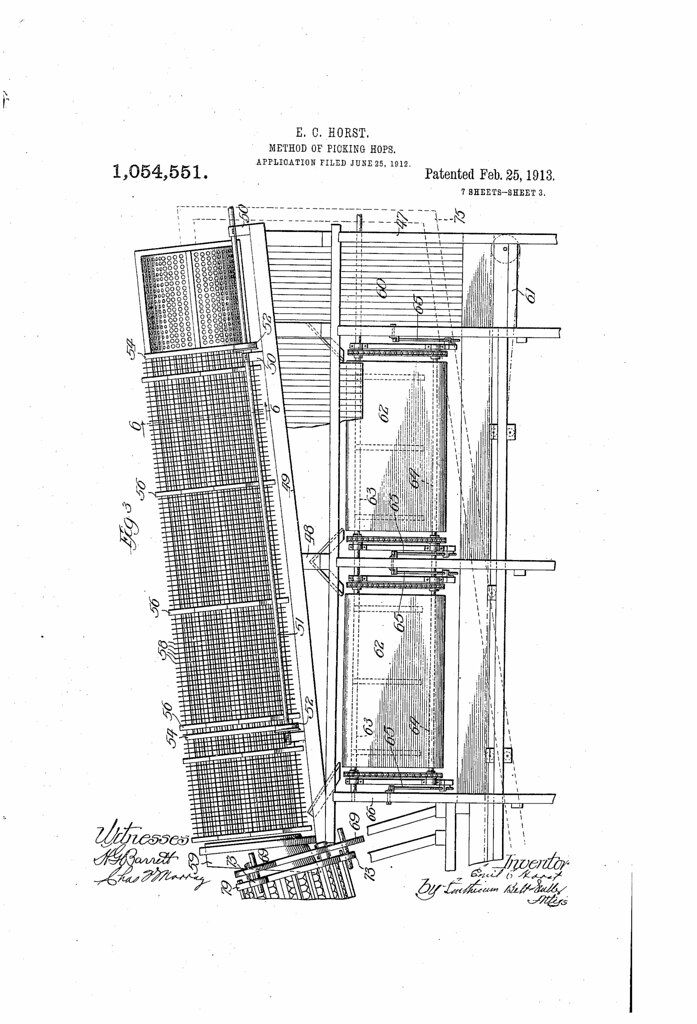
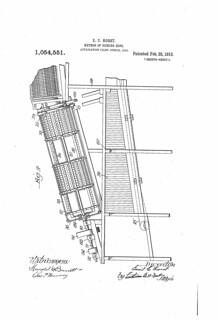
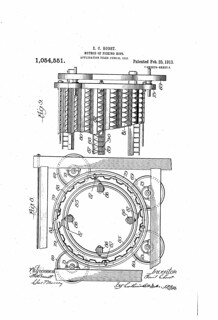
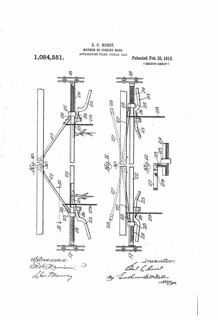
Today in 1913, US Patent 1054551 A was issued, an invention of Emil Clemens Horst, for his “Method of Picking Hops.” There’s no Abstract, but the description states that the “invention comprises a method of picking hops and [he has] disclosed in the accompanying drawings apparatus by which my method may be performed.”
To the attainment of the desirable results which will be hereinafter more particularly described, the method which I prefer to employ as comprehended in the scope of this application is as follows: First: Passing the hop vines over and in contact with suit able picker mechanism. Second: Depositing the hops by gravity into a suitable conveyer by means of which they’re carried to an inclined cylindrical separator. Third: Subjecting any clusters to a further separating action, then causing the hop stems and trash to be elevated and repassed through the separating cylinder just de scribed. Fourth: Finally conveying the hops to the dry house from the combined cleaning mechanism.

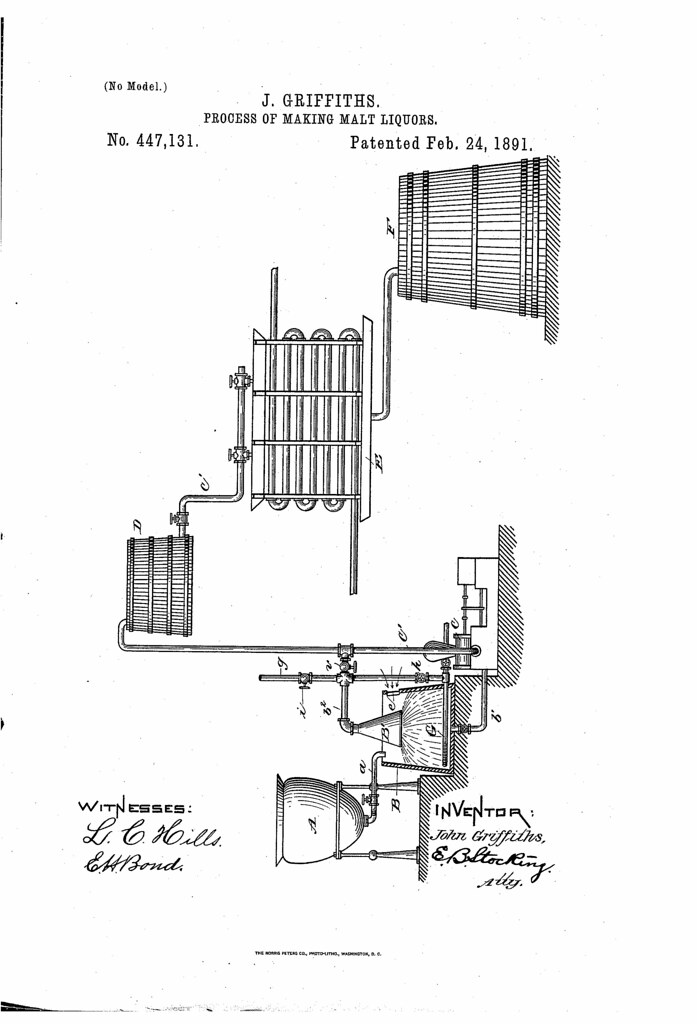
Patent No. 447131A: Process Of Making Malt Liquor
Today in 1891, US Patent 447131 A was issued, an invention of John Griffiths, for his “Process of Making Malt Liquor.” There’s no Abstract, but the description very generally states that the “invention relates to an improvement in the art of making malt liquors by which the quality of the liquor is improved,the cost of production reduced, a considerable saving effected in the time and appliances heretofore required, and a consequent gain realized in the capacity of a brewery.”
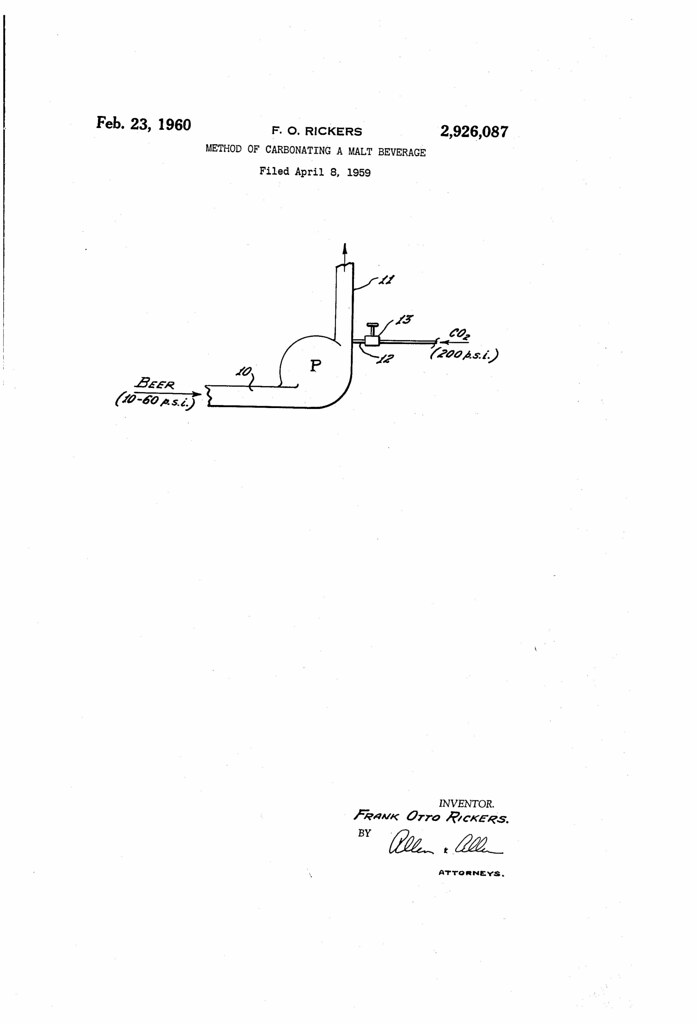
Patent No. 2926087A: Method Of Carbonating A Malt Beverage
Today in 1960, US Patent 2926087 A was issued, an invention of Frank Otto Rickers, assigned to the George Wiedemann Brewing Co, for his “Method of Carbonating a Malt Beverage.” There’s no Abstract, but the description states that the “one of the principal objects of the invention is to provide a method for carbonating beer at a very much more rapid rate than has been possible heretofore.”
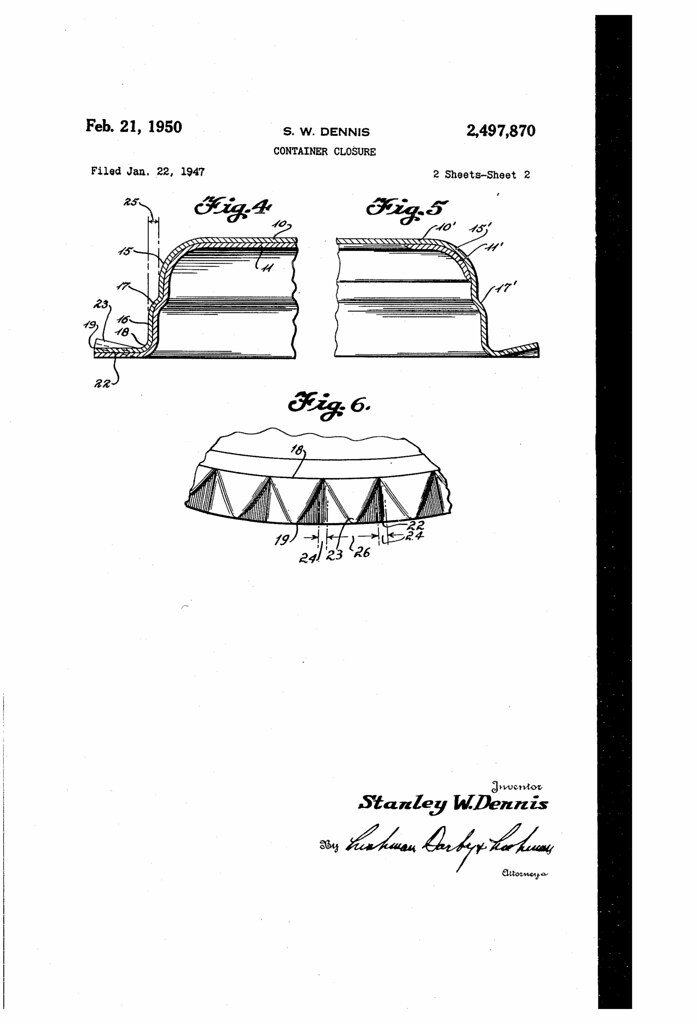
Patent No. 2497870A: Container Closure
Today in 1950, US Patent 2497870 A was issued, an invention of Stanley W. Dennis, assigned to the Crown Cork & Seal Co., for his “Container Closure.” There’s no Abstract, but the description states that the “The present invention relates to closures.” Happily, they expound upon that somewhat:
More particularly, the closure of the present invention is an improvement on closures of the type shown, described and claimed in a number of prior patents to G. W. Booth, owned by the assignee of the present application, such as Patents 1,956,209, Reissue 19,422, 1,956,213, 1,956,214, 1,956,215 and 1,956,217. Certain features of the invention, however, as regards cap structures, have utility and may be used in connection with caps of other types, as will be apparent from the following description and the appended claims.