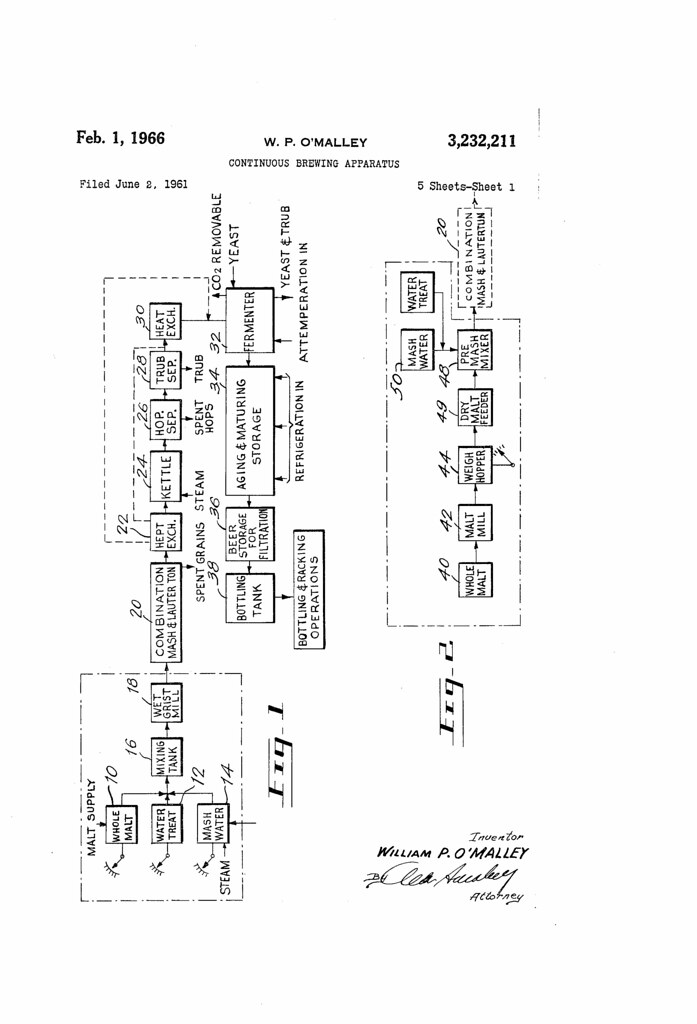
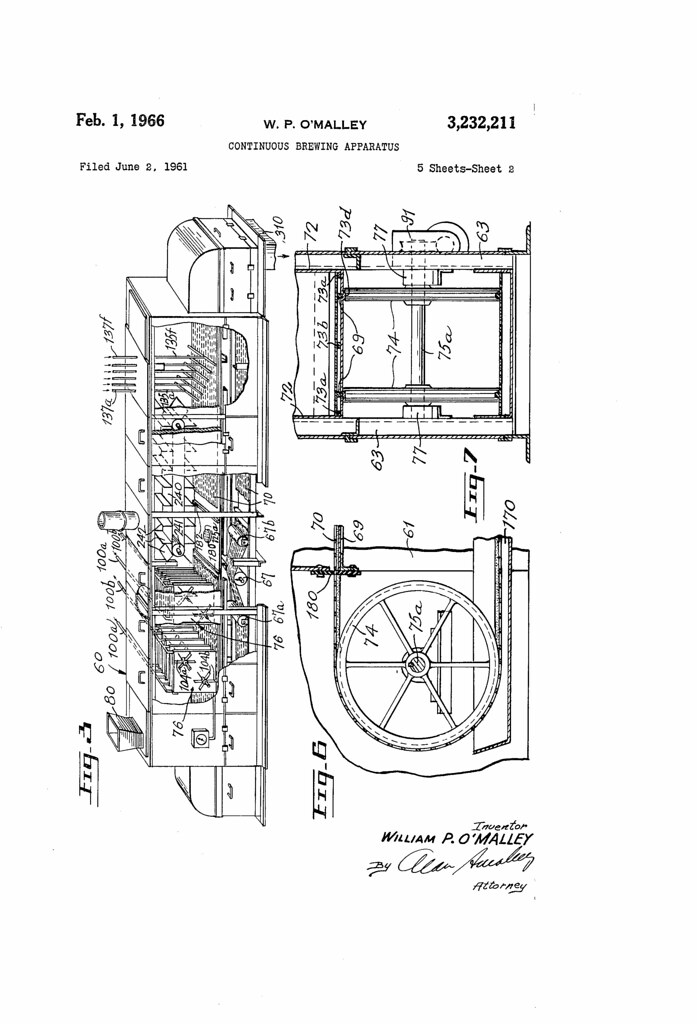
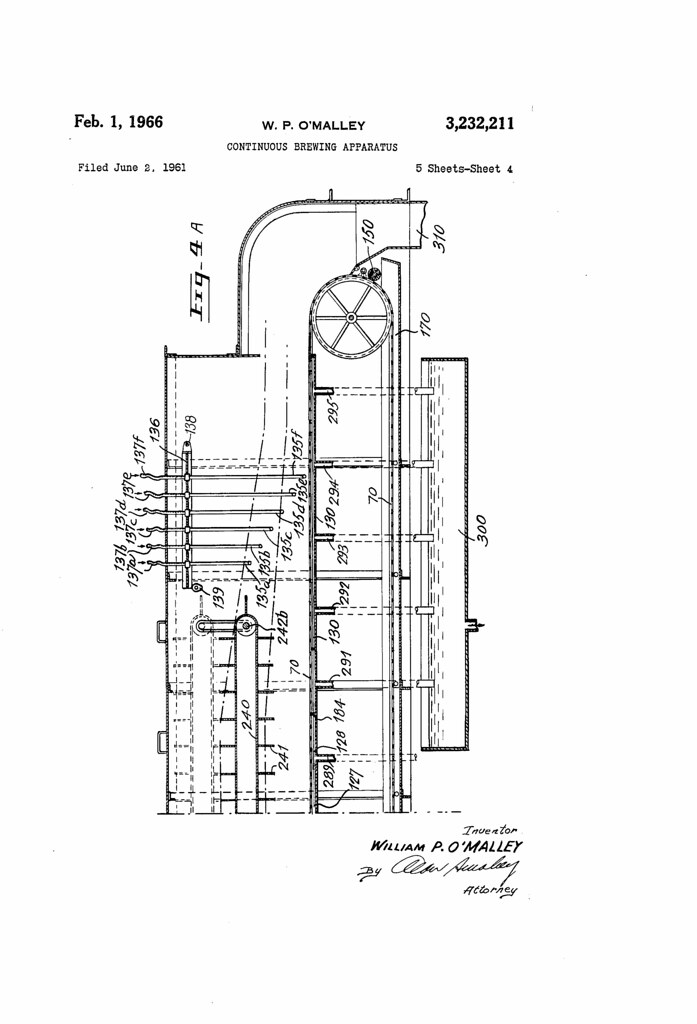
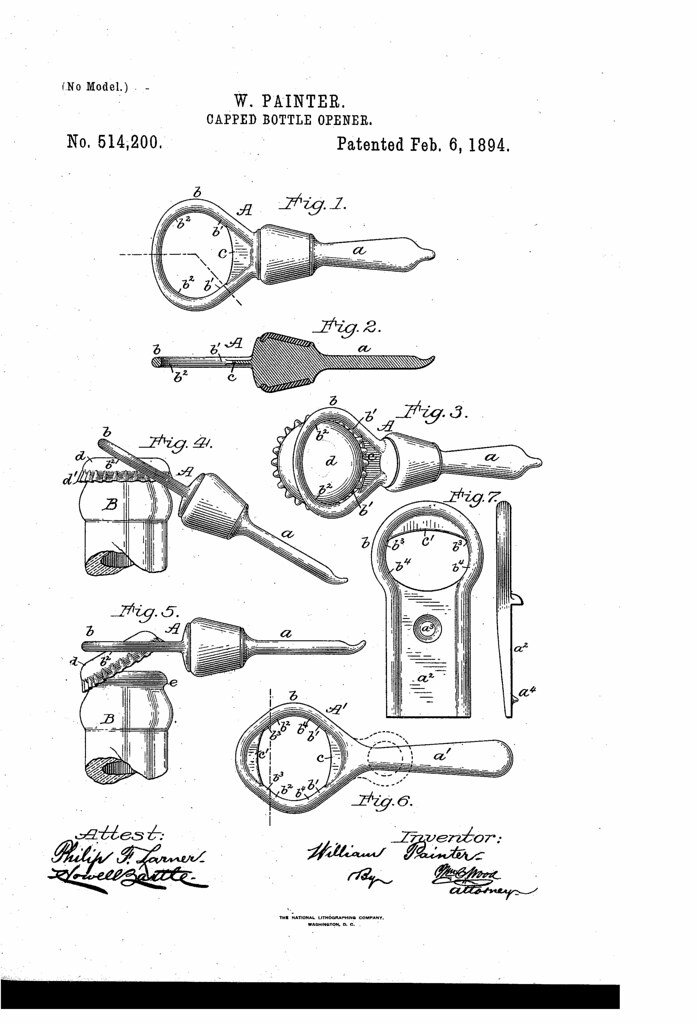
Today in 1894, US Patent 514200 A was issued, an invention of William Painter, for his “Capped-Bottle Opener.” There’s no Abstract, but in the introduction of his application, Painter states his “bottle opener essentially embodies a handle, having at one end thereof, a cap centering gage, and also a cap engaging lip, and however these three elements may be formed and combined, the centering gage should also afford a fulcrum, with respect of the handle and the cap engaging lip, and the latter should be substantially in line with the handle, so that when the opener is applied to a capped bottle, the gage will assure an appropriate bearing or fulcrum on top of the cap, with the lip located beneath or underlying a portion of the cap, and so enable the handle to serve as a lever for removing the cap from the bottle. Although without departure from my invention these three essential elements may be separately constructed and combined to form my bottle opener, they are more economically constructed integrally of iron or other suitably strong metal, as by molding or casting the opener in one piece, and it is in this form that my opener will be more particularly described.” After having patented the crown two years earlier, I guess he needed to invent a way to open the bottles, too.
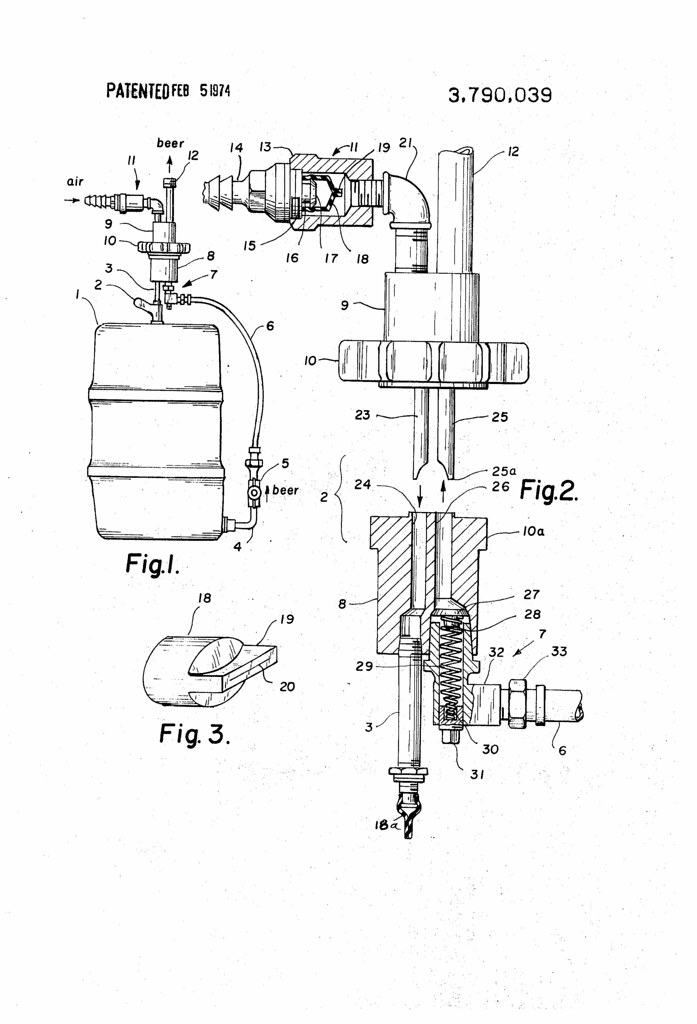
Patent No. 3790039A: Keg Tapping Assembly
Today in 1974, US Patent 3790039 A was issued, an invention of Homer R. Zucconi, for his “Keg Tapping Assembly.” There’s no Abstract, but this application apparently continues from a previous filing, and it “relates to an attachment for enabling the use of a conventional tapping attachment for application to two different tapping systems, namely, one in which a single tapping connection is made at the top (central) hole axially of the keg, or to one in which a connection is made not only at the top central hole, but also at a bottom side hole, which double connections have been used for many years in the industry.”
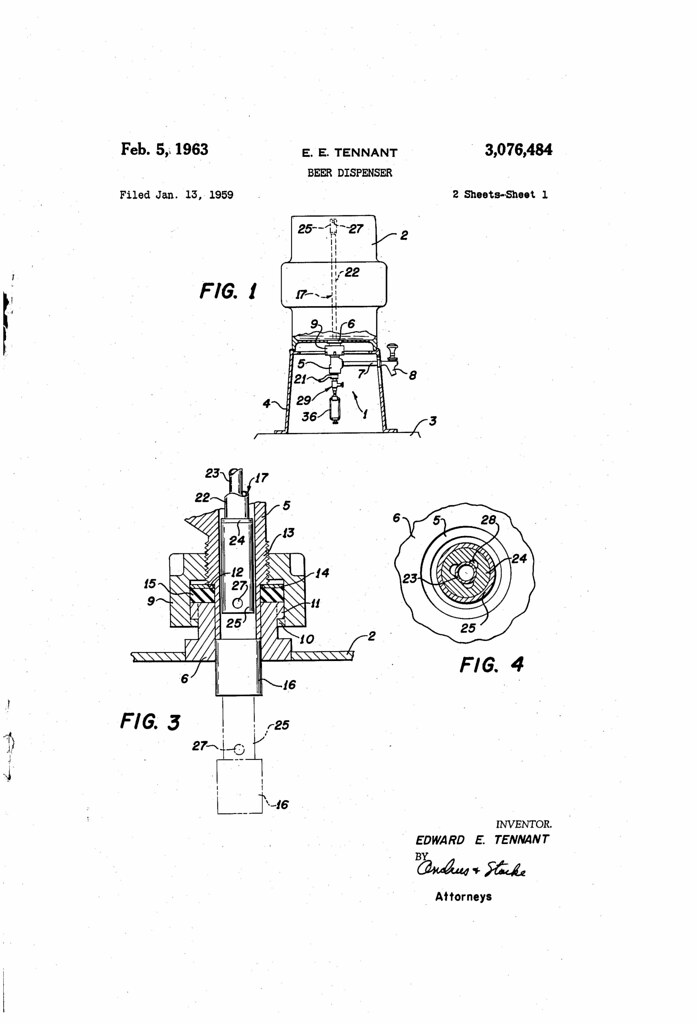
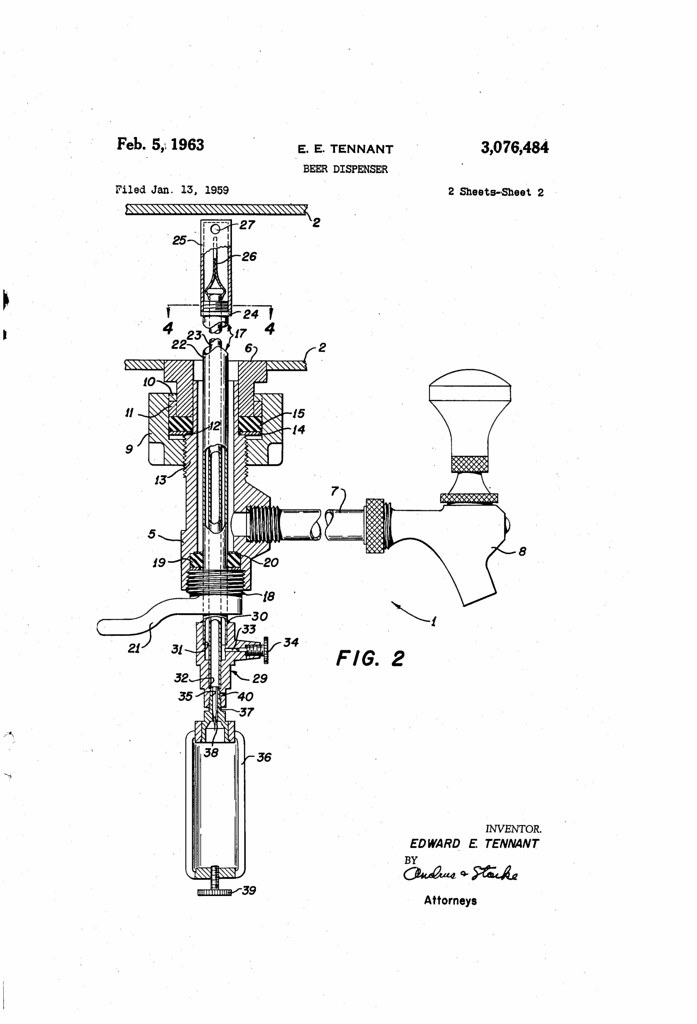
Patent No. 3076484A: Beer Dispenser
Today in 1963, US Patent 3076484 A was issued, an invention of Edward E. Tennant, assigned to Schlitz Brewing Co., for his “Beer Dispenser.” There’s no Abstract, but the application describes it, saying the “dispenser of the present invention is adapted for use with beer kegs or the like, such as are frequently used for party, picnic and other related applications where no regular beer dispensing equipment is available. The present device is of the general type utilizing gravity flow of the contained beverage which type of dispenser is highly desirable inasmuch as no hand pump or other pressure device is required to force the beer from the keg. The dispenser of the invention constitutes an improvement over gravity feed devices previously employed for dispensing beer.”
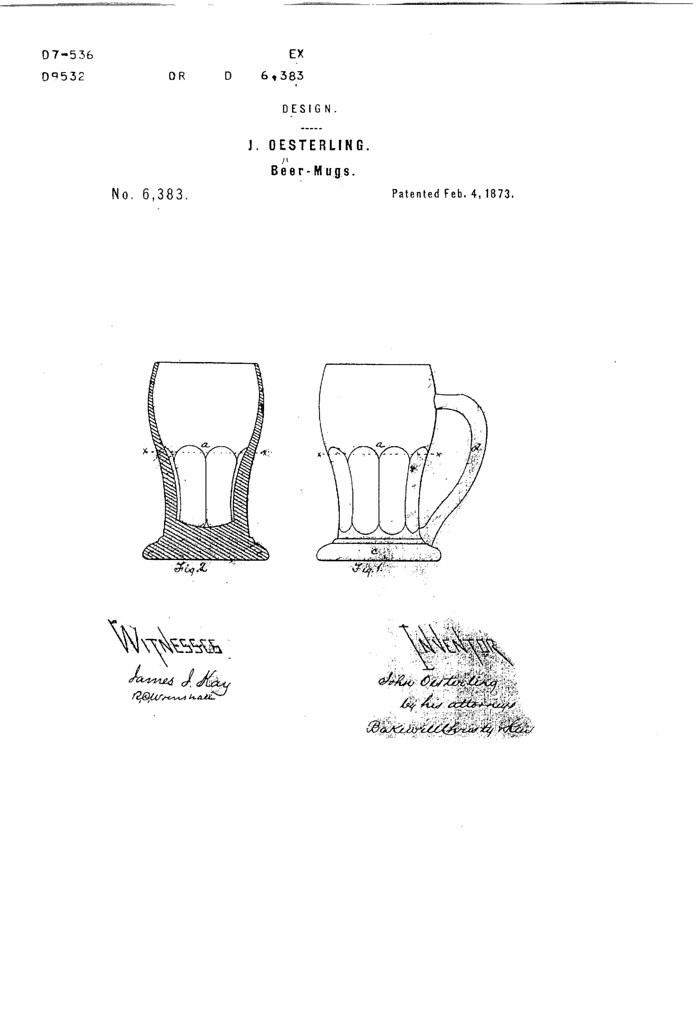
Patent No. D6383S: Design For Beer-Mugs
Today in 1873, US Patent D6383 S was issued, an invention of John Oesteeling, for his “Design for Beer-Mugs.” There’s no Abstract, but the application describes it, stating that the “design consists in making the upper half of the body of the beer or ale glass barrel shaped, and the lower half of a reduced diameter, with straight or slightly-concave sides, so as to present the appearance of a stem.” Looks more like an ice cream float glass than a beer mug, though.
Patent No. 37578A: Improved Extract Of Malt
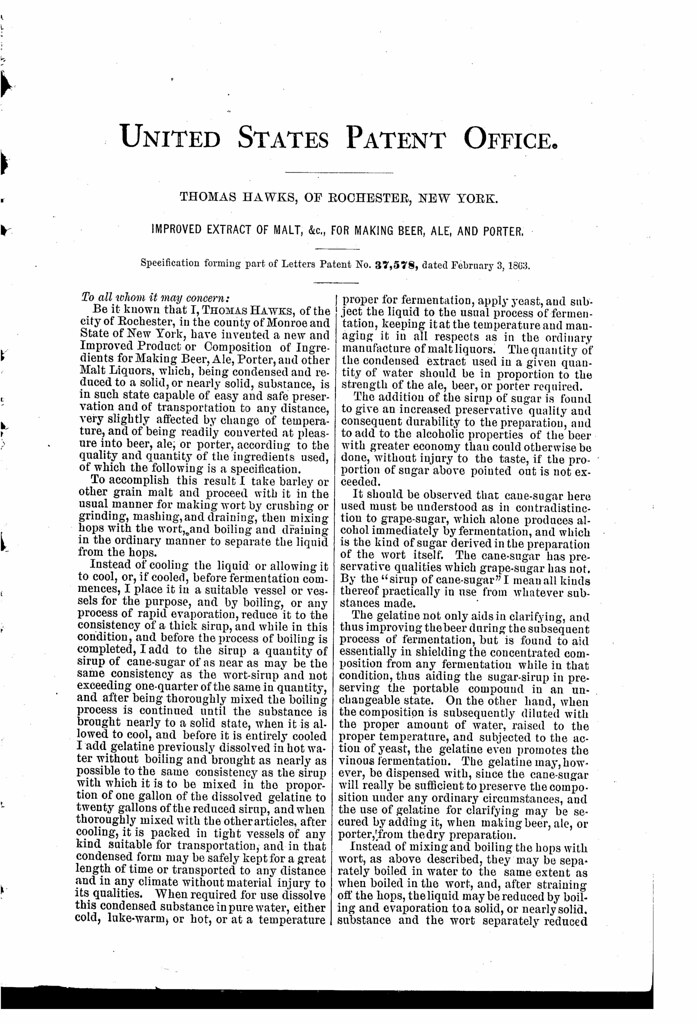
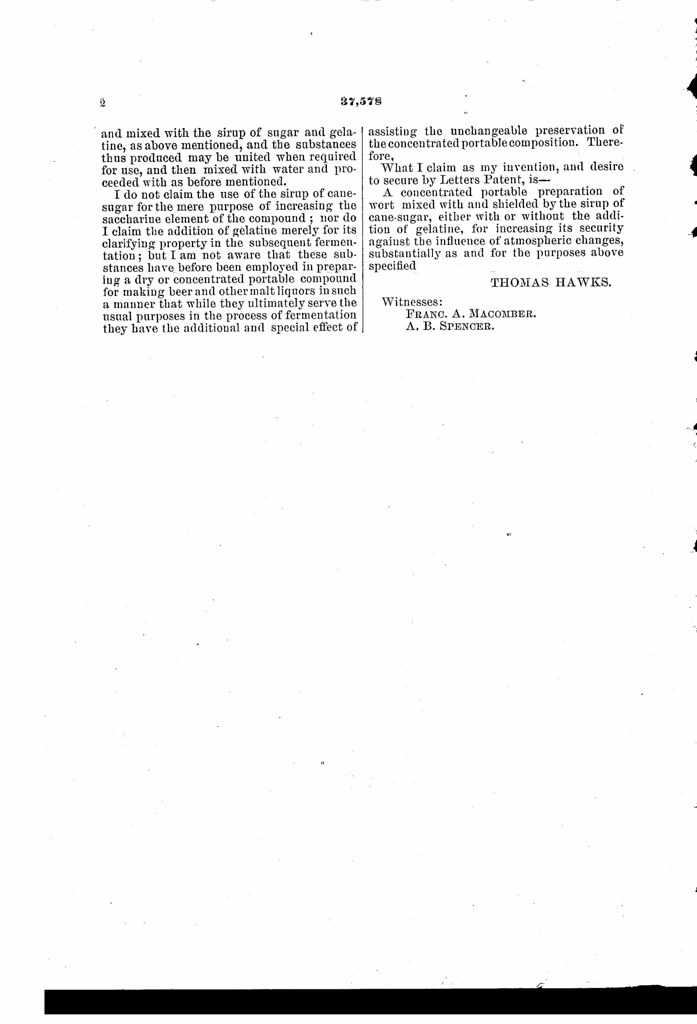
Today in 1863, US Patent 37578 A was issued, an invention of Thomas Hawks, for his “Improved Extract of Malt.” There’s no Abstract, but the entire application is rendered as a two-page image. This is a very old patent, older than most commercial breweries still with us, issued in the middle of the Civil War.
Patent No. D609053S1: Beer Glass
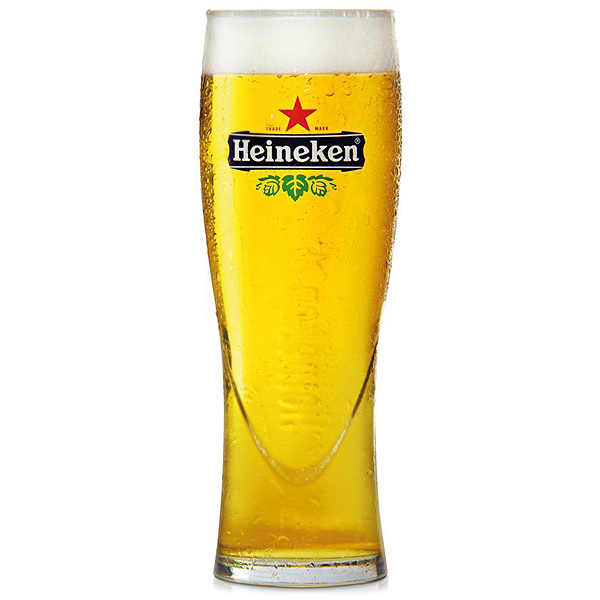
Today in 2010, US Patent D609053 S1 was issued, an invention of Ramses Dingenouts, assigned to Heineken Supply Chain B.V., for his “Beer Glass.” There’s no Abstract, and the entire application is just one sentence. “The ornamental design for beer glass, as shown and described.”
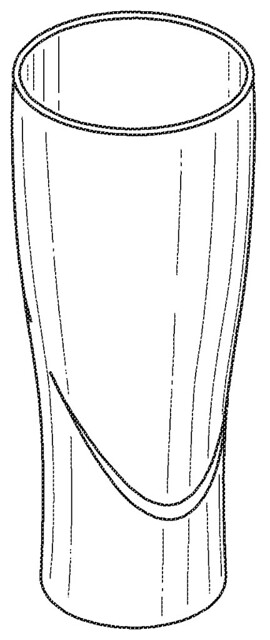
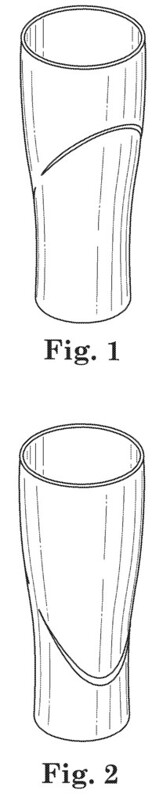



Obviously, this designed has been used by Heineken as a proprietary glass in recent years, over the five years since the patent was granted.
Patent No. 468258A: Bottle-Sealing Device
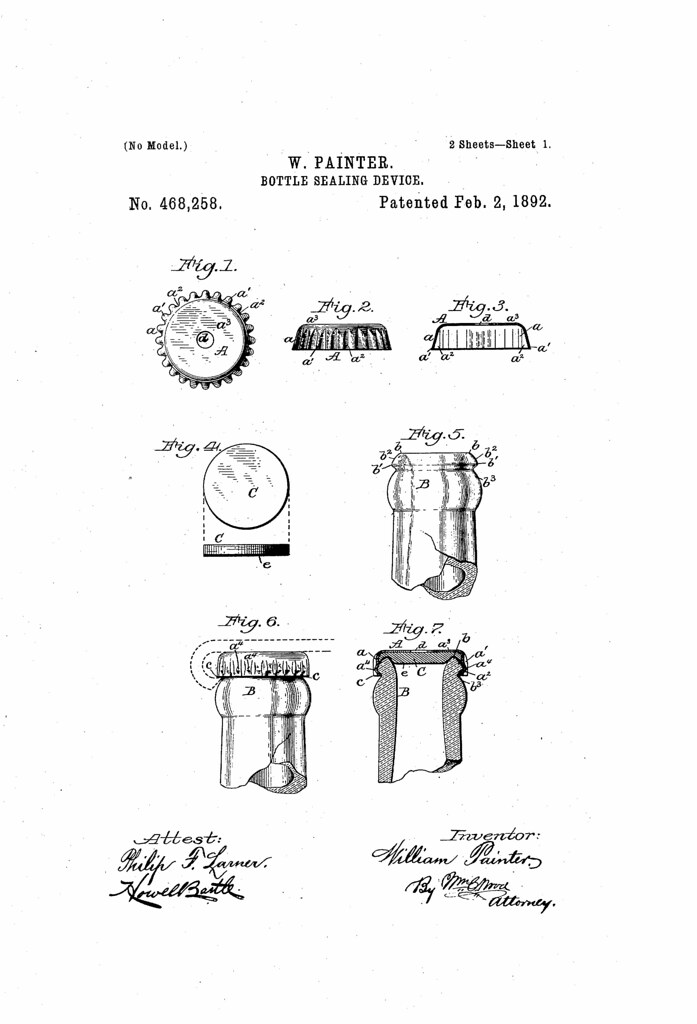
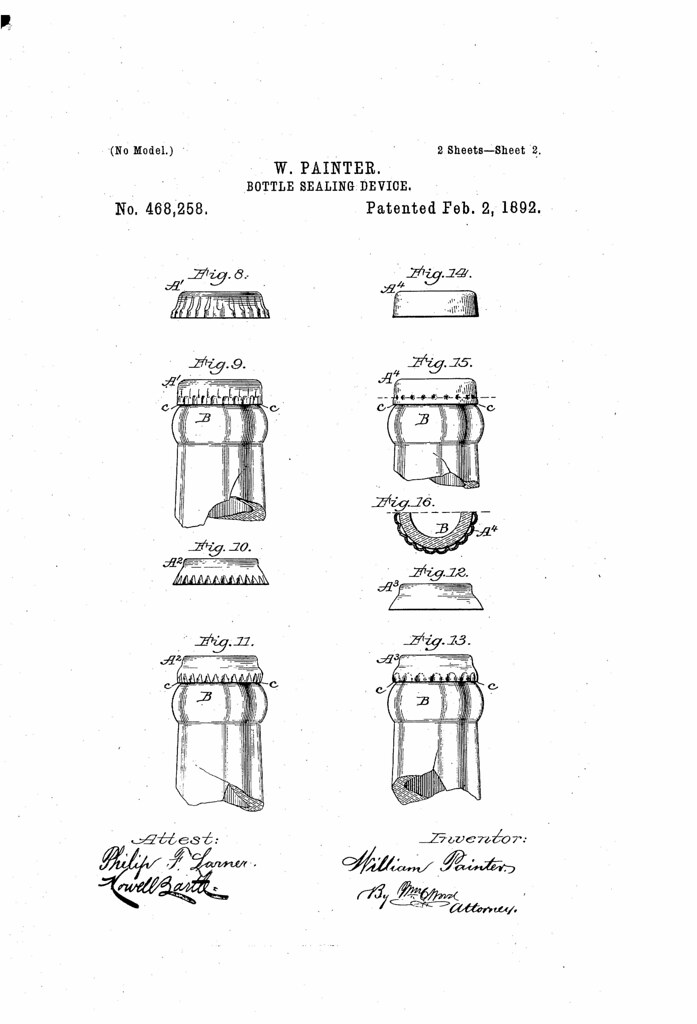
Today in 1892, US Patent 468258 A was issued, an invention of William Painter, for his “Bottle-Sealing Device.” There’s no Abstract, and it’s funny to see it called a “bottle-sealing device,” when essentially it’s simply a crown or bottle cap. Is it possible that the term had not yet been coined at this point? Painter in his application described his device:
For use with any suitable sealing medium, whether in the form vof a plug or a disk, or a combined disk and plug, applied at or in the mouth of a bottle, I have devised metallic sealing-caps embodying certain novel characteristics which render them highly effective and so inexpensive as to warrant throwing them away after a single use thereof, even when forcible displacement, as in opening bottles, has resulted in no material injury to the caps.
I have seen his name linked to the invention of crowns, so these may be the very first ones.
Patent No. 3232491A: Container For A Keg Or The Like
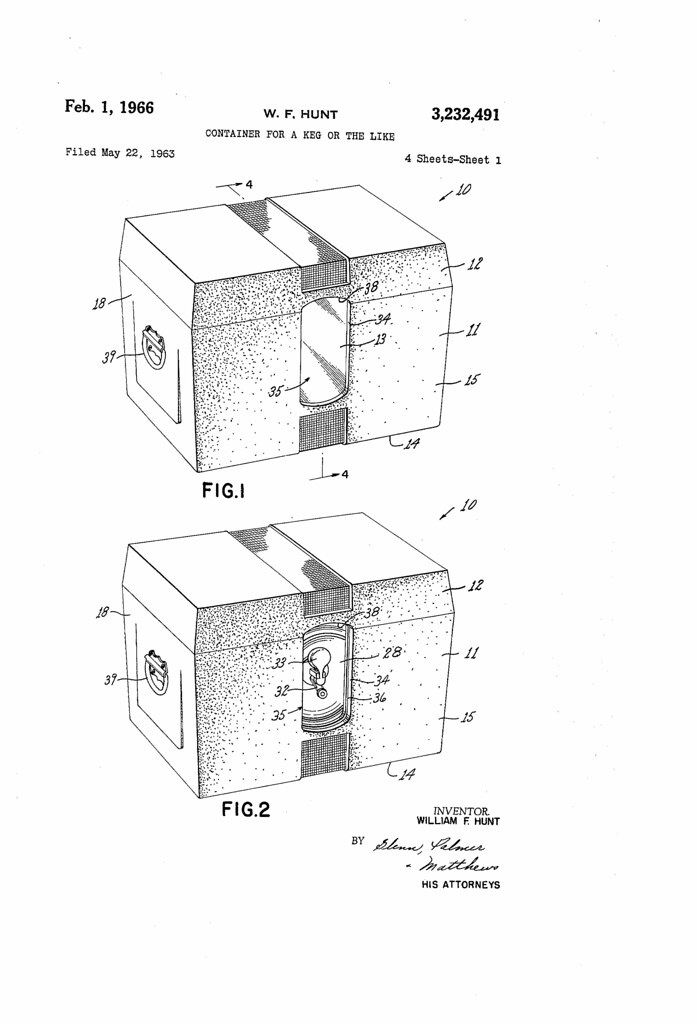
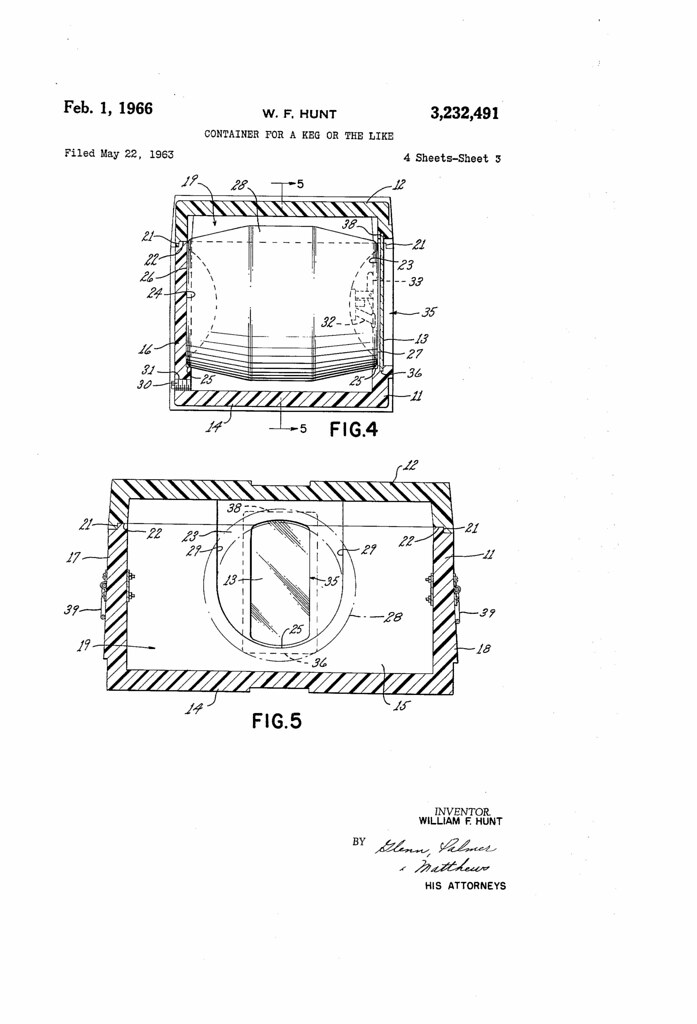
Today in 1966, US Patent 3232491 A was issued, an invention of William F. Hunt, assigned to Reynolds Metals Co., for his “Container for a Keg or the Like.” There’s no Abstract, and although the drawings suggest the invention is a jockey box-like container for kegs, at one point he mentions “beer is now being sold in barrel-shaped kegs formed of metallic material, such as aluminum containing metallic material or the like, having a capacity of around 2 to 2 1/2 gallons,” adding that this phenomena is growing in popularity and “that people are more frequently buying beer and other beverages in larger and more economical containers not only for home use but also for picnics and the like.” Now admittedly I was only seven in 1966, so wasn’t buying too many kegs at the time, but I certainly don’t remember these 2 to 2-1/2 gallon kegs of which he speaks. I do remember 5L mini kegs made primarily by German brewers in the mid-1990s, but that would have been just over 1.3 gallons. So despite its appearance, this keg box would have been much smaller than it looks, being designed for a much smaller keg, though it’s described as “an improved container is provided for receiving such a keg or the like wherein the container supports the keg in a novel manner to permit the same to be completely surrounded by ice or other cooling medium so that the keg will be refrigerated and the beverage remain cool until the same is dispensed from the keg.”

Patent No. 5282413A: Installation For Steeping Grains
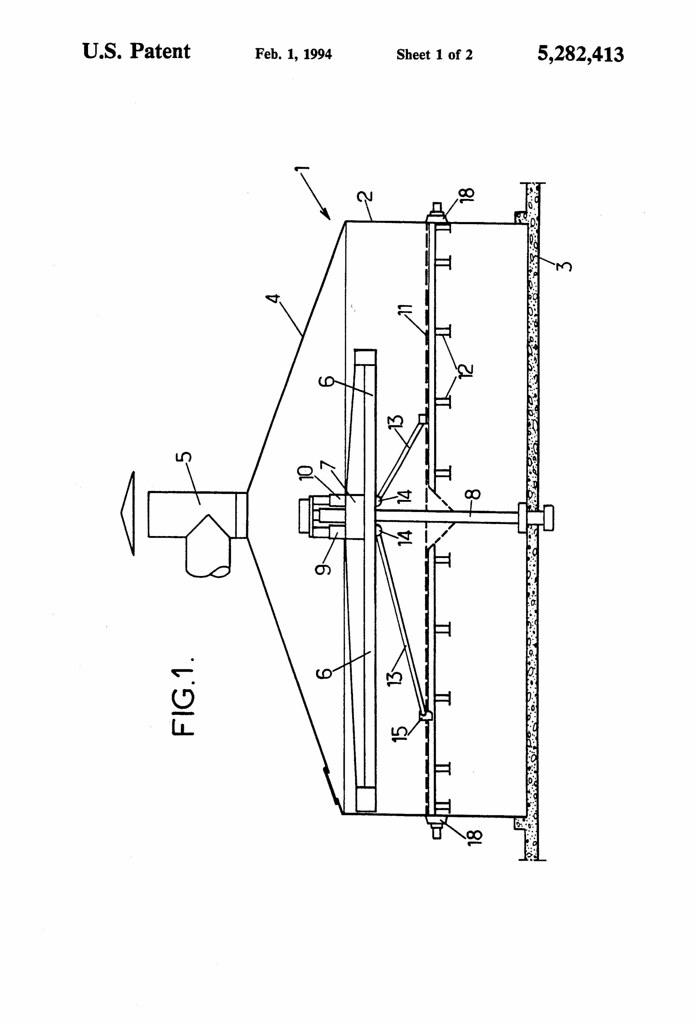
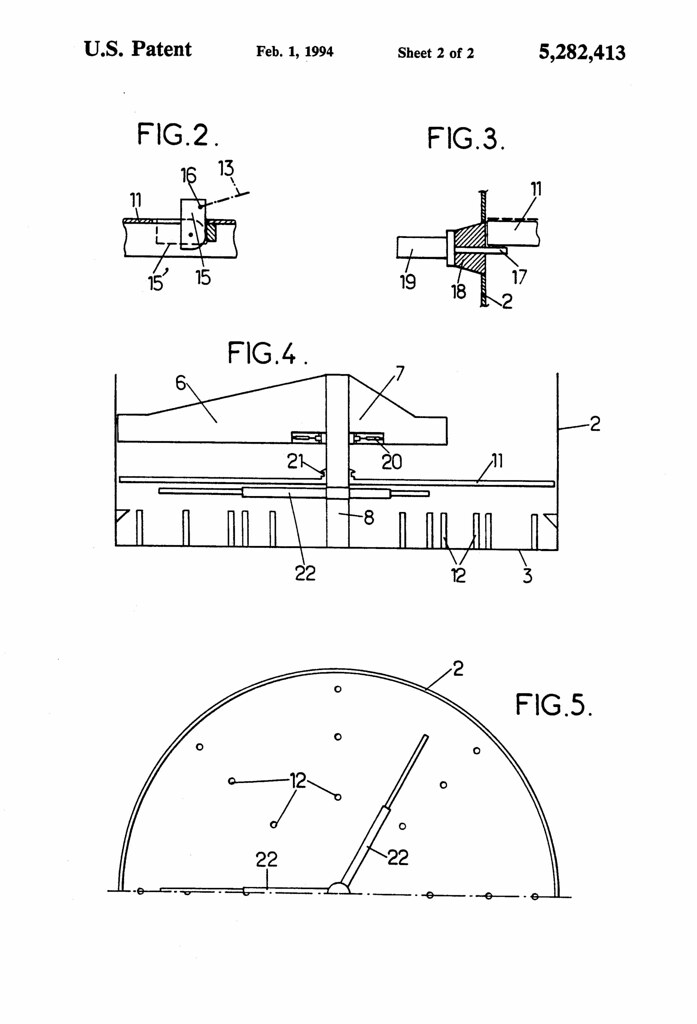
Today in 1994, US Patent 5282413 A was issued, an invention of Rene Sauvage, James Roget, Jean Amstutz, and Guy Flament, for their “Installation for Steeping Grains.” Here’s the Abstract:
Installation for steeping grains of the type comprising a tank (1) provided with a cylindrical lateral wall (2), with a bottom (3) and with a perforated platform (11) disposed at a certain distance from the bottom (3) and on which the grain rests in a layer of suitable thickness, the upper surface of this layer of grains being able to be levelled by a rotary system with raking arms (6) carrying blades and associated with a first motor (9) capable of rotating them, a second motor (10) being coupled to the system in order to make it vertically movable. This installation comprises removable connection making it possible to connect, mechanically and temporarily, the perforated platform (11) to the system with raking arms (6) and blades or directly to the second motor (10).
Patent No. 3232211A: Continuous Brewing Apparatus
Today in 1966, US Patent 3232211 A was issued, an invention of William P. O’Malley, assigned to Malley Brewery Ltd. of Montreal, Canada, for his “Continuous Brewing Apparatus.” There’s no Abstract, but there’s this in the description.
The present apparatus is designed so as to incorporate all of the operations and techniques used in the batch process. Thus, by imparting continuity to the individual batch process operations, the result obtained is a continuous brewing process, which can perhaps best be described by the somewhat contradictory statement, that it is the batch process made continuous.
The continuous brewing process of the invention is accordingly based on the principles of batch processing, and it follows that for each unit of the batch process, there must be a corresponding unit for the continuous process.
Since the sequence and nature of the batch operations in any of its units are already established and Well defined, the design of the continuous unit is consequently limited and governed to some extent by the physical aspect of the batch operations for that unit.
As a result, the design of the present continuous unit was made around the operations existing in the batch unit, imparting the added factor of continuity to the operations without altering their character or nature in any way.
In order to duplicate the batch process while maintaining the desired continuity certain new apparatus must be provided to take the place of the apparatus where separate fillings, mixings, restings and withdrawal were necessary with the batch process. With this in mind the present invention provides such apparatus as will be described in more detail later and wherein a main feature resides in the construction of a combination mash and lauter tun designed specifically for continuous operation.