Brookston Beer Bulletin

Jay R. Brooks on Beer

  • Home
  • About
  • Editorial
  • Birthdays
  • Art & Beer

Socialize

  • Dribbble
  • Email
  • Facebook
  • Flickr
  • GitHub
  • Instagram
  • LinkedIn
  • Pinterest
  • RSS
  • Twitter
  • YouTube

Powered by Genesis

Patent No. 3295988A: Preparation Of Reconstituted Beer

January 3, 2015 By Jay Brooks

patent-logo
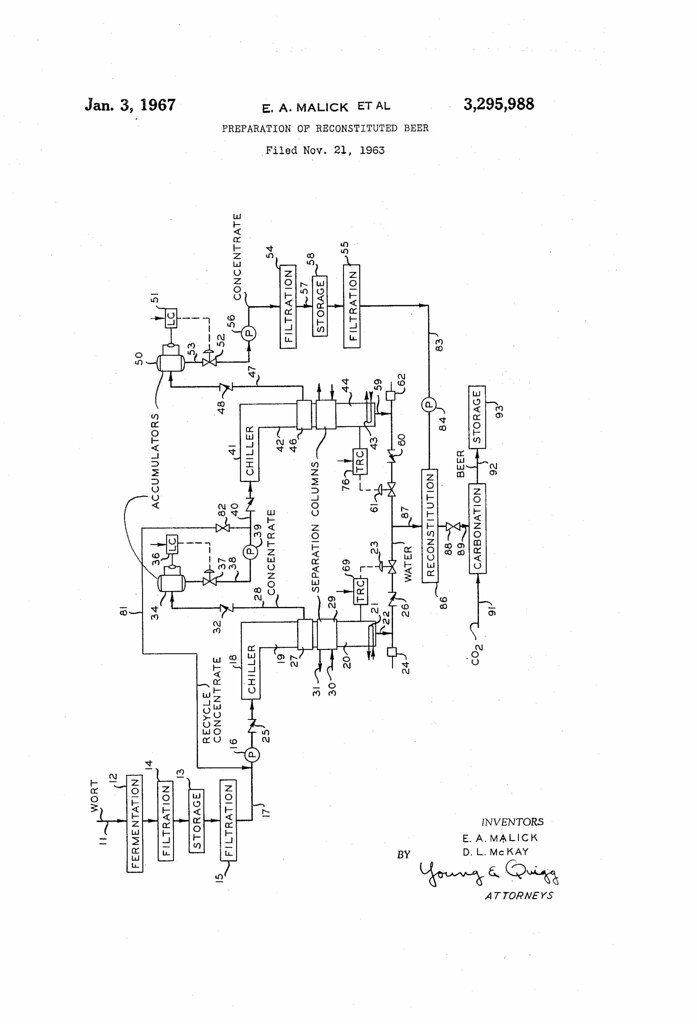
Today in 1967, US Patent 3295988 A was issued, assigned to Phillips Petroleum, for a “Preparation of Reconstituted Beer.” According to the application the invention “relates to a method of concentrating solutions by crystallization. In another aspect it relates to an improved method of using a crystal purification column for the removal of water from beer. In a further aspect it relates to an improved method of concentrating aqueous solutions, e.g., beer, and reconstituting the resulting concentrate.”
US3295988-0

Filed Under: Beers, Breweries, Just For Fun, Related Pleasures Tagged With: Patent, Science of Brewing

Patent No. 2967107A: Continuous Fermentation Process

January 3, 2015 By Jay Brooks

patent-logo
Today in 1961, US Patent 2967107 A was issued to Kenneth H. Geiger and John Compton, assigned to John Labott Ltd, for their “Continuous fermentation process.” According to the application the “invention relates to a novel continuous fermentation process for the production of potable beer.”

Figure 1 is a schematic illustrating a type of fermentation vessel which may be used in carrying out the process of the invention indicating typical fittings and controls.
US2967107-0

Continuous fermentation processes have already been utilized in connection with the production of industrial grade alcohols, and the desirability of continuous fermentation in the production of potable beer has long been recognized in the art. The principal obstacle to the adaptation of existing continuous fermentation methods to the production of potable beer has been the inability of such processes to provide adequate control of flavour. As is well recognized, the control of flavour is of paramount importance insofar as the production of potable beer is concerned.

The present invention provides a continuous fermentation process in which the control of flavour is readily achieved, and in which a number of additional advantages are to be found in addition to those important ones which might normally be expected to fiow from the conversion of what has previously been a batch operation into a continuous one.

Figure 2 is a schematic fiowsheet illustrating apparatus used for carrying out the process of the invention with one yeast propagation vessel and two alcohol producing vessels in the product formation stage.
US2967107-1

According to the present invention, potable beer is produced by the yeast fermentation of a fermentable carbohydrate which is carried out in stages. A first stage is provided in which aerobic conditions favourable to yeast growth are maintained, and a second stage is provided in which anaerobic conditions favourable to carbohydrate attenuation are maintained. Preferably according to the invention, the yeast concentration in the second stage of the process is maintained substantially constant at a concentration which is in excess of the maximum level normally obtainable or commonly used under batch fermentation conditions. This level of yeast concentration is maintained by separating at least a portion of the yeast from the efliuent of the second stage and recycling it through the second stage.

Operating in this manner, the first stage of the process serves primarily as a continuous yeast propagator under predetermined aerobic conditions while the second stage which may be, and preferably is, carried out in a series of separate series connected vessels serves primarily for ICC attenuation of the fermentable carbohydrates to alcohol under predetermined anaerobic conditions. For convenience hereinafter, we refer to the first stage of the process as the yeast propagation stage and the second stage as the product formation stage.

The inherent advantages of the continuous fermentation process described above are manifold, and of substantial practical importance. For instance, the growth rate of yeast and feed rate of fermentable substrate are equillbrated and controlled under steady state conditions in the first stage, so that the extent or rate of metabolism unconnected with yeast cell growth and/or reproduction is not critical. The maintenance of any predetermined high yeast concentration in the second stage is independent of flow rate, while, provided a relatively high concentration of yeast is present in the second stage, the rate of product formation will be for all practical purposes independent of yeast growth and, provided the substrate is satisfactory, almost entirely dependent on total quantity of yeast present and temperature.

Because the process of the invention makes for more efiicient substrate utilization, less is used for yeast production than in normal batch fermentations.

Furthermore, a very rapid fermentation is possible, with a holdup time appreciably less than in other conventional fermentation systems, batch or continuous, without concommitant adverse eifects on the quality of the product.

Figure 3 is a general schematic fiowsheet illustrating the process of the invention as it would be carried out using four separate vessels in the product formation stage.
US2967107-2

Filed Under: Beers, Breweries, Just For Fun, Related Pleasures Tagged With: Patent, Science of Brewing

Patent No. 3782609A: Keg Tapping Assembly

January 1, 2015 By Jay Brooks

patent-logo
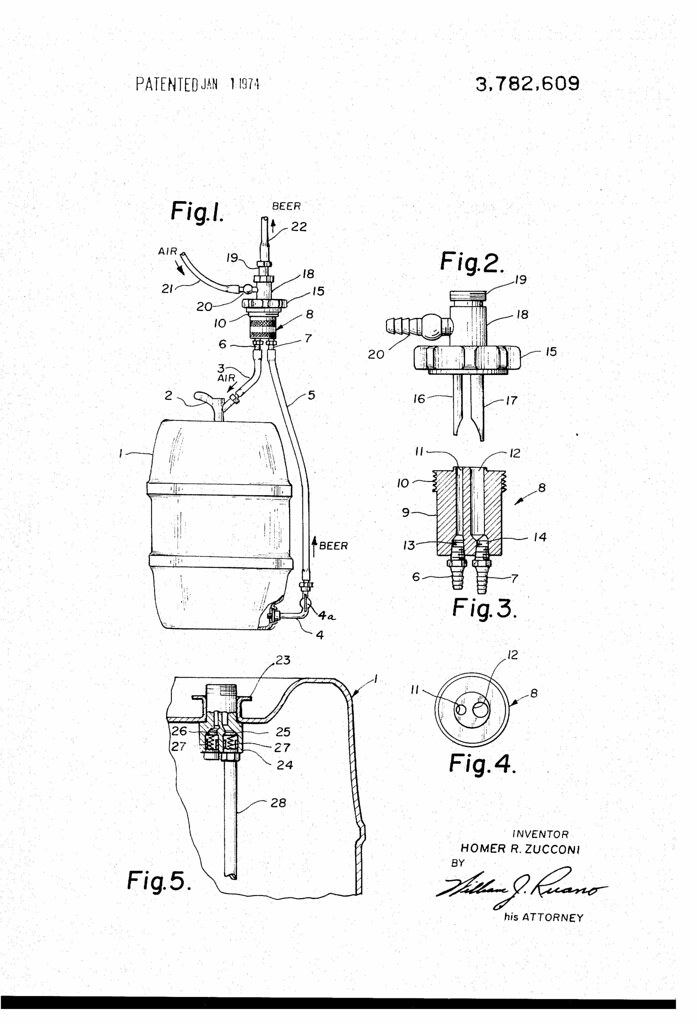
Today in 1974, US Patent 3782609 A was issued, an invention of Homer R. Zucconi, for a “Keg Tapping Assembly.” Here’s the Abstract:

A keg tapping assembly comprising a tavern unit having two prongs which are sleeve-like with tapered ends to unseat the two spring closed valves of a permanently attached keg unit detachably connected to the top central hole of a keg, upon insertion into the keg unit. The invention embodies an attachment having two bores through which said prongs are detachably fitted and having serrated terminal connections onto which hoses may be slip-fitted for attachment, respectively, to a tap rod insertable in the top center opening and to a valved outlet connection at the bottom of the keg. By simply unplugging the tavern unit from the keg unit and plugging it into said attachment it is selectively usable on either a conventional single connection tap or on the older double connection tap.

US3782609-1

Filed Under: Beers, Just For Fun, Related Pleasures Tagged With: Kegs, Patent

Patent No. 395468A: Apparatus For Making Malt

January 1, 2015 By Jay Brooks

patent-logo
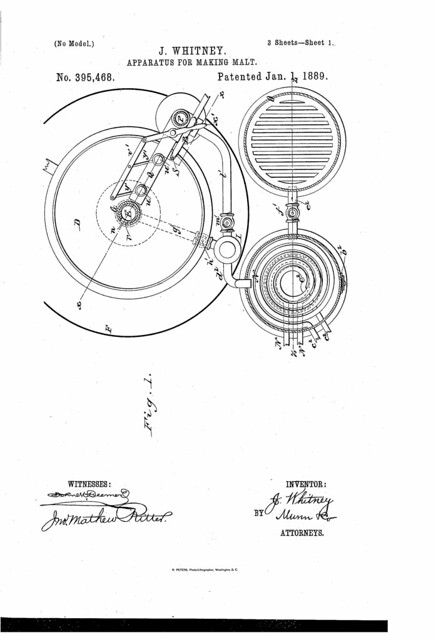
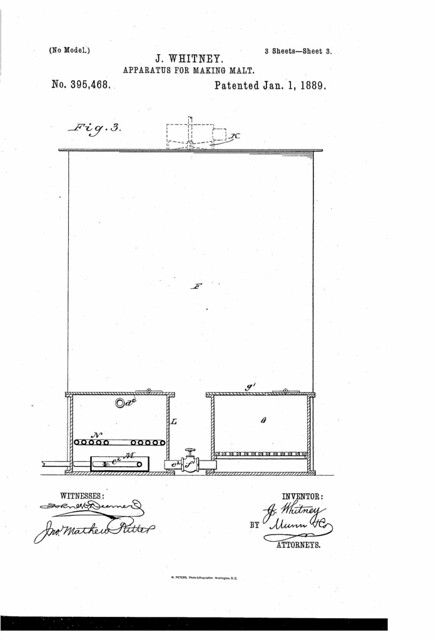
Today in 1889, US Patent 395468 A was issued, an invention of Justin Whitney, for an “Apparatus For Making Malt.” There’s no Abstract for this one, but you can read the full description about his “novel means and apparatus for making malt” at the patent page.

US395468-0

US395468-1

US395468-2

Filed Under: Beers, Just For Fun, Politics & Law, Related Pleasures Tagged With: Malt, Patent

« Previous Page

Find Something

Northern California Breweries

Please consider purchasing my latest book, California Breweries North, available from Amazon, or ask for it at your local bookstore.

Recent Comments

  • Bob Paolino on Beer Birthday: Grant Johnston
  • Gambrinus on Historic Beer Birthday: A.J. Houghton
  • Ernie Dewing on Historic Beer Birthday: Charles William Bergner 
  • Steve 'Pudgy' De Rose on Historic Beer Birthday: Jacob Schmidt
  • Jay Brooks on Beer Birthday: Bill Owens

Recent Posts

  • Beer In Ads #5138: Flower City Bock Beer March 1, 2026
  • Historic Beer Birthday: Regina Wauters March 1, 2026
  • Historic Beer Birthday: Danny Williams March 1, 2026
  • Historic Beer Birthday: Charles Weyand March 1, 2026
  • Beer In Ads #5137: Bock Is Back… Look For It March 1st February 28, 2026

BBB Archives

Feedback

Head Quarter
This site is hosted and maintained by H25Q.dev. Any questions or comments for the webmaster can be directed here.