Brookston Beer Bulletin

Jay R. Brooks on Beer

  • Home
  • About
  • Editorial
  • Birthdays
  • Art & Beer

Socialize

  • Dribbble
  • Email
  • Facebook
  • Flickr
  • GitHub
  • Instagram
  • LinkedIn
  • Pinterest
  • RSS
  • Twitter
  • YouTube

Powered by Genesis

The Angry Arm Of Alcohol

August 9, 2009 By Jay Brooks

angry-arm
I was outside the news bubble all last week, happily ignorant of most of the goings on stateside. I left just after the infamous Beer Summit, a relatively non-event that was blown completely out of proportion but which allowed the news media to avoid talking about more important issues for a while. The San Jose Mercury News even asked me to weigh in on the beer choices. And I was certainly not the only one, as the Brewers Association had a summary of links about it. Consensus seemed to be that we were all glad beer was in the public spotlight, we just wished it had been better beer. Of course, not everyone was happy about beer getting a moment in the sun, and the usual chuckleheads started complaining even before it took place. But afterward, it got even worse.

The head of the Delaware chapter of the notorious neo-prohibitionist group Mothers Against Drunk Driving, Nancy Raynor, said she “hopes those images don’t send the wrong message to the millions of young people who saw the president drinking on TV” during a radio interview on WDEL Radio 1150 AM. I’m not exactly sure how an adult being shown doing something that’s perfectly legal sends the “wrong message,” whatever that even means, but logic is not apparently her strong suit. She also said that “it’s a well-known fact that young people tend to mimic the actions that they see be adult (sic).” I’d think she might then be more concerned about images on TV of people shooting each other with guns. That would be a greater threat than drinking if indeed young people are mimicking what they see on television.

And that might have been the end of it except that the American Beverage Institute (ABI), a trade organization representing primarily restaurants serving alcohol, issued a press statement taking MADD to task for what Raynor said during her interview.

“MADD is no longer an organization that opposes drunk driving, but an anti-alcohol group that has been hijacked by the modern day temperance movement,” said Sarah Longwell, ABI Managing Director. “That someone in a position of leadership at MADD would criticize President Obama for simply drinking beer, illustrates the neoprohibitionist mentality that now dominates the group.”

Last week, President Obama met with the men involved in the Cambridge police incident in an attempt to diffuse the situation. Obama, Vice President Joe Biden, Harvard professor Henry Louis Gates, and Cambridge police Sergeant James Crowley enjoyed cold beers while working out their differences. But in an interview this weekend, the President of the Delaware chapter of MADD, Nancy Raynor, expressed concern that the event could send the wrong message to young people who saw the president drinking on TV.

“MADD’s position on the ‘Beer Summit’ should remind Americans that the group once dedicated to preventing drunk driving has transitioned into leading the anti-alcohol movement,” said Longwell. “MADD has even been denounced by its founder Candy Lightner as ‘very neo-prohibitionist.’”

“MADD should return to its original mission of stopping drunk driving,” said Longwell. “The more time and resources the group spends pushing an anti-alcohol agenda, the more irrelevant it becomes.”

I’d say that the ABI statement is accurate from my experience watching how MADD operates and what they do, say and support. But MADD at the national level chimed in to defend both their position and the organization’s Delaware chapter head. Frank Harris, a spokesman with MADD’s national office in Washington, D.C. (though some accounts label him a “state policy specialist”), “emphasizes that his organization has no problem with safe alcohol consumption” and “is not against responsible drinking of alcohol for those over 21 years of age.” If that were true, of course, there would be no reason for Raynor to have been “concerned” about the Beer Summit sending “the wrong message.” She’s the head of an entire state, after all. She wouldn’t have attained that position without drinking the Kool-Aid. Everything that followed her statements was just damage control. And one of the most common tactics used to is to simply discredit your opponent. Harris attempted to do just that in hilarious fashion, by claiming that the ABI represents “the angry arm of the alcohol lobby.”

After I stopped laughing, it got me to thinking. The real question shouldn’t be that some people are angry, but that why aren’t more people angry? Why shouldn’t we be angry? For many years now, the anti-alcohol neo-prohibitionist groups have set the agenda. The media and politicians more often than not fall into lockstep in letting their side of the story be told, and very rarely give any meaningful time to any contrary position. That’s primarily because neo-prohibitionists pretend to own the moral high ground, forcing everyone into a defensive position. But there’s nothing remotely moral or immoral about alcohol. It just is. Like any other consumable food, it cannot be good or bad, just delicious or unappetizing. Despite our dysfunctional history of puritanical posturing, it can only be a sin to drink if you believe it’s a sin to drink. Not even different religions agree on this point. Not even different denominations of Christian religions can agree on whether or not drinking is a sin. That it’s wrong to decide for everyone through legislation what is essentially just personal preference should be obvious. That it didn’t work here, or anywhere else Prohibition was tried, should be a potent reminder that what they want is already a failed idea. Yet still they persist.

But as much as they wish it were otherwise, alcohol is legal is the United States, and the majority of people who drink do so responsibly and without the societal burdens or problems that are ascribed to alcohol by these groups. So something perfectly legal, used correctly by most people, is under constant attack by a minority who distort facts, prey on fear and will use almost any tactic to stop people from enjoying it. And people aren’t angry? Why not?!? I firmly believe we have every right to be angry — and not just the ABI — but everyone who drinks responsibly, isn’t a burden on society, and whose life didn’t turn into a bad country song the moment alcohol touched their lips should be angry that there are people who just won’t let them be. This is an issue that should have been settled over 75 years ago, but anti-alcohol groups not only won’t just admit defeat but have been fighting just as relentlessly as ever. They’re like that Japanese soldier on the deserted island who didn’t get the word that World War II was over, except that neo-prohibitionists are actually making headway and many people listen to these cranks because of the way they frame their arguments and because people are afraid to stand up to them, especially politicians.

So when they accuse the ABI of being the angry arm of the alcohol lobby, I say we embrace that idea and be angry. I am. I’m angry. Why aren’t you?

hurra-bier

My wife had the wonderful idea that we should make t-shirts, and she’s rarely, excuse me, never wrong. Anyone out there with some artistic skills want to create a logo for the “Angry Arm of Alcohol?” I’m picturing simply an outstretched horizontal arm holding a full pint glass or other beer glass. Perhaps with “The Angry Arm of Alcohol” tattooed on the forearm.


Filed Under: Beers, Editorial, News, Politics & Law Tagged With: Prohibitionists

The Teachable Moment

July 30, 2009 By Jay Brooks

red-stripe bud-light blue-moon
In a few hours, our President, Barack Obama, will sit down at a picnic table with two men in an event that’s been blown way out of proportion with the even more ridiculous title “Beer Summit.” The idea is to discuss race relations in America after events that unfolded much like the beginning of the Nicholas Cage film Amos & Andrew last week in Cambridge, Mass. I won’t go into all the controversy about the incident, and who was right or wrong, and what can be done about it. That’s been talked about to death. But there’s something else, a bit more under the radar, which has to do, I think, with the “teachable moment” that Obama was hoping to accomplish with his “Beer Summit.”

For me, the over-looked “teachable moment” is that three adults can sit down and discuss an issue, any issue really, over a beer. Sharing a beer is a way people have bonded for centuries. It’s the reason the Tavern was so critical to the success of the American Revolution. Drinking beer, I think, is particularly good as a shared experience and that adults can enjoy having a convivial conversation while responsibly enjoying a beer or two is beer’s power and an underlying reason for its popularity.

That should be obvious, but I’ve noticed a number of odd statements towards the end of various news reports, presumably in an effort to get a balanced perspective. But since having a couple of beers to talk over a problem seems like such an ordinary experience for a majority of people, they’ve had to go pretty far into the fringes to find dissenting opinions.

Take this example, from the Wall Street Journal, where the Woman’s Christian Temperance Union chimes in. I confess, I was unaware of their continued existence. But here’s what they had to say:

Rita K. Wert, the group’s national president, said her organization is disappointed that the president is serving beer at all. “There are so many other beverages he could have chosen that would have served just as well,” she said, mentioning lemonade or iced tea.

Served, maybe, but as well, doubtful. I love Iced Tea more than anyone really should [I drink at least a liter a day, usually more], but neither it nor lemonade is appropriate for a discussion of race relations. They might be fine if you were planning a high school dance. But for the harder issues, you need the harder stuff.

Then there’s this gem, from Politico:

But it wouldn’t be a contrived Washington event without a contrived Washington protest. Already, “Citizens Against the Beer Summit at White House”, a makeshift gathering spearheaded by Baltimore pastor Dr. Emmett Burns, will picket the White House today between 12 and 3 p.m. “The president’s actions are sending the wrong message to our nation’s youth who are becoming alcoholics at young ages,” reads an announcement for the protest. “This pernicious habit is also the reason for the large number of teen motor vehicle accidents throughout the country.”

Burns is not exactly just a pastor, but also a politician, a 4-term Democrat in Maryland’s House of Delegates. And he’s a Baptist minister, a denomination that generally comes out against alcohol, so it’s not too surprising.

But there are two things I just don’t get about what’s he’s saying. How are three adults, legally entitled to drink alcohol, sending a bad message to kids, who aren’t yet allowed alcohol? That makes no sense whatsoever. People allowed to do something, doing it (and doing it responsibly) does not send any rational person the message that it’s alright for anyone to do that same thing, especially if they’re not permitted to do it. A torturous sentence to be sure, but it’s a ridiculous notion, but one that’s often trotted out. “What about the kids.” Well, I’d say they’ll get to see a great model of responsible behavior, and perhaps learn that drinking can be done in a responsible manner instead of the scare tactics employed by Burns and people of his misguided ilk. That’s exactly the teachable moment I see. To say that seeing adults enjoy something legally can be the cause of teenagers having car accidents is so utterly a stretch of logic, that I have to seriously wonder about the mind of the author who included the quote. As I, and literally millions of responsible adults can attest, drinking beer does not always, or even usually, lead to a “pernicious habit” (defined as “highly injurious or destructive”). What does it add to the conversation, except to give voice to the fringe element?

Despite these rather pathetic attempts to admonish the President for doing something perfectly legal, something that’s a time-honored tradition, and take any opportunity to get their crazed anti-alcohol message out there, the real message is just the opposite. No matter what you think about Obama’s politics, having people sit down to talk over a beer is always a good idea. Beer as social lubricant: it bonds people, opens them up to talk more freely and discuss uncomfortable issues head on. If the three men walk away from the “Beer Summit” with a successful result — and how could it be otherwise? — beer will have played the role it’s been facilitating throughout history. This is nothing new. When enjoyed responsibly, like the vast majority of legal drinkers do, beer can have countless positive effects on society. If only all our differences could be tackled over a beer, now that would be real progress. We might actually get somewhere. But the real message is that anybody, from President to average citizen, can sit down and discuss the world, and any issue in it, over a beer in a positive, responsible and effective manner. To me, that’s the “teachable moment.”

Filed Under: Beers, Editorial, Events Tagged With: Big Brewers, Prohibitionists

Session #22: 75 Years Demonizing Alcohol

December 5, 2008 By Jay Brooks

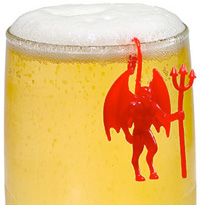
demon
This is our 22nd Session a.k.a. Beer Blogging Friday and today’s topic is quite relevant for the day, as this is the 75th anniversary of the repeal of the 21st Amendment to the U.S. Constitution ending thirteen years of our national prohibition. Our host today, naturally, is the 21st Amendment Blog, written by Shaun O’Sullivan and Nico Freccia, co-founders of the 21st Amendment Brewery & Restaurant in San Francisco, California. Here’s how they put their approach to this month’s topic:

In 1920, there were thousands of breweries across America making unique, hand-crafted beer. The passage of Prohibition wiped out this great culture. On December 5, 1933, the states ratified the 21st Amendment, repealing the 18th Amendment, thus ending 13 years of Prohibition in America. At the 21st Amendment Brewery, the repeal of Prohibition means we can celebrate the right to brew beer, the freedom to be innovative, and the obligation to have fun.

What does the repeal of Prohibition mean to you? How will you celebrate your right to drink beer?

session_logo_all_text_200

I confess I’ve been struggling mightily for something to write about Prohibition, as I feel like I’ve written about it so much lately that there’s really not much left to say. But then my friend and colleague, historian and author Maureen Ogle sent me a link to an Op-Ed piece she did for U.S. News & World Report. Her unique and fresh take on the ramifications of Prohibition’s end was a revelation for me. It was like getting in the bathtub of cheap hooch with Archimedes himself. It was a real “Eureka,” “a-ha moment” and “epiphany” all rolled into one. The wheels started turning. Maybe there’s another way to look at this.

Most of us have taken it as a given that the repeal of Prohibition was a victory for the pro-alcohol majority and a denunciation of the anti-alcohol sentiments that had brought it about. But maybe not. Despite its obvious failures on many fronts, it was the depression that really hastened its end. The economy needed a shot in the arm, and legalizing alcohol created jobs, tax revenue and good will. In the end, it was money, not morals that brought down Prohibition.

For just one example of how bad Prohibition was, check out Prohibition and the Rise of Crime, a blog post by J. Michael Jones, a retired police chief.

That’s not to say I won’t be celebrating today. I will. I’ll be in downtown San Francisco later marching in a Repeal Day parade. I’ll be enjoying some legal beer and toasting how good the American beer scene is today. And I won’t be alone, of course. There are numerous celebrations throughout the country today. But I wonder if we’re celebrating the right things? Or celebrating the right way?

The NBWA (National Beer Wholesalers Association) released a press release today extolling the virtues of the three-tier distribution, a system created out of whole cloth as a way to return alcohol to the public arena after passage of the 21st Amendment.

“This anniversary is a great time to recognize the success of the past 75 years of effective, state-based alcohol regulation since the ratification of the 21st Amendment,” said NBWA President Craig Purser. “A ‘one size fits all’ approach to alcohol regulation during Prohibition was a failure. The 21st Amendment allows individual states to regulate alcohol as their citizens see fit.”

Their celebration is understandable, of course, since after Prohibition an entirely new segment of the beer industry was created — The Distributor. But while understandable, it’s hard not to view their celebration as little too self-serving. They’re not really celebrating alcohol being legally available again so much as their own success in creating a new business model. This new system created a lot of wealth for a number of people and organizations. I’m not saying they haven’t worked hard for it or that they don’t deserve to celebrate their success, but it just feels a little too much like self-congratulatory patting themselves on back. To be fair the Distilled Spirits Council of the United States had a similar press release.

Many other mainstream writing about today’s anniversary is likewise self-congratulatory. Many gave very standard accounts, such as the Illinois Telegraph, the San Francisco Chronicle (which also has some interesting local info and photos), USA Today and even the UK’s Independent. There’s nothing whatsoever wrong with any of these or the countless other similar articles that will be published around the world today.

alcohol-squares

In the Independent, author Rupert Cornwell reflects on the fact that in America “the mindset that produced Prohibition lives on. The cocktail, it is said, is enjoying a new golden age. But a third of American adults don’t drink at all, and the country ranks only 40th in the international league table of alcohol consumption. Indeed, since the late 1970s, consumption per head in the US has been falling steadily.”

The great “war on alcohol” between 1920 and 1933 may have ended in resounding defeat. But an American belief that human vices can be eradicated, and human nature perfected, persists, visible in the continuing, scarcely less futile “war on drugs” declared by Richard Nixon in 1971 and, who knows, maybe in George Bush’s “war on terror” as well. But don’t let such somber thoughts spoil the party tonight.

He’s not the only one to notice the comparison between Prohibition and our current drug policy, such as Stop the Drug War. Even the Wall Street Journal has an article today entitled Let’s End Drug Prohibition. Are we finally starting to realize as a culture that regulating is better than outlawing? Sadly, probably not. The neo-prohibitionists are still running amuck.

But as Maureen Ogle points out in yet another Repeal Day article, this one in the Philadelphia Inquirer, it’s really our Constitution that was saved by ending Prohibition. As she details, Prohibition led to corruption, conspiracy and contempt for the law by not just citizens, but which also — and I just can’t put it better than Ogle — “oozed into and out of every level of government, from Washington to the smallest municipality.” And that’s not just hindsight, a report in 1931 by federal commission that had studied Prohibition for two years, concluded that it was an abject failure and as “the more flagrantly authorities disregarded citizens’ rights, the more cynical Americans became. Young adults in particular — the very people who would become “leaders in the next generation” — demonstrated overt ‘hostility to or contempt for the law.'”

As the Patriot Act (not to mention our current lame duck administration) similarly disregards the Constitution and the rights of American citizens, and we appear to be heading into another protracted recession (if not an actual depression), the conditions seem eerily similar to those of seventy-five plus years ago. As they worried then, what might a continuing disrespect for the Constitution lead to? I’m worried. Aren’t you? Don’t get me wrong, I’m thrilled that “change” may be on the horizon, but I can’t help but continue to be apprehensive that our swing to the right and the threats to democracy that that entailed will so easily be undone by good intentions. Movement Conservatism may be in a weakened state right now, but it’s hardly on life support.

And speaking of beer and elections, did you know that in seven states, it’s still illegal to sell or serve alcohol on Election Day? Weird, huh? In Alaska, Kentucky, Indiana, Massachusetts, South Carolina, Utah and West Virginia alcohol and voting apparently still don’t mix. According to TriState, these [s]o-called “Blue Laws” date back to the 1930s and make it illegal to sell alcohol on certain important religious or political days. Blue laws were meant to protect the integrity of the voting process in a time when many saloons also served as polling places. In the past 70 years, most states have either relaxed their Election Day bans or repealed them altogether.”

demon-beer

But finally, back to Maureen Ogle’s devastating insight into what the end of Prohibition has wrought. Though she finds the term clumsy, I like it. She asserts that repeal “institutionalized the demonization of alcohol.” For some, that may be hard to swallow (yes, intended) but for me it made perfect sense and made me look at the issue from a different perspective.

To summarize what Ogle means by that, here’s her introductory paragraph:

Prohibition ended on Dec. 5, 1933, not with a bang but with the thud of thousands of pages of new city, state, and federal laws that dictated when, where, and how Americans could make, buy, sell, and drink alcohol. Ratification of the 21st Amendment, repealing Prohibition, was neither a green light to drink nor a victory over the “dry” crusade that had produced Prohibition. Seventy-five years later, we’re still captives of that crusade.

Indeed, the 21st Amendment heralded the age of regulating alcohol like never before. It created new rules and regulations, label approval procedures, licensing requirement, all manner of new taxes and previously unheard of restrictions on all aspects of how alcoholic beverages could be made, sold, marketed, packaged and even consumed. At every step from grain to glass, there was the watchful eye of the government to tell everybody what role they were to play and within what parameters the game would take place.

I can only imagine that people were so happy to have alcohol back that it was scarcely even noticed by the ordinary public. I’m sure the breweries were keenly aware, but they were undoubtedly thrilled to be back in business under any conditions and more likely figured being regulated in business was far better than not being in business at all.

Before Prohibition, there were around 1,500 breweries, but less than half reopened afterward. And for a variety of reasons, the number of breweries continued to decline sharply. By the year I was born, 1959, there were only about 200 left. At least one of the reasons that the re-opened breweries struggled was the maze of new federal and state regulations imposed on how alcohol companies operated their businesses.

After Prohibition, the original message of the temperance movement was not only alive and well, but became internalized and institutionalized — essentially set in stone — by the very laws created to regulate it. That message is still with us today. Simply put, it is this:

Alcohol is evil. No one can be trusted with it.

demons-three

That message permeates all discussions of alcohol policy and any “issues” about alcohol. That message has been communicated by the laws passed seventy-five years ago and generations of new adults have soaked up that message almost completely. That’s it’s thoroughly untrue goes not only unchallenged but the notion isn’t even considered as a topic for discussion, so embedded is it in our collective psyche. Every aspect of how we treat alcohol has this false message looking over our shoulder, refusing to go away.

Alcohol is not inherently evil, we just treat it as if it were. People can be trusted with it, and in fact most people who drink alcohol are responsible adults, we just treat them like children in our over-paternalistic society. And we do this because we’ve assumed the temperance propaganda message to be true and we’ve created alcohol laws under that same mistaken assumption.

Ogle sums up:

It’s a vicious, and lethal, cycle: As long as we remain addicted to demonization, we avoid serious discussion about those values. The longer we avoid that conversation, the longer we pass on the booze-is-bad message to our kids, who grow up to pass the message on to their kids. And as long as we teach children to fear rather than respect alcohol, we’ll interrupt the silence with periodic spasms of hand-wringing and finger-pointing about campus drinking, binge drinking, underage drinking, and the like. But here’s the truth: The “alcohol problem” is of our own creation. We’ve got the drinking culture we deserve.

I agree with everything Maureen says with the possible exception of that last sentence. I’m not entirely persuaded that we “deserve” the drinking culture we have today. If our present “drinking culture” had been arrived at by an ongoing open, fair and honest public debate about alcohol, then I’d wholeheartedly agree that we got what we deserve. But I believe that what we’re stuck with today is the result of subterfuge, conspiracy, propaganda and out and out lies by people and organizations with a Carrie Nation-style axe to grind.

I prefer an image of prohibitionists having slunk away to lick their wounds in defeat but the truth is they’ve never really gone away. They’ve never stopped trying to keep their message alive. That they’ve been so successful while at the same time convincing us they’d lost is deviously clever. They’re like the tortured, evil protagonist in every horror movie who refuses to die, no matter how many times he’s shot, sliced or garroted. They always come back, don’t they? To me, that’s the unfortunate message of this 75th anniversary. It’s certainly worth celebrating 75 years of beer in America. But it’s perhaps more important to recognize that the battle didn’t end December 5, 1933. It merely changed the terms of engagement from above ground prohibition to underground demonization. Happy Repeal Day everybody. Drink up.

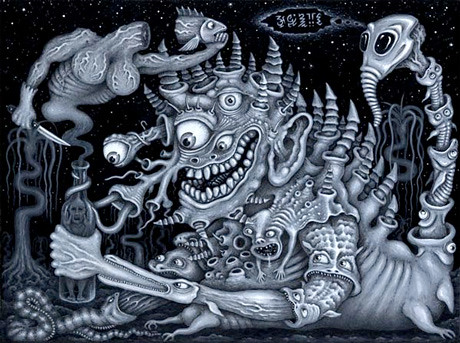
demon-alcohol

The Demon Alcohol, by Robert Steven Connett.

This is a nicely imagined vision of how we view alcohol today, in a Hieronymus Bosch sort of way.

For a lot more great information about Prohibition, check out Prohibition Repeal.
celebrate-repeal

Filed Under: Beers, Editorial, Politics & Law, The Session Tagged With: Law, Prohibitionists

Abe Lincoln on Beer & Politics

October 28, 2008 By Jay Brooks

lincoln-logo
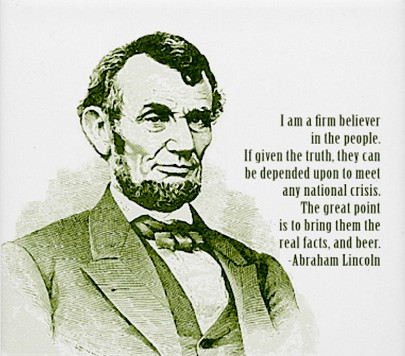
With a week to go before the U.S. Presidential election November 4, I thought I’d share one of my favorite quotes by our 16th President: Abraham Lincoln.

“I am a firm believer in the people. If given the truth, they can be depended upon to meet any national crisis. The great point is to bring them the real facts, and beer.”

          — Abraham Lincoln

Unless I hear otherwise from Bob Skilnik, I’m going to assume this is a quote that Honest Abe actually either uttered or wrote down on the back of an envelope. Though Lincoln is now generally reputed to have been a teetotaler, in his time some accounts do contradict that and say that on occasion he did drink in moderation. “Reliable testimony indicates that Lincoln was a light user of beverage alcohol.”

He was certainly pragmatic enough to understand beer’s importance to the economy, especially when during his first term he turned to the beer industry, among others, to help finance the Civil War. In Brewing Battles, by Amy Mittleman, she details how in July of 1861, the US Congress (or a least what was left of it in the north) levied the first income tax on the remaining states in order to raise money to fight the war with the southern states. By the end of the year, Congress realized it wasn’t enough and they needed a way to raise more funds for the war. In a special session in December 1861, Congress reviewed a request by the Secretary of the Treasury, Salmon P. Chase, to raise the percentage of income tax slightly and levy excise taxes on a number of goods, including beer, distilled spirits, cotton, tobacco, carriages (the automobiles of the day), yachts, pool tables and even playing cards, to name a few. The amendments passed, and Lincoln signed them into law July 1, 1862. They took effect September 1. Several weeks later, the first trade organization of brewers, the United States Brewers Association (USBA), was founded in New York. They held their first national convention in 1863 and elected Frederick Lauer as their first president. Lauer owned a brewery in Reading, Pennsylvania, my home town, and I remember the statue of him in City Park as a child. It was the first statue erected in Reading. But I digress.

lincoln-quote

Excise taxes are a “type of tax charged on goods produced within the country (as opposed to customs duties, charged on goods from outside the country).” The excise taxes were intended to be “temporary” but it was the beginning of temperance sentiments in the nation, and many people objected to alcohol on moral grounds. In the decade following the war, most were rescinded, but the taxes on alcohol and tobacco were the only two to remain in force, and in fact are still in effect today.

The only reason these excise taxes remained after the Civil War was primarily on moral grounds, coming from prohibitionist organizations. And I think that’s still relevant in 2008 because today’s neo-prohibitionists are also trying to use a moral sledgehammer to raise taxes on alcohol in an effort to put beer companies out of business and/or bring about another national prohibition. In state legislatures in many states, neo-prohibitionist groups are trying a variety of tactics to further their agenda. Usually it’s couched in propaganda that pretends they’re concerned for the children, or people’s health or some other hollow claim that hides their true aims.

I still find the argument strange that there should be higher taxes on products some people find morally objectionable. I find soda morally objectionable because it’s so unhealthy that it’s contributing to a nation of obese kids (and adults) — not to mention that beer in moderation is much healthier for you. But I wouldn’t argue pop should have an excise tax. The very concept of a so-called “sin” tax seems antithetical to the separation of church and state. Sin is a religious concept, and should play no role whatsoever in our government. Making people pay a higher price for goods that other people don’t like seems not only a little cruel, but also contrary to freedom of religion, because those are the morals people are using to deny people getting (or making prohibitively expensive) certain goods that not everyone agrees are sins. By using one set of morals as the basis for a particular law (in this case an excise tax) it ignores other sets of morals that differ from the prevailing one. That’s how a theocracy works, and we’re not one yet, despite recent efforts to make religion a central issue in government.

What would Abe Lincoln have thought about all this? Well, first I think he’d be horrified that for the most part the “truth” he felt the people needed to “meet any national crisis” is not much a part of our mainstream media nor of the political process in particular. There are very few “real facts” in play. What there is, is propaganda and the manipulation of quasi-factual information distorted to suit an agenda. All that’s left, really, is the beer.

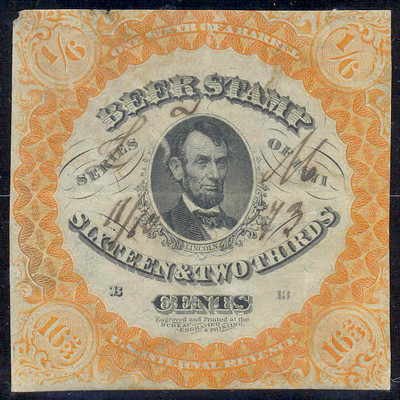
lincoln-beer-stamp

This beer stamp for 16 2/3 cents, to pay the tax on a 1/6 barrel of beer, depicting Abraham Lincoln, is believed to be from 1871.

Filed Under: Beers, Editorial, Politics & Law Tagged With: Prohibitionists, Taxes

Backlash Brewing?

January 25, 2008 By Jay Brooks

There was an interesting item in yesterday’s USA Today called Frustration Over Liquor Laws Brewing. The story details just a few of the battles around the country to update their state’s antiquated alcohol laws, which in many cases haven’t been updated since Prohibition’s repeal in 1933. I’m sure the neo-prohibitionists will be fighting these tooth and nail, employing their usual bag of dirty tricks, but perhaps it’s finally time to stop playing defense and pick up the ball. In Mississippi, for example, it’s still illegal to sell beer in excess of 6% abv. The argument against raising it, predictably, is, according to William Perkins of the Mississippi Baptist Convention Board, that an “intellectual argument ignores the ill effects of alcohol.” Well, I’d sure hate for logic or intelligence to interfere with his world view, but you can buy wine and liquor in Mississippi already and, unless it’s some weird watered-down varieties, those are all well above 6% so please tell me how that makes any sense whatsoever? Not to mention there are plenty of positive health claims that can be made not only about beer, but the moderate use of alcohol in general. If Perkins’ thinking shows nothing else, it’s illustrative that logic plays no role at all in the anti-alcohol league’s canon. By any means necessary seems to be the only rule. So perhaps it’s time to mount an offensive. After all, a good defensive very well may be a strong offense.


Filed Under: Editorial, Politics & Law Tagged With: History, Law, National, Prohibitionists

Baptists Live in Parallel Universe

January 15, 2008 By Jay Brooks

The only explanation I can come up with for this is that Baptists must live in some kind of parallel universe. According to today’s Baptist Press, Baptists in Texas, and presumably everywhere else, are mobilizing their forces to protest a grave new threat to their youth. What horror could possibly be the cause of this dire situation that threatens not only their very way of life, but the very lives of their children? Apparently the theme park in Arlington, near Dallas/Fort Worth, Six Flags Over Texas, has applied for — gasp — a liquor license in order to sell beer at certain locations in the park.

Now I don’t want to make light of someone else’s cherished beliefs, but listen to what the Baptist Press is reporting:

“Do we really want to send our youth groups — our church youth groups — to places where alcohol is served?” local Christian leader Linda Rosebury asked in an interview with KCBI-FM, the radio station of Criswell College in Dallas.

Do you mean the world? Because the last time I checked alcohol could pretty much be found anywhere you look. Have they heretofore been living in some Utopian fantasyland where there is no alcohol, like Iran? Can they really be saying anywhere that alcohol might be found is a dangerous place? Yes, apparently.

The sale of beer, Rosebury said, threatens the park’s image as a safe place for families.

So the real world, where beer is sold each and every day, is unsafe? If so, why are those families still there? Do people really walk around, see some heathen drinking a beer, and decide that it’s no longer a safe place? I’m pretty sure that you could live right next door to someone who drinks and still feel perfectly safe. In fact, my own next-door neighbor no longer drinks, and I believe he doesn’t feel that I’m a threat by virtue of my proximity to him in any way, shape or form.

You can even get a beer at Disneyland, and if they can pull it off and maintain their annoyingly hypocritical squeaky clean image, why not Six Flags? Perhaps Disneyland is not part of the Baptist parallel world?

I realize I’m probably being insensitive, but I can’t help myself. I find this sort of nonsense so patently ridiculous that I can’t really take it seriously. If you don’t want your child to even “see” a beer, don’t let him go to Six Flags, make him a shut-in. Shield him from every imagined horror you perceive out there in the world. I’m sure he’ll turn into a terrific young man or woman, with no problems whatsoever. I would personally never abuse my own kids in that way, but I’m not about to tell you how to raise your children.

As of January 8, the Texas Alcoholic Beverage Commission (TABC) has gotten 600 phonecalls and twelve letters of protest regarding Six Flags ability to sell beer to adults. On February 17, state officials will decide whether or not to hold a public hearing on their application and the Baptist Church is trying to get enough of its members to complain so that they’ll have the hearing.

Some of the current complainers are urging the TABC to “conduct an alcohol impact study to determine the threat to public safety.” Isn’t beer sold enough other places in the universe, including many other theme parks, that we can figure out with reasonable certainty what the impact would be? It would be zero, of course.

The people from Six Flags, naturally, have “pledged that such sales would be handled responsibly and would safeguard guest safety,” just like every other public place that serves such legal beverages as beer. In their own defense, Six Flags also offered the following.

Noting the park’s pledge to offer quality guest services, John Bement, Six Flags in-park services senior vice president, told the Southern Baptist TEXAN, “For quite some time, many of our guests have requested beer as an option while dining or visiting the park. In fact, several of the parks in the Six Flags system already provide such amenities and have done so successfully and responsibly for many years.”

How utterly reasonable. I’m sure that will mollify the faithful. Hardly, an attorney from the Southern Baptists of Texas Convention spells out exactly how to lodge a protest, and even offers some helpful legal arguments that one can use in their complaint.

Heaven forbid anyone with a different view of the world might want to go to Six Flags. Apparently this is their world, the rest of us just drink in it.


Filed Under: Editorial, News Tagged With: Law, Prohibitionists, Southern States

Punishing Drinkers With Taxes

January 15, 2008 By Jay Brooks

The Marin Institute, one of the more blunt and churlish of the anti-alcohol organizations, is mounting an offensive to raise alcohol taxes an incredible “25 cents per drink” in California. Their vision — my nightmare — is to bring about “communities free of the alcohol industry’s negative influence and an alcohol industry that does not harm the public’s health.” But as they naturally see any influence as negative and everything that the alcohol industry does as harmful, what they really want is nothing short of an another Prohibition.

Throughout their rhetoric (and even the sources they’re relying upon) is a call for “fairness” and for alcohol to pay its “fair share,” whatever that really means. But the carrot they’re holding out is that by doing so it would help to alleviate California’s budget deficit that’s been plaguing us for several years now. But I fail to see how raising the taxes of people who drink is in any way fair. Effectively what they’re suggesting is that because our state managed to get itself in a fix, budget-wise, people who drink should be called upon to foot the bill. They just want to punish those of us who choose to drink, and yet they call it fair? The first definition (of 26) for the word “fair” is “free from bias, dishonesty, or injustice.” There’s clearly bias, it’s dishonest in my opinion to claim it’s because of our state’s tax problems, and it hardly seems just to have drinkers pay a disproportionate share to get us out of our budget hole. So it’s really the very opposite of fair.

This is the same nonsense that’s going on with Indian gaming right now, with several state proposals on November’s ballot. We committed genocide against Native Americans and broke every single treaty we ever made. So when Indian gaming successfully exploited one of the few advantages left to them, we still can’t seem to let them be. This is the second time California politicians have tried to get (or more accurately extort) a bigger piece of their gambling revenues, and the exponents of these propositions try to sell them in the same way as the Marin Institute is doing with beer taxes, by twisting the idea of “fairness.”

Of course, the real reason they can say with a straight face that it’s fair to ask drinkers to pay more taxes than teetotalers is this odd notion that, in the words of David Leonhardt, “taxes serve a purpose beyond merely raising general government revenue. Taxes on a given activity are also supposed to pay the costs that activity imposes on society.” I’m not necessarily against this idea entirely, but I don’t understand when it became an unquestionable fait accompli and why people are so quick to believe it. Why is this only ever said of things that some people don’t like? The costs on society for our general obesity and unhealthiness has not brought about taxes on fast food, sugar or high fructose corn syrup. Hummers, SUVs and other similar gas-guzzling vehicles not only are not taxed at a higher rate but actually receive federal and state tax breaks and incentives and have lower standards of fuel efficiency than regular cars. With their poor MPG they do great harm to our society yet are actively subsidized and encouraged by our government over cars that get more miles per gallon and are kinder to the planet. Check out this Slate article for more on this. I’m not saying that’s as it should be, simply that this idea that all products must contain within their profit structure some tax scheme that balances the price with their damage to society caused by them is wholly fallacious.

But even if it wasn’t such a weak argument, we don’t charge a higher percentage of a person’s tax burden for the fire department if they live in a tinderbox house vs. an inflammable brick home. Instead we average the cost to society out and charge everyone the same amount since everyone gets the same potential benefit. That’s a fair arrangement in every sense of the word. It’s good for the whole town, not just for you, if your house does not burn down. So there’s really no reason why we can’t apply that same logic to the whole of society. I realize that will be unpopular with folks who don’t think it’s fair that while they choose to abstain, they may have to pay for problems supposedly caused my decision to drink. But if it’s legal for everyone who pays taxes (except, those 18-20 years old — hey, another reason they should be allowed) to drink then I don’t see why it’s so troubling that we all share the costs of society equally. You may think it’s unfair because you feel you’re not causing the (hypothetical) problem. Well I think you’re being selfish by only wanting to pay for services that that either benefit you or were caused by you. In a sense, it’s like after building your inflammable brick house you refuse to pay to support the fire department any longer under the theory that your house is in order.

Maybe it’s just me, but I don’t want to live in a world where everyone is so selfish that they don’t want to help other people. Look at this another way. The vast majority of drinkers do so in moderation and never are any burden to society whatsoever. But a tiny percentage of drinkers do cause problems for themselves and others. There are at least two ways we can shape policy to deal with problem drinkers. We can treat the causes of the problems and make tougher laws to deal with them, and only them. Or we can make it harder on everybody’s ability to drink, thus punishing everybody for the sins of the few. It’s not too difficult to figure out which approach the neo-prohibitionists have chosen. Even if only one in every ten-thousand persons who drink may exact a cost on society they would prefer to punish the other 9,999, too.

Another one of the contentions is that the last time California raised taxes on alcohol was 1992. That increase was apparently one cent on a glass of wine and two pennies for a bottle or can of beer and one shot of hard liquor. So clearly a 25-cent increase seems reasonable?!? Maybe sixteen years is too long without an increase, I’m not going to argue that point. But even if the tax had been raised another penny every year, the tax would still only be 16 cents higher today, so please tell me how 25 cents is a fair suggestion? Or are they just shooting for the moon in the hopes of a negotiation that ends up compromising higher as a result?

And if it’s tax fairness they’re after, taxes of corporations have fallen much more dramatically over the past several decades. They haven’t just stagnated and gone down merely by adjusting for inflation, but have actively been lowered. At the same time, personal taxes on the poor and middle-class have gone up while tax cuts for the rich keep increasing. So if the Marin Institute really cares about California’s budget crisis, I think a more prudent approach might be trying to raise corporate taxes across the board and removing unfair tax cuts and loopholes for the wealthiest among us. It wasn’t alcohol that got us into this mess, so why make it foot the bill.

One of the main sources that the Marin Institute cites for their proposal is Let’s Raise a Glass to Fairness, a polemic about why the author, David Leonhardt, believes federal alcohol taxes should be raised. Some of the supposed alcohol-related costs to society he cites are the following:

  1. child abuse
  2. drunken-driving checkpoints
  3. economic loss caused by death and injury
  4. hospital bills for alcohol-related accidents

So let’s look at those claims.

1. Child Abuse: This one’s a head-scratcher for me. Sure it sounds bad, but what does it really mean? I was terrorized as a child by an alcoholic, psychotic step-father but even as a kid I knew it wasn’t the alcohol that caused him to be that way. There were myriad things in his life that made my step-father such a mess, and alcohol was the least of them. At its worst it was merely a convenient catalyst. If alcohol had been removed from the situation, something else would have filled the void. I can’t see how alcohol causes child abuse any more than cake is directly responsible for obesity.

2. Drunken-Driving Checkpoints: If these are such a burden to our nation’s purse strings, then by all means stop them. They’re already an invasion of civil liberties because they randomly presume guilt of everyone behind the wheel of a vehicle. But saying these are a cost of alcohol seems weird to me. The fact is that police forces choose to do them, they aren’t mandatory, and they’re more often done because of politics or pressure from local neo-prohibitionist groups. So they aren’t caused by alcohol, they’re caused by people against alcohol. There are plenty of legitimate ways for the police to do their job in keeping potentially dangerous drivers off the road that don’t involve these checkpoints.

3. Economic Loss Caused by Death and Injury: Now I certainly don’t want to downplay or make light of anyone’s loss or injury, but the alcohol didn’t cause either. The idiot person who drank too much or otherwise couldn’t control himself is responsible for a death or injury that resulted from his actions. And he should be punished to the full extent of the law. But don’t punish me or my right to drink moderately because some yahoo couldn’t act responsibly.

4. Hospital Bills for Alcohol-related Accidents: This is the same as the last one, it’s economic harm inflicted by a person and we should be blaming the individual person. People scoff at the Twinkie defense, saying it’s ridiculous that too much sugar might cause a person to commit a crime, but here Leonhardt is saying effectively the same thing.

He also throws around a lot of statistics about how many people die each year in “alcohol-related car accidents” along with “other accidents, assaults or illnesses in which alcohol plays a major role.” But as we learn time and time again, the way “alcohol-related” is defined is usually pretty deceptive. Many such studies have considered an accident “alcohol-related” if one of the passengers had earlier been drinking so it’s pretty hard to take such stats very seriously. Do people die from causes related to alcohol? I’m sure they do. But the number one cause of death: living. What I mean by that is every single thing we do every single moment has some risk associated with it. It’s a fool’s errand to dissect every thing we humans do and determine which ones to tax more heavily.

Leonhardt likens his strategy to the same argument for higher tobacco taxes, saying for alcohol the impetus “is even stronger” with this gem. “Tobacco kills many more people than alcohol, but it mainly kills those who use the product.” Did I miss a meeting? Isn’t one of the strongest reasons for all the recent tobacco bans that second-hand smoke is far more dangerous to people around smokers than previously believed?

He then goes on to say. “Many alcohol victims are simply driving on the wrong road at the wrong time.” And that may be true, and it is certainly tragic, but why then is it fair that I should pay more for my beer because of other drunk drivers, especially if I and millions of other responsible drinkers don’t place anyone else at risk. If the argument for fairness is that all alcohol drinkers should pay more for their beer because of the costs that alcohol exacts on society, how then does that same logic explain why this burden is so unfairly placed on all drinkers and not just the problem drinkers? Isn’t that just a teensy-weensy bit hypocritical?

Leonhardt later admits, or at least accepts, that there are plenty of responsible drinkers around and even quotes Jeff Becker, President of the Beer Institute. “Most people — the vast majority of consumers — don’t impose any additional costs on anyone.” But in the end he concludes that since he can’t figure out a way to “tax only those people who were going to drive drunk in the future” then it’s somehow fairer to just tax everybody who drinks. Yeah, that makes sense. No wonder the Marin Institute loves this guy.

But another flaw in this theory is that raising taxes on alcohol will raise an additional $3 billion in tax revenue to help with California’s $14 billion current deficit. One of the major prongs of the Marin Institutes’s plan is that by raising the price of beer, drinking will be curtailed once again. If people are drinking less, then how will that result in more tax revenues? If this proposal was really about solving California’s budget crisis, wouldn’t it make more sense to raise alcohol taxes and then actively encourage drinking to help raise more money to apply to the deficit? But this never really was about taxes or California’s budget crisis. It was always about keeping people from drinking or at least making it harder for them to do so. But not enough people were apparently getting their message and were — gasp — still enjoying a drink now and again. So instead they dressed this proposal up as a panacea for our state’s budget crisis hoping that people might respond more favorably to that gambit. Don’t you believe it.

Look, we have the highest federal budget deficit in history and many states, including my own, have similarly terrible fiscal situations that they’re facing. But no matter how much junk science you throw at this problem, alcohol did not cause our current situation. As a result, trying to raise more taxes by arguing that it would be fairer for the nation’s alcohol drinkers to help pick up the tab is just ludicrous. Perhaps taxes should be higher across the board to get us out of this deficit and that might include alcohol taxes, too. But politicians don’t like to raise taxes generally because people tend to vote out of office any politician who tries to do so, no matter how vital they might be in paying for our infrastructure and making our society work for everyone. So we keep electing fiscal conservatives who slash and burn social programs. And then we wonder why there’s no unemployment available when we get laid off so that the factory we used to work for can relocate overseas and chain ten-year old girls to a sewing machine to slave away for twelve-hour days, seven days-a-week for peanuts just so we can be spared the injustice of paying a few cents more for some crap we don’t really need at Wal-Mart. Let’s not change that situation, let’s blame alcohol instead. Raise a glass to fairness, indeed. I’ll buy the first round.


Filed Under: Editorial, Politics & Law Tagged With: Business, California, Law, Press Release, Prohibitionists, Statistics

Let No Good Deed Go Unpunished

December 21, 2007 By Jay Brooks

I confess at the outset that this story has nothing to do with beer, but is about bourbon … sort of. But it is also about the assault on alcohol — and to some extent civil liberty — a subject I find myself writing about more and more these days, so that’s why I decided to write this. I certainly didn’t set out to make the neo-prohibitionists my cause célèbre, but I find that few things get me as worked up and angry than people whose sole mission appears to be telling the rest of us how to live. I guess that makes me an anti-control freak, or something.

At any rate, the story involved a St. Petersburg, Florida man named Evan Preston who local authorities have dubbed the “Woodstock Santa.” He’s been given this epithet by local authorities, and especially city council member Bill Foster, who hopes to stop Preston from giving gifts to the homeless. Now lest I paint Foster as a complete Scrooge, he’s apparently okay with giving them blankets or a warm bowl of soup. What he doesn’t like is that Foster gives the homeless what they really want: booze.

The eccentric Evan Preston (at left in the long gray beard), age 72, owns a well-known jewelry and art store and has in the past helped the local community raise money for a variety of causes by donating artwork.

He’s apparently helped his town’s Make-A-Wish Foundation and also nearby Tampa’s Big Cat Rescue. Four years ago, he decided he wanted to do something for St. Petersburg’s growing homeless population that congregate around the downtown Williams Park, near his business. So for a few years now, he and several friends and colleagues pass out 100 bottles of bourbon and cigars to the homeless.

Here, let’s pick up the story from Tampa’s Creative Loafing website:

“At first, I thought it would be interesting to give out a six-pack and a cigar,” he says over a glass of homemade sangria in his kitchen. “When I saw the excitement in their faces, it was inspirational.”

After a few outings to various homeless enclaves around the city, he says, St. Pete’s homeless began to recognize him. When he pulled up in his Bentley, they would run at him, jump on the car and hug him tightly.

Preston became the homeless’ Santa Claus, a 6-foot-2 bearded Samaritan in a T-shirt and jeans who gave all the good street men and women what they really wanted for Christmas.

“Last time, a man came up and said, ‘Thank you, this is so much better than a warm blanket,'” he recalls. “It’s shocking how much everybody loves it.”

“There is no motive to what we do,” he says. “It’s a gesture of goodwill.”

Well, you just know something like that will not be permitted for very long, not without somebody trying to put a stop to it. And right on cue, Foster is appalled that someone might give alcohol to alcoholics. Part of his reasoning is that alcohol is what put them on the street in the first place. While that may be true in some cases, he really doesn’t know that with any certainty whatsoever. But the idea that not giving a homeless person that alcohol is somehow going to cure them or make their life any better seems ridiculous at best, and uncharitable and obnoxiously self-righteous at worst.

Apparently there’s already a local ordinance in force that prohibits passing out alcohol in public parks — which seems weird enough, why would that be a problem? — but the code does not apply to city streets or right of ways, a loophole that Foster is trying to close. He’s sent a memo to the mayor and other city council members urging them to make it illegal to hand out alcohol in essentially any public space. If you want to give your neighbor a bottle of wine this Christmas, you better be careful not to hand it to him on the sidewalk. Stay on your own property if you don’t want to break the law. Apparently it doesn’t matter that alcohol is legal for adults and giving gifts is likewise not a crime, but don’t put those two things together in Florida. Yeah, that seems reasonable.

In the memo Foster claims “Mr. Preston is an affront to every business owner and resident of the downtown area, and should not be a welcomed figure in St. Petersburg.” An affront? An affront is a “deliberate act or display of disrespect,” an “intentional slight.” I don’t know who Bill Foster thinks he is, but he obviously believes people should be bowing and scraping to his delusions of grandeur. Can he really have convinced himself that Preston is giving the homeless booze to personally offend him? This is a difference of opinion at best. I don’t see how it’s the business of government to regulate where citizens can commit a legal act like gift-giving? Foster may not like what Preston’s doing but in a free society that should be the end of it. But Bill Foster apparently believes a free society is only one where people do what he likes, and apparently he’s not even the only nut job on the city council.

“Is that really the best gift you can give somebody sleeping outside—bourbon?” said Rene Flowers. “I don’t know what a bottle of bourbon goes for these days, but I’m sure that would buy some soap, a small washrag, maybe a comb, some coffee, maybe a nice, hot meal.”

Where exactly would a homeless person use a washrag and soap exactly since they probably don’t have a bathtub for them to use there in Williams Park? And while a nice dinner does sound good, why does Flowers think that private citizens have to confine their charity to what she thinks is appropriate? For all their posturing, the homeless problem itself is never addressed by the city council, only that a private citizen shouldn’t be allowed to give them a little comfort from time to time at his own expense. It really doesn’t matter if you or anyone else thinks giving alcohol to a homeless person is a bad idea, in a free society any private citizen is and ought to be allowed to choose both the scope and nature of his charity. They should be applauding the fact that’s he’s doing something, anything. But from the response of the city council, they don’t seem overly concerned about the homeless people themselves. The very fact that there is such a homeless problem in this medium-sized town (the population is just under 250,000) suggests that whatever the city council is doing, if anything, it has not alleviated the situation or the conditions that caused these people to become homeless in the first place. Maybe it’s the guilt over their own failures that makes them lash out over someone merely trying to provide a little solace and comfort to someone whose life is, I can only assume, complicated and difficult, to say the least. But please, let’s stop attacking alcohol already, shall we? I’d like to get back to talking about beer again, thank you very much.


If you want to hear more about this, a local Tampa television, Tampa Bay 10, station did a report that’s online. Also, a Los Angeles radio station recently did an interview with Evander Preston which you can listen to online.
 

Filed Under: Editorial, News, Politics & Law Tagged With: Law, Prohibitionists, Southern States, Strange But True

Look Away From the Beer

December 19, 2007 By Jay Brooks

This interesting tidbit comes by way of the Fermenting Barrel via Tomme Arthur (thanks, Tomme), who knew my little crusading heart would appreciate the inanity of it all. It seems a new ordinance in the southern Utah town of Springville “requires beer displays be erected no closer than 15 feet from a store’s public entrance.” The Utah County Health Department’s Division of Substance Abuse also wanted retailers to keep all “beer 10 feet back from a store’s front windows,” too, but the City Council decided instead to just keep it away from the front doors. According to a story in the Salt Lake Tribune, “Richard Nance, substance-abuse division director, said the goal is to try to ensure that children do not get mixed messages about where the community stands on alcohol use.” What exactly is that mixed message he’s so worried about? Seriously, what is it? Anybody know? I mean, despite a huge religious influence in Utah, beer is still legal there, right? So what message is being sent by its proximity to the front door, for chrissakes?

Retailers, however, don’t appear too concerned about the new law — not that there’s much they could probably do anyway. Apparently most stores already keep their beer stock in the back of the store, which is also where most keep the milk, isn’t it? One added benefit, I suppose, is that less beer may be exposed to the light streaming through the front door, which may reduce skunking (hey, I’m looking for the silver lining here).

The Fermenting Barrel‘s take:

Tell me this, are the kids absorbing the alcohol by being in the mere vicinity of a case of beer? Can’t the kids still walk to the back of the store and *gasp* be exposed to beer? Or are the children confined to the front of the store?

In my opinion there’s way worse things kids can be exposed to right at the counter, say…pornography, cigarettes, or even junk food, candy, and soda. Last I checked diabetes was one of the worst epidemics in the US. How does it usually develop? Through obesity caused from a poor diet and a sedentary lifestyle. How about going even a little further, what about all the easy access kids have to the crap on TV, the Internet, and movies.

OK, I’m done ranting. You get my point. There’s bigger fish to fry than fretting over kids walking past a case of beer when they walk in a store. Just leave it to Utah to come up with even more insane alcohol laws. As if their laws weren’t already weird enough.

Amen, brother.


Filed Under: Editorial, News Tagged With: Business, Law, Prohibitionists, Strange But True, Western States

Beer & Christianity Redux

December 14, 2007 By Jay Brooks

This came to me via Rick Sellers at his Pacific Brew News concerning another poll by ChristiaNet concerning Christian’s attitudes towards beer drinking. I meant to write about this earlier, but it got away from me. The story is about a poll ChristiaNet conducted with their readership, which they state involves twelve million monthly page loads, and they further claim to be the “world’s largest Christian portal.” The question they asked was “[i]s it wrong for a Christian to consume beer?” Now why they singled out beer is still a mystery to me. To justify the question, Bill Cooper, the president of ChristiaNet, says “Christ warns of the results of drunkenness.” But, of course, the question wasn’t “is it wrong for a Christian to consume beer to the point of drunkenness” or to be drunk, it was simply whether it was acceptable to consume any amount of beer. That’s a vastly different question and one which does nothing to examine the “results of drunkenness.” They did a similar poll last year, too, which I wrote about on Christmas Eve, but more about that later.

According to their press release, 5,200 completed the online poll and beer drinking got the thumbs up by a very slim margin, about 51%. A little over a third (38%) did, however, respond that they believed that having a beer was “wrong.” Here is some of their rationale.

They felt that one beer almost always leads to more and then can also lead to alcoholism, “I don’t know anyone that only drinks one beer, they usually drink more to get a buzz and that is wrong. Sometimes they even turn into alcoholics.” Others in this group quoted Proverbs 20:1 which states, “Wine is a mocker, strong drink is raging: and whosoever is deceived thereby is not wise.” Most felt that all alcohol consumption was wrong, “There just isn’t any good reason to drink alcohol, and it is not like it tastes good.”

Wow, I don’t want to hang out with the person who doesn’t know even one person who can stop at a single beer. Being someone who visits the ChristiaNet website, I would think most — or at least some — of his friends were likely Christians like him. And not one of them could resist the temptation to have a second drink of beer? This guy needs to start hanging out with a new crowd. I can’t tell you the number of times that I’ve enjoyed one beer at a bar or with my dinner without being unable to stop there and even without turning into an alcoholic. I can’t help but picture that process as a bit like the gentlemanly Dr. Jekyll turning into the unsavory Mr. Hyde. Without trying to make light of alcoholism, is that really how it happens? And why on occasion is getting a buzz so wrong? Or is drinking “beer” to get that buzz what’s wrong here? Having the sacred wine makes it acceptable, does it? I guess I just don’t understand how these people think.

Just over ten percent wondered “about whether or not beer, in particular, was wrong” and at least one respondent was confused “because the Bible only talks about drunkenness with wine and strong drink, not about having only one beer.” What I assume many do not realize is that when the Bible was translated into Greek that there was no exact match for the Hebrew word and “wine” was simply substituted as being the closest word available. There are a number of serious scholars who believe that it is possible that it was actually beer (apparently the Greeks at that time had no word for beer) that Jesus turned the water into and that it may even have been beer that was served at the last supper. How different our world might be today if beer had early on achieved the exalted place in religion that wine did, possibly as the result of a mis-translation.

Last year about this same time, ChristiaNet asked this same question but got very different results. Only 339 people filled out the previous survey, of which 192 — or 57% — thought drinking beer was wrong. Armed with those staggeringly small and unscientific statistics, ChristiaNet proceeded to tell the world that Christians think drinking beer is wrong. I wrote about it a few days after their press release in a post I called Beer & Christianity. I thought it was nonsense then, and I’m not convinced it’s any less so this year, despite the fact that 5,200 people took the poll this year. When you look at how random sampling for polling data is usually done, this type of online poll has none of the features that make it a statistically accurate sample of the general population. Instead, as Rick also points out, the people responding are all people who regularly visit ChristiaNet’s website, most likely evangelical Christians — fanatics, possibly. That already greatly skews any data they collect on this or any subject they might ask their visitors’ opinions about. Of course, you may say, isn’t that obvious? Well, maybe it is, but then why bother with a press release unless you’re trying to convince somebody of something as a result of this poll? I scratched my head over this before and I’m afraid it’s still itchy.

Anyway, in his post, Rick called me a fanatic — which is true, of course — with regard to the agenda of neo-prohibitionists though he has tended to feel that “there’s no way we, as Americans, have anything to worry about with our beer related rights. Now, if there are this many ‘Christians’ in our country who think my beer consumption is flat wrong, it would seem appropriate to assume they wouldn’t mind seeing some form of control on my consumption.” I think that’s correct, and I think it’s also why there is a lot that we should be worried about. That’s precisely why I’m fanatical, because I believe apathy and complacency will ultimately spell doom. And while there are millions of self-avowed Christians who think drinking beer is no mortal sin, those that do seem to be more vocal and shrill about imposing that belief on everybody else.

Many neo-prohibitionist groups are religiously based, and often claim that Christian morals are at odds with alcohol, which suggests to me that fundamentalist Christians have more in common with fundamentalist Muslims than either group might be willing to admit. Both seem to argue that their belief leads them to prohibiting alcohol and both likewise believe that whatever their religion teaches should apply to non-believers and believers alike. Muslims have been more successful in building sovereign nations that use religious law as the law of the land, regardless of an individual’s religion, and under such rule religious freedom is not tolerated. But Christian evangelicals want exactly the same thing: to replace our secular nation — founded on the principle of church and state being separate — with a Christian United States, whose laws are all based on their literal interpretation of the Bible. And whether or not beer would be permitted under such an intolerant society would depend largely on whose interpretation holds sway.

So I see these polls as dangerous, because even though they are based on poor science, most people probably won’t examine that too closely and will accept them at face value. That seems to happen a lot with polling data. You see inaccurate statistics quoted over and over again, oftentimes even after they’ve been discredited. For reasons I can’t explain (perhaps because people trust the media or because in school we’re not taught how to think, only what to think) polls tend to be believed more often than not. In my experience, human nature causes people to want to side with the majority or the winner so polls which report that a majority feel one way or another often have the effect of bringing about that result, especially if it’s close. This is why I hate political election polling and exit polls on election day, because I think they have the effect of swaying voter’s opinions to vote for the leader. And therein lies the danger. Tell people that enough other folks just like them think drinking beer is wrong and they’ll start to believe it, too. One thing you can safely say about all religions is that they don’t encourage independent thought: the whole point of faith is to believe without questioning so it seems to me religiously-based agendas are particularly susceptible to manipulation.

Rick is quite right to question that statistic claiming 38% of Christians “feel that drinking beer [is] wrong.” As he correctly concludes, “it is likely only those with strong enough opinions took the survey. But that too scares me, because it isn’t just the church goers in our country who are more than slightly apathetic — its seems to be the American way these days.” But if ChristiaNet and others with a neo-prohibitionist agenda keep sowing these anti-alcohol seeds with their questionable statistics they may win over enough of the “more than slightly apathetic” to make their proclamation a self-fulfilling prophecy. And trying to play my small part in making sure that doesn’t happen, keeping the neo-prohibitionist wolves at the door so to speak, is what makes me a fanatic. Because allowing an extreme minority to dictate morality and tell you and me we can’t enjoy a beer is not the way a free society should operate. Those with the loudest voices are not supposed to be who wins. So in the hopes of keeping that from happening, I’ll keep shouting in the wilderness until they pry the glass of beer from my cold, dead hand. But let’s try not to let it come to that, shall we? Let’s take this threat seriously. I really don’t want the Pyrrhic victory that forces me to say “I told you so.”


Filed Under: Editorial Tagged With: National, Press Release, Prohibitionists, Statistics, Websites

« Previous Page
Next Page »

Find Something

Northern California Breweries

Please consider purchasing my latest book, California Breweries North, available from Amazon, or ask for it at your local bookstore.

Recent Comments

  • Ernie Dewing on Historic Beer Birthday: Charles William Bergner 
  • Steve 'Pudgy' De Rose on Historic Beer Birthday: Jacob Schmidt
  • Jay Brooks on Beer Birthday: Bill Owens
  • Steve 'Pudgy' De Rose on Beer Birthday: Charles Finkel
  • Steve 'Pudgy' De Rose on Beer Birthday: Bill Owens

Recent Posts

  • Historic Beer Birthday: Joseph Bosch February 11, 2026
  • Historic Beer Birthday: Charles Engel February 11, 2026
  • Historic Beer Birthday: Daniel Jung February 11, 2026
  • Beer In Ads #5198: Back Again! Wiedemann’s Genuine Bock Beer February 10, 2026
  • Historic Beer Birthday: Jacob Hammel February 10, 2026

BBB Archives

Feedback

Head Quarter
This site is hosted and maintained by H25Q.dev. Any questions or comments for the webmaster can be directed here.