Brookston Beer Bulletin

Jay R. Brooks on Beer

  • Home
  • About
  • Editorial
  • Birthdays
  • Art & Beer

Socialize

  • Dribbble
  • Email
  • Facebook
  • Flickr
  • GitHub
  • Instagram
  • LinkedIn
  • Pinterest
  • RSS
  • Twitter
  • YouTube

Powered by Genesis

What Is Addiction?

February 21, 2013 By Jay Brooks

addiction
In my experience, people who don’t like alcohol, and especially hate the people who do enjoy it, often tend to blame the alcohol as being addictive. I’ve always found that odd, since not everybody who takes a drink automatically becomes an alcoholic, unable to stop drinking. In fact, it doesn’t work that way for most people, and certainly nobody I’ve ever met. It should be obvious to everyone that some people have more addictive personalities than others. Whether that’s genetic, learned or some combination of the two is still an open question, but what’s clear is that it effects different people differently. That alone should let alcohol off the hook, but it never does. Many people remain convinced that addiction is confined to the traditional instruments of sin: booze and drugs.

But gambling can be an addiction, can’t it? And there’s certainly food addictions, in part foisted on society by unscrupulous processed food companies who add sugar and salt and fat to everything. But the point is that as the list of accepted addictions grows, it confirms what I’ve believed all along. That addiction has to do with the addictive personality — the person — and not the object of the addiction. There are, of course, substances which have addictive properties. Tobacco springs to mind, but even it doesn’t effect everybody the same way. Over the course of my life, I’ve had the odd cigarette, and even enjoyed the occasional cigar, but have never felt like I *had* to have another one. That may just be because I don’t have an addictive personalty for such things, or it may take more repeated use before it kicks in, though I doubt it. It seems more likely it’s the former. So while I have no doubt that cigarettes are bad for me, I don’t fear they’ll grab hold of me and I’ll be unable to stop smoking.

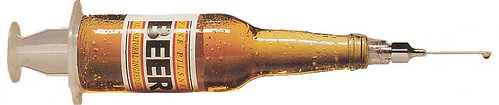
So why is it that the neo-prohibitionists seem so reluctant to include personal responsibility as a factor, if not the factor? It boggles the mind. They seem far more interested in blaming the alcohol companies for trying to “hook” people in with advertising, as if people have no choice but to fall prey and begin binge drinking. Some anti-alcohol groups have gone so far as to portray alcohol in a syringe in an attempt to paint heroin and beer as the same.
beer-syringe-white

With the publication this May of the new DSM-5, the bible of psychiatric disorders and treatment that’s put out by the American Psychiatric Association, “compulsive gambling” will be added to the list of accepted “addictions.” The DSM-5 also replaced the term “dependence” and goes back to using the term “addiction” again instead. Why that’s the case is a fascinating story in and of itself, which you can read an overview of in Blinded by Biochemistry. Oddly enough, compulsive “binge-eating” and “hypersexuality” are both not considered addictions, at least not yet. As Stanton Peele, author of Love and Addiction, writes, “Binge-drinking can bring on addiction, but not binge-eating? How come?”

I’m convinced that’s because of the social acceptability of eating, as contrasted by the demonization of alcohol. Drinking has been treated as a sin and a moral failing by alcohol’s opponents for so long now that the very concept has been absorbed into the culture at large. The DSM-5 is merely reflecting that prejudice in our society.

But as Steele points out in a more recent article, What Is Addiction? Addiction isn’t what it used to be, the New York Times recently identified new trends of addiction, that of being addicted to “junk food” and playing “mindless games.” (How those can be considered “new” is also quite puzzling, frankly.) But as I can’t quite shake the notion that it’s not the substance of the addiction that’s at fault, but the individual’s reaction to it that makes it addictive, Steele offers some confirmation that I’m not off my rocker.

What makes such a thing an addiction? And it is no more the existence and consumption of junk food, repetitive games or other video stimulation, or placing a bet that makes it so; it is the way the individual interprets and reacts to the experience of the thing in the context of his or her life that creates an addiction (think of heroin addiction in Vietnam, soon left behind by most vets on their return home). When a powerful experience is welcomed for its reassurance and as a life solution, when it become preoccupying and detrimental to the consumer, and — finally — when the individual him or herself comes to see and to believe that the experience is addictive — voila!
addiction

But as Steele wrote earlier in Psychology Today magazine:

Addiction is the search for emotional satisfaction — for a sense of security, a sense of being loved, even a sense of control over life. But the gratification is temporary and illusory, and the behavior results instead in greater self-disgust, reduced psychological security, and poorer coping ability. That’s what all addictions have in common.

As he points out, we can never agree on a exhaustive list of all of the stuff one could become addicted to, because it’s not about the object of addiction, but the addictive person’s reaction and relationship to his particular obsession. And that’s where, in his opinion, the new DSM-5 is still taking the wrong approach by “viewing the nature of addiction as a characteristic of specific substances,” because it doesn’t recognize the basic truth that addiction is more complicated than just banning anything that someone might become addicted to. Steele continues.

[T]hink about obsessive-compulsive disorder (OCD): People are not diagnosed based on the specific habit they repeat — be it hand-washing or checking locked doors. They are diagnosed with OCD because of how life-disruptive and compulsive the habit is. Similarly, addictive disorders are about how badly a habit harms a person’s life.

And that is, or should be, the point. How a person reacts to anything, and alcohol in particular, is almost as individual and unique as they are. Most people can drink beer responsibly and without their lives falling into ruin. A few can’t. But can we please stop targeting the beer and use those same resources to get the minority of people who can’t some help?

Filed Under: Beers, Editorial, Politics & Law Tagged With: Health & Beer, Science

More Evidence of the Myth of the Beer Belly

February 12, 2013 By Jay Brooks

binge-barney
I’ve been saying this for years, that the beer belly is a myth and that drinking low-calorie diet light beer is a foolish decision, especially since it’s a sacrifice of too much flavor for too little discernible positives for your health or your waistline. Here’s the nutshell overview, the first paragraph from the UK Telegraph’s coverage — sure to make the head of the average neo-prohibitionist uncontrollably spin with rage — “The ‘beer belly’ is a myth as there is no scientific evidence to suggest that the beverage causes weight gain, a new report has claimed.”

In fact beer, the country’s national drink, has nutritional and wellbeing benefits similar to wine when consumed in moderation, it is claimed.

Nutritionist Dr Kathryn O’Sullivan, who carried out the review of the scientific review, believes that swapping beverages for beer may actually be a sensible way to diet.

Although the industry-sponsored research may seem incredible to some it in fact adds to an emerging body of thought that the beer belly is a myth.

Beer has fewer calories per 100ml than wine, spirits, and even orange juice, it is claimed.

“Unfortunately beer has this image as a high-calorie, high-fat drink,” Dr O’Sullivan told The Times. “It is very unfair.”

The study itself is called “Beer & calories; a scientific review” and I’d love to read the whole thing, but so far it doesn’t appear to be available online.

And an Irish report, “Study: ‘Beer belly’ is a myth” adds the following:

The study does note that if you drink vast amounts of beer (or pretty much anything for that matter) you will gain weight, and Dr O’Sullivan also does not dispute the evidence that drinking too much can lead to an early death.

However, Dr O’Sullivan said that swapping two large glasses of wine a day with two bottles of lager could save 58,240 calories a year (that equates to roughly 106 Big Mac’s a year).

“Beer drinking has become regarded by many as a vice and not a component of a healthy balanced lifestyle. But this is contrary to the latest scientific evidence,” she said.

“Enjoyed in moderation, beer, like wine, can provide many essential vitamins and minerals and moderate consumption may also protect against many conditions such as heart disease, osteoporosis and diabetes.”

This new study also is consistent with an earlier study in Denmark, where Professor Arne Astrup, who’s at the Department of Human Nutrition at The University of Copenhagen, found “that there is no concrete scientific evidence to support the idea of the ‘beer belly.'”

Filed Under: Beers, Editorial, News Tagged With: Science, Statistics

X-ray Crystallography Figures Out Structure Of Hops

February 8, 2013 By Jay Brooks

beer-x-ray
Here’s an interesting scientific development, where a team of scientists “used a process called X-ray crystallography to figure out the exact structure of [hop] acids, humulone molecules, and some of their derivatives, produced from hops in the brewing process.” According to the story in Futurity, they already knew that “beer and its bittering acids, in moderation, have beneficial effects on diabetes, some forms of cancer, inflammation, and perhaps even weight loss.”

The story comes from the journal Angewandte Chemie International Edition and a recent article Absolute Configuration of Beer′s Bitter Compounds. Here’s the opening part of the article.

The science and art of making beer, likely the oldest liquid fermented by humans, stretches over millennia. Production typically involves boiling beer wort together with hops, which acts as a natural preservative, but the generated iso-α-acids are known to be prone to decomposition, and consequently, more stable reduced hops extracts, such as the tetrahydro-iso-α-acids, have been developed. These latter compounds are separately produced and frequently added to beer to achieve a consistent level of bitter taste. Scheme 1 gives an overview of the iso-α-acids formed by heat-induced isomerization.

nsch001

The rest of the story talks about how they isolated the hops in such a way that they might be able to be extracted to use in medicine to take advantage of their healthful properties, that you couldn’t really get just by drinking beer because the amounts in beer were too small to be effective.

The press release from the University of Washington, where the study was conducted, explains the study in layman’s terms.

Humulone molecules are rearranged during the brewing process to contain a ring with five carbon atoms instead of six. At the end of the process two side groups are formed that can be configured in four different ways—both groups can be above the ring or below, or they can be on opposite sides.

Which of the forms the molecule takes determines its “handedness,” Kaminsky says, and that is important for understanding how a particular humulone will react with another substance. If they are paired correctly, they will fit together like a nut and bolt.

If paired incorrectly, they might not fit together at all or it could be like placing a right hand into a left-handed glove. That could produce disastrous results in pharmaceuticals.

Kaminsky cites thalidomide, which has a number of safe uses but was famously used to treat morning sickness in pregnant women in the late 1950s and early 1960s before it was discovered to cause birth defects. Molecule “handedness” in one form of the drug was responsible for the birth defects, while the orientation of molecules in another form did not appear to have the negative effects.

To determine the configuration of humulones formed in the brewing process, coauthors from KinDex Therapeutics, a Seattle pharmaceutical firm that funded the research, recovered acids from the brewing process and purified them.

They converted the humulones to salt crystals and sent them to Kaminsky, who used X-ray crystallography to determine the exact configuration of the molecules.

“Now that we know which hand belongs to which molecule, we can determine which molecule goes to which bitterness taste in beer,” Kaminsky says.

The authors point out that while “excessive beer consumption cannot be recommended to propagate good health, isolated humulones and their derivatives can be prescribed with documented health benefits.”

Some of the compounds have been shown to affect specific illnesses, Kaminsky says, while some with a slight difference in the arrangement of carbon atoms have been ineffective.

The new research sets the stage for finding which of those humulones might be useful in new compounds to be used as medical treatments.

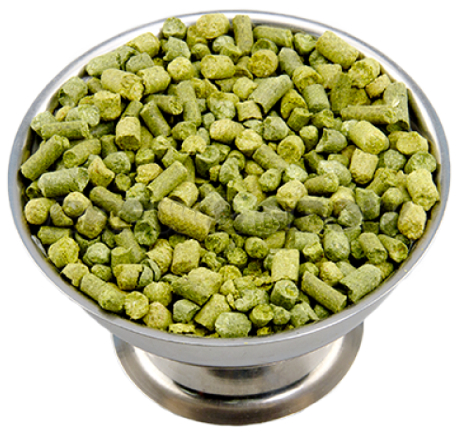
Anybody seeing a new kind of hop pellet? One you take every day with your vitamins, perhaps.
hop-pellets

Filed Under: Beers, News Tagged With: Hops, Science, Statistics

Three Logicians Walk Into A Bar …

January 25, 2013 By Jay Brooks

logic-brain
While I had a logic class in college, and dabbled in debate, I’ve probably forgotten more than I ever learned. But I still love the notion of breaking down the thought process. My son, who’s 11 and autistic, often has trouble understanding humor. As a result, I increasingly find myself trying to explain the punchline of a joke — why it’s funny — and I’ll break it down for him. What invariably happens, of course, is that in that process, the joke is stripped of its humor and is no longer funny. For some reason, that never deters me. I’ve always had a thing for jokes and thinking about why they’re funny. If I wasn’t so damn shy I would have loved to have tried my hand at stand-up comedy back when I was a younger man. I think that’s why I loved The Aristocrats so much. Ninety minutes breaking down and re-telling one joke. What’s not to love?

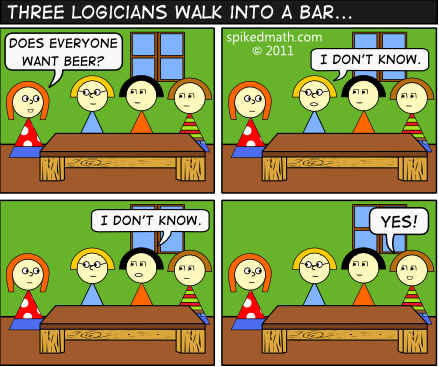
So check out the comic strip below. It’s mildly amusing, at least to me. You most likely won’t laugh out loud, but you may smile, at least. But from the point of view of logic, it’s also quite correct, and instructional. It was originally posted by Spiked Math Comics, who admits he doesn’t know the strip’s original creator.

three-logicians

But here’s where it veers headlong into geekdom. It was picked up by a Danish University linguistics student, Emil Kirkegaard, who posted Three Logicians Walk Into a Bar: A Formal Explanation, a breakdown and analysis of the joke, complete with formulas, and explanation of the logic principles behind it.

Here’s one expressing the root problem: E↔(Wa∧Wb∧Wc)

The whole explanation is just as funny as the original strip, to me at least, in its own right and certainly does explain the joke, although if you didn’t think it was funny to begin with, this probably isn’t going to help. But us geeks have to stick together, no matter what geekworld we belong to.

Filed Under: Just For Fun, Related Pleasures Tagged With: Cartoons, Humor, Math, Pubs, Science

The Biology Of A Hangover

January 21, 2013 By Jay Brooks

hangover
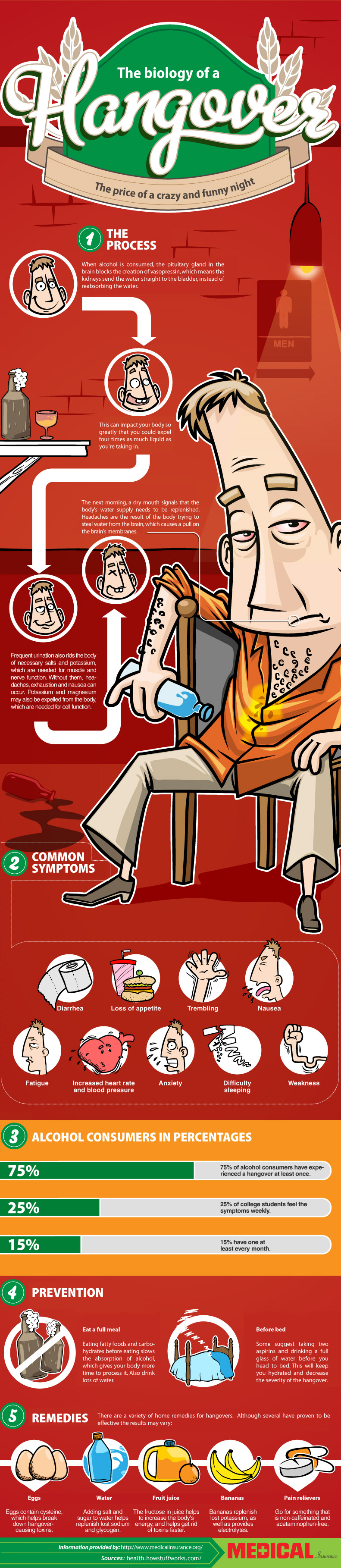
Today’s infographic tackles the morning after. In the Biology of a Hangover, it “goes over the course our bodies go through as it processes alcohol and how it leaves us with the dreaded hangover.”

hangover

Filed Under: Beers, Just For Fun, Related Pleasures Tagged With: Hangovers, Health & Beer, Infographics, Science, Statistics

The Science Of Beer Color

January 14, 2013 By Jay Brooks

color
Popular Science’s BeerSci series had another interesting post last month on How Beer Gets Its Color, this time addressing “the two chemical reactions that most influence the malt character and color of your brew.” It’s wonderfully geeky, and goes into the Maillard reaction, named for French chemist Louis Camille Maillard, which is also known as “browning,” and is essentially how “amino acids react with a reducing sugar.” Between that, and caramelization, the various colors in beer are created.

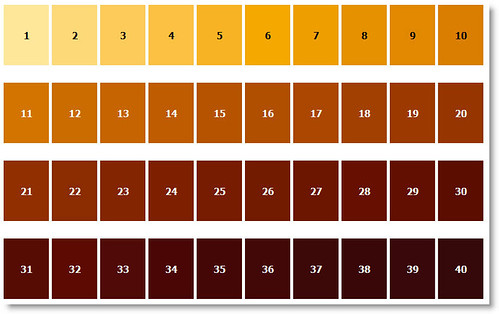
Brewers used to use the Lovibond scale — expressed as “Degrees Lovibond” — when referring to color, but it’s largely been replaced by SRM (Standard Reference Measurement) or the EBC (European Brewing Convention), which is similar but has a different numbering system. Here’s what the SRM range looks like:

SRM_Beer_Color_Chart

For more infomation, check out the terrific Beer Color Laboratories. I keep their wallet size color reference guide in my wallet at all times, and have the larger one in my office. They’re great if you don’t have a spectrophotometer lying around.

logo-beertone

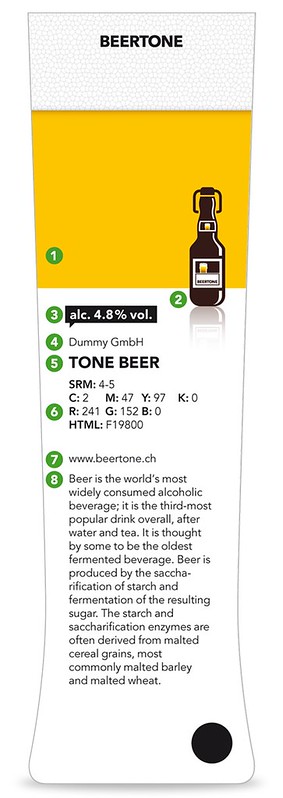
Another interesting expression of beer color is coming out of Switzerland. Beertone is essentially a playful spoof on or homage to the Pantone color system used by design professionals. Beertone is taking individual beers and making a beertone card for each, with information about each beer on it. Here’s a sample mock-up of what the cards will look like.
beertone-card

  1. The Beer Color: The concept from Beertone. Each beer has been shot in a special glass, to avoid reflexes and extern influences. The results are amazing.
  2. The Beer Bottle: There’s so many cool Beer Labels that we thought, we must have the bottle on each page.
  3. Alcohol by Volume: The percent alcohol by volume (% alc/vol). It’s a standard measure of how much alcohol (ethanol) is contained in an alcoholic beverage.
  4. Brewery: it’s important to know who produced the Beer. Big and small companies have their places on Beertone.
  5. Beer Name: That’s most important thing to remember when the barkeeper asks what do you wanna drink.
  6. The Color Information: As part from Beertone concept, we present the color references from different color models. With the best values compared to the Beer color.
  7. Brewery Site: If you want to know more about the Beer and its Brewery, here you will have their official site.
  8. Beer Description: Here the Beer enthusiasts will have a description about each Beer. Useful information is always relevant. What a better way to start a good conversation at the bar?

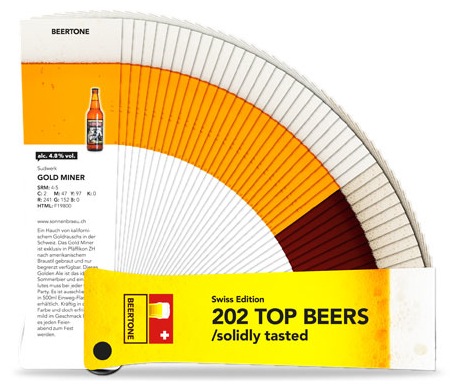
So far, only Swiss beers are available for pre-order — and they’re pretty pricey — with plans for German beers and Brazilian beers to be released later this year.

beertone-1

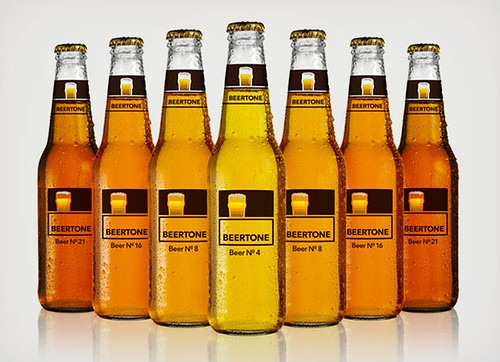
It certainly seems like a cool idea, if a little unwieldy. I think they should sell them like trading cards and sell packs at bars. But I’d certainly like to see them expanded into the U.S., Great Britain, the Czech Republic, et al., and see what a wider geographic range of beers would look like.

beertone-2

Filed Under: Beers, Just For Fun, Related Pleasures Tagged With: Science, Science of Brewing

How Alcohol Travels Through The Body

January 12, 2013 By Jay Brooks

ethyl-alcohol
Today’s infographic concerns the subject of How Alcohol Travels Through the Body, each stage of the way and what happens at each place alcohol travels from mouth to liver and out again. Remember, you don’t buy alcohol, you just rent it. Just click on the image to view it full screen.

How Alcohol Travels Through the Body infographic

Filed Under: Just For Fun, Related Pleasures Tagged With: Health & Beer, Infographics, Science

The Science Of Making Beer Stronger

January 11, 2013 By Jay Brooks

science
Popular Science’s intermittent series BeerSci had an interesting post yesterday on How To Make Strong Beer Stronger, tackling the issue of how “fractional freezing will concentrate any beer, provided you have a bit of patience and a very cold freezer.”

beersci-logo

Filed Under: Beers, Just For Fun Tagged With: Science, Science of Brewing

The Science Of The Spins

December 31, 2012 By Jay Brooks

spins
Given that today is New Year’s Eve — what I generally refer to as Amateur Drinking Day — I thought this science lesson from Mental Floss on what causes the spins was an appropriate topic. In Why Does Alcohol Cause the Spins?, author Matt Soniak explains that sometimes after an evening’s drinking that the room appears to be spinning out of control. You lie down, but it doesn’t help. No matter what you do, the vertigo persists, causing great discomfort and often the loss of lunch, dinner and everything else that used to be in your stomach. Here’s why.

The spins happen because of an odd effect alcohol has on your ears — specifically, on three tiny, fluid-filled structures called the semicircular canals. Inside each of these canals is a fluid called endolymph and a gelationous structure called the cupula, which is filled with cells covered in fine, hair-like stereocilia.

As you move around, the movement of the endolymph lags behind the more solid cupula, distorting and bending it — and those little hairs. When the hairs bend, the electrical signal they send to your brain is altered, helping you to make sense of the rotations your head experiences on each of the three planes the canals sit on — movements up and down, left and right and backward and forward — and keep your balance.

Booze throws this system out of whack. Alcohol thins the blood, and when boozy blood travels to the inner ear, it creates a density difference between the cupula and the fluid in the canals, and distorts the cupula’s shape. The little hairs bend and send a signal to your brain that tells it you’re rotating when you’re really not, and this illusion of motion makes it seem like the room is spinning.

Some of the things that you most want to do when you’re good and drunk, like lie down and close your eyes, make the sensation worse, since you don’t have any visual or physical cues to counteract the false sense of motion. Looking at a fixed object and keeping your feet planted on the ground can help lessen the effect, but there’s no real way to stop it.

So now you know. The bad news is there’s pretty much nothing you can do about it apart from practicing moderation and drinking plenty of water. If I know I’ll be drinking a lot, I try to eat a hearty meal beforehand, drink a glass of water in between each beer, snack during the party and take some Advil and Vitamin B before going to sleep. Happy New Year everybody.

Maybe this will help; maybe not.

the-spins

Filed Under: Beers, Just For Fun, Related Pleasures Tagged With: Hangovers, Humor, Science

The Science of Beer Goggles

December 20, 2012 By Jay Brooks

beer-goggles
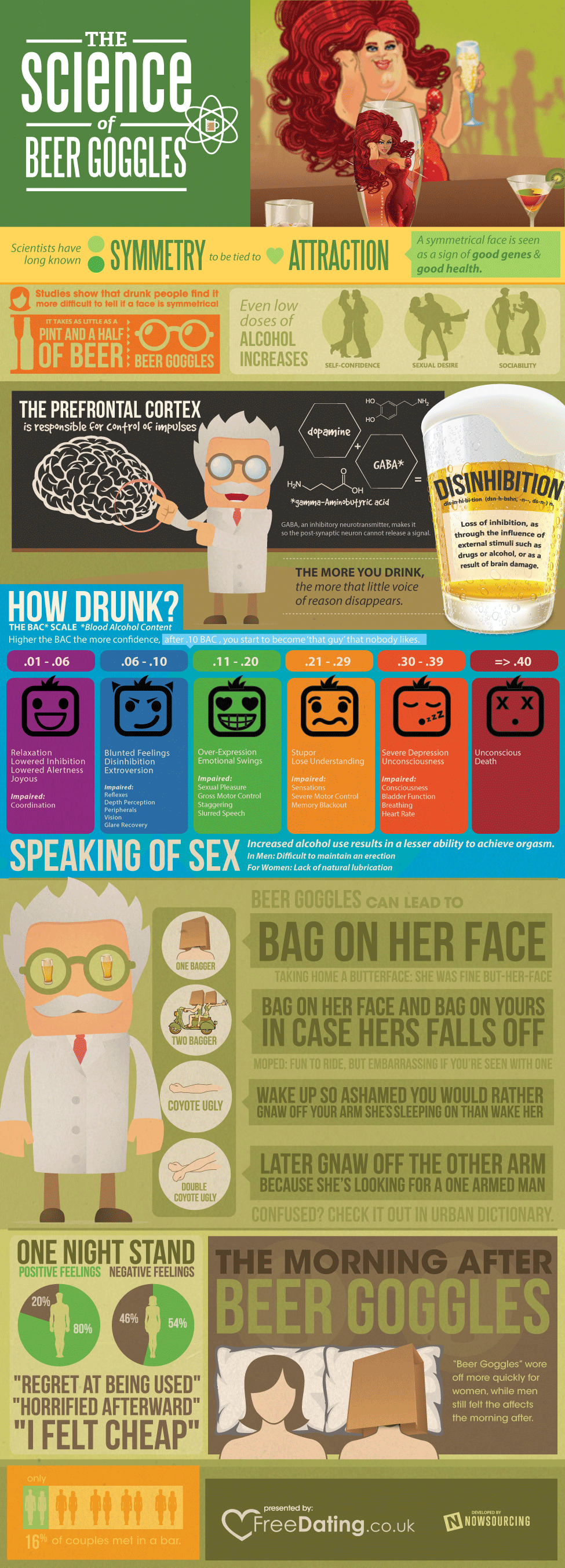
Hmm, not sure how to think about this one. It’s kinda fun, and occasionally funny, but it also goes a little bit too far when it tackles the “bag over her face” issue, although it does offer advice for both women and men. The infographic was created by freedating.co.uk, an online dating website in Great Britain, so it was probably meant to be somewhat tongue in cheek.

There is actually some science behind the concept of beer goggles, and a couple of years ago I wrote about the Math Behind Beer Goggles. The infographic does also include some of that, too, at least.

science-of-beer-goggles
You can see this chart larger at Love Infographics.

Filed Under: Beers, Just For Fun Tagged With: Infographics, Science

« Previous Page
Next Page »

Find Something

Northern California Breweries

Please consider purchasing my latest book, California Breweries North, available from Amazon, or ask for it at your local bookstore.

Recent Comments

  • Ernie Dewing on Historic Beer Birthday: Charles William Bergner 
  • Steve 'Pudgy' De Rose on Historic Beer Birthday: Jacob Schmidt
  • Jay Brooks on Beer Birthday: Bill Owens
  • Steve 'Pudgy' De Rose on Beer Birthday: Charles Finkel
  • Steve 'Pudgy' De Rose on Beer Birthday: Bill Owens

Recent Posts

  • Beer In Ads #5185: It’s Bock Time January 28, 2026
  • Beer Birthday: Shane McNamara January 28, 2026
  • Historic Beer Birthday: John Goetz January 28, 2026
  • Beer Birthday: Jean-Marie Rock January 28, 2026
  • Beer In Ads #5184: The “B”s Are Here, Bruton Bock Beer January 27, 2026

BBB Archives

Feedback

Head Quarter
This site is hosted and maintained by H25Q.dev. Any questions or comments for the webmaster can be directed here.