
In response to the highly unscientific study published in The Lancet last week suggesting alcohol is more dangerous than heroin, FullFact.org — “A [British] independent fact-checking organisation” — asked the question “Are alcohol-related problems on the rise?” Their conclusion? “Full Fact finds little support in the evidence.”
Beer More Dangerous Than Heroin!?!
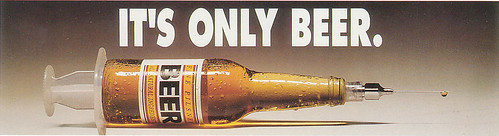
I suppose it was inevitable. Anti-alcohol folks have been saying for years that alcohol is the worst drug on the planet. And comparing it to heroin is not exactly new, either. A popular neo-prohibitionist PSA shows a beer bottle as a syringe to remind people that alcohol is also a drug. You can even buy bookmarks and posters of it at Face, the one-stop shop for neo-prohibitionist propaganda. Of course, aspirin is also a drug, but who would drink beer in either pill or syringe form?
The characterization of alcohol as a drug is mostly a specious one, because it ultimately depends on how you define what a drug is or how it’s used. You might be tempted to think that it’s fairly easy to explain exactly what is a “drug,” but it’s actually not. Even the most common dictionaries define it rather differently, and how people connote it varies even more widely. Some say it’s only a drug if it’s used as medicine, others any chemical substance that alters something physical, while still other definitions insist a drug is something illicit or illegal. A lot of what definition you choose is dependent on your message or what point you’re trying to make. In other words, context matters. What we can agree on — I hope — is that there are both good and bad drugs. I know there won’t be universal agreement on which is which, but that they’re not all the same I trust can be acknowledged by either side of the alcohol divide.
Today the scientific journal The Lancet published a new article entitled Drug Harms in the UK: A Multicriteria Decision Analysis that purports to show that alcohol is more dangerous than heroin. According to their results it is indeed claimed that alcohol is more dangerous to society and individuals than anything else on Earth, including crack, cocaine, tobacco, Ecstasy and LSD. The article — I refuse to call it a study — was authored by David Nutt, the former UK chief drugs adviser who was fired in October of last year by the British government.
Why this so-called study is garnering such media attention has to do with its volatile headline. As they say, if it bleeds it leads, and this definitely has blood on it. But it’s not exactly scientific. I’d always thought of the Lancet as one of the more rigidly scientific journals, but this gives me pause. Essentially, the way the results of this article were collected was by gathering together sixteen “experts,” specifically “members of the Independent Scientific Committee on Drugs (an organization founded by David Nutt after his firing), including two invited specialists” who then sat down for a one-day meeting — called a “workshop” — where each of them was asked to “score 20 drugs on 16 criteria: nine related to the harms that a drug produces in the individual and seven to the harms to others. Drugs were scored out of 100 points, and the criteria were weighted to indicate their relative importance.” Well, how scientific.
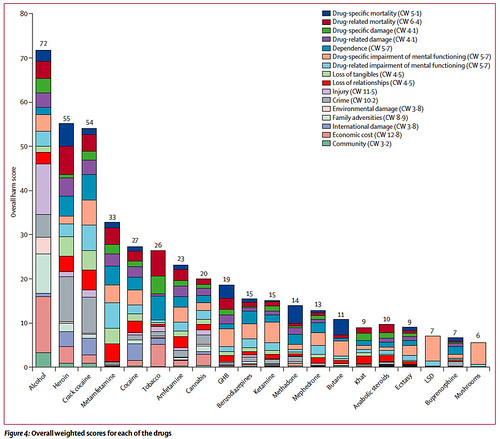
This is the 16 criteria they scored:

So essentially this “study” is simply the scores collected by a few so-called “experts” — almost entirely made up of members of one organization thick with agenda — during a one-day retreat. That’s hardly “proof” of anything. If I were The Lancet, though, I’d be a little embarrassed about having so unscientific a piece being in my previously distinguished pages. Throughout the article, the author infuriatingly keeps referring to the results as “findings,” as if they’re a tally of something more meaningful than mere opinion. Self-fulfilling prophecy is a more reasonable assessment of their “findings.”
Here’s how they explain themselves:
The issue of the weightings is crucial since they affect the overall scores. The weighting process is necessarily based on judgment, so it is best done by a group of experts working to consensus. Although the assessed weights can be made public, they cannot be cross-validated with objective data.
They also admit that their opinionated scores only include the supposed harm of the substances they’re evaluating, and that they did not take into account any benefits, apart from admitting that some do exist.
Limitations of this approach include the fact that we scored only harms. All drugs have some benefits to the user, at least initially, otherwise they would not be used, but this effect might attenuate over time with tolerance and withdrawal. Some drugs such as alcohol and tobacco have commercial benefits to society in terms of providing work and tax, which to some extent offset the harms….
So they admit alcohol’s economic benefits, but still conveniently ignore the many health benefits of responsible, moderate consumption, including the rather important fact that most people who drink moderately will live longer than those who either totally abstain or over-indulge.
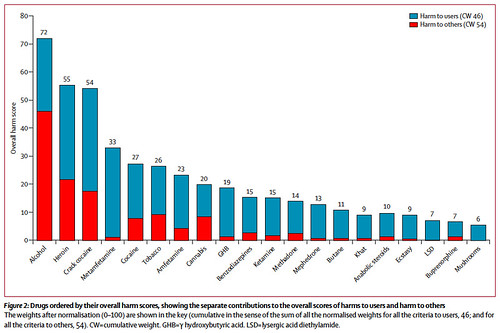
No matter, the experts conclude that both heroin and crack-cocaine are nearly a third less dangerous than alcohol. Mushrooms, they’ve declared, are the safest of all.
But essentially they’re taking the minority of people who abuse alcohol and from there go on to imply that essentially everyone who drinks alcohol exacts that same cost to themselves and society, extending the data out to include all drinkers. But that’s clearly untrue and quite ludicrous. All they’ve done is dress up opinions — and biased ones at that — and presented them as facts and findings, based solely on the idea that expert opinions are facts. That The Lancet went along with it shows how mesmerized we are by the lure of so-called, and even self-proclaimed, “expert opinions.”
Finally, the chart below shows the breakdowns of each of the 16 criteria and how much they assigned to each “drug.”
The BBC even collected drinkers’ responses and one woman noted that her grandmother has had a glass of wine every single day since she was 18 and is still going strong, reasonably suggesting that she might not still be here if she’d been taking heroin every day for the same period of time. Professor Nutt won’t even concede that point, saying that it’s not necessarily true, stating that the woman’s grandmother might be better off if she’d taken the heroin instead! He says “all medicines are safe if they’re used appropriately.” Maybe, but why wouldn’t that same logic then extend to alcohol? Why can’t he concede that it’s also safe if used “appropriately?” Can anyone really believe that a prescription of heroin every day is safer than a drink or two of beer per day, just because it didn’t come from a doctor’s advice?
Is it possible there’s another reason for Professor Nutt’s war on alcohol? Well here’s at least one possibility. In December, the London Telegraph reported that Nutt was leading a team at Imperial College London in developing a synthetic alcohol, produced using chemicals related to Valium. According to the report, it “works like alcohol on nerves in the brain that provide a feeling of well-being and relaxation,” but “unlike alcohol its does not affect other parts of the brain that control mood swings and lead to addiction. It is also much easier to flush out of the body.” And because it’s “much more focused in its effects, it can also be switched off with an antidote, leaving the drinker immediately sober.” It’s not too hard to imagine that the scarier and more dangerously alcohol is perceived as a societal evil and health risk, the more customers for synthetic alcohol there would be.
No matter what his true motives, Nutt is … well, I’ve been trying to avoid this but there’s just no way around it, something of a nutter. He claims that his “findings showed that ‘aggressively targeting alcohol harms is a valid and necessary public health strategy.'” Of course, that’s been his position since well before this farce began, so again, it’s much more of an agenda in search of its own validation. Not so much a self-fulfilling prophecy, but a self-created justification for a position he already held. All he needed to do was to create the official-sounding organization “Independent Scientific Committee on Drugs” and then have them say the same thing he’s been saying all along, this time with charts and people with strings of alphabets after their names so it all sounds on the up and up. But this is just another case of the Emperor having no lab coat, and few people in the media even noticing.
UPDATE: As expected, Pete Brown has also tackled Nutt’s Lancet article and its attendant publicity in The MAIN reason Professor Nutt is bad for our health. Check it out.
Busch Jumps On Cold Indicator Label Bandwagon

For many years, Coors has been the brewery obsessed with cold. But that may be changing, as Anheuser-Busch InBev is debuting their own cold-activated labels on bottles of Busch Light. ABI is calling their version of the cold-activated label an “ice-cold easy indicator.”

According to an article today by AdAge:
An “ice-cold easy indicator” thermometer turns blue when the temperature is just right, an Anheuser-Busch spokesman told Ad Age, noting that the special packaging has already hit some stores. The innovation resembles what competitor MillerCoors has done with its Coors Light bottles, which feature mountains that turn blue “when it’s as cold as the Rockies.”
“Thermochromatic ink on beer [bottles]? I’ve heard that’s been done before,” said a MillerCoors spokesman.
Coors Light is one of the few big beer brands whose sales are growing, albeit slowly, and the cold-activated bottles are a focal point of its advertising. It is unclear if A-B plans a big promotional push for its new Busch Light bottles. The sub-premium brand traditionally gets less advertising attention than Budweiser and Bud Light.
As far as I’m concerned, the only good reason to make sure either of these beers are cold enough to turn the label blue is so they’re cold enough to numb your taste buds so you can no longer taste them. But it’s that reliance on marketing gimmicks instead of making products people actually want that makes this such a bad idea to me.

European Study Shows Raising Beer Taxes A Bad Idea

Earlier this month, the Brewers of Europe — a trade organization of European breweries — released the results of an independent study they commissioned by PriceWaterhouseCoopers. They asked PWC to “quantify the impact of excise taxes on the overall tax collection, and employment and profitability in the brewing sector compared to other alcoholic beverages.” In Europe, like in the United States, a poor economy coupled with tireless anti-alcohol organizations are causing some politicians to look to the alcohol industry to help fund problems not of their making in the form of higher taxes. The entire report, Taxing the Brewing Sector: A European Analysis of the Costs of Producing Beer and the Impact of Excise Duties, is available online.
They also released a press release, highlighting the findings. From the press release:
“The study provides strong evidence that arbitrary increases in excise tax would hit brewers — and the 1.8 million jobs created in the European hospitality sector generated by the brewing sector — hard just as the economy is striving to emerge from a deeply damaging recession. The study also shows that tax increases will ultimately NOT increase government revenues nor attain the expected levels.”
The study comes at a crucial time, with skyrocketing taxes on beer in some European countries as governments scramble to rake in cash. “At a time when regulators across Europe are looking at scenarios about taxation, we would urge them to give any plan a full economic reality check,” [said] Pierre-Olivier Bergeron, [secretary-general of the Brewers of Europe]. “This study provides the data for sound judgments.”
A comparative cost analysis within the study shows that producers of alcoholic beverages constitute a significant industry within the EU, worth €242.5bn in 2007 in terms of sales. Sales of beer account for the highest proportion by value — €111.5bn or 46%. Beer contributed the highest amount of taxes to Member States across the EU and the lion’s share of jobs.
“This study shows that beer is the most expensive form of alcohol to produce,” observed Pierre-Olivier Bergeron. “So any move toward taxing all drinks based solely on alcohol content (‘unitary taxation’) would disadvantage a low alcohol beverage such as beer further in terms of cost of the product to the consumer.”
The study shows that an increase in excise taxes on the beer and hospitality sectors would be negative in terms of employment and tax collection. This is because increases in excise tax revenue are more than offset by decreases in the revenues obtained by the Government from personal and corporate income taxes, social security payments and, in some cases, from value added tax (VAT).
“The excise tax research shows that a 20% increase in beer excise taxes at national level across Europe would lead to loss of over 70,000 jobs and a fall in government revenues of €115 million EU-wide, due to lower sales and lower income from VAT and corporate taxes,” adds Pierre-Olivier Bergeron. “Also an increase of current EU minimum rates of excise tax will have no beneficial impact on the EU’s internal market or on national treasuries concerned. Plainly this is an ineffective measure for improving public finances and detrimental for brewers.” Bergeron concludes: “Europe’s brewing sector fully backs Europe 2020, the European strategy for smart, sustainable and inclusive growth. Our call for good sense and reason on the excise duty front fully meets the strategic objectives the EU has rightly set for itself, particularly in terms of fostering a high-employment economy.”
Perhaps the biggest finding is how many jobs would be lost if excise taxes were increased. The Marin Institute and the City of San Francisco insisted there would be no job losses if their recently proposed alcohol tax for the city passed. They were quite insulting, I believe, to the concerns of both local businesses and workers for even suggesting that was a potential outcome. This EU study does appear to lend credence to the claims made by many critics of the San Francisco Alcohol Tax, especially the California Alliance for Hospitality Jobs.
Naturally, critics of this study will undoubtedly point to its origin, having been commissioned by a trade organization. But the Brewers of Europe appear to have been very diligent in making the study as impartial as possible, and, perhaps more importantly, they’ve been extremely transparent and up front about their sponsorship of the study. That’s something that American anti-alcohol groups have not been as forthcoming about, with the more common scenario being that they fund academic institutions to conduct a study and then all but hide that fact, or at a minimum downplay it. Those same groups then use the studies they themselves commissioned in propaganda that tries to make them appear impartial or from an independent source, as was seen recently in the City of San Francisco’s nexus study supporting the alcohol tax. So at least this study involved no such subterfuge. People know exactly where it came from, can read the report and draw their own conclusions in full command of all the facts.
Effects of Alcohol At Different BAC Levels

Here’s another interesting infographic created by, of all people, a Term Life Insurance website, showing The Impact of Alcohol on your Body as your blood-alcohol content percentage increases.

Son of Binge Drinking Statistics Inconsistencies

If you read my previous post about Inflating Binge Drinking Statistics, you’ve seen how data can be manipulated and essentially bent to any purpose. Today a second news item in U.S. News & World Report, 1 in 4 U.S. Teens and Young Adults Binge Drink, presents yet another portrait of reality using binge drinking data from the CDC.
This one focused more on underage drinking, declaring that 1 in 4 U.S. teens and young adults are binge drinkers. According to CDC director Dr. Thomas R. Frieden, “[n]inety percent of the alcohol consumed by high school students is consumed in the course of binge drinking.” Frieden goes on to say that “[a]mong drinkers, one-third of adults and two-thirds of high school kids binge drink, but doesn’t that contradict the 1 in 4 statistic and the 90% declaration? Which is it: 25%, 66% or 90%?
Beyond the fuzzy math, that high school students binge drink is a bit of a duh statistic, they don’t exactly have much choice under the circumstances. That’s because all underage drinking is done underground, none of it is out in the open. So any time they do get a chance to drink it’s without supervision. And that’s a direct result of the minimum age being 21 instead of 18 and also because not only is education not available, but is even considered criminal in some states. It was not unusual when I was a teenager for parties where alcohol was served to be chaperoned by parents with the full knowledge of other parents, too. Today, that would be cause in many places for arrests and jail time. But as a result of adult supervision, I never witnessed any problems at those parties and they were very safe. But thanks to zealotry and a no tolerance policy such safe environments are now impossible.
Another discrepancy is that in the U.S. News & World Report, the CDC claims that “more than 33 million adults have reported binge drinking in the past year.” That’s in contrast to the NPR story, in which the CDC claims that “half of all alcohol consumed by adults in the US is binge drinking.” Then on the CDC’s website there’s a map of the U.S. showing binge drinking averages by state, with the lowest state being Tennessee (with 6.8%) and the highest being Wisconsin (23.9%).
Inflating Binge Drinking Statistics

The biggest problem with binge drinking statistics is that the definition keeps changing. Over the last few decades it’s gone from somewhat vague to an increasingly narrow definition. Each change in the definition increases the number of binge drinkers. It’s not that more people are binge drinking necessarily, but that more people fall under the definition as they lower it and lower it.
At the bottom of an NPR story, Binge Drinking: A Big Problem, Especially For The Prosperous, there’s a strange little video about binge drinking put together by the CDC. In it, they reveal some disturbing ways of looking at what it means to binge drink.
The most recent way our government defines binge drinking is “[f]our or more drinks within a few hours for a woman and five or more for a man.” That actually narrows yet again, as recently as the last few years it’s been “five or more drinks in a row,” which tends to imply more speed. Adding “within a few hours” means even drinking at a leisurely pace makes you a binge drinker. I wrote more about this shift last year in a post, Inventing Binge Drinking.
The CDC video further claims that “half of all alcohol consumed by adults in the US is binge drinking.” Wow, that’s pretty remarkable, especially if you consider that according to the DOJ only 54% of adults drink alcohol. We’re now a nation of binge drinkers. You’d think a society where 1 in 2 people drinking is on a bender would be more noticeable. But look out your door or window and unless there’s a car alarm going off, it’s more likely you’ll hear crickets and birds chirping, not the devastation implied by that alarming factoid.
They also claim “1.5 billion episodes of binge drinking” take place each year in the U.S. That’s 5 for every man, woman and child in the country, or 6.25 times for every adult. If we assume the DOJ’s statistic that 46% of adults don’t drink alcohol, then that’s 11.6 for every adult who does imbibe, or nearly once a month. That’s a lot of benders. Or is it? Is having five drinks less than once a month really an alarming societal problem? I go to a beer dinner probably at least once a month and most are at least five courses. That makes me a binge drinker, but I’m hardly a danger to society because of it. Clearly, for some individuals persistent binge drinking is a serious problem, but the people who fall into that category represent a very small minority of all drinkers.
Toward the end of the NPR article, they have this to add.
The problem, though bad, isn’t a lot worse than it used to be. In 1993, the CDC says, about 14 percent of adults had gone on drinking binges. But as Dr. Thomas Frieden, head of the CDC put it, “Because binge drinking is not recognized as a problem, it has not decreased in 15 years.”
That’s a pretty glaring inconsistency. On one hand, the CDC claims that “half of all alcohol consumed by adults in the US is binge drinking” but only “14 percent of adults had gone on drinking binges.” But my favorite howler is the statement that “binge drinking is not recognized as a problem.” What planet is he living on, because neo-prohibitionists and the health, university and government research communities, not to mention all the treatment and addiction businesses that stand to make more money if the problem keeps increasing, have been screaming about the perils of binge drinking as long as I’ve been an adult, and probably longer. And the hue and cry has only increased in recent decades. But this just serves to prove that binge drinkers aren’t born, they’re created … by statistics.
But wait, it gets worse. According to the CDC video, the NIAAA now defines binge drinking as “consumption that raises blood-alcohol content to .08%.” That’s right folks “binge drinking” and being “drunk” are now exactly the same! Then they go on to say that binge drinkers are “14 times more likely to drive drunk.” Duh, if you define binge drinking as getting drunk, then that’s a self-fulfilling statistic, isn’t it? But it’s pretty alarming that a government agency’s standard for binge drinking is simply drinking enough to raise your BAC to 0.08%.
Other interesting tidbits include that statistic that 70% of binge drinkers are 26 or older and that 80% of binge drinkers are not alcoholics. Of course they’re not alcoholics if all they have to do to binge drink is get drunk once. And if most are legal adults, why the insistence later in the video to maintain 21 as the minimum age of consumption?
Naturally, they propose all the same old chestnuts to “fix” the problems they just created by inflating the statistics. Nothing new is ever proposed. Of course, none of the proposals ever work, either, wherever they’ve been implemented. Here’s the CDC recommendations.
- Increase alcohol taxes
- Close places that sell alcohol, reducing their number
- Close the remaining outlets earlier
- Enforce the laws that prohibit underage drinking
But by continually widening the net and artificially adding to the number of people that are considered binge drinkers, it lessens the chances of actually helping the people who truly do need help. All they do is increasingly demonize alcohol manufacturers and criminalize law-abiding people. It’s as if all of the organizations that are anti-alcohol or who make their money from addiction, be it through treatment, medications or whatever, need to keep the issue a dangerous one and have to keep it just bad enough so the money keeps flowing. So it becomes a game of creating the perception of effectiveness while the problem remains perpetually, and conveniently, elusive.
Family Dining Leads To Responsible Drinking

It’s not often I agree with the neo-prohibitionists but last month the National Center on Addiction and Substance Abuse (CASA) released the findings of their sixth annual Importance of Family Dinners survey. And guess what, kids who eat with their parents at family dinners are less likely to develop bad habits like binge drinking, smoking or drug use. It’s one of those studies I characterize as “duh studies,” because the results are so obvious. Do we really need a survey to tell us that being engaged with our children is better than being alienated from them? At any rate, Medical News Today, has the story of this year’s survey.
The first one was conducted in 2003, and based on their survey concluded that “teens who have dinner with their families five or more nights in a week are 32 percent likelier never to have tried cigarettes (86 percent vs. 65 percent), 45 percent likelier never to have tried alcohol (68 percent vs. 47 percent), and 24 percent likelier never to have smoked pot (88 percent vs. 71 percent). This also led to CASA creating a holiday, Family Day — A Day to Eat Dinner with Your Children (September 27) and it’s one that I support and list on my calendar database of holidays.
But here’s my one quibble and where we part company — it’s always something, right? — these same organizations that celebrate family are the same groups that also have pushed to make it illegal for parents to give their own children a taste of alcohol in the home, believing they know better. For example, California just added civil penalties to the criminal ones for giving alcohol to a minor in the home. In theory, I’m not allowed to teach my own children about alcohol when I, as their parent, believe it’s appropriate. The best I can do is model responsible behavior by my example of drinking in moderation and trying to cast doubt on the propaganda they’ve been receiving at school literally since kindergarten that’s mandated by the state and with “learning” materials from MADD.
These same groups also have pressured state alcohol regulators to not allow kids at beer festivals, though wine tastings are usually just fine. They claim to love family and want kids to not engage in what they believe to be dangerous behaviors, at least while they’re minors, but at the same time want to deny parents the tools and resources to educate their own children about those dangers. They don’t want kids even seeing adults drink, even though it’s legal for adults to do so and it would allow children to see their parents drink responsibly, thus showing by example how the majority of Americans consume it. It would model good behavior and act as a balance to negative stereotypes, showing that drinking can be part of a healthy adult lifestyle. Showing both the positive and the negative stereotypes would teach kids they have a choice, that drinking doesn’t have to lead to destructive behaviors if done responsibly.
We already know what happens when they’re not permitted to learn that lesson. They go off to college or out in the world and, on their own for the first time, binge drink or worse. And who can blame them? If they’ve seen no positive drinking examples and only know the propaganda they’ve been brainwashed with since elementary school, what else should we expect?
I agree that families should be engaged, that parents should be involved with their kids and especially their teenagers. But as long as parents are handicapped by misguided anti-alcohol advocates who think “just say no” is a valid approach or think kindergarten is an appropriate age to begin teaching kids about drinking and driving, then nothing will change. Real change has to begin at home, with the family, and that also has to include modeling positive behavior and freeing parents to make decisions about their own children.
I see the negative effects of the propaganda every time my six-year old daughter reminds me beer is a drug and I have to, yet again, explain to her that it’s okay for Daddy and other adults to drink it. Either they can’t be bothered to explain the difference between legal alcohol and drugs or she’s too young to grasp the concept. Either way, it’s not working. When Porter was her age, he came home from the “Red Ribbon Week” lectures chiding us for using cold medicine because it was a drug, and “all drugs are bad.” That’s the message he got. But that’s what happens when zealots are allowed to shape the policy and parents are cut out of the decision-making process for raising their own children.
Beer Drinkers Are Normal, Study Derisively Claims

In yet another hatchet job by the National Institute on Alcohol Abuse and Alcoholism, a new study they sponsored declares “Alcohol Consumers Are Becoming The Norm,” as if that’s a bad thing. The longitudinal study using data almost two decades old from the NIAAA’s 1991-92 National Longitudinal Alcohol Epidemiologic Survey and the 2001-02 National Epidemiologic Study on Alcohol and Related Conditions was conducted by researchers at the UT Southwestern School of Health Professions. The results are being be published this month in Alcoholism: Clinical and Experimental Research, a journal of the National Council on Alcoholism and Drug Dependence. To say the study is most likely biased, without even having to look at it, is something of an understatement.
The press release for the study begins with this eye-catching pronouncement. “More people are drinking than 20 years ago.” But that’s not correct. A more accurate statement would be that more people are drinking eight years ago than were doing so twenty years ago. Not quite as sexy, or alarming, but correct based on the actual data the study examined.
But really, even if true, if more people are indeed drinking today than twenty years ago, so what? The statement completely ignores context. We know mass-produced beer is down. We know craft beer is up. Couldn’t an equally valid explanation be that more people are drinking less, but better beer. That would mean more moderate drinking, which has shown to cause people to live longer than either abstaining or over-drinking. Shouldn’t that be considered be excellent news? But when the people studying the data owe their careers and paychecks to the study of “alcoholism,” it’s always bad news. The glass is quite literally, always half empty.

Just look at how they define drinkers vs. non-drinkers. For purposes of the study, someone who has had twelve drinks of at least “0.6 ounces” in the last year is considered a drinker. That’s a total of 7.2 ounces in an entire year and you’re a “drinker.” That’s less than half a pint in a year, for chrissakes. Less than that and you’re a non-drinker. Talk about just saying no. But an increase in the number of people who’ve had less than a half pint is on the increase, apparently, and that’s cause for alarm? Are you kidding me? That would be laughable if lead researcher Dr. Caetano didn’t sound so serious. He thinks “that continuous monitoring of alcohol consumption levels is needed to understand better the factors that affect consumption. Monitoring also would help to detect as early as possible signs that rates of risky drinking behaviors such as binge drinking or drinking to intoxication may be increasing.” And he’s worried about people who’ve consumed as little as 7.2 oz. in one year. Is it just me, or is that the proverbial tempest in a pint glass?
But wait, it gets better. Based on what any reasonable person would consider almost no drinking at all, he has the following recommendations.
“This suggests to us that a variety of public-health policies such as restrictions on alcohol advertising, regulating high-alcohol-content beverages, increasing taxes on alcohol, as well as treatment and brief interventions may be needed to reduce alcohol-related problems,” he said.
How? How does that suggest these draconian measures? To them, the “reasons for the uptick vary and may involve complex sociodemographic changes in the population, but the findings are clear: More people are consuming alcohol now than in the early 1990s.” But that’s not even true from their own findings. First of all, as I said before, this compares a study from 1991-92 to another one conducted in 2001-02. That was eight years ago, not “now” as he states. Then with such flimsy increases using as their base amount less than 8 oz. of alcohol consumed in an entire year, they think it’s appropriate to make recommendations calling for more regulation, higher taxes and more medical intervention. That’s completely absurd and utterly disproportional to the findings.
This seems so obviously an agenda in search of a study. The suggestions were already in place. It’s the same nonsense that neo-prohibitionist groups have been pushing for years. This study was just shamelessly shoe-horned into that agenda.
But again I think part of what bothers me about these type of studies is that they take the view that any drinking is bad, no matter how small or moderate. They don’t take into account the context of the drinking. Is it with food? Is it with friends over a long period of time? Is it a few times a week or all at once? Even the Federal government increased their recommendations of safe drinking from two to four drinks a day, assuming the weekly intake stays below their recommendations. And they’ve acknowledged the numerous studies that show moderate drinking is part of a healthy lifestyle and will also most likely mean you’ll live longer. But these anti-alcohol funded studies just add up the amounts people drink and say it’s all bad for you, no context necessary. It’s just self-serving propaganda. If an alcohol industry group had sponsored this, it would have been dismissed immediately. But anti-alcohol groups get no such scrutiny. Their studies are embraced by the medical community, such as Medical News Today, which ran the study’s press release as a news story almost verbatim. Also, Science Daily reprinted the press release as news, disclosing its source at the bottom, well after the average reader stopped reading it. They also provide a link to the press release and the original journal article, something that Medical News Today can’t be bothered to do.
Though the headline is Alcohol Consumers Are Becoming The Norm, the title of the study itself is Sociodemographic Predictors of Pattern and Volume of Alcohol Consumption Across Hispanics, Blacks, and Whites: 10-Year Trend (1992–2002), the headline bears very little resemblance to the study itself.
Here’s the abstract:
Keywords: Ethnicity; Race; Binge Drinking; Drunkenness; Intoxication; Whites; Blacks; Hispanics
Background: There have been limited trend studies examining variations on the patterns of alcohol consumption among Whites, Blacks, and Hispanics in the United States. The current paper reports national trends in drinking patterns, volume of drinking (number of drinks per month), binge drinking, and drinking to intoxication among Blacks, Whites, and Hispanics over a period of 10 years and identifies sociodemographic predictors of these behaviors across the 3 ethnic groups.
Methods: Data are from the 1991 to 1992 National Longitudinal Alcohol Epidemiologic Survey (NLAES; n = 42,862) and the 2001 to 2002 National Epidemiologic Study on Alcohol and Related Conditions (NESARC; n = 43,093). Both surveys used multistage cluster sample procedures to select respondents 18 years of age and older from the U.S. household population.
Results: Trends varied across different dimensions of drinking and ethnic groups. There were no statistically significant differences in the mean number of drinks consumed per month among men and women in any of the 3 ethnic groups between 1992 and 2002, but there was a significant rise in the proportion of current drinkers in both genders and in all 3 ethnic groups. Multivariate analysis indicated that, compared to Whites in 1992, Blacks and Hispanics did not increase their volume of drinking, but Whites did. Drinking 5 or more drinks in day at all did not increase between 1992 and 2002, but drinking 5 or more drinks at least once a month was more likely for all groups in 2002 compared to Whites in 1992. Drinking to intoxication at all was more likely among Whites in 2002 than 1992, but drinking to intoxication at least once a month was more likely among Whites and Blacks in 2002 than 1992.
Conclusion: The only common trend between 1992 and 2002 across both genders and 3 ethnic groups was a rise in the proportion of drinkers. There was also a rise in drinking 5 or more drinks in a day (Whites, Blacks, and Hispanics) and drinking to intoxication (Whites and Blacks), but this was limited to those reporting such drinking at least once a month. The reasons for these changes are many and may involve complex sociodemographic changes in the population. It is important for the field to closely monitor these cross-ethnic trends in alcohol consumption.
I don’t see a reference to the headline, Alcohol Consumers Are Becoming The Norm, anywhere in either the press release or the abstract. Nothing in the abstract addresses normalization of any kind. After the headline, it’s never mentioned again. I don’t understand what it even means, becoming the norm? Alcohol has been consumed since the beginning of civilization. It hasn’t suddenly become anything. It’s been perfectly normal for adults to drink alcohol since at least 1933, when it became legal again in the U.S. It’s pretty hard to take the whole thing very seriously, when the headline itself is nothing but sensationalist propaganda.
Original AA Bible More Religious

I’ve been somewhat suspicious of Alcoholics Anonymous for many years. I grew up with an alcoholic stepfather, and had some experience with AA when I was younger, which you can read about in an earlier post. One of my big issues has been the idea of powerlessness and giving yourself over to a “higher power.” Though AA has been careful to use the non-denominational “higher power,” it always felt like a thinly veiled religious god, and more specifically one of the monotheistic sky-gods (of Christianity, Islam and Judaism).
But the idea that you can’t rely on yourself, your own will, has always troubled me. I know it seems to work for a lot of people, but it never felt like a cure, just a lifelong band-aid over a wound that never heals because the wound itself is never even treated. And I know I’m not the only one. There are treatment centers in Japan whose patients are able to drink in moderation without immediately becoming “alcoholics” after one sip. And a controversial book last year by Harvard psychology professor Gene M. Heyman, Addiction: A Disorder of Choice, punched further holes in AA’s insistence of powerlessness in alcoholics.
Why that matters, I think, is for this reason. As Science-Based Medicine reminds us, that makes AA a faith-based treatment, not a scientifically sound method of treating anyone. They write: “Alcoholics Anonymous is the most widely used treatment for alcoholism. It is mandated by the courts, accepted by mainstream medicine, and required by insurance companies. AA is generally assumed to be the most effective treatment for alcoholism, or at least “an” effective treatment. That assumption is wrong.”
And there are plenty of other critics out there, such as Sober Without Gods, Stinkin’ Thinkin’ and this particularly interesting essay, I Was An AA Nazi, at When they tell you to ‘Keep Coming Back’, run for your life!!! Escape from Alcoholics Anonymous. And there’s at least two Yahoo groups, Escaping the Cult of AA and 12-Step Free. And that, I assume, just skims the surface. Reading some of those, AA comes off more like a cult than anything else. As many of its critics also point out, many former alcoholics replace their addiction to booze with an addition to AA or religion more generally. I realize many people will argue that the latter is safer and healthier than the former, but isn’t obvious that trading one addiction for another is no cure and does nothing to address any underlying causes?
Now, more evidence is coming to light that even the “higher power” dodge in AA wasn’t always there. As a recent article in the Washington Post reported, founder Bill Wilson’s original manuscript from before 1939, which is being published for the first time, shows that the original document was nakedly Christian in its tone. But before it was published, Wilson had a number of people help him edit his manuscript, and how to characterize religion in it became a hotly debated topic. Eventually all references to a specific god were generalized and changed so they could be essentially anything. That was a calculated decision.
According to the Post, “AA historians [whatever that means] and treatment experts say” claim the edits were made to “adopt a more inclusive tone was enormously important in making the deeply spiritual text accessible to the non-religious and non-Christian.” Frankly, that sounds like apologetics. The changes were largely semantical, the tone of the program remained deeply religious, only the names were changed so it could be claimed it was not. That allowed it to be spread farther and wider than if it had remained true to its roots, and I’m even willing to believe that in 1939 their heart was in the right place. The idea of religious freedom has been in our Constitution almost since the beginning, but we’ve been a mostly-Christian nation for the majority of our history. It’s really only been in recent decades that the promise of the First Amendment is beginning to be addressed and enforced.
But in 1939, they decided not to address the role of religion in treating addiction, instead opting to essentially try to hide its “spirituality” or at least tried to couch it in non-denominational platitudes.
But the crossed-out phrases and scribbles make clear that the words easily could have read differently. And the edits embody a debate that continues today: How should the role of spirituality and religion be handled in addiction treatment?
They also take readers back to an era when churches and society generally stigmatized alcohol addicts as immoral rather than ill. The AA movement’s reframing of addiction as having a physical component (the “doctor’s opinion” that opens the book calls it “a kind of allergy”) was revolutionary, experts say.
Maybe, but today AA’s Big Book (a.k.a. its “Bible”) has changed little since those initial edits. It’s remained almost exactly the same, only a few of the stories have been updated. But the world has not stayed the same as it was in 1939. People’s approach to religion has changed dramatically. We’re a more diverse nation spiritually than we were then, I’d wager, and more tolerant (I continue to hope) of other points of view. I’m sure AA seemed revolutionary at the time, 70+ years ago, but remaining the same while the world changed around it has turned it into an antiquated cult. Not to mention, much more has been learned about addiction, much of contradicting AA’s original premises and methods. And while some claim AA has incorporated these newer insights into the program, it seems to me it’s remained largely unchanged at its core. Certainly its bible has remained the same, as religious as the day it started.
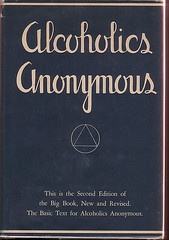
The 4th edition of AA’s Big Book, which is the most current, is available online.