Brookston Beer Bulletin

Jay R. Brooks on Beer

  • Home
  • About
  • Editorial
  • Birthdays
  • Art & Beer

Socialize

  • Dribbble
  • Email
  • Facebook
  • Flickr
  • GitHub
  • Instagram
  • LinkedIn
  • Pinterest
  • RSS
  • Twitter
  • YouTube

Powered by Genesis

A New Justification For More Beer Taxes

September 26, 2010 By Jay Brooks

rwjf
Ugh, here we go again. Three researchers at the University of Florida, led by epidemiologist Alexander C. Wagenaar, have just released a new study which they claim shows that raising alcohol taxes — in fact doubling them — will reduce consumption and cure society’s problems.

The study, Effects of Alcohol Tax and Price Policies on Morbidity and Mortality: A Systematic Review, is to be published in the November issue of the American Journal of Public Health, but was released online last week, as is common for academic journals.

As I don’t have the resources to buy a subscription to every related academic journal, I have to make do with the abstract and what other news outlets write about it. Here’s the abstract:

Objectives. We systematically reviewed the effects of alcohol taxes and prices on alcohol-related morbidity and mortality to assess their public health impact.

Methods. We searched 12 databases, along with articles’ reference lists, for studies providing estimates of the relationship between alcohol taxes and prices and measures of risky behavior or morbidity and mortality, then coded for effect sizes and numerous population and study characteristics. We combined independent estimates in random-effects models to obtain aggregate effect estimates.

Results. We identified 50 articles, containing 340 estimates. Meta-estimates were r=–0.347 for alcohol-related disease and injury outcomes, –0.022 for violence, –0.048 for suicide, –0.112 for traffic crash outcomes, –0.055 for sexually transmitted diseases, –0.022 for other drug use, and –0.014 for crime and other misbehavior measures. All except suicide were statistically significant.

Conclusions. Public policies affecting the price of alcoholic beverages have significant effects on alcohol-related disease and injury rates. Our results suggest that doubling the alcohol tax would reduce alcohol-related mortality by an average of 35%, traffic crash deaths by 11%, sexually transmitted disease by 6%, violence by 2%, and crime by 1.4%.

Those are some pretty specific promises and some pretty specific recommendations, something most academic papers assiduously avoid. To me that’s a red flag about the intentions of this study.

Science Daily covered the study in an article today (thanks to Richard S. for sending me the link) entitled Increasing Taxes on Alcoholic Beverages Reduces Disease, Injury, Crime and Death Rates, Study Finds. Obviously, I’m as predisposed to question such a study as the average anti-alcohol wingnut is to swallow it unquestioningly. And I confess something doesn’t smell right with it. My alky sense is tingling.

Having not seen the full article, I’m left wondering exactly what the “50 published research papers containing 340 estimates” means. What is being “estimated?” It reads like it’s the supposed harm that’s being estimated, because I can’t for the life of me understand how you could ever say there’s definitive causation for such a complex relationship as the price of something to “other misbehaviors,” or indeed any of the laundry list of issues the researchers believe are caused by people drinking alcohol. In my experience at looking at these studies, any event in which there was alcohol present is usually sufficient to consider the incident alcohol-related, but that’s nowhere near the same as having been caused by the alcohol. And so these statistics tend to be inflated and, consequently, misused.

But the key insight into the study came in the very last paragraph of Science Daily’s coverage of the study, where they reveal that the funding for the study came from the notorious Robert Wood Johnson Foundation (RWJF), the godfather of neo-prohibitionist groups. The RWJF funds many other neo-prohibitionist groups, and also sets the national agenda in the anti-alcohol community. That they funded this, and other similar studies, suggests that the answer preceded the study, that is it was designed to support their agenda, its conclusions a fait accompli.

To me this also explains professor Wagenaar’s statement. “Results are surprisingly consistent.” Of course, they would be if you’re looking for a correlation. The same team did a similar study in 2007, Raising Alcohol Taxes Reduces Deaths, Study Finds where they examined alcohol-related deaths in Alaska after beer taxes were raised in the state. That study was also funded by the RWJF. Predictably they found the correlation they were looking for, but this is playing with statistics for incredibly complex relationships. Their simple conclusions seem absurd. They ignore any underlying causes for alcohol abuse or suicide or anything else, for that matter. As almost every study like this I’ve ever seen, “alcohol-related” is a thinly veiled attempt to paint any alcohol use, however responsible or moderate, as dangerous and life-threatening. Beer is not a syringe of heroin, despite these same groups’ attempts to portray it that way.

Mark my words, we’re going to see this study used by groups all over the country in renewed efforts to raise beer taxes in state after state. But the only thing I remember happening when the federal excise tax on beer was doubled in 1990 was a loss of jobs and long term economic harm visited on the brewing industry. I don’t recall seeing any victory parties by the anti-alcohol groups once that doubling cured all the problems they previously ascribed to alcohol. They went right on complaining about all the supposed damage caused by the industry. That’s a real world example of what they want to do having none of the outcomes this new study claims would occur under the exact same conditions.

Filed Under: Beers, Editorial, News, Politics & Law Tagged With: Prohibitionists, Science, Statistics

Heavy Drinkers Outlive Abstainers

August 31, 2010 By Jay Brooks

binge-barney
Many different studies have shown that people who drink alcohol in moderation liver longer than binge drinkers and abstainers. Anti-alcohol groups, and especially AA, have petulantly insisted the reason that abstainers show up in the data as having shorter lifespans than moderate drinkers is because they are all former heavy drinkers who stopped drinking after the damage was done. A new study finally puts that self-serving lie to rest.

Late-Life Alcohol Consumption and 20-Year Mortality was recently published in the journal Alcoholism: Clinical and Experimental Research. The study examined “the association between alcohol consumption and all-cause mortality over 20 years among 1,824 older adults, controlling for a wide range of potential confounding factors associated with abstention.” The results, according to the abstract were the following;

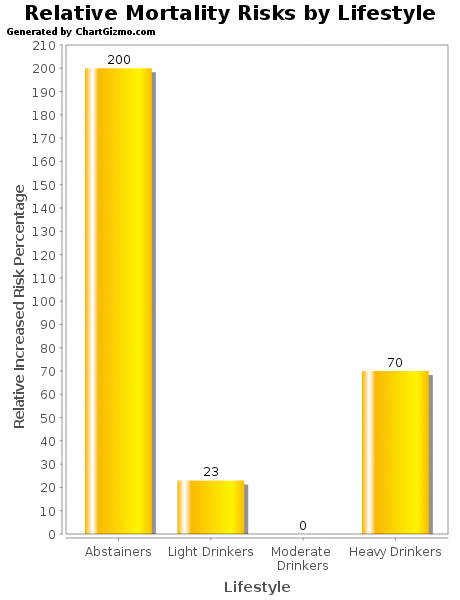
Controlling only for age and gender, compared to moderate drinkers, abstainers had a more than 2 times increased mortality risk, heavy drinkers had 70% increased risk, and light drinkers had 23% increased risk. A model controlling for former problem drinking status, existing health problems, and key sociodemographic and social-behavioral factors, as well as for age and gender, substantially reduced the mortality effect for abstainers compared to moderate drinkers. However, even after adjusting for all covariates, abstainers and heavy drinkers continued to show increased mortality risks of 51 and 45%, respectively, compared to moderate drinkers.

And here it is again in a handy chart I made:

mortality-risk

See, drinking is good for you. It is part of a healthy lifestyle. Drinking moderately is the best choice you can make to lead a healthier life. It’s better for you than drinking only occasionally, drinking heavily or not at all.

Here’s how Time Magazine put it.

But even after controlling for nearly all imaginable variables — socioeconomic status, level of physical activity, number of close friends, quality of social support and so on — the researchers (a six-member team led by psychologist Charles Holahan of the University of Texas at Austin) found that over a 20-year period, mortality rates were highest for those who had never been drinkers, second-highest for heavy drinkers and lowest for moderate drinkers.

They conclude:

These are remarkable statistics. Even though heavy drinking is associated with higher risk for cirrhosis and several types of cancer (particularly cancers in the mouth and esophagus), heavy drinkers are less likely to die than people who have never drunk. One important reason is that alcohol lubricates so many social interactions, and social interactions are vital for maintaining mental and physical health. As I pointed out last year, nondrinkers show greater signs of depression than those who allow themselves to join the party.

That said, the new study provides the strongest evidence yet that moderate drinking is not only fun but good for you. So make mine a double.

Of course, the researchers bend over backwards to make sure no one thinks they might be advocating for drinking. Heaven forbid. That’s been pretty much SOP for academic papers that have findings at odds with the anti-alcohol community for as long as I can remember. If they discovered tomorrow that chocolate cured cancer, do you think there would be warnings about the dangers of obesity attached to it? My point is everything has consequences but it seems that alcohol continues to carry a stigma that most others do not.

Still, this is great news.

Filed Under: Beers, Editorial, News, Politics & Law Tagged With: Prohibitionists, Science, Statistics

The Science Of Smell

August 30, 2010 By Jay Brooks

smell
NPR’s Science Friday had a show last week devoted to The Science of Smell. If you’ve ever taken tasting beer seriously, you know how important smell is to the flavor of beer (and everything else). Host Ira Flatow discussed Olfaction with research scientists Stuart Firestein and Donald Wilson. The show’s only a little under 18 minutes but is pretty interesting.

For example, twenty years ago [the field of olfaction] made the most important discovery in the modern era of olfaction, which “was the identification and cloning of a large family of receptors in our noses that mediate the sense of smell that act like a lock. If you think of it, odor is a key, and when they fit together, the brain is clued in to the fact that this odor is out there somehow. And this identification of this large, large family of genes, a thousand of them in many animals, as many as 450 in us, mediates this smell.

This turns out to be “the largest gene family in the mammalian genome. The mammalian genome, typically, we think consists of about 25,000 genes. So in a mouse, it’s about 5 percent of the genes and even in us, it’s almost 2 percent. About one out of every 50 genes in your genome was devoted to your nose.”

And here’s a later revealing exchange, from the transcript:

Dr. FIRESTEIN: I think we use our nose a lot more than most people believe. The biggest problem with our sense of smell or the feeling that we don’t have a good sense of smell is actually our bipedalism, the fact that we walk on two legs. And we have our noses stuck up here five or six feet in the air, when all the good odors are about eight or 10 inches off the ground. Or for example, as the case with other animals, they’re more willing to put their nose where the odors are, shall we say, delicately.

FLATOW: And well, we’ve always heard that animals like let’s pick out dogs, bloodhounds and things like that, that dogs are able to smell so much more sensitively than us in all different kinds of smells. Is that true?

Dr. FIRESTEIN: Well, it’s a good question. I mean, I often say to people who ask me that question, if they have such a good sense of smell, why do they think they do that greeting thing that they do?

Dr. FIRESTEIN: You think you could do that from 10 feet away, you know?

FLATOW: Well, that’s true. They get right up there and sniff you.

Dr. FIRESTEIN: Boy, they sure do.

FLATOW: So why do they need to be so close if they smell…

Dr. FIRESTEIN: Yes, well so some of this is behavioral, and a part of it, the another way to show that, I think, for humans, is that we actually have very sophisticated palate, for example, for food, much more than many other animals and we know that most of flavor is really olfaction.

And here’s another interesting exchange about the specifics of our sense of smell, insert “beer” in the place of “coffee” and the process of judging beer critically works the same way.

FLATOW: Don Wilson, tell us what happens what is connected to our noses in the sensory? What goes on in the brain when we smell something?

Dr. WILSON: Well, it’s actually really exciting because – so these you mentioned the ABCs of olfaction. I think that’s a good analogy because these hundreds of different receptors that Stuart just mentioned essentially are recognizing different features of a molecule. You don’t have — for most of odors, you don’t have a receptor for that particular odor. You don’t have a coffee receptor or a vanilla or a strawberry receptor. You have receptors that are recognizing small pieces of the molecules that you’re inhaling, and the aroma of coffee, for example, is made up of hundreds of different molecules.

So what the brain then has to do is make sense of this pattern of input that’s coming in: I’ve got receptors A, B and C activated when I smell this odor, and I’ve got receptors B, C, D and E activated when I smell this other odor. And what we’ve found is that what the brain is really doing with the olfactory cortex and the early parts of the olfactory system are doing is letting those features into what we and others would consider something like an odor object, so that you perceive now a coffee aroma from all of these individual features that you’ve inhaled. And, in fact, once you’ve perceived that coffee aroma, you really can’t pick out that, you know, there’s a really good ethyl ester in my Starbucks today or something – you really have an object that you can’t break down into different components. So that’s what the brain is doing.

And we know that part of that building of the object, that synthetic processing of all these features, is heavily dependent on memory. So you learn to put these features together and experience this odor the first time. So it’s really a – in some ways, olfaction seems really simple. They suck a molecule up my nose and it binds to a receptor and so I must know what I’ve just inhaled. But, in fact, it’s a fairly complex process where it’s akin to object perception and other sensory systems.

FLATOW: Does the fact that it elicits such strong memories — you know, so you can a smell from 40 years ago or something. Is it because — are they close together, the centers for smell and memory in the brain?

Dr. WILSON: Well, in humans, it’s — in some ways, the olfactory cortex is really enveloped by — embraced by parts of the brain that are important for emotion and memory. There are direct reciprocal connections between the olfactory system and the amygdala and hippocampus, these parts that are important for emotion and memory. So – and we think that as you’re putting these features together to make this perceptual object, the brain and the cortex is also sort of listening to the context of which I’m smelling it, maybe the emotions that I’m having as I’m smelling it. And those can, in fact, we think can become an integral part of the percept itself. So it not only becomes difficult to say what the molecules were within that coffee aroma, but it also becomes difficult to isolate the emotional responses you’re having with that same odor.

After that they go on about memory and aromas, and then take calls from listeners. You can also hear the entire discussion below or at Science Friday’s website (or download it below or at NPR) and also see the full transcript.


download mp3:

Filed Under: Beers, Just For Fun, Related Pleasures Tagged With: Aroma, Science, Senses

Anatomy Of A Hangover

August 28, 2010 By Jay Brooks

hangover-vise
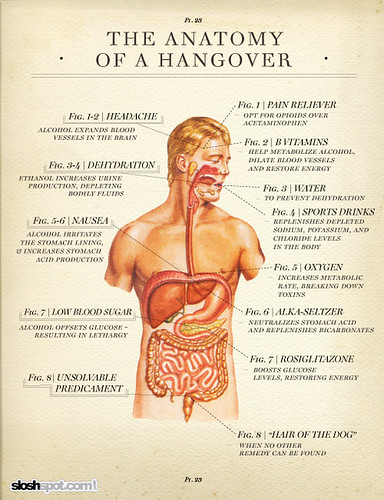
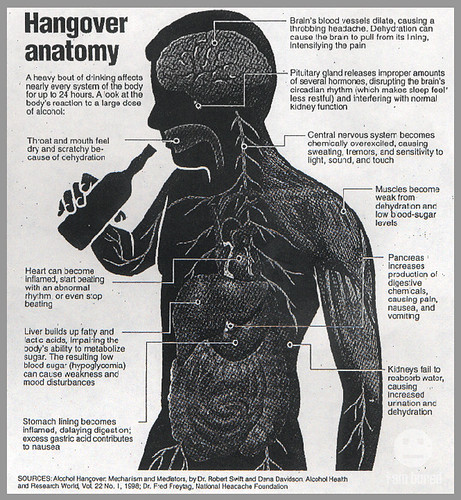
Here’s an interesting couple of infographics about how a hangover effects your body. The first is from Sloshspot (though I can’t find the original post) and the second is from an academic paper, Alcohol Hangover: Mechanism and Mediators, written in 1998.

hangover-anatomy-1
For a larger view, click here.

hangover-anatomy-2
For a larger view, click here.

Filed Under: Beers, Just For Fun Tagged With: Hangovers, Health & Beer, Science

Civilization’s First Decision: Orgies Or Beer?

August 19, 2010 By Jay Brooks

ninkasi-tablet
Gizmodo has an intriguing post up right now, combining ideas from two books about early man and the dawn of civilization, Sex at Dawn: The Prehistoric Origins of Modern Sexuality and Uncorking the Past: The Quest for Wine, Beer, and Other Alcoholic Beverages. In Orgies or Beer? You Only Get One, author Joel Johnson speculates that early man eschewed group sex with multiple partners to settle down and make beer, setting us on the path to modern civilization, monogamy and the happy hour. As long as you don’t take it too seriously, it’s a pretty funny idea. (In other words, you can safely ignore the many outraged commenters who seem to have confused Gizmodo with an academic journal, they’re an entirely different kind of funny.)

As Patrick McGovern makes the case in Uncorking the Past, a growing body of evidence is pointing to alcohol — and most likely beer, or a rudimentary form of it, at least — as the reason early nomadic man settled down, in order to grow the crops to insure a steady supply of it. In other words, beer, rather than bread, may have been responsible for civilization as we know it today, with all its good and bad developments and legacies. In the newer book, Sex at Dawn, authors Christopher Ryan and Cacilda Jethá argue that what we gave up for civilization, agriculture and beer was free love, group sex and orgies. Gizmodo summarizes the book’s claims in chart form.

agro-to-war

One thing that’s funny about the chart is that everything leads to war, and the most hate-filled comment that I ever received was from someone calling himself “The Savagist” who took that same view to ridiculous heights. He vehemently believed that beer and alcohol were directly responsible for every bad thing that ever happened in the history of mankind, ignoring anything good that civilization also brought. Given his epithet, one might have reasonably presumed he had or wanted to return to that savage “pre-civilized” time, but he was obviously still living in a building, with electricity, and typing on a computer connected to the internet, with no sense of irony. Apparently, when he looked in Pandora’s Box, there was no hope at all after beer released all the evil into the world. Me, I found hope … and hops.

But back to Sex at Dawn, and the key points, as laid down in the Gizmodo article:

  • Before humans settled down into civilization, we were small bands of hunter-gatherers who had no notion of sexual monogamy. Within our relatively small tribes, most humans had multiple partners, primarily from within the tribal group, although occasionally we’d have a dalliance with a stranger to keep the DNA pool zesty. Children had multiple social “fathers,” jealousy was nearly nonexistent, and relatively easy access to calories kept us fit, happy, and satisfied well into our 70s and 80s—provided we managed to get past the perils of high mortality rates expected from a wild environment and primitive medicine.
  • Upon the discovery of agriculture, nomadic wandering was no longer possible—someone has to stick around to water the crops—so the ideas of property and inheritance became sadly useful. Domesticated food could become scarce, unlike the effectively endless bounty of hunter-gathering (ignoring the occasional climate-torqued famine or run of bad luck), so hoarding became necessary to ensure calories even in lean times. It’s a lot of work to farm, so it became important to ensure that you weren’t wasting your precious grains on someone else’s offspring, especially if it meant you own kid was getting short shrift. Hence monogamy, marriage, and the unfortunate concept of partners as property, manifested in agrarian societies as a tendency to view women as chattel.
  • Our genes, still tuned toward sexual novelty, cause us to really hate being monogamous, but societal pressures—including centralized codified religion—force men and women into an arrangement that brings with it just as many problems as it solves. Men cheat, women wither in sexual shackles (or, you know, cheat), wars erupt over resources or sexual exclusivity, cats and dogs almost start sleeping together except they’re afraid the neighbors might find out—Old Testament, real wrath of God-type stuff.

But accidental alcohol was around for probably millions of years and the “drunken monkey hypothesis” proposed by biologist Robert Dudley “attempts to explain why our bodies have evolved such a happy capacity for metabolizing ethanol.” McGovern extends that idea in Uncorking the Past.

On average, both abstainers and bingers have shorter, harsher lives. The human liver is specially equipped to metabolize alcohol, with about 10 percent of its enzyme machinery, including alcohol dehydrogenase, devoted to generating energy from alcohol. Our organs of smell can pick up wafting alcoholic aromas, and our other senses detect the myriad compounds that permeate ripe fruit.

A couple of years ago, this came up in a different context, in a post I wrote entitled Beer and Civilization which discussed a book by Steven Johnson entitled The Ghost Map: The Story of London’s Most Terrifying Epidemic — and How It Changed Science, Cities, and the Modern World. In Johnson’s book, he discusses how at the dawn of civilization, survival often depended on how a person’s body reacted to and could tolerate the beer that was generally safer to drink than water. Over time, only people who were genetically predisposed with the ability to drink large quantities of beer survived, passing that trait down to their children so that perhaps today most of us have such an ancestor as evidenced simply by the fact that we’re here. As [George] Will (and Johnson) explains.

The gene pools of human settlements became progressively dominated by the survivors — by those genetically disposed to, well, drink beer. “Most of the world’s population today,” Johnson writes, “is made up of descendants of those early beer drinkers, and we have largely inherited their genetic tolerance for alcohol.”

But sitting here in my pajamas, typing on my laptop, beer in hand, surrounded by the trappings of modern society, I can’t help but think we made the right choice. I know the world has many, many challenges and problems but would any of us be happier crawling around the Savannah in a loincloth hunting (and gathering) for our next meal — and without a beer to pair with it? Beer may have been responsible for the single greatest butterfly effect in our civilization’s history because it’s nearly impossible to say what life might be like had we not taken the path we’re on. Did we give up orgies for our beer and civilization? Who knows, but I still think we chose wisely.

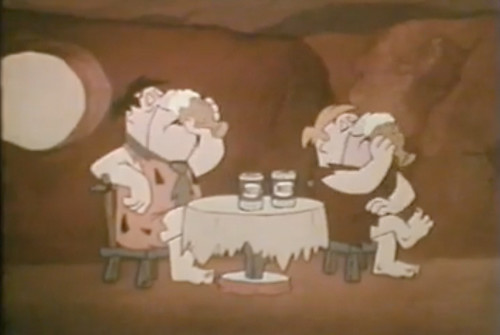
Another funny and very interesting excerpt from Sex at Dawn is The Flintstonization of Prehistory in which modern morals and values are super-imposed on to the past.

flint-busch-3

Filed Under: Beers, Editorial, Food & Beer, Just For Fun Tagged With: Archeology, Beer Books, History, Science

Awesomely Geeky Science Beers From Wired

August 10, 2010 By Jay Brooks

triceratops
Wired Magazine has a funny, and interesting, post about seven science-influenced craft beers, by Betsy Mason, who earlier had a very funny post, proving Why Geologists Love Beer. The seven beers are listed below. Give it a read.

  1. Tricerahops Double IPA (Ninkasi Brewing)
  2. Pangaea Ale (Dogfish Head)
  3. Biere de Mars (New Belgium Brewing)
  4. Pliny the Elder (Russian River Brewing)
  5. Evolution Amber Ale (Wasatch Brewing)
  6. Moog Filtered Ale (Asheville Brewing)
  7. Gigabit IPA (Hopworks Urban Brewery)

Filed Under: Beers, Just For Fun Tagged With: Humor, Science

Don’t Let Facts Get In Your Way

July 7, 2010 By Jay Brooks

marin-institute
Regular Bulletin readers know how I feel about the Marin Institute. They style themselves as a “watchdog” group but in reality they’re a run of the mill anti-alcohol, neo-prohibitionist group. I often accuse them of going to great lengths to distort facts or manufacture reality to further their cause, taking an ends justify the means approach to everything they do. The “charge for harm” nonsense they’re trying to foist on San Francisco is a prime example, but today witnessed an even clearer example of how far they’ll go in bending reality to their will.

The USDA has released their updated version of the Dietary Guidelines For Americans 2010, where they looked at more recent research regarding food and beverages of all kinds, updating the 2005 edition (it’s regularly updated every five years). Well, this is bad news for the anti-alcohol folks, because recent science has been revealing more and more health benefits for the moderate consumption of alcohol, and so not surprisingly, that’s what is reflected in the new guidelines. But the Marin Institute has never been one to let facts stand in their way, and so they’ve wasted no time in criticizing the report’s findings and asking their unquestioning faithful to do likewise, calling the whole thing “dangerous” and “unscientific,” despite the fact that the whole report is based on science and each study relied upon is cited in the bibliography. It’s laughable that they’d call it “unscientific” while they themselves just shout it down and spread propaganda and utterly nonfactual claims about why they don’t like its conclusions. To them, it’s only science if they agree with the results. To me, that’s far more dangerous than anything in the report.

So what does this dangerous report say? It’s Chapter 7 that tackles alcohol and it’s fairly balanced from my point of view, and probably would be for any reasonable person. It talks about both the risks of over-consumption and the benefits of moderate drinking. It’s quite cautious in making any affirmative recommendations. There were also some interesting statistics. For example, I’d often heard that about a third of adults don’t drink alcohol, but a recent survey revealed that 76% of men and 65% of women had consumed alcohol in the past year. Most compelling was the decision to change the definition of moderate drinking from a daily standard to a weekly one, and to raise the daily recommendations from 2/1 (men/women) to 4/3.

The recent release of Rethinking Drinking by the National Institutes of Alcohol Abuse and Alcoholism (NIAAA), provides guidelines that are consistent, in part, with the 2005 Dietary Guidelines, but also add additional guidance on weekly patterns of consumption. This NIAAA booklet, which is also designed to help individuals drink less if they are heavy or “at risk drinkers,” defines “low-risk” drinking as no more than 14 drinks a week for men and 7 drinks a week for women with no more than 4 drinks on any given day for men and 3 drinks a day for women (NIAAA, 2009).

The 2010 Dietary Guidelines Advisory Committee (DGAC) largely agreed with this definition of moderation from the NIAAA because it implied that consumption was based on daily intake averaged over the week and also because the NIAAA guideline was generally consistent with the recommendation from the 2005 Dietary Guidelines.

Not surprisingly, this caused the Marin Institute to go apoplectic. Of course, the definition of “binge drinking” has been five drinks in a single session, which is laughingly absurd, especially so now in light of four being considered within the bounds of moderation. The five-drink-standard branded every single person who attends a five-course beer dinner a binge drinker, which is utter nonsense.

dietary-guidelines-2010

The Dietary Guidelines also asked some interesting questions about the effects of moderate drinking, and reports some findings that the anti-alcohol groups will have a hard time dismissing, and in fact any rebuttal of them is so far missing from their complaints. For example:

What is the Relationship between Alcohol Intake and Cognitive Decline with Age?

Conclusion

Moderate evidence suggests that compared to non-drinkers, individuals who drink moderately have a slower cognitive decline with age. Although limited, evidence suggests that heavy or binge drinking is detrimental to age-related cognitive decline.

Implications

Alcohol, when consumed in moderation, did not quicken the pace of age-related loss of cognitive function. In most studies, it was just the opposite—moderate alcohol consumption, when part of a healthy diet and physical activity program, appeared to help to keep cognitive function intact with age.

They also did a meta-study on the effects of moderate drinking on total mortality, meaning how does responsible drinking do in creating a more or less healthy lifestyle. Predictably, it was found that a majority, if not all, of the studies examined show a positive correlation between moderate drinking and living longer and being more healthy.

Total Mortality. In most Western countries where chronic diseases such as CHD, cancer, stroke and diabetes are the primary causes of death, results from large epidemiological studies consistently show that alcohol has a favorable association with total mortality especially among middle age and older men and women. A recent updated meta-analysis of all-cause mortality demonstrated an inverse association between moderate drinking and total mortality (Di Castelnuovo, 2006). The relative risk of all-cause mortality associated with moderate drinking was approximately 0.80. The J-shaped curve, with the lowest mortality risk for men and women at the average level of one to two drinks per day, is likely due to the protective effects of moderate alcohol consumption on CHD, diabetes and ischemic stroke as summarized in this chapter.

In other words, you’ll be healthier if you have one or two beers a day. But woe be to any brewery that might think to actually suggest that to a potential customer. That’s where the neo-prohibitionists are most worried. In the conclusion to their comments to the new dietary guidelines, the Marin Institute are very “concerned.” Here are some excerpts of their worrying, and my open letter response as to why they’re on the train to loony town.

There is no public health organization that recommends starting to drink alcohol for abstainers, or drinking more alcohol for current drinkers, as either a preventive behavior to address specific medical problems, or as a population-level primary prevention strategy.

Perhaps not, but there should be. The only reason there isn’t, is because organizations like the Marin Institute would treat such a recommendation as a declaration of war. Even though the facts indicate that moderate drinking is healthier than abstaining, nobody would dare to state the obvious conclusion to draw from that just because of how they’d react, in other words fear is the reason, not common sense.

Indeed, federal, state, local and community public health agencies, including Marin Institute, work tirelessly to address the tremendous physical, social, and economic harm caused by alcohol. Yet the Report sounds as if drinking alcohol is not only a suggested therapeutic option to discuss with one’s doctor, but also a general recommendation for all Americans to consider as part of an overall wellness plan.

It “sounds as if drinking alcohol is a therapeutic option” because it is. Alcohol does not cause the harm, too much alcohol may cause harm, but moderate consumption is beneficial. You just continuing to say the opposite of what’s true doesn’t make it any less so.

The Committee must be aware that the Report’s messages about alcohol consumption will be misinterpreted by the powerful corporations and trade organizations that sell and promote alcoholic beverages. The alcohol industry has a long history of exploiting the Dietary Guidelines for their benefit, and the suggestions contained in the Report lend themselves to further misuse. We are especially concerned that despite the Report’s caveats, the industry will use the new recommendations to promote alcohol consumption and increased consumption.

Don’t worry, you’re safe. Maybe you should relax and enjoy a frosty beverage; perhaps I could suggest a beer? You must think the alcohol companies are pretty stupid, despite how shrewd you usually paint them. With you “watchdogging” them, there’s no way any alcohol company could launch a campaign suggesting people start drinking or drinking more, even though the evidence points to the fact that it wouldn’t be a bad idea. At any rate, thanks to your predecessors after prohibition, the advertising guidelines already expressly forbid health claims, so as usual you’re worrying about nothing.

We also ask that the Committee revise the Report and subsequent Guidelines to send a much more cautionary, evidence-based message regarding alcohol consumption to the public. Finally, we recommend that the new Guidelines maintain the formulation of 2/1 per-day consumption of alcohol. We urge you to err on the side of caution when recommending safe alcohol consumption levels and behaviors to improve health and prevent harm.

Err on the side of caution? Let’s see, they reviewed the science and came to a conclusion you didn’t like. That’s not an error or not being cautious, it’s simply letting facts dictate what makes sense in terms of a policy of what’s best for the average person.

But your whole posturing, tantrum-filled press release and comments speak volumes about your real intentions. While an average person might look at those findings and think to themselves, “great, it’s good to be informed and know how eating and drinking certain things will affect me. Now I can make an informed decision on how to live my life.” But you look at that and instead cry, “I don’t like those finding, they must be wrong. There’s science behind it, but I don’t like the conclusions so the science must be wrong. I don’t like the recommendations, so they must be “dangerous.”

I know it’s nearly impossible for the Marin Institute or any similar organization to have an open mind and be reasonable about these sorts of things. Fanaticism is rarely compatible with reason or common sense. But I continue to marvel at how any organization who never misses an opportunity to call an alcohol company on not being truthful can themselves be so fast and loose with the truth. Lying to keep someone else truthful (or at least for a cause you believe in) seems completely immoral, or at least amoral, to me. If the facts are contrary to your point of view, maybe it’s your point of view that’s wrong? Maybe it’s time to question your assumptions? I know that’s not going to happen, but not letting the facts get in your way by just ignoring them or pretending they don’t exist or are wrong isn’t going to fool anybody except the people who you’ve hoodwinked already. And maybe that’s their point in the end, maybe it’s just about keeping the faithful faithful by telling them what they want to hear and appearing to fight their absurd fight. But I sure wish they’d let the facts get in their way.

Filed Under: Beers, Editorial, News, Politics & Law Tagged With: Prohibitionists, Science, Statistics

Manipulation Of The Crowd: Online Ratings

July 4, 2010 By Jay Brooks

science
The latest issue of Scientific American has an interesting article, Manipulation of the Crowd: How Trustworthy Are Online Ratings?, a topic of interest to any brewery who’s ever received a bad review from either Beer Advocate or Rate Beer. Intuitively, it’s seemed to me that the overall quality of the ratings on those sites have been improving as they’ve matured and built up the number of users and reviews.

According to Scientific American, the bad news is that while most review-driven websites don’t accurately reflect the expected statistical bell curve (which would imply their accuracy), the good news is that the beer reviews online prove the exception to the rule and are, in fact, more often fairly and reasonably accurate.

The philosophy behind such rating sites is known as the “crowdsourcing strategy” insofar as the “truest and most accurate evaluations will come from aggregating the opinions of a large and diverse group of people.” But according to Eric K. Clemons, at the Wharton School of the University of Pennsylvania, ratings sites like Amazon, TripAdvisor and Yelp “suffer from a number of inherent biases.”

  1. Disproportion: “People who rate purchases have already made the purchase. Therefore, they are disposed to like the product. ‘I happen to love Larry Niven novels,’ [professor Eric K.] Clemons says. “So whenever Larry Niven has a novel out, I buy it. Other fans do, too, and so the initial reviews are very high—five stars.” The high ratings draw people who would never have considered a science-fiction novel. And if they hate it, their spite could lead to an overcorrection, with a spate of one-star ratings.”
  2. Polarization: “People tend not to review things they find merely satisfactory. They evangelize what they love and trash things they hate. These feelings lead to a lot of one- and five-star reviews of the same product.”
  3. Oligarchy of the Enthusiastic: “A small percentage of users account for a huge majority of the reviews. These super-reviewers—often celebrated with ‘Top Reviewer’ badges and ranked against one another to encourage their participation—each contribute thousands of reviews, ultimately drowning out the voices of more typical users (95 percent of Amazon reviewers have rated fewer than eight products). ‘There is nothing to say that these people are good at what they do,’ [computer scientist Vassilis] Kostakos says. ‘They just do a lot of it.’ What appears to be a wise crowd is just an oligarchy of the enthusiastic.”

Yelp, the one I’ve heard more people consistently complain about, apparently has some of the worst transparency issues and there’s the “perception that the company itself might be manipulating the playing field.”

A separate look at Netflix user data, Dissecting the Netflix Dataset, found some of the same relationships in rating the films rented from Netflix. For example, the average rating for a film is 3.8 (out of 5), neatly fitting the average bell curve results, such as this study mentioned in Scientific American.

A controlled offline survey of some of these supposedly polarizing products revealed that individuals’ true opinions fit a bell-shaped curve—ratings cluster around three or four, with fewer scores of two and almost no ones and fives. Self-selected online voting creates an artificial judgment gap; as in modern politics, only the loudest voices at the furthest ends of the spectrum seem to get heard

A similar look at IMDb ratings, Mining gold from the Internet Movie Database, part 1: decoding user ratings, saw complimentary results and the same looking bell curve. The average rating on the IMDb was 6.2 (out of 10) and the median was 6.4.

It seems that the more popular a ratings website is, and consequently the more reviews it gets, the more reliable the results are, or at least the better they seem to fit the bell curve of expected distribution of reviews that usually result from non-online sources. The higher number of reviews, the more fringe reviews at either ends of the spectrum are less heavily weighed. Unless, of course, it just plain sucks or everyone agrees on how terrific it is, but that’s most likely a situation that’s pretty rare.

But, as I said at the outset, the good news is that those problem issues with online ratings are apparently not a problem for the beer ratings websites, which are specifically mentioned as an instance where the crowdsourcing model does work.

RateBeer.com, which has attracted some 3,000 members who have rated at least 100 beers each; all but the most obscure beers have been evaluated hundreds or thousands of times. The voluminous data set is virtually manipulation-proof, and the site’s passionate users tend to post on all beers they try—not just ones they love or hate.

I’m quite certain those numbers would be similar for Beer Advocate, too, of course, suggesting that for both of the most popular beer ratings websites, that the results have become reasonably reliable, especially for the beers that have been most heavily reviewed. For new beers with just a few reviews, obviously it wouldn’t automatically be as reliable, but the only way to build up reviews is start somewhere. And that’s where looking more carefully at the reviewers becomes more important. A review with only 5 reviews where all 5 reviewers are experienced would arguably be different from one where all 5 reviewers were rookies or had very little experience. Obviously, the number of reviews a person has done is no guarantee that his or her reviews are better or more reliable, but it stands to reason that anyone who takes something seriously and continues to practice it will improve over time. And like craft beer itself, the longer it’s been around, the better it gets. It’s nice to see some scientific support to confirm that intuition.

Filed Under: Beers, Editorial, Related Pleasures, Reviews Tagged With: Science

The Science Of Parenting & Drinking

June 30, 2010 By Jay Brooks

science
Often times, science conducts studies that test theories that most of us pretty much take for granted. A few recent examples include the fact that too many meetings cause stress and unproductive employees (Group Dynamics, March 2005), objects are harder to see when they’re farther away (Psychonomic Bulletin & Review, Feb. 2005) and it’s harder to remember stuff and concentrate when you’re older (Journal of Experimental Psychology, May 2005). [From PopSci’s Science Confirms the Obvious.] I’ve always referred to such studies as “d’uh” studies, because the results are often so head-smackingly obvious. But they do have value since they do confirm and quantify things we take for granted and even occasionally disprove cherished beliefs.

A new d’uh study has just been published by the Journal of Studies on Alcohol and Drugs. The study, entitled Parenting Style, Religiosity, Peers, and Adolescent Heavy Drinking, was conducted by two sociology professors, Steve Bahr and John Hoffmann, at Brigham Young University.

Here’s part of the press release they sent out:

Parents may be surprised, even disappointed, to find out they don’t influence whether their teen tries alcohol.

But now for some good news: Parenting style strongly and directly affects teens when it comes to heavy drinking — defined as having five or more drinks in a row — according to a new Brigham Young University study.

The researchers surveyed nearly 5,000 adolescents between the ages of 12 and 19 about their drinking habits and their relationship with their parents. Specifically, they examined parents’ levels of accountability — knowing where they spend their time and with whom — and the warmth they share with their kids. Here’s what they found:

  • The teens least prone to heavy drinking had parents who scored high on both accountability and warmth.
  • So-called “indulgent” parents, those low on accountability and high on warmth, nearly tripled the risk of their teen participating in heavy drinking.
  • “Strict” parents – high on account ability and low on warmth — more than doubled their teen’s risk of heavy drinking.

About.com’s Alcoholism page added the handy chart below.

Researchers at Brigham Young University asked 4,983 adolescents between age 12 and 19 about their drinking habits and their relationship with their parents. As a result, the researchers identified four parenting styles:

  • Authoritative Parents: Rank high in discipline and monitoring (accountability) and high in support and warmth.
  • Authoritarian Parents: Rank high in control, but low in warmth and support.
  • Indulgent Parents: Rank high in warmth and support, but low in accountability.
  • Neglectful Parents: Rank low in support, warmth, and accountability.

It’s apparently only the first parenting type — Authoritative — that is effective in reducing binge drinking in teens. And that’s where the d’uh comes in. I’m going to guess that the authoritative style of parenting is more effective in a wide range of behaviors, because we’ve all seen or experienced the effects of other kinds of parents. Extremes are rarely a good idea. Too strict is bad, and so is too lenient. What a revelation! Goldilocks had it right after all.

But I would also suggest that such parents would teach their children about alcohol, possibly sampling them on it it a controlled environment, such as at dinner, teaching them about it, and modeling the behavior of moderate and responsible alcohol use. And these are exactly the kinds of steps that so many anti-alcohol groups are dead set against and have even made illegal in some states.

Anti-alcohol groups instead use fear and scare tactics to keep kids from drinking, a notoriously ineffective method. They preach abstinence and just saying “no.” MADD runs a program, with local law enforcement, where schools pretend a popular kid has been killed by a drunk driver and then use the grief (which is real to the kids) to scare them into pledging not to drink, causing all manner of emotional harm. These are not the actions of parents who are “supportive” and show “warmth” toward their children.

Curiously, while most news sources that picked up the press release titled their piece something along the lines of Parenting Style Influences Teen Binge Drinking, Parenting Style Can Prevent Teen Binge Drinking , Parenting style can prevent heavy drinking or Teens and Alcohol Study: After a Few Drinks, Parenting Style Kicks in, anti-alcohol groups ran a very different headline. For example the Mormon Times used the headline BYU study finds indulgent parents may aid binge drinking, ignoring entirely the fact that the study also showed that strict parents were similarly ineffective. In fact, not once in the entire article does the author ever even mention that “strict” parents — high on accountability and low on warmth — more than doubled their teen’s risk of heavy drinking.” Draw your own conclusions.

Likewise, the neo-prohibitionist organization Join Together titled their take on the study Being a Strict Parent Doesn’t Protect Against Youth Drinking, Study Says. As one commenter on their website points out, “shouldn’t the headline of this article REALLY read: ‘Kids with loving, engaged parents less likely to drink’? In other words, the STRICT-NESS of parents is not where fault lies. The headline is a bit misleading.”

But it makes sense in terms of such anti-alcohol policy and rhetoric, where the emphasis is always on the negative. Their whole focus was on what parenting styles didn’t work in keeping kids from binge drinking, ignoring entirely what was effective, at least according to the study. Why does that matter? I think it matters because it shows where the priorities lie with such organizations. They’re not interested in kids becoming responsible adult drinkers of alcoholic beverages. They want everyone to stop drinking, by force, coercion and whatever means necessary.

In the study’s abstract, the authors conclude as follows:

Authoritative parenting appears to have both direct and indirect associations with the risk of heavy drinking among adolescents. Authoritative parenting, where monitoring and support are above average, might help deter adolescents from heavy alcohol use, even when adolescents have friends who drink. In addition, the data suggest that the adolescent’s choice of friends may be an intervening variable that helps explain the negative association between authoritative parenting and adolescent heavy drinking.

In other words, it’s an upbeat attempt to figure out how to stop kids from binge drinking, suggesting what parental behaviors might be employed effectively. But having known my fair share of authoritarian parents (as well as overly indulgent), this is not something such people would respond to and it’s unlikely that many could change their behavior accordingly. As George Lasker explored in his book Don’t Think of an Elephant?, such parenting styles are fundamental to the values of various political groups and he believes a majority of conservatives follow the “strict father model,” which often (though no always) includes a lack of warmth — essentially what Bahr and Hoffmann describe as the authoritarian parent. Is there a connection? I would say “yes,” though I hasten to add that it’s probably not cut and dried. But in my own experience I would argue that many people who are politically and especially socially conservative are often the same people who are against drinking and are most likely to belong to a neo-prohibitionist group or at least be susceptible to their rhetoric, and that such group members disproportionately fall into that category.

So perhaps the real takeaway from all of this is that we should all be nicer to our kids, while not ignoring the obvious firm disciplines that are often necessary to teach important life lessons. If the findings in the ground-breaking NurtureShock: New Thinking About Children, by Po Bronson and Ashley Merryman, teach us anything, it’s that many of our cherished beliefs about how kids develop and learn are wrong. So it’s not a stretch to suggest that the conventional wisdom being used to stop kids from drinking is not working either. Kids are drinking and, if anything, are drinking more because they’re drinking underground and unsupervised. What we need to do is both model responsible drinking behavior and proactively teach our kids about alcohol in a warm and loving environment. D’uh.

Filed Under: Beers, Editorial, Politics & Law Tagged With: Science

The Math Behind Beer Goggles

June 29, 2010 By Jay Brooks

math
This isn’t exactly news, the effect known as “beer goggles” — where after a few pints people appear more attractive — was confirmed in 2002 and the mathematical formula was announced in 2005. Whether Matt Damon wrote it out on a hallway blackboard one late night is still not known. But How Stuff Works (under the TLC Cooking imprimatur) has a nice summary of the formula.

The first study I recall seeing was in 2002, and was conducted by the University of Glasgow. Both the BBC and the Daily Collegian had the story. Then, in 2005, researchers at the University of Manchester stumbled upon the formula for how it all works. They also discovered that “alcohol is not really the only factor affecting the drunken perception of beauty. Other factors, according to their research, include:

  • How brightly lit the area is
  • The observer’s eye-sight quality
  • The amount of smoke in the air
  • The distance of the observer from the observed

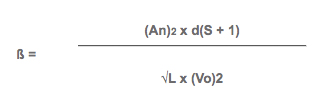
The formula is laid out below.

goggles-formula

Here’s how to decode the formula:

  • An is the number of servings of alcohol
  • d is the distance between the observer and the observed, measured in meters
  • S is the smokiness of the area on a scale of 0 – 10
  • L is the lighting level of the area, measured in candelas per square meter, in which 150 is normal room lightning
  • Vo is Snellen visual acuity, in which 6/6 is normal and 6/12 is the lower limit at which someone is able to drive

The formula works out a “beer goggle” score ranging from 1 to 100+. When ø = 1, the observer is perceiving the same degree of beauty he or she would perceive in a sober state. At 100+, everybody in the room is a perfect 10.

And one last odd finding of the second study. “A nearsighted, sober person who isn’t wearing his or her glasses can experience a beer-goggle effect equivalent to drinking eight pints of beer.”

Filed Under: Beers, Just For Fun, Related Pleasures Tagged With: Math, Science, Statistics

« Previous Page
Next Page »

Find Something

Northern California Breweries

Please consider purchasing my latest book, California Breweries North, available from Amazon, or ask for it at your local bookstore.

Recent Comments

  • Ernie Dewing on Historic Beer Birthday: Charles William Bergner 
  • Steve 'Pudgy' De Rose on Historic Beer Birthday: Jacob Schmidt
  • Jay Brooks on Beer Birthday: Bill Owens
  • Steve 'Pudgy' De Rose on Beer Birthday: Charles Finkel
  • Steve 'Pudgy' De Rose on Beer Birthday: Bill Owens

Recent Posts

  • Historic Beer Birthday: Gottlieb Sigismund Kirchhof February 19, 2026
  • Beer Birthday: Spike Buckowski February 19, 2026
  • Beer In Ads #5210: Drink A Toast To Spring With Butte Bock February 19, 2026
  • Historic Beer Birthday: Henry Allsopp February 19, 2026
  • Beer Birthday: Chris Black February 19, 2026

BBB Archives

Feedback

Head Quarter
This site is hosted and maintained by H25Q.dev. Any questions or comments for the webmaster can be directed here.