Brookston Beer Bulletin

Jay R. Brooks on Beer

  • Home
  • About
  • Editorial
  • Birthdays
  • Art & Beer

Socialize

  • Dribbble
  • Email
  • Facebook
  • Flickr
  • GitHub
  • Instagram
  • LinkedIn
  • Pinterest
  • RSS
  • Twitter
  • YouTube

Powered by Genesis

European Study Shows Raising Beer Taxes A Bad Idea

October 15, 2010 By Jay Brooks

brewers-europe
Earlier this month, the Brewers of Europe — a trade organization of European breweries — released the results of an independent study they commissioned by PriceWaterhouseCoopers. They asked PWC to “quantify the impact of excise taxes on the overall tax collection, and employment and profitability in the brewing sector compared to other alcoholic beverages.” In Europe, like in the United States, a poor economy coupled with tireless anti-alcohol organizations are causing some politicians to look to the alcohol industry to help fund problems not of their making in the form of higher taxes. The entire report, Taxing the Brewing Sector: A European Analysis of the Costs of Producing Beer and the Impact of Excise Duties, is available online.

They also released a press release, highlighting the findings. From the press release:

“The study provides strong evidence that arbitrary increases in excise tax would hit brewers — and the 1.8 million jobs created in the European hospitality sector generated by the brewing sector — hard just as the economy is striving to emerge from a deeply damaging recession. The study also shows that tax increases will ultimately NOT increase government revenues nor attain the expected levels.”

The study comes at a crucial time, with skyrocketing taxes on beer in some European countries as governments scramble to rake in cash. “At a time when regulators across Europe are looking at scenarios about taxation, we would urge them to give any plan a full economic reality check,” [said] Pierre-Olivier Bergeron, [secretary-general of the Brewers of Europe]. “This study provides the data for sound judgments.”

A comparative cost analysis within the study shows that producers of alcoholic beverages constitute a significant industry within the EU, worth €242.5bn in 2007 in terms of sales. Sales of beer account for the highest proportion by value — €111.5bn or 46%. Beer contributed the highest amount of taxes to Member States across the EU and the lion’s share of jobs.

“This study shows that beer is the most expensive form of alcohol to produce,” observed Pierre-Olivier Bergeron. “So any move toward taxing all drinks based solely on alcohol content (‘unitary taxation’) would disadvantage a low alcohol beverage such as beer further in terms of cost of the product to the consumer.”

The study shows that an increase in excise taxes on the beer and hospitality sectors would be negative in terms of employment and tax collection. This is because increases in excise tax revenue are more than offset by decreases in the revenues obtained by the Government from personal and corporate income taxes, social security payments and, in some cases, from value added tax (VAT).

“The excise tax research shows that a 20% increase in beer excise taxes at national level across Europe would lead to loss of over 70,000 jobs and a fall in government revenues of €115 million EU-wide, due to lower sales and lower income from VAT and corporate taxes,” adds Pierre-Olivier Bergeron. “Also an increase of current EU minimum rates of excise tax will have no beneficial impact on the EU’s internal market or on national treasuries concerned. Plainly this is an ineffective measure for improving public finances and detrimental for brewers.” Bergeron concludes: “Europe’s brewing sector fully backs Europe 2020, the European strategy for smart, sustainable and inclusive growth. Our call for good sense and reason on the excise duty front fully meets the strategic objectives the EU has rightly set for itself, particularly in terms of fostering a high-employment economy.”

Perhaps the biggest finding is how many jobs would be lost if excise taxes were increased. The Marin Institute and the City of San Francisco insisted there would be no job losses if their recently proposed alcohol tax for the city passed. They were quite insulting, I believe, to the concerns of both local businesses and workers for even suggesting that was a potential outcome. This EU study does appear to lend credence to the claims made by many critics of the San Francisco Alcohol Tax, especially the California Alliance for Hospitality Jobs.

Naturally, critics of this study will undoubtedly point to its origin, having been commissioned by a trade organization. But the Brewers of Europe appear to have been very diligent in making the study as impartial as possible, and, perhaps more importantly, they’ve been extremely transparent and up front about their sponsorship of the study. That’s something that American anti-alcohol groups have not been as forthcoming about, with the more common scenario being that they fund academic institutions to conduct a study and then all but hide that fact, or at a minimum downplay it. Those same groups then use the studies they themselves commissioned in propaganda that tries to make them appear impartial or from an independent source, as was seen recently in the City of San Francisco’s nexus study supporting the alcohol tax. So at least this study involved no such subterfuge. People know exactly where it came from, can read the report and draw their own conclusions in full command of all the facts.


Filed Under: Breweries, Editorial, News, Politics & Law Tagged With: Europe, Prohibitionists, Science, Statistics, Taxes

Effects of Alcohol At Different BAC Levels

October 9, 2010 By Jay Brooks

bac-chart
Here’s another interesting infographic created by, of all people, a Term Life Insurance website, showing The Impact of Alcohol on your Body as your blood-alcohol content percentage increases.

bac-graphic

Filed Under: Beers, Just For Fun, Politics & Law Tagged With: Infographics, Science, Statistics

The World’s Strongest & Strangest Beers

October 8, 2010 By Jay Brooks

squirrel
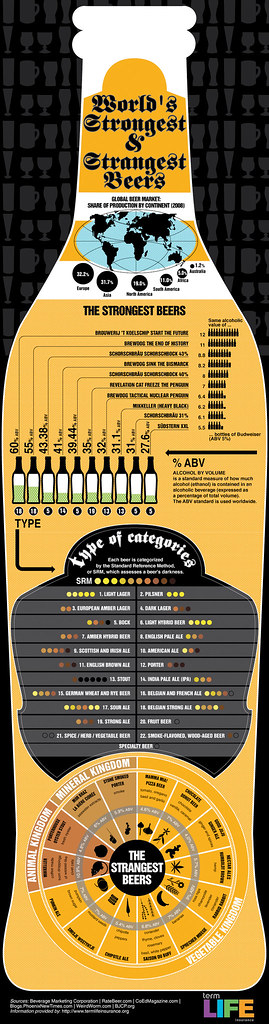
Here’s an interesting infographic created by, of all people, Term Life Insurance, showing The World’s Strongest & Strangest Beers.

strong-strange-beers

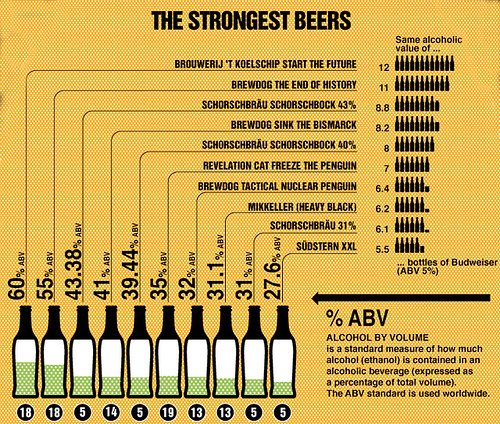
Here’s a close-up of the strongest beers.
strongest-beers

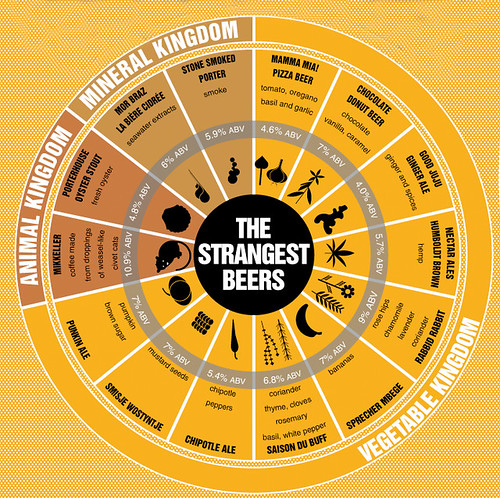
And another close-up of the strangest beers.
strangest-beers

Filed Under: Beers, Just For Fun Tagged With: Humor, Statistics

Son of Binge Drinking Statistics Inconsistencies

October 6, 2010 By Jay Brooks

binge-modern
If you read my previous post about Inflating Binge Drinking Statistics, you’ve seen how data can be manipulated and essentially bent to any purpose. Today a second news item in U.S. News & World Report, 1 in 4 U.S. Teens and Young Adults Binge Drink, presents yet another portrait of reality using binge drinking data from the CDC.

This one focused more on underage drinking, declaring that 1 in 4 U.S. teens and young adults are binge drinkers. According to CDC director Dr. Thomas R. Frieden, “[n]inety percent of the alcohol consumed by high school students is consumed in the course of binge drinking.” Frieden goes on to say that “[a]mong drinkers, one-third of adults and two-thirds of high school kids binge drink, but doesn’t that contradict the 1 in 4 statistic and the 90% declaration? Which is it: 25%, 66% or 90%?

Beyond the fuzzy math, that high school students binge drink is a bit of a duh statistic, they don’t exactly have much choice under the circumstances. That’s because all underage drinking is done underground, none of it is out in the open. So any time they do get a chance to drink it’s without supervision. And that’s a direct result of the minimum age being 21 instead of 18 and also because not only is education not available, but is even considered criminal in some states. It was not unusual when I was a teenager for parties where alcohol was served to be chaperoned by parents with the full knowledge of other parents, too. Today, that would be cause in many places for arrests and jail time. But as a result of adult supervision, I never witnessed any problems at those parties and they were very safe. But thanks to zealotry and a no tolerance policy such safe environments are now impossible.

Another discrepancy is that in the U.S. News & World Report, the CDC claims that “more than 33 million adults have reported binge drinking in the past year.” That’s in contrast to the NPR story, in which the CDC claims that “half of all alcohol consumed by adults in the US is binge drinking.” Then on the CDC’s website there’s a map of the U.S. showing binge drinking averages by state, with the lowest state being Tennessee (with 6.8%) and the highest being Wisconsin (23.9%).

Filed Under: Beers, Editorial, News, Politics & Law Tagged With: Health & Beer, Prohibitionists, Science, Statistics

Inflating Binge Drinking Statistics

October 6, 2010 By Jay Brooks

binge-barney
The biggest problem with binge drinking statistics is that the definition keeps changing. Over the last few decades it’s gone from somewhat vague to an increasingly narrow definition. Each change in the definition increases the number of binge drinkers. It’s not that more people are binge drinking necessarily, but that more people fall under the definition as they lower it and lower it.

At the bottom of an NPR story, Binge Drinking: A Big Problem, Especially For The Prosperous, there’s a strange little video about binge drinking put together by the CDC. In it, they reveal some disturbing ways of looking at what it means to binge drink.

The most recent way our government defines binge drinking is “[f]our or more drinks within a few hours for a woman and five or more for a man.” That actually narrows yet again, as recently as the last few years it’s been “five or more drinks in a row,” which tends to imply more speed. Adding “within a few hours” means even drinking at a leisurely pace makes you a binge drinker. I wrote more about this shift last year in a post, Inventing Binge Drinking.

The CDC video further claims that “half of all alcohol consumed by adults in the US is binge drinking.” Wow, that’s pretty remarkable, especially if you consider that according to the DOJ only 54% of adults drink alcohol. We’re now a nation of binge drinkers. You’d think a society where 1 in 2 people drinking is on a bender would be more noticeable. But look out your door or window and unless there’s a car alarm going off, it’s more likely you’ll hear crickets and birds chirping, not the devastation implied by that alarming factoid.

They also claim “1.5 billion episodes of binge drinking” take place each year in the U.S. That’s 5 for every man, woman and child in the country, or 6.25 times for every adult. If we assume the DOJ’s statistic that 46% of adults don’t drink alcohol, then that’s 11.6 for every adult who does imbibe, or nearly once a month. That’s a lot of benders. Or is it? Is having five drinks less than once a month really an alarming societal problem? I go to a beer dinner probably at least once a month and most are at least five courses. That makes me a binge drinker, but I’m hardly a danger to society because of it. Clearly, for some individuals persistent binge drinking is a serious problem, but the people who fall into that category represent a very small minority of all drinkers.

Toward the end of the NPR article, they have this to add.

The problem, though bad, isn’t a lot worse than it used to be. In 1993, the CDC says, about 14 percent of adults had gone on drinking binges. But as Dr. Thomas Frieden, head of the CDC put it, “Because binge drinking is not recognized as a problem, it has not decreased in 15 years.”

That’s a pretty glaring inconsistency. On one hand, the CDC claims that “half of all alcohol consumed by adults in the US is binge drinking” but only “14 percent of adults had gone on drinking binges.” But my favorite howler is the statement that “binge drinking is not recognized as a problem.” What planet is he living on, because neo-prohibitionists and the health, university and government research communities, not to mention all the treatment and addiction businesses that stand to make more money if the problem keeps increasing, have been screaming about the perils of binge drinking as long as I’ve been an adult, and probably longer. And the hue and cry has only increased in recent decades. But this just serves to prove that binge drinkers aren’t born, they’re created … by statistics.

But wait, it gets worse. According to the CDC video, the NIAAA now defines binge drinking as “consumption that raises blood-alcohol content to .08%.” That’s right folks “binge drinking” and being “drunk” are now exactly the same! Then they go on to say that binge drinkers are “14 times more likely to drive drunk.” Duh, if you define binge drinking as getting drunk, then that’s a self-fulfilling statistic, isn’t it? But it’s pretty alarming that a government agency’s standard for binge drinking is simply drinking enough to raise your BAC to 0.08%.

Other interesting tidbits include that statistic that 70% of binge drinkers are 26 or older and that 80% of binge drinkers are not alcoholics. Of course they’re not alcoholics if all they have to do to binge drink is get drunk once. And if most are legal adults, why the insistence later in the video to maintain 21 as the minimum age of consumption?

Naturally, they propose all the same old chestnuts to “fix” the problems they just created by inflating the statistics. Nothing new is ever proposed. Of course, none of the proposals ever work, either, wherever they’ve been implemented. Here’s the CDC recommendations.

  1. Increase alcohol taxes
  2. Close places that sell alcohol, reducing their number
  3. Close the remaining outlets earlier
  4. Enforce the laws that prohibit underage drinking

But by continually widening the net and artificially adding to the number of people that are considered binge drinkers, it lessens the chances of actually helping the people who truly do need help. All they do is increasingly demonize alcohol manufacturers and criminalize law-abiding people. It’s as if all of the organizations that are anti-alcohol or who make their money from addiction, be it through treatment, medications or whatever, need to keep the issue a dangerous one and have to keep it just bad enough so the money keeps flowing. So it becomes a game of creating the perception of effectiveness while the problem remains perpetually, and conveniently, elusive.

Filed Under: Beers, Editorial, Politics & Law Tagged With: Health & Beer, Prohibitionists, Science, Statistics, Video

Onion Spoof: Americans Get Majority of Exercise While Drunk

October 5, 2010 By Jay Brooks

onion-the
For something a little lighter than recent topics, here’s a funny video from The Onion, spoofing scientific studies about drinking, Americans Get Majority of Exercise While Drunk. It begins. “Over 75% of an average American’s exercise now comes from drunkenly dancing, stealing street signs, and carrying home passed-out friends.” It looks like embedding isn’t working, so go view at The Onion.

Filed Under: Just For Fun, Politics & Law Tagged With: Humor, Statistics, Video

Family Dining Leads To Responsible Drinking

October 5, 2010 By Jay Brooks

family-dinner-4
It’s not often I agree with the neo-prohibitionists but last month the National Center on Addiction and Substance Abuse (CASA) released the findings of their sixth annual Importance of Family Dinners survey. And guess what, kids who eat with their parents at family dinners are less likely to develop bad habits like binge drinking, smoking or drug use. It’s one of those studies I characterize as “duh studies,” because the results are so obvious. Do we really need a survey to tell us that being engaged with our children is better than being alienated from them? At any rate, Medical News Today, has the story of this year’s survey.

The first one was conducted in 2003, and based on their survey concluded that “teens who have dinner with their families five or more nights in a week are 32 percent likelier never to have tried cigarettes (86 percent vs. 65 percent), 45 percent likelier never to have tried alcohol (68 percent vs. 47 percent), and 24 percent likelier never to have smoked pot (88 percent vs. 71 percent). This also led to CASA creating a holiday, Family Day — A Day to Eat Dinner with Your Children (September 27) and it’s one that I support and list on my calendar database of holidays.

But here’s my one quibble and where we part company — it’s always something, right? — these same organizations that celebrate family are the same groups that also have pushed to make it illegal for parents to give their own children a taste of alcohol in the home, believing they know better. For example, California just added civil penalties to the criminal ones for giving alcohol to a minor in the home. In theory, I’m not allowed to teach my own children about alcohol when I, as their parent, believe it’s appropriate. The best I can do is model responsible behavior by my example of drinking in moderation and trying to cast doubt on the propaganda they’ve been receiving at school literally since kindergarten that’s mandated by the state and with “learning” materials from MADD.

These same groups also have pressured state alcohol regulators to not allow kids at beer festivals, though wine tastings are usually just fine. They claim to love family and want kids to not engage in what they believe to be dangerous behaviors, at least while they’re minors, but at the same time want to deny parents the tools and resources to educate their own children about those dangers. They don’t want kids even seeing adults drink, even though it’s legal for adults to do so and it would allow children to see their parents drink responsibly, thus showing by example how the majority of Americans consume it. It would model good behavior and act as a balance to negative stereotypes, showing that drinking can be part of a healthy adult lifestyle. Showing both the positive and the negative stereotypes would teach kids they have a choice, that drinking doesn’t have to lead to destructive behaviors if done responsibly.

We already know what happens when they’re not permitted to learn that lesson. They go off to college or out in the world and, on their own for the first time, binge drink or worse. And who can blame them? If they’ve seen no positive drinking examples and only know the propaganda they’ve been brainwashed with since elementary school, what else should we expect?

I agree that families should be engaged, that parents should be involved with their kids and especially their teenagers. But as long as parents are handicapped by misguided anti-alcohol advocates who think “just say no” is a valid approach or think kindergarten is an appropriate age to begin teaching kids about drinking and driving, then nothing will change. Real change has to begin at home, with the family, and that also has to include modeling positive behavior and freeing parents to make decisions about their own children.

I see the negative effects of the propaganda every time my six-year old daughter reminds me beer is a drug and I have to, yet again, explain to her that it’s okay for Daddy and other adults to drink it. Either they can’t be bothered to explain the difference between legal alcohol and drugs or she’s too young to grasp the concept. Either way, it’s not working. When Porter was her age, he came home from the “Red Ribbon Week” lectures chiding us for using cold medicine because it was a drug, and “all drugs are bad.” That’s the message he got. But that’s what happens when zealots are allowed to shape the policy and parents are cut out of the decision-making process for raising their own children.

Filed Under: Beers, Editorial, Food & Beer, News, Politics & Law Tagged With: Prohibitionists, Science, Statistics

The Most Dangerous Things & The Duckworth Scale

October 4, 2010 By Jay Brooks

duck
Over the weekend I was perusing a book I picked up during my last trip to England, The Book of General Ignorance, a trivia book based on a British TV show, QI, which stands for Quite Interesting. There’s a whole series of QI books, and I was drawn to it initially because Stephen Fry was involved, and I’m a big fan of his work. One of the entries I read recently was entitled “What’s three times more dangerous than war?” It was the first sentence that leapt out at me. “Work is a bigger killer than drink, drugs or war.”

Many anti-alcohol organizations begin their press releases, policy papers, etc. with the eye-catching statistic that alcohol-related deaths account for a higher number of deaths than another kind. But this seems to fly in the face of that. It claims that “around two million people die every year from work-related accidents and diseases, as opposed to a mere 650,000 who are killed in wars.” While I might quibble with the adjective “mere,” it’s clear that far more die at work or in war than from alcohol. You can read the entire entry on the bottom of page 69 through Google Books.

Of course, some recent studies insist that two million die worldwide each year due to alcohol-related causes. Still others insist it’s involved in 1 in 25 deaths, which would mean that if it were really 2 million, then total world mortality for a given year would be 50 million. According to the UN, about 62 million people die each year. In the World Health Organization’s top 10 causes of death worldwide, alcohol is not among them. In 2001, a study by the CDC claimed 75,754 deaths were attributable to alcohol, but added that “low consumption has some beneficial effects, so a net 59,180 deaths were attributed to alcohol.” I could keep going citing study after study with different results, because the way you structure the statistics leads to the ultimate results. And that’s why who does the study and/or their motives are so important. And that’s why you shouldn’t believe such statistics without finding out where they came from, not even mine.

duck-scale

Somewhat off-topic, but quite interesting — at least to me — is the statistics behind the QI’s pronouncement of what’s safe and what’s dangerous were based on The Duckworth Scale, a “scale for assessing the risks involved in various activities” created in 1999. It takes its name from its creator, Dr. Frank Duckworth, a retired statistician. The scale is logarithmic, like the Richter scale for earthquakes. It grades one’s risk of death from activities ranging from washing up to playing Russian Roulette. It starts at zero for living on planet earth for a year, to a maximum of eight for certain death.

The Duckworth Scale

  • 8.0 Suicide Russian roulette (six bullets)
    Jumping off Eiffel Tower
    Lying in front of Flying Scotsman
  • 7.2 Russian Roulette (one game)
  • 7.1 Continuing smoking cigarettes (male aged 35 – 40 a day)
  • 6.9 Continuing smoking cigarettes (male aged 35 – 20 a day)
  • 6.7 Continuing smoking cigarettes (male aged 35 – 10 a day)
  • 6.4 Deep sea fishing (40 year career)
  • 6.3 Rock climbing over 20 years
  • 5.5 Accidental falls (new born male)
    Lifetime car travel (new born male)
    Dying while vacuuming
    Dying while washing up
    Dying while walking down the street
  • 4.6 Murder (new born male)
  • 4.2 Rock climbing (one session)
  • 2.0 Riding fairground rides (100 times)
  • 1.9 100 mile car journey (sober middle aged driver)
  • 1.7 100 mile flight
  • 1.6 Destructive asteroid impact (in the life-time of a new born male)
  • 0.3 100 mile rail journey

Those are the only ones I could find on the scale, but I’d love to see where more activities fall on the scale. Has anyone seen a more comprehensive list?

Filed Under: Beers, Editorial, Politics & Law Tagged With: Prohibitionists, Statistics

Beer Drinkers Are Normal, Study Derisively Claims

October 3, 2010 By Jay Brooks

pint
In yet another hatchet job by the National Institute on Alcohol Abuse and Alcoholism, a new study they sponsored declares “Alcohol Consumers Are Becoming The Norm,” as if that’s a bad thing. The longitudinal study using data almost two decades old from the NIAAA’s 1991-92 National Longitudinal Alcohol Epidemiologic Survey and the 2001-02 National Epidemiologic Study on Alcohol and Related Conditions was conducted by researchers at the UT Southwestern School of Health Professions. The results are being be published this month in Alcoholism: Clinical and Experimental Research, a journal of the National Council on Alcoholism and Drug Dependence. To say the study is most likely biased, without even having to look at it, is something of an understatement.

The press release for the study begins with this eye-catching pronouncement. “More people are drinking than 20 years ago.” But that’s not correct. A more accurate statement would be that more people are drinking eight years ago than were doing so twenty years ago. Not quite as sexy, or alarming, but correct based on the actual data the study examined.

But really, even if true, if more people are indeed drinking today than twenty years ago, so what? The statement completely ignores context. We know mass-produced beer is down. We know craft beer is up. Couldn’t an equally valid explanation be that more people are drinking less, but better beer. That would mean more moderate drinking, which has shown to cause people to live longer than either abstaining or over-drinking. Shouldn’t that be considered be excellent news? But when the people studying the data owe their careers and paychecks to the study of “alcoholism,” it’s always bad news. The glass is quite literally, always half empty.

half-empty-2

Just look at how they define drinkers vs. non-drinkers. For purposes of the study, someone who has had twelve drinks of at least “0.6 ounces” in the last year is considered a drinker. That’s a total of 7.2 ounces in an entire year and you’re a “drinker.” That’s less than half a pint in a year, for chrissakes. Less than that and you’re a non-drinker. Talk about just saying no. But an increase in the number of people who’ve had less than a half pint is on the increase, apparently, and that’s cause for alarm? Are you kidding me? That would be laughable if lead researcher Dr. Caetano didn’t sound so serious. He thinks “that continuous monitoring of alcohol consumption levels is needed to understand better the factors that affect consumption. Monitoring also would help to detect as early as possible signs that rates of risky drinking behaviors such as binge drinking or drinking to intoxication may be increasing.” And he’s worried about people who’ve consumed as little as 7.2 oz. in one year. Is it just me, or is that the proverbial tempest in a pint glass?

But wait, it gets better. Based on what any reasonable person would consider almost no drinking at all, he has the following recommendations.

“This suggests to us that a variety of public-health policies such as restrictions on alcohol advertising, regulating high-alcohol-content beverages, increasing taxes on alcohol, as well as treatment and brief interventions may be needed to reduce alcohol-related problems,” he said.

How? How does that suggest these draconian measures? To them, the “reasons for the uptick vary and may involve complex sociodemographic changes in the population, but the findings are clear: More people are consuming alcohol now than in the early 1990s.” But that’s not even true from their own findings. First of all, as I said before, this compares a study from 1991-92 to another one conducted in 2001-02. That was eight years ago, not “now” as he states. Then with such flimsy increases using as their base amount less than 8 oz. of alcohol consumed in an entire year, they think it’s appropriate to make recommendations calling for more regulation, higher taxes and more medical intervention. That’s completely absurd and utterly disproportional to the findings.

This seems so obviously an agenda in search of a study. The suggestions were already in place. It’s the same nonsense that neo-prohibitionist groups have been pushing for years. This study was just shamelessly shoe-horned into that agenda.

But again I think part of what bothers me about these type of studies is that they take the view that any drinking is bad, no matter how small or moderate. They don’t take into account the context of the drinking. Is it with food? Is it with friends over a long period of time? Is it a few times a week or all at once? Even the Federal government increased their recommendations of safe drinking from two to four drinks a day, assuming the weekly intake stays below their recommendations. And they’ve acknowledged the numerous studies that show moderate drinking is part of a healthy lifestyle and will also most likely mean you’ll live longer. But these anti-alcohol funded studies just add up the amounts people drink and say it’s all bad for you, no context necessary. It’s just self-serving propaganda. If an alcohol industry group had sponsored this, it would have been dismissed immediately. But anti-alcohol groups get no such scrutiny. Their studies are embraced by the medical community, such as Medical News Today, which ran the study’s press release as a news story almost verbatim. Also, Science Daily reprinted the press release as news, disclosing its source at the bottom, well after the average reader stopped reading it. They also provide a link to the press release and the original journal article, something that Medical News Today can’t be bothered to do.

Though the headline is Alcohol Consumers Are Becoming The Norm, the title of the study itself is Sociodemographic Predictors of Pattern and Volume of Alcohol Consumption Across Hispanics, Blacks, and Whites: 10-Year Trend (1992–2002), the headline bears very little resemblance to the study itself.

Here’s the abstract:

Keywords: Ethnicity; Race; Binge Drinking; Drunkenness; Intoxication; Whites; Blacks; Hispanics

Background:  There have been limited trend studies examining variations on the patterns of alcohol consumption among Whites, Blacks, and Hispanics in the United States. The current paper reports national trends in drinking patterns, volume of drinking (number of drinks per month), binge drinking, and drinking to intoxication among Blacks, Whites, and Hispanics over a period of 10 years and identifies sociodemographic predictors of these behaviors across the 3 ethnic groups.

Methods:  Data are from the 1991 to 1992 National Longitudinal Alcohol Epidemiologic Survey (NLAES; n = 42,862) and the 2001 to 2002 National Epidemiologic Study on Alcohol and Related Conditions (NESARC; n = 43,093). Both surveys used multistage cluster sample procedures to select respondents 18 years of age and older from the U.S. household population.

Results:  Trends varied across different dimensions of drinking and ethnic groups. There were no statistically significant differences in the mean number of drinks consumed per month among men and women in any of the 3 ethnic groups between 1992 and 2002, but there was a significant rise in the proportion of current drinkers in both genders and in all 3 ethnic groups. Multivariate analysis indicated that, compared to Whites in 1992, Blacks and Hispanics did not increase their volume of drinking, but Whites did. Drinking 5 or more drinks in day at all did not increase between 1992 and 2002, but drinking 5 or more drinks at least once a month was more likely for all groups in 2002 compared to Whites in 1992. Drinking to intoxication at all was more likely among Whites in 2002 than 1992, but drinking to intoxication at least once a month was more likely among Whites and Blacks in 2002 than 1992.

Conclusion:  The only common trend between 1992 and 2002 across both genders and 3 ethnic groups was a rise in the proportion of drinkers. There was also a rise in drinking 5 or more drinks in a day (Whites, Blacks, and Hispanics) and drinking to intoxication (Whites and Blacks), but this was limited to those reporting such drinking at least once a month. The reasons for these changes are many and may involve complex sociodemographic changes in the population. It is important for the field to closely monitor these cross-ethnic trends in alcohol consumption.

I don’t see a reference to the headline, Alcohol Consumers Are Becoming The Norm, anywhere in either the press release or the abstract. Nothing in the abstract addresses normalization of any kind. After the headline, it’s never mentioned again. I don’t understand what it even means, becoming the norm? Alcohol has been consumed since the beginning of civilization. It hasn’t suddenly become anything. It’s been perfectly normal for adults to drink alcohol since at least 1933, when it became legal again in the U.S. It’s pretty hard to take the whole thing very seriously, when the headline itself is nothing but sensationalist propaganda.

Filed Under: Beers, Editorial, News, Politics & Law Tagged With: Prohibitionists, Science, Statistics

A New Justification For More Beer Taxes

September 26, 2010 By Jay Brooks

rwjf
Ugh, here we go again. Three researchers at the University of Florida, led by epidemiologist Alexander C. Wagenaar, have just released a new study which they claim shows that raising alcohol taxes — in fact doubling them — will reduce consumption and cure society’s problems.

The study, Effects of Alcohol Tax and Price Policies on Morbidity and Mortality: A Systematic Review, is to be published in the November issue of the American Journal of Public Health, but was released online last week, as is common for academic journals.

As I don’t have the resources to buy a subscription to every related academic journal, I have to make do with the abstract and what other news outlets write about it. Here’s the abstract:

Objectives. We systematically reviewed the effects of alcohol taxes and prices on alcohol-related morbidity and mortality to assess their public health impact.

Methods. We searched 12 databases, along with articles’ reference lists, for studies providing estimates of the relationship between alcohol taxes and prices and measures of risky behavior or morbidity and mortality, then coded for effect sizes and numerous population and study characteristics. We combined independent estimates in random-effects models to obtain aggregate effect estimates.

Results. We identified 50 articles, containing 340 estimates. Meta-estimates were r=–0.347 for alcohol-related disease and injury outcomes, –0.022 for violence, –0.048 for suicide, –0.112 for traffic crash outcomes, –0.055 for sexually transmitted diseases, –0.022 for other drug use, and –0.014 for crime and other misbehavior measures. All except suicide were statistically significant.

Conclusions. Public policies affecting the price of alcoholic beverages have significant effects on alcohol-related disease and injury rates. Our results suggest that doubling the alcohol tax would reduce alcohol-related mortality by an average of 35%, traffic crash deaths by 11%, sexually transmitted disease by 6%, violence by 2%, and crime by 1.4%.

Those are some pretty specific promises and some pretty specific recommendations, something most academic papers assiduously avoid. To me that’s a red flag about the intentions of this study.

Science Daily covered the study in an article today (thanks to Richard S. for sending me the link) entitled Increasing Taxes on Alcoholic Beverages Reduces Disease, Injury, Crime and Death Rates, Study Finds. Obviously, I’m as predisposed to question such a study as the average anti-alcohol wingnut is to swallow it unquestioningly. And I confess something doesn’t smell right with it. My alky sense is tingling.

Having not seen the full article, I’m left wondering exactly what the “50 published research papers containing 340 estimates” means. What is being “estimated?” It reads like it’s the supposed harm that’s being estimated, because I can’t for the life of me understand how you could ever say there’s definitive causation for such a complex relationship as the price of something to “other misbehaviors,” or indeed any of the laundry list of issues the researchers believe are caused by people drinking alcohol. In my experience at looking at these studies, any event in which there was alcohol present is usually sufficient to consider the incident alcohol-related, but that’s nowhere near the same as having been caused by the alcohol. And so these statistics tend to be inflated and, consequently, misused.

But the key insight into the study came in the very last paragraph of Science Daily’s coverage of the study, where they reveal that the funding for the study came from the notorious Robert Wood Johnson Foundation (RWJF), the godfather of neo-prohibitionist groups. The RWJF funds many other neo-prohibitionist groups, and also sets the national agenda in the anti-alcohol community. That they funded this, and other similar studies, suggests that the answer preceded the study, that is it was designed to support their agenda, its conclusions a fait accompli.

To me this also explains professor Wagenaar’s statement. “Results are surprisingly consistent.” Of course, they would be if you’re looking for a correlation. The same team did a similar study in 2007, Raising Alcohol Taxes Reduces Deaths, Study Finds where they examined alcohol-related deaths in Alaska after beer taxes were raised in the state. That study was also funded by the RWJF. Predictably they found the correlation they were looking for, but this is playing with statistics for incredibly complex relationships. Their simple conclusions seem absurd. They ignore any underlying causes for alcohol abuse or suicide or anything else, for that matter. As almost every study like this I’ve ever seen, “alcohol-related” is a thinly veiled attempt to paint any alcohol use, however responsible or moderate, as dangerous and life-threatening. Beer is not a syringe of heroin, despite these same groups’ attempts to portray it that way.

Mark my words, we’re going to see this study used by groups all over the country in renewed efforts to raise beer taxes in state after state. But the only thing I remember happening when the federal excise tax on beer was doubled in 1990 was a loss of jobs and long term economic harm visited on the brewing industry. I don’t recall seeing any victory parties by the anti-alcohol groups once that doubling cured all the problems they previously ascribed to alcohol. They went right on complaining about all the supposed damage caused by the industry. That’s a real world example of what they want to do having none of the outcomes this new study claims would occur under the exact same conditions.

Filed Under: Beers, Editorial, News, Politics & Law Tagged With: Prohibitionists, Science, Statistics

« Previous Page
Next Page »

Find Something

Northern California Breweries

Please consider purchasing my latest book, California Breweries North, available from Amazon, or ask for it at your local bookstore.

Recent Comments

  • Ernie Dewing on Historic Beer Birthday: Charles William Bergner 
  • Steve 'Pudgy' De Rose on Historic Beer Birthday: Jacob Schmidt
  • Jay Brooks on Beer Birthday: Bill Owens
  • Steve 'Pudgy' De Rose on Beer Birthday: Charles Finkel
  • Steve 'Pudgy' De Rose on Beer Birthday: Bill Owens

Recent Posts

  • Beer In Ads #5204: Oh Brother! Griesedieck Bros. Genuine Premium Bock Beer Is Here! February 15, 2026
  • Historic Beer Birthday: Emil Resch February 15, 2026
  • Historic Beer Birthday: Philip Zang February 15, 2026
  • Beer In Ads #5203: Robert Portner’s Bock Beer February 15, 2026
  • Historic Beer Birthday: August Schell February 15, 2026

BBB Archives

Feedback

Head Quarter
This site is hosted and maintained by H25Q.dev. Any questions or comments for the webmaster can be directed here.