Brookston Beer Bulletin

Jay R. Brooks on Beer

  • Home
  • About
  • Editorial
  • Birthdays
  • Art & Beer

Socialize

  • Dribbble
  • Email
  • Facebook
  • Flickr
  • GitHub
  • Instagram
  • LinkedIn
  • Pinterest
  • RSS
  • Twitter
  • YouTube

Powered by Genesis

Craft Beer Numbers Up Again Mid-Year

August 2, 2010 By Jay Brooks

ba
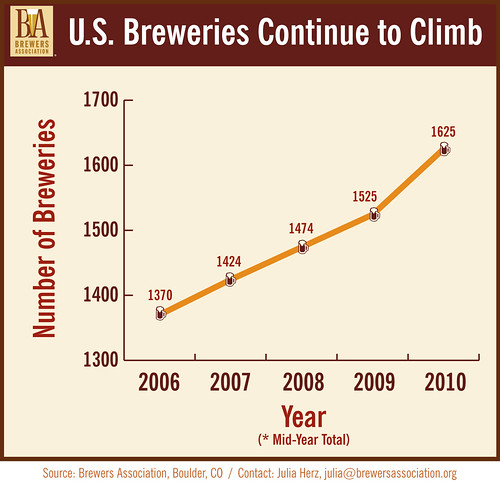
Good news again this year for craft brewers. The Brewers Association has released the mid-year numbers and they’re positive again this year despite a rocky economy. Volume sales grew 9% over the same period last year and sales dollars are up 12% for the first six months of 2010 as compared to 2009. Last year those same stats were 5% and 9% respectively.

From the press release:

Craft breweries continue to grow despite many challenges, and currently provide an estimated 100,000 jobs and contribute significantly to the U.S. economy. Barrels sold by craft brewers for the first half of the year are an estimated 4.6 million, compared to 4.2 million barrels sold in the first half of 2009.

“While craft brewer sales volume climbed 9 percent in the first half of 2010, overall U.S. beer industry volume sales are down 2.7 percent so far,” noted Paul Gatza, director of the Brewers Association. “There is a movement by beer lovers to the innovative and flavorful beers created by America’s small and independent craft brewers. More people are starting to think of craft-brewed beer first when they buy in restaurants, bars and stores.”

The other great news is the number of new brewery openings, which continues to rise, too. 100 new breweries or brewpubs have opened over the last year. Picking up the press release again:

The U.S. now boasts 1,625 breweries—an increase of 100 additional breweries since July of 2009—and the highest number in 100 years. A century ago in 1910, consolidation and the run-up to Prohibition had reduced the number of breweries to 1,498.

“Entrepreneurs across the land are creating jobs by opening new microbreweries and brewpubs, and we are also seeing many homebrewing hobbyists going pro by starting what have been referred to as nanobreweries,” Gatza added. “Super tiny microbreweries or brew pubs, that make beer for a very localized network of taverns and stores, are starting to become a trend, primarily in the states that allow self-distribution as a means of getting beer to market.”
Mid Year Graph

Filed Under: Breweries, News Tagged With: Business, Statistics, United States

Some Beery Trends

July 26, 2010 By Jay Brooks

trends
Over the weekend, I got the latest newsletter from Michael Kuderka of the DBBB, the book of Domestic Brewers and their Bottled Brands, published by MC Bassett. One highlight was some interesting trends from recent IRI data.

If you’re not familiar with IRI data, it’s one of the two major data reporters, along with Nielsen, of sales trends along a variety of products. IRI is short for Information Resources, Inc., though the company is now known as the Symphony IRI Group. IRI data only covers certain kinds of retailers that sell beer, primarily grocery stores and convenience stores, and usually only chains at that. So it’s of limited use, but because the sales data is collected from consistent sources, it is fairly reliable and can show trends. I used to see it all the time, when I was a beer buyer, because most package brewers subscribe to one or the other service and usually bring carefully mined data to show their own positive trends. Anyway, here’s the interesting bits.

Fat Tire, from New Belgium, apparently “made more gains than any other brand when considering both year-over-year case sales and total dollars,” with case sales up 26% and total dollars just under $50 million. What that doesn’t take into account, of course, is that New Belgium opened several new states and a good portion of that bump may have been from being in new markets that weren’t in the data last year. But that does catapult them into the number 3 spot, making the top three best-selling craft beers as follows:

  1. Samuel Adams Boston Lager
  2. Sierra Nevada Pale Ale
  3. New Belgium Fat Tire

And here’s some additional trends and brands to watch, at least according to IRI:

  • IPAs: Trending up 29%!
  • Sierra Nevada seasonals: Up 23%
  • Magic Hat #9: Up 22%
  • Alaskan Brewing seasonals: Up 21%
  • Amber Ale & Pale Ale also trending up

Filed Under: Beers, Breweries, Editorial, News Tagged With: Statistics

Alcohol Consumption On The Rise

July 22, 2010 By Jay Brooks

ethyl-alcohol
A new study was just published online, and will be in print in next month’s journal Alcoholism: Clinical and Experimental Research with the nearly impenetrable title Sociodemographic Predictors of Pattern and Volume of Alcohol Consumption Across Hispanics, Blacks, and Whites: 10-Year Trend (1992–2002). CNN simplified the story’s title, originally from Health.com, to More Americans Drinking Alcohol. To me the most interesting thing about this is that it’s really two stories, one positive and one sort of negative, and it’s all in the way it’s framed.

As presented on CNN, the story begins with mainly the positive aspects of the story. More Americans Drinking (Alcohol) summarizes the study like this:

Between 1992 and 2002, the percentage of men and women who drank alcohol increased, as did the percentage of whites, blacks, and Hispanics, the study found.

Americans don’t seem to be drinking more, however, as the average number of drinks consumed per month remained steady.

“More people are drinking, but they seem to not be drinking heavily as frequently,” says Rhonda Jones-Webb, an epidemiologist and alcohol expert at the University of Minnesota School of Public Health, in Minneapolis.

So that’s good news, especially considering that moderate drinking is healthier for you than abstaining or over-indulging. So if more people are hitting the sweet spot, so to speak, that should be good news, eh?

Oh, but wait, here comes the other shoe:

Yet the study revealed an important exception to that trend: an uptick in the number of people who binge drink at least once a month. Binge drinking is defined as consuming five or more drinks in one day.

“We need to address this increase, which may be associated with alcohol abuse,” says Dr. Deborah Dawson, Ph.D., a staff scientist at the National Institute on Alcohol Abuse and Alcoholism, in Bethesda, Maryland. “We may need focus our attention on preventive measures that target binge drinking.”

Of course the main problem with all that alarm over binge drinking is the definition itself. Five drinks in one day is an absurd way to define binge drinking. Originally it was essentially a bender with no limits. Little by little the definition has been whittled down by organizations and our government keen to have a number they could use in compiling statistics. But that also means a five-course beer dinner creates an event where every single diner is a binge drinker. Even the new Dietary Guidelines just released have changed the standard from daily to weekly allowable amounts and changed the daily standard to four drinks for a male, so long as the weekly limit is not reached. So that means four drinks in one day is fine, but one more and you’re a dangerous binge drinker. It’s this sort of nonsense that allows neo-prohibitionist groups to use suspect statistics with the government imprimatur to give them more credibility than they rightly deserve.

Then there’s this chestnut:

The rise in the proportion of drinkers and in binge drinking could be a sign that society is more accepting of alcohol consumption (and overconsumption), says Dr. Stephen Bahr, Ph.D., a professor of sociology at Brigham Young University, in Provo, Utah.

“There has been much emphasis on drug education and treatment but not as much emphasis on alcohol misuse, which could signal a change in norms and explain the increase in the prevalence of drinkers,” he says.

I don’t know what planet Bahr lives on, but when my kindergartner is lectured to with MADD propaganda that alcohol is a drug and he comes home with the notion that his parents are drug users because they have a beer with dinner, I’d say there’s plenty emphasis on alcohol misuse. It’s absurd in light of all the anti-alcohol propaganda for anyone to suggest people are drinking more because they haven’t heard it might be bad for them. If anything, they’re preached to death.

The original Health.com piece, Survey: More Americans Drinking Alcohol, is under the section heading Alcoholism, subtly framing the story as if it’s about alcoholism, which of course it’s not. More people drinking does not automatically mean there are more alcoholics or even more people at risk of becoming alcoholics. But framed the way it is, that’s what it seems to presuppose.

Some of the other findings, as reported by Health.com:

  • The percentage of men who drank increased by about 5% to 7% across all ethnic groups. The increases were slightly higher among women, between 8% to 9%.
  • Roughly 64% of white men drank alcohol in 2002, compared to 60% of Hispanic men and 53% of black men. Among women, 47% of whites, 32% of Hispanics, and 30% of blacks drank any alcohol.
  • For all three ethnic groups, the average number of drinks consumed per month remained level between 1992 and 2002.
  • White men drank about 22 drinks per month in 2002, on average, compared to about 19 for blacks and 18 for Hispanics. By contrast, white, black, and Hispanic women consumed just 6, 5, and 3.5 drinks per month, respectively.
  • Binge drinking increased across the board, but especially among men. The percentage of white men who had five drinks in a day at least once a week increased from 9% to 14%, and there was a similar increase among Hispanic men.
  • Whites are more likely than blacks and Hispanics to get drunk. Twenty percent of white men drank to intoxication at least once a month, compared to just 13% of black men.

The study itself only concluded the following, at least in the abstract:

The only common trend between 1992 and 2002 across both genders and 3 ethnic groups was a rise in the proportion of drinkers. There was also a rise in drinking 5 or more drinks in a day (Whites, Blacks, and Hispanics) and drinking to intoxication (Whites and Blacks), but this was limited to those reporting such drinking at least once a month. The reasons for these changes are many and may involve complex sociodemographic changes in the population.

I’m sorry, having five drinks on a given day once a month, or even once a week, is hardly a sign of the fall of civilization, even if a few more are now than they were ten years ago. I’m not even sure it’s all that newsworthy. But for reasons passing understanding — perhaps it’s simply the 24/7 news cycle — it became news and even got picked up by CNN.

Filed Under: Beers, Editorial, Politics & Law Tagged With: Health & Beer, Mainstream Coverage, Statistics

Restaurant Closings Increase

July 21, 2010 By Jay Brooks

food-2
According to a recent study by the NPD Group, a research firm, 5,204 restaurants have closed since the Spring of 2009, representing a 1% drop in the total number. As reported in the Nations Restaurant News, “[i]ndependent restaurants took the hardest hits, while chains kept their unit counts relatively stable.” As the Brewers Association revealed last week, brewpub openings increased slightly, reversing a trend where they’d been losing ground to the recession. Perhaps that’s tied to craft beer’s continuing increases, perhaps not. In any event, less restaurant visits means less opportunities to purchase beer, so that’s bad news for the production breweries who sell packaged and draft beer to restaurants.

closed-sorry-red

Filed Under: Editorial, Food & Beer, News, Related Pleasures Tagged With: Restaurants, Statistics

Home Drinking On The Rise … D’uh.

July 20, 2010 By Jay Brooks

graphchart
Another d’uh study was just released by the Mintel Group, showing that Alcohol Manufacturers Drink in Profits From At-Home Consumption, almost as if the alcohol industry manufactured the recession.

With fewer jobs, less money circulating (at least in the bottom 99% of the economy) and the nation deep in recession, exactly what result would any reasonable person expect but the fact that more people are staying home? Here’s what Mintel’s study found:

Among alcohol drinkers, 90% consume alcoholic beverages at home, compared to 77% who drink outside the home. Furthermore, those surveyed consume almost twice the amount of drinks at home in an average month than they do in restaurants or bars (10 vs. 5.7).

The nearly $80 billion off-premise alcoholic beverage market has grown 21% since 2004 as more consumers cut back on eating out in light of trying economic times. Drinkers are also cutting back in terms of the alcohol they’re purchasing for at-home consumption — 28% of respondents who drink alcoholic beverages at home have traded down to less expensive brands than last year to save money.

“In a price-sensitive environment, consumers may shy away from discretionary expenses, like alcohol, to save a few bucks,” says Garima Goel-Lal, senior analyst at Mintel. “About half of those who report drinking alcohol at home are drinking less than they did a year ago, but the market is still enjoying viability.”

While beer enjoys the largest share of market sales (48%), wine is the most popular alcoholic beverage consumed off-premise, with 67% of those who drink alcohol at home indulging in a glass. Distilled spirits are consumed by 57% of respondents and regular beer by 53%.

To me, the most interesting statistic is that drinking at home is causing people to have almost twice as much when they imbibe. In a sense, it’s like a backlash against people being afraid to drink when they’re out due to the efforts of neo-prohibitionists to create such anti-alcohol atmosphere. I wonder how that registers with their community? In fact, Join Together led with the bit about people drinking more, though you’d think that perhaps they’d be celebrating the fact that less people are driving to do their drinking.

Filed Under: Beers, Editorial, News Tagged With: Statistics

Brewery Openings Surge

July 17, 2010 By Jay Brooks

copper-kettle
The Brewers Association had an interesting little item yesterday, A New Brewery Nearly Every Day, in which they detailed the recent numbers of new brewery openings. It’s a pretty remarkable jump.

  • Last Year: 110 confirmed openings
  • So Far This Year: 155 confirmed openings
  • Total U.S. Breweries Now: 1,625

If that pace continues, we’d see roughly 250 open this year, which is more than in any other year I can recall. From the work of brewery detective Erin Glass, most of these are not nanobreweries, either — not that there’s anything wrong with nanobreweries or even picobreweries.

This is made even more impressive given the state of our economy. I’d be curious to know where the financing for these new businesses is coming from, whether traditional small business loans or from more creative sources.

Here’s where that leaves us:

Where does that put us for brewery counts? We believe there were 1,625 U.S. breweries as of the June 30 count. While the brewpub roster is climbing a little, up to 993, as we see some closings to offset the growth somewhat, the number of microbreweries is at 520 now.

Will it continue for the rest of the year? Here’s a stat. One year ago we had 260 projects on our breweries-in-planning list. Today we have 389.

open-comein

Filed Under: Breweries, News Tagged With: Statistics, United States

Don’t Let Facts Get In Your Way

July 7, 2010 By Jay Brooks

marin-institute
Regular Bulletin readers know how I feel about the Marin Institute. They style themselves as a “watchdog” group but in reality they’re a run of the mill anti-alcohol, neo-prohibitionist group. I often accuse them of going to great lengths to distort facts or manufacture reality to further their cause, taking an ends justify the means approach to everything they do. The “charge for harm” nonsense they’re trying to foist on San Francisco is a prime example, but today witnessed an even clearer example of how far they’ll go in bending reality to their will.

The USDA has released their updated version of the Dietary Guidelines For Americans 2010, where they looked at more recent research regarding food and beverages of all kinds, updating the 2005 edition (it’s regularly updated every five years). Well, this is bad news for the anti-alcohol folks, because recent science has been revealing more and more health benefits for the moderate consumption of alcohol, and so not surprisingly, that’s what is reflected in the new guidelines. But the Marin Institute has never been one to let facts stand in their way, and so they’ve wasted no time in criticizing the report’s findings and asking their unquestioning faithful to do likewise, calling the whole thing “dangerous” and “unscientific,” despite the fact that the whole report is based on science and each study relied upon is cited in the bibliography. It’s laughable that they’d call it “unscientific” while they themselves just shout it down and spread propaganda and utterly nonfactual claims about why they don’t like its conclusions. To them, it’s only science if they agree with the results. To me, that’s far more dangerous than anything in the report.

So what does this dangerous report say? It’s Chapter 7 that tackles alcohol and it’s fairly balanced from my point of view, and probably would be for any reasonable person. It talks about both the risks of over-consumption and the benefits of moderate drinking. It’s quite cautious in making any affirmative recommendations. There were also some interesting statistics. For example, I’d often heard that about a third of adults don’t drink alcohol, but a recent survey revealed that 76% of men and 65% of women had consumed alcohol in the past year. Most compelling was the decision to change the definition of moderate drinking from a daily standard to a weekly one, and to raise the daily recommendations from 2/1 (men/women) to 4/3.

The recent release of Rethinking Drinking by the National Institutes of Alcohol Abuse and Alcoholism (NIAAA), provides guidelines that are consistent, in part, with the 2005 Dietary Guidelines, but also add additional guidance on weekly patterns of consumption. This NIAAA booklet, which is also designed to help individuals drink less if they are heavy or “at risk drinkers,” defines “low-risk” drinking as no more than 14 drinks a week for men and 7 drinks a week for women with no more than 4 drinks on any given day for men and 3 drinks a day for women (NIAAA, 2009).

The 2010 Dietary Guidelines Advisory Committee (DGAC) largely agreed with this definition of moderation from the NIAAA because it implied that consumption was based on daily intake averaged over the week and also because the NIAAA guideline was generally consistent with the recommendation from the 2005 Dietary Guidelines.

Not surprisingly, this caused the Marin Institute to go apoplectic. Of course, the definition of “binge drinking” has been five drinks in a single session, which is laughingly absurd, especially so now in light of four being considered within the bounds of moderation. The five-drink-standard branded every single person who attends a five-course beer dinner a binge drinker, which is utter nonsense.

dietary-guidelines-2010

The Dietary Guidelines also asked some interesting questions about the effects of moderate drinking, and reports some findings that the anti-alcohol groups will have a hard time dismissing, and in fact any rebuttal of them is so far missing from their complaints. For example:

What is the Relationship between Alcohol Intake and Cognitive Decline with Age?

Conclusion

Moderate evidence suggests that compared to non-drinkers, individuals who drink moderately have a slower cognitive decline with age. Although limited, evidence suggests that heavy or binge drinking is detrimental to age-related cognitive decline.

Implications

Alcohol, when consumed in moderation, did not quicken the pace of age-related loss of cognitive function. In most studies, it was just the opposite—moderate alcohol consumption, when part of a healthy diet and physical activity program, appeared to help to keep cognitive function intact with age.

They also did a meta-study on the effects of moderate drinking on total mortality, meaning how does responsible drinking do in creating a more or less healthy lifestyle. Predictably, it was found that a majority, if not all, of the studies examined show a positive correlation between moderate drinking and living longer and being more healthy.

Total Mortality. In most Western countries where chronic diseases such as CHD, cancer, stroke and diabetes are the primary causes of death, results from large epidemiological studies consistently show that alcohol has a favorable association with total mortality especially among middle age and older men and women. A recent updated meta-analysis of all-cause mortality demonstrated an inverse association between moderate drinking and total mortality (Di Castelnuovo, 2006). The relative risk of all-cause mortality associated with moderate drinking was approximately 0.80. The J-shaped curve, with the lowest mortality risk for men and women at the average level of one to two drinks per day, is likely due to the protective effects of moderate alcohol consumption on CHD, diabetes and ischemic stroke as summarized in this chapter.

In other words, you’ll be healthier if you have one or two beers a day. But woe be to any brewery that might think to actually suggest that to a potential customer. That’s where the neo-prohibitionists are most worried. In the conclusion to their comments to the new dietary guidelines, the Marin Institute are very “concerned.” Here are some excerpts of their worrying, and my open letter response as to why they’re on the train to loony town.

There is no public health organization that recommends starting to drink alcohol for abstainers, or drinking more alcohol for current drinkers, as either a preventive behavior to address specific medical problems, or as a population-level primary prevention strategy.

Perhaps not, but there should be. The only reason there isn’t, is because organizations like the Marin Institute would treat such a recommendation as a declaration of war. Even though the facts indicate that moderate drinking is healthier than abstaining, nobody would dare to state the obvious conclusion to draw from that just because of how they’d react, in other words fear is the reason, not common sense.

Indeed, federal, state, local and community public health agencies, including Marin Institute, work tirelessly to address the tremendous physical, social, and economic harm caused by alcohol. Yet the Report sounds as if drinking alcohol is not only a suggested therapeutic option to discuss with one’s doctor, but also a general recommendation for all Americans to consider as part of an overall wellness plan.

It “sounds as if drinking alcohol is a therapeutic option” because it is. Alcohol does not cause the harm, too much alcohol may cause harm, but moderate consumption is beneficial. You just continuing to say the opposite of what’s true doesn’t make it any less so.

The Committee must be aware that the Report’s messages about alcohol consumption will be misinterpreted by the powerful corporations and trade organizations that sell and promote alcoholic beverages. The alcohol industry has a long history of exploiting the Dietary Guidelines for their benefit, and the suggestions contained in the Report lend themselves to further misuse. We are especially concerned that despite the Report’s caveats, the industry will use the new recommendations to promote alcohol consumption and increased consumption.

Don’t worry, you’re safe. Maybe you should relax and enjoy a frosty beverage; perhaps I could suggest a beer? You must think the alcohol companies are pretty stupid, despite how shrewd you usually paint them. With you “watchdogging” them, there’s no way any alcohol company could launch a campaign suggesting people start drinking or drinking more, even though the evidence points to the fact that it wouldn’t be a bad idea. At any rate, thanks to your predecessors after prohibition, the advertising guidelines already expressly forbid health claims, so as usual you’re worrying about nothing.

We also ask that the Committee revise the Report and subsequent Guidelines to send a much more cautionary, evidence-based message regarding alcohol consumption to the public. Finally, we recommend that the new Guidelines maintain the formulation of 2/1 per-day consumption of alcohol. We urge you to err on the side of caution when recommending safe alcohol consumption levels and behaviors to improve health and prevent harm.

Err on the side of caution? Let’s see, they reviewed the science and came to a conclusion you didn’t like. That’s not an error or not being cautious, it’s simply letting facts dictate what makes sense in terms of a policy of what’s best for the average person.

But your whole posturing, tantrum-filled press release and comments speak volumes about your real intentions. While an average person might look at those findings and think to themselves, “great, it’s good to be informed and know how eating and drinking certain things will affect me. Now I can make an informed decision on how to live my life.” But you look at that and instead cry, “I don’t like those finding, they must be wrong. There’s science behind it, but I don’t like the conclusions so the science must be wrong. I don’t like the recommendations, so they must be “dangerous.”

I know it’s nearly impossible for the Marin Institute or any similar organization to have an open mind and be reasonable about these sorts of things. Fanaticism is rarely compatible with reason or common sense. But I continue to marvel at how any organization who never misses an opportunity to call an alcohol company on not being truthful can themselves be so fast and loose with the truth. Lying to keep someone else truthful (or at least for a cause you believe in) seems completely immoral, or at least amoral, to me. If the facts are contrary to your point of view, maybe it’s your point of view that’s wrong? Maybe it’s time to question your assumptions? I know that’s not going to happen, but not letting the facts get in your way by just ignoring them or pretending they don’t exist or are wrong isn’t going to fool anybody except the people who you’ve hoodwinked already. And maybe that’s their point in the end, maybe it’s just about keeping the faithful faithful by telling them what they want to hear and appearing to fight their absurd fight. But I sure wish they’d let the facts get in their way.

Filed Under: Beers, Editorial, News, Politics & Law Tagged With: Prohibitionists, Science, Statistics

The Math Behind Beer Goggles

June 29, 2010 By Jay Brooks

math
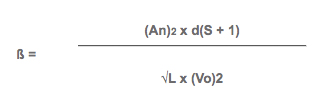
This isn’t exactly news, the effect known as “beer goggles” — where after a few pints people appear more attractive — was confirmed in 2002 and the mathematical formula was announced in 2005. Whether Matt Damon wrote it out on a hallway blackboard one late night is still not known. But How Stuff Works (under the TLC Cooking imprimatur) has a nice summary of the formula.

The first study I recall seeing was in 2002, and was conducted by the University of Glasgow. Both the BBC and the Daily Collegian had the story. Then, in 2005, researchers at the University of Manchester stumbled upon the formula for how it all works. They also discovered that “alcohol is not really the only factor affecting the drunken perception of beauty. Other factors, according to their research, include:

  • How brightly lit the area is
  • The observer’s eye-sight quality
  • The amount of smoke in the air
  • The distance of the observer from the observed

The formula is laid out below.

goggles-formula

Here’s how to decode the formula:

  • An is the number of servings of alcohol
  • d is the distance between the observer and the observed, measured in meters
  • S is the smokiness of the area on a scale of 0 – 10
  • L is the lighting level of the area, measured in candelas per square meter, in which 150 is normal room lightning
  • Vo is Snellen visual acuity, in which 6/6 is normal and 6/12 is the lower limit at which someone is able to drive

The formula works out a “beer goggle” score ranging from 1 to 100+. When ø = 1, the observer is perceiving the same degree of beauty he or she would perceive in a sober state. At 100+, everybody in the room is a perfect 10.

And one last odd finding of the second study. “A nearsighted, sober person who isn’t wearing his or her glasses can experience a beer-goggle effect equivalent to drinking eight pints of beer.”

Filed Under: Beers, Just For Fun, Related Pleasures Tagged With: Math, Science, Statistics

The Top 50 Annotated 2009

April 14, 2010 By Jay Brooks

ba
This is my fourth annual annotated list of the Top 50 so you can see who moved up and down, who was new to the list and who dropped off. So here is this year’s list again annotated with how they changed compared to last year.

  1. Anheuser-Busch InBev; #1 last year, no surprises
  2. MillerCoors; ditto for #2
  3. Pabst Brewing; ditto for #3
  4. D. G. Yuengling and Son; Moved up 1, over Boston Beer again
  5. Boston Beer Co.; Moved down 1 to behind Yuengling, where they’d been the 2 years prior to 2008
  6. Sierra Nevada Brewing; Same as last year
  7. New Belgium Brewing; Moved up 1
  8. Craft Brewers Alliance; Moved down 1
  9. Spoetzl Brewery (Gambrinus); Moved up 1
  10. High Falls Brewing; Moved down 1
  11. Minhas Craft Brewery; Up 3 over last year
  12. Pyramid Breweries (IBU); Down 1, after two years moving up
  13. Deschutes Brewery; Down 1
  14. F.X. Matt Brewing; Moved up 1, after dropping down 1 last year
  15. Magic Hat Brewing (IBU); Up 3 from #18 last year
  16. Boulevard Brewing; Same as last year, as others move all around them
  17. Harpoon Brewery; Up 3 from #20 last year
  18. Alaskan Brewing; Up 1 from #19 last year
  19. Bell’s Brewery; Up 2 from #21 last year
  20. Goose Island Beer; Up 2 from #22 last year
  21. Kona Brewing; Up 2 from #23 last year, after Shooting up 14 the previous year
  22. Full Sail Brewing; Down 5, primarily from removing contract beers from their total to give a more accurate figure of their own brands
  23. Stone Brewing; Up 5 again this year from 28, same jump as last year
  24. Dogfish Head Craft Brewery; Shot up 9 from #33, after being up 5 and 4 the two previous years
  25. Iron City Brewing; Plummeted 12, after a Chapter 11 bankruptcy and moving production out of Pittsburgh
  26. August Schell Brewing; Down 1 from last year
  27. Brooklyn Brewery; Up 4 from #31 last year
  28. Abita Brewing; Up 2 from #30 last year
  29. Summit Brewing; Down 2 from #27 last year
  30. Anchor Brewing; Down 6 from #24
  31. Shipyard Brewing; Down 5 from #26 last year
  32. New Glarus Brewing; Same as last year
  33. Great Lakes Brewing; Up 4 from #37 last year
  34. Rogue Ales/Oregon Brewing; Up 2 from #36, canceling being Down 2 last year, and Up 2 the year before that
  35. Long Trail Brewing; Down 1 from #34 last year
  36. Lagunitas Brewing; Up 2 from #38 last year, after being up 3 for the prior 2 years
  37. Mendocino Brewing; Down 8 from #29 last year
  38. Gordon Biersch Brewing; Down 3 from #35
  39. Sweetwater Brewing; Up 1 from #40 last year
  40. Firestone Walker Brewing; Down 1 from #39 last year
  41. Victory Brewing; Up 5 from #46 last year
  42. Flying Dog Brewery; Down 1 from #41 last year
  43. BJs Restaurant & Brewery; Down 1 from #42 last year
  44. Odell Brewing; Up 1 from #45 last year
  45. Rock Bottom Brewery Restaurants; Down 2 from #43 last year, a reversal of the year before
  46. Straub Brewery; Up 1 from #47 last year
  47. BridgePort Brewing (Gambrinus); Down 3 from #44 last year
  48. Lost Coast Brewing; Not in Top 50 last year
  49. Big Sky Brewing; Up 1 from #50 last year
  50. Stevens Point Brewery; Not in Top 50 last year

Two breweries are new to the list this year, Lost Coast and Stevens Point (who’ve transitioned to primarily all-malt brewing), while two dropped off the list; Cold Springs Brewery (fka Gluek Brewing) and Mac and Jack’s Brewery.

If you want to see the previous annotated lists for comparison, here is 2008, 2007 and 2006.

Filed Under: Breweries, Editorial, News Tagged With: Big Brewers, Statistics, United States

Top 50 Breweries For 2009

April 14, 2010 By Jay Brooks

ba
The Brewers Association has also just announced the top 50 breweries in the U.S. based on sales, by volume, for 2009. This includes all breweries, regardless of size or other parameters. Here is the new list:

  1. Anheuser-Busch InBev; St Louis MO
  2. MillerCoors; Chicago IL
  3. Pabst Brewing; Woodridge IL
  4. D. G. Yuengling and Son; Pottsville PA
  5. Boston Beer Co.; Boston MA
  6. Sierra Nevada Brewing; Chico CA
  7. Craft Brewers Alliance (Widmer/Redhook); Portland OR
  8. New Belgium Brewing; Fort Collins CO
  9. Spoetzl Brewery (Gambrinus); Spoetzl TX
  10. High Falls Brewing; Rochester NY
  11. Minhas Craft Brewery; Monroe WI
  12. Pyramid Breweries (IBU); Seattle WA
  13. Deschutes Brewery; Bend OR
  14. F.X. Matt Brewing; Utica NY
  15. Magic Hat Brewing (IBU); Burlington VT
  16. Boulevard Brewing; Kansas City MO
  17. Harpoon Brewery; Boston, MA
  18. Alaskan Brewing; Juneau AK
  19. Bell’s Brewery; Galesburg MI
  20. Goose Island Beer; Chicago IL
  21. Kona Brewing; Kailua-Kona HI
  22. Full Sail Brewing; Hood River OR
  23. Stone Brewing; Escondido CA
  24. Dogfish Head Craft Brewery; Lewes DE
  25. Iron City Brewing; Pittsburgh PA
  26. August Schell Brewing; New Ulm MN
  27. Brooklyn Brewery; Brooklyn NY
  28. Abita Brewing; New Orleans LA
  29. Summit Brewing; Saint Paul MN
  30. Anchor Brewing; San Francisco CA
  31. Shipyard Brewing; Portland ME
  32. New Glarus Brewing; New Glarus WI
  33. Great Lakes Brewing; Cleveland OH
  34. Rogue Ales/Oregon Brewing; Newport OR
  35. Long Trail Brewing; Burlington VT
  36. Lagunitas Brewing; Petaluma CA
  37. Mendocino Brewing; Ukiah CA
  38. Gordon Biersch Brewing; San Jose CA
  39. SweetWater Brewing; Atlanta GA
  40. Firestone Walker Brewing; Paso Robles CA
  41. Victory Brewing; Downington PA
  42. Flying Dog Brewery; Frederick MD
  43. BJs Restaurant & Brewery; Huntington Beach CA
  44. Odell Brewing; Fort Collins CO
  45. Rock Bottom Brewery Restaurants; Louisville CO
  46. Straub Brewery; Saint Mary’s PA
  47. Bridgeport Brewing (Gambrinus); Portland OR
  48. Lost Coast Brewing; Eureka CA
  49. Big Sky Brewing; Missoula MT
  50. Stevens Point Brewery; Stevens Point WI

Here is this year’s press release.

Also, the Annotated List is now up.

Filed Under: Breweries, News Tagged With: Big Brewers, Statistics, United States

« Previous Page
Next Page »

Find Something

Northern California Breweries

Please consider purchasing my latest book, California Breweries North, available from Amazon, or ask for it at your local bookstore.

Recent Comments

  • Ernie Dewing on Historic Beer Birthday: Charles William Bergner 
  • Steve 'Pudgy' De Rose on Historic Beer Birthday: Jacob Schmidt
  • Jay Brooks on Beer Birthday: Bill Owens
  • Steve 'Pudgy' De Rose on Beer Birthday: Charles Finkel
  • Steve 'Pudgy' De Rose on Beer Birthday: Bill Owens

Recent Posts

  • Beer In Ads #5204: Oh Brother! Griesedieck Bros. Genuine Premium Bock Beer Is Here! February 15, 2026
  • Historic Beer Birthday: Emil Resch February 15, 2026
  • Historic Beer Birthday: Philip Zang February 15, 2026
  • Beer In Ads #5203: Robert Portner’s Bock Beer February 15, 2026
  • Historic Beer Birthday: August Schell February 15, 2026

BBB Archives

Feedback

Head Quarter
This site is hosted and maintained by H25Q.dev. Any questions or comments for the webmaster can be directed here.