Brookston Beer Bulletin

Jay R. Brooks on Beer

  • Home
  • About
  • Editorial
  • Birthdays
  • Art & Beer

Socialize

  • Dribbble
  • Email
  • Facebook
  • Flickr
  • GitHub
  • Instagram
  • LinkedIn
  • Pinterest
  • RSS
  • Twitter
  • YouTube

Powered by Genesis

Beer In Ads #5024: Now Ready! Gettleman’s Bock Beer

July 14, 2025 By Jay Brooks

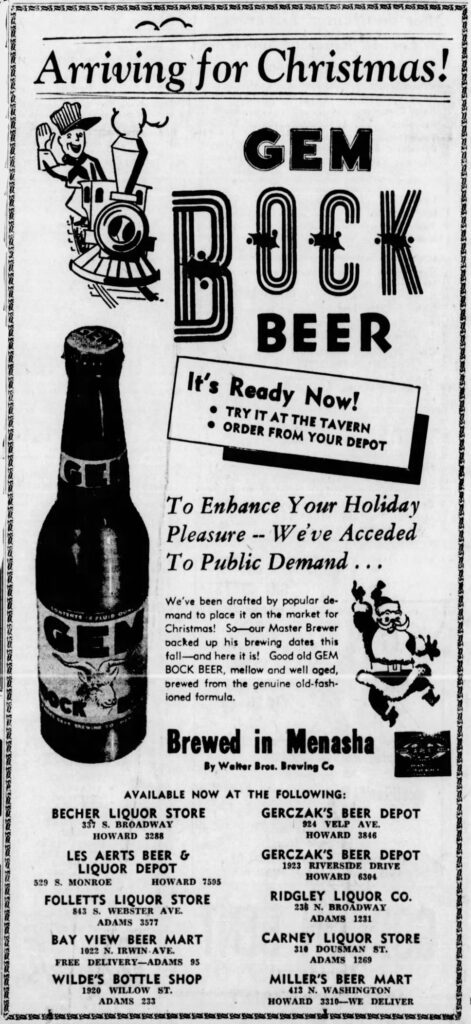
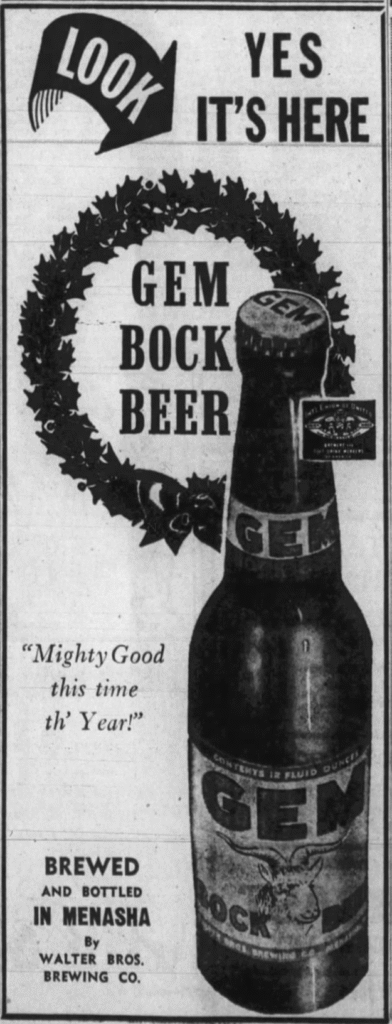
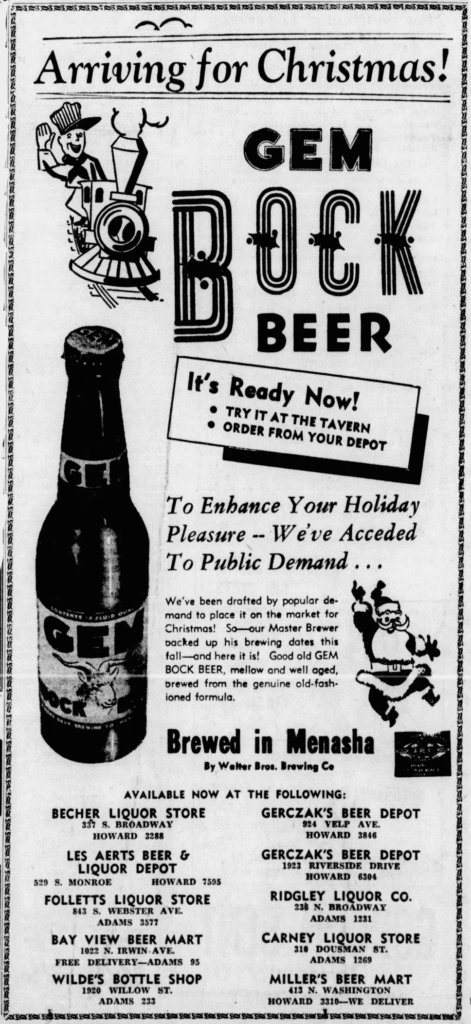
Last year I decided to concentrate on Bock ads. Bock, of course, may have originated in Germany, in the town of Einbeck. Because many 19th century American breweries were founded by German immigrants, they offered a bock at certain times of the year, be it Spring, Easter, Lent, Christmas, or what have you. In a sense they were some of the first seasonal beers. “The style was later adopted in Bavaria by Munich brewers in the 17th century. Due to their Bavarian accent, citizens of Munich pronounced ‘Einbeck’ as ‘ein Bock’ (a billy goat), and thus the beer became known as ‘Bock.’ A goat often appears on bottle labels.” And presumably because they were special releases, many breweries went all out promoting them with beautiful artwork on posters and other advertising.

Monday’s ad is for Gettelman’s Bock Beer, which was published on July 14, 1939. This one was for the A. Gettelman Brewing Co. of Milwaukee, Wisconsin, which was originally founded in 1855. This ad ran in The Journal Times, of Racine, Wisconsin.

Filed Under: Art & Beer, Beers, Breweries, Just For Fun Tagged With: Advertising, Bock, History, Wisconsin

Historic Beer Birthday: Frank Selinger

July 8, 2025 By Jay Brooks

schlitz2

Today is the birthday of Frank J. Selinger (July 8, 1914-June 15, 2000). He was born in Philadelphia and was trained as a chemist and later became a brewmaster, first with the Esslinger Brewing Co. in Philadelphia, but later with the Burger Brewing Co. and Anheuser-Busch. But in 1977, he accepted the position of CEO for Schlitz Brewing and even appeared in television commercials for them in the early 1980s.

frank-sellinger-tv

Here’s an obituary of Sellinger, from the Williamsburg Daily Press:

Francis J. Sellinger, a former brewing executive in Milwaukee, St. Louis, Cincinnati and Philadelphia, died Thursday, June 15, 2000, at Williamsburg Community Hospital. He was 85.

A native of Philadelphia, Mr. Sellinger graduated in 1936 with a degree in chemistry from St. Joseph’s College in Philadelphia. According to his son, Joseph Sellinger, he initially wanted to become a doctor but took a job in a brewery in order to help support his family. He began his career in the brewing industry in 1936 as chief chemist and assistant brewmaster with the Esslinger Brewing Co. in Philadelphia. In 1952, he joined the Burger Brewing Co. in Cincinnati, and he became vice president and general manager in 1956.

Mr. Sellinger joined Anheuser-Busch Inc. in St. Louis, Mo., in 1964. During his 14 years with the company, he held many senior executive positions, including vice president of engineering, and was a key figure in the company’s rapid brewery expansion during the 1970s, with the construction of breweries in Columbus, Ohio; Jacksonville, Fla.; Merrimack, N.H.; Williamsburg, Va.; and Fairfield, Calif. Mr. Sellinger was also heavily involved in the promotion of new technological advances within the company.

“He was the one that understood the direction the economics of the industry were going in,” said Patrick Stokes, president of Anheuser-Busch Inc.

He also played a key role in the development of the company’s Busch Gardens-The Old Country theme park and the Kingsmill Residential Community and Resort, both in Williamsburg.

In 1978, he became the vice chairman and chief executive officer of Schlitz Brewing Co. in Milwaukee. According to Joseph Sellinger, one of his first tasks at Schlitz was to turn the image of the company around. He worked to accomplish this by returning the company to a traditional brewing process. In addition, Mr. Sellinger appeared in the “Taste My Schlitz” television advertising campaign that began in 1978. Joseph Sellinger said that the locales for his father’s commercials ranged from barley fields to bars. Mr. Sellinger continued his career at Schlitz until his retirement in 1983 to Kingsmill in Williamsburg.

After his retirement, Mr. Sellinger became involved with the Anheuser-Busch Golf Classic, now the Michelob Golf Classic, and worked for St. Bede’s Catholic Church.

Mr. Sellinger will be remembered for his integrity, caring and generosity toward his family, friends and employees. He came from very humble beginnings, said Joseph Sellinger, yet gave so much to others.

BurgerSoftTopIntro
Frank Sellinger (left), when he was Vice-President and General Manager of Burger Brewing.

And this is from the New York time, from March 1, 1981, an article by Ray Kenny entitled “Trying to Stop the Flight from Schlitz.”

MILWAUKEE SHORTLY after Frank J. Sellinger went to work at the Jos. Schlitz Brewing Company in November 1977, he faced the first in a long list of problems.

A daughter, who then lived on the West Coast, telephoned and confessed: “Daddy, I don’t like that beer.” She had a lot of company. Schlitz, which had reformulated its flagship brand in a disastrous economy move in the 70’s, has been fighting a steady decline in sales ever since. Earnings plunged from almost $50 million five years ago to a $50.6 million loss in 1979 when it sold its newest brewery.

Said Mr. Sellinger: “I told my daughter, ‘Honey, do me a favor. Try Schlitz Malt Liquor. If you still don’t like it, go back to Budweiser.'”

After all, Mr. Sellinger said, “Anheuser-Busch put bread and butter on the Sellinger table for a lot of years.” Mr. Sellinger was an executive there all those years. Now, as vice chairman and chief executive at Schlitz charged with getting people to drink Schlitz again, he has reworked its taste, pitted it against the major beers in taste competitions televised live and gone on television commercials himself as the company’s down-to-earth pitchman. He has also pared expenses, cut excess brewing capacity and tightened quality control.

For all that, Schlitz is still losing sales position. In its best year, 1976, the company sold 24.2 million barrels. In 1980, shipments declined 11 percent on the year, to 15 million barrels. The company lost its fingertip hold on third place in the industry, behind the Anheuser-Busch Companies, which sold 50.2 million barrels in 1980, and the Miller Brewing Company, a subsidiary of Philip Morris Inc., which shipped 37.3 million barrels last year. Schlitz dropped to fourth place, behind its crosstown rival, Pabst, which shipped 15.1 million barrels.

“This company faced the toughest marketing problem you’ve ever seen,” an outside director said. “Beer drinkers are intensely loyal and we drove them away. Getting them to switch back is a horrendous challenge.”

Despite the continued falling sales, the company managed to show a profit last year of $27 million, or 93 cents a share, on revenues of $1 billion. Mr. Sellinger’s efforts apparently have paid off, along with gains by Schlitz’s container division and some profits attributed to nonoperating areas of the business. Clearly, corporate executives and members of the Uihlein (rhymes with E-line) family, who continue to hold the controlling interest in the company, were buoyed by the earnings swing.

“When sales are falling, the first thing you do is arrest the decline,” Mr. Sellinger said. “We’ve slowed things down but it’s too early to tell whether we’ve turned it around. Ask me again in June.”

Mr. Sellinger, 66, was named vice chairman and chief executive officer at Schlitz last April after coming on board in 1977 as president. One of the first things he did in an attempt to slow falling sales was to formulate what he calls “one helluva good brew.” He assembled technical personnel and urged them to create a flagship beer that would appeal to the eye as well as the taste.

“It has to look good,” he said. “Americans drink with their eyes. Beer has to be rich in flavor and hold its head. “There is just so much you can do. You can increase the barley malt and change the amount of hopping – the ratio of hops to corn. But the malt is the soul of the beer.

“From January of 1978 until July, we conducted test after test after test. Finally, we all agreed, and I’ll tell you, if we can get people to taste the beer, we’ll keep ’em.”

Then he sought to improve quality control. “If the quality guy at a plant says it doesn’t go, it doesn’t go,” he said. “He reports to headquarters, not to the plant manager, and if that means we dump 5,000 cans because of high air content, then we dump 5,000 cans.”

Mr. Sellinger pared the payroll to 6,100 employees, eliminating 800 to 1,000 jobs. “I believe in paying fair wages,” he said, “but I can’t afford two workers for one job. We eliminated a lot of people. We sacrificed a few for the good of the many.”

As for expenses, he said, “We had grown fat. Lax. I mean, how many WATS lines do you really need? How many copies do you have to make? There a million ways to save.”

He cut deeply into excess capacity when he closed the company’s newest brewery – a six-year-old facility in Syracuse, N.Y., in 1979. The move, together with the closing of a small brewery in Honolulu, trimmed production capacity by 5.4 million barrels. But the company is still swimming in capacity. Last year it was capable of turning out 25.6 million barrels while it sold 15 million.

A year ago, the Syracuse plant was sold to Anheuser-Busch for $100 million. The company absorbed a $44.3 million loss in the process. “That was a beautiful brewery,” Mr. Sellinger said, “but it was an albatross. That doesn’t mean the decision to build it wasn’t right at the time. If your sales trend is a plus 12 percent a year, then you know that in three and a half years – the time it takes to construct a brewery – you will need so much beer to satisfy demand. The 1974 trend told us we would have to spend $157 million for the beer we would need by 1977.”

B REWERIES are built with the wholesalers in mind, Mr. Sellinger said. “We pressure them to sell Schlitz and they want to know whether Schlitz will have the beer if the business continues. We can’t say, ‘we have no beer.’ That takes all their incentive away.”

But if the customers leave, there’s no need for a brewery. “That’s the chance business takes constantly,” Mr. Sellinger said. “Look at our friends at Miller. Their trend line has been a plus 24 percent a year, but now it’s 3 1/2 percent.” Between 1954 and 1964, no breweries were built in the United States, the Schlitz chief recalled.

“Only Anheuser-Busch and Schlitz had the guts to borrow the money at 9.2 percent interest and build new plants. We didn’t have a ‘cash cow,’ ” he said, using his favorite description for Philip Morris. “What would Miller’s profit be if they paid even 8 percent interest on that Philip Morris investment?”

Schlitz embarked on an expensive campaign featuring live taste tests on television, pitting its product, at various times, against Miller High Life and Anheuser’s Budweiser and Michelob. Half the 100 Budweiser drinkers pulled the lever for Schlitz in one test supervised by Tommy Bell, a widely recognized referee in the National Football League. Other scores were respectable. But some critics said that the nature of the tests gave Schlitz the advantage. (Since the participants in a given test were all, say, Budweiser drinkers, Schlitz could claim victory if any favored its beer.)

Concluded Joseph Doyle, a brewing industry analyst at Smith Barney Harris Upham & Company: “All the media coverage (of the taste tests) is giving Schlitz a big bang for their buck. I’d count the campaign a huge success if it arrests the decline of the brand, and it looks like it is doing that.”

The company trumpeted the results in follow-up newspaper ads, but there are no current plans to continue the live taste tests. Nevertheless, Mr. Sellinger’s desk is piled with letters and comments. “Here’s one from five students at Holy Cross – Bud drinkers – who have started a Tommy Bell/Schlitz fan club,” he said. “The young drinkers are the ones you want to win.”

The company has not disclosed sales figures related to the television campaign but some distributors reported sales gains. “We doubled our January sales in the first week,” after the commercials began, reported Jack Lewis, a distributor in Cleveland. Joe Scheurer, in Philadelphia, said his sales were up 10 percent. Other distributors reported gains.

Mr. Sellinger, who prefers the term “beer tasting” to beer guzzling, will drink to that.

Here’s one of Sellinger’s TV ads, this one from 1981.

And here’s another one.

Filed Under: Birthdays, Breweries, Just For Fun Tagged With: Advertising, Anheuser-Busch, History, Milwaukee, Pennsylvania, Philadelphia, Schlitz, Video, Wisconsin

Beer In Ads #5018: Point Bock Beer

July 7, 2025 By Jay Brooks

Last year I decided to concentrate on Bock ads. Bock, of course, may have originated in Germany, in the town of Einbeck. Because many 19th century American breweries were founded by German immigrants, they offered a bock at certain times of the year, be it Spring, Easter, Lent, Christmas, or what have you. In a sense they were some of the first seasonal beers. “The style was later adopted in Bavaria by Munich brewers in the 17th century. Due to their Bavarian accent, citizens of Munich pronounced ‘Einbeck’ as ‘ein Bock’ (a billy goat), and thus the beer became known as ‘Bock.’ A goat often appears on bottle labels.” And presumably because they were special releases, many breweries went all out promoting them with beautiful artwork on posters and other advertising.

Monday’s ad is for Point Bock Beer, which was published on July 7, 1967. This one was for the Stevens Point Brewery of Stevens Point, Wisconsin, which was originally founded in 1857. This ad ran in The Merrill Daily Herald, of Merrill, Wisconsin.

Filed Under: Art & Beer, Beers, Breweries, Just For Fun Tagged With: Advertising, Bock, History, Wisconsin

Beer In Ads #5016: Enjoy The 4th With Del’s Bock Beer

July 5, 2025 By Jay Brooks

Last year I decided to concentrate on Bock ads. Bock, of course, may have originated in Germany, in the town of Einbeck. Because many 19th century American breweries were founded by German immigrants, they offered a bock at certain times of the year, be it Spring, Easter, Lent, Christmas, or what have you. In a sense they were some of the first seasonal beers. “The style was later adopted in Bavaria by Munich brewers in the 17th century. Due to their Bavarian accent, citizens of Munich pronounced ‘Einbeck’ as ‘ein Bock’ (a billy goat), and thus the beer became known as ‘Bock.’ A goat often appears on bottle labels.” And presumably because they were special releases, many breweries went all out promoting them with beautiful artwork on posters and other advertising.

Saturday’s ad is for Bock Beer at Del’s Tavern, which was published in July 1942. This one was for an unnamed bock, though itvwas probably a local one. The iconic La Crosse bar was originally founded in 1933. This ad ran in The La Crosse Tribune, also of La Crosse, Wisconsin.

Filed Under: Art & Beer, Beers, Breweries, Just For Fun Tagged With: Advertising, Bock, History, Holidays, Wisconsin

Historic Beer Birthday: J.P. Binzel

July 4, 2025 By Jay Brooks

Today is the birthday of J.P. Binzel, who sometimes went by J. Philipp or J. Philip (July 4, 1833-1902). He learned to brew as an apprentice at both the Schlitz Brewery and the Val. Blatz Brewery, both in Milwaukee. He first started his own brewery in Wapun, Wisconsin, but it burned down and was a total loss. In 1866, he bought the Farmer’s Brewery in nearby Beaver Dam, Wisconsin, which had originally opened in 1857.

The Farmer’s Brewery, before Binzel bought it in 1866.

Localeben Magazine picks up the story:

Philip Binzel passed away in 1902, and his wife with the assistance of two sons, Edward and Alvin, continued to run the business.  The name was changed from Farmer’s Brewery to J. Philip Binzel Brewing Company to honor her late husband. A third son, Rudolf, bought the brewery four years later and operated it until they quit brewing in 1920 at the beginning of Prohibition.

Filed Under: Birthdays, Breweries, Just For Fun Tagged With: Wisconsin

Historic Beer Birthday: John Schreihart

June 28, 2025 By Jay Brooks

schreihart
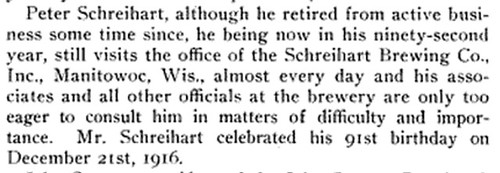
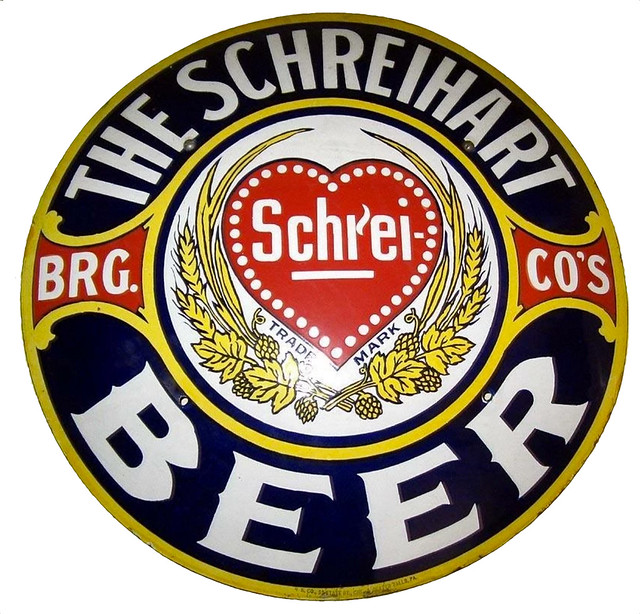
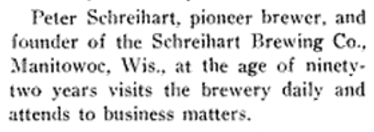
Today is the birthday of John Schreihart (June 28, 1842-January 6, 1925). He was born in Austria, but moved to Wisconsin when he was 25, in 1867. Along with a partner, Frederick Pautz, bought the William Fricke Brewery, which had been founded in 1862. In 1879, John become soler proprieter, re-naming it the John Schreihart Brewery, and later the Schreihart Brewing Co. John Schreihart died during prohibition, and the brewery re-opened as the Bleser Brewing Co. in 1937, closing for good in 1942.

Schreihart-freiersangerbundSchreihart apparently liked to sing. That’s him in the front row, seated on the left.

Here’s his obituary from Find-a-Grave:

J. SCHREIHART, PIONEER DIES, TODAY, AGED 82
Pioneer Brewer Who Came Here in ’67, Is Called Death early today claimed John Schreihart, pioneer brewer of the city and for many years identified with business life of the community, Mr. Schreihart passing away at his home at 1017 South Eleventh street at the age of 82 years. Up to a few weeks ago Mr. Schreihart, despite his age, had been in good health and was active, but five weeks ago suffered a decline which caused him to fall rapidly and brought death today. For a week he was a patient at the hospital but later, at his request, returned to his home where the end came.

Funeral services for Mr. Schreihart will be held Friday morning at 9 o’clock from St. Boniface church, the Rev. Kersten officiating. Burial will be at Calvary cemetery.

Came to City in ’67
Mr. Schreihart was born at Duerngren, Austria, June 28, 1842 and spent his early life there. In 1866 he was married to Frances Wilfer there and a year later came to America, retiring after a short stay to bring Mrs. Schreihart to this country and the couple came directly to Manitowoc where they have since resided. On February 2, 1916, they celebrated their golden wedding at their home here.

In 1871 Mr. Schreihart, who had been seeking a business formed a partnership with Mr. Pautz and the two purchased what was known as the old Fricke brewery plant with which Mr. Schreihart was identified until 1885 when, on occasion of a trip to Europe, he leased, but he again resumed management of the property upon his return and in 1890 a new association was formed with Mr. Schreihart, Frank Willinger and Gustave Mueller as partners, Mr. Willinger retiring from the company in 1891 after which the business was operated under name of the Schreihart & Mueller Brewing Company until 1904 when the business was incorporated under the name of the Schreihart Brewing Company, Mr. Schreihart having continuously been director of its affairs. In 1911 Charles Kulnick purchased the Mueller interest in the concern and H.J. Schreihart became president of the company, its founder retaining interest but not giving attention to active management of the business.

In later years the plant became a part of a merger of three brewing concerns of the city, the Schreihart, Rahr Sons and Kunz & Bleser company and the merger incorporated under name of the Manitowoc Products Company by which title it is still known. With the advent of the prohibition law, the brewing plant of the Schreihart Company on Washington street was transformed into a plant for manufacture of ice cream and soft beverages and still continues in that operation. Mr. Schreihart retained his interest in the company.

Built Schreihart Block
During his long career as a business man in the city Mr. Schreihart was widely known and enjoyed the respect of the community had been active in support of building of the city and contributed freely to the enterprises which aimed to this end. He build the Schreihart block at Tenth and Washington, one of substantial business blocks of the city.

After his retirement from active life, as his advanced years necessitated, Mr. Schreihart continued to take an interest in civic affairs and up until a short time of his last illness, was about as usual.

Shreihart-beer-sign

And this is biography is from the “History of Manitowoc County Wisconsin,” by Dr. L. Falge, 1911-1912, v.2, p.74:

John Schreihart, who is one of the well known brewers of Manitowoc county, Wisconsin, is a native of Austria, and came to this county in 1869, working for others for two years, and then forming a partnership with a Mr. Pautz. He eventually purchased the Fricke Brewery, which he rented in 1885 when he went on a trip to Europe, but in 1890 assumed management of it again with Frank Willinger and Gus Miller. In 1891 Mr. Willinger sold his interests to Mr. Schreihart, and it was operated by the other partners until 1904, when the firm was incorporated under the style of Schreihart Brewing Company. On January 1, 1911, Charles Kulnick bought the Miller interests, and at this time H. J. Schreihart, who up to that time had been brewmaster of the concern, was made president; Otto Senglaub was elected secretary; and Charles Kulnick, treasurer and manager. The plant has a capacity of thirty thousand barrels per year and produces the well known “Weiner” and “Old German Style” beers, employing fifteen men. John Schreihart married Frances Wilfer, a native of Germany, and they had five children, namely: Mrs. Charles Kulnick; H. J.; Ed, who is engineer at the brewery; Helene; and Adolph, who is studying for the priesthood. Ed Schreihart married Miss Schroeder of Milwaukee. H. J. Schreihart attended the Hanthe Brewing School of Milwaukee, now known as the Industrial Chemical Institute, after leaving which he entered his father’s brewery as brewmaster, a position which he held until his election as president in 1911. He has served as supervisor of the third ward for two years, and is prominent in business and fraternal circles. He was married to Miss Hattie Hartwig, of Manitowoc, Wisconsin.

Pautz’s Brewery was built in 1849, by Mr. Hottleman, he being the first to brew beer in the county. G. Kuntz purchased the brewery of him in 1865. Messrs. Fred. Pautz and John Schreihart became the owners in 1875. In November, 1878, the former purchased the interest of the latter, and is now conducting the business alone. The capacity of the brewery is about 1,600 barrels of beer per annum.

Schreiharts’s Brewery. In 1879, John Schreihart established himself in business, and is now conducting a brewery on Washington street. He has been brought up in the business and understands it.

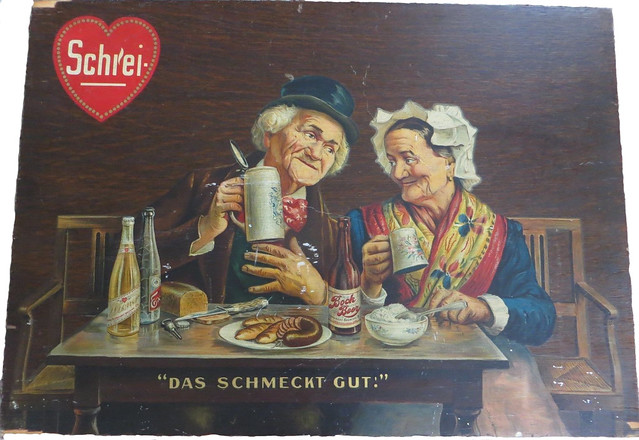
Schreihard-das-schmeckt-gut

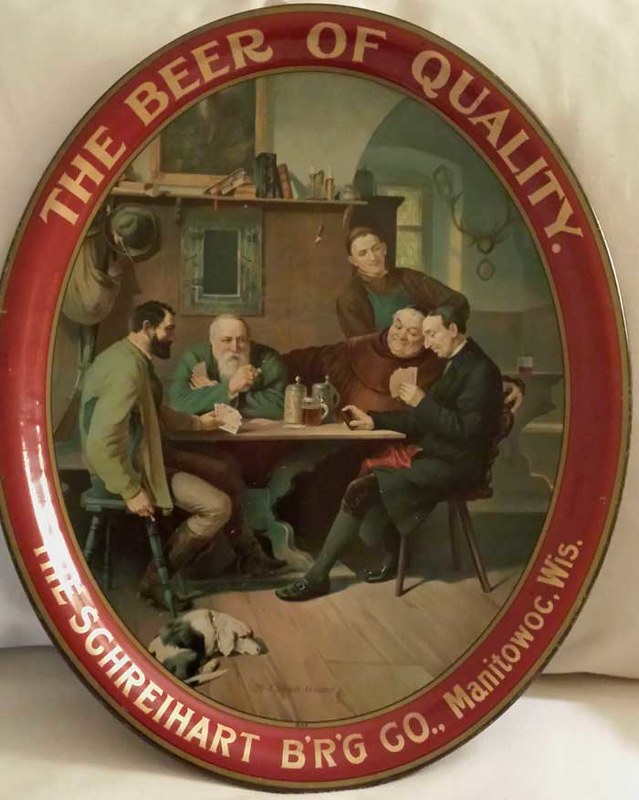
From what I can piece together about the brewery itself, it appears to have been built in 1849, and went through several name changes from the William Fricke Brewery, the Christian Fricke Brewery, and then the Carl Fricke Brewery. It seems to have been called by the latter name when Frederick Pautz and John Schreihart bought it in 1875, but it didn’t become the John Schreihart Brewery until he bought out Pautz in 1879. A few years later, in 1884 until the following year, it was known as the John Schreihart & George Kunz Brewery, presumably because Schreihart took on George Kunz as a partner. Then there’s a gap in the record, but by 1891 it was known as the Schreihart Brewing Co. until it was closed by prohibition in 1920. The building apparently lay dormant after repeal in 1933, but from 1937-1942 housed the Bleser Brewing Co., which I assume was because they leased or bought the building where the Schreihart had brewed.

schreihartbeertray

Filed Under: Birthdays, Just For Fun Tagged With: Austria, History, Wisconsin

Beer In Ads #5005: Valter & Droopy Love Old Imperial Bock

June 21, 2025 By Jay Brooks

Last year I decided to concentrate on Bock ads. Bock, of course, may have originated in Germany, in the town of Einbeck. Because many 19th century American breweries were founded by German immigrants, they offered a bock at certain times of the year, be it Spring, Easter, Lent, Christmas, or what have you. In a sense they were some of the first seasonal beers. “The style was later adopted in Bavaria by Munich brewers in the 17th century. Due to their Bavarian accent, citizens of Munich pronounced ‘Einbeck’ as ‘ein Bock’ (a billy goat), and thus the beer became known as ‘Bock.’ A goat often appears on bottle labels.” And presumably because they were special releases, many breweries went all out promoting them with beautiful artwork on posters and other advertising.

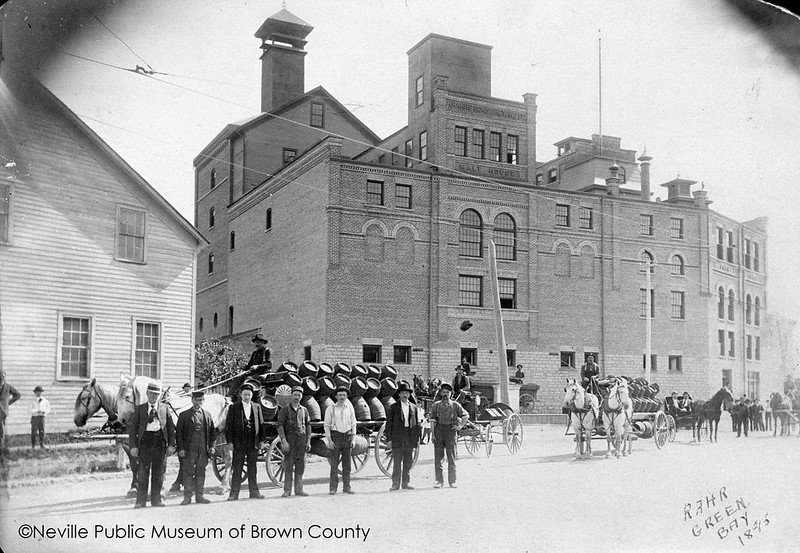
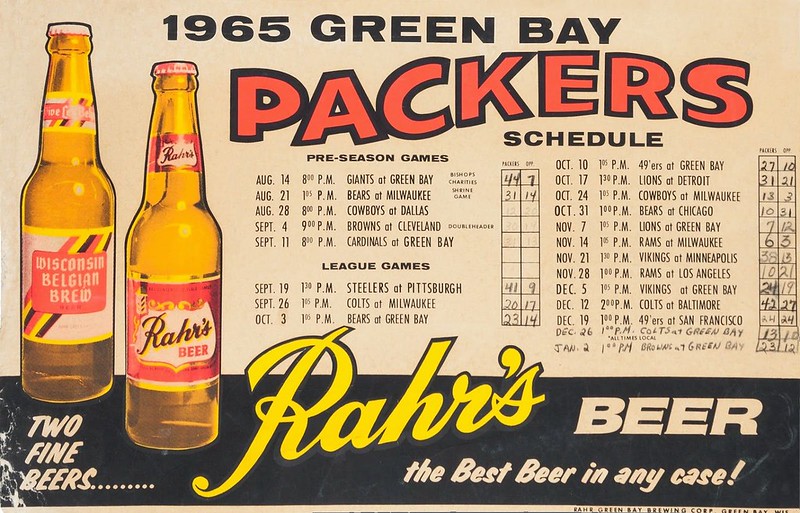
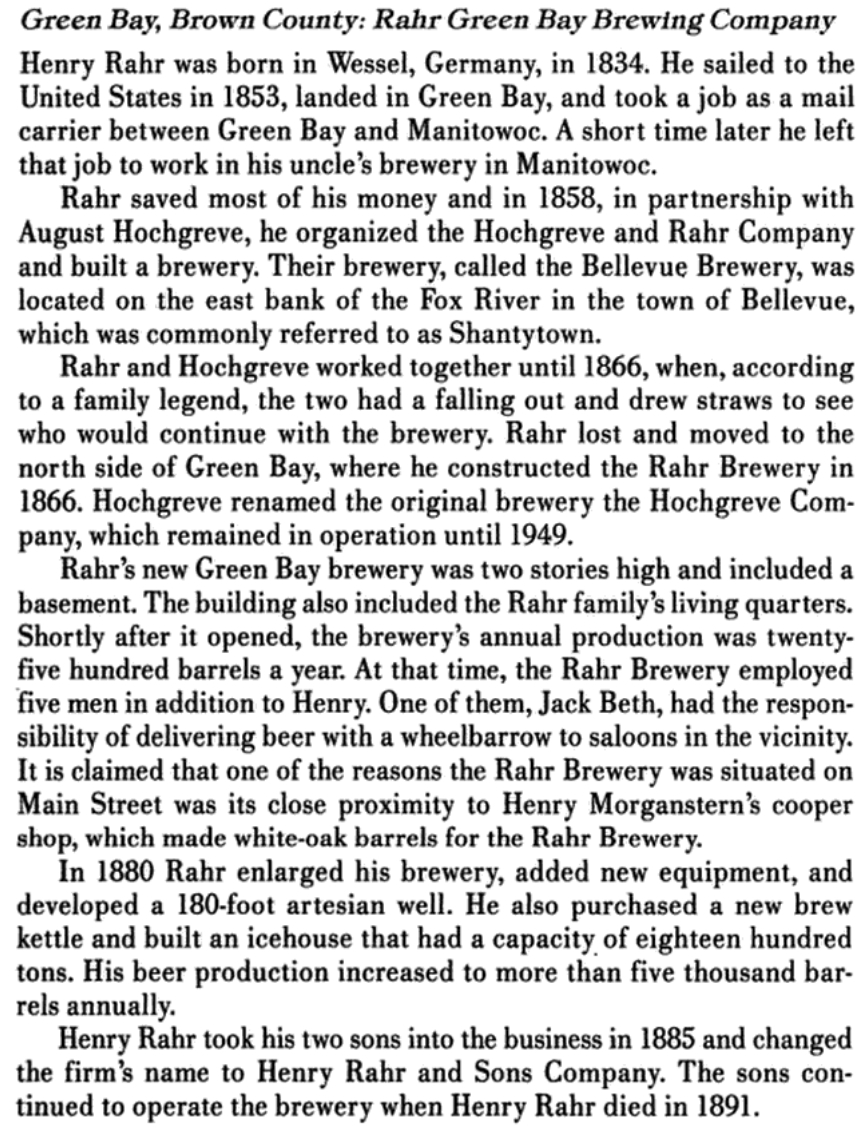
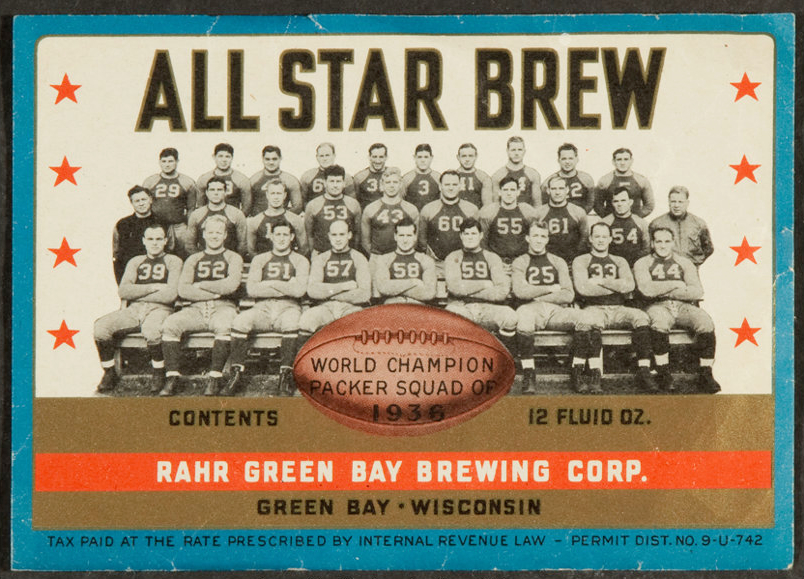
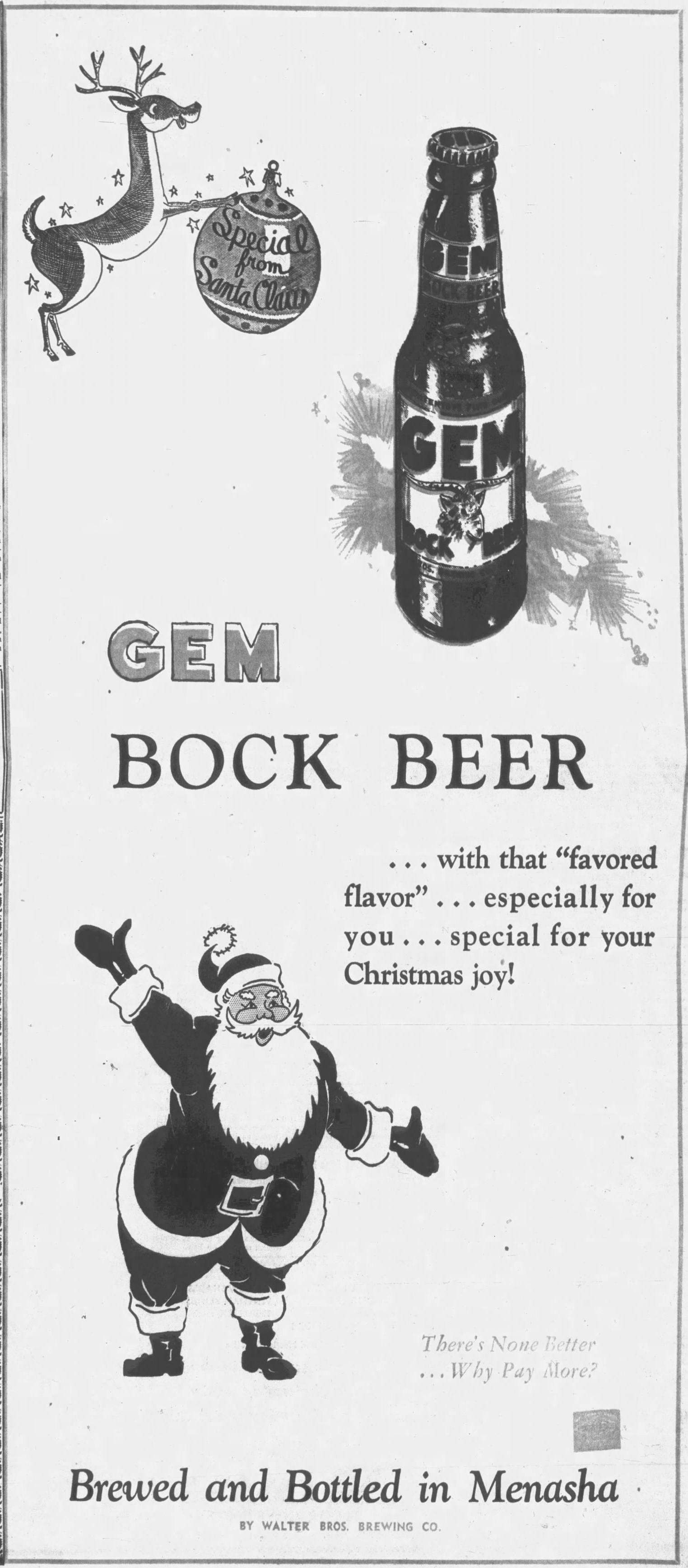
Saturday’s ad is for Old Imperial Bock Beer. The ad was published in 1962. This one was for the Rahr-Green Bay Brewing Co., which was located in Green Bay, Wisconsin and was originally founded in 1853. This ad ran in The Green Bay Press Gazette, of Green Bay, Wisconsin. The text on this one is great. “Cool, Refreshing, Palatable.” Palatable? Not exactly a great descriptor. But even better are the two endorsements, first from Valter: “Ven I say ‘good,’ I mean ‘GOOD!'” followed by Droopy: “‘Ach! You know de answer.”
Filed Under: Art & Beer, Beers, Breweries, Just For Fun Tagged With: Advertising, Bock, History, Wisconsin

Historic Beer Birthday: Adolph G. Bechaud

May 30, 2025 By Jay Brooks

bechaud

Today is the birthday of Adolph G. Bechaud (May 30, 1840-March 5, 1919). He was born in Rheinpflz, Germany, but emigrated with his parents in 1850, when he was ten, settling in Fond du Lac, Wisconsin. In 1871, along with two of his brothers, Frank and Jean (a.k.a. John), founded the A.G. Bechaud Brewery, which was also known as the A.G. Bechaud & Bros. Brewery and later, beginning in 1875, traded under the Empire Brewery name, before returning to Bechaud Brewery when it reopened after prohibition ended, before closing for good in 1941.

Adolph-G-Bechaud
Bechaud as a Captain in the U.S. Army.

This obituary is from Bechaud’s Find-a-Grave page, on originally ran on the front page of the Fond du Lac Daily Commonwealth, Wednesday, March 5, 1919:

 ADOLPH G. BECHAUD DEAD; LEADER IN BUSINESS CIRCLES. End Comes to Interesting and Active Life. WAS CAPTAIN IN CIVIL WAR. Fond du Lac Banker, Capitalist and Manufacturer Succumbs at Age of 79. Captain Adolph G. Bechaud; vice president of the Commercial National Bank since its organization, veteran of the Civil War, and a man whose business energy and integrity has left a deep impression upon the life of Fond du Lac, died at 4:30 o’clock this morning at the family residence 457 West Eleventh street. his illness has been of about four weeks’ duration, though for some months past there has been a noticeable lack of that interest and activity which has always been characteristic of him. Mr. Bechaud was born May 30, 1840, in Dirmstein, Germany, and came to the United States in 1853, settling in Fond du Lac with his parents. The outbreak of the Civil War found Mr. Bechaud, then a young man just turning his twenties, ready and willing to serve. On October 29, 1861, he volunteered at Chicago and was assigned to Company B of the Thirteenth Illinois Cavalry. At the age of 23 he was advanced from rank of sergeant to that of first lieutenant. He was commissioned as such January 6, 1863. His command was detailed for duty in the western theater of the war, being engaged largely in scouting work in Missouri, Mississippi and Arkansas. On Oct. 19, 1863, he was advanced to the rank of captain taking command of Company B, of the Thirteenth cavalry and serving as such in the later campaigns of the war, and being in command on his discharge from the service at the close of the war. Capt. Bechaud served under Generals Davis, Carr and Steel. In 1864 he took his discharge and came back home to take the duties of civil life. He became associated with Paul Hauser who conducted one of the pioneer breweries of the county on the ledge east of the city. Here Mr. Bechaud learned the fundamentals of the business which was later to become his life work. In 1871 he joined his brothers in the organization of the Bechaud Brewing company, taking the office of president which he has continuously held. On June 6, 1870 he was married to Miss Elizabeth Kramer, then of the town of Taycheedah. Mr. Bechaud leaves in addition to his wife, the following children: Mrs. F.W. Orth, Mrs. H.T. Schmidt, August Bechaud, Mrs. John P. Kalt, Adolph Bechaud, Jr., and Mrs. W.W. Petrie, also six grandchildren, Adolph V. Orth, Charlotte Venne, Robert Bechaud, Ross Petrie, Marcia Petrie and Audrey Bechaud. He is also survived by two brothers; J.B. Bechaud of this city and Armand Bechaud of Chehalis, Wash. Mr. Bechaud was a man of keen business judgment, an indefatigable worker, one who stood unflinchingly by the accepted honorable principles of business dealing. His energy interest and desire that everything should be attended to in a business like way was characteristic of him. He was one of the moving spirits in the organization of the Commercial National bank, and his counsel was often sought and always relied upon in matters requiring decision that would be unerring. In business and social circles he will be missed by a wide circle of friends. Socially he was a member of the Elks and Edwin A. Brown Post No. 130 G.A.R. While plans for the funeral are not fully determined, it is probable that the service will be held Friday afternoon at the residence.

Adolph-G-Bechaud-pair

And this obituary ran on page 1 of the Fond du Lac Daily Reporter, Wednesday, March 5, 1919:

CAPT. A.G. Bechaud. Born May 30, 1840 Died March 5, 1919. CAPT. BECHAUD EXPIRES AFTER LONG ILLNESS. Brewing Co. Head and Bank Officer Dies at Home on West Eleventh St. VETERAN OF THE CIVIL WAR. Captain Adolph G. Bechaud, aged 79, president and one of the founders of the Bechaud Brewing company, vice-president and director of the Commercial National bank and one of the city’s most prominent residents died at 4:30 o’clock this morning at his home, 457 West Eleventh street, after a lingering illness. Mr. Bechaud was taken seriously ill about four weeks ago and since then has been confined to his bed. His condition gradually grew worse until this morning, when the end came peacefully. The deceased was born in Dirmstein Germany, on May 30, 1840, and when thirteen years of age came to the United States with his parents. The family settled in Fond du Lac county in 1853 and Mr. Bechaud had resided in this vicinity practically ever since. When the civil war broke out, Adolph G. Bechaud was one of the first Fond du Lac county young men to join forces. He enlisted as a private in the Thirteenth company of the Illinois Cavalry at Chicago, Ill., on October 29, 1861. He was commissioned as a first lieutenant on January 6, 1863 and on October 19, 1863, was promoted to rank of captain. He commanded the Thirteenth company and did scouting work under Generals Davis, Carr and Steele in the states of Missouri, Mississippi, Arkansas and Louisiana. He was mustered out of the service December 31, 1864. After the war Captain Bechaud returned to Fond du Lac county and for sometime was employed at the Hauser Brewery at Taycheedah. When the Hauser Brewery burned, Mr. Bechaud came to this city and was one of the founders of the Bechaud Brewing company. The present brewery on West Eleventh was built in 1872 and has been in operation since that time under the direction of Captain Bechaud and his brothers. He served as president of the brewing company for many years. The deceased had been a director of the Commercial National bank for several years and a few years ago was chosen vice-president of the institution. he was a member of the Fond du Lac lodge N. 57 B.P. O. E. and also the G.A.R. Although he never held a public office, Mr. Bechaud has always taken an active interest in public affairs. Mr. Bechaud was married to Miss Elizabeth Kraemer in Taycheedah on June 16, 1870. Besides a widow, Mr. Bechaud leaves four daughters, Mrs. F.W. Orth, Mrs. A.H.T. Schmidt, Mrs. P. Kalt, and Mrs. W.W. Petrie, all of this city, two sons, August Bechaud and Adolph Bechaud, Jr., and six grandchildren, Adolph Orth, Charlotte Venne, Robert Bechaud, Ross Petrie, Marcia Petrie and Audrey Bechaud. he also leaves two brothers, J.B. Bechaud of this city and Armand Bechaud of Washington, D.C. The funeral will be held at 2 o’clock Friday afternoon from the residence, 457 West Eleventh street and interment will be held at Rienzi cemetery.

Adolph-G-Bechaud-and-wife
Adolph and his wife, Elizabeth Kraemer Bechaud.

This history of the Bechaud Brewery is from Oshkosh Beer’s post “An Illustrated History of the Brewing Industry in Fond du Lac.”

In 1871, Fond du Lac’s most successful brewery was opened at 515 Main Street by the brothers Frank, John and Capt. A.G. Bechaud. Formed during the presidency of Ulysses S. Grant, their brewing company also set the standard for longevity among Fond du Lac beer makers, surviving until 1941, when Franklin Delano Roosevelt began his third term in office.

Bechaud-Brewery

The Bechaud brothers, all born in Bavaria, started brewing at their Main Street location but they also bought lakeshore property on Lake Winnebago just northwest of the city limits, where they envisioned locating their permanent brewing empire. However, the beachfront brew-house was not to be. Instead, in 1873, the Bechauds opened their new large brewery on Eleventh Street, just west of Hickory Street.

Bechaud Brewery Perfect Brew Label

The Bechauds also maintained a Main Street address. Their “sample room” gave people a chance to enjoy the freshest beer the company had to offer. The most popular brand produced by Bechaud, “Empire” was bottled and sold in various cities. Their other beers included “Műnchner” and “Pilsener.” In all, the company sold an average of 15,000 barrels of their beers annually.

fond-du-lac-wi-bechaud-brewing-company-1911
Extra-Brew-Beer-Labels-Bechaud-Brewing-Co-Empire-Brewery
Bachaud-Bock

Write caption…

Filed Under: Birthdays, Breweries, Just For Fun Tagged With: Germany, History, Wisconsin

Beer In Ads #4979: Geo. Walter’s Bock Beer

May 24, 2025 By Jay Brooks

Last year I decided to concentrate on Bock ads. Bock, of course, may have originated in Germany, in the town of Einbeck. Because many 19th century American breweries were founded by German immigrants, they offered a bock at certain times of the year, be it Spring, Easter, Lent, Christmas, or what have you. In a sense they were some of the first seasonal beers. “The style was later adopted in Bavaria by Munich brewers in the 17th century. Due to their Bavarian accent, citizens of Munich pronounced ‘Einbeck’ as ‘ein Bock’ (a billy goat), and thus the beer became known as ‘Bock.’ A goat often appears on bottle labels.” And presumably because they were special releases, many breweries went all out promoting them with beautiful artwork on posters and other advertising.

Saturday’s ad is for Geo. Walter Bock Beer. The ad was published on May 24, 1932. This one was for Geo. Walter Brewing Co. of Appleton, Wisconsin, which was originally founded in 1862 but through a variety of owners and name changes over the years until closing in 1972. This ad ran in the Post Crescent, also of Appleton, Wisconsin.

Filed Under: Art & Beer, Beers, Breweries, Just For Fun Tagged With: Advertising, Bock, History, Wisconsin

Historic Beer Birthday: Jacob Leinenkugel

May 22, 2025 By Jay Brooks

leinenkugel
Today is the birthday of Jacob Leinenkugel (May 22, 1842-July 21, 1899). He was born in what today is Germany, but moved with his family to American when he was only three years old, in 1845. In 1867, along with John Miller, he co-founded the Spring Brewery in Chippewa Falls, Wisconsin. In 1884, Jacob bought out Miller and the name was changed to the Jacob Leinenkugel Brewing Co. Miller Brewing Co. bought the brewery in 1988, but it continues to be managed by the Leinenkugel family.

Jacob-Leinenkugel

This biography of Jacob is taken from Find-a-Grave:

Jacob Leinenkugel was one of the most generous, and in thought and deed one of the most upright men. He was a thoughtful, patriotic citizen, ever devoted to the welfare of the city and anxious in every way with his reach to promote the happiness and welfare of his fellow men. No man ever heard from the lips of Jacob Leinenkugel an unkind or uncharitable saying concerning another. His word was indeed his bond; and in small matters as well as large.” (as written of Jacob Leinenkugel in the the Daily Independent, July 22, 1899).

Jacob Mathias Leinenkugel, born in Germany (Prussia) in 1842, came to America with parents in 1845. He grew up in Sauk City, Wisconsin. There he and his four brothers were taught the art of brewing by their father, Matthias.
He married Josephine Imhoff, daughter of another German immigrant family from Highland, Wisc., in 1865. Shortly after the birth of their first son Matt in 1866, Jacob realized a growing desire for independence and a business of his own. Together Jacob, Josephine and baby Matt journeyed north into logging territory, eventually settling in Chippewa Falls. There, in 1867, he built a little brewery with his friend John Miller (no relation to the Miller Brewing Company).

Jacob built a home on the brewery property where his two daughters, Rose and Susan, and a second son, William, were born.

Josephine, in the tradition of pioneer women, worked beside her husband as he struggled to establish the small company. Josephine prepared three meals a day for up to 20 hungry men, in addition to caring for her family. As the brewery grew larger and the major expansion of the brewery started to take place, there were more employees to feed. She would rise at 3 a.m. to do the family (which now included three adopted children) wash before beginning breakfast for employee boarders at 5 a.m. Josephine died of acute pneumonia in 1890, at the age of forty-four, the winter before the expansion was completed. Family members remember Susan Mayer Leinenkugel, daughter to Josephine, describing her mother as having “worked herself to death.” The city newspaper wrote of Josephine after her death: She was a devoted wife and mother, one who was ever ready to strengthen in all labor, and comfort in all sorrow: one who faithfully performed the common duties of life, the noblest part of woman’s work in this world.

Two years after the death of Josephine, Jacob married Louisa Wilson, and a son Edward, was born.

Leinenkugels-Chippewa-Pride-Beer--Labels-Jacob-Leinenkugel-Brewing-Co_29959-1

It wasn’t unusual for Jacob Leinenkugel to choose a life of brewing. It was his legacy. Plus, he looked the part! Perfectly cast, he was a big, round, hard-working German. What many people don’t know is that Jacob had other interests too.

He erected and owned the first creamery in the county. He opened a meat and grocery store on brewery property. He milled feed grains for the dairy industry and made “Snowdrift” flour for the local retail market. (The firms dam formed the millpond which was located across from Irvine Park. After Jacob’s death and the venture became unprofitable, the mill was razed and the land donated to the city in connection with the Marshall family to form Marshall Playgrounds.) He was elected alderman in the first city election of 1869 and was reelected in 1871,1880 and 1883. He was the mayor of Chippewa Falls on three separate occasions: 1873, 1884 and 1891. He was extremely progressive and enjoyed and embraced the use of new inventions and technology. In fact, as mayor of Chippewa Falls he pushed for electric streetlights in the downtown area. (Our fine city had electric streetlights before the large thriving metropolis to the west, called St. Paul, Minnesota.)

Jacob and his family had their “summer home” on the shores of a lake north of Chippewa Falls. It was his refuge-that special spot where an individual or the family gathered to celebrate all of life’s blessings. Each year a family “outing” was planned. One summer Sunday all members of the family arrived home to head north for the annual outing when Jacob became ill. He requested that the family not wait for him … he’d follow in a few days after he felt better. Jacob never felt better. The family was summoned home.

Leinenkugel-brewery-1930
The brewery around 1930.

And this fuller history is from the website Chippewa Falls History:

When people hear the name Leinenkugel, most would think of the beer or maybe even Chippewa Falls, Wisconsin. As the owner of Colette’s Tavern says, “Some people get hysterical when they find out I have it. The beer’s got some kind of charm.” (Brewer’s Digest). Most, however, do not think of the rich and interesting history that has gone into the Jacob Leinenkugel Brewing Company. Most of this history comes from its origins and how over five generations, the business has kept within the Leinenkugel family. To properly tell the history of this family, we must start at the beginning with Jacob Mathias Leinenkugel himself. Jacob Leinenkugel was born May 22nd, 1842 in Prussia to Matthias and Maria Leinenkugel (1860 Federal Census). Jacob and his entire family arrived in New York on August 2nd, 1845. They had taken a ship, the American, from Amsterdam to New York, New York. Jacob Leinenkugel was three at the time of this trip (Arrival in New York, 1845). The Leinenkugel family settled in Prairie du Sac, Wisconsin and stayed there to raise their children (1860 Federal Census). In 1865, Jacob Leinenkugel married Josephine Imhoff in Sauk City, Wisconsin. Two years later, Jacob, Josephine and their son, Mathias, all moved to Chippewa Falls when Jacob started the Spring Brewery, now known as the Jacob Leinenkugel Brewing Company (Chippewa Falls Main Street, pg. 76).
Leinenkugel's-Spring-Brewery

The brewery was constructed in 1867 on property along the Duncan Creek which Jacob had purchased from Hiram Allen (Chippewa Falls Main Street, pg. 10). Jacob Leinenkugel established the Spring Brewery with John Miller (Chippewa Falls Wisconsin). In their first year alone, they “…delivered 400 barrels…with a small cart pulled by a horse named Kate.” (Bottom’s Up). Originally, the Brewery only had two teams of horses, which meant they could deliver kegs of beer up to ten miles outside of Chippewa Falls. “During the early years, Jacob Leinenkugel drove the wagon himself.” (Chippewa Falls Main Street). The Spring Brewery was named as such because it was built near the Big Eddy Springs in Chippewa Falls. These springs “…poured nonacidic, non-alkaline water that the brewery uses without treatment to this day.” (Breweries of Wisconsin). The Spring Brewery soon became the Jacob Leinenkugel Spring Brewery Company when John Miller sold his share in 1883 (Bottom’s Up).

It is said that “Jacob Leinenkugel…was more than a brewer of Leinenkugel’s beer. Described as a noble, magnanimous man and a generous contributor to Notre Dame Church, he served two years as mayor.” (Chippewa Falls Wisconsin). Indeed, Jacob Leinenkugel was more than just a brewer. He also had a rich family life. He had five children with his first wife, Josephine. The oldest, Mathias “Matt” Jacob was born in 1866. Their oldest daughter, Rose, was born in 1867. Their next oldest son, William, was born in 1870. Susan, the second oldest daughter, was born nine months later in 1870 (1870 Federal Census). And finally, they had one child who was born in 1873 but sadly passed away as an infant (Infant Leinenkugel). Josephine Leinenkugel passed away in 1890, at the age of 44 (Chippewa Falls Main Street). A few years later, Jacob Leinenkugel re-married in 1892. He married Anna Wilson and had two children. Della, the oldest, was born in 1894 and Edward was born in 1896 (1905 State Census).
Jacob-Leinenkugel-family-1842

In further blogs, I will touch on each of his children and their families. Unfortunately, William from Jacob Leinenkugel’s first marriage did not live very long. He passed away suddenly on January 22nd, 1897. The Chippewa Herald reported that he “…died at noon today of consumption after suffering about two years with this disease.” William had worked at the brewery with his father and the rest of his family. The paper states how he was “…a hard and faithful worker and a valuable assistant to his father who depended largely on his son’s good judgment on matters pertaining to the…business.” (Chippewa Herald).

Jacob Leinenkugel passed away on July 21st, 1899. Before his death, he contributed many things to Chippewa Falls, other than the Brewery. One of these accomplishments was erecting and owning the first creamery in the county. He was also able to serve as mayor three separate times in Chippewa Falls, in 1873, 1884, and 1891. All of these accomplishments paint a picture of a man who was “…a thoughtful, patriotic citizen, ever devoted to the welfare of the city and anxious in every way with his reach to promote the happiness and welfare of his fellow men.” (Daily Independent).

Leinenkugel-fermenting-tanks-1897
Leinenkugel’s fermenting tanks in 1897.

Another post at the website Chippewa Falls History explores Jacob Leinenkugel: The Later Years:

After Jacob Leinenkugel’s first wife, Josephine, passed away, he waited two years before marrying Anna Louise Wilson in 1892. Not nearly as much is known about his second marriage, but it’s still quite interesting.

Anna Louise Wilson was born in December of 1865, in Pennsylvania (Wisconsin State Census, 1905). Her parents were Bernhard and Eva Wehrle. Her father was born in 1823 and her mother in 1823. They were both born in Switzerland. Their whole family lived in St. Louis, Missouri, where her father worked as a backer (St. Louis 1880 Census).

After Jacob and Anna’s marriage in April, 1892, they had two children. The first was named Della and she was born in 1894 (Wisconsin State Census, 1905). However, there was no further information found on her after 1905. Their other child was Edward J. and he was born on September 21st, 1896 (Wisconsin Vital Record Index). Edward grew up to be a first lieutenant in the U.S. Army during World War I. He started his service on June 5th, 1918 (U.S. Veterans Gravesites). When he came back from the war, he married Eleanor in 1920 (1930 Federal Census). Edward and Eleanor lived in St. Paul, Minnesota for a short time after getting married, where Edward worked as a salesman (City Directories).

For the next few years, it appears they moved around as they started having a family. Patricia “Patty” Leinenkugel was born June 17th, 1923 in Illinois. Their second oldest, Joanne Leinenkugel, was born in 1927 in Missouri. Finally, their youngest, Roberta O. Leinenkugel, was born June 4th, 1929 in Florida (1930 Federal Census, Cook County Birth Index). According to the City Directories, Edward and Eleanor stayed in Tampa, Florida until 1932. During this time, Edward worked as a real estate agent and as a salesman. Then, in 1934, the family moved back to St. Paul, Minnesota. Here, Edward worked as a broker, a box maker, and a packer. In 1941, he worked as a packer for Swift & Co. (City Directories). Edward and Eleanor were able to live out the rest of their days together. Edward passed away on October 31st, 1967. Not even three years later, Eleanor passed away as well on August 6th, 1970 (Minnesota Death Index).

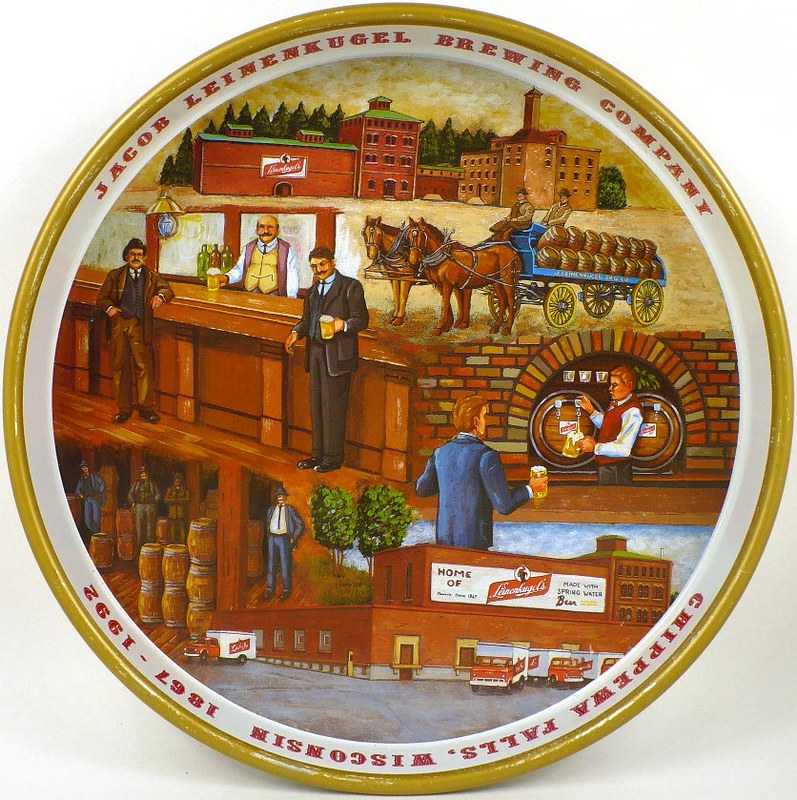
And this tray was created to commemorate the brewery’s 125th anniversary in 1992.

Leinenkugels-125th-Anniversary-Serving-Trays-10-16-inches-Jacob-Leinenkugel-Tray-1
Leinenkugels-125th-Anniversary-Serving-Trays-10-16-inches-Jacob-Leinenkugel-Tray-2

Filed Under: Birthdays, Breweries, Just For Fun Tagged With: Germany, History, Wisconsin

« Previous Page
Next Page »

Find Something

Northern California Breweries

Please consider purchasing my latest book, California Breweries North, available from Amazon, or ask for it at your local bookstore.

Recent Comments

  • Bob Paolino on Beer Birthday: Grant Johnston
  • Gambrinus on Historic Beer Birthday: A.J. Houghton
  • Ernie Dewing on Historic Beer Birthday: Charles William Bergner 
  • Steve 'Pudgy' De Rose on Historic Beer Birthday: Jacob Schmidt
  • Jay Brooks on Beer Birthday: Bill Owens

Recent Posts

  • Beer In Ads #5220: Hello People! I Am The Centlivre Bock Beer Goat April 13, 2026
  • Beer Birthday: Ray McCoy April 13, 2026
  • Historic Beer Birthday: George Gund II April 13, 2026
  • Historic Beer Birthday: Albert C. Houghton April 13, 2026
  • Beer Birthday: Andreas Fält April 13, 2026

BBB Archives

Feedback

Head Quarter
This site is hosted and maintained by H25Q.dev. Any questions or comments for the webmaster can be directed here.