Brookston Beer Bulletin

Jay R. Brooks on Beer

  • Home
  • About
  • Editorial
  • Birthdays
  • Art & Beer

Socialize

  • Dribbble
  • Email
  • Facebook
  • Flickr
  • GitHub
  • Instagram
  • LinkedIn
  • Pinterest
  • RSS
  • Twitter
  • YouTube

Powered by Genesis

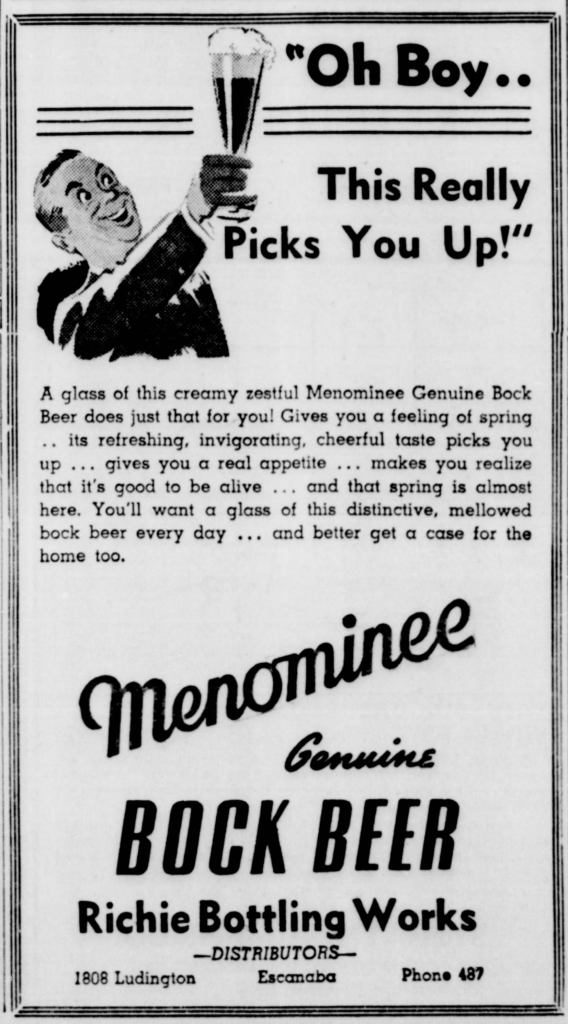
Beer In Ads #5256: Oh Boy.. This Really Picks You Up!

June 1, 2026 By Jay Brooks Leave a Comment

Two years ago I decided to concentrate on Bock ads for awhile. Bock, of course, may have originated in Germany, in the town of Einbeck. Because many 19th century American breweries were founded by German immigrants, they offered a bock at certain times of the year, be it Spring, Easter, Lent, Christmas, or what have you. In a sense they were some of the first seasonal beers. “The style was later adopted in Bavaria by Munich brewers in the 17th century. Due to their Bavarian accent, citizens of Munich pronounced ‘Einbeck’ as ‘ein Bock’ (a billy goat), and thus the beer became known as ‘Bock.’ A goat often appears on bottle labels.” And presumably because they were special releases, many breweries went all out promoting them with beautiful artwork on posters and other advertising. With Spring approaching, there are so many great examples that I’m going to post two a day for a few months.

Monday’s ad is for Menominee Genuine Bock Beer, which was published on June 1, 1941. This ad was for the Menominee-Marinette Brewing Co., of Menominee, Michigan, which was founded in 1870 as the De Heck & Scharmbruch Brewery. This ad ran in The Escanaba Daily Press, of Escanaba, Michigan.
Filed Under: Art & Beer, Beers, Breweries, Just For Fun Tagged With: Advertising, Bock, History, Michigan

Historic Beer Birthday: John Gilroy

May 30, 2026 By Jay Brooks Leave a Comment

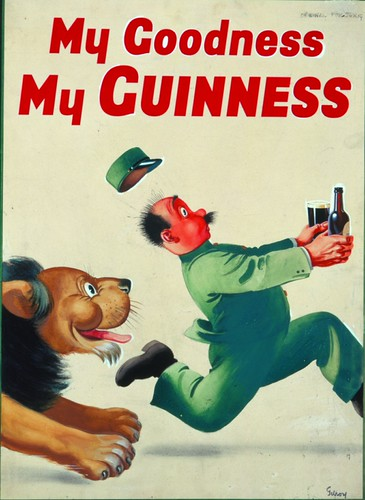
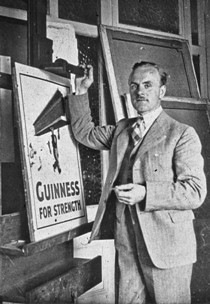
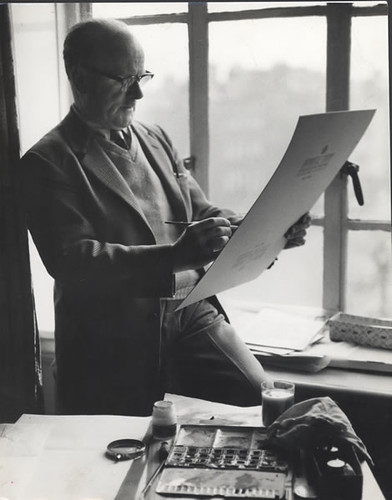
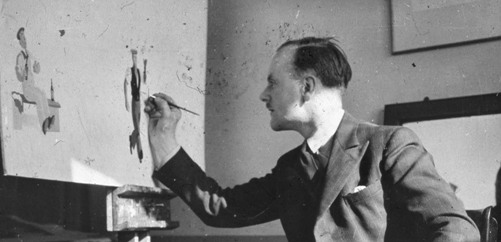
Today is the birthday of John Gilroy (May 30, 1898-April 11, 1985). While not a brewer or even brewery owner, he was nonetheless at least partially responsible for the success of Guinness with his iconic advertising that he created for them beginning in 1928.

Here’s his entry from Wikipedia.

“Born in Whitley Bay, Northumberland, England, Gilroy attended Durham University until his studies were interrupted by World War I, during which he served with the Royal Field Artillery. He resumed studying at the Royal College of Art in London, where he remained as a teacher. He taught at Camberwell College of Arts.

In 1925, he gained employment at S.H. Benson’s advertising agency, where he created the iconic advertisement art for Guinness featuring the Zoo Keeper and animals enjoying Guinness. He worked with Dorothy L. Sayers. He was also an accomplished portrait painter, numbering Royalty, Politicians, Actors and many others amongst his sitters. He worked in his large studio at 10 Holland Park, London, the former home and studio of Sir Bernard Partridge. He was a long-standing and much loved member of the Garrick Club, where he was created a Life Member and Chairman of the Works of Art Committee 1970-1975. He was awarded and Honorary MA by Newcastle University in 1975, and was made a Freeman of the City of London in 1981.”

The Guinness Collectors Club has a more thorough biography:

John Gilroy (1898-1985) was a superb natural draughtsman and a versatile illustrator and artist who produced advertsising material, portraits, landscapes, murals and greeting cards.

Born on the 30th of May 1898 at Whitley Bay, Newcastle upon Tyne, he was one of a family of eight (five boys and three girls), born to John William Gilroy and his wife Elizabeth. William Gilroy was a marine landscape painter and technical draughtsman and it was obvious from an early age that John junior was going to follow in his footsteps. The young John practised copying cartoons from Punch and took on all kinds of work to pay for drawing materials. From the age of fifteen he was a cartoonist for the Evening Chronicle, Newcastle, commissioned to produce cartoons of well-known entertainers who played the Newcastle theatres.

John attended Sandyford School followed, in 1909, by Heaton Park Road Upper School. At this date his family was living at 25 Kingsley Place. In June 1912, he left Heaton Park and, having attained his drawing certificate, won a scholarship to Armstrong College Art School, Durham University to study under Professor K.G. Hatten.

The First World War interrupted Gilroy’s studies and he served with the Royal Field Artillery in France, Italy and Palestine. In September 1919 he resumed his studies taking a place at the Royal College of Art, London (RCA). During his time there he produced illustrations for the college student magazine and occasionally played in goal for the college football team. In 1920 he attained his Board of Education certificate and the RCA diploma in decorative painting. His work was also rewarded through scholarships and prizes, winning, in 1919, the North Lordbourne prize for composition and, in 1921, the college drawing prize and the British Institute Scholarship for decorative painting. In 1922 Gilroy won an RCA travelling scholarship in mural painting having missed the Prix de Rome by only one vote.

Gilroy graduated from the RCA in July 1923 but stayed on there until 1925 as a teacher. From 1924 to 1926 he also taught drawing from the figure in the evenings at the Camberwell School of Art. In 1924 he married Gwendoline Peri-Short who had been a fellow pupil at the RCA and three years later they had a son, John.

In 1925 Gilroy embarked on his long association with the advertising agency S H Benson Ltd (Benson’s). Although Benson’s was the first advertising agency for whom Gilroy worked as an in-house artist, he had already proven himself in the commercial art sphere. His earliest known piece of commercial art, dating from 1920 when he was still a student, was for a promotional leaflet for the Mangnall-Irving Thrust-Borer commissioned by the Hydraulic Engineering Co.

Gilroy’s early work at Benson’s is reputed to have been on campaigns for Skipper Sardines and Virol. During his time there he also worked on campaigns for Bovril, Macleans and Monk & Glass Custard. His first significant assignment was the Mustard Club campaign for Coleman’s of Norwich, on which he worked with fellow artist William Brearley and copywriters Oswald Greene and Dorothy L Sayers. Between 1926 and 1933 the pens of Gilroy and Brearley brought eccentric characters like Baron de Beef, Signor Spaghetti and Miss Di Gester to life on bill boards and in magazines everywhere.

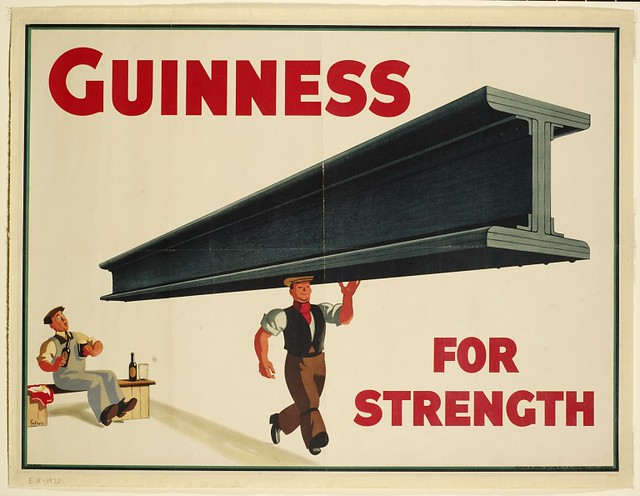
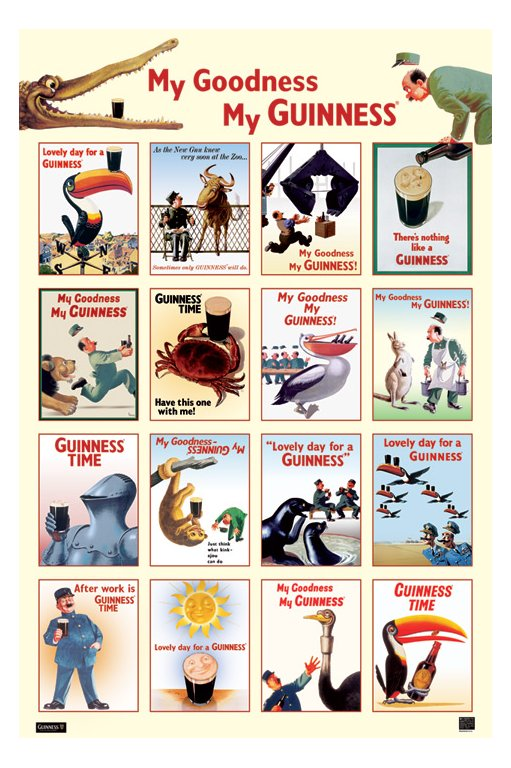
In 1928 Benson’s won the Guinness advertising account and Gilroy became involved with the product with which his work is most closely associated. Gilroy’s first known Guinness poster was produced in 1930. Working with copywriters like Ronald Barton and Robert Bevan, Gilroy produced more than 100 press advertisements and nearly 50 poster designs for Guinness over 35 years. He is perhaps best remembered for his posters featuring the girder carrier and the wood cutter from the Guinness for Strength campaigns of the early 1930s and for the Guinness animals. The animals, including a lion, toucan, gnu and kangaroo, appeared, with their long-suffering zookeeper, on posters, press advertisements, show cards and waiter trays from the 1930s to the 1960s.

Gilroy continued to produce Guinness advertisements well into the 1960s even though he left Benson’s employment as an in-house artist in the 1940s to continue freelance work.

During the 1920s and succeeding decades commercial art was not Gilroy’s sole occupation; he began to build his reputation as a painterboth of portraits and landscapes. One of his earliest portrait commissions was to paint the future Edward V111 for the Royal Mid-Surrey Golf Club, of which Gilroy was a member and the Prince was patron.

In 1930, while the family was living at The Cottage, Hyde Park Road, Kew Gardens, Gilroy has his first painting, Gwen. exhibited at the Royal Academy. Throughout the 1930s Gilroy’s work continued to be exhibited at the Royal Academy and to appear on advertising boardings, in newspapers and even in the Radio Times. In 1941, with the onset of the blitz, the artist moved to Rasehill, Chorleywood Road, Rickmansworth. His wife and son moved to Cheltenham where, in the same year, he held a one-man exhibition of his work, which then travelled to Sunderland Public Art Gallery.

Throughout the war years, Gilroy’s work continued to be exhibited at the Royal Academy while his commercial art talents were employed by the Ministry of Information in campaigns such as Make-do-and-mend, Keep it under your hat and We want your kitchen waste. He also improved morale by painting murals at various Royal Air Force bases and produced a series of drawings-in-one-line of contemporary political and military figures, called Headlines, which appered in The Star.

By 1945, when his painting Diamond Setting was exhibited at the Royal Academy, the artist’s address was given as 6 Avenue Studios, Sydney Close, SW3. A year laterhe prodced another mural, this time in the bar of the Mrritt Arms Hotel near Greta Bridge on the estate of his close friend Major Morritt. The work at the Morritt Arms began on the 1st February 1946 and was completed within10 days. When Gilroy and his assistant proudly displayed the walls of the bar decorated with Dickensian figures, closer inspection revealed them to be caricatures of local people and staff from the hotel.

In 1949 Esme Jeudwine, a former pupil and portrait subject, introduced Gilroy to the Royle family and another long and successful association began. Gilroy produced five greeting card designs for Royle Publications Ltd (Royles) in that year with another 464 published designs over the next 35 year. In 1966, Gilroy was acting Art Director for Royles.

In 1950 Gilroy married Elizabeth Margaret Bramley (nee Outram Thwaite). The couple lived at 17 Queen’s Gate, Kensington, but moved a year later to 10 Holland Park Road, W14, the former home and studio of Sir Bernard Partridge, whose cartoons Gilroy had copied from Punch as a child. The magnificent studio at Holland Park Road saw the creation of advertising work for T.F. Carrington Van PostingLtd. where Gilroy was Head of the Art Department, and was regularly visited by members of the Royal Family, politicians, actors and many others who came to have theit portraits painted.

In 1957 Gilroy held another one-man exhibition this time at Leighton House Gallery and two years later produced a series of landscapes of McGill University, Montreal, to illustrate a book McGill, The Story of a University, edited by Hugh MacLennan. In 1970 Gilroy held a retrospective exhibition at Upper Grosvenor Galleries and three years later an exhibition of his humorous designs for Royles was held at the London headquarters of Austin Reed Ltd.

In his later years ‘Jack’ Gilroy was a longstanding and much loved member of the Garrick Club where he was Chairman of the Works of Art Committee and where a number of his portraits now hang. In 1975 Gilroy was awarded an honorary MA by Newcastle University and in 1981, now living at 6 Ryecroft Street, Fulham, he was appointed a Freeman of the City of London.

John Gilroy died at Guildford on the 11th April 1985, aged 86, and is buried at Ampney St Peter in Gloucestershire near the home of his son and three grandchildren.

He created the zoo animals and other popular characters for Guinness from either 1928 or the early 1930s (accounts differ), but the first one he did appears to be the Guinness for Strength ad featuring a steel girder in 1934. According to some accounts, it was so popular that people even started ordering a ‘girder’ in the pub.

Guinness-1934-girder

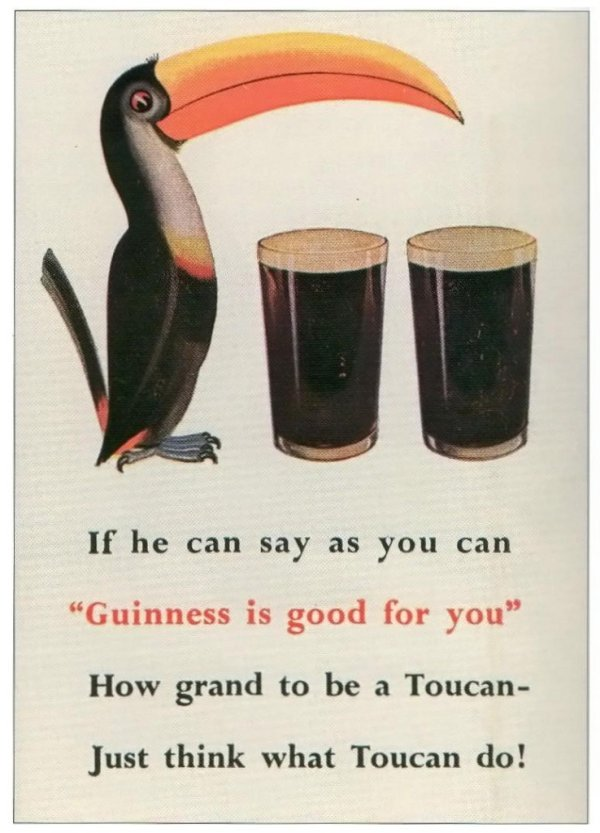
The following year, the Toucan debuted, and quickly became one of the most recognizable of the Guinness animals, used in marketing and advertising by Guinness for over 45 years. Here’s the story of its design from History House:

The idea of using a toucan was born in the advertising agency of S.H.Benson in London. Staff included the talented artist John Gilroy was newly employed as the poster artist, and among the copywriting team was Dorothy L Sayers, now famous as a writer, poet and playwright, and best known for her amateur detective stories featuring Lord Peter Wimsey. She had started at the agency in 1922 and worked there while writing books in her spare time.

This team produced some memorable posters for Guinness including several posters in the whimsical “Zoo” series. These included a zoo keeper with a Guinness, a sea lion balancing drink on his nose, an ostrich with the shape of a swallowed glass halfway down its neck, a tortoise with a glass of stout on its back, and a toucan with two Guinness bottles balanced on its beak accompanied by the words.

If he can say as you can
“Guinness is good for you”
How grand to be a Toucan
Just think what Toucan do.

Gilroy remained with the advertising agency until 1960 during which time he designed many other Guinness posters. As to how animals came to be used in an advertising campaign was recalled later by Gilroy. “The Guinness family did not want an advertising campaign that equated with beer. They thought it would be vulgar. They also wanted to stress the brew’s strength and goodness. Somehow it led to animals.”

The toucan returned on several occasions on all types of advertising media and on memorabilia. In 1982 Guinness changed advertising agencies and it was decided that the toucan was no longer an effective advertising motif and it was dropped.

The text from that ad was actually written by Dorothy L. Sayers, who worked for the same advertising agency as Gilroy before she became a famous mystery writer, well-known for such characters as Lord Peter Wimsey, and others.

Gilroy’s first Toucan ad, from 1935.

And here’s a sample of some more of his work for Guinness.

And finally, by no means complete, these are other Guinness ads I’ve collected in a Flickr gallery, many of which are by John Gilroy. And here’s some more accompanying an article entitled John Gilroy for Guinness: Four Corners and Some Vision.

Filed Under: Art & Beer, Beers, Birthdays, Breweries, Just For Fun, Related Pleasures Tagged With: Advertising, Guinness, History

Beer In Ads #5255: Bock de Bière

May 27, 2026 By Jay Brooks

Two years ago I decided to concentrate on Bock ads for awhile. Bock, of course, may have originated in Germany, in the town of Einbeck. Because many 19th century American breweries were founded by German immigrants, they offered a bock at certain times of the year, be it Spring, Easter, Lent, Christmas, or what have you. In a sense they were some of the first seasonal beers. “The style was later adopted in Bavaria by Munich brewers in the 17th century. Due to their Bavarian accent, citizens of Munich pronounced ‘Einbeck’ as ‘ein Bock’ (a billy goat), and thus the beer became known as ‘Bock.’ A goat often appears on bottle labels.” And presumably because they were special releases, many breweries went all out promoting them with beautiful artwork on posters and other advertising. With Spring approaching, there are so many great examples that I’m going to post two a day for a few months.

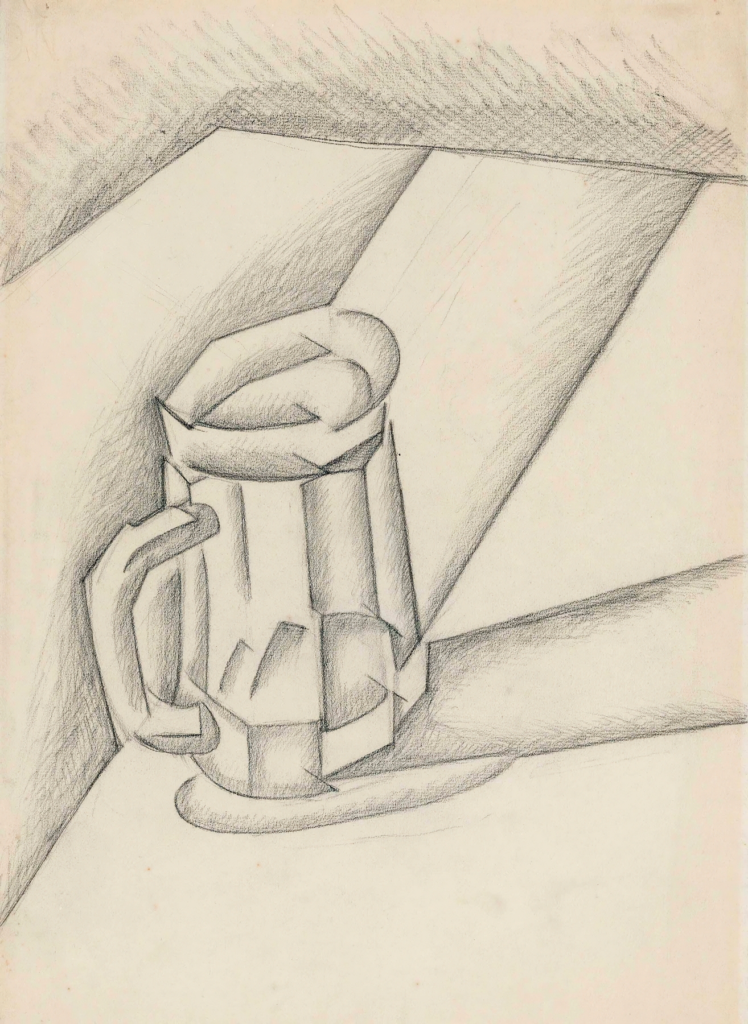
Wednesday’s work is for “Bock de Bière” created in 1911. This drawing of a beer mug was done by the famed Spanish artist Juan Gris.

Filed Under: Art & Beer, Beers, Just For Fun Tagged With: Advertising, Bock, History, Spain

Beer In Ads #5254: Geo. Walter Bock Is Just What You Need To Tone Up Your System

May 26, 2026 By Jay Brooks

Two years ago I decided to concentrate on Bock ads for awhile. Bock, of course, may have originated in Germany, in the town of Einbeck. Because many 19th century American breweries were founded by German immigrants, they offered a bock at certain times of the year, be it Spring, Easter, Lent, Christmas, or what have you. In a sense they were some of the first seasonal beers. “The style was later adopted in Bavaria by Munich brewers in the 17th century. Due to their Bavarian accent, citizens of Munich pronounced ‘Einbeck’ as ‘ein Bock’ (a billy goat), and thus the beer became known as ‘Bock.’ A goat often appears on bottle labels.” And presumably because they were special releases, many breweries went all out promoting them with beautiful artwork on posters and other advertising. With Spring approaching, there are so many great examples that I’m going to post two a day for a few months.

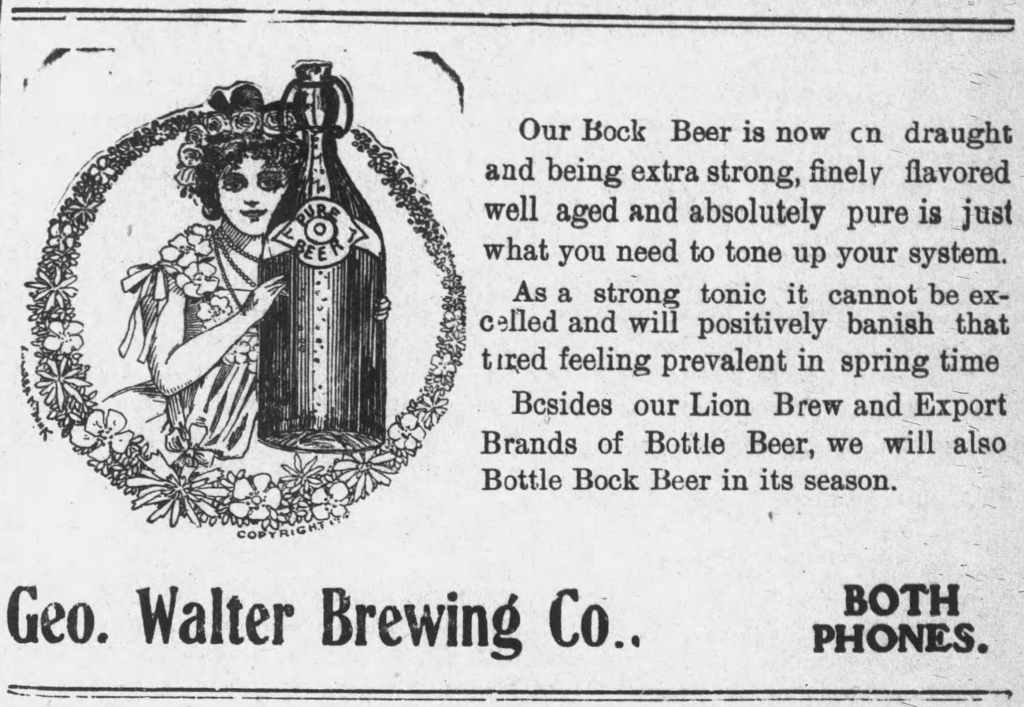
Tuesday’s ad is for Geo. Walter Bock Beer, which was published on May 26, 1906. This ad was for  the Geo. Walter Brewing Co., which was founded in 1862 by George Muench, which George Walter becoming involved around 1880. This ad ran in The Post-Crescent, of Appleton, Wisconsin.

Filed Under: Art & Beer, Beers, Breweries, Just For Fun Tagged With: Advertising, Bock, History, Wisconsin

Historic Beer Birthday: Eduard Buchner

May 20, 2026 By Jay Brooks

nobel-prize
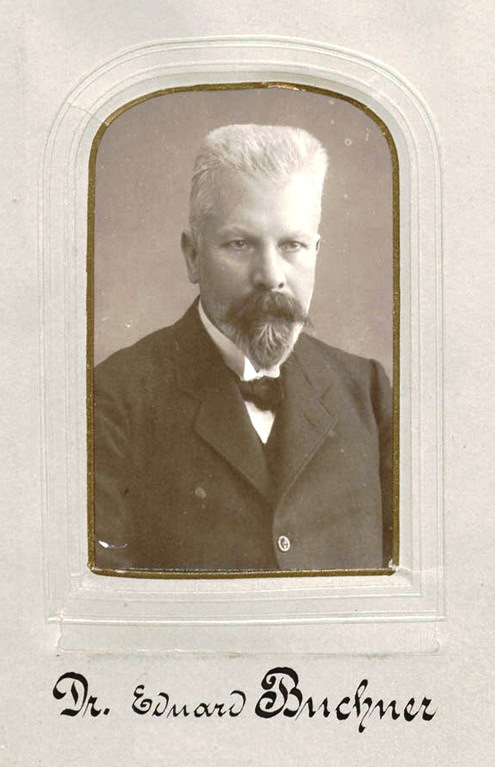
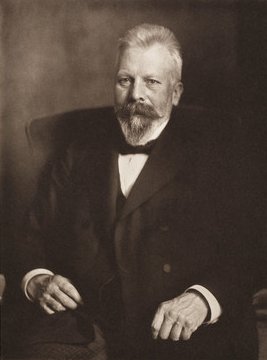
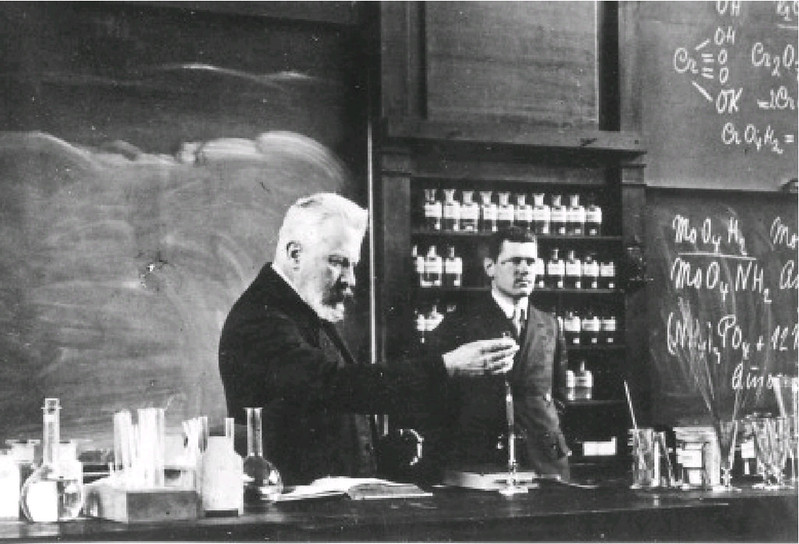
Today is the birthday of Eduard Buchner (May 20, 1860-August 13, 1917). Buchner was a German chemist and zymologist, and was awarded with Nobel Prize in Chemistry in 1907 for his work on fermentation.

Buchner

This is a short biography from The Famous People:

Born into an educationally distinguished family, Buchner lost his father when he was barely eleven years old. His elder brother, Hans Buchner, helped him to get good education. However, financial crisis forced Eduard to give up his studies for a temporary phase and he spent this period working in preserving and canning factory. Later, he resumed his education under well-known scientists and very soon received his doctorate degree. He then began working on chemical fermentation. However, his experience at the canning factory did not really go waste. Many years later while working with his brother at the Hygiene Institute at Munich he remembered how juices were preserved by adding sugar to it and so to preserve the protein extract from the yeast cells, he added a concentrated doze of sucrose to it. What followed is history. Sugar in the presence of enzymes in the yeast broke into carbon dioxide and alcohol. Later he identified the enzyme as zymase. This chance discovery not only brought him Nobel Prize in Chemistry, but also brought about a revolution in the field of biochemistry.

eduard-buchner

Eduard Buchner is best remembered for his discovery of zymase, an enzyme mixture that promotes cell free fermentation. However, it was a chance discovery. He was then working in his brother’s laboratory in Munich trying to produce yeast cell free extracts, which the latter wanted to use in an application for immunology.

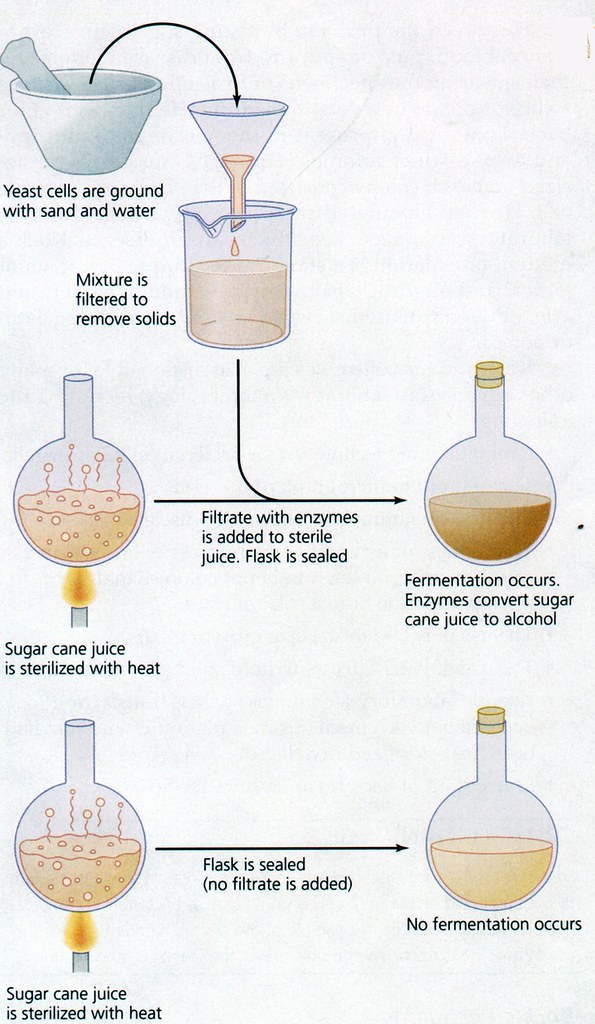
To preserve the protein in the yeast cells, Eduard Buchner added concentrated sucrose to it. Bubbles began to form soon enough. He realized that presence of enzymes in the yeast has broken down sugar into alcohol and carbon dioxide. Later, he identified this enzyme as zymase and showed that it can be extracted from yeast cells. This single discovery laid the foundation of modern biochemistry.

buchner-fermentation

One of the most important aspects of his discovery proving that extracts from yeast cells could elicit fermentation is that it “contradicted a claim by Louis Pasteur that fermentation was an ‘expression of life’ and could occur only in living cells. Pasteur’s claim had put a decades-long brake on progress in fermentation research, according to an introductory speech at Buchner’s Nobel presentation. With Buchner’s results, “hitherto inaccessible territories have now been brought into the field of chemical research, and vast new prospects have been opened up to chemical science.”

In his studies, Buchner gathered liquid from crushed yeast cells. Then he demonstrated that components of the liquid, which he referred to as “zymases,” could independently produce alcohol in the presence of sugar. “Careful investigations have shown that the formation of carbon dioxide is accompanied by that of alcohol, and indeed in just the same proportions as in fermentation with live yeast,” Buchner noted in his Nobel speech.

E._Buchner_WS_1911-12

This is a fuller biography from the Nobel Prize organization:

Eduard Buchner was born in Munich on May 20, 1860, the son of Dr. Ernst Buchner, Professor Extraordinary of Forensic Medicine and physician at the University, and Friederike née Martin.

He was originally destined for a commercial career but, after the early death of his father in 1872, his older brother Hans, ten years his senior, made it possible for him to take a more general education. He matriculated at the Grammar School in his birth-place and after a short period of study at the Munich Polytechnic in the chemical laboratory of E. Erlenmeyer senior, he started work in a preserve and canning factory, with which he later moved to Mombach on Mainz.

The problems of chemistry had greatly attracted him at the Polytechnic and in 1884 he turned afresh to new studies in pure science, mainly in chemistry with Adolf von Baeyer and in botany with Professor C. von Naegeli at the Botanic Institute, Munich.

It was at the latter, where he studied under the special supervision of his brother Hans (who later became well-known as a bacteriologist), that his first publication, Der Einfluss des Sauerstoffs auf Gärungen (The influence of oxygen on fermentations) saw the light in 1885. In the course of his research in organic chemistry he received special assistance and stimulation from T. Curtius and H. von Pechmann, who were assistants in the laboratory in those days.

The Lamont Scholarship awarded by the Philosophical Faculty for three years made it possible for him to continue his studies.

After one term in Erlangen in the laboratory of Otto Fischer, where meanwhile Curtius had been appointed director of the analytical department, he took his doctor’s degree in the University of Munich in 1888. The following year saw his appointment as Assistant Lecturer in the organic laboratory of A. von Baeyer, and in 1891 Lecturer at the University.

By means of a special monetary grant from von Baeyer, it was possible for Buchner to establish a small laboratory for the chemistry of fermentation and to give lectures and perform experiments on chemical fermentations. In 1893 the first experiments were made on the rupture of yeast cells; but because the Board of the Laboratory was of the opinion that “nothing will be achieved by this” – the grinding of the yeast cells had already been described during the past 40 years, which latter statement was confirmed by accurate study of the literature – the studies on the contents of yeast cells were set aside for three years.

In the autumn of 1893 Buchner took over the supervision of the analytical department in T. Curtius’ laboratory in the University of Kiel and established himself there, being granted the title of Professor in 1895.

In 1896 he was called as Professor Extraordinary for Analytical and Pharmaceutical Chemistry in the chemical laboratory of H. von Pechmann at the University of Tübingen.

During the autumn vacation in the same year his researches into the contents of the yeast cell were successfully recommenced in the Hygienic Institute in Munich, where his brother was on the Board of Directors. He was now able to work on a larger scale as the necessary facilities and funds were available.

On January 9, 1897, it was possible to send his first paper, Über alkoholische Gärung ohne Hefezellen (On alcoholic fermentation without yeast cells), to the editors of the Berichte der Deutschen Chemischen Gesellschaft.

In October, 1898, he was appointed to the Chair of General Chemistry in the Agricultural College in Berlin and he also held lectureships on agricultural chemistry and agricultural chemical experiments as well as on the fermentation questions of the sugar industry. In order to obtain adequate assistance for scientific research, and to be able to fully train his assistants himself, he became habilitated at the University of Berlin in 1900.

In 1909 he was transferred to the University of Breslau and from there, in 1911, to Würzburg. The results of Buchner’s discoveries on the alcoholic fermentation of sugar were set forth in the book Die Zymasegärung (Zymosis), 1903, in collaboration with his brother Professor Hans Buchner and Martin Hahn. He was awarded the Nobel Prize in 1907 for his biochemical investigations and his discovery of non-cellular fermentation.

Buchner married Lotte Stahl in 1900. When serving as a major in a field hospital at Folkschani in Roumania, he was wounded on August 3, 1917. Of these wounds received in action at the front, he died on the 13th of the same month.

Chemistry-1907-Buchner

Filed Under: Beers, Birthdays, Just For Fun, Related Pleasures Tagged With: Germany, History, Science, Science of Brewing

Beer In Ads #5253: Bock-Bier Adlerbrauerei Düsseldorf

May 19, 2026 By Jay Brooks

Two years ago I decided to concentrate on Bock ads for awhile. Bock, of course, may have originated in Germany, in the town of Einbeck. Because many 19th century American breweries were founded by German immigrants, they offered a bock at certain times of the year, be it Spring, Easter, Lent, Christmas, or what have you. In a sense they were some of the first seasonal beers. “The style was later adopted in Bavaria by Munich brewers in the 17th century. Due to their Bavarian accent, citizens of Munich pronounced ‘Einbeck’ as ‘ein Bock’ (a billy goat), and thus the beer became known as ‘Bock.’ A goat often appears on bottle labels.” And presumably because they were special releases, many breweries went all out promoting them with beautiful artwork on posters and other advertising. With Spring approaching, there are so many great examples that I’m going to post two a day for a few months.

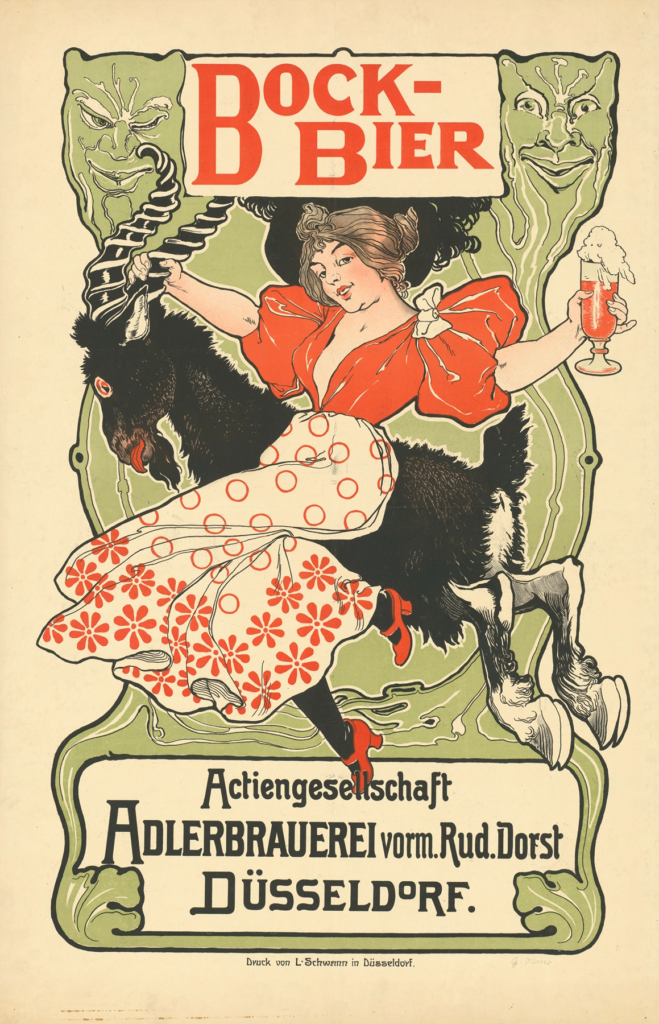
Tuesday’s ad is for “Bock-Bier Adlerbrauerei Düsseldorf” created in 1900. This poster was for the Adlerbrauerei Düsseldorf (or Adler Brewery) of Düsseldorf, Germany, which was founded in 1875. The poster was created by German artist Gustav Olms.

Filed Under: Art & Beer, Beers, Breweries, Just For Fun Tagged With: Advertising, Bock, Germany, History

Beer In Ads #5252: Bockbier Löwenbrauerei Böhmisches Brauhaus

May 18, 2026 By Jay Brooks

Two years ago I decided to concentrate on Bock ads for awhile. Bock, of course, may have originated in Germany, in the town of Einbeck. Because many 19th century American breweries were founded by German immigrants, they offered a bock at certain times of the year, be it Spring, Easter, Lent, Christmas, or what have you. In a sense they were some of the first seasonal beers. “The style was later adopted in Bavaria by Munich brewers in the 17th century. Due to their Bavarian accent, citizens of Munich pronounced ‘Einbeck’ as ‘ein Bock’ (a billy goat), and thus the beer became known as ‘Bock.’ A goat often appears on bottle labels.” And presumably because they were special releases, many breweries went all out promoting them with beautiful artwork on posters and other advertising. With Spring approaching, there are so many great examples that I’m going to post two a day for a few months.

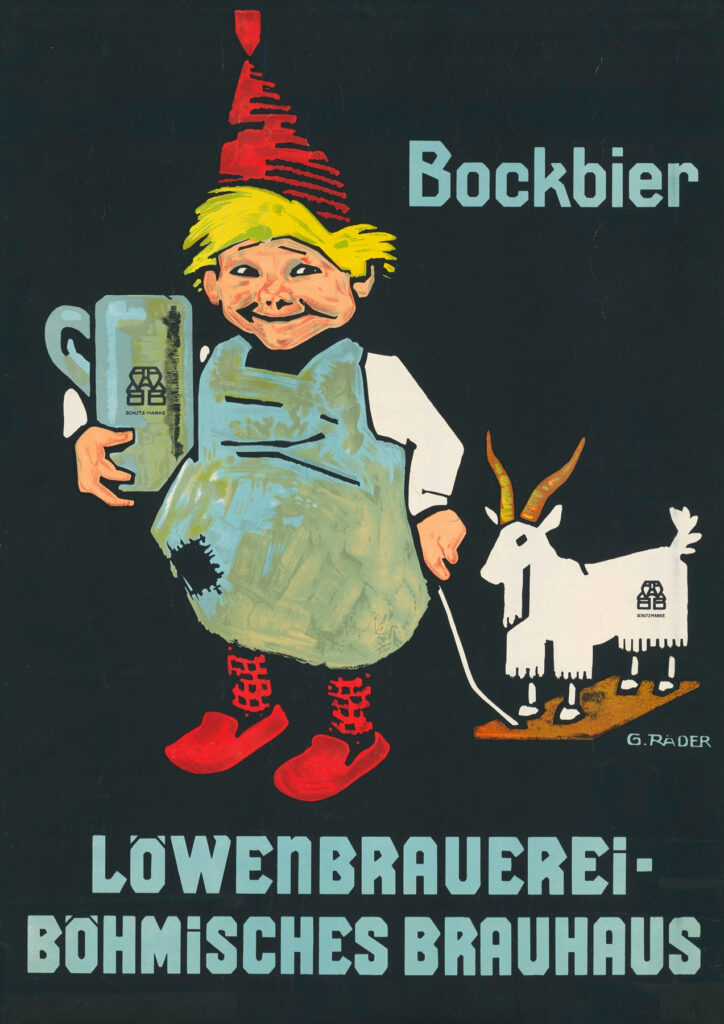
Monday’s ad is for “Bockbier Löwenbrauerei Böhmisches Brauhaus,” created most likely in or after 1922 (although one source claims 1912, which makes no sense). This poster was for the (or Löwenbrauerei-Bohemian Brewery) of Berlin, Germany, which was created by a merger between the Böhmisches Brauhaus and Löwenbrauerei in 1922. The poster was created by German artist Georg Räder.

Filed Under: Art & Beer, Beers, Breweries, Just For Fun Tagged With: Advertising, Bock, Germany, History

Beer In Ads #5251: Gesundheit Beer

May 14, 2026 By Jay Brooks

Two years ago I decided to concentrate on Bock ads for awhile. Bock, of course, may have originated in Germany, in the town of Einbeck. Because many 19th century American breweries were founded by German immigrants, they offered a bock at certain times of the year, be it Spring, Easter, Lent, Christmas, or what have you. In a sense they were some of the first seasonal beers. “The style was later adopted in Bavaria by Munich brewers in the 17th century. Due to their Bavarian accent, citizens of Munich pronounced ‘Einbeck’ as ‘ein Bock’ (a billy goat), and thus the beer became known as ‘Bock.’ A goat often appears on bottle labels.” And presumably because they were special releases, many breweries went all out promoting them with beautiful artwork on posters and other advertising. With Spring approaching, there are so many great examples that I’m going to post two a day for a few months.

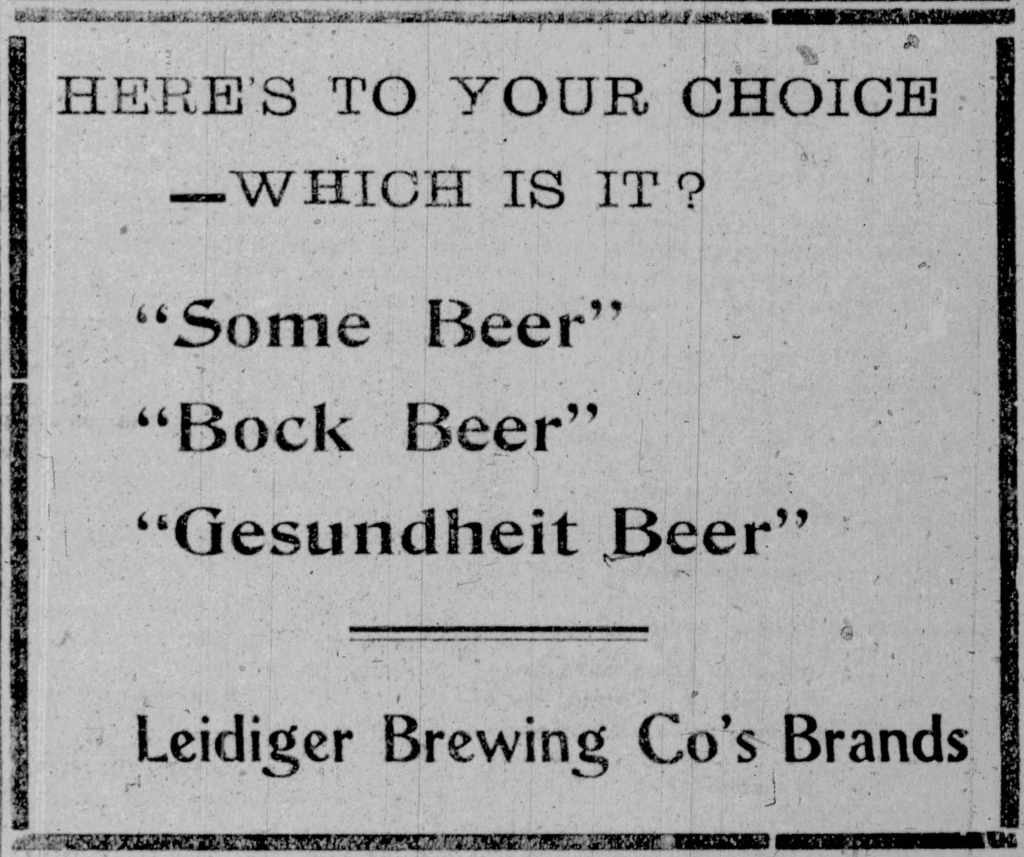
Thursday’s ad is for Leidiger Bock Beer, which was published on May 14, 1915. This ad was for  the Leidiger Brewing Co., which was founded in 1884. This ad ran in The Merrill Star Advocate, also of Merrill, Wisconsin. I’m going to guess that “Gesundheit Beer” or “Some Beer” is meant to be joke, and neither actually existed, but who knows. There was a beer called “Gesundheit” that was brewed by the Neustadtl Brewing Co. of Stroudsburg, Pennsylvania from 1933 to 1935

Filed Under: Art & Beer, Beers, Breweries, Just For Fun Tagged With: Advertising, Bock, History, Wisconsin

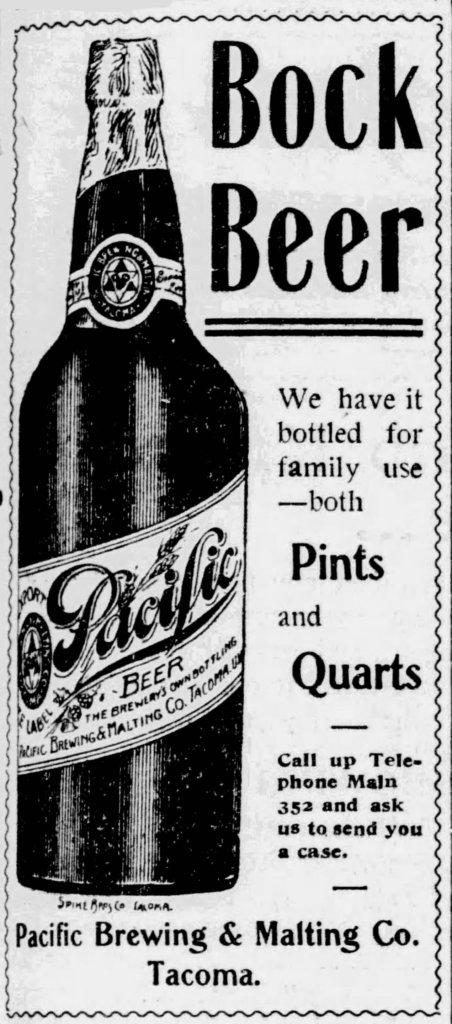
Beer In Ads #5250: Pacific Bock Beer

May 13, 2026 By Jay Brooks

Two years ago I decided to concentrate on Bock ads for awhile. Bock, of course, may have originated in Germany, in the town of Einbeck. Because many 19th century American breweries were founded by German immigrants, they offered a bock at certain times of the year, be it Spring, Easter, Lent, Christmas, or what have you. In a sense they were some of the first seasonal beers. “The style was later adopted in Bavaria by Munich brewers in the 17th century. Due to their Bavarian accent, citizens of Munich pronounced ‘Einbeck’ as ‘ein Bock’ (a billy goat), and thus the beer became known as ‘Bock.’ A goat often appears on bottle labels.” And presumably because they were special releases, many breweries went all out promoting them with beautiful artwork on posters and other advertising. With Spring approaching, there are so many great examples that I’m going to post two a day for a few months.

Wednesday’s ad is for Pacific Bock Beer, which was published on May 13, 1900. This ad was for  the Pacific Brewing & Malting Co., which was founded in 1897 in Tacoma, Washington. This ad ran in The Tacoma Daily Ledger, also of Tacoma, Washington.

Filed Under: Art & Beer, Beers, Breweries, Just For Fun Tagged With: Advertising, Bock, History, Washington

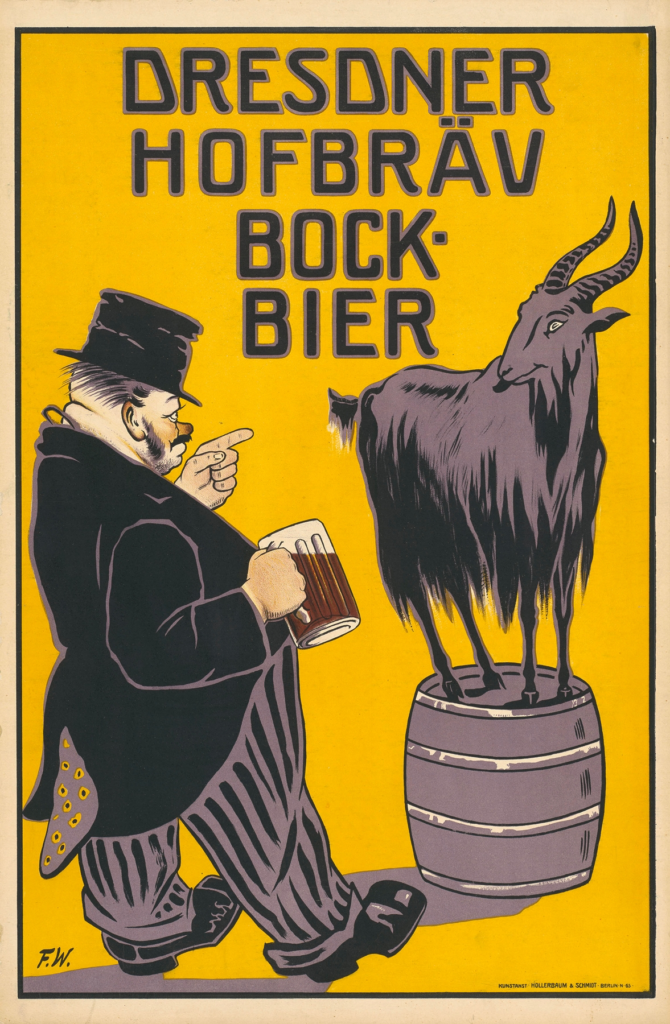
Beer In Ads #5249: Dresdner Hofbräu Bock-Bier

May 12, 2026 By Jay Brooks

Two years ago I decided to concentrate on Bock ads for awhile. Bock, of course, may have originated in Germany, in the town of Einbeck. Because many 19th century American breweries were founded by German immigrants, they offered a bock at certain times of the year, be it Spring, Easter, Lent, Christmas, or what have you. In a sense they were some of the first seasonal beers. “The style was later adopted in Bavaria by Munich brewers in the 17th century. Due to their Bavarian accent, citizens of Munich pronounced ‘Einbeck’ as ‘ein Bock’ (a billy goat), and thus the beer became known as ‘Bock.’ A goat often appears on bottle labels.” And presumably because they were special releases, many breweries went all out promoting them with beautiful artwork on posters and other advertising. With Spring approaching, there are so many great examples that I’m going to post two a day for a few months.

Tuesday’s ad is for “Dresdner Hofbräu Bock-Bier,” created in 1899. This poster was for the Dresdner Hofbräuhaus (or Dresden Court Brewery) of Dresden, Germany, which was originally founded in 1872 but closed in 1921. The poster was created by German artist Fritz Wolff. It was produced by Hollerbaum & Schmidt of Berlin.

Filed Under: Art & Beer, Beers, Breweries, Just For Fun Tagged With: Advertising, Bock, Germany, History

« Previous Page
Next Page »

Find Something

Northern California Breweries

Please consider purchasing my latest book, California Breweries North, available from Amazon, or ask for it at your local bookstore.

Recent Comments

  • Bob Paolino on Beer Birthday: Grant Johnston
  • Gambrinus on Historic Beer Birthday: A.J. Houghton
  • Ernie Dewing on Historic Beer Birthday: Charles William Bergner 
  • Steve 'Pudgy' De Rose on Historic Beer Birthday: Jacob Schmidt
  • Jay Brooks on Beer Birthday: Bill Owens

Recent Posts

  • Beer Birthday: Wagner Falci June 10, 2026
  • Beer In Ads #5264: Bock-Bier Brauerei Hülsmann Eickel June 9, 2026
  • Historic Beer Birthday: Prosper Cocquyt June 9, 2026
  • Beer Birthday: Todd Ashman June 9, 2026
  • Historic Beer Birthday: Edmund Resch June 9, 2026

BBB Archives

Feedback

Head Quarter
This site is hosted and maintained by H25Q.dev. Any questions or comments for the webmaster can be directed here.