Brookston Beer Bulletin

Jay R. Brooks on Beer

  • Home
  • About
  • Editorial
  • Birthdays
  • Art & Beer

Socialize

  • Dribbble
  • Email
  • Facebook
  • Flickr
  • GitHub
  • Instagram
  • LinkedIn
  • Pinterest
  • RSS
  • Twitter
  • YouTube

Powered by Genesis

Historic Beer Birthday: Charles Voegtle

June 7, 2026 By Jay Brooks Leave a Comment

Today is the birthday of Charles Voegtle (June 7, 1841-September 27, 1914). He was born in Rothwell, Germany, and emigrated to the U.S. just as the Civil War was ending, in 1865, initially settling in Illinois. He started work in a brewery there and was promoted to foreman after five years. In 1869, he married Johanna Weisenhorn, herself a German immigrant who arrived through New Orleans in 1857 with her family and also settled in Adams County, Illinois.

Johanna Weisenhorn and Charles Voegtle.

The couple later moved to Boulder, Colorado, where Voegtle would co-found the Crystal Springs Brewing & Ice Co. with his brother-in-law, Frank Sales Weisenhorn in 1875.

The Crystal Springs Brewing & Ice Co. sometime between 1879-1907.

Here’s Tavern Trove picks up the story:

Voegtle’s brother-in-law, Frank Sales Weisenhorn, was the son of a well-to-do farmer and saloon operator.  In 1873, Franks’s younger brother August moved his family and business out to Montana, where he quickly found success making wagons for miners who had plenty of gold and nothing to purchase. 

Frank decided he might try his own luck in a boomtown, and in 1876 he persuaded his brother-in-law Charles Voegtle to pack up their families and move west to Boulder, Colorado.  There they purchased the Crystal Springs Brewery from Keller & Zuelfehofer.  Frank’s father had likely provided the funding, and Charles provided the skill, as the firm was christened with Frank’s name first, “Weisenhorn & Voegtle.”  Their brewhouse was situated on the picturesque Boulder Creek, near where the Boulder County Library is today.  The creek was both the source of the water used to cool the brewing beer and the source of the gold that fed the quickly growing town.
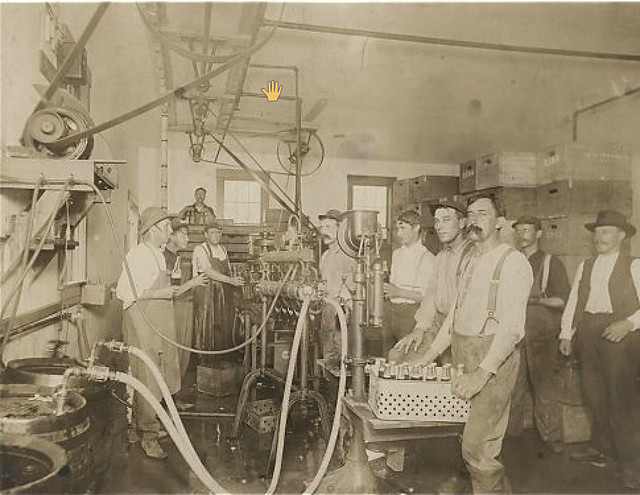
Weisenhorn and Voegtle ran the brewery as partners for eleven years, after which Voegtle sold his partnership to Weisenhorn.  At age 45, Voegtle retired from the rough and tumble occupation of a brewer in a mining town. He, Johanna, and their children moved away from the rowdy brewhouse to a then-rural plot of land under the shadow of the Flatirons.  There they grew flowers and sold fruit. 

Sketch of the old Crystal Springs Brewing property by Joseph Bevier Sturtevant.

After Voegtle left the brewery, it went through several different owners and configurations of owners before closing for good due to prohibition in 1911. He died September 27th, 1917, at the age of 76 years.

A Crystal Springs Brewing Ice Wagon in 1901.

Filed Under: Birthdays, Breweries, Just For Fun Tagged With: Colorado, Germany, History, Illinois

Historic Beer Birthday: Joseph Theurer

May 24, 2026 By Jay Brooks

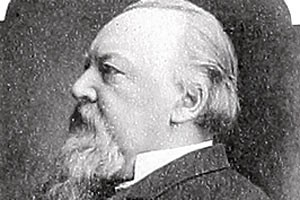
Today is the birthday of Joseph Theurer (May 24, 1852-May 14, 1912). Born in Philadelphia of German descent, who became a well-known brewer in both his native Pennsylvania and Illinois. After he married Emma Schoehofen, he became VP of his father-in-law’s Chicago brewery, the Peter Schoenhofen Brewing Company in 1880. After Peter passed away in 1893, Theurer became president and remained at the helm until his own death in 1912.

Here’s a biography from Find a Grave:

Joseph Theurer, who was of German descent, was born in Philadelphia in 1852. He became one of the most knowledgeable brewers of his day. He served as Treasurer of the Illinois State Brewers Association from 1898 to 1911 and he held title of President of the United States Brewing Association from 1903 to 1905.

Joseph arrived in Chicago in the Fall of 1869 and worked as an apprentice to brewers Adam Baierle and K.G. Schmidt. In 1871, he had been working at the Huck Brewery for less than a week when the brewery was destroyed in The Great Chicago Fire.

So he returned to Philadelphia for a year to work at the brewery of Bergdoll & Psotta. And then headed back to Chicago in 1872 to work at Bartholomae & Leicht brewery until 1874. He was also employed for one season at the Clybourn Avenue Malthouse of F. Wacker & Co. before returning to Philadelphia until his marriage to Peter Schoenhofen’s daughter, Emma Schoehofen, in 1880.

Upon his marriage to Emma, he became Vice President of Schoenhofen Brewing Company in Chicago until his father in law Peter’s death in 1893. Joseph took over as President of Schoenhofen Brewing from 1893 until 1911.

In 1896, Joseph commissioned what is now known as the Theurer-Wrigley Mansion. The Mansion, built in the late Italian Renaissance style, was designed by Richard Schmidt and listed on the National Register of Historic Places in 1979. The 20,000+ square foot mansion features 11 bedrooms and 6 baths. Furnished with nearly all Tiffany light fixtures, many have been removed by previous owners or sold. An original Tiffany stained glass window from the Mansion is currently on display at the Chicago History Museum. Recent reports show the Mansion being listed for 9.5 million dollars as a foreclosure in 2011, but it has since been purchased and is currently occupied by a single owner.

On May 14, 1912 Joseph died from pneumonia and was laid to rest along with Peter Schoenhofen in the magnificent Egyptian revival style tomb in Graceland Cemetery. Services were conducted on May 17th in front of the tomb and conducted in both English and German. Attendees included members of the Illinois and Cook County Brewers Associations as well as a large number of charitable organizations, family and close friends.

Joseph was survived by his widow Emma, two sons, Peter S. and Joseph Jr., and two daughters Miss Margareta Theurer and Mrs. Marie (Richard) Ostenrieder.

The Encyclopedia of Chicago has a concise history of the Peter Schoenhofen Brewing Co.:

Peter Schoenhofen, a Prussian immigrant, was in Chicago working in the brewing trade by the 1850s. In 1861, he started a partnership with Matheus Gottfried; they were soon operating a brewery at Canalport Avenue and 18th Street where, during the early 1860s, they made about 600 barrels of lager beer a year. In 1867, Schoenhofen bought out his partner, and the company became the Peter Schoenhofen Brewing Co. By 1868, annual output had increased to about 10,000 barrels. During the 1890s, when the business was owned by the City Contract Co. of London, England, annual output reached 180,000 barrels. Around 1900, the Schoenhofen family regained control of the company, which employed about 500 people at its brewery on West 12th Street by 1910. During this time, the company was also known as the National Brewing Co. The company’s “Edelweiss” brand of beer was a big seller. Operations shut down during Prohibition, but by 1933, after the national ban on alcohol production was lifted, the company was back in business as the Schoenhofen-Edelweiss Co. After being purchased by the Atlas Brewing Co. in the late 1940s, Schoenhofen became part of Dewery’s Ltd. of South Bend, Indiana, in 1951, and thereafter assumed the Dewery’s name. By the beginning of the 1970s, there was nothing left of its Chicago operations, although Dewery’s reintroduced the famous Edelweiss brand in 1972 after nearly a decade-long hiatus.
Today, the land where the brewery was located is known as the Schoenhofen Brewery Historic District and to see earlier photos of that area, Forgotten Chicago has a short history, with lots of pictures.

edelweiss-yellow

Filed Under: Birthdays, Breweries, Just For Fun Tagged With: Chicago, History, Illinois, Philadelphia

Historic Beer Birthday: John A. Huck

May 15, 2026 By Jay Brooks

Today is the birthday of John A. Huck (May 15, 1818-January 26, 1878). He was born in Baden-Württemberg, Germany, and in 1847 he came to the U.S. and settled in the Chicago, Illinois area. In 1847, long with a partner, John Schneider, he founded the John Huck & John Schneider Brewery, but for five years beginning in 1855 it was known as the Eagle Brewery, but apparently he bought out Schneider in 1860, when its name was changed again, this time to Huck’s Chicago Brewing Co. and then 1869 became the John A. Huck Brewing Co. But in 1871, the brewery was destroyed by the Great Fire and never reopened after that. A few years before, his son, Louis C. Huck, opened his own malting business, the L.C. Huck Malting Co., so maybe he went to work with him or simply retired.

Here’s account of Huck by Gregg Smith from RealBeer.com:

The story begins in 1847, shortly after lagers arrived in America, when John Huck entered a partnership with John Schneider to construct a brewery. Located just two blocks east of Chicago’s first ale brewery (Lill’s Cream Ale) it had an interesting connection to that facility. Chicago’s first mayor, William Ogden, who had a financial interest in Lill’s, owned the land at Chicago Avenue and Division Street which Huck and Schneider purchased for their facility.

This location provided another innovation in Chicago beer drinking. The property included a tree filled square, and in the center Huck put his house. This he surrounded with a beer garden, another first in the city. More than just a retail outlet for their product, brewers in Europe had long built beer gardens for a more practical reason. An essential part of lager brewing is cool temperatures. These are needed for lager yeast to work its magic. For this reason brewers aged the beer in subterranean “lagering cellars”. The trees of the beer garden, usually elm, provided a shady canopy on the ground above and helped ensure cellars would remain lager friendly cool.

Huck’s beer was a success and rather than sacrifice his home and beer garden to expansion he moved brewing operations in 1855 to a new facility on Wolcott (now N.State Street) near Division. With the move came a new name – Eagle Brewing. The new brewery was, in its day, one of the city’s largest. It boasted both brew and malt houses along with more than 2 miles of underground vaults. The name changed again in 1860, to Huck’s Chicago Brewing Co. and from 1869 to 1871 was known as John A. Huck Brewing Company.

Huck’s Brewery when it opened in 1847.

This is from a blog post about The Huck Tunnels:

In the 1840s, Huck opened the first lager brewery in Chicago at Chicago and Rush, back when the area was still practically the wilderness. In the 1850s he moved to a new location at Banks and Astor, just south of the Catholic portion of City Cemetery (now Lincoln Park), which started at Schiller. The area seems to have been bounded by State and Astor at the West and East, and from Banks to Goethe from the North to South – a full square block, across the corner from the future Playboy mansion, though one source says that it went clear north to Schiller. In what was then quite an innovation, the brewery featured a whole network of subterranean tunnels and vaults for brewing the beer at low temperatures year round, and apparently there were two full miles of them in total. The brewery was destroyed in the Great Chicago Fire in 1871, but the tunnels remained.

In 1977, the Joseph Huber Brewing Co. of Monroe, Wisconsin created a set of 18 commemorative cans featuring Huck’s brewery.

And this is from One Hundred Years of Brewing:

The first lager beer brewery in Chicago and one of the first to manufacture any kind of malt liquor was that founded on the corner of Chicago avenue and Rush street, by the late John A. Huck, in 1847. Two blocks cast was Lill’s cream ale brewery, which had been in successful operation for about eight years. It is worthy of note that Wm. B. Ogden, the first mayor of Chicago, and in many respects its foremost citizen, was identified with ] both of these pioneer breweries; for, as has been stated, he was at first the financial support of the Lill brewery, and it was upon the Ogden block that the Huck lager beer plant was installed—upon the square bounded by Chicago avenue and Superior, Rush and Cass streets. In the center of the square, which was well covered by trees, was Mr. Huck’s residence, which, in turn, was the center of a beer garden—the first in Chicago.

In 1855 Mr. Huck removed his plant to the corner of Banks and North State street, where the residence of Franklin Head now stands, and by the time of the Great Fire it had expanded into one of the most extensive establishments of the kind in the country. With two miles of subterranean vaults and brew and malt houses, in proportion, it was one of the marked sights of the city. In 1871, however, all was swept away and the labors of many years lay in ruins. The property remained idle for several years, but in the latter portion of 1877, Mr. Huck began to lay his plans for a rebuilding of the brewery on the old site. While in the midst of these preparations, however, in January, 1878, he was taken away, leaving, among other children, the Louis C. Huck, who first associated himself with his father in 1861, established an independent malting business in 1869 and is now a well-known capitalist of Chicago.

Huck gravestone in Chicago’s Graceland Cemetary.

Filed Under: Birthdays, Breweries, Just For Fun Tagged With: Chicago, Germany, Illinois

Beer Birthday: Marty Nachel

May 10, 2026 By Jay Brooks

ale-conner
Today is the 68th birthday of beer writer Marty Nachel, author of Beer For Dummies and Homebrewing For Dummies. I’ve gotten to know Marty better over the last few years, judging the finals of the Longshot Homebrew competition and the World Beer Awards, and he’s a great person to share a pint with. This week, we also judging together in South Africa. And more recently he’s founded the American Craft Beer Hall of Fame, and invited me to become their official historian, which has been great. Join me in wishing Marty a very happy birthday.

In South Africa a couple of years ago.
Last beers before we would begin judging the next day in Toronto for the first Canadian Beer Cup.
win-bassett-1
Marty, me and a few others judging the finals of the Longshot Homebrew Competition at Samuel Adams HQ in Boson in 2013.
Marty-Nachel-and-Drew
Marty and Drew Nachel enjoying a beer in Northern Italy.
Marty-Nachel-and-Diane
Marty with his older sister Diane in, maybe, the late 1970s. [Note: Last two photos purloined from Facebook.]

Filed Under: Birthdays, Just For Fun Tagged With: Chicago, Illinois

Historic Beer Birthday: William Leonard Hoerber

April 15, 2026 By Jay Brooks

hoerber
Today is the birthday of William Leonard Hoerber (April 5, 1849-May 7, 1933). He was the son of German-born John L. Hoerber, who founded the John L. Hoerber Brewery in 1858, after emigrating to Chicago, Illinois. William was brought up in the family business and took over the brewery after his father passed away in 1898. After prohibition, it reopened as The Hoerber Brewing Co., and remained in business until 1941, when it closed for good.

This short biography is from “The Book of Chicagoans: A Biographical Dictionary of Leading Living Men of the City of Chicago, edited by Albert Nelson Marquis, published in 1911:

Chicago historian and beer writer Bob Skilnik had an article in the Chicago Tribune that mentioned the Hoerber Brewery in 1997:

A population increase from a few hundred in 1833 to more than 100,000 in 1860 opened the market and made success possible for scores of brewers. In 1857, the city council ordered the grades of all existing properties to be raised to a height that would ensure proper drainage. John Hoerber used this opportunity to raise his combination saloon, store and boardinghouse and install a small brewery underneath, pumping fresh beer to his customers. By doing so, Hoerber beat the now-defunct Siebens on West Ontario by about 150 years for the title of Chicago’s first brew pub.

Filed Under: Birthdays, Breweries, Just For Fun Tagged With: Chicago, History, Illinois

Historic Beer Birthday: Rudolf Brand

April 10, 2026 By Jay Brooks

Today is the birthday of Rudolf Brand (April 10, 1851-March 25, 1916). He was born in Odenheim, Rheinhessen, Germany. When he was seventeen, in 1868, he emigrated to the U.S., initially to New York, where he worked as a cooper. A few years later he was a foreman at the Busch and Brand brewery in Chicago, Illinois, which was founded by a Michael Brand, who appears to be Rudolf’s uncle. In 1880, he partnered with Ernest (or Ernst) Hummel and founded his own brewery in Chicago, initially known as the Brand (Charles) & Hummel (Ernest) Brewing. A few years after opening, they started trading under the name South Chicago Brewing Co.

The brewery was located at Avenue L and 100th Street. Unfortunately it closed for good in 1922, presumably due to Prohibition.

In May of 1873, he married Clara Sophia Uhlich. The couple had three children two boys and a girl.

He appears to have served as President of the Brewers Association around 1899.

Filed Under: Birthdays, Breweries, Just For Fun Tagged With: Chicago, Germany, History, Illinois

Historic Beer Birthday: Mathias Meller

April 9, 2026 By Jay Brooks

Today is the birthday of Mathias Meller (April 9, 1827-April 1, 1900). He was born in  Neuss, Germany, which is in the North Rhine-Westphalia area, and emigrated to the U.S. when he was 22, in 1849. He eventually settled in Galena, Illinois. In 1860 (or 1874, sources differ), he founded the Math. Meller Brewery (also called the Fulton Brewery), which would become the Casper Eulberg & Sons Brewery, and later, briefly, the Galena Brewing Co. after prohibition, before closing for good in 1936.

Here’s a short biography of Meller:

And this biography appears to be from a book on people from Jo Davis County

Curiously, their most popular beer was called Red Stripe, and had been made since the late 19th century. Apparently, when prohibition closed the brewery, they sold their recipe to British brewers who began production of the now-famous label in Jamaica.

Filed Under: Birthdays, Breweries, Just For Fun Tagged With: Germany, History, Illinois

Historic Beer Birthday: Caspar Eulberg

April 6, 2026 By Jay Brooks

Today is the birthday of Caspar Eulberg (April 6, 1826-May 19, 1902). There’s very little information I could find about him. He was born in Kreis Westerburg, Hessen-Nassau, which was then Prussia. He married Franciska Rost, also from Prussia, and together they had ten children, six of whom were boys. At least some of them must have worked at his brewery in Galena, Illinois, because for most of its life it was called Casper Eulberg & Sons Brewery. Originally called Math. Meller Brewery when in opened in 1874, it appears Eulberg acquired it in 1885, changing the name to his own, at least until closed by prohibition in 1920. It tried to open after repeal, under the name Galena Brewing Co., but closed for good in 1936.

Eulberg-tray

Here’s an obituary of Eulbert from the American Brewers’ Review:

Caspar Eulberg & Sons Brewing around 1900.

This short history is from Northern Public Radio’s “This Week in Illinois History.“

On October 11, 1886, the Galena Daily Gazette reported that Casper Eulberg and his two sons had launched the Galena Brewery. Eulberg had purchased the long-operating brewery a year earlier, running it as C. Eulberg & Sons, but after only six months the entire operation burned to the ground. Eulberg rebuilt bigger and better, with modern machinery and a larger capacity. He changed the name to Galena Brewery. Within a few years, his flagship beer, Red Stripe, became one of the most popular beers in northern Illinois, southern Wisconsin and Iowa.

Red Stripe’s reign continued until Prohibition shut down the brewery in 1920. When Prohibition ended in 1933, the Galena Brewery reopened under new ownership and relaunched Red Stripe, based on the Eulberg family’s formula. In 1935, it trademarked the Red Stripe label but went out of business one year later.

Filed Under: Birthdays, Breweries, Just For Fun Tagged With: History, Illinois

Historic Beer Birthday: Edward John Birk

April 2, 2026 By Jay Brooks

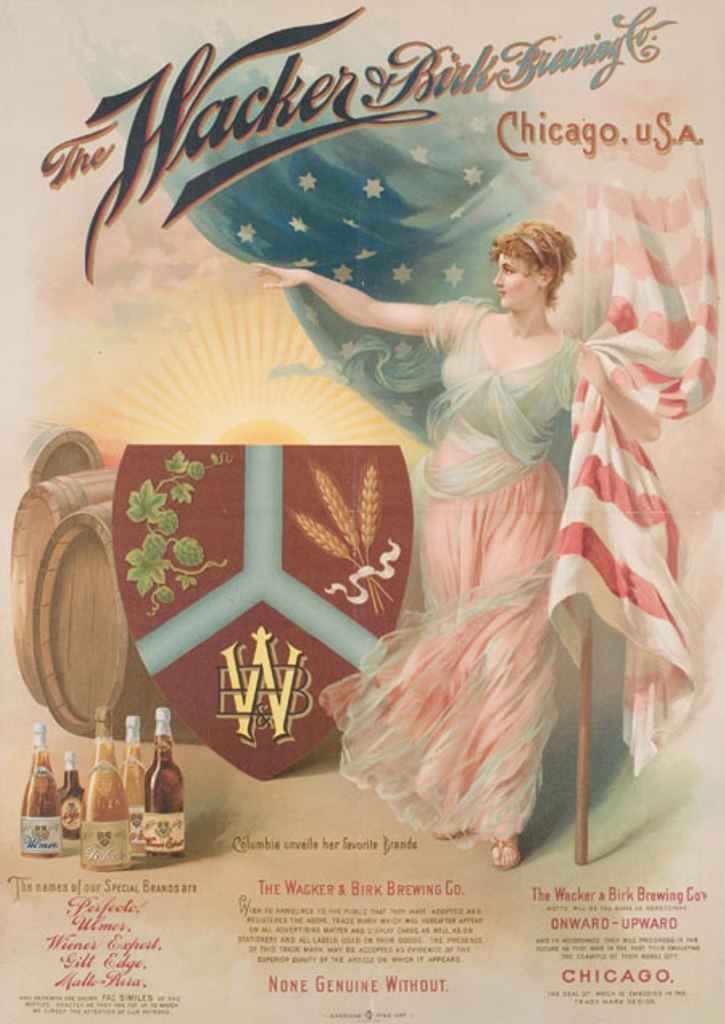
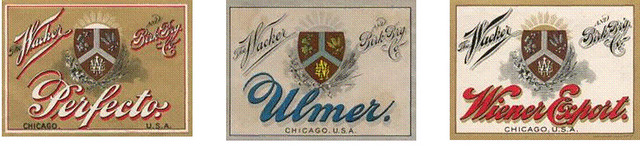
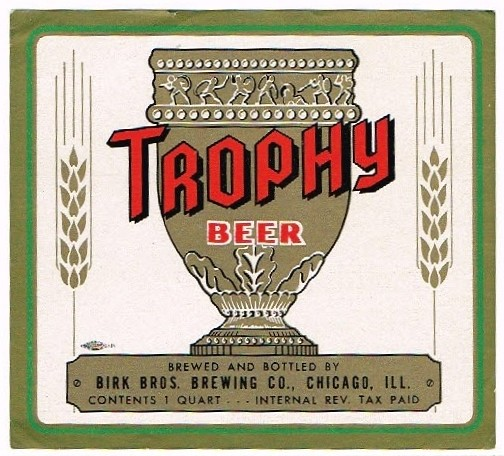
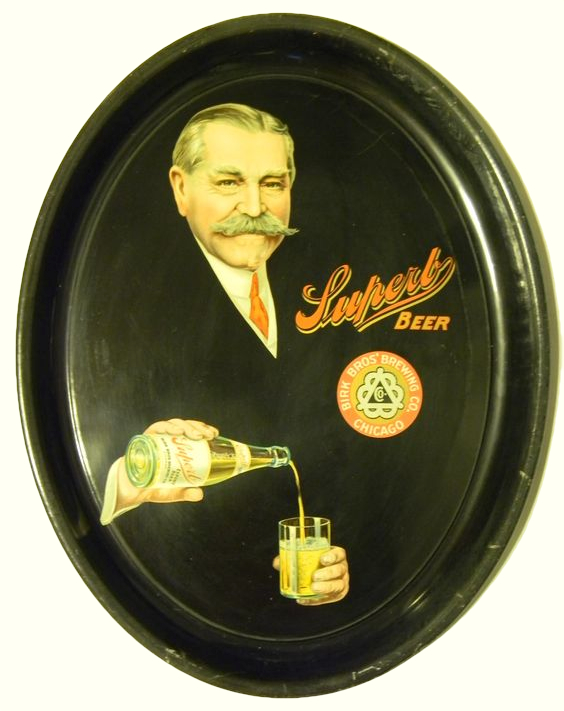
Today is the birthday of Edward John Birk (April 2, 1867-April 22, 1940). Edward was the son of Jacob Birk, who co-founded Chicago’s Wacker & Birk Brewing Co. When Jacob retired, he bought the Corper & Nocklin Brewery for his sons, renaming it the Birk Bros. Brewing Co. Edward and his brother William ran the brewery through Prohibition, and it successfully reopened after repeal, and continued until closing on September 15, 1950.

That’s definitely famed Prohibition agent Eliot Ness in this photo (at the far end of the table, on our left) and it’s possible that the man next to him was Edward J. Birk during his trial in 1922, during prohibition.

The New York Times reported on the case in 1922:

FIRST BREWERY TRIAL ENDS IN AN ACQUITTAL

E.T. Birk of Chicago is Freed by a Jury of Charge of Transgressing Voltead Act.

A precedent was established in the Federal Court here today when a jury before Judge Wilkerson acquitted Edward J. Birk, president of Birk Brothers’ Brewery, who was accused of aiding in the manufacture and sale of beer of illegal alcoholic content.

The acquittal came after a four-day trial. When the case started F.J. Birk, Vice President of the brewery; F.J. Wetzel, shipping clerk, and Leonard Dressler, brewmaster, also were on trial. The cases against these defendants were dismissed because the Government found that its witnesses had vanished. [my emphasis]

This was the first case tried here before a jury in which officials of a brewery were accused of violating the law….

The jury reached a verdict after three and a half hours’ deliberation. When the verdict was read Birk walked up to the jury box and announced in a loud voice: “Gentlemen of the jury, I want to thank you from the bottom of my heart.” He then turned to the Judge and said, “And I want to thank you, too, Judge Wilkerson.”

While a controversy was pending over taxes claimed by the Internal Revenue Department a squad of prohibition agents sent from Washington in the Spring of 1921 raided loop saloons and seized twenty-five barrels of Birk Brothers beer.

The brewery was closed by the Government and remained closed until April of this year, when at a hearing of forfeiture proceedings instituted by the Government, it was turned back by Judge Carpenter to its owners.
Can’t you just hear the theme song from The Untouchables in the background?”

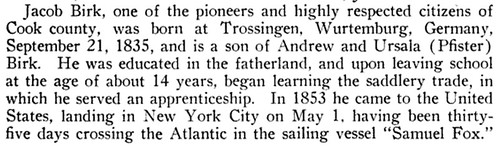
Here’s some biographical info from “Historical Review of Chicago and Cook County and Selected Biography,” by A.N. Waterman:

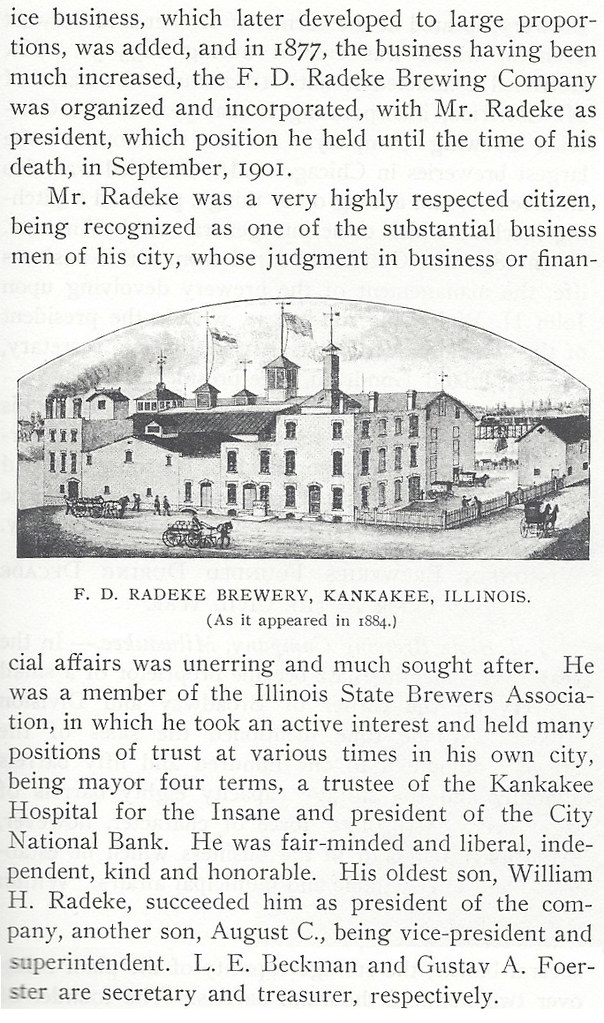
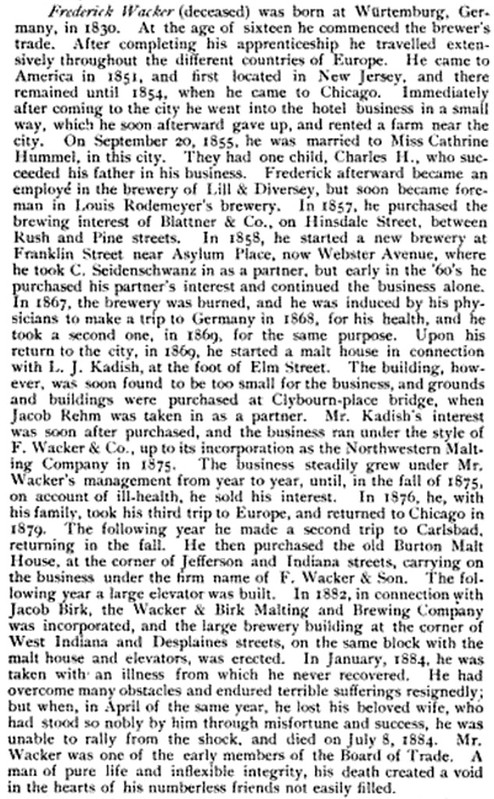
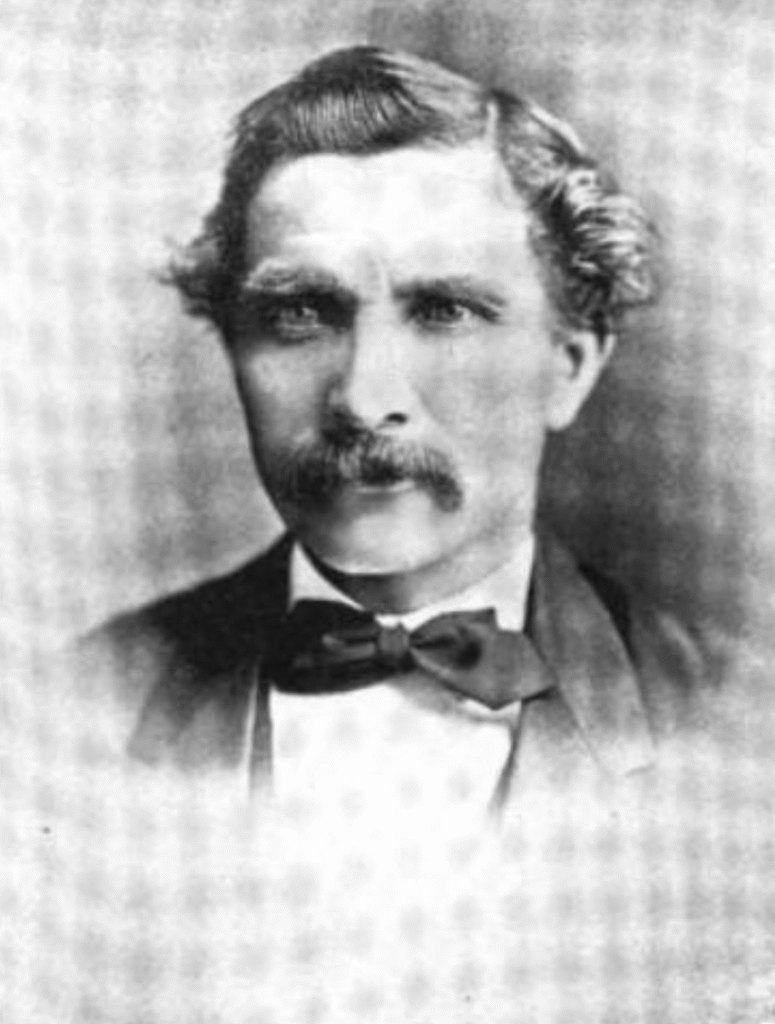
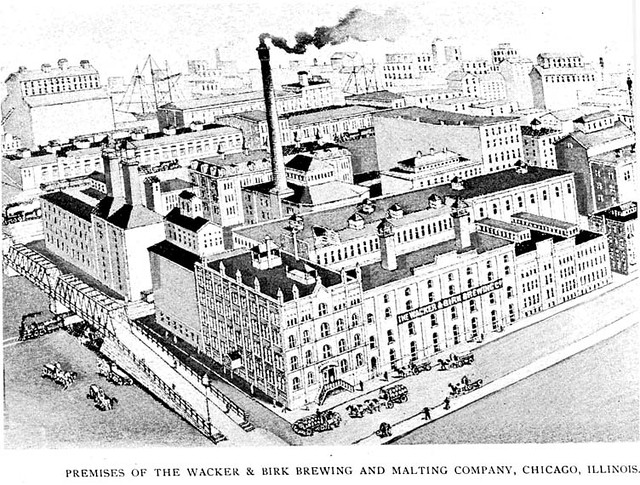
Birk, his father having been born in Germany and being in early manhood a harnessmaker. He came to Chicago in 1854, prospered in trade and business, and for many years conducted a hotel on West Lake street. In 1881 he became associated with Fred Wacker & Son, then engaged in the malting business, and in the following year became associated with the firm in brewing operations under the firm name of the Wacker & Birk Brewing Company. In 1891 the business was sold to the English corporation, the Chicago Breweries, Limited, and Jacob Birk and his two sons, William A. and Edward J., incorporated the Birk Brothers’ Brewing Company. Since the founding of the company, at that time, William A. has been president and Edward J. Birk, secretary and treasurer. The basis of the complete and extensive plant was the Corper & Nockin brewery, purchased in 1891, and since remodeled and enlarged. The elder Birk retired from his connection with the business in 1895.

And here’s another account, from the “History of Cook County, Illinois,” published in 1909:

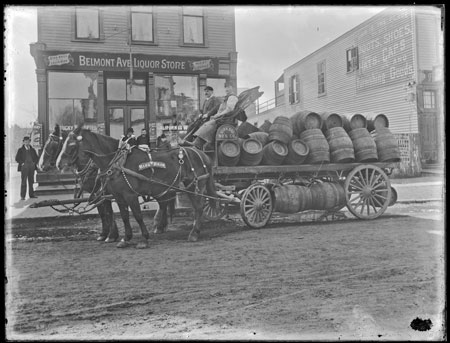
Birk Brothers Brewing Company delivery wagon on Belmont Avenue, around 1895.
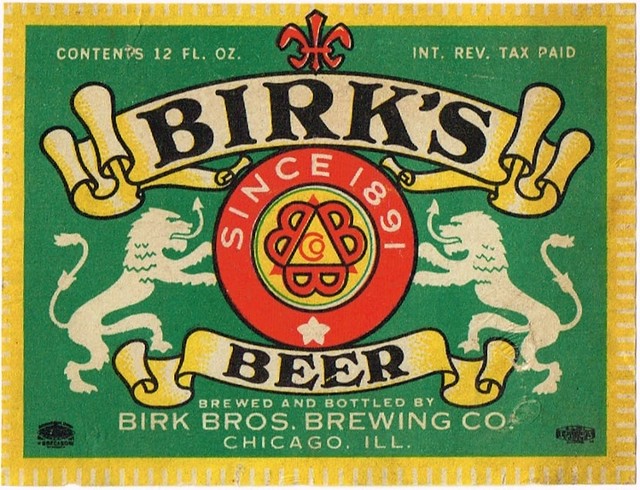
Birks-Beer-Labels-Birk-Bros-Brewing-Company

Filed Under: Birthdays, Breweries, Just For Fun Tagged With: Chicago, History, Illinois

Beer In Ads #5188: Drink Bock Beer And You Will Soon Become Eligible To Membership In The “Don’t Worry” Club

March 27, 2026 By Jay Brooks

Two years ago I decided to concentrate on Bock ads for awhile. Bock, of course, may have originated in Germany, in the town of Einbeck. Because many 19th century American breweries were founded by German immigrants, they offered a bock at certain times of the year, be it Spring, Easter, Lent, Christmas, or what have you. In a sense they were some of the first seasonal beers. “The style was later adopted in Bavaria by Munich brewers in the 17th century. Due to their Bavarian accent, citizens of Munich pronounced ‘Einbeck’ as ‘ein Bock’ (a billy goat), and thus the beer became known as ‘Bock.’ A goat often appears on bottle labels.” And presumably because they were special releases, many breweries went all out promoting them with beautiful artwork on posters and other advertising. With Spring approaching, there are so many great examples that I’m going to post two a day for a few months.

Friday’s first ad is for Ballentine’s Bock Beer, which was published on March 27, 1908. This one is from the Rockford Brewing Co., of Rockford, Illinois, which was originally founded in 1849 by Jonathan Peacock, which is why it was often known as the Peacock Brewery. This ad ran in The Rockford Register Star, also of Rockford, Illinois. The ad itself is quite plain, but I absolutely love the hilarious headline: “Drink Bock Beer And You Will Soon Become Eligible To Membership In The ‘Don’t Worry’ Club.”

Filed Under: Art & Beer, Beers, Breweries, Just For Fun Tagged With: Advertising, Bock, History, Illinois

Next Page »

Find Something

Northern California Breweries

Please consider purchasing my latest book, California Breweries North, available from Amazon, or ask for it at your local bookstore.

Recent Comments

  • Bob Paolino on Beer Birthday: Grant Johnston
  • Gambrinus on Historic Beer Birthday: A.J. Houghton
  • Ernie Dewing on Historic Beer Birthday: Charles William Bergner 
  • Steve 'Pudgy' De Rose on Historic Beer Birthday: Jacob Schmidt
  • Jay Brooks on Beer Birthday: Bill Owens

Recent Posts

  • Beer & Whiskey Birthday: John Hansell June 7, 2026
  • Historic Beer Birthday: Charles Voegtle June 7, 2026
  • Beer In Ads #5261: Bockbier Aus Der Actienbrauerei Basel June 6, 2026
  • Historic Beer Birthday: Ernest G.W. Woerz June 6, 2026
  • Beer In Ads #5260: It’s Beer Weather June 5, 2026

BBB Archives

Feedback

Head Quarter
This site is hosted and maintained by H25Q.dev. Any questions or comments for the webmaster can be directed here.