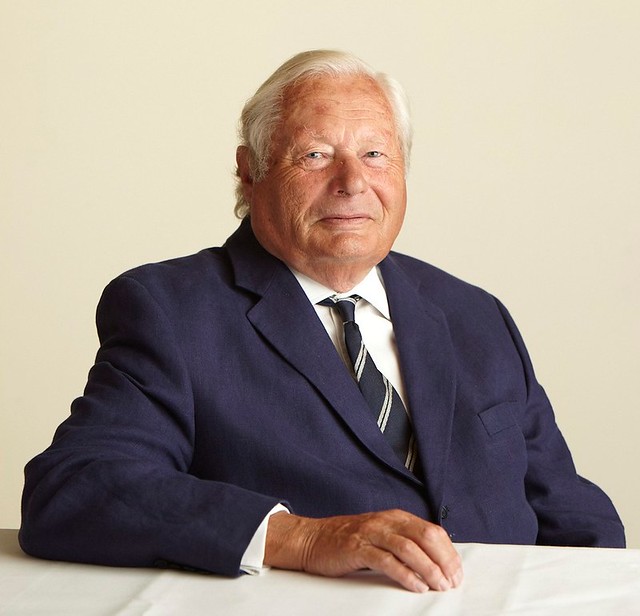
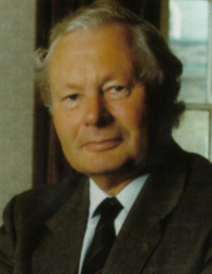
Today is the birthday of Robert Harry Beale Neame, though he was generally known as Bobby (February 25, 1934-November 15, 2019). He joined his family’s company, Shephard Neame in 1956, and in 1971 became the chairman of the company, a position he held until retiring in 2005, when he was named president.
He passed away recently, in 2019, and here is his obituary from the Guardian:
Robert Neame, who has died aged 85, helped safeguard the independence of Shepherd Neame, Britain’s oldest brewery. He was a director from 1957 until 2006 and steered it through the turbulence of the 1960s and 70s, when many family breweries were taken over by national groups keen to acquire more pubs to fill with keg beer and lager.
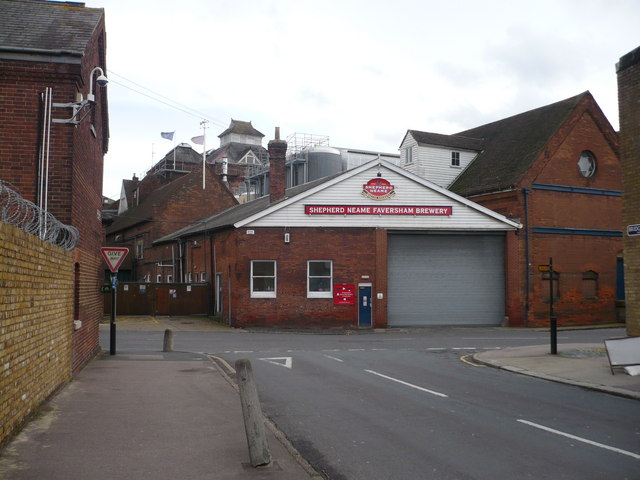
Bobby, as he was known, joined the family business as marketing director in 1956. Shepherd Neame, founded in 1698 in Faversham in the heart of the Kent hop fields, enjoyed a good reputation for its beer, while its large estate of pubs was tempting bait for bigger brewers. In 1967 Shepherd Neame’s rival in Faversham, Fremlin’s, was bought by Whitbread. Bobby and his family were determined that their brewery would not suffer a similar fate.
Born in London, Bobby was the son of Violet (nee Cobb) and Jasper Neame, chairman and managing director of the brewery until 1961. He went to Harrow school, where he became head boy. Before he joined the family firm he went on a grand tour of breweries in Europe and Scandinavia to gain experience of both making and selling beer. He finished the tour at Hürlimann in Zurich, a visit that led to the Swiss lager being brewed at Faversham.
One of Bobby’s first tasks at the family brewery was to add keg beer to its cask and bottled ales. Such filtered and pasteurised keg beers as Watney’s Red Barrel and Worthington E were taking sales away from traditional beer – and Shepherd Neame knew it had to respond with its own version.
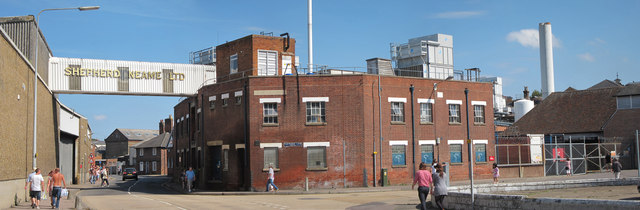
The Shepherd Neame brewery in Faversham, Kent. Photograph: Shepherd Neame
Bobby was given £1,000 to set up a keg plant and he recalled buying two tanks from a Mr Roberts in north London. It was like a scene from Steptoe and Son, he said, with the deal sealed behind Tottenham Hotspur football ground over a lunch of greasy chops on a tablecloth of newspapers. At the brewery the new keg beer was pasteurised in a primitive fashion, with kegs lowered into two zinc baths filled with hot water.
Bobby became chairman of the brewery in 1971 and was able to add more distinguished beers than those brewed under the keg initiative. One of his great achievements was to launch, in 1990, a new cask and bottled beer called Spitfire. It commemorated the 50th anniversary of the Battle of Britain, when the RAF defeated the Luftwaffe in the skies above Kent. Spitfire went on to become the brewery’s best known and biggest-selling beer.
In the 90s Bobby and the brewery faced the threat of a new invasion, with the rise of hordes of British drinkers crossing to Calais on what became known as “booze cruises”. They returned with boxes of French beer that cost half the price of British beer as a result of far lower rates of duty in France.
Shepherd Neame, close to Dover and Folkestone, was badly affected by the cheap imports. Bobby hit back by exporting his strong ale, Bishops Finger, to Calais and other parts of northern France. The beer, first brewed in the 50s, takes its name from ancient road signs directing pilgrims to the shrine of Thomas Becket in Canterbury Cathedral. Bishops Finger became a cult beer in France and helped counter the impact of cheap imports.
Bobby and his fellow directors lobbied successive British governments over the punitive rates of duty imposed on British beer. The campaign had only limited success, with some freezes on duty in recent years, but Bobby was able to use another government policy to build his pub estate.
In the early 90s the Conservative government, following advice from a report by the Monopolies and Mergers Commission into the brewing industry that had castigated the national brewers, forced the nationals (the Big Six) to sell off large parcels of their pubs. As a result, Bobby was able to snap up a number of pubs from Whitbread.
When Bobby retired as chairman in 2005 he was given the honorary role of president. He passed to his son, Jonathan, a company producing 200,000 barrels of beer a year, with 320 pubs and hotels, and substantial free trade.
Bobby was active in Kent life. A one-nation Tory, he was leader of Kent county council between 1982 and 1984. He was deputy lieutenant of Kent in 1992 and high sheriff in 2001. A passionate supporter of cricket, he was president of Kent county cricket club in 1992. He was appointed CBE in 1999.
He was married twice, first in 1961 to Sally Corben. The marriage ended in divorce, and in 1974 he married Yvonne Mackenzie. He is survived by Yvonne, their daughter, Moray, his children Jonathan, Charlotte and Sarah from his first marriage, and nine grandchildren; his son Richard died in 1968.
Shepherd Neame is an English independent regional brewery founded in 1698 in Faversham, Kent. Evidence has been uncovered showing brewing has taken place continuously on the current site since at least 1573. It is the oldest brewer in Great Britain and has been family-owned since 1864. The brewery produces a range of cask ales and filtered beers. Production is around 281,000 brewers’ barrels a year. It owns 338 pubs & hotels predominantly in Kent, London and South East England.
The next generation faced the same difficulties in the 1960s. Bobby Neame came to work at the Brewery in 1956. In September 1957 he became a director when Madeleine Finn, due to retire, decided to step down. Jasper, his father was ill at the time, but Bobby was back at work in the following January. By the September 1969 AGM he had widened his range considerably and it was said that he was helping in the Brewery, and was in charge of the free trade, advertising etc.
Laurie’s son, Colin Roger Beale Neame joined the company in October 1959, to help his father in the bottled beer department, a month after Rex Neame had joined in Managing ‘Queen Court’. At the September 1961 AGM after serving a probationary period on the Board, they both became full members. As the production director, he was in charge of the more technical side of the brewing business, making improvements in the bottling plant and keg beer, by utilizing many labour saving techniques. He also introduced a small biochemical laboratory employing a laboratory technician.
Jasper died on 18 Jan 1961 at the early age of 56, Laurie then becoming sole managing director. He survived his brother for another nine years and continued his interest in production.
Following is his father’s footsteps, Bobby took particular interest in the sales side of the business. This became especially important once the larger brewers started investing heavily in advertising, especially on commercial television. Bobby then became marketing manager in charge of “improving the image of the Company in the eyes of the public”, showing greater attention to publicity, with advertising on Southern Television in 1970.
In 1968 the Cobb brewing company in Margate (with its family connection) again came on the market, together with 38 licensed premises. The Cobbs found it increasingly difficult to survive independently after the increasing success of the Butlins hotels group took over much of its trade. It was taken over by the Whitbreads in Januray 1968 and ceased to brew in the following October. This now left Shepherd Neame as ‘the last independent brewery in Kent.’
On 19 Dec 1970, Laurie died suddenly and unexpectedly at the end of the day, after all the excitement when his second son, Stuart, was married. In March 1971 Bobby became chairman and Colin managing director.
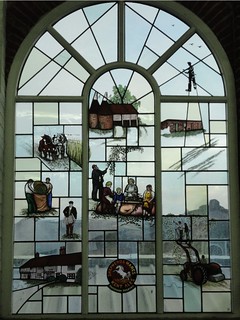
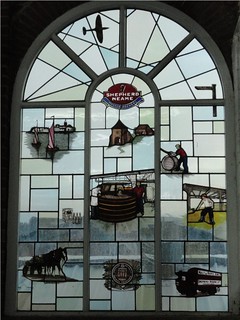
I love the stained glass windows showing the brewery’s history.
Martyn Cornell has a nice photo tour of the Shepherd Neame Brewery. And on YouTube there’s an interesting tour of the brewery.
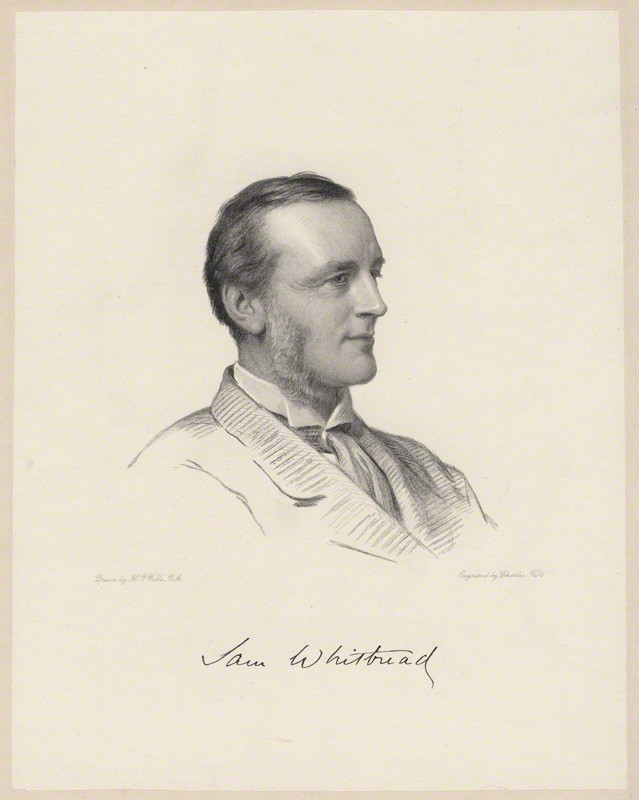
Today is the birthday of Samuel Charles Whitbread (February 16, 1796-May 22, 1879). “He was the grandson of Samuel Whitbread,” who founded the brewery Whitbread & Co. Samuel C. “represented the constituency of Middlesex (1820–1830) and was High Sheriff of Bedfordshire in 1831. His interests were astronomy and meteorology. He served as president of the Royal Meteorological Society from 1850 to 1853. In June 1854 he was elected a Fellow of the Royal Society.”
b. 16 Feb. 1796, 3rd but 2nd surv. s. of Samuel Whitbread† (d. 1815) of Cardington and Southill, Beds. and Elizabeth, da. of Lt.-Gen. Sir Charles Grey of Falloden, Northumb.; bro. of William Henry Whitbread*. educ. by private tutor Richard Salmon 1802-7; Sunninghill, Berks. (Rev. Frederick Neve) 1807; Eton 1808; St. John’s, Camb. 1814. m. (1) 28 June 1824, Juliana (d. 13 Oct. 1858), da. of Maj.-Gen. Henry Otway Trevor (afterwards Brand), 3s. (1 d.v.p.) 3da. (1 d.v.p.); (2) 18 Feb. 1868, Lady Mary Stephenson Keppel, da. of William Charles, 4th earl of Albemarle, wid. of Henry Frederick Stephenson*, s.p. suc. bro. to family estates 1867. d. 27 May 1879. Offices Held Sheriff, Beds. 1831-2.
Biography
Whitbread, a member of the brewing dynasty, was raised in London and Bedfordshire, where his father, a leading Foxite Whig, inherited the family’s recently purchased estate of Southill in 1796. His parents’ favourite, he was educated with his elder brother William and sent to Cambridge to prepare him for a career in the church or politics. Little is known of his reaction to his father’s suicide in July 1815. His uncle Edward Ellice*, who now oversaw the Whitbreads’ troubled finances, dismissed the brothers’ private tutor Sam Reynolds, who ‘goes about as an idle companion to the boys’, and pressed their continued attendance at Cambridge. Whitbread joined Brooks’s, 22 May 1818, and became a trustee the following month of his father’s will, by which he received £5,000 and £500 a year from the age of 21, £5,000 in lieu of the church livings of Southill and Purfleet (Essex) reserved for him, and was granted the right to reside at Cardington when the house fell vacant. William came in for Bedford at the general election of 1818 and Samuel was now suggested for Westminster and Middlesex, where he nominated the Whig veteran George Byng* in a speech proclaiming his own credentials as a candidate-in-waiting. Encouraged by his mother, who took a house in Kensington Gore after William came of age, he fostered his connections with the Westminster reformers, purchased a £10,000 stake in the brewery and in 1819 joined their controlling partnership, which was then worth £490,000 ‘on paper’ and dominated by his father’s partners Sir Benjamin Hobhouse†, William Wilshere of Hitchin and the Martineau and Yallowley families. Maria Edgeworth, who now met Whitbread for the first time, described him as a ‘good, but too meek looking … youth’.
Whitbread grasped the opportunity to contest Middlesex at the general election of 1820, when, backed by his relations, brewing partners, the Nonconformists and the Whig-radical coalition campaigning in Westminster (which he denied), he defeated the sitting Tory William Mellish in a 12-day poll to come in with Byng. His lacklustre brother had shown none of their father’s talent and energy, but Samuel impressed with his enthusiasm and appealed throughout to his father’s reputation as a reformer and advocate of civil and religious liberty. Ellice praised his common sense and popularity and surmised that Parliament ‘may save him by throwing him into society and engaging him in politics, although possibly the situation he will occupy will be rather too prominent for either his abilities or experience’. He later informed Lord Grey:
Sam has exceeded all our expectations … He has on every occasion conducted himself with skill and feeling, and shown a quickness and talent, which I did not give him credit for, and if he will only apply himself with activity and industry to the business of the county, he may retain the seat as long as he pleases.
Samuel C. later in life.
While most of the rest of his biography concerns political machinations, toward the end, there’s some more about his life outside politics:
Out of Parliament, Whitbread acted to combat the ‘Swing’ riots in Bedfordshire in December 1830, attended the Bedford reform meeting in January 1831, and addressed the Middlesex meeting at the Mermaid with Charles Shaw Lefevre, 21 Mar. He declared for the Grey ministry’s reform bill, notwithstanding the omission from it of the ballot. As sheriff, he assisted his brother and the Bedford reformers in the county and borough at the May 1831 general election, when both constituencies were contested. He continued to promote reform and the ministerial bill at district meetings in Middlesex, where he turned down a requisition to contest the new Tower Hamlets constituency at the 1832 general election. A lifelong Liberal, Whitbread did not stand for Parliament again, but from 1852 took a keen interest in his son Samuel’s political career as Member for Bedford. His health remained erratic, and he increasingly devoted his time to business and scientific pursuits. As a fellow since 1849 of the Royal Astronomical Society, and treasurer, 1857-78, he built the Howard observatory at Cardington (1850), and became a founder member that year of the British Meteorological Society and a fellow of the Royal Society in 1854. In 1867 he succeeded his childless brother William to the family estates and as head of the brewery and trusts, and in 1868, almost ten years after Juliana’s death, he married into the Albermarle family, making Cardington available for Samuel, who had inherited his uncle’s shares in Whitbreads’. He died in May 1879 at his town house in St. George’s Square, survived by his second wife (d. 20 Sept. 1884) and four of his six children. According to his obituary in the Bedford Mercury:
in the world at large, Mr. Whitbread did not figure greatly. He was fond of sport, but not to a base degree; his caution prevented him making rash ventures, which often end unhappily. As a walker he was rather famous; it was a matter of amusement to his friends to see how in the vigour of his manhood and even of late years he used to walk down interviewers who bored him … The anecdotes of this species of pedestrianism are neither few nor far between, and the richest of them are those in which the bores were portly and ponderous to a degree. It may be imagined therefore that he was humorous; and so he was. He was good company everywhere. Political economists might have praised his habits of economy, for his chief fault was his desire never to waste anything.
His will, dated 30 Nov. 1875, was proved in London, 24 July 1879. By it he confirmed Samuel’s succession to the entailed estates and several family settlements, ensured that the non-entailed estates, including the brewery’s Chiswell Street premises, passed to his younger son William, and provided generously for other family members.
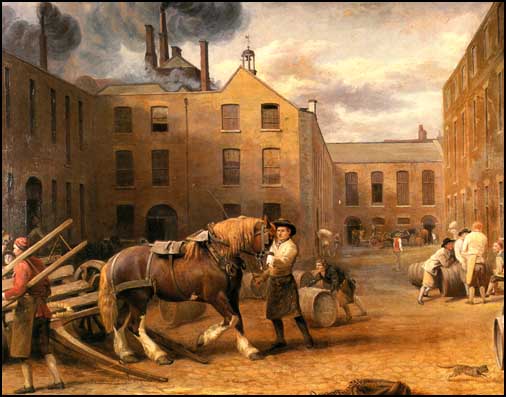
The Whitbread Brewery in Chiswell Street, 1792, painted by George Garrard.
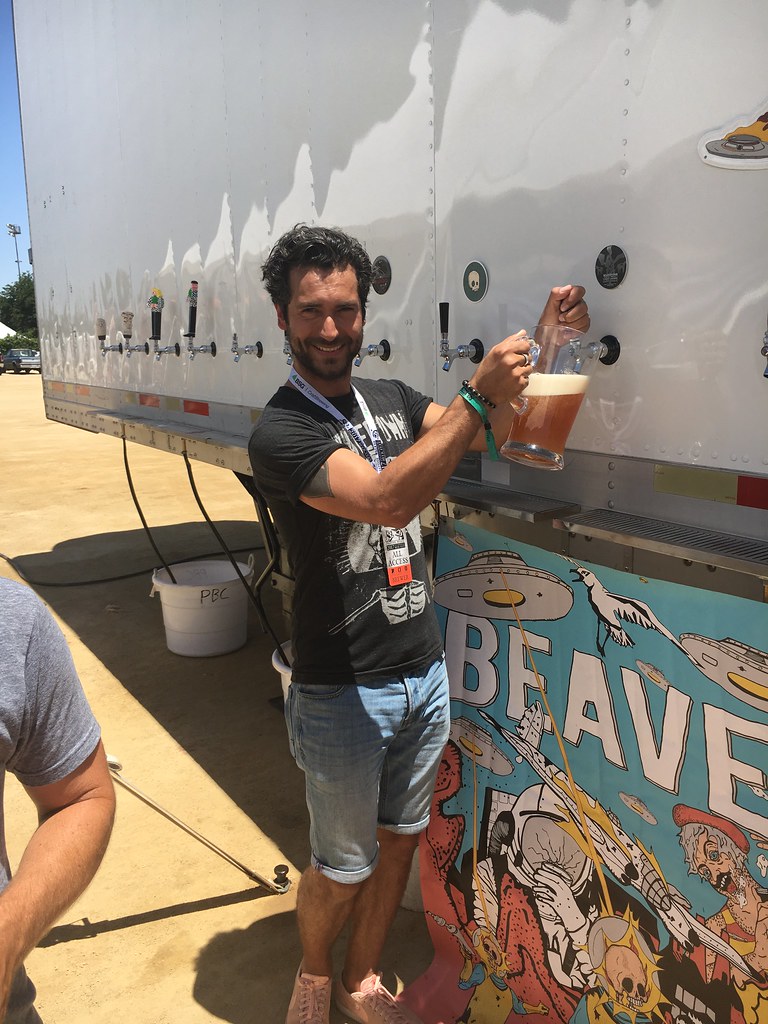
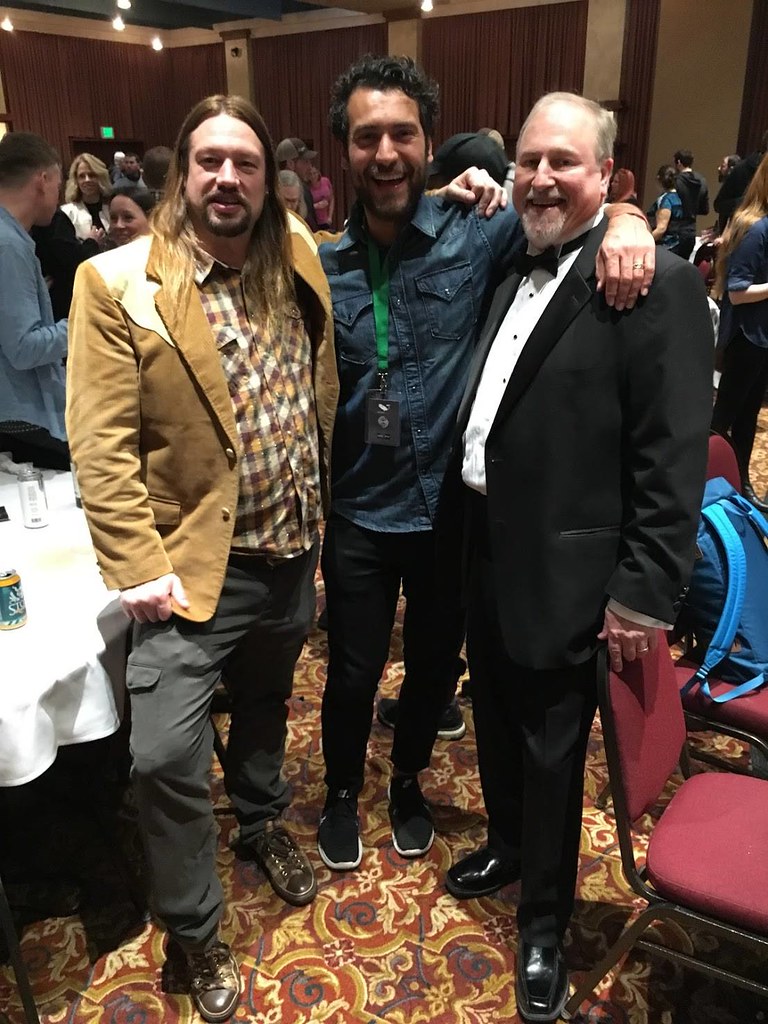
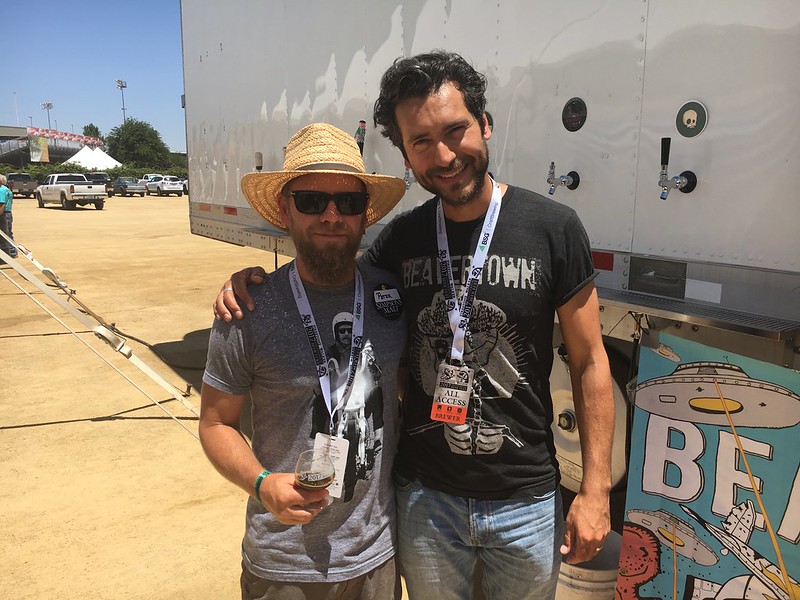
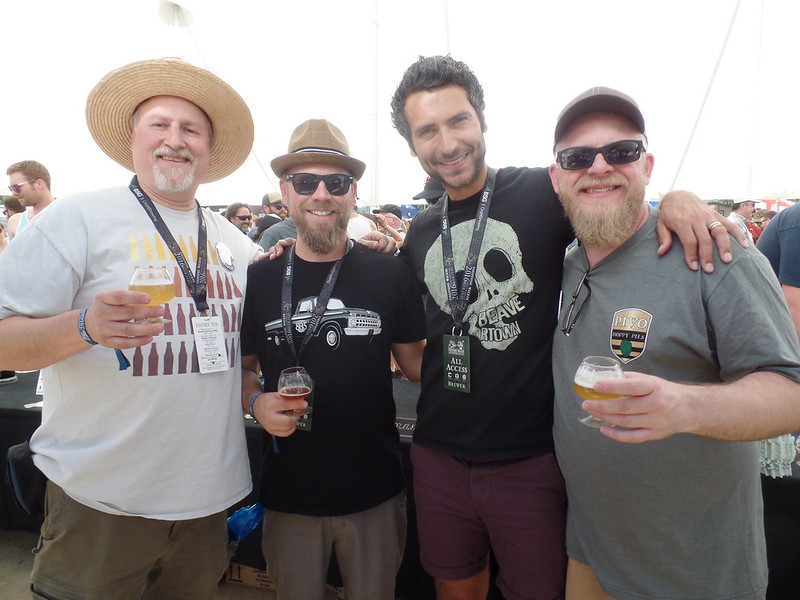
Today is the 46th birthday of Logan Plant, founder and brewmaster of Beavertown Brewery, which he started in 2011. I met Logan first at the Firestone-Walker Invitational Beer Festival a few years ago and have run into a couple of times since both there and at the RateBeer Best Festival. He’s a very friendly and talented person and his beer is great, and it’s always been a pleasure to hang out with him. Please join me in wishing Logan a very happy birthday.
At the Firestone-Walker Invitational in 2017.
With Jeremy Marshall, from Lagunitas, and me at the RateBeer Best Awards show in January 2017.
With Matt Brynildson at the Firestone-Walker Invitational in 2017.
With me, Matt Brynildson and another F-W brewer at the Firestone-Walker Invitational in 2016.
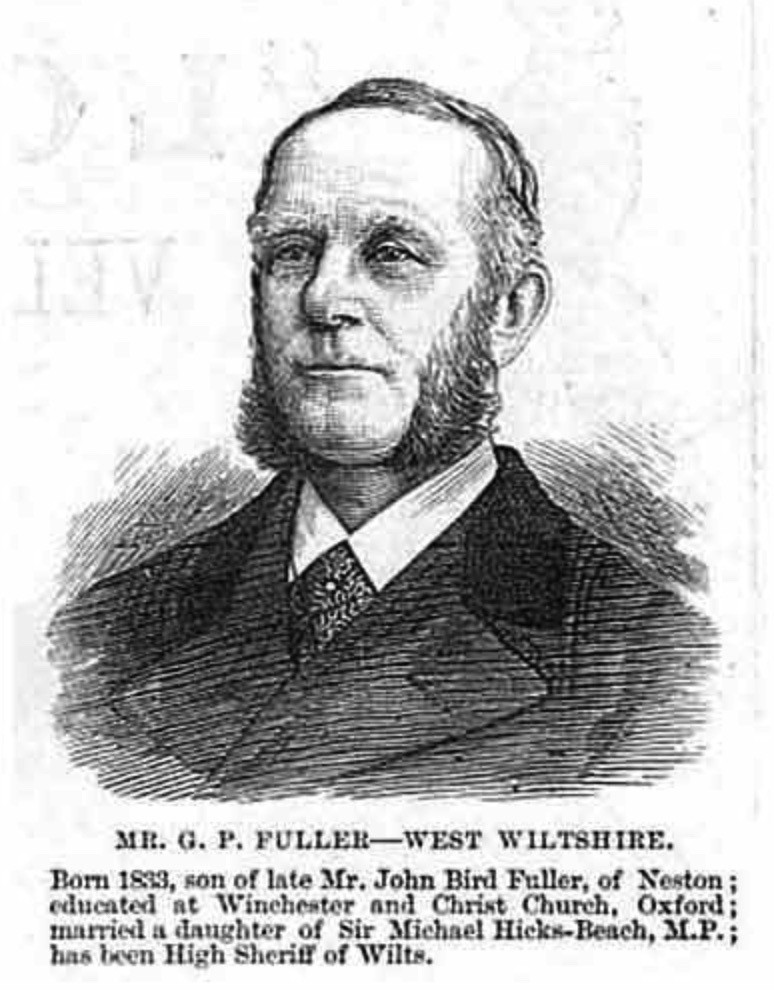
Today is the birthday of George Pargiter Fuller (January 8, 1833-April 2, 1927). He was the “the eldest surviving son of John Bird Fuller, a partner in Fuller Smith & Turner, brewers.” “Fuller inherited a share in the family brewery (in Chiswick, London) on his father’s death in 1872, and was also chairman of Avon Rubber in Melksham.
He also served as High Sheriff of Wiltshire in 1878. He lived at Neston Park, Corsham, Wiltshire.” He spent most of his time, however, as a politician. He “was a member of the Wiltshire County Council, chairman of the Chippenham Rural District Council and of the Corsham Parish Council and School Board and a Justice of the Peace for Wiltshire,” and “a Liberal Party politician in the United Kingdom who sat in the House of Commons from 1885 to 1895.” Despite his lineage and ownership stake in his family’s brewery, he doesn’t appear to have been very involved in its management at all.
Today is the 40th birthday — The Big 4-O — of Mark Dredge, who writes the beer blog Pencil and Spoon from his home in Kent, England. I’ve had the pleasure of drinking with Mark on a few of his trips across the pond. The first time, at the opening gala for SF Beer Week, and several years ago at the Beer Bloggers Conference in Boulder, Colorado, and more recently judging at GABF. By day, he works in digital marketing and social media, most recently for Pilsner Urquell, and by night, he’s “a beer writer and blogger.” The last two times I saw him, a few years ago in Belgium, and also in San Francisco, it was working for Pilsner Urquell. In December 2009, he won the British Guild of Beer Writers New Media Writer of the Year for Pencil and Spoon. If you don’t read his stuff, you should. Join me in wishing Mark a very happy birthday.
With Mark at Central Kitchen in San Francisco on the anniversary of the 1st tapping of Pilsner Urquell, November 9, 1842.
Mark, at left, having lunch at Mountain Sun in Boulder, Colorado during the Beer Bloggers Conference a few years ago.
Raising a toast. (Note: This last photo was purloined from Facebook.)
Today is the 49th birthday of Melissa Cole, UK beer writer extraordinaire. I’d met Melissa first online and then in person at the Rake in London seemingly many years ago. She’s also been coming over to our side of the pond to judge at both GABF and the World Beer Cup. She’s a great advocate for beer generally, but especially for women, and is great fun to hang out and drink with. She also writes online at Taking the Beard Out of Beer! which is subtitled “A Girl’s Guide To Beer.” Her first book, Let Me Tell You About Beer, was published a couple of years ago, which she followed up last year with The Beer Kitchen: The Art and Science of Cooking, & Pairing, with Beer. Join me in wishing Melissa a very happy birthday.
At the Great British Beer Festival several years ago, with Roger Protz.
Melissa with Greg Koch, from Stone Brewing, at GABF in 2009.
The Lost Abbey’s Tomme Arthur with a blushing Melissa at the World Beer Cup dinner in Chicago a few years ago.
A couple of years ago at the Rake in London, Melissa and Matt Brynildson, from Firestone Walker.
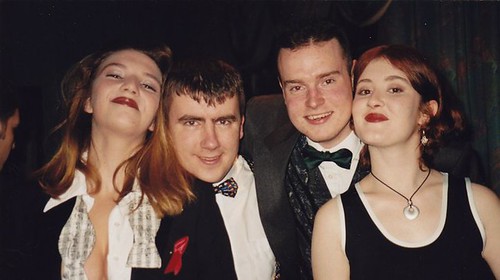
With friends at University sometime between 1993-97 (photo purloined from Facebook).
Today is the 68th birthday of Ron Pattinson, a brewing historian who writes online at Shut Up About Barclay Perkins. Ron lives in Amsterdam but is obsessed with the British brewery Barclay Perkins, which is what the title of his blog refers to. I have finally had the pleasure of meeting Ron in person, when we were both guests of Carlsberg for a press trip to Copenhagen a couple of years ago, and then again two years ago again in Denmark, when he was there with his lovely wife. A few more years ago, Lew Bryson had a chance to go drinking with Ron, too. Join me in wishing Ron a very happy birthday.
Me and Ron at a bar in Copenhagen.
In that same bar, with (clockwise from lower left) Martyn Cornell, Jeff Alworth, Evan Rail, me, Stephen Beaumont, Pete Brown, Stan Hieronymus and Ron.
Ron, talking with Jeff Bell and Mark Dredge.
Leaving Copenhagen; Pete Brown, Ron, Jeff Bell, Stephen Beaumont and Stan Hieronymus.
Ron while drinking with Lew Bryson.
At Pretty Things 1901: Jim Barnes, Dann Paquette (Pretty Things), Jay Sullivan (Cambridge Brewing) and Ron Pattinson.
Today is the birthday of John Courage (October 1, 1761-October 1797). He founded the Courage Brewery in London in 1787, when he bought a brew house in Horselydown, Bermondsey, London.
This biography is from Courage & Co., a website dedicated to the Courage Brewery and the Courage family.
John Courage, the founder of Courage & Co., came to London in 1780 as a younger son of a French Huguenot family who had been exiled and settled in Scotland a century before.
In a letter dated 7th February 1786, the Founder’s sister writes to him congratulating him on his marriage to Harriet Murdoch and that “the marriage is no surprise to us and be that she be a sober good woman and that we drank your health on your marriage night very hearty.”
The Anchor Brewhouse, the location of the original Courage Brewery.
By 1787 he had already been in business in London for eight years as an agent for the Glasgow shipping firm of Carron which traded from the Glasgow Wharf (the Carron and Continental Wharves) on the north side of the Thames, downstream from the Tower of London.
John Courage was the only surviving son of his late father, Alexander, when he left Aberdeen for London in about 1780 to become the Wapping agent for Carron Shipping, leaving behind in Aberdeen his mother Isabel and his unmarried sister Ann. John could see across the river to the foreshore of Southwark and decided to diversify his interests by going into the beer business. Thus it was that the name of Courage became associated with the brewing industry.
When John Courage, together with a number of friends, settled for the purchase of a brew house at Horselydown, on the south bank of the Thames, he was investing his acumen and money in a staple industry at an opportune time. He purchased the Anchor Brewery at Horselydown, Bermondsey, in 1787 from John and Hagger Ellis. An earlier owner of the Brewery was Vassal Webbing a Flemish émigré. What is interesting is that both Vassal Webbing and John were described in G.N. Hardinge’s book, Courages 1787-1932, as being Protestant émigrés. Frank Courage wrote to his daughter Milly in New Zealand in 1914, that he thought John (his Grandfather), could have come from Flanders, as brewing has always been more of an industry there than in France. The only known French Protestant Courages in the 1600s were Thomas and Nicholas Courage, and their names do not appear in Aberdeen, so the search has shifted to Flanders (Belgium), for our Protestant forebears.
On 17th December 1787, John Courage, aged 26, paid a cheque for £100 to the Morris Estate as part payment for the Private House and Old Brewhouse at Horselydown over the Thames and opposite Wapping. On Christmas Eve, John paid the balance on the purchase of £674 18s 9d. On 4th January 1788, he paid George Courage £26 6s for sundries and scroll book. On 15th January 1788 John purchased one silk waistcoat for 19 shillings 8d, and on 7th June paid John Ward £10 for a gelding. On 15th November 1788, the Founder’s sister Ann writes to her brother “this piece of news that our king is died” (Bonnie Prince Charlie in exile in Italy).
In March 1793, tragedy struck and John’s sister Ann died of a fever in Aberdeen and was buried beside her father in Old Machar; there is a long letter from the Founder’s mother, Isabel Courage, about this in the Courage Collection at the Greater London Record Office, EC1, together with the other original letters that survive from this period including the old brewery book.
In May 1793, Archibald Courage from Findhorn supplies his cousin “with 1000 American staves and 20 bundles hoops”. Courage Beer was being shipped all over the world, as its reputation grew. 2 hogsheads of Porter on 25th February 1793 were shipped back to Scotland to the Earl of Fife, and throughout 1794 barrels of porter were dispatched to India, Dominica, Antigua, Amsterdam, Hambro, Gibraltar and Lisbon. Ann Murdoch, the Founder’s mother-in-law spent £6-10-6 on clothes for her grandson John in September 1796 and Mrs Courage’s house expenses for the month of October 1796 were £9-6-10d.
On 26th June 1788 a son, John, was born to John and his wife Harriet and on 8th June 1790 twins Ann and Elizabeth were born. On 23rd February 1795 another daughter, Harriet, was born.
John Courage died in October 1797 aged 36 and was buried at St John’s, Horselydown. His widow, Harriet died in May the following year aged 32, and was also buried at Horselydown. On Harriet’s death, the new John Courage was only 10, and John Donaldson, the managing clerk, took over the running of the Brewery, becoming a partner in the newly named firm of Courage and Donaldson, taking a third of the gross profits which was afterwards enlarged to half, as well as half of the capital.
This is a short history of the brewery from its Wikipedia page:
Courage & Co Ltd was started by John Courage at the Anchor Brewhouse in Horsleydown, Bermondsey in 1787. He was a Scottish shipping agent of French Huguenot descent. It became Courage & Donaldson in 1797. By 1888, it had been registered simply as Courage. In 1955, the company merged with Barclay, Perkins & Co Ltd (who were located at the nearby Anchor Brewery) to become Courage, Barclay & Co Ltd. Only five years later another merger with the Reading based Simonds Brewery led to the name changing to Courage, Barclay, Simonds & Co Ltd. In the late 1960s, the group had assets of approximately £100m, and operated five breweries in London, Reading, Bristol, Plymouth and Newark-on-Trent. It owned some 5,000 licensed premises spread over the whole of Southern England, a large part of South Wales and an extensive area of the East Midlands and South Yorkshire. It was employing some 15,000 people and producing something like 75 million imperial gallons (340,000,000 L) of beer annually. Its name was simplified to Courage Ltd in October 1970 and the company was taken over by the Imperial Tobacco Group Ltd two years later.
Its vast Worton Grange (later the Berkshire) brewery was opened on the Reading/Shinfield border in 1978. The Anchor Brewery closed in 1981 and all brewing was transferred to Reading. Imperial Tobacco was acquired by the Hanson Trust in 1986 and it sold off Courage to Elders IXL who were renamed the Foster’s Brewing Group in 1990. The following year the Courage section of Foster’s merged with the breweries of Grand Metropolitan. Its public houses were owned by a joint-company called Inntrepreneur Estates. Scottish & Newcastle purchased Courage from Foster’s in 1995, creating Scottish Courage as its brewing arm.
Today is the birthday of William H. Worthington II (September 10, 1764-March 4, 1825). He was the son of William H. Worthington, who founded the Worthington Brewery in Burton-on-Trent in 1761, with the help of his wife Ann Tarratt, when “he purchased a brewery in the High Street for 320 pounds from Richard Cummings of Repton.” Worthington II assumed control of the company following his father’s death, and his son, also named William, succeeded him.
And here’s more from the brewery’s Wikipedia page:
It is the second oldest continuously brewed British beer brand after Whitbread. The best known Worthington beers are its Creamflow nitrokeg bitter and White Shield India Pale Ale.
When William Worthington died in 1800, his brewery was one of the largest outside London. Horace Tabberer Brown, a chemist employed by Worthington, pioneered brewing science in the separation and cultivation of pure yeast strains from 1866, and the brewery was the first in the world to systematically use a laboratory in the brewing process from 1872. Worthington & Co merged with its major Burton rival Bass in 1927. Until the 1960s the Worthington brand, in bottled form, ranked alongside Bass and Guinness as one of only three beers with nationwide distribution. However, bottled beer sales declined as keg beer grew in popularity throughout the 1960s, and the Worthington brewery closed in 1965. The beers continued to be brewed elsewhere, and the Worthington brand has remained prominent up to the present day.
The Worthington brand was purchased from Bass by the American brewing company Coors in 2002, which following a merger became Molson Coors in 2005. Creamflow is the third highest selling ale in the United Kingdom, as well as the highest selling ale in Wales, and is brewed in Burton. Worthington’s White Shield IPA has continued to be brewed since 1829, and has been the recipient of a number of awards. In 2010, Molson Coors opened the William Worthington microbrewery, which brews historical and seasonal beers.
And this history is from “Messers. Worthington’s Brewery at Burton,” originally published January 2, 1875 and reprinted in the Brewery History journal edition in 2017.
A few years after his first start this gentleman determined to follow the example of Printon, and add the wine trade to his business as a brewer; and his son, the second William Worthington, while yet almost a boy, finding himself the sole possessor of the business, joined a partner in shipping a large proportion of the season’s brewings as a joint speculation to St. Petersburg. But those were the days when communications with foreign lands were difficult, when posts were rare, irregular, and untrustworthy, and eighteen months went by and no news arrived of the venture on which so much had been risked. The sharer in the cargo became nervous and dispirited, and at length, when the underwriters refused to take insurances on the goods, he came to William Worthington and offered for a small sum to give up the entire of the venture. Small as the sum was in proportion to the yield of a successful trading, it was yet as much as under the circumstances the share was worth. But William Worthington had the courage and confidence which seems to have ever been a characteristic of his house, and was anxious to close with the offer. His business, however, was not then the extensive concern it subsequently became, and so much of his available capital had been locked up in the seemingly unlucky adventure, that there were difficulties in the way. Once more, as has so frequently been the case in the history of mankind, a woman proved the dea ex machinâ. William Worthington was at the time engaged to be married to Mrs. Tarratt, and this lady, after considerable thought, agreed to advance the money. Her sacrifice was rewarded as it deserved to be, for six months later – months, doubtless, of weary anxiety to the young brewer – news arrived, not merely of the safety of the cargoes, but of a trading successful beyond hope and expectation, and this success established the fortunes of the house beyond fear of trifling shocks, and when William Worthington died he left behind him a fortune which in those days was considered large. He was succeeded by his son, the third William Worthington.
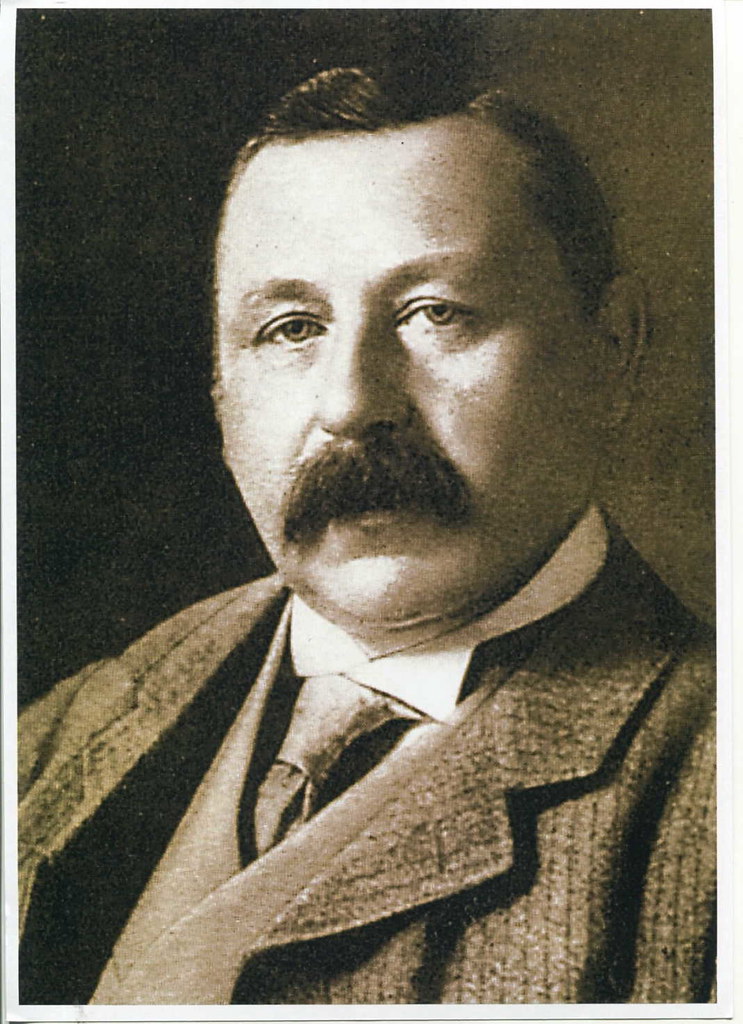
Today is the birthday of Thomas William Everard (September 8, 1851-January 1, 1925). Thomas William Everard was the son of William Everard, co-founder of what would become known as the Everards Brewery, which is still a going concern today, and is still run by an Everard, who is fifth generation from William, and fourth from Thomas William.
Thomas William Everard was born on the 8th of September 1851, the year the Great Exhibition was staged by Prince Albert in Crystal Palace in London. He was the youngest of three children and joined his father’s firm at an early age. Thomas became very involved in his work at the brewery. He was so fond of his work he did not like to take holidays.
In 1890 a new partnership was formed to run the company- Everards, Son and Welldo. The partners were Thomas, his 69 year old father William, and a local wine and spirits merchant. Charles Leeds William Welldon.
Thomas took over the running of the brewery after the death of his father William, in 1892. He married Florence Muriel Nickisson of London on the 28th of September 1888. They had two children-William Lindsay, born in 1891, and his sister Phyllis Muriel, born three years later. William Lindsay would later go onto run the brewery.
Thomas enjoyed both country and urban life and was an active member of the Leicestershire Agricultural Society, as was his father. He continued the Everards tradition of public service and, like his father; he became a J.P. before being made a deputy Lieutenant of the County, and, in 1905, High Sheriff.
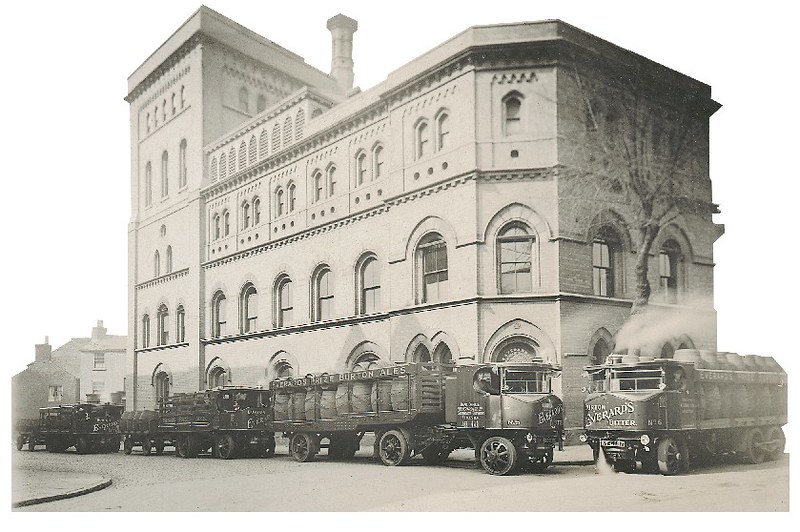
The brewery, around 1875.
And here’s the basic brewery history from Wikipedia:
The company began as Hull and Everard in 1849 when William Everard, a farmer from Narborough Wood House and brewer Thomas Hull leased the Southgate Street Brewery of Wilmot and Co from the retiring proprietors. Although Hull continued as a maltster, Everard was the driving force behind the business which he managed until his death in 1892.
The business expanded as the company progressively acquired outlets, with over 100 pubs by the late 1880s. In 1875 the company moved to a new state of the art tower brewery designed by William’s nephew architect John Breedon Everard. The brewery, on the corner of Southgate St and Castle St extracted very pure water from wells 300 feet deep beneath the premises and steam engines played a significant part in the mechanisation.
After the death of William, control passed to his son Thomas. The historic centre of the UK brewing industry remained some 40 miles away at Burton-upon-Trent, which by the 1890s produced one tenth of Britain’s beer. Everard’s leased the Bridge Brewery on Umplett Green island in 1895 but its 10,000 barrels per year capacity proved insufficient. It was replaced with the newer Trent brewery in Dale St which became available after going into liquidation in 1898. The Southgate brewery remained the distribution centre to the Leicestershire pubs with beer arriving by rail from Burton. The Trent brewery was purchased outright in 1901. It was renamed the Tiger Brewery around 1970.
At some point their Tiger Best Bitter became their flagship beer, and I remember really enjoying during my first CAMRA festival in the early 1990s. It was a regional festival in Peterborough, which happened to be going on in later summer at the end of my wife’s summer semester at the University of Durham. So we took the train up to Peterborough from London to attend the festival, and it was great fun. I had many fine beer that night, but for whatever reason I clearly recall liking this one.













 The brewery, around 1875.