Brookston Beer Bulletin

Jay R. Brooks on Beer

  • Home
  • About
  • Editorial
  • Birthdays
  • Art & Beer

Socialize

  • Dribbble
  • Email
  • Facebook
  • Flickr
  • GitHub
  • Instagram
  • LinkedIn
  • Pinterest
  • RSS
  • Twitter
  • YouTube

Powered by Genesis

Archives for September 2014

Beer In Ads #1307: Beer Contributes To The Re-Building Of America

September 8, 2014 By Jay Brooks


Monday’s ad is another one from the United Brewers Industrial Foundation, another one from 1939. This was well before the “Beer Belongs” series, and just before World War II. This one is second ad talking about how “What Beer contributes to the re-building of America would fill a great volume.” For example, “the entire cost of the C.C.C. (Civilian Conservation Corps) could be paid for by the taxes of the brewing industry!”
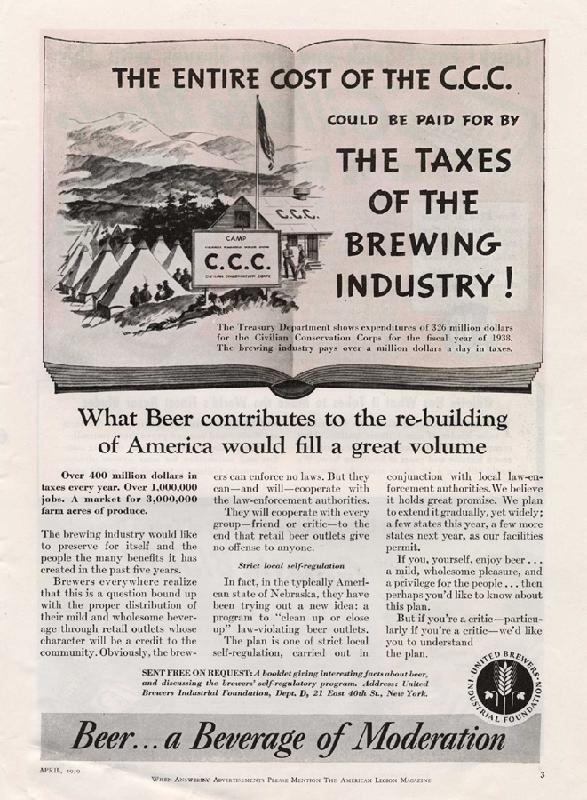
USBF-1939-ccc

Filed Under: Beers

Beer In Ads #1306: Nature Makes Beer

September 7, 2014 By Jay Brooks


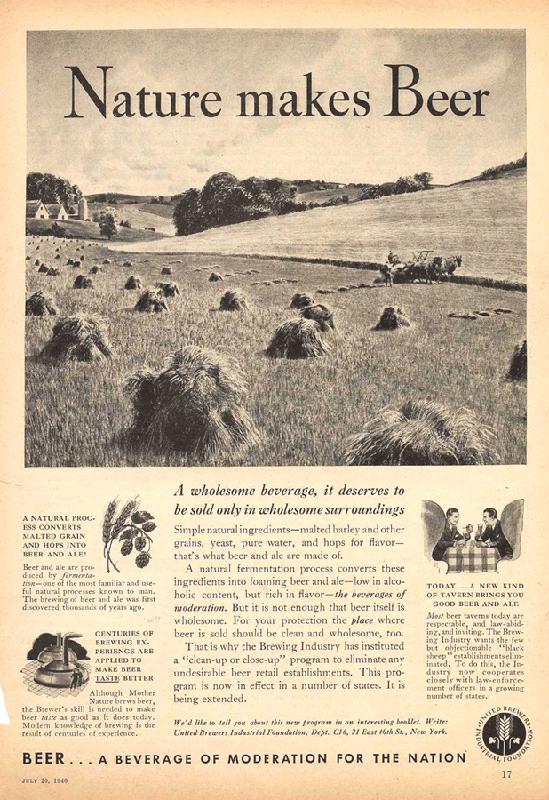
Sunday’s ad is another one from the United Brewers Industrial Foundation, another one from 1940. This was well before the “Beer Belongs” series, and just before World War II. This one focuses on the fact that “Nature Makes Beer,” but it’s hard not to love this. “A wholesome beverage, it deserves to be sold only in wholesome surroundings.”

USBF-1940-nature

Filed Under: Art & Beer, Beers Tagged With: Advertising, Brewers Association, History

Beer In Ads #1305: The Moderation Hour

September 6, 2014 By Jay Brooks


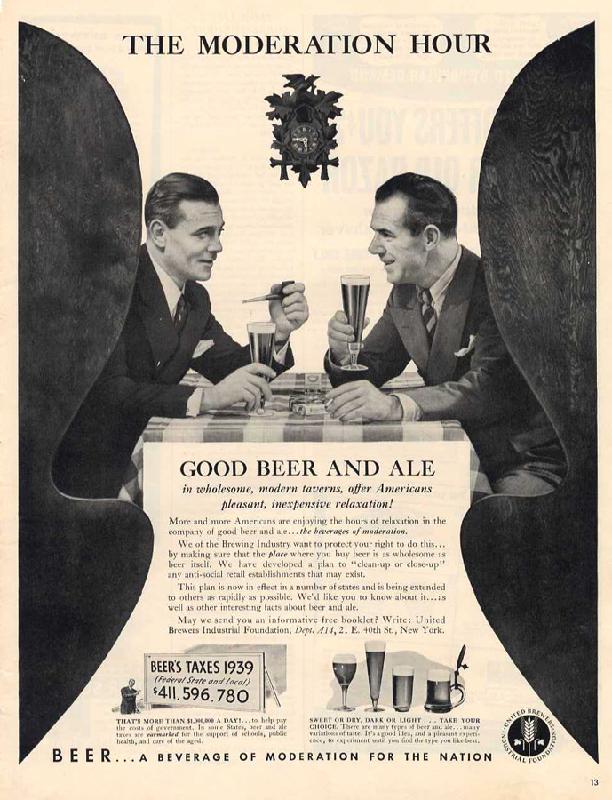
Saturday’s ad is another one from the United Brewers Industrial Foundation, this one from 1940. This was well before the “Beer Belongs” series, and just before World War II. Ah, “The Moderation Hour,” where “Good Beer and Ale in wholesome, modern taverns, offer Americans pleasant inexpensive relaxation!” In all of the 1939 ads I’ve been running, they’ve been saying annual taxes brewers pay is $400 million but now the results are in for 1939, and the new number is $411,596,780, for both state and federal.

USBF-1940-moderation

Filed Under: Art & Beer, Beers Tagged With: Advertising, Brewers Association, History

Beer In Ads #1304: It Brings A Livelihood To Thousands Of Farmers

September 5, 2014 By Jay Brooks


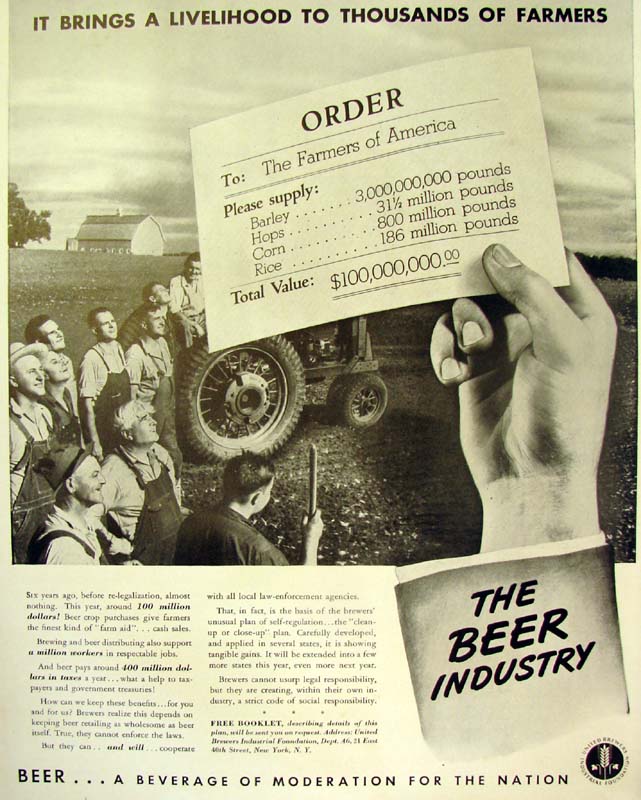
Friday’s ad is another one from the United Brewers Industrial Foundation, again from 1939. This was well before the “Beer Belongs” series, and just before World War II. Showing an order for $100 million dollars worth of crops, including 3 billion pounds of barley, along with hops, corn and rice, the ad points out how important the brewing industry is to farmers growing those crops.

USBF-1939-farm-bill

Filed Under: Art & Beer, Beers Tagged With: Advertising, Brewers Association, History

Hops, One Of Our Nature Neighbors

September 5, 2014 By Jay Brooks

hop-leaf
Here’s an interesting look at hops from a 1914 publication. The book is Nature Neighbors, a lavishly illustrated multi-volume set of nature books published by the American Audubon Association in Chicago, which was limited to only 2,500 printed copies. It was edited by Nathaniel Moore Banta, with “articles by Gerard Alan Abbott, Dr. Albert Schneider, William Kerr Higley, Thomas Crowder Chamberlin, John Merle Coulter, David Starr Jordan, and Other Eminent Naturalists.”

natureneighborse04bant_0013

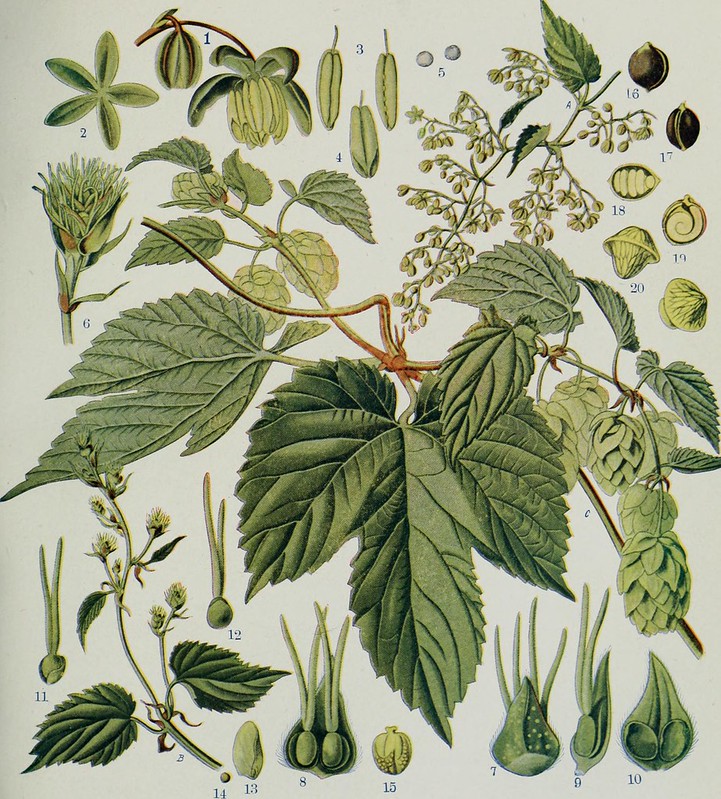
In Volume 4, covering minerals and plants, under Chapter III: Medicinal Plants, by Dr. Albert Schneider, beginning at page 133, they include a description and illustration of hops.

HOPS

“The Hop has been called the Northern vine. It is found in a wild state throughout Europe, excepting the extreme North, and extends east to the Caucasus and through Central Asia. It is a handsome plant and not infrequently used as an arbor plant. The lower or basal leaves are very large, gradually decreasing in size toward the apex.

Hops is also cultivated in Brazil and other South American countries, Australia, and India.

The principal use of hops is in the manufacture of beer, to which it imparts the peculiarly bitter taste, and its repute as a tonic. For this purpose enormous quantities are consumed in Germany and England. The exhausted hops
from the breweries form an excellent fertilizer for light soils. The leaves have been used as fodder for cows. Leaves, stems, and roots possess astringent properties and have been used in tanning. In Sweden the fiber of the stem is used in manufacturing a very durable white cloth, not unlike the cloth made from hemp and flax.

Hops is used medicinally. It at first causes a very slight excitation of brain and heart, followed by a rather pronounced disposition to sleep. Pillows stuffed with hops form a very popular domestic remedy for wakefulness.

Hop bags dipped in hot water form a very soothing external application in painful inflammatory conditions, especially of the abdominal organs. It has undoubted value as a bitter tonic in dyspepsia and in undue cerebral excitation.”

hops-1914

Description of plate : A, staminate (male) inflorescence; B, pistillate (female) inflorescence; C, fruiting branch; 1, staminate flower; 2, perigone; 3, stamen; 4, open anther; 5, pollen; 6, pistillate catkin; 7, 8, 9, pistillate flowers; 10, scales; 11, 12, 13, scales and flowers; 14, 15, fruit; 16, 17, 19, seed; 20, resin gland (lupuhn).

You can see the book in its entirety at the Internet Archive, where you can also download a pdf, ePub or Kindle formatted file there. Or read it online via Open Library, where you want to look for page 308.

Filed Under: Just For Fun, Related Pleasures Tagged With: History, Hops

Beer In Ads #1303: One-Sixth Of A Nation Blowing Away!

September 4, 2014 By Jay Brooks


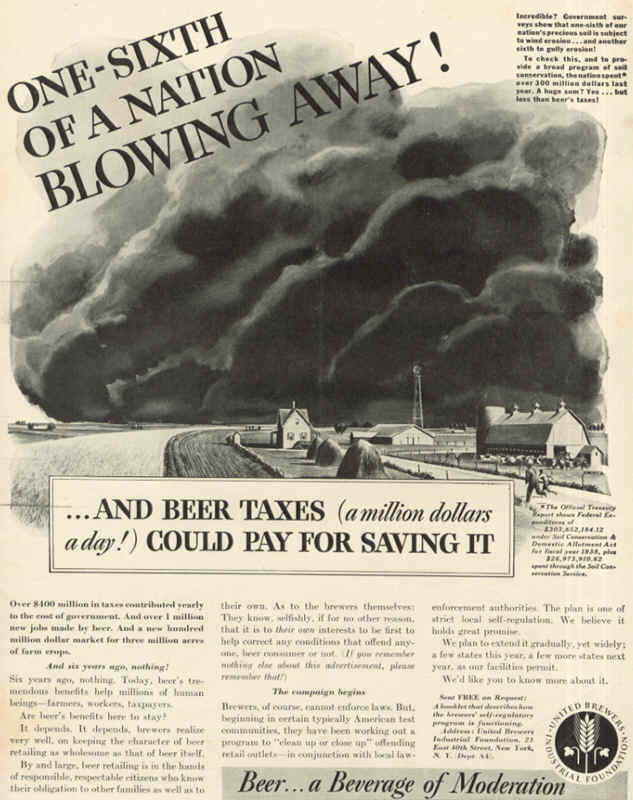
Thursday’s ad is another one from the United Brewers Industrial Foundation, again from 1939. This was well before the “Beer Belongs” series, and just before World War II. That “One-Sixth of a Nation Blowing Away!” is referring to the dust bowl of the midwest. But not to worry, it can all be saved, thanks to beer taxes — “a million dollars a day!”

USBF-1939-dust-bowl

Filed Under: Art & Beer, Beers Tagged With: Advertising, Brewers Association, History, Taxes

Beer In Ads #1302: Which Road, America?

September 3, 2014 By Jay Brooks


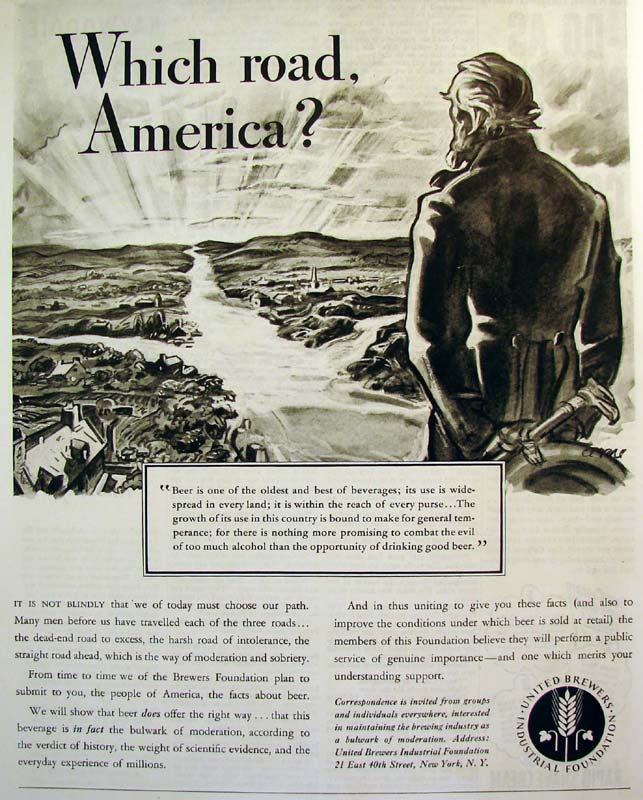
Wednesday’s ad is still another one from the United Brewers Industrial Foundation, again from 1939. This was well before the “Beer Belongs” series, and just before World War II. The ad shows Uncle Sam (who first appeared today in 1813) peering out on a sunlit landscape, with a road spreading out before him. He’s stop, holding his hat behind his back, deep in thought trying to decide which of three roads to take just up ahead. What are his choices? “It is not blindly that we of today must choose our path. Many men before us have travelled each of the three roads … the dead-end road to excess, the harsh road of intolerance, the straight road ahead which is the way of moderation and sobriety.” I vote for the way of mod sob. But I also love the text from the inset box:

“Beer is one of the oldest and best of beverages; its use is widespread in every land; it is within the reach of every purse … The growth of its use in this country is bound to make for general temperance; for there is nothing more promising to combat the evil of too much alcohol than the opportunity of drinking good beer.”

USBF-1939-which-road

Filed Under: Art & Beer, Beers Tagged With: Advertising, Brewers Association, History

Anchor’s BigLeaf Maple Autumn Red Returns For Fall

September 3, 2014 By Jay Brooks

anchor-new
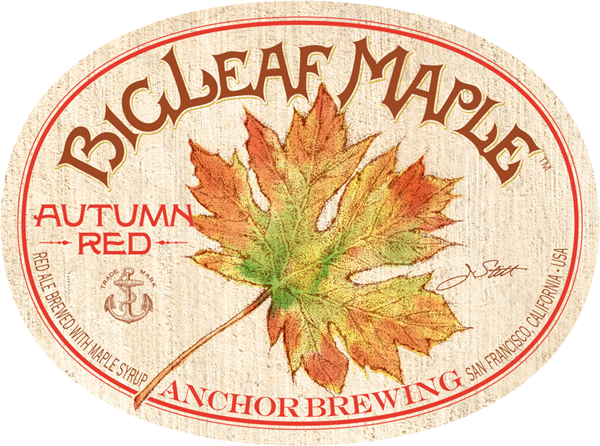
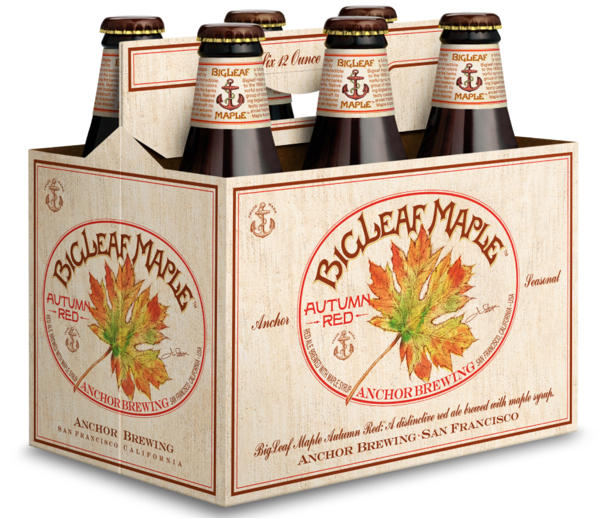
BigLeaf Maple Autumn Red, Anchor Brewing‘s fall seasonal, is back on store shelves and on draft in bars from now until the end of October. This is just the second year for the 6% a.b.v. red ale, which debuted last fall. The beer uses a “unique blend of hops — Nelson Sauvin, Citra, and Cascade for dry hopping — specialty malts including a combination of two caramel malts and pale malt,” with a hint of maple syrup that makes it “unlike any other red ale today.”

BigLeaf-Maple-Autumn-Red-label-600

First released in August 2013, BigLeaf Maple Autumn Red was inspired by a native California tree, its incredible leaves, its delicious syrup, and the colors of fall. The tree, known as Bigleaf maple, thrives along the banks of California’s mountain streams. Native Californians once made rope and baskets from its bark. Bigleaf maple sugaring in California dates to the 1800s; yet this tree’s unusually flavorful syrup remains the product of a small group of hobbyists. A hint of maple—including bigleaf maple—syrup in every brew perfectly complements the malty complexity, balanced hoppiness, and rich fall hue of BigLeaf Maple Autumn Red.

anchor-bigleaf

Anchor also released a video about their fall seasonal.

Filed Under: Beers, Breweries, News Tagged With: Anchor Brewery, California, San Francisco, Seasonal Release, Video

Popular Is As Popular Does

September 3, 2014 By Jay Brooks

underage-drinking
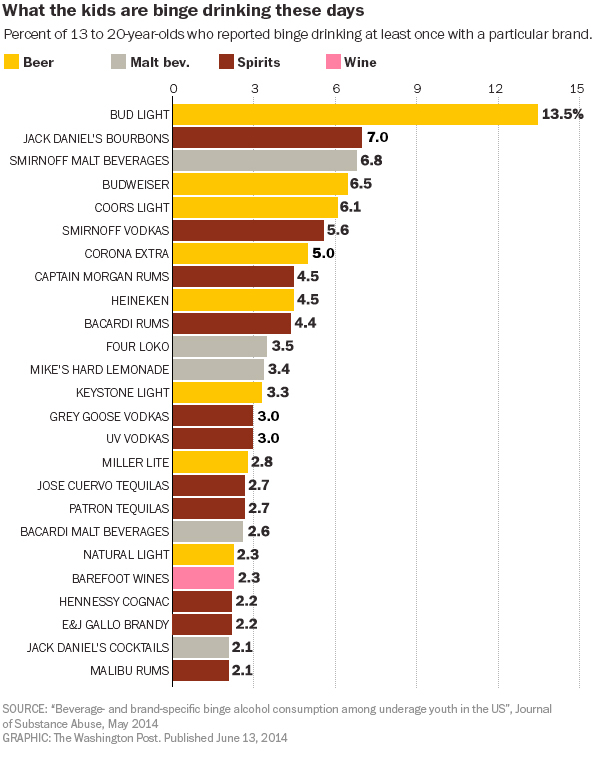
A variation of “stupid is as stupid does,” either works, as far as I’m concerned. Because this is a stupid type of study that keeps going around and pretending to be scientific and valuable, of which it appears to be neither. The latest one of these, entitled Beverage- and brand-specific binge alcohol consumption among underage youth in the US, appeared in the May edition of the Journal of Substance Use (although the Post’s infographic mis-identifies the source as the “Journal of Substance Abuse,” which ceased publication in 2002). What it “found,” is that when underage youth drink, and binge drink (a ridiculously defined term), they drink popular brands of alcohol, from which they draw sinister conclusions. Here’s how the Washington Post reported the the absurd conclusions drawn in What underage drinkers drink when they binge drink:

“The most important finding is that the phenomenon of binge drinking among our youth is extremely brand specific,” Dr. Michael Siegel, professor at Boston University School of Public Health and one of the study’s authors, said in an interview. “For the first time we’ve found the brands that are most responsible for binge drinking among our nation’s youth.”

For the first time? Seriously? This sort of “study” has been done before, as I detailed last year in New Study Concludes Kids Drink Same Beers As Adults, in which I found it’s been done previous to that one, as well. It’s not exactly groundbreaking, or new.

youth-brand-preference-2014

Perhaps most obnoxious is Alcohol Justice, who naturally has been tweeting with their usual glee anything that they believe shows alcohol in a negative light. Here’s how they characterized it:

What underage drinkers drink when they binge drink http://wapo.st/1u1V76Y Spoiler alert: BEER.”

So what’s especially annoying about that, is that while beer is indeed number one on the list, of the 25 brands listed, only 8 are beers, or only 32%. And even by the total percentage, the eight beer brands are 44%, less than half. Then there’s the fact that the spirits and wine are, on average, much higher in alcohol than beer, so comparing straight percentages skews the actual amount of alcohol consumed. If we adjusted this for the amount of alcohol in each, and thus how much alcohol was consumed, the amount of beer would likely plummet to an even smaller percentage of the whole. So by virtually every measure, beer is not the biggest culprit, yet Alcohol Justice singles it out with typical ignobility by saying “Spoiler alert: BEER.” Yet it’s not really beer, if you bother to actually look at the data. In the abstract of the actual study, even the conclusion of the researchers is that “binge drinking among youth is most commonly involves spirits [sic].” But Alcohol Justice ignores that — reading is hard, after all — and targets beer once more.

Of course, the data itself is questionable, too. According to the abstract, it was compiled via “[a]n Internet panel [that] was used to obtain a sample of 1032 underage youth aged 13–20, who drank alcohol in the last 30 d. For each brand consumed, youth reported drinking quantity and frequency, and whether they engaged in binge drinking with that brand (≥5 drinks for males and ≥4 for females). Each youth reporting binge drinking with a brand constituted a binge drinking report.” So they put up an internet poll and asked kids to report on their own illegal activity. How scientific. How could anything go wrong?

But it’s especially the conclusions they draw from them that seem absurd. For example, as was found in the previous study I reported on, Bud Light was the brand most often chosen. But Bud Light is, of course, the best-selling brand of beer in the U.S., a fact you’d think the researchers would be aware of. You don’t need a slide rule to figure why the beer that most of their parents are buying, might also be the one their kids are drinking, too. The same is true for just about every brand on the list, all very popular ones, the best-sellers in their individual categories. So you’d expect that they’d be the same brands consumed by our youth, especially if they’re taking them from their parents or other adults’ stashes. It’s the most obvious reason. Even if minors are asking adults to buy them some booze, the more popular brands would be the ones most readily available and sold by the most retailers. But the obvious answers seem to always elude the scientists, who seem more interested in making tenuous, off-the-wall but apparently agenda-supporting conclusions.

But even if we assumed that beer was number one, so what? In terms of both volume and sales, beer outsells every other adult beverage by a wide margin. So why wouldn’t that be across the board, including underage drinking, too. Why would they appear to be surprised that the best-selling type of alcohol, as well as the best-selling brand of beer, are also the most popular among minors?

And they seem to do the same thing with the others, too. So instead of recognizing that Jack Daniels in the best-selling whiskey (the chart incorrectly calls it bourbon, which I’m not sure means the researchers or the Post don’t know what they’re talking about), they instead go down the road less traveled of bizarre reasoning.

The list of the most popular alcohol brands among America’s heavy-drinking youth might appear somewhat disjointed at first glance. Some of them, after all, are difficult to comprehend — Jack Daniel’s bourbons [sic], for one, is significantly more expensive than other lower shelf whiskeys, and yet ranks as the second most popular brand across all spirits and beers. But there’s actually a reasonably clear thread that could be tying them all together: millions upon millions of dollars in marketing.

“Why are these brands the most popular? Is there something in their marketing? There could be messages in their marketing efforts that are encouraging the use of these not just by youths but also in excess,” Siegel said. “We need to take a closer look at the marketing practices of these larger brands.”

Yup, kids choose them because of “millions upon millions of dollars in marketing,” not because they’re already the most popular brands, or because their parents drink them and so are in their homes, or because they’re the brands available for sale at the most places. Yes, you could argue that it’s marketing that built and now maintains their popularity, but that some malicious scheme will be revealed by “tak[ing] a closer look at the marketing practices of these larger brands” is completely absurd. When you go looking for a bogeyman, that’s what you find, especially when you ignore the simple, logical answers and try to find something more complicated. Because it seems like they’re going out of their way to ignore the obvious in favor of finding something to blame alcohol companies for.

Another reason to suspect this study is about promoting an agenda is something they state in “Background and objectives.” They begin their “study” with this underlying premise. “Binge drinking is a common and risky pattern of alcohol consumption among youth.” But as even the NIH admits, “[s]ince 2007, alcohol use and heavy drinking have shown appreciable declines in national surveys of middle and high school students. One study found that 12th-grade alcohol use declined from 66.4 percent to 62 percent in 2013, with a similar downward trend seen in eighth- and 10th-graders.”

And finally, in the Post article’s conclusion, author Roberto A. Ferdman, whose beat is “food policy, consumer business, and Latin American economics,” really shows what he doesn’t know about beer and its history, with this. “Currently, national and state-level policies aimed at curbing underage drinking are more focused on the point of purchase and consumption than on the time of potential indoctrination that precedes them.” Hardly. The moment prohibition ended, prohibitionist organizations began targeting advertising regulations to limit where, when and how alcohol could be advertised, along with where it could be sold, to whom, and all manner of other restrictions intended to do anything they could to limit it, figuring it was the next best thing if they couldn’t outlaw it outright. And they’ve been crying about that very issue ever since, incessantly trying to move the needle to limit “the time of potential indoctrination that precedes” … “the point of purchase and consumption,” exactly what Ferdman seems to think has been ignored has been the number priority of prohibitionist strategies for over eighty years.

I find it amazing that these types of so-called “studies” — what are essentially internet polls — are taken seriously and that they find journals willing to publish them, in effect legitimizing them somewhat. Because if it’s in a journal, the mainstream media often just writes about it uncritically, taking them at face value. But more insidious, prohibitionist organizations, like the ever delightful Alcohol Justice, will distort then and even fabricate their already questionable findings to use in their own agenda, like saying it’s beer that’s the biggest culprit, when even the study does not say that.

Filed Under: Beers, Editorial, Politics & Law Tagged With: Prohibition, Statistics

Beer In Ads #1301: Thanks A Million!

September 2, 2014 By Jay Brooks


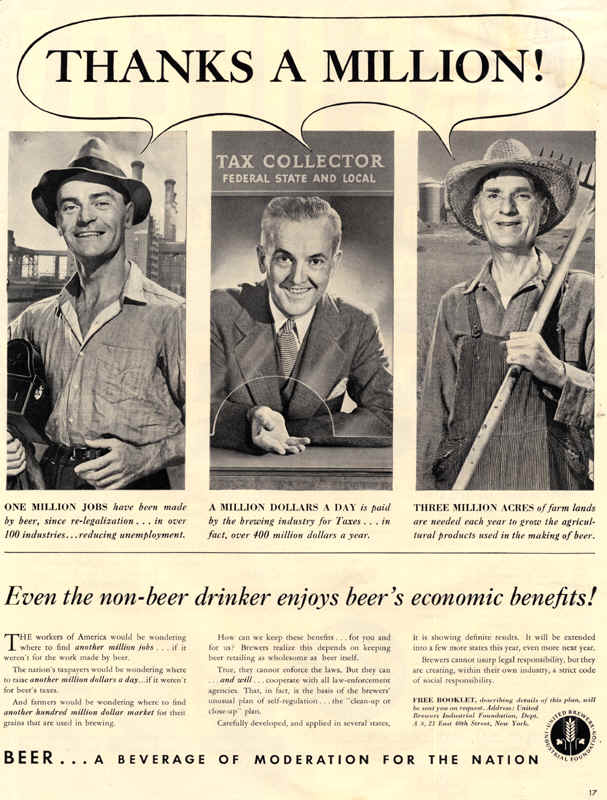
Tuesday’s ad is yet another one from the United Brewers Industrial Foundation, again from 1939. This was well before the “Beer Belongs” series, and just before World War II. The worker, the taxman and the farmer are all saying “Thanks a Million!” for the over one million dollars paid in taxes each and every day by the beer industry. But I especially love this line. “Even the non-beer drinker enjoys beer’s economic benefits!”

USBF-1939-thanks

Filed Under: Art & Beer, Beers Tagged With: Advertising, Brewers Association, History, Taxes

« Previous Page
Next Page »

Find Something

Northern California Breweries

Please consider purchasing my latest book, California Breweries North, available from Amazon, or ask for it at your local bookstore.

Recent Comments

  • Ernie Dewing on Historic Beer Birthday: Charles William Bergner 
  • Steve 'Pudgy' De Rose on Historic Beer Birthday: Jacob Schmidt
  • Jay Brooks on Beer Birthday: Bill Owens
  • Steve 'Pudgy' De Rose on Beer Birthday: Charles Finkel
  • Steve 'Pudgy' De Rose on Beer Birthday: Bill Owens

Recent Posts

  • Beer In Ads #5125: Bowler Brothers’ Bock February 22, 2026
  • Beer Birthday: Fred Bueltmann February 22, 2026
  • Historic Beer Birthday: John Emmerling February 22, 2026
  • Beer In Ads #5124: Möerlbach Bock February 22, 2026
  • Historic Beer Birthday: George M. Biner February 22, 2026

BBB Archives

Feedback

Head Quarter
This site is hosted and maintained by H25Q.dev. Any questions or comments for the webmaster can be directed here.