Brookston Beer Bulletin

Jay R. Brooks on Beer

  • Home
  • About
  • Editorial
  • Birthdays
  • Art & Beer

Socialize

  • Dribbble
  • Email
  • Facebook
  • Flickr
  • GitHub
  • Instagram
  • LinkedIn
  • Pinterest
  • RSS
  • Twitter
  • YouTube

Powered by Genesis

Beer In Ads #3632: Relaxing With Budweiser

February 6, 2021 By Jay Brooks

Saturday’s ad is for “Budweiser,” from 1959. This ad was made for Anheuser-Busch, and was part of their series using the tagline. “Where there’s Life … there’s Bud,” which ran from the 1950s into the 1960s, and this one features a man in a terrible hat and shirt combination relaxing in a comfy chair of some kind while a woman’s hand pours a bottle of beer into a glass for him as he looks up appreciably. The text begins “Relax.” And all I can think of is “Frankie Goes to Hollywood.”

Filed Under: Art & Beer, Beers Tagged With: Advertising, Anheuser-Busch, Budweiser, History

Beer Saints: St. Amand

February 6, 2021 By Jay Brooks

Today is also the feast day of St. Amand (c. 584 CE–679 CE). He was known for his hospitality, and is the patron saint of all who produce beer: brewers, innkeepers and bartenders and was also known as Amandus, Amandus of Elnon and Amantius. He was a bishop of Tongeren-Maastricht and one of the great Christian missionaries of Flanders. He is venerated as a saint, particularly in France and Belgium. He was born in Poitou, France, and died in the monastery at Elnone-en-Pevele (modern Saint-Amand-les-Eaux), France.

This account of his life is by T.J. Campbell from the Catholic Encyclopedia:

One of the great apostles of Flanders; born near Nantes, in France, about the end of the sixth century. He was, apparently, of noble extraction. When a youth of twenty, he fled from his home and became a monk near Tours, resisting all the efforts of his family to withdraw him from his mode of life. Following what he regarded as divine inspiration, he betook himself to Bourges, where under the direction of Saint Austregisile, the bishop of the city, he remained in solitude for fifteen years, living in a cell and subsisting on bread and water. After a pilgrimage to Rome, he was consecrated in France as a missionary bishop at the age of thirty-three. At the request of Clotaire II, he began first to evangelize the inhabitants of Ghent, who were then degraded idolaters, and afterwards extended his work throughout all Flanders, suffering persecution, and undergoing great hardship but achieving nothing, until the miracle of restoring the life of a criminal who had been hanged, changed the feelings of the people to reverence and affection and brought many converts to the faith. Monasteries at Ghent and Mt. Blandin were erected. They were the first monuments to the Faith in Belgium. Returning to France, in 630, he incurred the enmity of King Dagobert, who he had endeavoured to recall from a sinful life, and was expelled from the kingdom. Dagobert afterwards entreated him to return, asked pardon for the wrong done, and requested him to be tutor of the heir of the throne. The danger of living at court prompted the Saint to refuse the honour. His next apostolate was among of the Slavs of the Danube, but it met with no success, and we find him then in Rome, reporting to the pope what results had been achieved.

While returning to France he is said to have calmed a storm at sea. He was made Bishop of Maastricht about the year 649, but unable the repress the disorders of the place, he appealed to the Pope, Martin I, for instructions. The reply traced his plan of action with regard to fractious clerics, and also contained information about the Monothelite heresy, which was then desolating the East. Amandus was also commissioned to convoke councils in Neustria and Austrasia in order to have the decrees which had been passed at Rome read to the bishops of Gaul, who in turn commissioned him to bear the acts of their councils to the Sovereign Pontiff. He availed himself of this occasion to obtain his release from the bishopric of Maastricht, and to resume his work as a missionary. It was at this time that he entered into relations with the family of Pepin of Landen, and helped Saint Gertrude and Saint Itta to establish their famous monastery of Nivelles. Thirty years before he had gone into the Basque country to preach, but had met with little success. He was now requested by the inhabitants to return, and although seventy years old, he undertook the work of evangelizing them and appears to have banished idolatry from the land. Returning again to his country, he founded several monasteries, on one occasion at the risk of his life. Belgium especially boasts many of his foundations. Dagobert made great concessions to him for his various establishments. He died in his monastery of Elnon, at the age of ninety. His feast is kept 6 February.

And this history is from Catholic Online:

This great missionary was born in lower Poitou about the year 584. At the age of twenty, he retired to a small monastery in the island of Yeu, near that of Re. He had not been there more than a year when his father discovered him and tried to persuade him to return home. When he threatened to disinherit him, the saint cheerfully replied, “Christ is my only inheritance.” Amand afterward went to Tours, where he was ordained, and then to Bourges, where he lived fifteen years under the direction of St. Austregisilus, the bishop, in a cell near the cathedral. After a pilgrimage to Rome, he returned to France and was consecrated bishop in 629 without any fixed See, receiving a general commission to teach the Faith to the heathens. He preached the gospel in Flanders and northern France, with a brief excursion to the Slavs in Carinthia and perhaps, to Gascony. He reproved King Dagobert I for his crimes and accordingly, was banished. But Dagobert soon recalled him, and asked him to baptize his newborn son Sigebert, afterwards to become a king and a saint. The people about Ghent were so ferociously hostile that no preacher dared venture among them. This moved Amand to attempt that mission, in the course of which he was sometimes beaten and thrown into the river. He persevered, however, and in the end people came in crowds droves to be baptized.

As well as being a great missionary, St. Amand was a father of monasticism in ancient Belgium, and a score of monasteries claimed him as founder. He found houses at Elnone (Saint-Amand-les-Eaux), near Tournai, which became his headquarters, St. Peters on Mont-Blendin at Ghent, but probably not St. Bavo’s there as well; Nivells, for nuns, with Blessed Ida and St. Gertrude, Barisis-au-Bois, and probably three more. It is said, though possibly apocryphal, that in 646 he was chosen bishop of Maestricht, but that three years later, he resigned that See to St. Remaclus and returned to the missions which he had always had most at heart. He continued his labors among the heathens until a great age, when, broken with infirmities, he retired to Elnone. There he governed as Abbot for four years, spending his time in preparing for the death which came to him at last soon after 676. That St. Amand was one of the most imposing figures of the Merovingian epoch, is disputed by no serious historian; he was not unknown in England, and the pre-Reformation chapel of the Eyston family at east Hendred in Birkshire is dedicated in his honor.

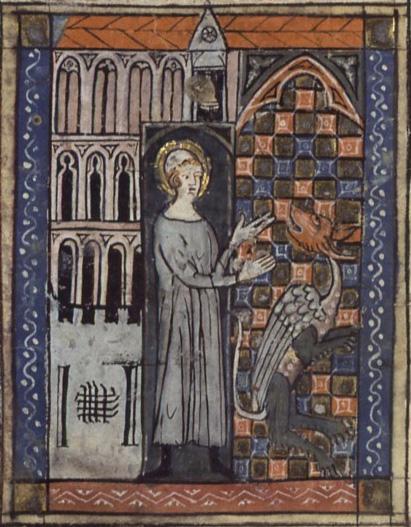
St. Amandus and the serpent, from a 14th-century manuscript.

He has quite a few patronages, including the Boy Scouts, bar staff, barkeepers, bartenders, brewers, grocers, hop growers, hotel keepers, innkeepers, merchants, pharmacists, druggists, vinegar makers, vine growers, vintners, wine-makers, and wine merchants; plus he’s against diseases of cattle, against fever, against paralysis, against rheumatism, against seizures, against skin diseases, against vision problems; and of the places: Flanders, Belgium; Maastricht, Netherlands; Salzburg, Austria; Utrecht, Netherlands; and Wingene, Belgium.

Leaded glass window (detail) of St. Amand in the Catholic parish church of Saint-Vincent-de-Paul in Clichy, France.

Modern Usage

There are several examples of beers named for St. Amand and at least one beer importer.

  1. St. Amand French Country Ale from Brasserie Castelain, though it’s no longer on their website so maybe they discontinued it.

2. Brasserie Brunehaut also used to make an Abbaye de St Amand beer.

3. There’s also a St Amand Imports that imports a few beer brands.

Filed Under: Art & Beer, Just For Fun, Related Pleasures Tagged With: Belgium, France, Religion & Beer

Beer Saints: St. Dorothy of Caesarea

February 6, 2021 By Jay Brooks

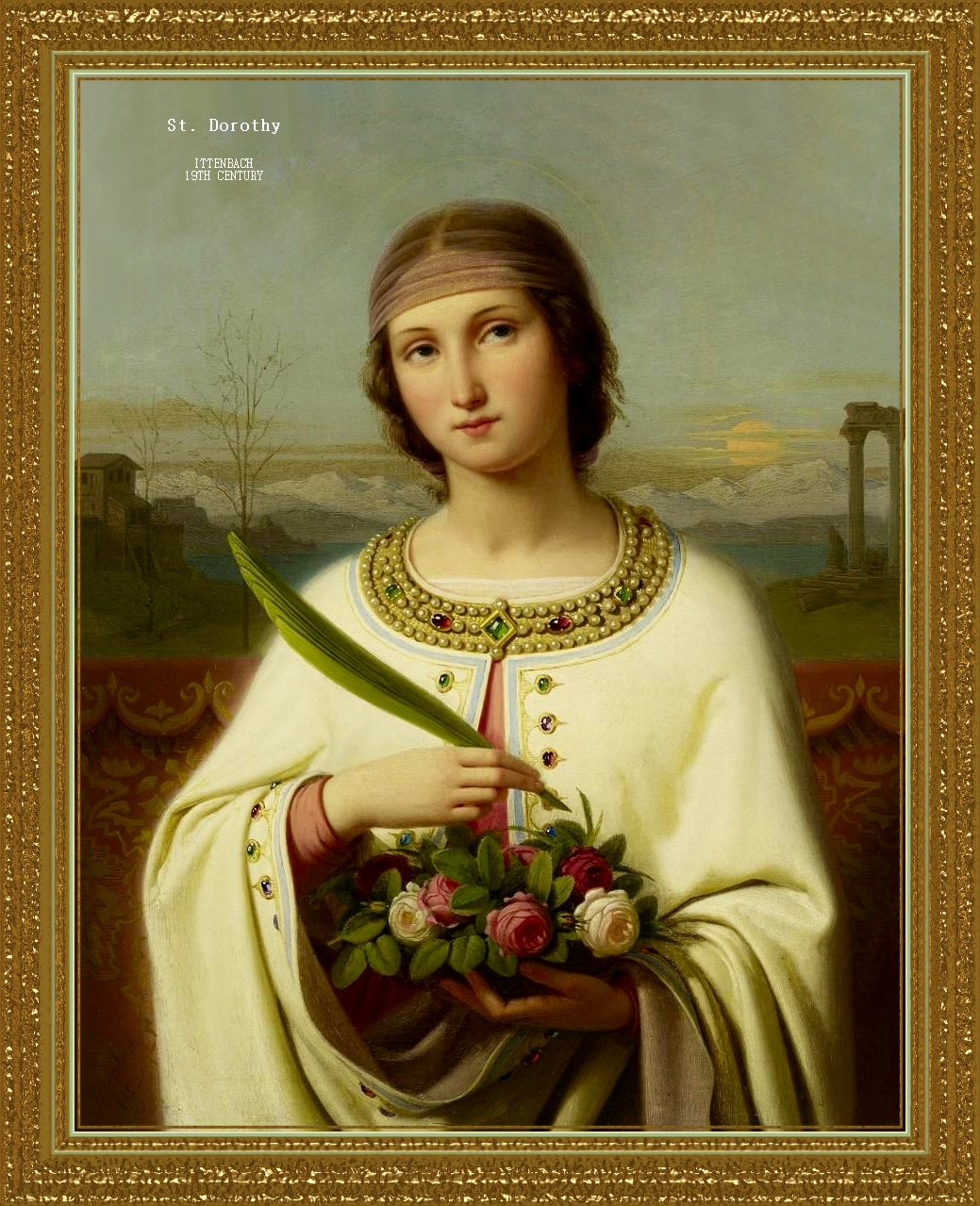
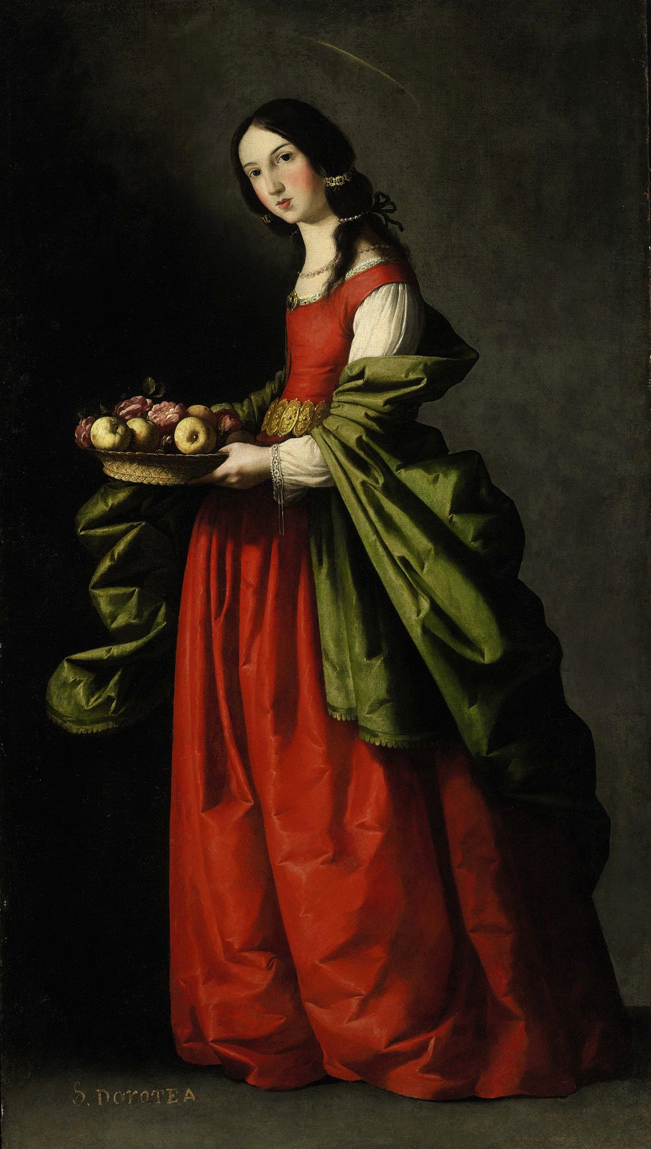
Today is the feast day of St. Dorothy of Caesarea (?–February 6, 311 CE). She was a patron saint of brewers and is also known as Dora, Dorotea, and Dorothy. There’s very little information about her life, just a few scant details and I’m not even sure exactly why her patroness extended to brewers.

This is her overview from Wikipedia:

St. Dorothea “is a 4th-century virgin martyr who was executed at Caesarea Mazaca. Evidence for her actual historical existence or acta is very sparse. She is called a martyr of the Diocletianic Persecution, although her death occurred after the resignation of Diocletian himself. She should not be confused with another 4th-century saint, Dorothea of Alexandria.

She and Theophilus are mentioned in the Roman Martyrology as martyrs of Caesarea in Cappadocia, with a feast day on 6 February. She is thus officially recognized as a saint, but because there is scarcely any non-legendary knowledge about her, she is no longer (since 1969) included in the General Roman Calendar.

Despite there being little information about her life, or maybe because of it, “she has been venerated in the west since the seventh century. Dorothy’s cult became widespread in Europe during the Middle Ages. In late medieval Sweden she was considered as the 15th member of the Fourteen Holy Helpers, and in art she occurred with Saint Barbara, Catherine of Alexandria and Margaret of Antioch, forming with them a quartet of female saints called de fyra huvudjungfrurna or in Latin, “Quattor Virgines Capitales” meaning “The four Capital Virgins.”

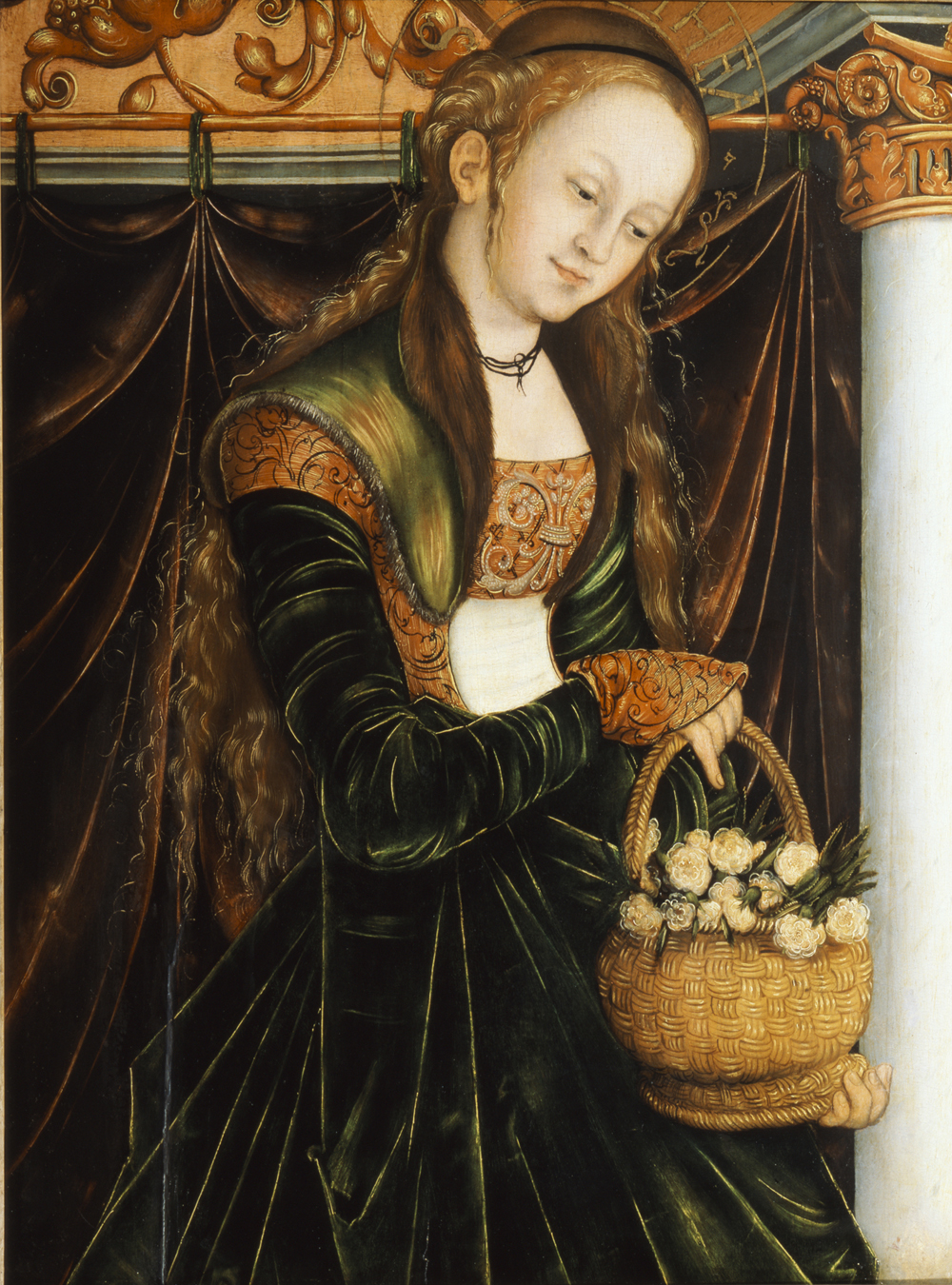
The St. Dorothy, by Lucas Cranach the Elder.

And this is her story from Catholic Saints:

Apochryphal martyr whose story has been beautifully told, and was popular for many years. Having made a personal vow of virginity, she refused to marry, or to sacrifice to idols. She was tried, tortured, and sentenced to death for her faith by the prefect Sapricius. The pagan lawyer Theophilus said to her in mockery, “Bride of Christ, send me some fruits from your bridegroom’s garden.” Before she was executed, she sent him, by a six-year-old boy who is thought to have been an angel, her headress which had the fragrance of roses and fruits. Seeing this gift, and the miraculous messenger who brought them, Theophilus converted, and was martyred himself. This story has been variously enlarged through the years. In some places, trees are blessed on her feast day because of her connection with a blooming, fruitful miracle.

Stained glass representing St. Dorothea of Caesarea. Upper Rhine, ca. 1450

In addition to brewers, she’s also the patron saint of patroness of gardeners, brides, florists, midwives, newlyweds and Pescia, Italy.

Filed Under: Art & Beer, Just For Fun, Related Pleasures Tagged With: Religion & Beer, Turkey

Beer In Ads #3631: Wear A Mask With Budweiser

February 5, 2021 By Jay Brooks

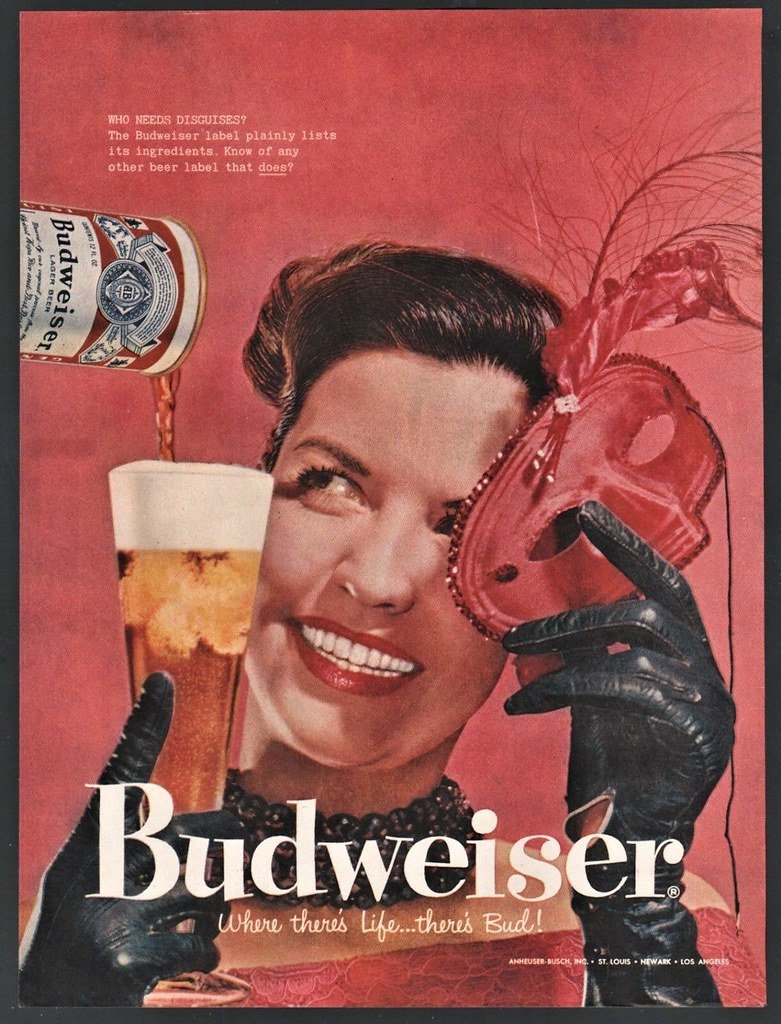
Friday’s ad is for “Budweiser,” from 1958. This ad was made for Anheuser-Busch, and was part of their series using the tagline. “Where there’s Life … there’s Bud,” which ran from the 1950s into the 1960s, and this one features a woman in black leather gloves and holding a mask while an unseen hand pours a can of beer into a glass she’s holding. The text begins “Who Needs Disguises?”

Filed Under: Art & Beer, Beers Tagged With: Advertising, Anheuser-Busch, Budweiser, History

Beer In Ads #3630: Budweiser With Cheese & Crackers

February 4, 2021 By Jay Brooks

Thursday’s ad is for “Budweiser,” from 1961. This ad was made for Anheuser-Busch, and was part of their series using the tagline. “Where there’s Life … there’s Bud,” which ran from the 1950s into the 1960s, and this one features a woman at a restaurant, or maybe it’s a bar, smiling as the waiter or waitress pours a beer into a glass she’s holding. Behind her on the table is a spread of cheese and crackers, along with charcuterie. I’m also pretty sure she’s holding a potato chip in her hand. The text begins “Ever Taken.”

Filed Under: Art & Beer, Beers Tagged With: Advertising, Anheuser-Busch, Budweiser, History

Beer In Ads #3629: Cuddling With Budweiser

February 3, 2021 By Jay Brooks

Wednesday’s ad is for “Budweiser,” from 1958. This ad was made for Anheuser-Busch, and was part of their series using the tagline. “Where there’s Life … there’s Bud,” which ran from the 1950s into the 1960s, and this one features a couple outdoors, I think leaning against a tree trunk, and cuddling, as the man pours a can of beer into a mug she’s holding. She’s looking back at him rather mischievously, but she really should be keeping an eye on the beer. It’s about spill over and that will definitely spoil the mood. The text begins “Keep It A Secret,” so maybe it’s more canoodling than mere cuddling after all.

Filed Under: Art & Beer, Beers Tagged With: Advertising, Anheuser-Busch, Budweiser, History

Beer In Ads #3628: Budweiser And Birthday Candles

February 2, 2021 By Jay Brooks

Tuesday’s ad is for “Budweiser,” from 1958. This ad was made for Anheuser-Busch, and was part of their series using the tagline. “Where there’s Life … there’s Bud,” which ran from the 1950s into the 1960s, and this one features a man about to blow out the candles his birthday cake while a woman out of sight pours him a glass of beer. And I know I shouldn’t be focused on this, but what the hell is that weird, abstract background supposed to be? The text begins “Bright Idea.”

Filed Under: Art & Beer, Beers Tagged With: Advertising, Anheuser-Busch, Budweiser, History

Beer In Ads #3627: No Commercial Budweiser

February 1, 2021 By Jay Brooks

Monday’s ad is for “Budweiser,” from 1959. This ad was made for Anheuser-Busch, and was part of their series using the tagline. “Where there’s Life … there’s Bud,” which ran from the 1950s into the 1960s, and this one features a woman wrapping Christmas presents while someone out of sight pours her a glass of beer. The text begins “No Commercial,” suggesting this ad is trying to not be an ad. I think it failed.

Filed Under: Art & Beer, Beers Tagged With: Advertising, Anheuser-Busch, Budweiser, History

Beer Saints: St. Brigid

February 1, 2021 By Jay Brooks

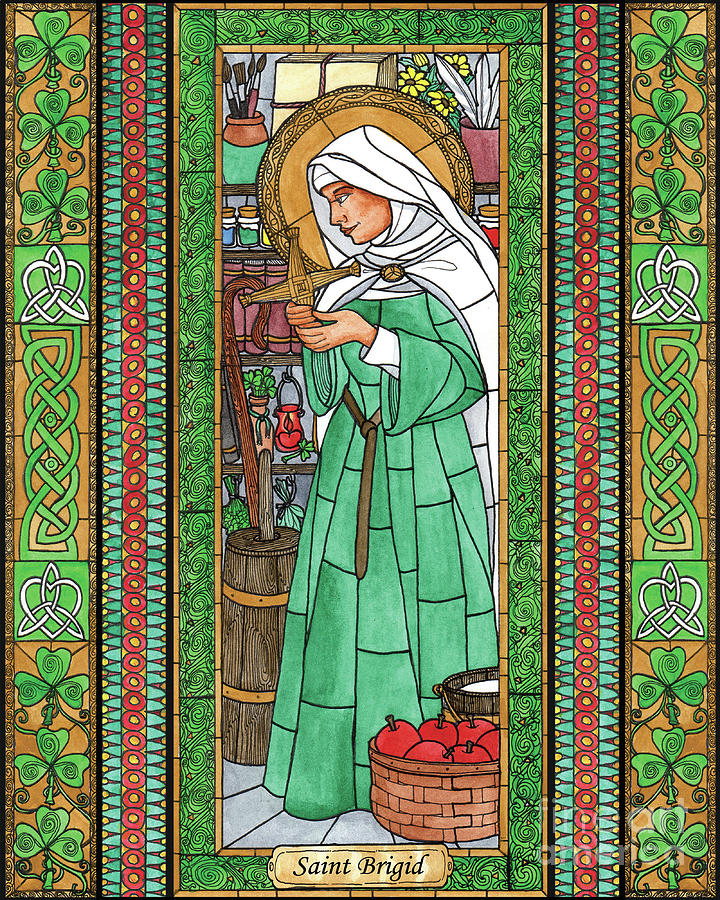
Today is the feast day of St. Brigid (c. 451 CE–525 CE). She is a patron saint of brewers. She was also known as Bride, Bride of the Isles, Bridget of Ireland, Bridget, Brigid of Kildare, Brigit, Ffraid, and Mary of the Gael. She is one of Ireland’s patron saints, along with Patrick and Columba. Irish hagiography makes her an early Irish Christian nun, abbess, and foundress of several monasteries of nuns, including that of Kildare in Ireland, which was famous and was revered. Her feast day is February 1, which was originally a pagan festival called Imbolc, marking the beginning of spring. Her feast day is shared by Dar Lugdach, who tradition says was her student, close companion, and the woman who succeeded her. She also a patron saint of brewers. “Brigid, who had a reputation as an expert dairywoman and brewer, was reputed to turn water into beer.”

Here’s account of her life, from Wikipedia:

Probably the earliest biography, Vita Sanctae Brigitae (Life of St. Brigid), was written by Cogitosus, a 7th century monk of Kildare. A second, Vita Prima Sanctae Brigitae (First Life of St. Brigid), by an unknown author, is sometimes attributed to St. Broccán Clóen (d. 650). The book of uncertain authorship is occasionally argued to be the first written biography of St. Brigid, though most scholars reject this claim.

A Vita sometimes attributed to St. Coelan of Inishcaltra in the early 7th century derives further speculation from the fact that a foreword was added, ostensibly in a subsequent edition, by St. Donatus, also an Irish monk, who became Bishop of Fiesole in 824. In his foreword, Donatus refers to earlier biographies by St. Ultan and St. Ailerán. The manuscript of Vita III, as it has come to be known, was preserved in the Italian monastery of Monte Cassino until its destruction during World War II. As the language used is not that of St. Coelan’s time, philologists remain uncertain of both its authorship and century of origin. Discussion on dates for the annals and the accuracy of dates relating to St. Brigid continues.

Early life

According to tradition, Brigid was born in the year 451 AD in Faughart, just north of Dundalk in County Louth, Ireland. Because of the legendary quality of the earliest accounts of her life, there is debate among many secular scholars and Christians as to the authenticity of her biographies. Three biographies agree that her mother was Brocca, a Christian Pict slave who had been baptized by Saint Patrick. They name her father as Dubhthach, a chieftain of Leinster.

The vitae says that Dubthach’s wife forced him to sell Brigid’s mother to a druid when she became pregnant. Brigid herself was born into slavery. Legends of her early holiness include her vomiting when the druid tried to feed her, due to his impurity; a white cow with red ears appeared to sustain her instead.

As she grew older, Brigid was said to have performed miracles, including healing and feeding the poor. According to one tale, as a child, she once gave away her mother’s entire store of butter. The butter was then replenished in answer to Brigid’s prayers. Around the age of ten, she was returned as a household servant to her father, where her habit of charity led her to donate his belongings to anyone who asked.

In both of the earliest biographies, Dubthach is portrayed as having been so annoyed with Brigid that he took her in a chariot to the King of Leinster to sell her. While Dubthach was talking to the king, Brigid gave away his bejeweled sword to a beggar to barter it for food to feed his family. The king recognized her holiness and convinced Dubthach to grant his daughter freedom.

Religious life

Saint Brigid as depicted in Saint Non’s chapel, St Davids, Wales.
It is said that Brigid was “veiled” or received either by St. Mac Caill, Bishop of Cruachu Brig Ele (Croghan, County Offaly), or by St. Mél of Ardagh at Mág Tulach (the present barony of Fartullagh, County Westmeath), who granted her abbatial powers. It is said that in about 468, she and a Bishop MacCaille followed St. Mél into the Kingdom of Tethbae, which was made up of parts of the modern counties Meath, Westmeath and Longford.

According to tradition, around 480 Brigid founded a monastery at Kildare (Cill Dara: “church of the oak”), on the site of a pagan shrine to the Celtic goddess Brigid, served by a group of young women who tended an eternal flame. The site was under a large oak tree on the ridge of Drum Criadh.

Brigid, with an initial group of seven companions, is credited with organizing communal consecrated religious life for women in Ireland. She founded two monastic institutions, one for men, and the other for women, and invited Conleth (Conláed), a hermit from Old Connell near Newbridge, to help her in Kildare as pastor of them. It has often been said that she gave canonical jurisdiction to Conleth, Bishop of Kildare, but Archbishop Healy says that she simply “selected the person to whom the Church gave this jurisdiction”, and her biographer tells us that she chose Saint Conleth “to govern the church along with herself”. For centuries, Kildare was ruled by a double line of abbot-bishops and of abbesses, the Abbess of Kildare being regarded as superior general of the monasteries in Ireland. Her successors have always been accorded episcopal honour. Brigid’s oratory at Kildare became a centre of religion and learning, and developed into a cathedral city.

Brigid is credited with founding a school of art, including metalwork and illumination, which Conleth oversaw. The Kildare scriptorium made the Book of Kildare, which drew high praise from Gerald of Wales (Giraldus Cambrensis), but disappeared during the Reformation. According to Giraldus, nothing that he ever saw was at all comparable to the book, every page of which was gorgeously illuminated, and the interlaced work and the harmony of the colours left the impression that “all this is the work of angelic, and not human skill”.

According to the Trias Thaumaturga Brigid spent time in Connacht and founded many churches in the Diocese of Elphin. She is said to have visited Longford, Tipperary, Limerick, and South Leinster. Her friendship with Saint Patrick is noted in the following paragraph from the Book of Armagh: “inter sanctum Patricium Brigitanque Hibernesium columpnas amicitia caritatis inerat tanta, ut unum cor consiliumque haberent unum. Christus per illum illamque virtutes multas peregit” (Between St. Patrick and St. Brigid, the pillars of the Irish people, there was so great a friendship of charity that they had but one heart and one mind. Through him and through her Christ performed many great works.)

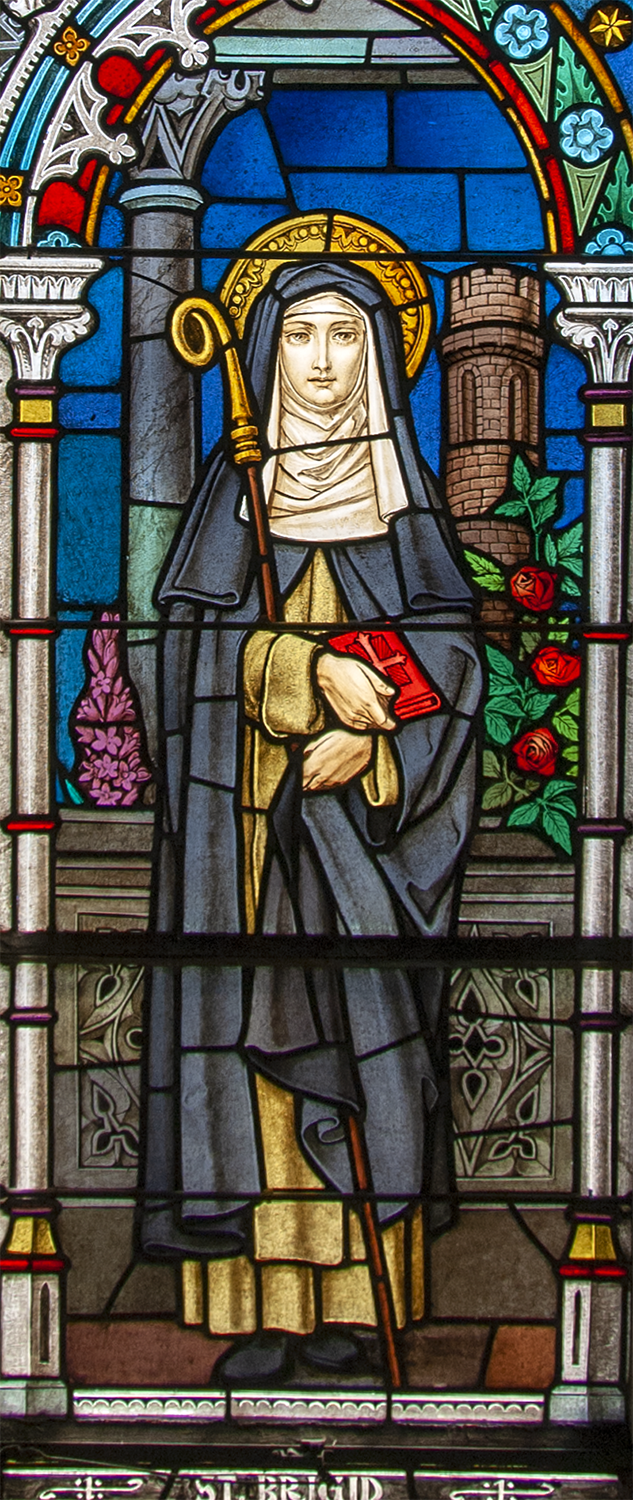
Stained glass window in St. Mary Basilica of Biloxi, Mississippi, created in 1961.

Her exploits appear to have included beer on more than on occasion, as detailed by journalist Jack Beresford in an article for the Irish Post last year.

One of Ireland’s three patron saints alongside St Colmcille and St Patrick, the feast of St Brigid also happens to fall on the Celtic first day of spring, Imbolc.

There are plenty of stories surrounding St Brigid, but few are as famous, fun or fascinating as the tale about how she supposedly turned some ordinary bathwater into beer.

The story goes that one day, while working in a leper colony, she discovered to her horror that they had run out of beer.

It’s important to understand that in those times, centuries ago, beer was consumed on a daily basis as a source of hydration and nourishment.

As opposed to today, of course, when…oh wait, scratch that.

In any case, back in those times many of the water sources close to villages and towns were often polluted to the point where consumption would likely result in illness or, worse still, death.

Alcohol offered an (almost) germ free alternative and was almost as good as any meal of the era.

So, to be faced with a beer drought was nothing short of disastrous.

Not that it mattered all that much to St Brigid.

Channelling a little divine intervention, she answered the prayers of the thirsty lepers under her charge by turning the water they used to bathe into not just any beer, but a genuinely brilliant beer that was enjoyed by one and all.

Her water-based exploits don’t end there either.

Another part of the legend says St Brigid also succeeded in turning dirty bathwater into beer for the clerics visiting the leper colony where she was based.

There’s even a tale of her supplying some eighteen churches with enough beer to last from Holy Thursday through to the end of Easter despite only having one barrel to her name.

Whether fact or fiction, one thing appears undeniable: St Brigid liked beer.

Though perhaps this 10th century poems captures Brigid’s commitment to beer best. It’s entitled “I’d like to give a lake of beer to God.”

I’d like to give a lake of beer to God.
I’d love the heavenly
Host to be tippling there
For all eternity.

I’d love the men of Heaven to live with me,
To dance and sing.
If they wanted, I’d put at their disposal
Vats of suffering.

White cups of love I’d give them
With a heart and a half;
Sweet pitchers of mercy I’d offer
To every man.

I’d make Heaven a cheerful spot
Because the happy heart is true.
I’d make the men contented for their own sake.
I’d like Jesus to love me too.

I’d like the people of heaven to gather
From all the parishes around.
I’d give a special welcome to the women,
The three Marys of great renown.

I’d sit with the men, the women and God
There by the lake of beer.
We’d be drinking good health forever
And every drop would be a prayer.

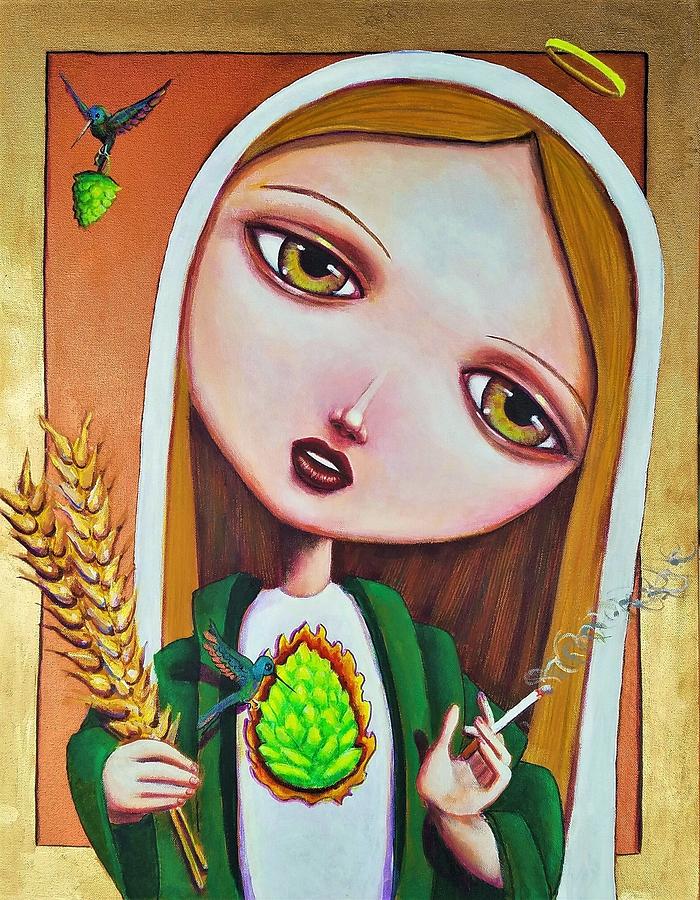
This contemporary painting of the St. Brigid is by artist Brenda Nippert of Pittsburgh, Pennsylvania.

And this is part of an account of Brigid entitled “Wild Irish Women: Saint Brigid – Mary of the Gaels” by Rosemary Rogers for Irish American.

Despite all her accomplishments, her legend grew because of her many miracles, so resonant with Irish mysticism: she taught a fox to dance, tamed a wild boar, hung her damp cloak (that cloak again!) on a sunbeam to dry, obliging the sunbeam to remain all night. In her later years, her powers took on almost Christ-like proportions – she could multiply food, exorcise demons with a casual sign of the cross, and calm storms. Proving she was someone you’d like to have a beer with, Brigid, fond of the brew herself, could produce bottomless barrels and turn both milk and water into ale. Once, while curing lepers, she learned there was nothing to drink and used her own bathwater to stand the entire colony to a pint.

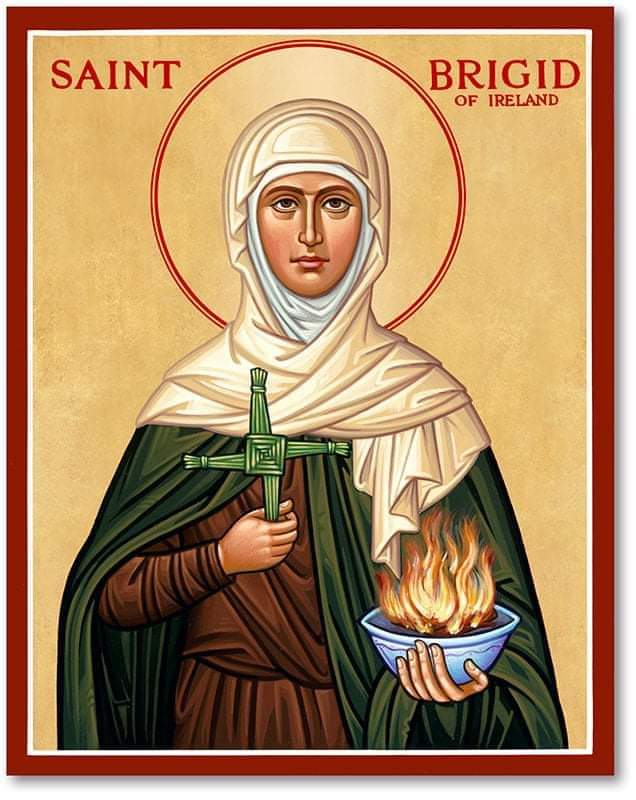
Another contemporary painting entitled “St. Brigid of Ireland” by St. Louis-based artisy Nelson Perez.

Filed Under: Art & Beer, Beers, Just For Fun, Related Pleasures Tagged With: Ireland, Religion & Beer

Beer In Ads #3626: Budweiser Threesome

January 31, 2021 By Jay Brooks

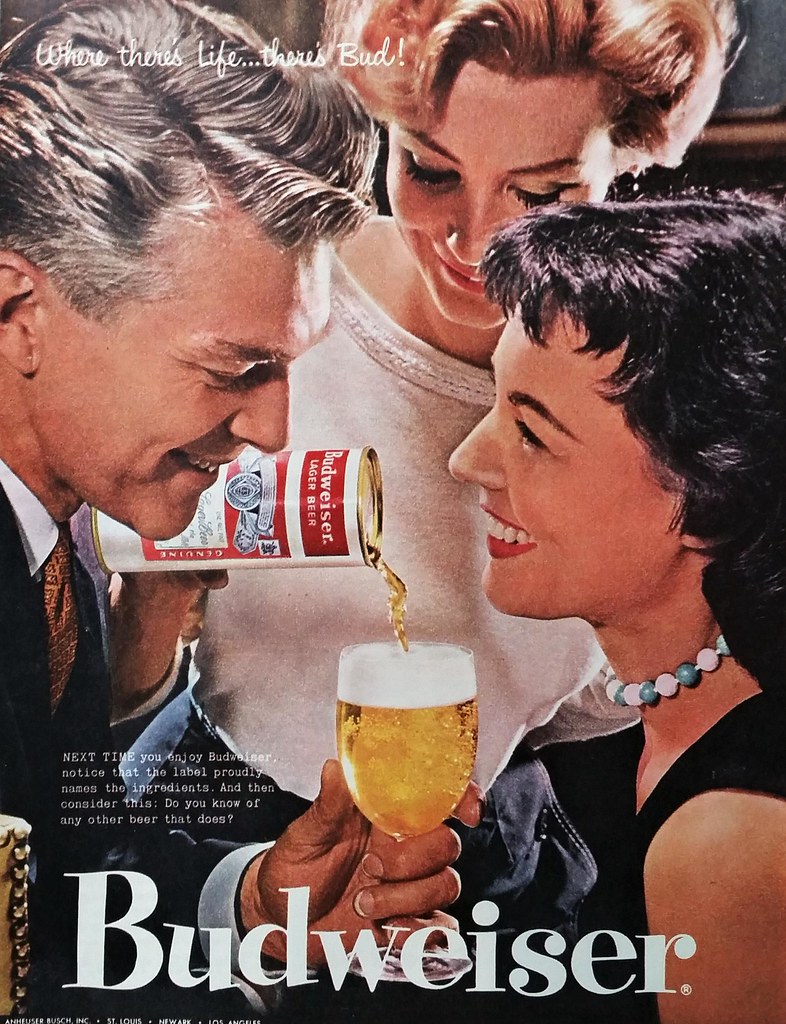
Sunday’s ad is for “Budweiser,” from 1958. This ad was made for Anheuser-Busch, and was part of their series using the tagline. “Where there’s Life … there’s Bud,” which ran from the 1950s into the 1960s, and this one features a couple standing very close together, perhaps at a crowded bar or maybe they just really like each other, while in between them another woman, who’s either much taller or perhaps the couple is actually sitting, it’s hard to tell. She’s pouring a glass of beer from a can while the couple stares into one another’s eyes seemingly ignoring the beer being poured. The text begins “Next Time.”

Filed Under: Art & Beer, Beers Tagged With: Advertising, Anheuser-Busch, Budweiser, History

« Previous Page
Next Page »

Find Something

Northern California Breweries

Please consider purchasing my latest book, California Breweries North, available from Amazon, or ask for it at your local bookstore.

Recent Comments

  • Bob Paolino on Beer Birthday: Grant Johnston
  • Gambrinus on Historic Beer Birthday: A.J. Houghton
  • Ernie Dewing on Historic Beer Birthday: Charles William Bergner 
  • Steve 'Pudgy' De Rose on Historic Beer Birthday: Jacob Schmidt
  • Jay Brooks on Beer Birthday: Bill Owens

Recent Posts

  • Beer Birthday: Pete Slosberg August 26, 2026
  • Historic Beer Birthday: Hans Adolf Krebs August 25, 2026
  • Historic Beer Birthday: August Uihlein August 25, 2026
  • Historic Beer Birthday: George F. Klotter Jr. August 25, 2026
  • Beer In Ads #5329: Wolf-Biere Bock August 24, 2026

BBB Archives

Feedback

Head Quarter
This site is hosted and maintained by H25Q.dev. Any questions or comments for the webmaster can be directed here.