Brookston Beer Bulletin

Jay R. Brooks on Beer

  • Home
  • About
  • Editorial
  • Birthdays
  • Art & Beer

Socialize

  • Dribbble
  • Email
  • Facebook
  • Flickr
  • GitHub
  • Instagram
  • LinkedIn
  • Pinterest
  • RSS
  • Twitter
  • YouTube

Powered by Genesis

Beer In Art #139: Stanfield’s The Burning of the Anchor Brewery

September 11, 2011 By Jay Brooks

art-beer
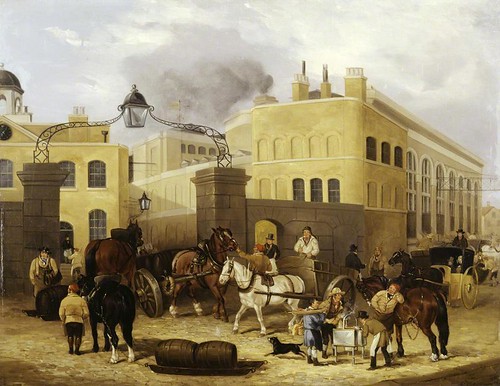
This week’s work of art is by English artist Clarkson Frederick Stanfield (sometimes incorrectly called William Clarkson Stanfield), and it depicts a real event that took place on May 22, 1832. I think the title says it all, which is The Burning of the Anchor Brewery. It was painted in 1832 and in 2009 it was purchased by the City of London for their Guildhall Art Gallery.
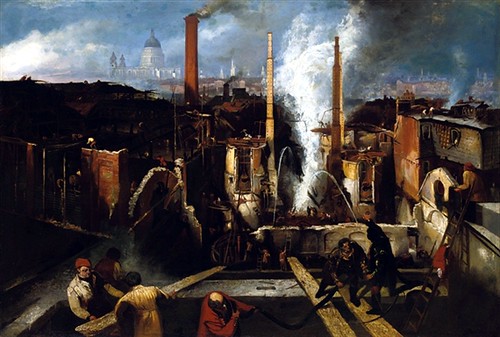
burning_anchor_brewery_clarkson_stanfield_1832

When the painting was first shown at the London Galley, a local community website had the following story posted:

The Burning of the Anchor Brewery was painted by Clarkson Stanfield and was purchased last year by the City of London Corporation.

The fire took place on 22 May 1832 when, it is believed, a lamp held by one of the employees of the brewery ignited. As the buildings were made of wood and contained very combustible material such as malt and hops, the fire spread quickly. A number of fire engines were brought in but the firemen and the brewery employees were unable stop the fire burning for many hours.

The Anchor Brewery was established in 1616 by James Monger the Elder and was then bought by Josiah Child who supplied beer to the Navy and named it the Anchor brewery. On the death of Henry Thrale, the owner in 1781, the brewery was sold to David Barclay, of Barclay’s Bank fame. Henry Thrale and his wife Hester were great friends of Dr Samuel Johnson, compiler of the first comprehensive English Dictionary and he was an executor of Henry’s will.

Henry’s brewery manager John Perkins was taken on by Barclays and the business was renamed Barclay, Perkins & Company Ltd. By 1815 it was the leading brewery in London producing 330,000 barrels a year and accommodating 200 dray-horses. Barclay Perkins were the owners of the brewery at the time of the fire.

The brewery was rebuilt and extended after the fire and it was said to be one of the sights of London. Charles Dickens featured the brewery and its beer in his novels and in The Old Curiosity Shop Dick Swiveller describes the porter as having ‘a spell in its every drop ‘gainst the ills of mortality’.

In 1955 Barclays merged with its rival Southwark brewery Courage at Shad Thames. In 1962 the site became a bottling factory and in 1970 the company was renamed Courage Ltd.

The Anchor Brewery site finally closed in 1981 and the buildings were demolished. The old brewery tap pub – The Anchor Bankside – is still open today and a plaque in Park Street commemorates the site of the brewery.

You can read more about Stanfield at his Wikipedia page and there are links to his works at ArtCyclopedia. You can also see more of his artwork at the Tate, Fine Art China, and WikiMedia Commons.

Filed Under: Art & Beer, Breweries Tagged With: UK

Guinness Ad #84: Keep Smiling

September 10, 2011 By Jay Brooks

guinness-toucan
Our 84th Guinness is yet another simple one, from 1936, showing a smiling a pint of Guinness and the tagline “Keep Smiling,” along with the usual slogan “Guinness is good for you.”

Guinness-smiling-1936

Filed Under: Art & Beer, Beers Tagged With: Advertising, Guinness, History

Beer In Art #138: Dean Wolstenholme’s Barclay and Perkins Brewery, Park Street, Southwark

September 4, 2011 By Jay Brooks

art-beer
This week’s work of art is by English artist Dean Wolstenholme, Jr., which is titled Barclay and Perkins’s Brewery, Park Street, Southwark, London. It was painted between 1832-1840 and today hangs at the Museum of London.

Wolstenholme-barclay-perkins

The painting shows the brewery in a wide angle shot that also shows part of the city of London from the same year.

Unfortunately, there’s little information about the artist, Dean Wolstenholme, Jr., that I’ve been able to find.

Filed Under: Art & Beer, Breweries Tagged With: UK

Guinness Ad #83: Two Heads Are Better Than One

September 3, 2011 By Jay Brooks

guinness-toucan
Our 83rd Guinness is another simple one, showing two anthropomorphized Guinness pints, though the one on the right seems to be lucky one, getting the last drop of Guinness. The appropriate slogan is “Two heads are better than one.”

Guinness-2-heads

Filed Under: Art & Beer, Beers Tagged With: Advertising, Guinness, History

Beer In Ads #440: The Choice Of Your Lifetime, Too

September 2, 2011 By Jay Brooks


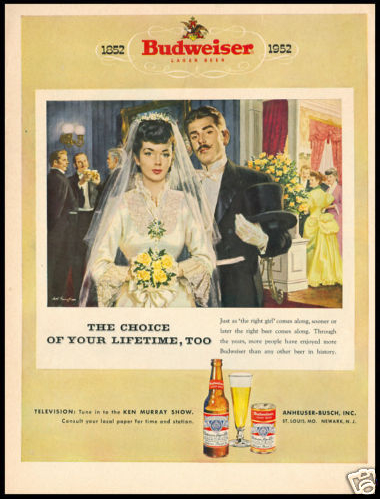
Friday’s ad brings Budweiser ad week to a close. This ad is from 1952, when A-B celebrated their 100th anniversary since the company that would become Anheuser-Busch first opened their doors in 1852. I can’t say the woman looks particularly happy on her wedding day, though perhaps it’s because the grooms looks a little too much like Snidely Whiplash with that cheesy mustache and the top hat.

Bud-1952-wed

Filed Under: Art & Beer, Beers Tagged With: Advertising, Anheuser-Busch, Budweiser, History

Beer In Ads #439: Hospitality Is Quickly Recognized

September 1, 2011 By Jay Brooks


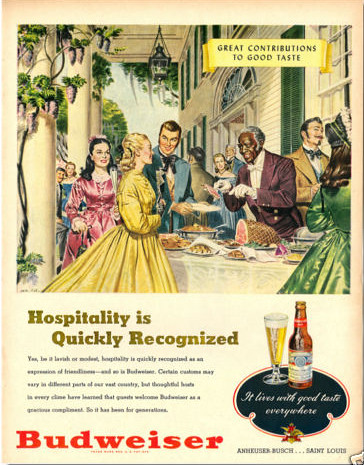
Thursday’s ad is yet another Budweiser ad, this one from 1949. It, too, shows a party, though this one looks like it’s a “Gone With the Wind” costume party. Or did people really throw parties that looks like this in post-war America? “My, my. It’s so hot. But at least it’s not sticky. I just hare it when it’s sticky.” Now give me a beer.

Bud-1949-hospitality

Filed Under: Art & Beer, Beers Tagged With: Advertising, Anheuser-Busch, Budweiser, History

Beer In Ads #438: That Woman Is Real Competition

August 31, 2011 By Jay Brooks


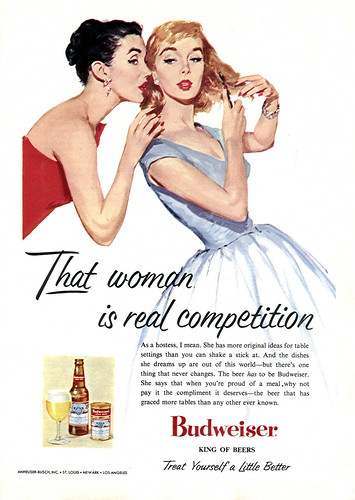
Wednesday’s ad is still another Budweiser ad, this one from 1956. Like yesterdays, it shows a woman’s domestic struggles at pleasing her man, this time in putting on the best dinner party. One woman in a cocktail dress is whispering to another, who’s combing her hair, about another woman who’s skills as a hostess make her “real competition.” In part, that’s because she insists on always serving Budweiser. But you knew that had to be the reason, right? I can’t imagine why feminist groups often accuse alcohol ads of portraying woman in a less-than-flattering light.

Bud-1956-family-circle

Filed Under: Art & Beer, Beers Tagged With: Advertising, Anheuser-Busch, Budweiser, History

Beer In Ads #437: She Married Two Men

August 30, 2011 By Jay Brooks


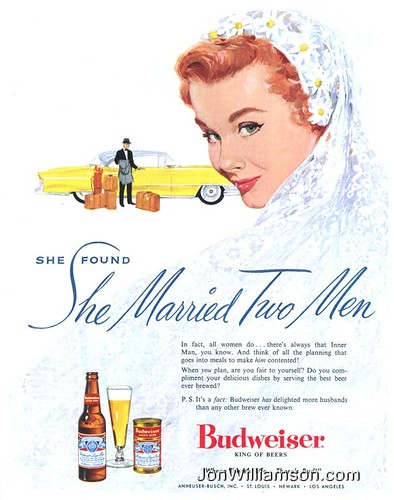
Tuesday’s ad is another Budweiser ad. I’m not sure of the date, but based on the car I’d say Fifties. After getting married, the coy-looking bride found “She Married Two Men” Then the ad copy goes on to say that “all women do.” That’s apparently because there’s an inner and outer men. “And think of all the planning that goes into meals to make him contented.” Or if he’s so hard to please, he could just make his own damn meals. But I love the post script. “It’s a fact: Budweiser has delighted more husbands than any other brew ever known.” Single people? Not so much, apparently. I can’t imagine how they compiled that statistic, because I’m sure they must have the numbers to back it up stretching all the back into recorded history. After all, they wouldn’t have just made it up, now would they?

Bud-married-2-men

Filed Under: Art & Beer, Beers Tagged With: Advertising, Anheuser-Busch, Budweiser, History

Beer In Ads #436: The Minuteman Is Still The Man Of The Hour

August 29, 2011 By Jay Brooks


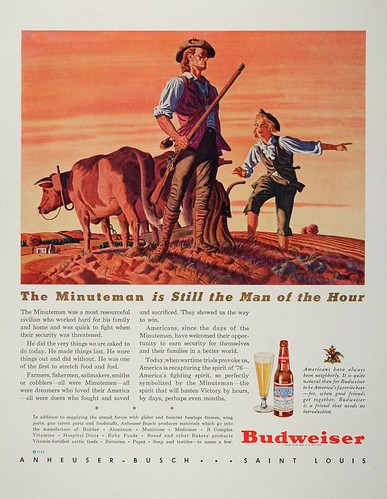
Monday’s ad is a Budweiser ad from 1944, during World War 2. The slogan being “The Minuteman is Still the Man of the Hour, the ad is comparing the colonial minutemen to the soldiers then fighting the war. The ad is surprisingly low key, and is very little about selling, with the only sales pitch at all simply being the logo, bottle and glass with just some small print about the brand.

Bud-1944-minuteman

Filed Under: Art & Beer, Beers Tagged With: Advertising, Anheuser-Busch, Budweiser, History

The Town of Malt

August 28, 2011 By Jay Brooks

uk
Last week, you may recall, that for the weekly beer in art last week I featured some sketches by French artist Gustave Doré. Those sketches were preliminary works that eventually were turned into engravings that became part of a larger work known as Doré’s London: A Pilgrimage, published in 1872. The final engravings appeared in Chapter 16 of the book, titled “The Town of Malt.” Digging a little further, I stumbled upon the text of Chapter 16, along with the six engravings that accompanied it. It’s an interesting time capsule and look backwards into what brewing was like in late 17th century London. Enjoy.

CHAPTER XVI: THE TOWN OF MALT

Dore-in-the-brewery-129
In the Brewery

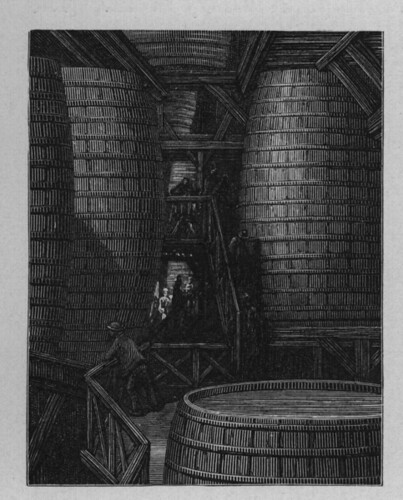
Among the earliest of risers in London are those who supply it with its beer. Having seen the opening of Covent Garden Market on a summer morning (and there is not a more striking picture by the banks of the Thames), stroll along the Strand and Fleet Street, alive with newsboys and newsmen, and home-returning compositors; through Thames Street, over Southwark Bridge, to Park Street. Your nose will lead you to the town of Malt …

Dore-mixing-the-malt-1872
Mixing the Malt

… and Hops. The massive drays are out; the prodigious draymen are arrayed in their leather, that would gall any limbs but theirs of Titan build ; the stately horses that are the astonishment of the foreigner and the pride of the English brewer are tossing their noble heads and pawing the ground. The barrels are rolling and swinging in all directions. Thirsty London is being attended to, with a will: and with perfect order, under the control of matutinal clerks and overseers. Before the ordinary tradesman has touched his shutters, lumbering processions of heavily laden drays are debouching on various quarters of London, bearing the famous “entire” to scores of customers.

Within the gates are the government houses of the town of Malt and Hops, in which there are upwards of forty officials, who direct the coming and going, the filling and repairing, the brewing and selling of a rolling army of something like eighty thousand barrels. Their domain covers an acre of land, and comprises several streets bridged by light iron bridges, that look slight as spider-webs from the pavements.

A journey through the town of Malt and Hops is heavy work. The departments are many, and are all spacious. They follow in well-considered sequence. The mashing, the boiling, the cooling, the fermenting, the cleansing, the barrel-filling, the storing, the despatching, are so many departments of the government; with a sustaining aroma holding all in one atmosphere and which keeps the mind in an unbroken train of thought even when contemplating the stables where the famous horses are kept as daintily as in the Royal Mews. Perhaps the first startling scene in the round is the mash-tun.

Mashing is the elementary process of beer making, and the object …

Doe-st-pauls-from-brewery-bridge-131
St. Paul’s from the Brewery Bridge

… of these strange workers with wooden spades is to mix the malt thoroughly with the water. The result is an amber liquid, called wort, lakes of which we proceed to view, lying placidly in tanks. During its progression to perfect beer the sweet wort grows sour. On its way it is pumped up from the cool lakes into gigantic copper boilers, and boiled with great care, for here the experienced and learned brewer shows himself. The boiling satisfactorily done, the wort flows out into broad lakes, airily situated, where it can become …

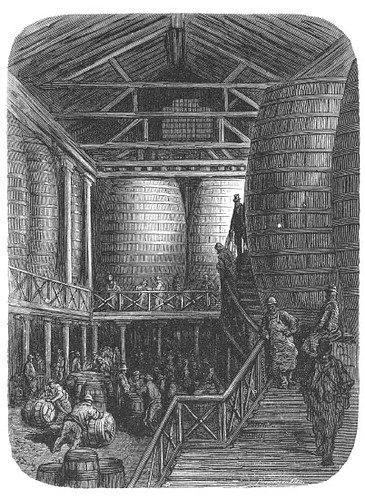
Dore-the-great-vats-1872
The Great Vats

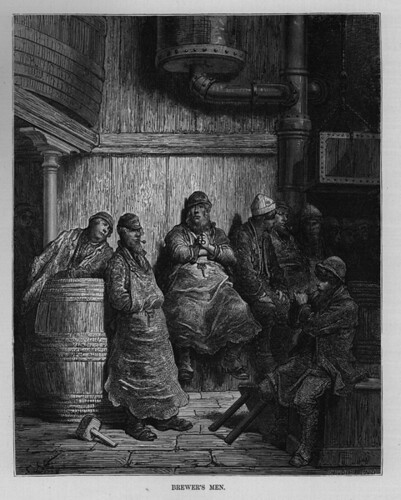
Dore-brewers-men-132b
Brewer’s Men

… rapidly cool, without getting sour; and then it gradually subsides into these prodigious gyle tuns, about which staircases are ranged, and in which you would have to drag carefully for the body of an elephant. In these towers, against which men look like flies, the wort ferments and we have porter, or “entire.” I should explain that “entire” is a combination of the qualities of three beers, that, in primitive London brewing days, were made separately, and mixed from different barrels in the customer’s glass. Hence the “Barclay, Perkins and Co.’s Entire” that is all over England, and the painting of which upon gaudy signboards occupies a distinct department in the town of Malt.

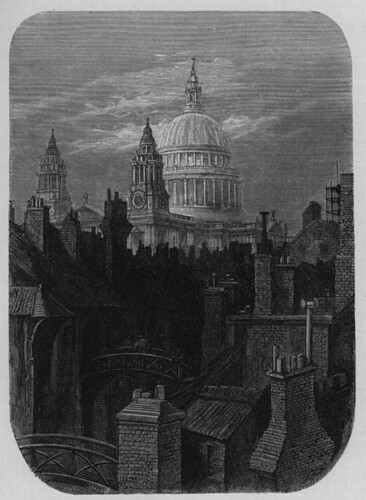
Looking over London from one of the high-perched galleries that traverse the streets of these mighty brewers’ realm, with St. Paul’s dominating the view from the north, our guide gently interposes the figure of Mr. Thrale, and his illustrious friend, that Londoner among Londoners, Samuel Johnson. We are upon classic ground. Where the coopers are overhauling hundreds of damaged barrels, and giving them their proper adjustment of hoops; where the red-capped draymen are gossiping in groups; where the enormous butts are ranged; where the smiths are shoeing the colossal horses, and where the 300 feet of stables stretches; Samuel Johnson lounged and talked, -and worked at his dictionary, under the protecting friendship of Mr. Thrale, then owner of the brewery. The rough old Doctor was executor to the will under which Mr. Thrale’s property passed into the families of its present owners, who have realised his description of its capabilities by extending it until it has become one of the representative industries of the world. “We are not,” said executor Johnson “to sell a parcel of boilers and vats, but the potentiality of growing rich beyond the dream of avarice.” The boilers and vats of the city of Malt realised £135,000, even when Messrs. Barclay and Perkins bought it.

How much would the boilers and vats: the drays and barrels, realise to-day?

The potentiality of growing rich beyond the dream of avarice may not have been reached even now by the firm; but a good step along the doctor’s highway has been taken. If “he who drinks beer thinks beer,” this must be a beer-thinking age, for how many foaming tankards take their laughing rise in this town of Malt! How many hop-yards to feed these vats and lakes? A humorous speculator, who accompanied us, and sat in a little office where we finally tasted the various brews, suggested, …

Dore-brewers-dray-134
The Brewer’s Dray

“Yes, and how many temperance advocates do these stupendous men and horses keep going, the ungrateful varlets!”

“There’s a good deal of ‘talkee’ yet to be done, sir,” a sensible drayman said to us, flirting a flower between his lips as he spoke, “before they teach English workmen that there’s sin and wickedness in a pint of honest beer.”

And with this he set his heavy dray in motion.

Filed Under: Art & Beer, Breweries, Just For Fun Tagged With: History, London, UK

« Previous Page
Next Page »

Find Something

Northern California Breweries

Please consider purchasing my latest book, California Breweries North, available from Amazon, or ask for it at your local bookstore.

Recent Comments

  • Bob Paolino on Beer Birthday: Grant Johnston
  • Gambrinus on Historic Beer Birthday: A.J. Houghton
  • Ernie Dewing on Historic Beer Birthday: Charles William Bergner 
  • Steve 'Pudgy' De Rose on Historic Beer Birthday: Jacob Schmidt
  • Jay Brooks on Beer Birthday: Bill Owens

Recent Posts

  • Beer In Ads #5305: Gnomes & Heute Bockbier! July 29, 2026
  • Historic Beer Birthday: Max Schwarz July 29, 2026
  • Beer In Ads #5304: Heute Bockbier! July 28, 2026
  • Historic Beer Birthday: Sharon Vaughn July 28, 2026
  • Beer In Ads #5303: Heute Bock July 27, 2026

BBB Archives

Feedback

Head Quarter
This site is hosted and maintained by H25Q.dev. Any questions or comments for the webmaster can be directed here.