Brookston Beer Bulletin

Jay R. Brooks on Beer

  • Home
  • About
  • Editorial
  • Birthdays
  • Art & Beer

Socialize

  • Dribbble
  • Email
  • Facebook
  • Flickr
  • GitHub
  • Instagram
  • LinkedIn
  • Pinterest
  • RSS
  • Twitter
  • YouTube

Powered by Genesis

Beer In Ads #5128: Dr. Seuss For E and B Bock Beer

February 24, 2026 By Jay Brooks

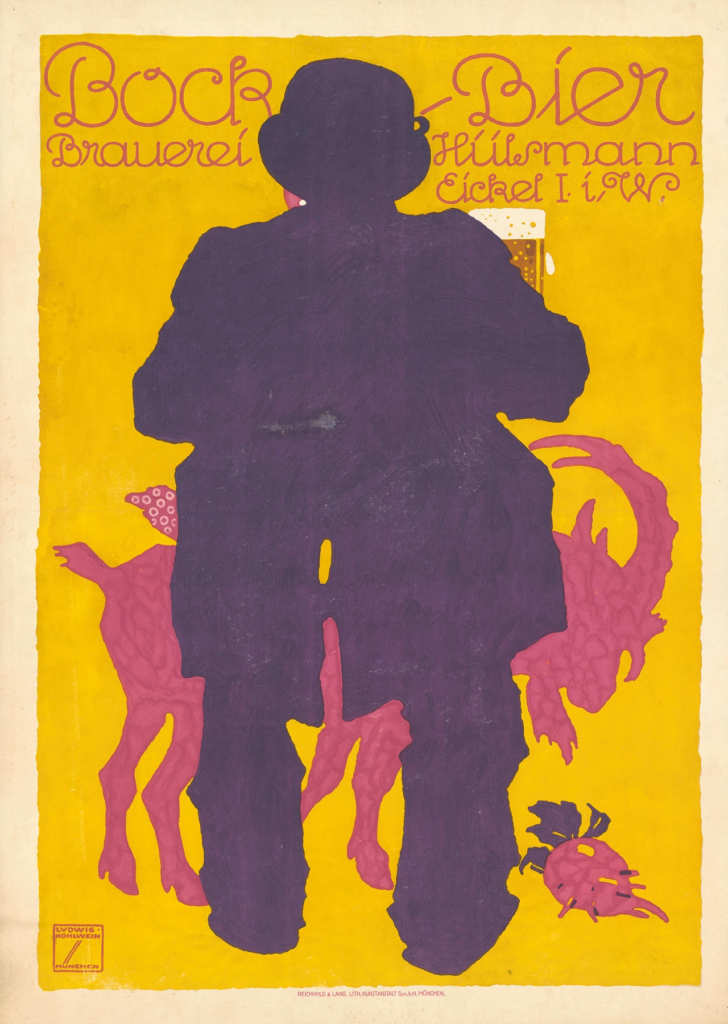
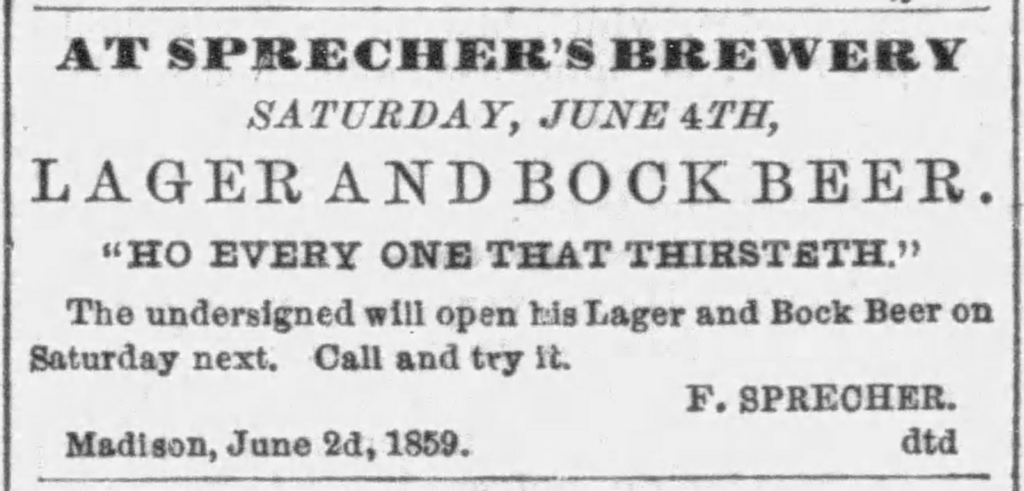
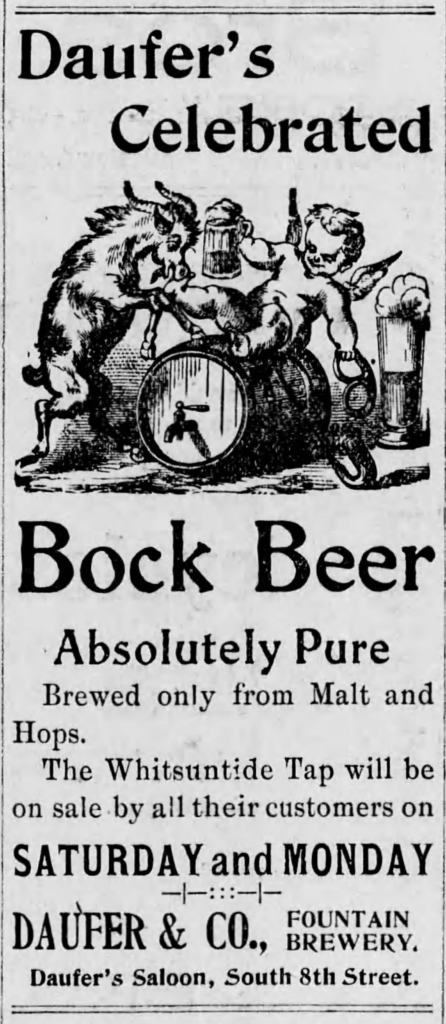
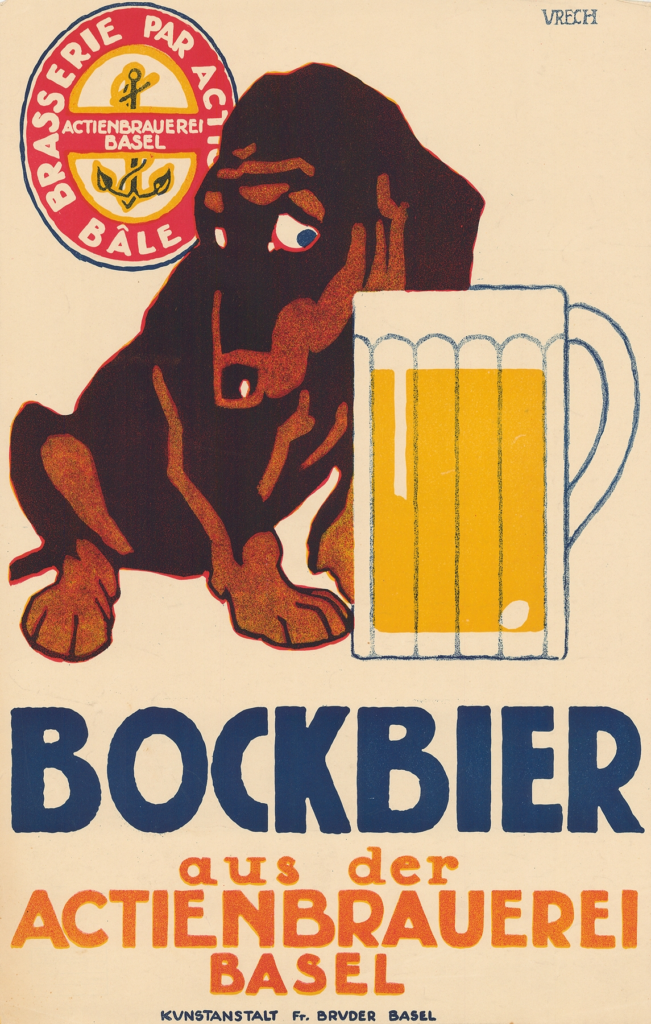
Two years ago I decided to concentrate on Bock ads for awhile. Bock, of course, may have originated in Germany, in the town of Einbeck. Because many 19th century American breweries were founded by German immigrants, they offered a bock at certain times of the year, be it Spring, Easter, Lent, Christmas, or what have you. In a sense they were some of the first seasonal beers. “The style was later adopted in Bavaria by Munich brewers in the 17th century. Due to their Bavarian accent, citizens of Munich pronounced ‘Einbeck’ as ‘ein Bock’ (a billy goat), and thus the beer became known as ‘Bock.’ A goat often appears on bottle labels.” And presumably because they were special releases, many breweries went all out promoting them with beautiful artwork on posters and other advertising. With Spring approaching, there are so many great examples that I’m going to post two a day for a few months.

Tuesday’s first ad is for E and B Bock Beer, which was published on February 24, 1938. This ad was for the Ekhardt and Becker Brewing Co. of Detroit, Michigan, which was originally founded in 1873 by August Ekhardt and Herman Becker. This ad ran in The Muskegon Chronicle, also of Muskegon, Michigan. A second identical ad ran the same day, but in the Monroe Evening News, from Monroe, Michigan, though I’ve included it below because while it’s slighter lighter it’s also a little clearer.

It’s certainly possible I’m wrong, since it is not definitively signed, but it sure looks like the artist was Theodor Geisel, a.k.a. Dr. Seuss. I know he did advertising work for Narragansett Brewing and also Schaefer Brewing, but was unaware of any others until today. If it’s not Seuss, then it’s surely an artist trying to copy his style.

Filed Under: Art & Beer, Beers, Breweries, Just For Fun Tagged With: Advertising, Bock, Cartoons, History, Michigan

Beer In Ads #5127: The Stock-Up “Dozen Sale” On Meister Bräu Bock Beer

February 23, 2026 By Jay Brooks

Two years ago I decided to concentrate on Bock ads for awhile. Bock, of course, may have originated in Germany, in the town of Einbeck. Because many 19th century American breweries were founded by German immigrants, they offered a bock at certain times of the year, be it Spring, Easter, Lent, Christmas, or what have you. In a sense they were some of the first seasonal beers. “The style was later adopted in Bavaria by Munich brewers in the 17th century. Due to their Bavarian accent, citizens of Munich pronounced ‘Einbeck’ as ‘ein Bock’ (a billy goat), and thus the beer became known as ‘Bock.’ A goat often appears on bottle labels.” And presumably because they were special releases, many breweries went all out promoting them with beautiful artwork on posters and other advertising. With Spring approaching, there are so many great examples that I’m going to post two a day for a few months.

Monday’s second ad is for Meister Bräu Bock Beer, which was published on February 23, 1940. This ad was for the Peter Hand Brewery Co. of Chicago, Illinois, which was originally founded in 1891. This ad ran in The Chicago Tribune, also of Chicago, Illinois.

Filed Under: Art & Beer, Beers, Breweries, Just For Fun

Beer In Ads #5126: Start Looking For Bock

February 23, 2026 By Jay Brooks

Two years ago I decided to concentrate on Bock ads for awhile. Bock, of course, may have originated in Germany, in the town of Einbeck. Because many 19th century American breweries were founded by German immigrants, they offered a bock at certain times of the year, be it Spring, Easter, Lent, Christmas, or what have you. In a sense they were some of the first seasonal beers. “The style was later adopted in Bavaria by Munich brewers in the 17th century. Due to their Bavarian accent, citizens of Munich pronounced ‘Einbeck’ as ‘ein Bock’ (a billy goat), and thus the beer became known as ‘Bock.’ A goat often appears on bottle labels.” And presumably because they were special releases, many breweries went all out promoting them with beautiful artwork on posters and other advertising. With Spring approaching, there are so many great examples that I’m going to post two a day for a few months.

Monday’s first ad is for Potosi Bock Beer, which was published on February 23, 1949. This ad was for the Potosi Brewing Co. of Potosi, Wisconsin, which was originally founded in 1852. This ad ran in The Grant County Herald, also of Elbow Lake, Minnesota.

Filed Under: Art & Beer, Beers, Breweries, Just For Fun Tagged With: Advertising, Bock, History, Minnesota, Wisconsin

Historic Beer Birthday: Johann Baier

February 23, 2026 By Jay Brooks

Today is the birthday of Johann ‘John’ Baier (February 23, 1823-June 26, 1866). He was born in Gopfersgrun, Bavaria, Germany and emigrated to the U.S. sometime before 1850, settling in Baltimore, Maryland. There ee established the Johann Baier Brewery (sometimes referred to as the Johann John Baier Brewery) in 1850. He married Anna Maria Hartmann, who was born in Oberfullbach, Bavaria, and when Johan passed away in 1866, she took over the running of the brewery, and it was renamed the Anna Baier Brewery. Three years later, she brought on a partner and it was then called the Anna & Frederick Wunder Brewery. Two more name changes occurred between 1872 and 1885 — Frederick Wunder Brewery and then Mrs. Anna M. Wunder Brewery (after she remarried Frederick Wunder in 1869) — before finally becoming the brewery by which it was famously known in Baltimore for the rest of its existence: National Brewery in 1885.

This brief account is from Baltimore Magazine:

It was around this time that the original iteration of the National Brewing Company was born. It’s said that, in 1850, a Fells Point brewer by the name of Johann Baier leased the northeast corner of Conkling and O’Donnell streets, expanding up to Dillon within the next decade, on the city’s eastern hinterlands then known as Lager Beer Hill. Hand-dug cellars were the foundation of what would eventually become the largest brewery in Baltimore, a few of their brick remnants still at the current building’s base. After Baier’s death, his widow and her second husband took over operations, adding a beer garden, tavern, and stables, with barrels delivered locally by horse-drawn cart.

But by 1885, they went bankrupt, ultimately selling the business to their malt suppliers, who renamed it the National Brewing Company. Within a few years, they expanded east to Eaton Street, then merged with more than two dozen other breweries to create the Maryland Brewing Company, hoping that shared resources would help them create more affordable beer at a higher profit—an early economy of scale. Which is exactly what they did. Until Prohibition kicked the keg in 1919.

And this is from German Marylanders:

The brewery was built in 1872 at the corner of Conkling and O’Donnell Street.  They were considered one of the smaller breweries in Baltimore.  The brewery was started there by Frederick and Anna Wunder (actually Anna and her first husband, Johann Baier).  When they couldn’t keep up any longer, the brewery was purchased in 1885 by Joseph and William Straus.  They named it the National Brewing Company.  National Bohemian beer was originally brewed in 1885.  In the 1888 Baltimore Business Directory, it is stated as owned by J.L. Straus & Bro. proprietors and located at O’Donnell near Third in Canton. It, primarily because of its size, it was forced to shut down during prohibition.  Many of the larger breweries remained in business by producing ‘near beer’.   After prohibition National returned with their famous mascot, the one eyed Mr. Boh. 

From the Smithsonian collection.


Filed Under: Beers

Beer In Ads #5125: Bowler Brothers’ Bock

February 22, 2026 By Jay Brooks

Two years ago I decided to concentrate on Bock ads for awhile. Bock, of course, may have originated in Germany, in the town of Einbeck. Because many 19th century American breweries were founded by German immigrants, they offered a bock at certain times of the year, be it Spring, Easter, Lent, Christmas, or what have you. In a sense they were some of the first seasonal beers. “The style was later adopted in Bavaria by Munich brewers in the 17th century. Due to their Bavarian accent, citizens of Munich pronounced ‘Einbeck’ as ‘ein Bock’ (a billy goat), and thus the beer became known as ‘Bock.’ A goat often appears on bottle labels.” And presumably because they were special releases, many breweries went all out promoting them with beautiful artwork on posters and other advertising. With Spring approaching, there are so many great examples that I’m going to post two a day for a few months.

Sunday’s second ad is for Bowler Brothers’ Bock Beer, which was published on February 22, 1915. This ad was for the Bowler Brothers’ Limited of Worcester, Massachusetts, which was originally founded in 1883. This ad ran in The Meriden Daily Journal, also of Meriden, Connecticut.

Filed Under: Art & Beer, Beers, Breweries, Just For Fun Tagged With: Advertising, Bock, Connecticut, History, Massachusetts

Beer In Ads #5124: Möerlbach Bock

February 22, 2026 By Jay Brooks

Two years ago I decided to concentrate on Bock ads for awhile. Bock, of course, may have originated in Germany, in the town of Einbeck. Because many 19th century American breweries were founded by German immigrants, they offered a bock at certain times of the year, be it Spring, Easter, Lent, Christmas, or what have you. In a sense they were some of the first seasonal beers. “The style was later adopted in Bavaria by Munich brewers in the 17th century. Due to their Bavarian accent, citizens of Munich pronounced ‘Einbeck’ as ‘ein Bock’ (a billy goat), and thus the beer became known as ‘Bock.’ A goat often appears on bottle labels.” And presumably because they were special releases, many breweries went all out promoting them with beautiful artwork on posters and other advertising. With Spring approaching, there are so many great examples that I’m going to post two a day for a few months.

Sunday’s first ad is for Möerlbach Bock Beer, which was published on February 22, 1913. This ad was for the Möerlbach Brewing Co. of Rochester, New York, which was originally founded in 1908 by Mathias Kondolf. This ad ran in The Rochester Democrat and Chronicle, also of Rochester, New York.

Filed Under: Art & Beer, Beers, Breweries Tagged With: Advertising, Bock, History, New York

Beer In Ads #5214: Bock Beer? Yes, Point Bock Beer!

February 21, 2026 By Jay Brooks

Two years ago I decided to concentrate on Bock ads for awhile. Bock, of course, may have originated in Germany, in the town of Einbeck. Because many 19th century American breweries were founded by German immigrants, they offered a bock at certain times of the year, be it Spring, Easter, Lent, Christmas, or what have you. In a sense they were some of the first seasonal beers. “The style was later adopted in Bavaria by Munich brewers in the 17th century. Due to their Bavarian accent, citizens of Munich pronounced ‘Einbeck’ as ‘ein Bock’ (a billy goat), and thus the beer became known as ‘Bock.’ A goat often appears on bottle labels.” And presumably because they were special releases, many breweries went all out promoting them with beautiful artwork on posters and other advertising. With Spring approaching, there are so many great examples that I’m going to post two a day for a few months.

Saturday’s ad is for Point Bock Beer, which was published on February 21, 1969. This ad was for the Stevens Point Brewery of Stevens Point, Wisconsin, which was originally founded in 1857 and still brewing today. This ad ran in The Stevens Point Journal, also of Stevens Point, Wisconsin. I love the expression on the two faces.

Filed Under: Art & Beer, Beers, Breweries, Just For Fun Tagged With: Advertising, Bock, History, Wisconsin

Historic Beer Birthday: Rudolph J. Schaefer

February 21, 2026 By Jay Brooks

schaefer
Today is the birthday of Rudolph J. Schaefer (February 21, 1863-November 9, 1923). He was the son of Maximilian Schaefer, who along with his brother Frederick, founded the F&M Schaefer Brewing Company in 1848. Rudolph became the president of F&M Schaefer Brewing in 1912, and continued in that position until his death. He also bought out his uncles and their heirs, and controlled the entire company.

rudolph-j-schaefer

This is what the brewery in Brooklyn looked like in 1916, shortly after Rudolph J. Schaefer took control of the company.

Schaefer-brewery-1916

Below is a chapter on the history of F&M Schaefer Brewing Co., from Will Anderson’s hard-to-find Breweries in Brooklyn.

Longest operating brewery in New York City, last operating brewery in New York City [as of 1976], and America’s oldest lager beer brewing company — these honors, plus many others, all belong to The F. & M. Schaefer Brewing Co.

“F. & M.”, as most breweriana buffs know, stands for Frederick and Maximilian, the brothers who founded Schaefer. Frederick Schaefer, a native of Wetzlar, Prussia, Germany, emigrated to the U.S. in 1838. When he arrived in New York City on October 23rd he was 21 years old and had exactly $1.00 to his name. There is some doubt as to whether or not he had been a practicing brewer in Germany, but there is no doubt that he was soon a practicing brewer in his adopted city. Within two weeks of his landing, Frederick took a job with Sebastian Sommers, who operated a small brewhouse on Broadway, between 18th and 19th Streets. Frederick obviously enjoyed both his job and life in America, and the next year his younger brother, Maximilian, decided to make the arduous trip across the Atlantic also. He arrived in June of 1839 and brought with him a formula for lager, a type of beer popular in Germany but unheard of in the United States. The brothers dreamed, and planned, and saved – and in the late summer of 1842 they were able to buy the small brewery from Sommers. The official, and historic, starting date was September, 1842.

schaefer1842
Sommers’ former facility was a start, but that’s all it was, as it was much too small. New York beer drinkers immediately took a liking to “the different beer” the brothers brewed, and in 1845 Frederick and Maximilian developed a new plant several blocks away, on 7th Avenue, between 16th and 17th Streets (7th Avenue and 17th Street is today, of course, well known as the home of Barney’s, the giant men’s clothing store). This, too, proved to be just a temporary move; the plant was almost immediately inadequate to meet demands and the brothers wisely decided to build yet another new plant, and to locate it in an area where they could expand as needed. Their search took them to what were then the “wilds” of uptown Manhattan. In 1849 the brewery, lock, stock and many barrels, was moved to Fourth Ave. (now Park Avenue) and 51st Street. Here, just north of Grand Central Station, the Schaefers brewed for the next 67 years, ever-expanding their plant. The only problem was that the brothers were not the only ones to locate “uptown.” The area in the 40’s, 50’s and 60’s grew rapidly all during the last half of the 19th century, and especially after the opening of the original Grand Central Terminal in 1871. Frederick and Maximilian had wisely purchased numerous lots between 50th and 52nd Streets, and by the time they passed away (Frederick in 1897 and Maximilian in 1904) the brewery was, literally, sitting atop a small fortune. Maximilian’s son, Rudolph J. Schaefer, fully realized this when he assumed the Presidency of the brewery in 1912. In that same year Rudolph purchased the 50% of the company owned by his uncle Frederick’s heirs. He thus had complete control of the brewery, and one of the first matters he turned to was the suitable location for a new, and presumably everlasting, plant. In 1914, in anticipation of its move, Schaefer sold part of the Park Ave. site to St. Bartholomew’s Church. This sale, for a reputed $1,500,000, forced Rudolph to intensify his search for a new location. Finally, in June of 1915, it was announced that the brewery had decided on a large tract in Brooklyn, directly on the East River and bounded by Kent Avenue and South 9th and 10th Streets. Here, starting in 1915, Rudolph constructed the very best in pre-Prohibition breweries. The move across the river to their ultra-new and modern plant was made in 1916, just four years before the Volstead Act crimped the sails (and sales!) of all United States breweries, new or old alike.

While it must have seemed a real shame to brew “near beer” in his spanking new plant, Rudolph Schaefer obviously felt that near beer was better than no beer at all; consequently, the brewery remained in operation all during Prohibition, producing mostly near beer but also manufacturing dyes and artificial ice.

In 1923 Rudolph J. Schaefer passed away at the relatively young age of 60. Control of the company thus passed to his two sons, Frederick M.E. Schaefer and Rudolph J. Schaefer, Jr. Frederick guided the brewery for several years but was troubled by poor health, therefore, in 1927, only a few years after his graduation from Princeton University, Rudolph Jr. was elected President. Although he was by far the youngest brewery President in the United States, Rudy, Jr. provided excellent leadership. Several months before that magic Repeal date of April 7, 1933, when 3.2% beer became legalized, he beat most of his New York City competitors to the punch by launching an extensive advertising campaign, centered around the theme that “Our hand has never lost its skill.” Rudy, Jr. also personally outlined and designed many of the new buildings added to the brewery in expansion programs in the 1930’s and early 1940’s.

In 1938 Schaefer joined that exclusive group of brewers that sold 1,000,000 barrels in a year, and the 2,000,000 mark was passed in 1944, two years after the company celebrated its 100th birthday in 1842. Sales continued strong throughout the 1940’s and, to increase capacity, Schaefer purchased the former Beverwyck Brewery Co. in Albany, New York in 1950. They remained a two-plant company until 1961 when, with an eye toward expanding into large areas of the mid-west, Rudy Schaefer purchased the Standard Brewing Company, of Cleveland, Ohio. This, however, did not turn out to be a wise move; Schaefer beer just didn’t seem to catch on in Ohio, and within two years Schaefer sold the plant to C. Schmidt and Sons, which used it as their midwestern brewing arm. In what almost seems like musical breweries, however, Schaefer added a plant in Baltimore in the same year, 1963, that it disposed of its Cleveland facility. Ironically, Schaefer purchased the Baltimore plant from Theo. Hamm, a large St. Paul, Minn. brewer that had been attemping, with little success, to move into the east coast. The grass may always seem greener in the other brewer’s territory, but it certainly wasn’t so for both Schaefer and Hamm’s in the early 1960’s!

Schaefer’s most dramatic move with respect to plants was the decision, in 1971, to build a brand new, ultra-modern brewery just outside of Allentown, Pa. Realizing that all three of its plants at the time, Brooklyn, Albany, and Baltimore, were old and inefficient, Schaefer management decided it had to go the route being taken by Pabst, Schlitz, Anheuser-Busch and Miller – build a brand new and thoroughly modernized brewery rather than continue to try to upgrade old facilities. To construct a new brewery is extremely expensive, of course, but when it was opened in 1972 Schaefer could be justifiably proud – their Lehigh Valley plant was one of the most modern and efficient breweries in the world!

What does a company do, however, when it has one ultra-modern plant and three that appear very dated by comparison? The question is really rhetorical, of course; strive to add to the modern plant while phasing out the less efficient facilities. And that’s exactly what Schaefer did. The Albany plant was shut down almost immediately, on December 31st of 1972. In 1974 the Lehigh Valley plant was expanded from its original 1,100,000 barrels-per-year capacity to 2,500,000 and then, in 1975, it was decided to expand again – to 5,000,000 barrels plus. By 1975, therefore, it was obvious that one of the two less efficient plants should and would be closed, the only questions remaining was which plant, Brooklyn or Baltimore, and when. Both questions were answered on January 22, 1976 when Robert W. Lear, Chairman and Chief Executive Officer of The F. & M. Schaefer Corp., announced the closing of the Brooklyn plant. This announcement, only one week after Rheingold disclosed its plans to also shut down in Brooklyn, left Brooklyn and New York City without a single producing brewery. While both Frederick and Maximilian Schaefer, if they were alive today, would undoubtedly be proud of Schaefer’s history and many years of brewing, and would certainly be impressed with the modern brewing techniques reflected in the Lehigh Valley plant, I suspect they’d feel very badly about the closing of the company’s brewery in New York City, the city that’s had a love affair with Schaefer lager for over 134 years.

Rudolph-J-Schaefer-1863
A painting of Rudolph J. Schaefer.

rudolph-and-family

The Schaefers around 1895, with Rudolph Schaefer standing, with his father Maximilian Schaefer sitting down, holding F.M. Emile Schaefer, his grandson and Rudolph’s son on his lap.

Schaefer--Beer-Labels-F--M-Schaefer-Brewing-Company_19149-1

Schaefer-family
Three generations of Schaefers.

Filed Under: Beers, Birthdays, Breweries, Just For Fun Tagged With: History, New York

Beer In Ads #5213: Sterling Bock At Its Mellow Best

February 20, 2026 By Jay Brooks

Two years ago I decided to concentrate on Bock ads for awhile. Bock, of course, may have originated in Germany, in the town of Einbeck. Because many 19th century American breweries were founded by German immigrants, they offered a bock at certain times of the year, be it Spring, Easter, Lent, Christmas, or what have you. In a sense they were some of the first seasonal beers. “The style was later adopted in Bavaria by Munich brewers in the 17th century. Due to their Bavarian accent, citizens of Munich pronounced ‘Einbeck’ as ‘ein Bock’ (a billy goat), and thus the beer became known as ‘Bock.’ A goat often appears on bottle labels.” And presumably because they were special releases, many breweries went all out promoting them with beautiful artwork on posters and other advertising. With Spring approaching, there are so many great examples that I’m going to post two a day for a few months.

Friday’s second ad is for Sterling Bock Beer, which was published on February 20, 1956. This ad was for the Sterling Brewers, Inc. of Evansville, Indiana, which was originally founded in 1880. This ad ran in The Birmingham News of Birmingham, Indiana.

Filed Under: Art & Beer, Beers, Breweries, Just For Fun Tagged With: Advertising, Alabama, Bock, History, Indiana

Beer In Ads #5212: Once Again … It Is The Professor’s Please To Present Bartel’s Bock Beer

February 20, 2026 By Jay Brooks

Two years ago I decided to concentrate on Bock ads for awhile. Bock, of course, may have originated in Germany, in the town of Einbeck. Because many 19th century American breweries were founded by German immigrants, they offered a bock at certain times of the year, be it Spring, Easter, Lent, Christmas, or what have you. In a sense they were some of the first seasonal beers. “The style was later adopted in Bavaria by Munich brewers in the 17th century. Due to their Bavarian accent, citizens of Munich pronounced ‘Einbeck’ as ‘ein Bock’ (a billy goat), and thus the beer became known as ‘Bock.’ A goat often appears on bottle labels.” And presumably because they were special releases, many breweries went all out promoting them with beautiful artwork on posters and other advertising. With Spring approaching, there are so many great examples that I’m going to post two a day for a few months.

Friday’s first ad is for Bartels Bock Beer, which was published on February 20, 1942. This ad was for the Bartels Brewing Co. of Edwardsville, Pennsylvania, which was originally founded in 1898. This ad ran in The Wilkes-Barre Times Leader Evening News of Wilkes-Barre, Pennsylvania.

Filed Under: Art & Beer, Beers, Breweries, Just For Fun Tagged With: Advertising, Bock, History, Pennsylvania

« Previous Page
Next Page »

Find Something

Northern California Breweries

Please consider purchasing my latest book, California Breweries North, available from Amazon, or ask for it at your local bookstore.

Recent Comments

  • Bob Paolino on Beer Birthday: Grant Johnston
  • Gambrinus on Historic Beer Birthday: A.J. Houghton
  • Ernie Dewing on Historic Beer Birthday: Charles William Bergner 
  • Steve 'Pudgy' De Rose on Historic Beer Birthday: Jacob Schmidt
  • Jay Brooks on Beer Birthday: Bill Owens

Recent Posts

  • Historic Beer Birthday: Henry Becker April 19, 2026
  • Beer In Ads #5226: Broadway Brewing Bock Beer April 18, 2026
  • Beer Birthday: Neil Miller April 18, 2026
  • Beer Birthday: Alan McLeod April 18, 2026
  • Beer In Ads #5225: Fabled Ambrosia Of The Ancients April 17, 2026

BBB Archives

Feedback

Head Quarter
This site is hosted and maintained by H25Q.dev. Any questions or comments for the webmaster can be directed here.