Brookston Beer Bulletin

Jay R. Brooks on Beer

  • Home
  • About
  • Editorial
  • Birthdays
  • Art & Beer

Socialize

  • Dribbble
  • Email
  • Facebook
  • Flickr
  • GitHub
  • Instagram
  • LinkedIn
  • Pinterest
  • RSS
  • Twitter
  • YouTube

Powered by Genesis

Historic Beer Birthday: Anton Geiger

February 17, 2026 By Jay Brooks

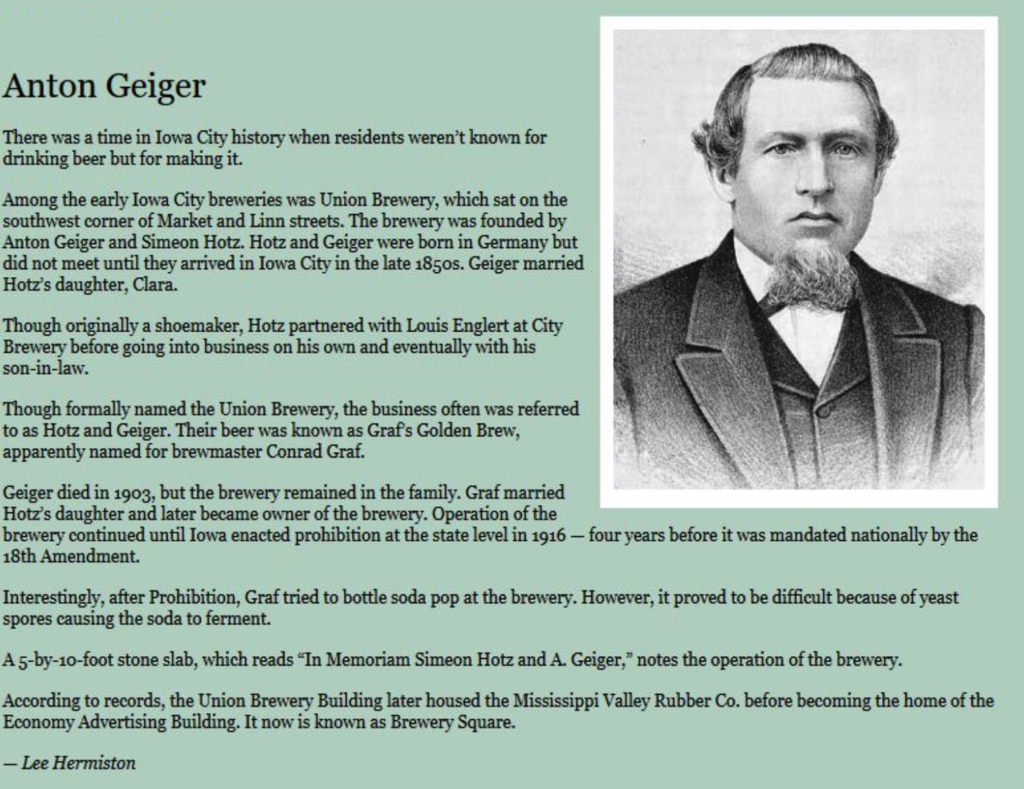
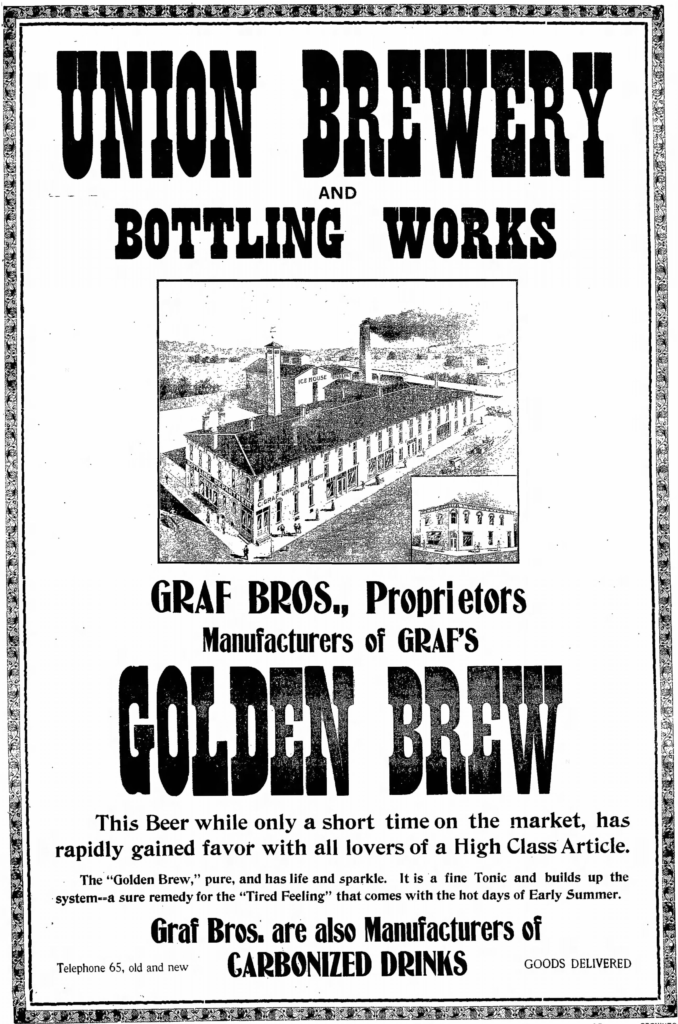
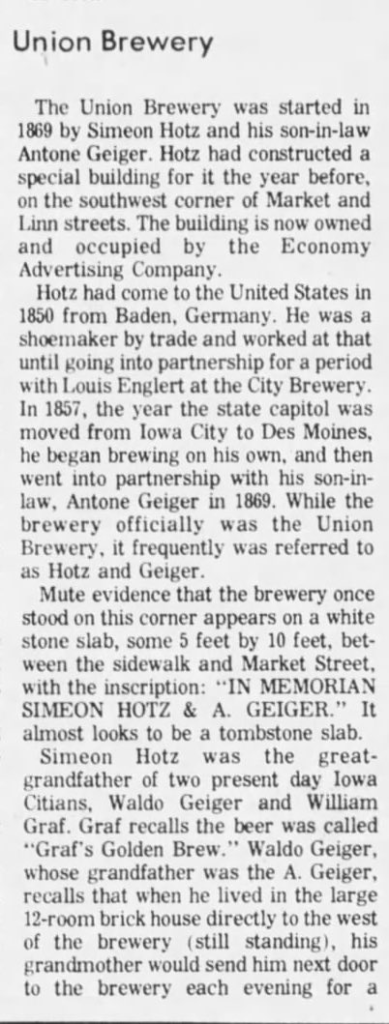
Today is the birthday of Anton Geiger (February 18, 1833-May 2, 1876). He was born in Nenningen, Germany, and emigrated to the U.S. when he was 21, in 1854. This account is from Tavern Trove: “He eventually settled in Iowa City, Iowa, where he met and married Clara Williams in around 1865.  Miss Williams was the daughter of Barbara Williams, a widow now rewed to Simeon Hotz. Hotz owned a brewery on Linn & Market streets and upon his stepdaughter’s marriage he brought his new son-in-law Geiger into the firm as junior partner.  Together they operated the brewery for eleven years.”
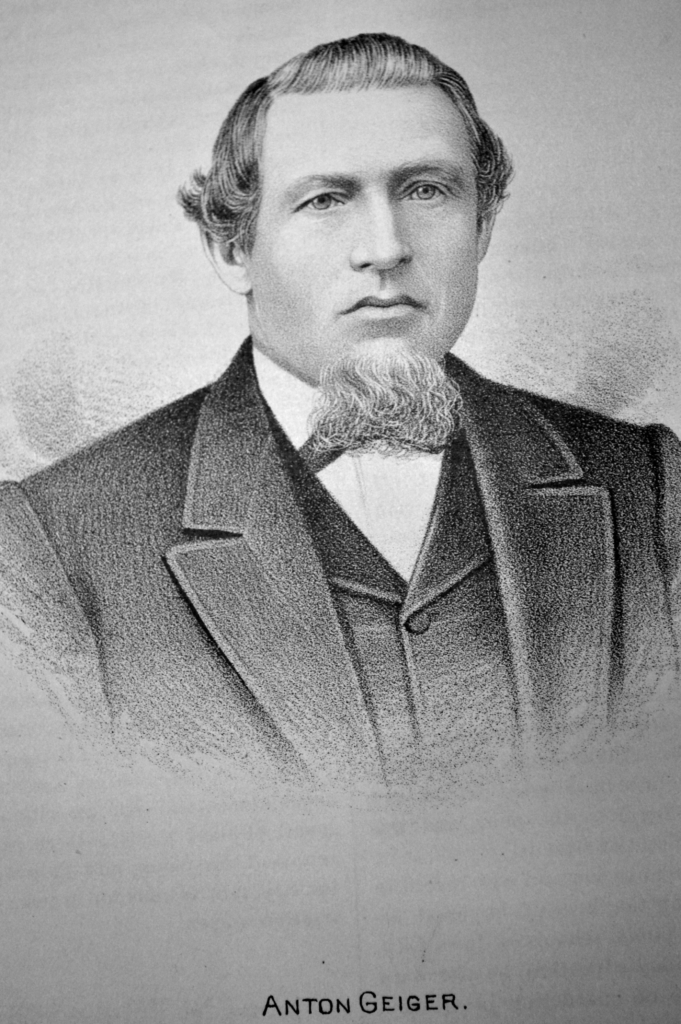
“Anton Geiger died on the 2nd of May, 1876 at just 43 years of age.  His father-in-law Simeon quit the brewery business for a time and leased the firm to his brewmaster. Despite the loss of the heir-apparent, the brewery continued in the family for another forty years, until finally being forced into the soft drink business by Iowa’s prohibition laws.  The company ultimately faded out of existence in 1933.”
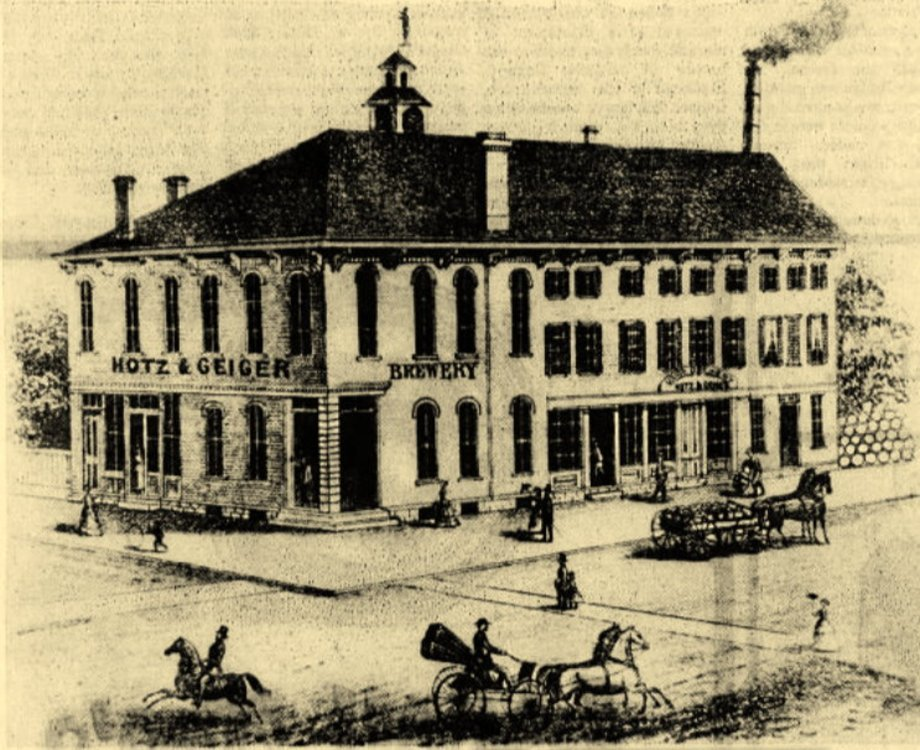
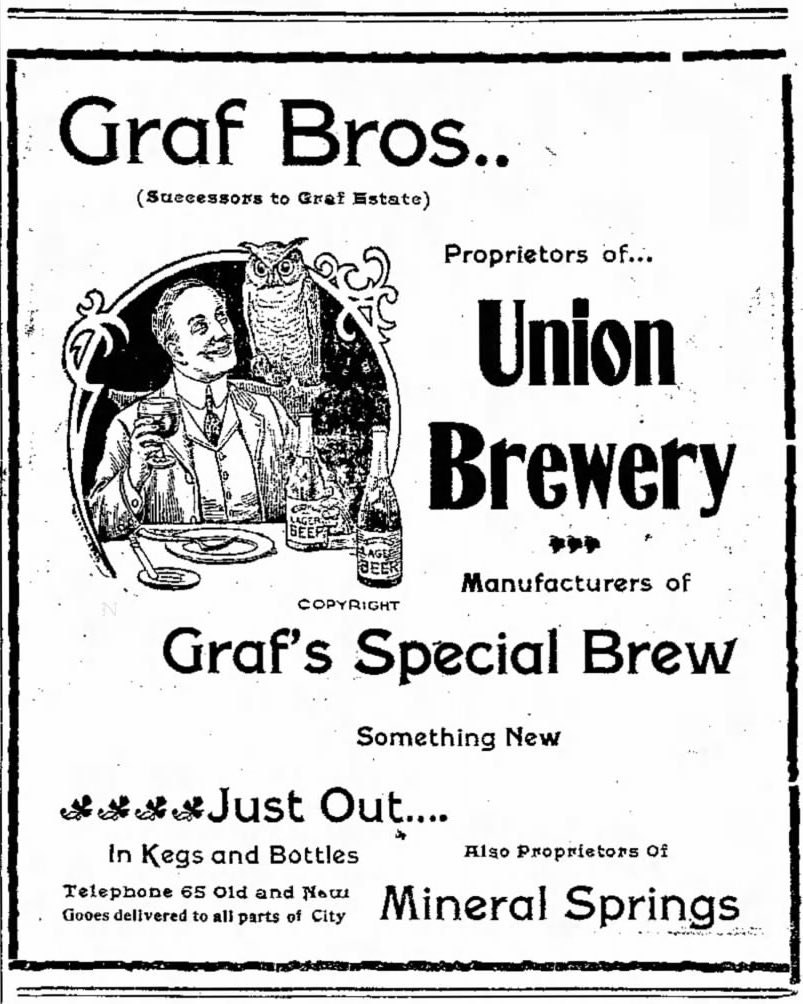
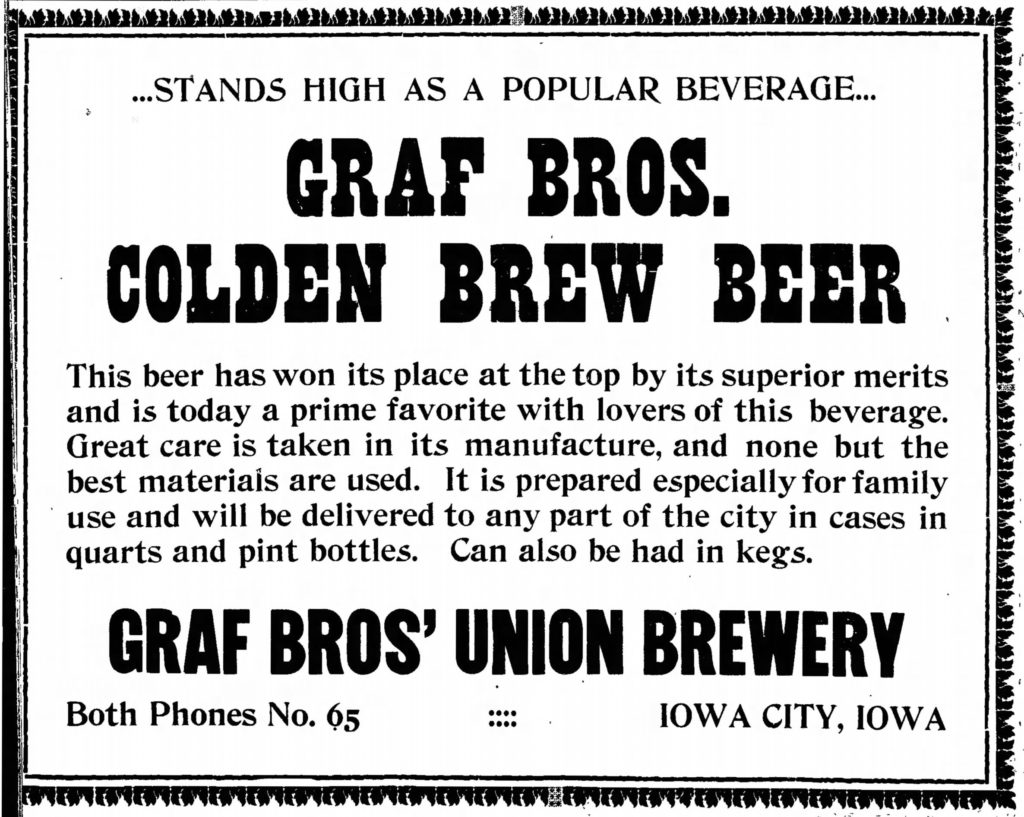
Hotz & Geiger Brewery.

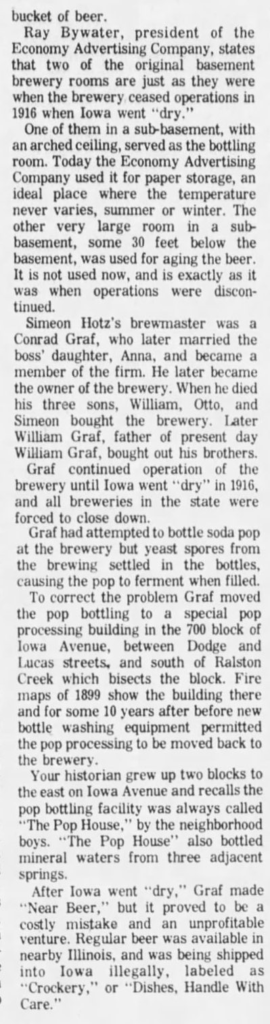
And this is about the history of the brewery, published in the Iow City Press Citizen in 1978:
Filed Under: Beers

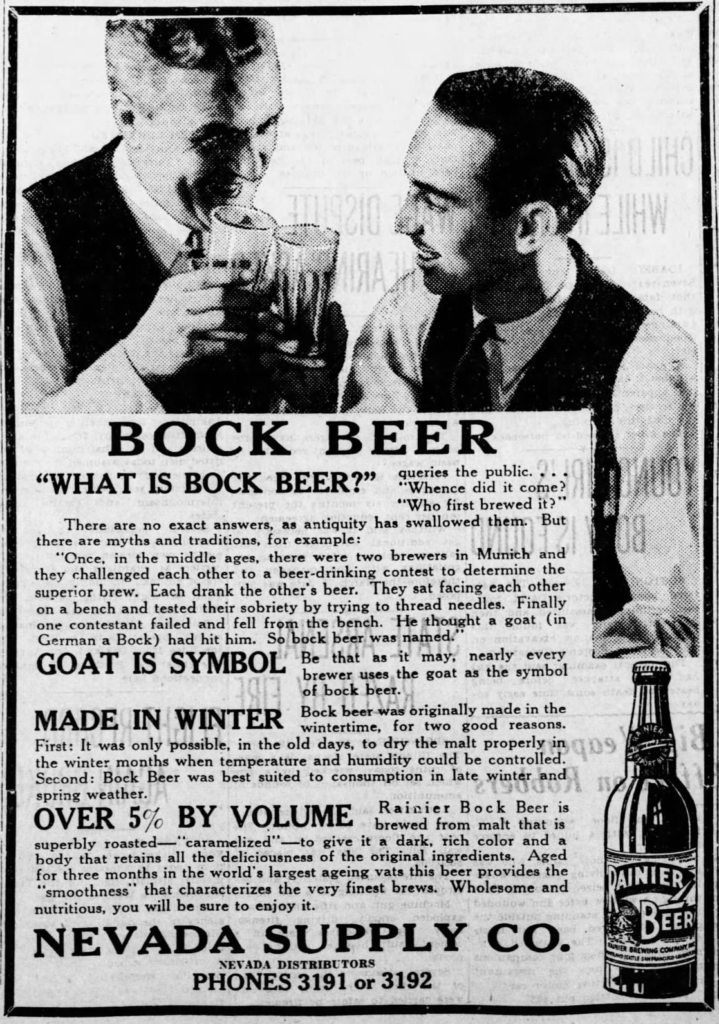
Beer In Ads #5206: What Is Rainier Bock Beer?

February 17, 2026 By Jay Brooks

Two years ago I decided to concentrate on Bock ads for awhile. Bock, of course, may have originated in Germany, in the town of Einbeck. Because many 19th century American breweries were founded by German immigrants, they offered a bock at certain times of the year, be it Spring, Easter, Lent, Christmas, or what have you. In a sense they were some of the first seasonal beers. “The style was later adopted in Bavaria by Munich brewers in the 17th century. Due to their Bavarian accent, citizens of Munich pronounced ‘Einbeck’ as ‘ein Bock’ (a billy goat), and thus the beer became known as ‘Bock.’ A goat often appears on bottle labels.” And presumably because they were special releases, many breweries went all out promoting them with beautiful artwork on posters and other advertising. With Spring approaching, there are so many great examples that I’m going to post two a day for a few months.

Tuesday’s first ad is for Rainier Bock Beer, which was published on February 17, 1934. This ad was for the Rainier Brewing Co., of Seattle, Washington, which was originally founded in 1878. This ad ran in The Reno Gazette-Journal, of Reno, Nevada.

Filed Under: Art & Beer, Beers, Breweries, Just For Fun Tagged With: Advertising, Bock, History, Nevada, Seattle, Washington

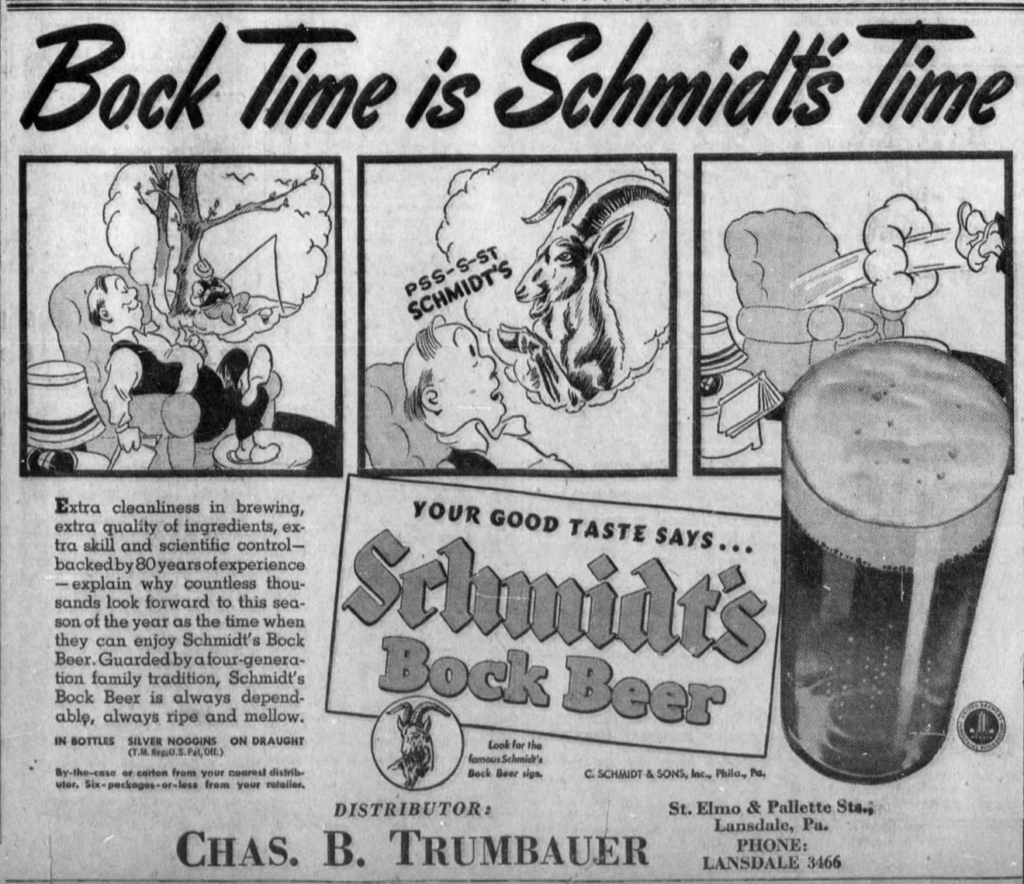
Beer In Ads #5205: Bock Time Is Schmidt’s Time

February 16, 2026 By Jay Brooks

Two years ago I decided to concentrate on Bock ads for awhile. Bock, of course, may have originated in Germany, in the town of Einbeck. Because many 19th century American breweries were founded by German immigrants, they offered a bock at certain times of the year, be it Spring, Easter, Lent, Christmas, or what have you. In a sense they were some of the first seasonal beers. “The style was later adopted in Bavaria by Munich brewers in the 17th century. Due to their Bavarian accent, citizens of Munich pronounced ‘Einbeck’ as ‘ein Bock’ (a billy goat), and thus the beer became known as ‘Bock.’ A goat often appears on bottle labels.” And presumably because they were special releases, many breweries went all out promoting them with beautiful artwork on posters and other advertising. With Spring approaching, there are so many great examples that I’m going to post two a day for a few months.

Monday’s ad is for Schmidt’s Bock Beer, which was published on February 16, 1940. This ad was for the C. Schmidt & Sons, of Philadelphia, Pennsylvania, which was originally founded in 1860 by Christian Schmidt. This ad ran in The North Penn Reporter, of Lansdale, Pennsylvania.

Filed Under: Art & Beer, Beers, Breweries, Just For Fun Tagged With: Advertising, Bock, History, Pennsylvania

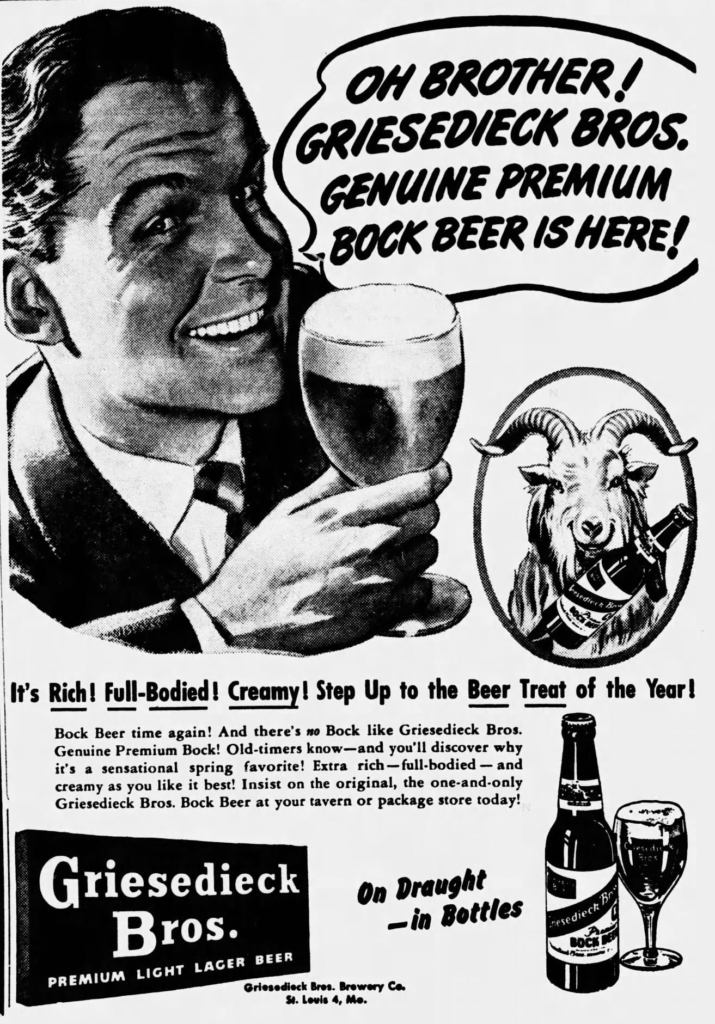
Beer In Ads #5204: Oh Brother! Griesedieck Bros. Genuine Premium Bock Beer Is Here!

February 15, 2026 By Jay Brooks

Two years ago I decided to concentrate on Bock ads for awhile. Bock, of course, may have originated in Germany, in the town of Einbeck. Because many 19th century American breweries were founded by German immigrants, they offered a bock at certain times of the year, be it Spring, Easter, Lent, Christmas, or what have you. In a sense they were some of the first seasonal beers. “The style was later adopted in Bavaria by Munich brewers in the 17th century. Due to their Bavarian accent, citizens of Munich pronounced ‘Einbeck’ as ‘ein Bock’ (a billy goat), and thus the beer became known as ‘Bock.’ A goat often appears on bottle labels.” And presumably because they were special releases, many breweries went all out promoting them with beautiful artwork on posters and other advertising. With Spring approaching, there are so many great examples that I’m going to post two a day for a few months.

Sunday’s second ad is for Griesedieck Bros. Genuine Premium Bock Beer, which was published on February 15, 1951. This ad was for the Griesedieck Bros. Brewery Co., of St. Louis, Missouri, which was originally founded in 1850 by William Strumpf. A Griesedieck first became involved around 1879 and the Griesedieck Brothers became part of the name in 1911. This ad ran in The St. Louis American, also of St. Louis, Missouri.

Filed Under: Art & Beer, Beers, Birthdays, Just For Fun Tagged With: Advertising, Bock, History, Missouri, St. Louis

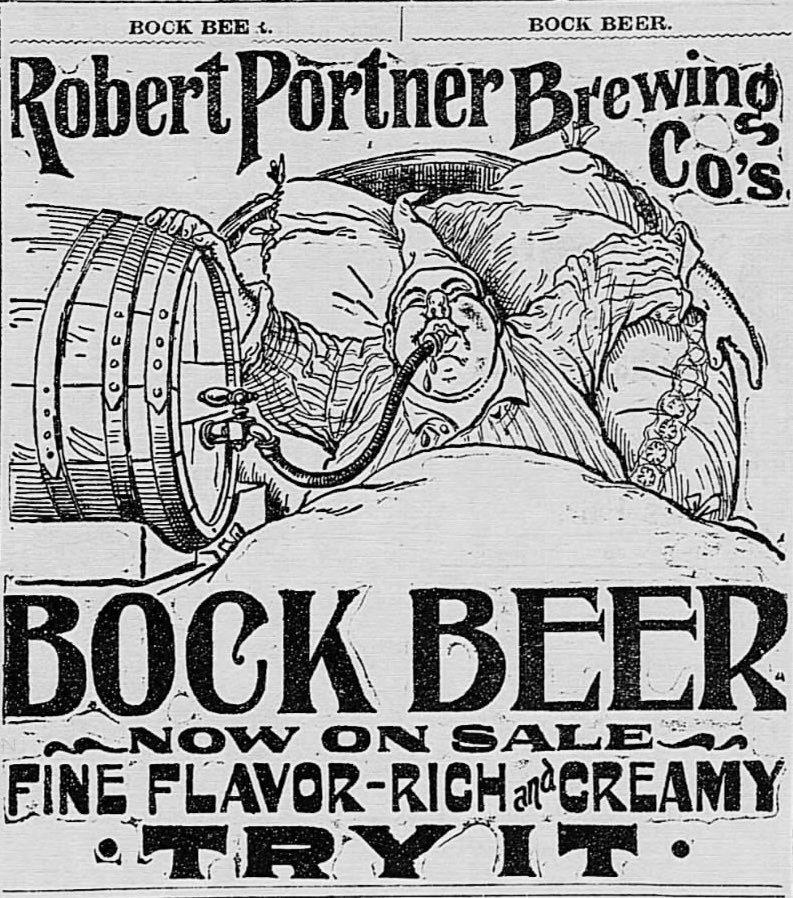
Beer In Ads #5203: Robert Portner’s Bock Beer

February 15, 2026 By Jay Brooks

Two years ago I decided to concentrate on Bock ads for awhile. Bock, of course, may have originated in Germany, in the town of Einbeck. Because many 19th century American breweries were founded by German immigrants, they offered a bock at certain times of the year, be it Spring, Easter, Lent, Christmas, or what have you. In a sense they were some of the first seasonal beers. “The style was later adopted in Bavaria by Munich brewers in the 17th century. Due to their Bavarian accent, citizens of Munich pronounced ‘Einbeck’ as ‘ein Bock’ (a billy goat), and thus the beer became known as ‘Bock.’ A goat often appears on bottle labels.” And presumably because they were special releases, many breweries went all out promoting them with beautiful artwork on posters and other advertising. With Spring approaching, there are so many great examples that I’m going to post two a day for a few months.

Sunday’s first ad is for Robert Portner’s Bock Beer, which was published on February 15, 1896. This ad was for the Robert Portner Brewing Co., of Alexandria, Virginia, which was originally founded in 1862 by Edward Abner, Fred Recker, and, of course, Robert Portner. This ad ran in The Alexandria Gazette, also of Alexandria, Virginia.

Filed Under: Beers

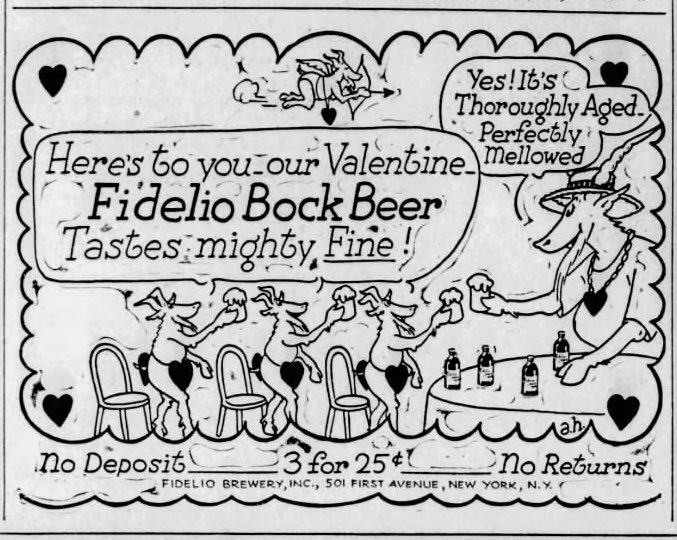
Beer In Ads #5202: Here’s To You Our Valentine Fidelio Bock Beer

February 14, 2026 By Jay Brooks

Two years ago I decided to concentrate on Bock ads for awhile. Bock, of course, may have originated in Germany, in the town of Einbeck. Because many 19th century American breweries were founded by German immigrants, they offered a bock at certain times of the year, be it Spring, Easter, Lent, Christmas, or what have you. In a sense they were some of the first seasonal beers. “The style was later adopted in Bavaria by Munich brewers in the 17th century. Due to their Bavarian accent, citizens of Munich pronounced ‘Einbeck’ as ‘ein Bock’ (a billy goat), and thus the beer became known as ‘Bock.’ A goat often appears on bottle labels.” And presumably because they were special releases, many breweries went all out promoting them with beautiful artwork on posters and other advertising.

Saturday’s ad is for Fidelio Bock Beer, which was published on February 14, 1939. This ad was for the Fidelio Brewery, Inc., of New York, New York, which was originally founded in 1844 by Alexander Gregory and Philip Harmon. This ad ran in The Mount Vernon Argus, of White Plains, New York.

Filed Under: Art & Beer, Beers, Breweries, Just For Fun Tagged With: Advertising, Bock, History, New York

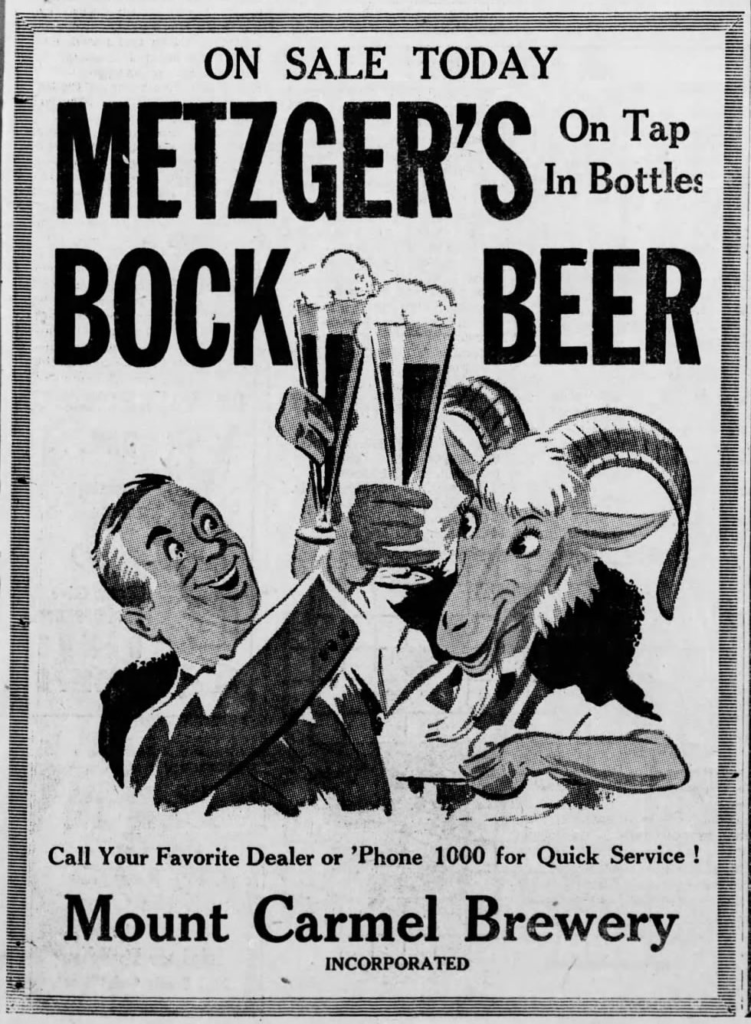
Beer In Ads #5201: Metzger’s Bock Beer

February 13, 2026 By Jay Brooks

Two years ago I decided to concentrate on Bock ads for awhile. Bock, of course, may have originated in Germany, in the town of Einbeck. Because many 19th century American breweries were founded by German immigrants, they offered a bock at certain times of the year, be it Spring, Easter, Lent, Christmas, or what have you. In a sense they were some of the first seasonal beers. “The style was later adopted in Bavaria by Munich brewers in the 17th century. Due to their Bavarian accent, citizens of Munich pronounced ‘Einbeck’ as ‘ein Bock’ (a billy goat), and thus the beer became known as ‘Bock.’ A goat often appears on bottle labels.” And presumably because they were special releases, many breweries went all out promoting them with beautiful artwork on posters and other advertising.

Friday’s ad is for Metzger’s Bock Beer, which was published on February 13, 1942. This ad was for the Mount Carmel Brewery of Mount Carmel, Pennsylvania, which was originally founded as the Anthracite Brewing Co. in 1897.  This ad ran in The Mount Carmel Item, also of Mount Carmel, Pennsylvania.

Filed Under: Art & Beer, Beers, Breweries, Just For Fun Tagged With: Advertising, Bock, History, Pennsylvania

Historic Beer Birthday: Mary of Burgundy

February 13, 2026 By Jay Brooks

duchesse
Today is the birthday of Mary of Burgundy (February 13, 1457-March 27, 1482), She was also known as the “Duchess of Burgundy, [and] reigned over the Low Countries from 1477 until her death. As the only child of Charles the Bold and his wife Isabella of Bourbon, she was the heiress to the vast, and vastly wealthy, Burgundian domains in France and the Low Countries upon her father’s death in the Battle of Nancy on January 5, 1477.”

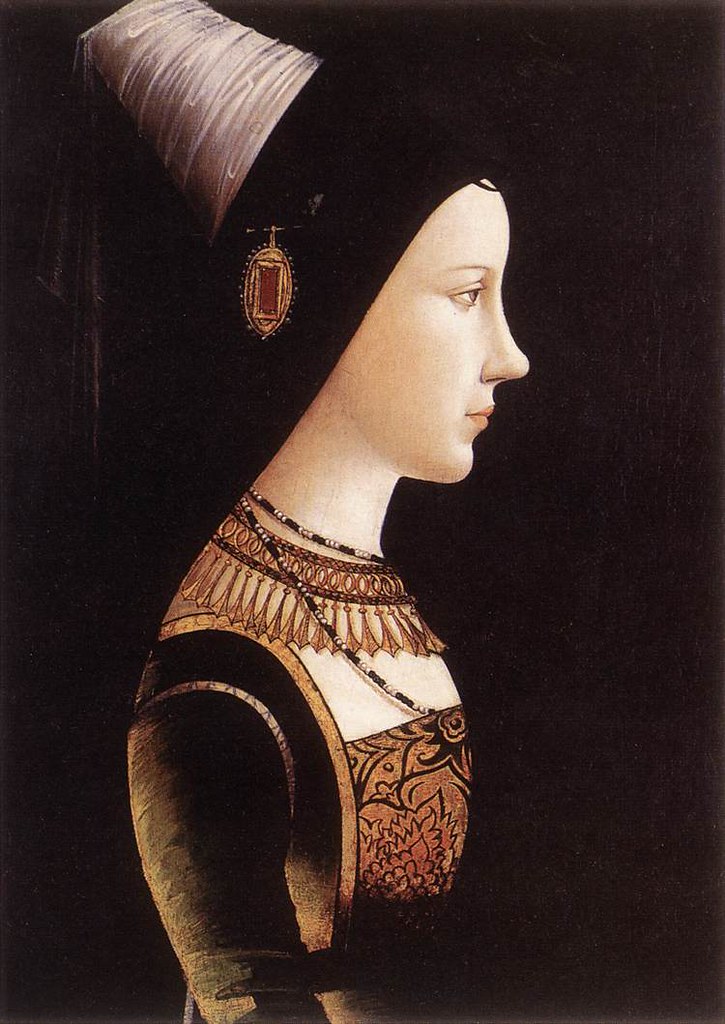
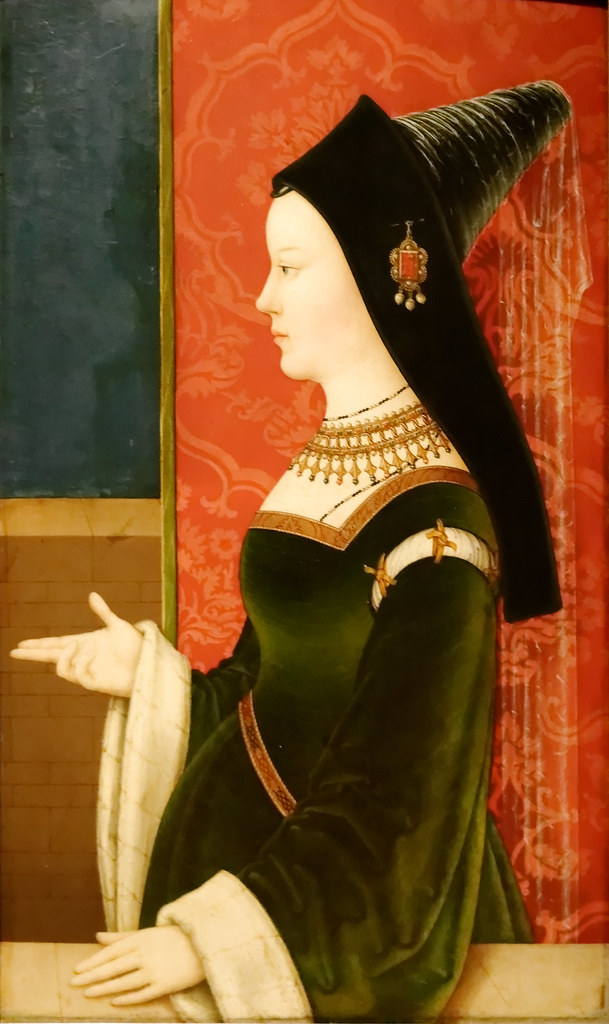
Mary_of_burgundy-1490-Michael_pacher
Portrait of Mary of Burgundy, painted in 1490 by Austrian artist, Michael Pacher.

Here’s more about Mary, most of it from her Wikipedia page:

Mary of Burgundy was born in Brussels, at the ducal castle of Coudenberg, to Charles the Bold, Count of Charolais, and his wife, Isabella of Bourbon. Her birth, according to the court chronicler, Georges Chastellain, was attended by a clap of thunder ringing from the otherwise clear twilight sky. Her godfather was Louis, Dauphin of France, in exile in Burgundy at that time; he named her for his mother, Marie of Anjou. Reactions to the child were mixed: the baby’s grandfather, Duke Philip the Good, was unimpressed, and “chose not to attend the [Baptism] as it was only for a girl;” the grandmother, Isabella of Portugal, was simply delighted at the birth of a granddaughter.

Philip the Good died in 1467, making his son Duke of Burgundy and his 10-year-old granddaughter heiress presumptive. As the only child of Charles the Bold, Mary was heiress presumptive to a vast and wealthy domain, made up of the Duchy of Burgundy, the Free County of Burgundy, and the majority of the Low Countries, and her hand was eagerly sought by a number of princes. The first proposal was received by her father when she was only five years old, to marry the future King Ferdinand II of Aragon. Later the younger brother of Louis XI, Charles, Duke of Berry, made an approach, to the intense annoyance of his brother the King, who attempted to prevent the necessary papal dispensation for consanguinity.

As soon as Louis produced a male heir who survived infancy, the future King Charles VIII of France, Louis wanted his son to be the one to marry Mary, despite his son being thirteen years younger than Mary. Nicholas I, Duke of Lorraine, was a few years older than Mary, and his duchy lay alongside Burgundian territory, but his plan to combine his territory with hers was ended by his death in battle in 1473.

Mary ascended upon her father’s death in the Battle of Nancy on 5 January 1477. King Louis XI of France seized the opportunity afforded by his rival’s defeat and death to attempt to take possession of the Duchy of Burgundy proper, and also of Franche-Comté, Picardy and Artois.

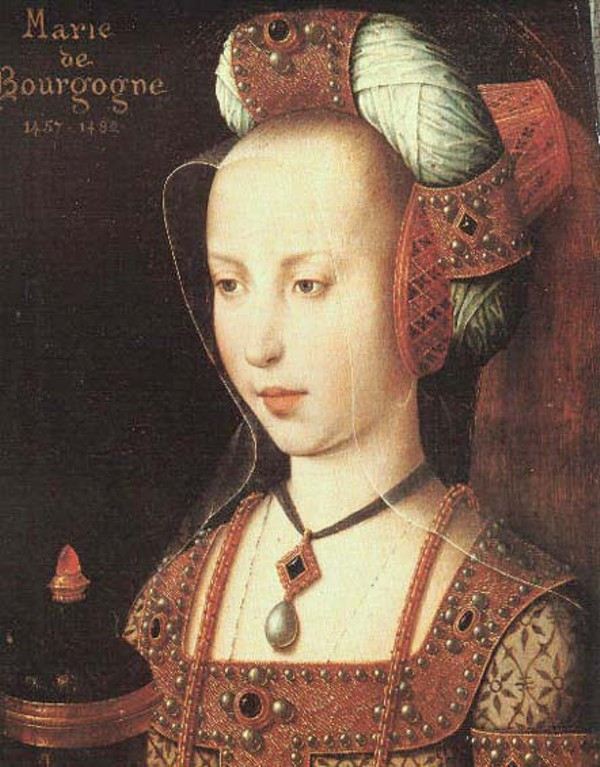
A portrait believed to have been painted by Niklas Reiser.

The King was anxious that Mary should marry his son Charles and thus secure the inheritance of the Low Countries for his heirs, by force of arms if necessary. Burgundy, fearing the French military power, sent an embassy to France to negotiate a marriage between Mary and six-year-old Charles VIII, but returned home without a betrothal, finding the French king’s demands of cession of territories to the French crown unacceptable.

On February 10, 1477 at Ghent on the occasion of her formal recognition, known as the Joyous Entry, as Charles’ heir, she was compelled to sign a charter of rights, called the Great Privilege. Under this agreement, the provinces and towns of Flanders, Brabant, Hainaut, and Holland recovered all the local and communal rights which had been abolished by the decrees of the dukes of Burgundy in their efforts to create a centralized state on the French model out of their separate holdings in the Low Countries. In particular, the Parliament of Mechelen (established formally by Charles the Bold in 1470) was abolished and replaced with the pre-existing authority of the Parliament of Paris, which was considered an amenable counterweight to the encroaching, if informal, centralization undertaken by both Charles the Bold and Philip the Good. The Duchess also had to undertake not to declare war, make peace, or raise taxes without the consent of the States, and to employ only native residents in official posts.

Such was the hatred of the people for the old regime that two of her father’s influential councilors, the Chancellor Hugonet and the Sire d’Humbercourt, having been discovered in correspondence with the King of France, were executed at Ghent despite the tears and entreaties of the Duchess.

Another, later portrait by an unknown Flemish artist.

Mary now made her choice among the many suitors for her hand, selecting Archduke Maximilian of Austria, who became her co-ruler. The marriage took place at Ghent on the evening of 16 August 1477.[5] The event initiated two centuries of contention between France and the Habsburgs (later of Spain, then of Austria) for their possession, which climaxed in the War of the Spanish Succession, 1701–1714.

In the Netherlands, affairs now went more smoothly, the French aggression was temporarily checked, and internal peace was in large measure restored.

Five years later, the 25-year-old Duchess died due to a fall from her horse on March 27, 1482 near Wijnendale Castle. She loved riding, and was falconing with Maximilian when her horse tripped, threw her, and then landed on top of her, breaking her back. She died several days later, having made a detailed will. She is buried in the Church of Our Lady in Bruges.

Louis was swift to re-engage, and forced Maximilian to agree to the Treaty of Arras (1482) by which Franche-Comté and Artois passed for a time to French rule, only to be regained by the Treaty of Senlis (1493), which established peace in the Low Countries. Mary’s marriage to the House of Habsburg would prove to be a disaster for France, for the Burgundian inheritance would later bring it into conflict with Spain and the Empire.

There’s also a nice account of her life from the Freelance History Writer and the Royal Women blog.

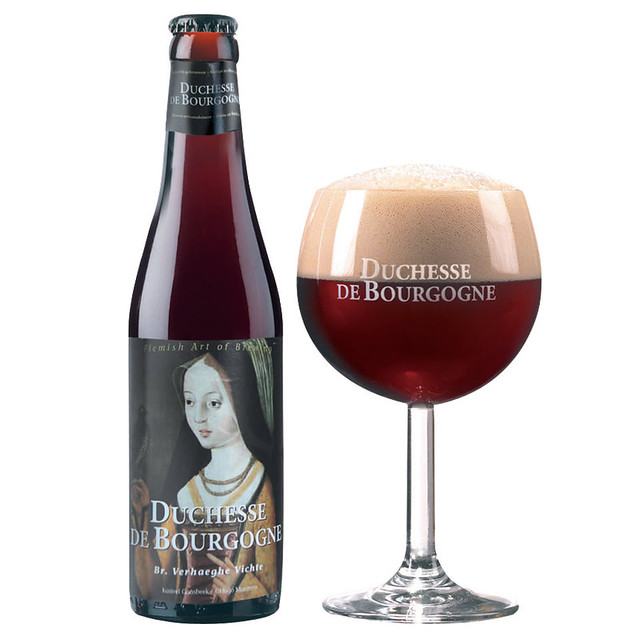
Duchesse-bottle

But, of course, she was also the inspiration for a Belgian beer, brewed by the Brouwerij Verhaeghe, located in Vichte, which is a ancient castle and farm in West Flanders. The beer is called Duchesse de Bourgogne, and it’s a personal favorite of mine. I know some people think it’s uneven, or not a classic Flanders Red Ale, but I love it.

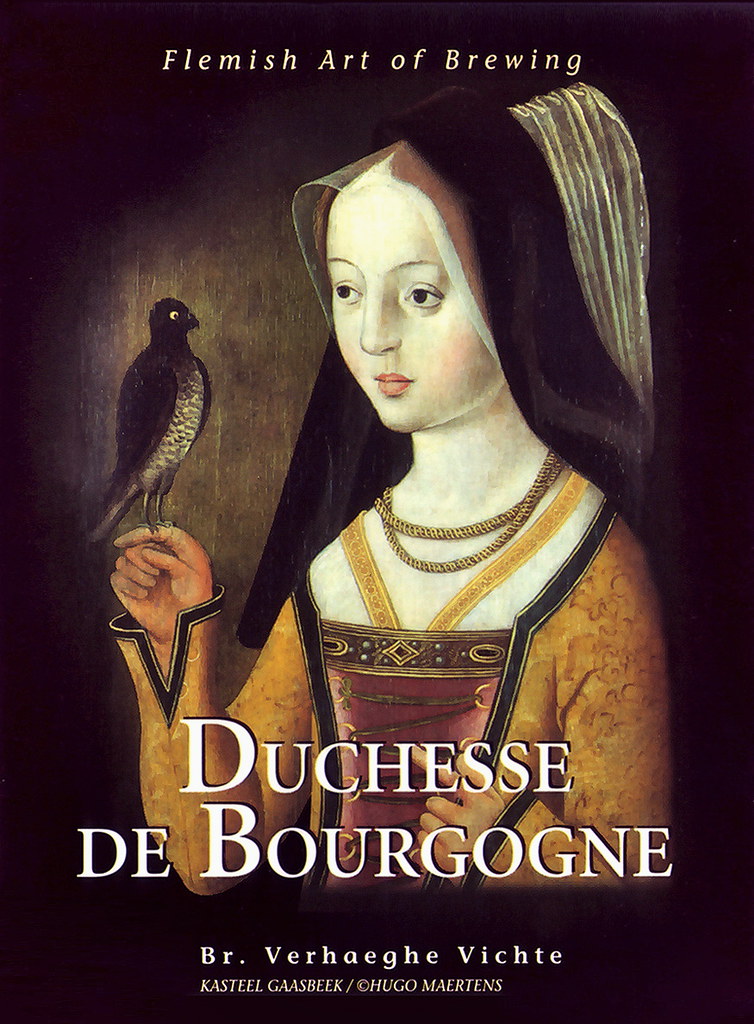
VerhaegheDuchesse

I also wrote about Duchesse de Bourgogne a few years ago, and at the time I did my own short overview of her life.

Beer aside, the history of the Duchesse is fascinating. Her anglicized name was Mary of Burgundy, though she was born in Brussels on February 13, 1457, the only child of Charles the Bold, Duke of Burgundy, and his wife Isabella of Bourbon. Needless to say she was quite a catch, especially after her father died in battle (at the siege of Nancy, not a particularly awful sounding name) in 1477, when she was nineteen. Louis XI of France tried to take Burgundy and the Low Countries for himself but was frustrated when Mary signed the “Great Privilege,” by which she gave Flanders, Brabant, Hainaut, and all of Holland autonomous rule (leaving for herself the remainder of the Low Countries, Artois, Luxembourg, and Franche-Comté). She then married Archduke Maximilian of Austria, who was later the Holy Roman Emperor Maximilian I, and part of the Hapsburg Austrian dynasty. This sparked a long-standing dispute over the Low Countries between France and the Hapsburg family.

One of Mary’s favorite hobbies was falconing, which was popular among royals in the day. Falconry is basically training and hunting using a falcon. While engaged in this pursuit, in 1482, Mary’s horse tripped, tossing her onto the ground where the horse then landed on top of her, breaking her back. A few days later she died. Mary was only 25. The beer label’s portrait pays homage to her love of falconry and her ultimate death because of it.

Her young son Philip became heir after her death, though Maximilian was in charge until he reached adulthood. King Louis forced Maximilian to sign the Treaty of Arras the same year, and it gave Franche Comté and Artois to France. But Philip was a virtual prisoner until 1485, and then it took Max another eight years to take back control of their lands in the Low Countries. The Treaty of Senlis, in 1493, finally established peace in the area, but Burgundy and Picardy remained French.

So during her short life, Mary had such great impact on European politics that they can be felt even now in the present. So it’s quite appropriate that she have so wonderful a beer that bears her name and her portrait. It’s a fitting legacy.

The description of the beer from the importer, D&V International:

The Duchesse de Bourgogne from Brouwerij Verhaeghe is the traditional Flemish red ale. This refreshing ale is matured in oak casks; smooth with a rich texture and interplay of passion fruit, and chocolate, and a long, dry and acidic finish. After the first and secondary fermentation, the beer goes for maturation into the oak barrels for 18 months. The final product is a blend of younger 8 months old beer with 18 months old beer. The average age of the Duchesse de Bourgogne before being bottled is 12 months.

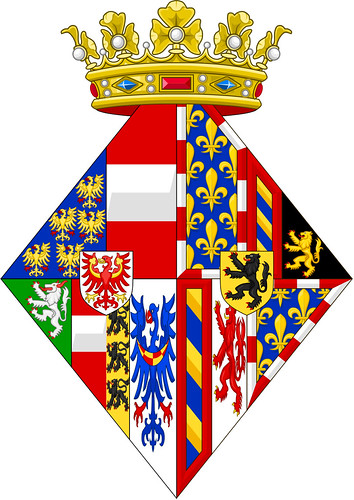
Coat of arms of Mary of Burgundy.

Filed Under: Beers, Birthdays, Just For Fun Tagged With: Belgium, France, History

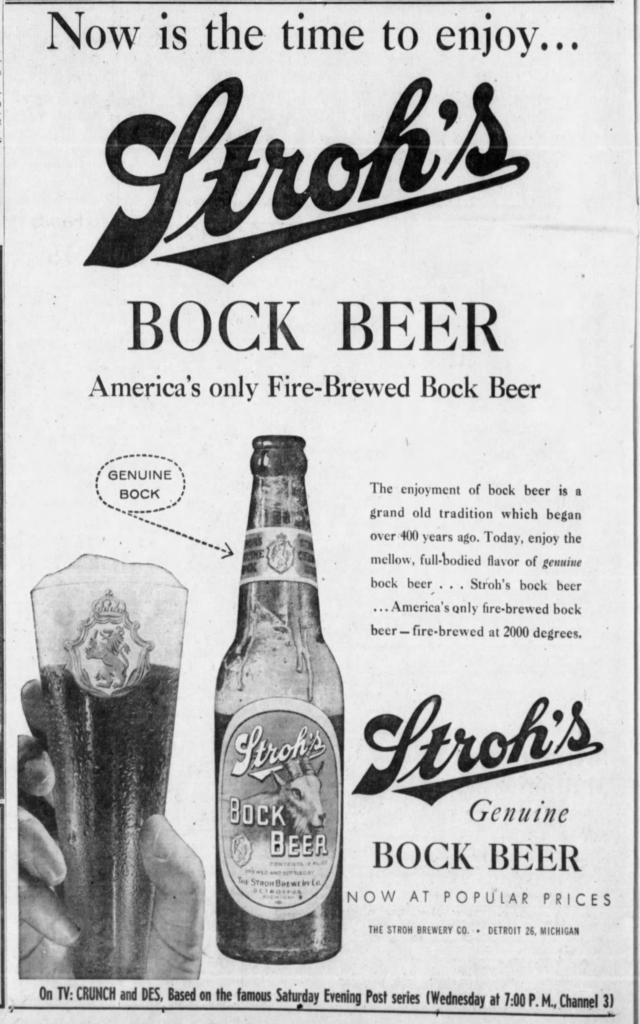
Beer In Ads #5200: Now Is The Time To Enjoy … Stroh’s Bock Beer

February 12, 2026 By Jay Brooks

Two years ago I decided to concentrate on Bock ads for awhile. Bock, of course, may have originated in Germany, in the town of Einbeck. Because many 19th century American breweries were founded by German immigrants, they offered a bock at certain times of the year, be it Spring, Easter, Lent, Christmas, or what have you. In a sense they were some of the first seasonal beers. “The style was later adopted in Bavaria by Munich brewers in the 17th century. Due to their Bavarian accent, citizens of Munich pronounced ‘Einbeck’ as ‘ein Bock’ (a billy goat), and thus the beer became known as ‘Bock.’ A goat often appears on bottle labels.” And presumably because they were special releases, many breweries went all out promoting them with beautiful artwork on posters and other advertising.

Thursday’s ad is for Stroh’s Bock Beer, which was published on January 12, 1957. This ad was for the Stroh Brewery Co. of Detroit, Michigan, which was originally founded in 1850.  This ad ran in The Mansfield News-Journal, of Mansfield, Ohio, serving “Richland, Ashland and Crawford counties, as well as parts of Morrow, Knox and Huron counties in the north central part of the state.”

Filed Under: Art & Beer, Beers, Breweries, Just For Fun Tagged With: Advertising, Bock, History, Michigan

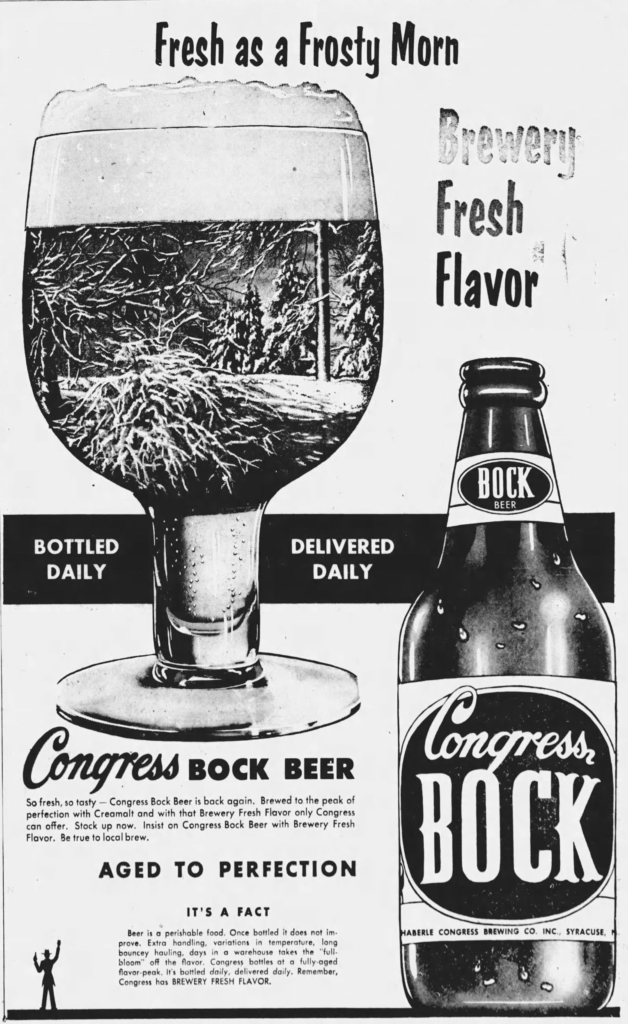
Beer In Ads #5199: Fresh As A Frosty Morn, Congress Bock Beer

February 11, 2026 By Jay Brooks

Two years ago I decided to concentrate on Bock ads for awhile. Bock, of course, may have originated in Germany, in the town of Einbeck. Because many 19th century American breweries were founded by German immigrants, they offered a bock at certain times of the year, be it Spring, Easter, Lent, Christmas, or what have you. In a sense they were some of the first seasonal beers. “The style was later adopted in Bavaria by Munich brewers in the 17th century. Due to their Bavarian accent, citizens of Munich pronounced ‘Einbeck’ as ‘ein Bock’ (a billy goat), and thus the beer became known as ‘Bock.’ A goat often appears on bottle labels.” And presumably because they were special releases, many breweries went all out promoting them with beautiful artwork on posters and other advertising.

Wednesday’s ad is for Congress Bock Beer, which was published on January 11, 1960. This ad was for the Haberle Congress Brewing Co. of Syracuse, New York, which was originally founded in either 1857 or 1865.  This ad ran in The Post-Standard, also of Syracuse, New York.

Filed Under: Art & Beer, Beers, Breweries, Just For Fun Tagged With: Advertising, Bock, History, New York

« Previous Page
Next Page »

Find Something

Northern California Breweries

Please consider purchasing my latest book, California Breweries North, available from Amazon, or ask for it at your local bookstore.

Recent Comments

  • Bob Paolino on Beer Birthday: Grant Johnston
  • Gambrinus on Historic Beer Birthday: A.J. Houghton
  • Ernie Dewing on Historic Beer Birthday: Charles William Bergner 
  • Steve 'Pudgy' De Rose on Historic Beer Birthday: Jacob Schmidt
  • Jay Brooks on Beer Birthday: Bill Owens

Recent Posts

  • Beer In Ads #5179: Back Again! Pittsburgh Brewing Co’s Bock Beer March 22, 2026
  • Historic Beer Birthday: Joseph A. Straub March 22, 2026
  • Beer Birthday: Steve Wellington March 22, 2026
  • Beer In Ads #5178: Wow! The Public Is Really Getting A Boot Out Of Gold Bond Double Bock Beer March 22, 2026
  • Beer In Ads #5177: The Fable Of Bock Beer! March 21, 2026

BBB Archives

Feedback

Head Quarter
This site is hosted and maintained by H25Q.dev. Any questions or comments for the webmaster can be directed here.