Brookston Beer Bulletin

Jay R. Brooks on Beer

  • Home
  • About
  • Editorial
  • Birthdays
  • Art & Beer

Socialize

  • Dribbble
  • Email
  • Facebook
  • Flickr
  • GitHub
  • Instagram
  • LinkedIn
  • Pinterest
  • RSS
  • Twitter
  • YouTube

Powered by Genesis

Latrobe Deal Not Done Yet

September 13, 2006 By Jay Brooks

Once the news was out that City Brewery of La Crosse, Wisconsin was negotiating to buy the Latrobe Brewery, many people, myself included, stopped paying close attention to this story. You’ll recall that brewing giant InBev sold the brand name Rolling Rock to Anheuser-Busch on May 19 of this year. But the Latrobe Brewery where Rolling Rock had been brewed since 1939 was not part of the deal. It had been scheduled to close July 31 if a buyer could not be found and a mad scramble ensued involving local and state politicians, the media, imaginative rumors, InBev and all manner of possible buyers. Finally on June 21, it was announced that City Brewery was in negotiations. Everyone breathed a collective sigh of relief, and moved on to the next story.

But it’s been almost three months now and a deal to buy the brewery has still not been finalized. While negotiations are ongoing, the brewery closed July 31 and has been dormant since then. City Brewery met yesterday with officials from local and state agencies to work out issues surrounding how anticipated production increases will effect the capacity of water treatment facilities. Currently the brewery’s capacity is 1.3 million barrels and City Brewery wants to brew two million. Let’s hope the deal will be done soon and the now unemployed brewery employees can back to work.

Filed Under: News Tagged With: Business, Eastern States, National

Tastes Great, Less Gesundheit

September 12, 2006 By Jay Brooks

Add hay fever to the growing list of maladies that can be helped by the moderate drinking of beer. A new preliminary study released today by Tadao Enomoto at the Japanese Red Cross Society’s medical center in Japan’s Wakayama Prefecture appears to show marked relief in alleviating sneezing and running noses for hay fever sufferers from a flavonol compound in hops. They study’s full findings will be presented next month to the Palynological Society of Japan.

Japanese brewer Sapporo, who co-sponsored the research, has filed for a patent on the process of extracting the hay fever-fighting flavonol, which involves pulverizing the hops and then soaking them in water. By next spring — before the next hay fever season — Sapporo plans to release a new beer containing the isolated hop flavonol that combats hay fever.

Filed Under: Beers, News Tagged With: Asia, Health & Beer, Hops, International

Fanning the Flames of Phony Fears

September 11, 2006 By Jay Brooks

The mainstream media, well El Paso, Texas anyway, is once again fanning the flames of fear with distorted statistics. They’re using the same misguided survey by the Wine and Spirits Wholesalers of America (WSWA) which others have already shown to be faulty at best and purposely distorted at worst, including Free the Grapes and myself, not once, but twice.

I’m sure this isn’t the only community newspaper trying to fan the flames of another prohibition, but they’ve used some clever tactics in their piece, whether inadvertently or not, that bear examining.

First let’s look at the title that Diana Washington Valdez of the El Paso Times uses for her story: “Youths use Web to buy beer, liquor.” Notice how wine is absent from the title? She does mention wine at the end of the first paragraph, but for the many people who only skim the headlines it reinforces the carefully managed stereotype of wine as angelic and beer and spirits as demonic. I don’t necessarily think this sort of thing is done consciously, but it shows how ingrained those perceptions really are. If you want to catch peoples’ attentions with a headline, pick on liquor and beer, wine won’t generate the same level of fear.

The article trotted out these recent gems:

Millions of underage youths are buying alcoholic beverages over the Internet or know someone who does, according to a survey commissioned by the Wine and Spirits Wholesalers of America in Washington, D.C.

The association also found that 20 states are easing up on the sales of alcohol from Web sites — without adopting corresponding measures to prevent youths from using such sites.

“This is a dangerous situation,” said Stan Hastings, association chairman. “For the first time, we have hard evidence that millions of kids are buying alcohol online and that the Internet is fast becoming a high-tech, low-risk way for kids to get beer, wine and liquor delivered to their home with no ID check.”

The survey is unique because news about the alarming trend comes from an organization that represents the alcohol industry.

This “millions of underage youths” is simply poppycock. The figure is just plain wrong. See my earlier post to take a closer look at how they arrived at this figure, but suffice it to say it’s not using anything resembling a scientific method.

What I find more interesting is that last sentence that while acknowledging that the study was done by an organization which, in their words, “represents the alcohol industry,” the author accepts that at face value. Not only doesn’t she question whether there’s any ulterior motive, but she even suggests that because the WSWA dd the survey that the results are more “alarming.” This is a person, mind you — I think they call them re-port-ers — whose job it is to find out and report the truth. Apparently never once did it occur to ask “why” the WSWA might have even sponsored such a survey. Now why is one of the five Ws in journalism, so I don’t think I’m off base here to expect her to ask that question.

Of course, if she had looked into the WSWA’s agenda, she would have discovered she had no story. Because the WSWA has just as much interest in scaring parents as the El Paso Times does. They don’t want internet sales of alcohol for one very simple reason: it will cut into their monopoly on alcohol sales. The WSWA represents the interests of wholesalers whose business depends on their maintaining exclusive territories to sell their wine and spirits. If someone else can sell alcohol in the same place they do, it will mean they’ll have to compete on price and they’ll no longer have a monopoly. So is it very surprising that a study they commissioned would find that sales they’re not making money on constitutes a problem? And, of course, the surest way to find support for yourself is to align yourself with protecting children. It’s always about the kids, never about the money.

Then the article turns to local concerns:

Another research finding is that little enforcement exists in this area, something that ought to concern parents.

Lt. Mark Decatur, an enforcement official in El Paso for the Texas Alcoholic and Beverage Commission, said the TABC conducted an operation two years ago aimed at identifying Web sites that made it easy for teenagers to buy alcohol.

“We found that a lot of people sold to kids over the Net,” he said. “The investigation used the children of TABC employees (as decoys) that used their parents’ credit card to place orders. Since then, we have taken steps in Texas to make changes in the law to address this.”

Of course, placing orders is not the same as the kids actually receiving any alcohol. They claim to have taken “steps” to address this problem, but unless I’m missing something, it’s been illegal to sell alcohol to underage kids for quite some time now, and delivering alcohol to any destination requires an adult signature. So if busy delivery persons don’t get the required signature, how is that the fault of the internet? And why should it inspire any fear whatsoever? It’s certainly not causing many arrests. As Texas liquor control spokesperson, Carolyn Beck, notes, “the commission does not have any enforcement actions on record for the past two years related to online alcohol sales to minors.” That’s because there are bigger problems, such as “[o]ne in five retailers are willing to sell to minors when they are looking right at them.” That’s obviously not something the WSWA cares much about, since they still reap the rewards of those underage sales.

The author concludes that “[f]or determined youths, none of these checks are impossible to get around.” Which begs the question if trying to stop internet alcohol sales doesn’t work, then why try to restrict such sales entirely since that keeps adults from obtaining goods which are legal for them. If what she says is true — and I suspect it is — what is the point of her article?

I grew up well before the internet age, and I had little trouble getting beer as a teenager. I’m not an alcoholic today. I work; I pay my taxes. By all accounts, I’m a responsible member of society. So what harm did underage drinking cause me? I rebelled a little bit, tried something forbidden at a time when I was struggling to find my identity. I was fumbling toward becoming an adult even before I really knew what that meant. So what? Let’s not forget our esteemed president went so far as to drive drunk and still grew up to be president. So perhaps this isn’t the big problem so many imagine it to be?

Perhaps when my kids hit their teens, they will likewise rebel a little bit. I hope not, and I’ll do my best to keep them safe, but there is a certain inevitability to it happening in one form or another. In the end there are a lot more things keeping me up at night besides whether they can buy beer over the internet. That so many people seem to care so deeply about this relatively insignificant problem, especially while there are so many other more pressing problems in the world today, says more about us than I care to think about.

Filed Under: Editorial, News Tagged With: Mainstream Coverage, Prohibitionists, Southern States

Three Cheers for Beer

September 9, 2006 By Jay Brooks

My good friend and colleague, Lisa Morrison — a.k.a. The Beer Goddess — had a nice article on the recent craft beer sales numbers released by the Brewers Association.

Filed Under: News Tagged With: Business, Mainstream Coverage, National

EU to Increase Beer Tax

September 8, 2006 By Jay Brooks

Beer taxes have rarely been doled out fairly. They’ve been used to support war efforts such as the very first beer tax in America, which was leveled to help pay for our Civil War in the 1860s. And while most brewers didn’t mind supporting their country, the fact that other industries were not asked to similarly help out was what led to the first U.S. trade association among brewers. Then there’s the so-called “sin tax” on many luxury goods deemed to be either bad for you or having some moral questionability — at least to the more pious elements of society.

So in a way it comes as no suprise that the European Union announced a 31% increase on the duty for beer and spirits. Proponents say it will add only about one Euro cent to the price of a beer (half-litre size). Critics say it will hurt small breweries. If passed by the 25 member states (it needs to be unanimous) it likely wouldn’t go into effect until 2008 or even 2010, with grace periods.

Some interesting facts about Europe’s beer industry from a Reuter’s report:

Europe’s brewing industry employs 2.6 million people directly or indirectly in 3,000 breweries. Over a third of the breweries are in Germany, where they already face a 3 percent rise in value-added sales tax (VAT) from next year.

But here’s the kicker. There’s no duty whatsoever on wine, because the industry has such enormous political influence. Yeah, that seems fair, doesn’t it?

Filed Under: News Tagged With: Business, Europe, International

Cans vs. Kegs

September 6, 2006 By Jay Brooks

Okay, to me kegs are cans, just really big ones, so comparing them seems a little strange. But seriously, an article in today’s Baltimore Sun takes on the topic of football game tailgating and which beer works better, canned or kegged. Boy I miss H.L. Mencken.

The story details tailgating at Baltimore Ravens games and to answer the “kegs vs. cans” inquiry does some blind tasting using some frankly questionable methods. But, oh well, the beers chosen aren’t exactly my favorites though happily Bitburger does come out on top over the corn-fed Yuengling Lager. Though to be fair, among light indistrial lagers and related styles, Yuengling makes some reasonably decent beers.

But it’s his conclusion that had me laughing, in a good way:

I now think of canned beer as the equivalent of a wide receiver. It is mobile, easy to carry and, when poured in the glass, packs more taste wallop than expected. Keg beer is like a lineman. It has substantial body. It has to keep cold to perform well. But once it has iced down and assumed its spot in the middle of the action, it can not be moved until it is drained.

Filed Under: Just For Fun, News Tagged With: Eastern States, Mainstream Coverage

Homelessness, Malt Liquor and Social Policy

August 31, 2006 By Jay Brooks

Well they’ve gone ahead and done it, legislated away malt liquor for several neighborhoods in Seattle, Washington, effective November 1. The state liquor board yesterday banned “29 drink brands” including, of course, malt liquor. Now I’m not a fan of malt liquor (except perhaps for Dogfish Head’s wacky craft malt liquor, but even that I wouldn’t drink under very many circumstances) but the idea that restricting the sale of certain inexpensive, but high alcohol drinks will in any way cure homelessness is ludicrous.

Apparently, the same or similar items were previously banned in the Pioneer Square area of Seattle. The new ban radiates out from Pioneer Square adding the neighborhoods of Belltown, Lower Queen Anne, Capitol Hill, the Central Area, the University District and the International District. This essentially widens the ban area considerably and adds a new ban area adjacent to the University of Washington. But that simply suggests that the previous ban didn’t work and what many residents fear actually happened before, customers for these cheap, high-alcohol drinks — who are primarily, let’s face it, homeless or low-income — simply bought them elsewhere. So now the areas where they took there business will see a ban, as well. It doesn’t take a genius to figure out what will happen next. Attendance at AA meetings will not sharply increase and homelessness will not disappear. Oh, it might be quieter in specific places where drunk homeless people would congregate and buy their vice of choice, but they won’t stop drinking. Heroin is illegal yet thousands and thousands manage to find it.

This will certainly make it easier for authorities to round up and further persecute the homeless. And it may keep them out of “your back yard,” a place nobody seems to want uncomfortable truths to stray into, but without treating the root causes of homelessness, alcoholism and other societal miseries nothing whatsoever will change. Naturally, city officials claim this is “only one step in an overall initiative to curtail homelessness.” When mayoral aide Jordan Royer says “[p]eople think we’re just pushing drunks around,” it shows he knows that’s exactly what he is doing. He goes on to say that the “city will monitor the effect of the new rules to ensure that they don’t simply displace the problems around fortified beer and wines favored by chronic inebriates.” Uh-huh, that’s believable.

The three-member Liquor Control Board defended its actions with such lofty principles as the ban was “needed for the greater good” and “[t]his was a community effort.” Board member Roger Hoen then had this priceless gem. “The fact is it’s a democracy and (the board) kind of went by votes and the majority of the testimony, the majority of the evidence and the majority of the information that came before the board was to support going forward with it.” I’m sure that’s true, but how many homeless people were allowed to speak, I wonder. Without addresses, they rarely vote so I don’t imagine their point of view was much sought after. But if they had, I imagine the more coherent and sane among them would have asked for shelter and perhaps a job. I don’t believe they chose homelessness or alcoholism as a lifestyle. And while this measure may do wonders for the residents who don’t like looking out of their windows and seeing the great unwashed littering “their” streets, it will do absolutely nothing to combat the issue of the homeless themselves, despite the local government’s hollow assurances.

Board member Roger Hoen “acknowledged some businesses would lose money because of the rules. But, in life, there’s a number of restrictions and inconveniences that we have to live with.” Actually, Roger, you won’t be inconvenienced one little bit so by “we,” you actually mean “they.” You should say what you mean or at least know what you’re saying. I think the “restrictions and inconveniences” you speak of will be borne, as usual, by the people with the least voice in our society, the invisible people without homes or a say in their lives.

But that’s depressing. Luckily, Merritt Long, chairman of the board, ends things on an “upbeat note.” “Besides,” he says, “customers can still choose from more than 4,000 other beer products allowed in Washington” Good point, Merritt, albeit cluelessly condescending, I’m sure we’ll see the homeless choosing a nice bottle of Westmalle Triple or a local barleywine. Way to show your compassion.

Filed Under: Editorial, News Tagged With: Business, Law, Washington

Time for Fresh Hop Beers

August 29, 2006 By Jay Brooks

Autumn brings many changes, even here in California where the change of seasons is not as dramatic as in more temperate areas. But regardless of specific climate, throughout the country, it’s harvest time. Only the exact date to begin picking changes. For Moonlight Brewing and Russian River’s combined hop harvest, that date was Monday.

A little more then ten years ago, small breweries began making “fresh hop beers,” which are usually ales made with freshly picked hops thrown into the boil as soon as possible after they were picked from the vine, often within a few hours of being harvested. Usually, many times more fresh hops are used than in ordinary brews and aficionados claim that fresh hopping enhances aromas. It may be merely a perceptional advantage, but to my mind — and senses — they definitely do have great aromas and flavors.

These beers are also known by other names, including “wet hop beers” and “harvest ales.” Sierra Nevada Brewing’s Harvest Ale was undoubtedly one of the first and today is sold in every state. But most remain small batches, generally limited by the fresh hops themselves, as well as other factors. Over the years, an increasing number of breweries are now making fresh hop beers, including Alpine Brewing of San Diego (WHAle, Wet Hopped Ale), Deschutes Brewery of Bend, Oregon (Hop Trip Harvest Ale), Dogfish Head of Delaware (Fed-Extra Mid), East End Brewing of Pittsburgh (Big Hop Harvest Ale), Great Divide Brewing of Denver (Maverick Fresh Hop Pale Ale), Left Hand Brewing of Longmont, Colorado (Warrior IPA), Rogue Ales of Newport, Oregon (Hop Heaven), and Victory Brewing of Downingtown, Pennsylvania (Harvest Pilsner) to name only a few.

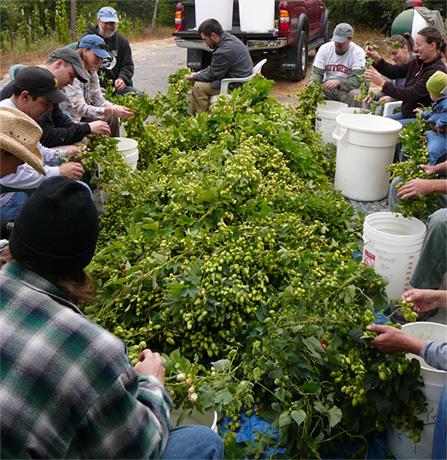
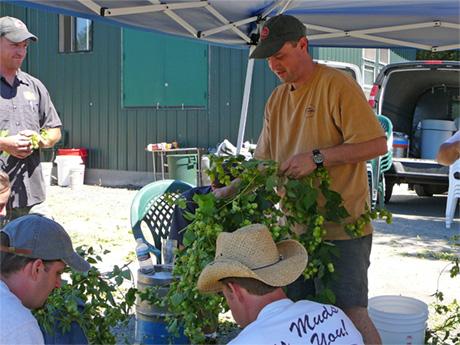
On Monday, I helped out with the hop harvest of cascade, chinook and red vine hops grown on the property at Moonlight Brewing and shared with Russian River Brewing for the two breweries’ fresh hop beers. Moonlight’s is called Homegrown (in some places) and Russian River’s is know as HopTime. It was a lot fun — though today I’m still a little sore and scratched up — and took about five or six hours to complete the harvest. Then both brewers retired to their respective breweries to begin the process of making their fresh hop ales. The rest of us enjoyed a yummy lunch at Russian River provided by Natalie Cilurzo, the hop queen of Russian River Brewing.

Barley, the dog, adorned with fresh hops plays in the hopyard.

The Moonlight/Russian River hopyard.

Brewers Brian Hunt, assistant brewer Travis, and Vinnie Cilurzo in their hopyard.

Brian Hunt on a ladder cutting down hopvines from ten-foot wires strung across the yard.

Then the bottoms are cut so the vines can be moved for picking.

The volunteer hop pickers in front of Moonlight’s brewery.

Everybody works in a circle picking the hop cones from the vine and collecting them in buckets.

A mound of hopvines ready to be picked. Cascade and Chinook hops are mixed in the pile.

Hops on the vine.

Stored in a bucket after picking.

A third hop is kept separate. This is Red Vine, a type of cluster hop.

Vinnie Cilurzo picking Red Vine hops.
 

Last Friday, the Wall Street Journal did a feature article about Fresh Hop Beers. If you don’t have a subscription, the Pittsburgh Post-Gazette syndicated the story and “To toast a new crop, brewers roll out ‘wet hop’ beer” is available online. I’ve been complaining lately that only smaller and regional traditional media is covering beer so it’s nice to see a big player step up. Though according to insiders, the story took many weeks to get approval and the author had to advocate persistently to finally get it published.

Filed Under: Events, News Tagged With: California, Hops, Mainstream Coverage, National, Northern California, Other Events, Photo Gallery

Craft Lager Fest Winners Announced

August 26, 2006 By Jay Brooks

Although in its fourth year, the Craft Lager Fest is a festival I have not had the opportunity to attend. But I like the idea of it, being another niche festival that highlights a particular style of beer, in this case lagers broadly. But since the majority of craft beer is undoubtedly ales, shining a spotlight on lager styles is a great idea.

The Craft Lager Festival takes place in a small town in Colorado, Manitou Springs, which is near Pikes Peak. This year they got 30 breweries from Hawaii to Boston participating. The winning breweries are listed below.
 

2006 Winners List

Best of Show: Edge City Pilsener (Bristol Brewing)

PILSENER

  1. Edge City Pilsner (Bristol Brewing)
  2. Skinny Dip (New Belgium)
  3. Polestar (Lefthand Brewing)

EXPORT/HELLES:

  1. Engineer Light Lager
  2. Longboard Island Lager (Kona Brewing)
  3. Edge City Pale Bock (Bristol Brewing)

BOCK:

  1. Sam Adams Double Bock (Boston Beer Co.)
  2. Black Bull Bock (Rock Bottom)
  3. Butthead Bock (Tommyknockers)

STRONG LAGER:

  1. No 1st Place Awarded
  2. Dutch (Rockyard American Grill & Brewery)
  3. Pre-Prohibition Pilsner (Phantom Brewing)

OKTOBERFEST/VIENNA/MARZEN:

  1. Damn Straight Lager (Dillon Dam)
  2. Lewis & Clark Lager (Lewis & Clark Brewing)
  3. Steam Engine Lager (Steamworks Brewing)

OTHER SPECIALTY LAGER:

  1. Dunkelstilsken (CB Potts)
  2. Z Lager (Fort Collins Brewing)
  3. Founders (Carvers Brewing)

SUMMER SPECIALTY ALE:

  1. East meets Wheat (Phantom Canyon Brewing)
  2. Raspberry Wheat (Il Vicino)
  3. Wildcat White Ale (Rockyard American Grill & Brewery)


Filed Under: Events, News Tagged With: Awards, Colorado, Festivals

Anhesuer-Busch Takes Over Marketing & Sales of Kirin

August 26, 2006 By Jay Brooks

Anheuser-Busch and Japan’s Kirin Brewery annnounced today that their alliance will be enlarged to include marketing and sales of Kirin beers in the United States. Currently, A-B contract brews all Kirin beers for the domestic market at its Los Angeles brewery. That relationship began ten years ago and included distribution, as well, through A-B’s network of 600 wholesalers. Since 1993, Kirin has been contract brewing Budweiser in Japan for the Japanese market.

August A. Busch IV, president of Anheuser-Busch, was quoted as saying. “American consumers have a great interest in high-end Asian cuisine and culture, including Asian beer.”

Now that’s high-end, klassy with a “k.” Anybody want to venture a guess as to how she’s holding that glass? It looks like it’s glued to her hand or was done with Photoshop.
 

Busch continued. “We are aggressively expanding our range of high-end beers to meet the diverse needs of our consumers. The Kirin beers are of the highest quality and have enormous potential, as the Asian influence is rapidly growing. This new agreement enhances a truly global relationship between our two companies. Now, we also share a deeper commitment to each other’s success.”

But the big three Japanese breweries — Asahi, Kirin and Sapporo — are experiencing the same loss of market share the big U.S. brewers are, and for much the same reasons. Japan’s consumers, mirroring their American counterparts, are demanding more flavorful beers. But at the same time, economic difficulties have led to price wars with so many customers shopping on price alone.

This in turn has led to the rise of cheaper beers made with grains other than barley. Because of oppressive taxes on beer in which over a third of a beer’s cost goes to the government, brewers have been making alternative brews using less than 67% malt by using rice, corn or even soybeans as substitutes. These beers can be sold for half of the all-malt beers. But as for taste, most say you get what you pay for. Long term, this is potentially very damaging to the industry.

As for Kirin’s story, American businessman William Copeland and German brewmaster Herman Heckard founded the Spring Valley Brewery outside Tokyo in 1870. For luck they put a “Kirin” on the label. A “Kirin” (Qilin in Chinese) is a mythical beast that is generally considered a sign of good luck. Though it was not necessarily lucky for the Spring Valley Brewery, which closed in 1884 and became the Japan Brewery Co. a year later under new owners from Yokohama. In 1907, the Mitsubishi family bought the brewery, renaming it the Kirin Brewery. Kirin is currently the best selling beer in Japan.

Filed Under: News Tagged With: Asia, Business, National, Press Release

« Previous Page
Next Page »

Find Something

Northern California Breweries

Please consider purchasing my latest book, California Breweries North, available from Amazon, or ask for it at your local bookstore.

Recent Comments

  • Bob Paolino on Beer Birthday: Grant Johnston
  • Gambrinus on Historic Beer Birthday: A.J. Houghton
  • Ernie Dewing on Historic Beer Birthday: Charles William Bergner 
  • Steve 'Pudgy' De Rose on Historic Beer Birthday: Jacob Schmidt
  • Jay Brooks on Beer Birthday: Bill Owens

Recent Posts

  • Beer In Ads #5138: Flower City Bock Beer March 1, 2026
  • Historic Beer Birthday: Danny Williams March 1, 2026
  • Historic Beer Birthday: Charles Weyand March 1, 2026
  • Beer In Ads #5137: Bock Is Back… Look For It March 1st February 28, 2026
  • Historic Beer Birthday: John Holme Ballantine February 28, 2026

BBB Archives

Feedback

Head Quarter
This site is hosted and maintained by H25Q.dev. Any questions or comments for the webmaster can be directed here.