Brookston Beer Bulletin

Jay R. Brooks on Beer

  • Home
  • About
  • Editorial
  • Birthdays
  • Art & Beer

Socialize

  • Dribbble
  • Email
  • Facebook
  • Flickr
  • GitHub
  • Instagram
  • LinkedIn
  • Pinterest
  • RSS
  • Twitter
  • YouTube

Powered by Genesis

New Study Reveals RWJF Behind Neo-Prohibitionist Movement

October 9, 2009 By Jay Brooks

rwjf
Dan Mindus at the Center for Consumer Freedom recently published a report entitled Behind the Neo-Prohibition Campaign detailing just how deep the tentacles of the Robert Wood Johnson Foundation (RWJF) go in funding neo-prohibitionist groups and campaigns. As someone who pays attention to the interconnectedness of the neo-prohibitionst organizations, I was still floored by what Mindus uncovered. I often take some flack for crying conspiracy concerning these organizations but I feel a certain vindication at just how big a role RWJF actually plays in leading the charge against alcohol.

Here’s an excerpt from the report:

America’s anti-alcohol movement is composed of dozens of overlapping community groups, research institutions, and advocacy organizations, but they are brought together and given direction by one entity: the Robert Wood Johnson Foundation (RWJF). Based in Princeton, New Jersey, the RWJF has spent more than $265 million between 1997 and 2002 to tax, vilify, and restrict access to alcoholic beverages. Nearly every study disparaging alcohol in the mass media, every legislative push to limit marketing or increase taxes, and every supposedly “grassroots” anti-alcohol movement was conceived and coordinated at the RWJF’s headquarters. Thanks to this one foundation, the U.S. anti-alcohol movement speaks with one voice.

For the RWJF, it is an article of faith that diminishing per capita consumption across the board can contain the social consequences of alcohol abuse. Therefore, it has engaged in a long-term war to reduce overall drinking by all Americans. The RWJF relentlessly audits its own programs, checking to see if each dollar spent is having the maximum impact on reducing per capita consumption. Over the past 10 years, this blueprint has been refined. Increased taxes, omnipresent roadblocks, and a near total elimination of alcohol marketing are just a few of the tactics the RWJF now employs in its so-called “environmental” approach.

The environmental approach seeks to shift blame from the alcohol abuser to society in general (and to alcohol providers in particular). So the RWJF has turned providers into public enemy number one, burdening them with restrictions and taxes to make their business as difficult and complex as possible. The environmental approach’s message to typical consumers, meanwhile, is that drinking is abnormal and unacceptable. The RWJF seeks to marginalize drinking by driving it underground, away from mainstream culture and public places.

The RWJF funds programs that focus on every conceivable target, at every level from local community groups to state and federal legislation. Every demographic group is targeted: women, children, the middle class, business managers, Hispanics, Blacks, Whites, Native Americans. Every legal means is used: taxation, regulation, litigation. Every PR tactic: grassroots advocacy, paid advertising, press warfare. Every conceivable location: college campuses, sporting events, restaurants, cultural activities, inner cities, residential neighborhoods, and even bars.

The RWJF scored a major victory in 2000 with a federal .08 BAC mandate, and can claim credit for restrictions on alcohol in localities all over the country. But its $265 million has accomplished much more: it has put in place all the elements required for more sweeping change. This includes a vast network of local community organizations, centers for technical support, a compliant press, and a growing body of academic literature critical of even moderate alcohol consumption. The next highly publicized study or angry local movement may now reach the “tipping point” where the RWJF-funded anti-alcohol agenda snowballs into the kind of orchestrated frenzy the tobacco industry knows well.

You can read the entire report in a pdf, and if you care about keeping alcohol legal in the U.S., I’d highly encourage you to do so. The report, Behind the Neo-Prohibition Campaign, is only 28 pages and includes a list of the organizations and people to watch out for.

Here’s another excerpt, listing the main points in the RWJF’s plan of attack:

The Anti-Alcohol Movement’s Game Plan

The RWJF-funded anti-alcohol movement seeks to convince the public of the following propositions:

  • The social consequences of alcohol consumption are immense, and require drastic action.
  • The vast majority of Americans either abuse alcohol or don’t drink it. The former shouldn’t have access to alcohol, and the latter won’t care if you take it away.
  • Responsible drinking is an oxymoron.
  • Drinking is not normal, it is not acceptable, and it should be isolated from mainstream culture.
  • Adult drinking encourages kids to engage in reckless behavior.
  • The alcohol industry “targets” children, abusers, and minorities with “deceptive” advertising.
  • Alcohol advertising leads inexorably to abuse.
  • Convenient, inexpensive alcohol leads inevitably to its abuse.
  • There is no such thing as responsible drinking and driving.

The more the public hears these messages, the more they will tolerate the legislation and regulation of the “environmental approach.” Billboards have been taken down, hours of service have been slashed, roadblocks have been thrown up, legal BAC levels have come down, taxes have been raised, ads in restaurants have been eliminated. It’s only the beginning.

Be afraid. Be very afraid. These folks are committed fanatics. They cannot be reasoned with. They will not bow to logic. They cannot be appeased. They have no qualms about bending the truth or outright fabrication. They will do absolutely anything to advance their misguided cause. They hate me and you, too, if you think drinking beer is okay.

Filed Under: Editorial, News, Politics & Law Tagged With: Prohibitionists

Not Drinking Leads To Depression

October 6, 2009 By Jay Brooks

pink-elephant
It will be interesting to see how the neo-prohibitionists spin this one. An article in Time magazine, entitled Why Nondrinkers May Be More Depressed, by John Cloud, details the findings of a recent study that suggests “those who never drink are at significantly higher risk for not only depression but also anxiety disorders, compared with those who consume alcohol regularly.”

That study, Anxiety and Depression Among Abstainers and Low-Level Alcohol Consumers, was published in the journal Addiction. According to the press release from the journal:

Abstaining from alcohol consumption is associated with an increased risk of depression according to a new study published in Addiction journal.

It has long been recognised that excessive alcohol consumption can lead to poor physical and mental health. However, there has been mounting evidence that low levels of alcohol consumption may also be associated with poor mental health possibly due to abstainers having other health problems or being reformed heavy drinkers.

The study utilized data from the Nord-Trøndelag Health Study (HUNT Study) based in Norway. This provided information on the drinking habits and mental health of over 38,000 individuals. Using this data the authors were able to show that those individuals who reported drinking no alcohol over a two week period were more likely than moderate drinkers to report symptoms of depression. Those individuals who additionally labeled themselves as “abstainers” were at the highest risk of depression. Other factors, such as age, physical health problems and number of close friends could explain some, but not all of this increased risk. The authors also had access to reported levels of alcohol consumption 11 years prior to the main survey. This showed that fourteen percent of current abstainers had previously been heavy drinkers, but this did not explain all of the increased risk of depression amongst abstainers.

The authors conclude that in societies where some use of alcohol is the norm, abstinence may be associated with being socially marginalized or particular personality traits that may also be associated with mental illness.

Though the authors of the study stop short of encouraging abstainers to start drinking, the Time magazine concludes with what any rational person reading this might think, which is “just say yes.”

The most powerful explanation seems to be that abstainers have fewer close friends than drinkers, even though they tend to participate more often in organized social activities. Abstainers seem to have a harder time making strong friendship bonds, perhaps because they don’t have alcohol to lubricate their social interactions. After all, it’s easier to reveal your worst fears and greatest hopes to a potential friend after a Negroni or two.

So does this mean we should all have a cocktail? Maybe, but Skogen says he doesn’t believe his study should encourage abstainers to become drinkers. Rather, he says doctors might want to investigate why abstaining patients don’t drink and explain that in societies where alcohol use is common, not drinking may lead them to feel left out. Sometimes, you should just say yes.

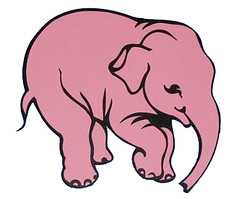
In addition to this study concerning mental health, several studies over the past decade or more have also concluded that the moderate consumption of alcohol leads to better physical health than for people who abstain from it. Better physical health and now better mental health, all from simply having a drink or two regularly. To me, that’s the pink elephant in the room.

pink-elephant

The anti-alcohol groups seem so hell bent on their all or nothing approach, seeing any alcohol as bad and no alcohol as all good, when the reality is hardly that simple. As these studies suggest, the common ground should be a more reasonable approach that leads to more drinking in moderation, removing the conditions that lead to over-consumption through education, strengthening infrastructure for public transportation so people can go out for a drink without fear, and recognizing that drinking alcohol does have many positive attributes when consumed responsibly. I realize that seems like a Herculean task at this moment in time, but that’s the only way I can see moving past the entrenched positions of both sides.

Obviously, I’m on one side of the aisle and I honestly believe that no one involved with the alcohol industry thinks that over-consumption or any extremes in drinking are a good thing. Both camps seem to agree on that. But the people against alcohol seem incapable of giving up any ground to concede that for most people moderate drinking may not be the evil they believe or that it doesn’t necessarily have to lead to greater problems. That very unwillingness, I believe, is actually exacerbating the problems that some people do experience with drinking too heavily because their focus is on the wrong problem and paints all drinkers will the same broad brush. As science continues to confirm that alcohol has been, and still is, a part of a healthy lifestyle, that position will become harder and harder to defend.

Remember the definition of an abstainer by Ambrose Bierce, in his Devil’s Dictionary:

Abstainer: n. a weak person who yields to the temptation of denying himself a pleasure.

Filed Under: Editorial, News, Politics & Law Tagged With: Mainstream Coverage, Prohibitionists, Statistics

Top 5 Beer Cities & America’s Best Beers

October 6, 2009 By Jay Brooks

mens-journal
Men’s Journal yesterday released their annual lists of beer, both America’s Best Beers and The Top Five Beer Towns in the U.S.. Let’s look at the top five cities first.

  1. San Diego
  2. New York City
  3. Portland
  4. Philadelphia
  5. Chicago

It’s nice to see San Diego get some much-deserved love. While I think New York has improved in it’s beer scene over the last few years, I still have a hard time seeing it as being superior to Portland or Philly. Of course, Men’s Journal, like many periodicals, is published in New York and it’s been my experience (I lived there for several years once upon a time) that New Yorkers have an over-developed sense of their central position in the world. Naturally, I would have liked to see San Francisco on the list, but really it’s the Bay Area in total that’s most deserving, not that just the city’s scene isn’t good, too.
top-5-beer-cities
As for the beers they highlight this year, it’s a pretty good list, I’m happy to say. I especially love their introduction, where they reveal what many of us in the beer world have been saying for a few years now: “American craft brews now dominate” around the world. Finishing with “[n]ow there’s no reason to travel farther than your nearest specialty grocery store for a perfect beer.” If only the grocery chains would catch up and stock a wider range of good beer.

The list is divided into five broad categories; ales, lagers, dark beers, Belgian-style and cutting edge. Authors Christian DeBenedetti and Seth Fletcher then chose three beers of each kind to come up their top 25. As subjective at these lists can be, I have to say Men’s Journal is getting better at picking their top beers. While there are plenty of other beers I might have put on such a list — as any two people would undoubtedly choose different beers — I can’t really quibble with any of the beers they picked, save one or two, but not even enough to mention. I’ll have to do my own list one of these days.

Filed Under: Beers, Editorial, Just For Fun, News, Reviews Tagged With: Lists, Mainstream Coverage, Statistics

Mad Money Man Jim Cramer Declares Beer Wars Over

October 6, 2009 By Jay Brooks

white
Jim Cramer, the knucklehead financial dramatist who hosts the Mad Money program on MSNBC, tackles the beer wars between the major brewers, and trips over himself all over the place. You’d think no one would would watch his show or take his advice after Jon Stewart exposed him so completely earlier this year, but apparently he’s as popular as ever. That’s surprising to me given that his track record is about as good as the average weatherman. The financial markets being complex and interconnected systems, his simple-minded advice seems doomed to failure for that reason alone, but he still promises on his website that you can “Make Money With Money Manager Jim Cramer.” Caveat emptor, I guess. Maybe it’s just me, but I don’t really like having my advice yelled at me while waving cheap props in my face.
mad_money
Like most financial analysts I’ve seen talk about the brewing industry lately, Cramer has no real sense of what’s going on or the history involved with why the industry is where it is today. And so they seem to attack in a vacuum, with no understanding of it at all. You can check out his screed here about the end of the beer wars.

He details how the beer world until recently was dominated by eight companies: Bud (Anheuser-Busch) Coors, Corona (Grupo Modelo), Dos Equis (FEMSA / Cervecería Cuauhtémoc Moctezuma), Heineken, Miller, Molson and Pabst. But now that InBev bought A-B and Coors and Miller merged their operation in the U.S., “suddenly” — to use Cramer’s surprising words — “we have a near oligopoly?” First of all, these eight are not the full picture. He’s ignored Kirin, Carlsberg, Asahi, and Diageo; all in the top 10 largest beer companies globally. That’s not to mention Radeberger, Tsingtao, Foster’s and others just below the Top 10.

Then there’s the “suddenly” that Cramer keep and his gang of idiots keep feigning. Brewery consolidation has been going on literally since Prohibition ended, 75 years ago. From roughly 1,000 breweries re-opening in the years after alcohol became legal again to 1984, when there were only 44 left, and the top six accounted for 92% of beer sold, mergers & acquisitions have been on-going. This is hardly a new situation. And that’s just the U.S. The same thing has been happening around the world, both locally and in global markets. We’ve been referring to the “Big 3” — A-B, Coors & Miller — for decades. Now that there are two it’s a problem? “Suddenly?” Please …. give me a break.

Recently, ABI announced they would raise prices this fall, and MillerCoors followed suit … like they’ve always done, again for years and years. But Cramer and others reacted as if this is the first time such a thing has happened. It’s not. The major beer companies, both domestic and import, have been following one another’s lead (usually A-B) for as long as I can remember, and undoubtedly longer.

The New York Times has a similar rant in, of all things, their “breaking Views” section called Rising Beer Prices Hint at Oligopoly. I find it funny that something going on without change for decades could be considered a “breaking view,” but I guess that’s what happens when you ignore history.

Anheuser-Busch InBev — purveyor of the president’s preferred brew, Bud Light — and MillerCoors, a joint venture between SABMiller and Molson Coors, are raising prices at the same time, during a recession and while beer demand is slumping. With 80 percent of the market between them, the move almost begs for an antitrust review. [my emphasis.]

Hello, is anybody home? They’ve been raising prices “at the same time” forever. It means nothing. These are not “hints,” but simply business as usual. What the hell is wrong with these people?

Cramer goes on to rave that because they’re both raising prices that somehow that signals an end to the competition between them. He states that they’ve been “going from competitors absolutely killing each other to a slap happy international beer oligopoly.” He’s more daft than I previously thought, and that’s saying a lot.

He keeps calling Labatt, “Labott,” and incorrectly identifies it with InBev. It is owned by InBev outside the U.S., but domestically it’s owned by North American Breweries. His audience is primarily American, so that makes no sense. Cramer’s advice about buying MolsonCoors stock I can’t say I understand completely and he throws around quite a few numbers that don’t seem to either support his conclusions or even appear rational. He’s mildly clever when he says “Give Beer A Chance” with a peace symbol made of beer cans, but I’d prefer he did his homework instead and knew what the hell he was talking about. What a maroon.

The beer wars, of course, are hardly over.

Filed Under: Breweries, Editorial Tagged With: Economics, Mainstream Coverage

If Beer Is The Kettle, CASA Is The Pot

October 2, 2009 By Jay Brooks

casa
The National Center on Addiction and Substance Abuse (CASA) at Columbia University, is nothing so grandly academic as its name suggests, but one of a growing number of anti-alcohol groups infecting America with its agenda. Today, its Chairman and Founder Joseph A. Califano, Jr., accused the Brewers Association and the Beer Institute of Chutzpah (which he misspelled “chutzpa”) and two specific members of the House of Representatives of hypocrisy. Talk about the pot calling the kettle black!

On his Chairman’s Corner blog today, he rails against the BEER Act, which Congress introduced back in mid-February. H.R. 836, or as its more commonly known, the Brewers Excise and Economic Relief Act of 2009, seeks to roll back the federal excise tax on beer that was doubled in 1991. The bill also would provide additional tax relief for small brewers. Most people, especially those who oppose alcohol, make the assumption that excise taxes are proper to punish the sin of drinking.

He gives his “First Annual Chutzpa (sic) Award” to the Brewers Association and the Beer Institute for H.R. 836, claiming they’re arrogant and he even has the balls to suggest them of bribery! First of all, he’s seriously delusional if he thinks small brewers have piles of cash for lobbyists.

The fact that a trade organization might work for favorable treatment by Congress for its industry or for a reform of the laws that regulate them, appears to be a novel concept to Califano. Isn’t that what every trade organization does? Did I miss a meeting? It’s okay for every other lobby, but not beer? And we’re arrogant for being happy when something goes our way?

He’s upset because for some reason he believes that the alcohol industry is responsible for the minority of people who abuse it. And, as usual, he throws around the nonsensical statistics of how much societal costs alcohol is apparently on the hook for, even though that’s not true of virtually any other industry.

As I’ve noted in Sin Tax Tyrannies, U.S. Senate Told To Raise Beer Taxes, Stupid Is As Stupid Does, The Lie That Won’t Go Away, and who knows how many others at this point, the notion of taxing only alcohol and tobacco should be deeply disturbing to any rational human being. Those two products are the only ones in our country that have excise taxes imposed on them, taxes no other companies have to pay.

People like Califano and his ilk see no apparent contradiction in tobacco and alcohol having to pay for their presumed sins but every other product that’s bad for us in quantity doesn’t have to. Soda companies don’t pay for the medical costs of the obesity epidemic. Meat companies don’t pay for higher heart risks from the over consumption of beef. Too much of almost anything can be bad for you, but we don’t say there shouldn’t be prescription drugs on the off chance that some people might abuse them.

Califano goes on to give his so-called “First Annual Hypocrisy Award” to the sponsors of H.R. 836, calling them hypocrites because for reasons passing understanding he seems to believe that being pro-alcohol and also for health care reform is contradictory. It appears to come back to the idea that alcohol has to pay for any health consequences that someone who drinks might encounter, yet no other industry has to do likewise. The Patriot Act specifically gave an exemption to pharmaceutical companies for any harm caused by them, but beer better pay its bill, by gum.

To me, that’s a far more hypocritical position to take, especially when his arguments are laced with the usual faulty statistics and, naturally, the “it’s for the children” gambit that has become de rigueur for anti-alcohol groups to invoke. Cutting the beer tax, Califano insists will mean more underage drinking, despite the fact that underage drinking is still illegal. The fact that people under 21 still manage to buy alcohol is somehow the beer industry’s fault; not law enforcement, not retail, not the ridiculousness of the law itself. But raising the tax (and thus the price) so it’s too expensive for kids punishes every adult who can legally buy alcohol, too. That’s not a problem if you want another prohibition, of course, but for the rest of society that seems patently unfair and even cruel.

Most intelligent legislators I should think are more concerned about getting our economy on firmer footing — something that H.R. 836 easily accomplishes — than following the misguided advice of the lunatic fringe that CASA represents. If I had my own made-up award for hypocrisy, Califano, CASA, and the rest of the Neo-Prohibitionist groups, would certainly be worthy recipients.

Filed Under: Editorial, Politics & Law Tagged With: Prohibitionists, Statistics

Serenity In Beer & Ale

October 2, 2009 By Jay Brooks

ubif
During World War 2, the brewing industry trade organization known as the United Brewers Industrial Foundation, which was formed by the USBA in 1937, worked with the U.S. Government to create a series of ads to build morale and on their own to highlight the positive aspects of beer. Out of these grew the more familiar “Beer Belongs” series and the “Home Life in America” series of ads that the United States Brewers Foundation created and ran from 1945 to 1956. You can read my article about these later ads in the current issue of All About Beer magazine. But I recently came upon the ad below that ran in Life magazine’s August 4, 1941 issue, at page 29. I just love the language of the text, which I reprinted below, because it’s hard to read with the ad displayed so small. (Though you can click on it or here to see a larger view.)

In a hurrying, scurrying world


there’s serenity in beer and ale

 
Telephones jangling … radios blaring … auto horns honking … airplanes roaring. In big city or small town, peace is hard to find … and precious.

YES! It’s a busy, dizzy world in which we live! And every man and woman in it needs now and then to get away from it all. Needs to sit down quietly and shut out the din and noise for a peaceful hour or so.

In your needed hours of relaxation, beer can play a pleasant part. For this delicious brew does more than delight your taste. Its mellow, kindly nature helps to unsnarl tangled nerves, helps to refresh a weary body, helps to restore a faltering spirit.

Made from nature’s choicest grains and flavored with plump, ripe, fragrant hops, beer is a mild, wholesome brew. In fact, from earliest times, men have called beer and ale the “beverages of moderation.” Make them part of your own plan of balanced, tolerant, temperate living.

UBIF

Isn’t that just beautiful. It brings a tear to your eye. Beer is certainly part of my own balanced, tolerant, temperate living. It’s funny how the pressures of life in 1941 seem almost exactly the same as those of 2009, isn’t it? I need a vacation. Good thing I’m taking one in less than two weeks.

Filed Under: Art & Beer, Breweries, Editorial, Just For Fun Tagged With: Advertising

Beer Raped Your Daughter and Gave Her Gonorrhea … Again

October 1, 2009 By Jay Brooks

reason
Thanks to Anat Baron for tweeting this my way, but it seems that the storm clouds are once again gathering over ridiculous propaganda aimed at beer. Luckily, Reason Magazine — a periodical I’ve written for — is on the case in a piece entitled Beer Raped Your Daughter and Gave Her Gonorrhea. Again.

It concerns a Washington Post editorial where two doctors argue out of — one hopes — a sense of fealty to their Hippocratic oath that more expensive beer means lower consumption, less problems, less issues, less greenhouse gas emissions, less poverty, less .. well, you get the idea — the world will be a magically better place if only there were more taxes on beer. Of course, we’ve been down this argumentative road before and their statistics, like others before them, don’t add up. They never do, but that doesn’t stop them for spouting off and making this shit up, because they seem to be taking the approach of a lie repeated often enough becomes a fact over time. As a member of The Angry Arm of the Alcohol Lobby, I say bullshit.

Here’s their nut job argument in a nutshell:

One way to reduce the harmful effects of heavy drinking is to make drinking more expensive: the more a drink costs, the less people drink. This is true of young people, pregnant women and even heavy drinkers. Research indicates that a 10 percent increase in current alcohol excise taxes — that is a penny for a beer — would result in less drinking, especially among underage drinkers, reducing rape, robbery, domestic violence and liver disease. A tax increase of 3 cents per beer would cut youth gonorrhea by 9 percent.

So more expensive beer means less rape, less STDs, less domestic violence and all manner of other horrors. Because that’s the way it’s worked as cigarette prices have kept going up, right? Here’s how Reason looked at this argument:

I’m going to pull out that last line one more time in case you, like me, sometime skim over blockquotes too quickly:

A tax increase of 3 cents per beer would cut youth gonorrhea by 9 percent.

Look at the lovely young lady at right [an old Budweiser print ad of a couple fishing]. If only a three cent tax on that Budweiser could have saved her from the heartbreak of VD.

Messrs. (Drs.?) Sederer and Goplerud have taken the fine art of vaguely claiming that “studies show…” to a new level. Obviously, the argument here is that lots of beer makes people more likely to rape, pillage, etc. and that pricier beer means less consumption. A quick Google reveals that they’re pulling from 2000 study that looked at beer taxes and gonorrhea rates in various states. Reason, of course, tore this study a new one back when first made the rounds. Key passage:

[David Murray of the Statistical Assessment Service, a non-profit think tank in D.C.] does yeoman’s work pointing out the junk reasoning at the root of so much junk science. This one was a high, hanging curve for Murray, who said the CDC’s thinking was on the level of “the sun goes down because we turn on the street lights.”

The really interesting thing is that the CDC, in effect, agrees with that criticism. It buries its assent, however, in an editorial note that says the findings “do not prove a causal relation between higher taxes and declining STD [sexually transmitted disease] rates.”

To get a sense of how bad their math is, just look at their assertion that a 10% increase means only one penny more in excise taxes. That would mean that the taxes now would be 10 cents for that to be true. Are they? Not even close. There’s a federal excise tax on beer, and then a state one, too, and the amount varies widely from state to state, making that line ridiculous on its face.

And they trot out this old saw:

It has been 18 years since federal taxes on alcohol have changed. If all spirit taxes had increased at the consumer price index and been taxed like liquor, federal taxes on a shot of spirits would have increased by 10 cents, a beer by 21 cents, and a glass of wine by 24 cents. Making that adjustment now would raise $101 billion over 10 years, without state tax increases. Equalizing the tax among beer, wine and spirits, without inflation, would raise $60 billion over 10 years.

Don’t you believe it. I’ve examined this argument thoroughly before in Here We Go Again: Beer & Taxes and Why Alcohol Doesn’t Get A Pass, among others, and it’s nothing but vicious propaganda. And propaganda made even worse by virtue of it coming from medical doctors, who people tend to believe have their best interests at heart. They don’t, of course, doctors have their own interests at heart, like everyone else. Just look at how they attacked the idea of health care reform, beginning all the way back in 1948 when a P.R. firm hired by the AMA actually coined the term “socialized medicine” to scare people into making sure we wouldn’t have universal health care in this country. That’s how much they care about you and me.

If you track these things, like I tend to, you’ll notice that the attacks on alcohol have been getting more frequent, more virulent and more mainstream. You don’t think that could have anything to do with pharmaceutical ads proliferating while alcohol ads are highly regulated and restricted? Nah, must be a coincidence. Now where does your daughter hang out? I want to buy her a beer.

Filed Under: Editorial, News, Politics & Law Tagged With: Mainstream Coverage, Prohibitionists, Statistics

Time and Money and Beer

September 20, 2009 By Jay Brooks

Clock
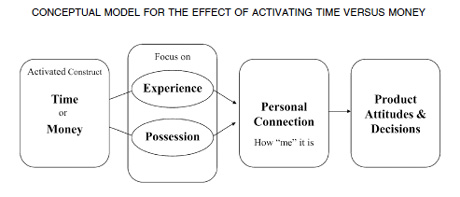
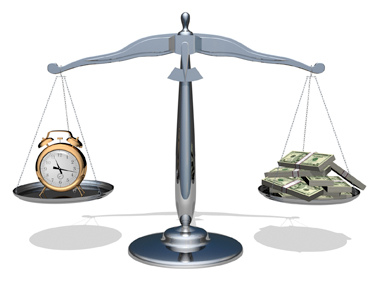
Forbes had an interesting article Friday entitled Time Vs. Money: Which Rules Buying Decisions?. The article is based on a recent academic paper published in the Journal of Consumer Research by Cassie Mogilner, a professor of marketing at Wharton, and Jennifer Aaker, a professor of marketing at Stanford University’s Graduate School of Business. That paper, entitled The Time vs. Money Effect: Shifting Product Attitudes and Decisions through Personal Connection [pdf], examines people’s associations with both time and money and how they relate to decisions about what products to buy. It’s a fairly common element in advertising. According to the study, “a content analysis of ads in four magazines targeting a wide range of consumers (Money, New Yorker, Cosmopolitan, and Rolling Stone) revealed that, out of 300 advertisements, nearly half of the ads (48%) integrated the concepts of time and/or money into their messages.”

time-money-model

Irrespective of whether feelings of personal connection stem from experiences gained using the product or from the mere possession of the product, we hypothesize that increasing one’s feelings that the product is “me” will lead to more favorable product attitudes and increased choice. Indeed, decades of research in psychology have given credence to the assumption that individuals are motivated to (and do) view themselves favorably. Consequently, people tend to have positive automatic associations with respect to themselves—which can influence their feelings about almost anything that is associated with them. For example, people like the letters that appear in their own names more than those that do not, and they are nicer to strangers who share their birthday than they are to other strangers.

One example the authors use is about beer (which is how I came to notice it). From the Forbes article:

“One thing that was surprising,” [Mogilner] says, “was to see how consumers’ attitudes and behaviors toward products and brands can be shifted by something as subtle and as pervasive as mere mentions of time or money. “The concept of time, for example, evokes a personal connection with a product in terms of the experience the consumer gains while using it, she says. To illustrate her point, [she] cites a well-known phrase in beer marketing—”It’s Miller Time.” The ads are still remembered by many consumers from the 1980s because consumers associated the beer with the routine, end-of-day transition from work to leisure.

As for the different emotions that money and social status-related campaigns can conjure, Mogilner points to advertisements for Stella Artois, a premium beer from Belgium. One of the product’s ads shows a man struggling to earn money—whether by chasing pigs, hauling sticks or herding goats—so he can buy his grandmother a pair of beautiful, expensive red shoes. But, alas, just as he’s about to present her with the gift, he spies a pint of Stella and makes a shoes-for-beer trade with the waitress. The commercial is funny, but it also captures the company’s “Perfection has its price” tagline, Mogilner says.

Both Miller and Stella are trying to sell beer. But using the concept of either time or money invites consumers to connect with a product—in this case, beer—in different ways. Of the two, the researchers found that a “Miller Time” connection typically leads to more favorable consumer attitudes and purchasing decisions because people tend to identify more closely with products they have experienced. “If you can dial up one’s thinking about time spent experiencing the product relative to thinking about the money spent to own the product, then you tend to get … beneficial effects,” Mogilner says.

But the “Perfection has its price” crowd is also important, Mogilner adds, even though there are fewer examples of consumers connecting to a product primarily because of its acquisition price. “There are cases where thinking about money can actually be a good thing for particular types of consumers, and particular types of products.”

time-or-money

This is not the first time the psychology surrounding time and money has been studied. Not surprisingly, it adds to the chorus that time beats money in the rochambeau of life. As the article explains, “[r]esearchers have found that because time is less fungible—or less easily replaced—than money, losing time tends to be a more painful event for people, particularly when they think about how they are not able to make up for it. Another difference is that people feel less accountable for how they spend their time because it can be more difficult to measure than monetary outlays. These two characteristics—fungibility and ambiguity—are important differentiators in how consumers think about time and money.”

From prior research, they posit that it “seems highly likely that people will also like products more that are more closely connected to the self than products that are not. Evidence from consumer research offers support for this prediction, showing that consumers report more favorable attitudes toward products that reflect their personal identities.” But then they take their hypothesis in a different direction for conventional wisdom, arguing ” that when these feelings of personal connection stem from experiences gained using the product, activating time (vs. money) should lead to more favorable product attitudes and decisions. In contrast, when feelings of personal connection stem more from product possession,” this does not occur, or least not as strongly.

To me, that’s the important revelation in this new study; that a third consideration is equally important: “the extent to which each concept is linked to consumers’ personal experiences, identity and emotions.” To advertisers, they specifically “propose that activating the construct of time while consumers evaluate a product will lead them to focus on their experiences using the product, which generally will heighten their personal connection to that product—their feeling that the product reflects the self.” So between time and money, the clear winner according to the results of their work is time. “By simply directing people’s attention to time, rather than money, you can actually make people make happier decisions.” But the true insight, I think, is linking that to the experience.

Many of us who write about beer, myself included, have waxed philosophically, even poetically, about how drinking beer is a community affair, that it’s best as a shared experience. Indeed, countless ads for beer are set in social situations and in fact I can’t think of one that features solitary drinking — not counting George Thorogood. Although I often drink alone for professional reasons, in most instances it’s considered a societal taboo, carrying very negative associations. While I don’t think it’s necessarily indicative of “problem” drinking or anything so sinister, it’s certainly not desirable.

So while I think their study is applicable universally, it seems more relatable to beer than many other products, because I think drinking beer is such an experiential beverage. I imagine I’m not alone in having all my best drinking memories ones with friends. It’s probably not a stretch to say that’s universal, too. So the idea that time and the emotional experience of spending it with friends seems almost obvious, but it’s still interesting that it’s borne out by this, and other, studies. For me personally, it may not be Miller Time, but it is “beer time.” Who wants to join me?

If you have the time (yes, pun intended) and inclination, the five studies they conducted (and the whole paper) is worth reading. It’s a little dry and steeped in academic jargon, but interesting nonetheless. (It’s also only 15 pages, and three of those are references.)

Filed Under: Editorial, Politics & Law Tagged With: Advertising, Marketing, Statistics

Back Door Advertising

September 10, 2009 By Jay Brooks

bud-lime-can
Several people sent me a link to ABIB‘s latest ad campaign for Bud Light Lime in a can. You can watch the online commercial below.

I’m not quite sure what to make of it. I’m generally a fan of the double entendre and the wit it often employs, but this Bud Light Lime ad seems less witty and more coarse, low-brow and unsophisticated. Klassy with a “K.” And I say that not because of its naked and unsubtle allusions to sex or because — gasp — children might see it. I’m not personally offended in any way. But regardless of what I think about Bud Light Lime, it hardly shows beer in a positive light. It may be the least respectful ad since Miller’s infamous mud wrestling ad or Bud’s recently flatulent horse.

Created by the ad agency DDB Chicago, so far the reaction has been mixed, yet both sides seem to prove my point that this is not the way to portray beer if we want anyone to take it seriously. (And before anyone chimes in with “but it’s just Bud Light,” like all advertising it accumulates to the overall perception of beer by society at large, so I believe it does matter.) On one hand, Advertising Age says In Juvenile Bud Light Lime Spot, This Butt’s for You, finding it too tasteless to be effective. They conclude:

Crude ads are, of course, nothing new in the category that brought the world the “Swedish Bikini Team,” but they’ve been a bit scarce since Miller Brewing Co.’s bottom-scraping use of bikini-clad mudwrestlers in a 2003 “tastes great, less filling” brawl.

That ad sparked wide recriminations about how lowest-common-denominator advertising turns the product into a commodity indistinguishable by any measure other than whose proprietor has lower standards. For a while after, advertisers toned it down, taking a back seat to fast-food chains and even domain registrars when it came to over-the-top ads.

But perhaps our long national nightmare of relatively tasteful beer ads is coming to an end at last.

But BrandFreak’s Kenneth Hein felt that it is the best thing Bud Light’s done in a while,” completely disagreeing with Advertising Age.

The problem with Bud Light and beer advertising in general is that brands are afraid to have fun. Sure, thinly veiled anal-sex jokes appeal to “the lowest common denominator,” but who cares? We’re talking about beer. A-B and its agencies need to have a couple and loosen up even more, because its recent run of ads have been a buzzkill.

But here’s where he proves my point. He likes the ad precisely because it’s tasteless as he writes “who cares? We’re talking about beer.” And that’s the rub. It perpetuates the perception that beer is just beer, nothing more. And that’s the belief a vast majority of people hold, which I think is almost entirely the fault of of ads like this one. Only the breweries that can afford to advertise on television nationally get their message to consumers. And for decades, that message has appealed to a lowest-common denominator ethos that’s painted beer as an interchangeable commodity. Only the brand is important, because for most of those beer companies, what’s inside is virtually the same. So you sell other ideas, and end up with a populace that perceives all beer as being the same. And that overall perception is hardly flattering. So most people tend to believe that beer is all the same; it’s just that swill that frat boys drink at tailgate parties or while binge-drinking their way through college.

And I hardly think this ad will change that. What do you think about it?

Filed Under: Beers, Editorial Tagged With: Advertising, Cans, Packaging, Video

U.S. Select Beer Taste

September 6, 2009 By Jay Brooks

us-outline
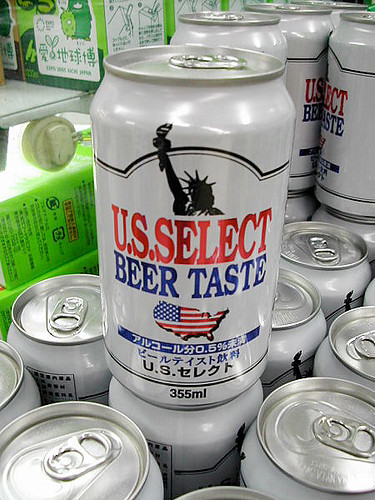
I stumbled on the photo of a peculiar beer below while looking for another image. It was on Holy Taco, a humor website as far as I can tell.

us-s-beer-taste

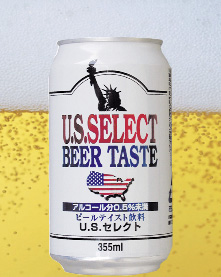
Best I could find out is that it’s a Japanese beer made by what appears to be a fairly large global food and drinks company called SC Foods Co., Ltd. The beer is called U.S. Select Beer Taste and is fairly resplendent with patriotic imagery from using a red, white and blue palette to the U.S. flag, an outline of the lower 48 and even part of the Statue of Liberty.

uss-beer-taste

It’s certainly an odd duck. But what fascinates me most is wondering what it tastes like. I mean that in an abstract sense. I know in reality it’s likely a clone of a tasteless American-style macro lager or similar low-calorie light beer. Or is it? What is the perception of the “select beer taste of the U.S.?” Is is still the former big three, or has craft beer managed to upstage that as an antiquated image of American beer?

I also can’t help but wonder, if it is an American light lager, why? The three major brands in Japan — Asahi, Kirin, Sapporo — aren’t substantially different from Bud, Miller or Coors. So if you’re going to label it U.S. Select Beer Taste, then it has to mean something to the intended consumer, which appears to be the Japanese. They have to perceive it as being something different than their own beer, don’t they? And if so, then doesn’t it follow that U.S. Select Beer Taste might be more craft-oriented in taste? It wouldn’t taste like a German, Belgian, Czech or English import. Sadly, I couldn’t find any ratings for the beer on either Beer Advocate of Rate Beer, so I don’t really know if it’s more Dale’s Pale Ale than Bud Light.

So what exactly is American Beer’s Taste perception in Japan and around the world? Among brewers and the über beer geeks certainly our reputation for quality is unsurpassed and the craft industry has staged a remarkable comeback for American beer since the low point of the 1970s. But that’s among the small, niche customer for whom beer matters. To the general consumer, I’m not so sure. Budweiser and Coors both sell surprisingly well in Great Britain and Bud is even making modest progress in Germany. What do you think U.S. Select Beer Taste is?

Filed Under: Beers, Breweries, Editorial, Just For Fun Tagged With: Asia, Japan, Packaging

« Previous Page
Next Page »

Find Something

Northern California Breweries

Please consider purchasing my latest book, California Breweries North, available from Amazon, or ask for it at your local bookstore.

Recent Comments

  • Bob Paolino on Beer Birthday: Grant Johnston
  • Gambrinus on Historic Beer Birthday: A.J. Houghton
  • Ernie Dewing on Historic Beer Birthday: Charles William Bergner 
  • Steve 'Pudgy' De Rose on Historic Beer Birthday: Jacob Schmidt
  • Jay Brooks on Beer Birthday: Bill Owens

Recent Posts

  • Beer Birthday: Dave Alexander May 8, 2026
  • Historic Beer Birthday: Emil Christian Hansen May 8, 2026
  • Beer In Ads #5244: Southern Brewing Bock Beer May 7, 2026
  • Historic Beer Birthday: Anton Dreher May 7, 2026
  • Beer In Ads #5243: Union Brewery Bock Beer! May 6, 2026

BBB Archives

Feedback

Head Quarter
This site is hosted and maintained by H25Q.dev. Any questions or comments for the webmaster can be directed here.