Brookston Beer Bulletin

Jay R. Brooks on Beer

  • Home
  • About
  • Editorial
  • Birthdays
  • Art & Beer

Socialize

  • Dribbble
  • Email
  • Facebook
  • Flickr
  • GitHub
  • Instagram
  • LinkedIn
  • Pinterest
  • RSS
  • Twitter
  • YouTube

Powered by Genesis

Politics & Big Beer Brands

September 28, 2012 By Jay Brooks

politics-balloons
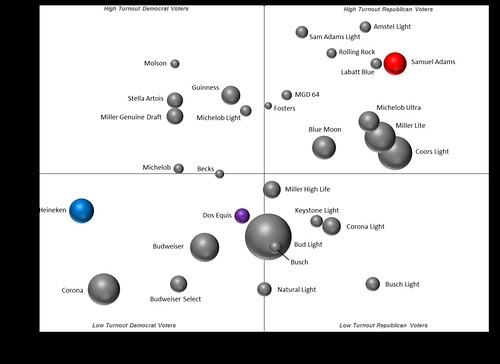
Here’s a curious piece of data, showing how which big beer brand you prefer may determine how likely you are to vote in the upcoming election and whether you lean more to the Democratic side of the aisle, or the Republican. The poll was conducted by Scarborough Research and the results written up in the National Journal as What Your Beer Says About Your Politics.

But it’s only the big brands that were tallied, the domestics and the most popular imports. The only one close to craft is Samuel Adams, who in most people’s mind, I think, is straddling both worlds right now. Even so, there are a few surprising results, at least to my mind. I would not have thought, for example, Samuel Adams drinkers would skew so heavily Republican. Maybe it’s the naked jingoism, the patriotic perception of the brand, I don’t know.

The other one that surprised me was that Heineken skewed so far on the Democratic side. I tend to think of Heineken as a brand that people who don’t know any better think is a high end, premium brand, in the same way bald, middle-aged men drive Corvettes to recapture their youth, not realizing it’s no longer the hip car it once was. But maybe that’s just my own bias. In any sort of polling, I rarely fall under the “typical” findings.

Take a look at the chart below and see what you think. Does it make sense to you?
beer-politics-2012
The chart is tough to see this small, but you can see it full size, or look at on the original National Journal post.

Filed Under: Beers, Just For Fun, Politics & Law Tagged With: Big Brewers, Imports, Statistics

Beer From Beard Yeast, Yes; From Vaginas, No

September 28, 2012 By Jay Brooks

women
You most likely remember that Rogue harvested some yeast from the beard of their longtime brewmaster, John Maier, and White Labs analyzed it and propagated a brewing yeast that Rogue in turn used to brew a beer with. Not everyone responded favorably to the news, but in terms of attention and publicity, it’s been a huge hit, with almost every news agency, website and blog writing about it. I made it the subject of part of one of my newspaper columns back in July. A Google search of “rogue beard beer” turns up over 1.4 million hits.

But just when you think things can’t get any weirder, my wife — who’s been working in Shanghai this week — just sent me an article from a feminist blog she reads regularly, Jezebel. Inspired by John Maier’s beard beer exploits, they wrote an article about one more place known for its occasional yeast production that we can write off as a place to harvest for brewing. The article, entitled Just So You Know, You Can’t Make Beer With Your Vagina, answers the question I’m not sure anyone was asking. But now that I know there is an answer, I can’t look away. It’s like that car crash on the side of the road. I know I shouldn’t look, but I just can’t help myself.

Beginning with the premise that “[y]east is everywhere, even (as we ladies well know) buried deep inside our vaginas, waiting to go bad and ruin our week at any moment,” they wonder if anyone could “turn a yeast infection into a full-bodied IPA.” At this point, I’ll let author
Madeleine Davies share the results.

We did some research and, in a word, no. The yeast used in beer is a completely different strain of yeast than the one that causes yeast infections. And there goes your artisanal brewery idea!

The yeast used in beer is called Saccharomyces cerevisiae and works by converting carbohydrates to carbon dioxide and alcohols. This is also the yeast used in bread, which is why baking yeast can be used to brew beer, though it generally makes the end product doughy in flavor and texture. Yeast infections are caused by Candida albicans, a fungus that grows as both yeast and filamentous cells and can cause oral and genital infections in humans. Using this to brew would be entirely ineffective, not to mention, guh-ross.

So there you have it. No vagina beer. I, for one, am relieved. It was one thing to have Sam Calagione and his team spitting in his Peruvian-style chicha beer, and Maier’s beard never bothered me too much, because White Labs removed any lingering ick factor by growing the yeast in their San Diego lab. But in the on-going quest to push the envelope, generate publicity and maybe even make something worth drinking, this may be crossing a line. What do you think?

vergina
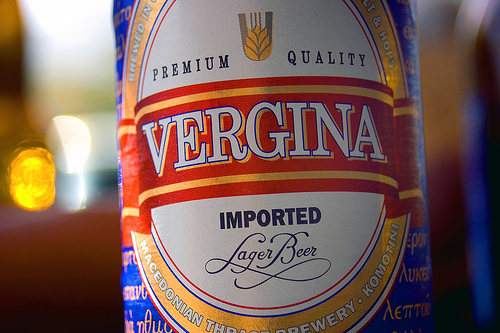
Close, but no vagina.

Filed Under: Beers, Just For Fun, News, Politics & Law Tagged With: Oddities, Strange But True, Yeast

Beer Institute Releases Results Of New Beer Drinkers Poll

September 27, 2012 By Jay Brooks

beer-institute
According to the Beer Institute (BI), recent economic analysis has revealed “that brewing and importing accounted for $223.8 billion in the economic output of the United States — with employees earning nearly $71.2 billion wages and benefits, and generating more than $44 billion taxes. In 2010, the last year tax statistics were available, 45 percent of what every beer drinker paid for a beer went to taxes of some kind, which “makes taxes the most expensive ingredient in your beer,” Joe McClain, president of the BI, stated.

The Beer Institute has just released a national poll of 1,000 likely voters, which found strong opposition to increasing taxes on beer. Nine out of 10 voters in the poll agreed that “raising taxes on beer will mean working class consumers will have to pay more.”

The poll also found that self-identified “beer drinkers” are a larger proportion of the electorate than self-identified supporters of either the Tea Party of Occupy Wall Street movement, and were evenly split between Republican and Democratic parties.

Beer drinkers are also more political than the average likely voter:

  • 68 percent of regular beer drinkers say they discuss what’s going on in the presidential campaign with friends or co-workers.
  • 66 percent of regular beer drinkers say they are going to be watching the presidential debates, meaning they are more likely to watch presidential debates than watch the World Series or an NFL game.
  • 25 percent say they will likely donate or contribute money to a political party, cause, or candidate running for public office.
  • 14 percent (or one out of seven) beer drinkers say they will likely volunteer for a political party, cause, or on the campaign for a candidate running this year.

Filed Under: Beers, Just For Fun, News, Politics & Law Tagged With: Poll, Press Release, Statistics

Beer Drinking Speed Influenced by Glass Shape

September 12, 2012 By Jay Brooks

beer-glass-tulip
With binge drinking front and center of many public policy concerns, the UK’s University of Bristol decided to examine whether it was because of the glass people were drinking out of. The School of Experimental Psychology set out to “explore the influence of glass shape on the rate of consumption of alcoholic and non-alcoholic beverages.” Their results, Glass Shape Influences Consumption Rate for Alcoholic Beverages, were published recently in PLOS ONE, a peer reviewed, open access journal.

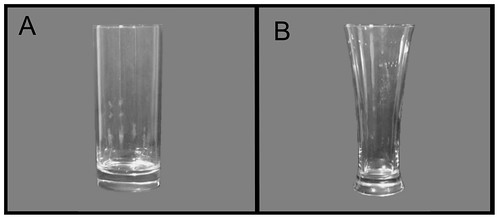
Study participants were given one of the two types of glasses below.

Figure 1

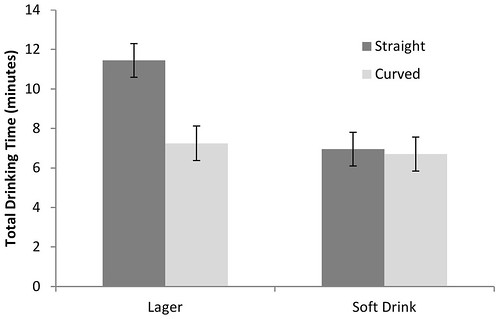
According to the summary by Health Today, “People took about almost twice as long to finish when drinking alcohol from the straight-sided glass, compared with the curved glass. There was no difference in drinking rates from the glasses when the drink was nonalcoholic.” The Bristol scientists conducting the study speculated that “people may swill their alcohol faster from curved glasses because it is more difficult to accurately judge the halfway point of these glasses,” adding that “drinkers may be less able to gauge how much they have consumed.”

They continued:

“People often talk of ‘pacing themselves’ when drinking alcohol as a means of controlling levels of drunkenness, and I think the important point to take from our research is that the ability to pace effectively may be compromised when drinking from certain types of glasses,” said study researcher Angela Attwood of the University of Bristol’s School of Experimental Psychology in the United Kingdom.

While there is a difference, is there a correlation? The researchers seem to think so, though their methodology is unique and it’s the first time, as far as they know, that such a study has been conducted.

Figure 2

Here’s their nutshell conclusion.

Participants were 60% slower to consume an alcoholic beverage from a straight glass compared to a curved glass. This effect was only observed for a full glass and not a half-full glass, and was not observed for a non-alcoholic beverage. Participants also misjudged the half-way point of a curved glass to a greater degree than that of a straight glass, and there was a trend towards a positive association between the degree of error and total drinking time.

But unfortunately they begin with the false premise that “alcohol consumption is associated with increased mortality and morbidity.” Numerous studies have shown that people who drink alcohol in moderation are likely to live longer than either abstainers or binge drinkers (however that’s defined). And at least one study has shown that even binge drinkers will likely live longer than teetotalers. And while there are some persons genetically more susceptible to certain diseases if they drink too much, many other diseases have positive correlations with moderate drinking, that is alcohol use may lower the risk of people contracting those diseases. So public policy really should be aimed at educating the citizenry that it’s in their best interest to drink alcohol responsibly and in moderation. At a minimum, both sides of the story of alcohol should be part of the public discussion instead of the often one-sided version we have today that takes all of the negatives as givens and has no time for any positive findings to balance perspectives.

After more proselytizing and propaganda in their introduction it seems clear which side of the debate they come down on, which I think tends to influence the study itself. They’re looking for a way to reduce drinking — not that that’s a bad goal in and of itself — but while the results seem interesting, the fact is that they set out not to “explore the influence of glass shape on the rate of consumption of alcoholic and non-alcoholic beverages,” as they initially stated, but instead to effect public policy for their somewhat anti-alcohol agenda. It’s not hard to tease that out of how they characterize what they’re doing. For example, when they explain the rise of “branded drinking glasses in the United Kingdom,” they also include statements like “[w]hile alcohol advertising is still permitted in the United Kingdom” (as if they’d prefer it was not or suggesting it one day may not be) and state that glassware with a brewery’s logo on it constitutes a “currently unregulated, marketing channel,” it becomes nakedly obvious that they disagree with the world the way it is.

Happily, unlike many such studies, the entire journal article is online, so you can judge for yourself. I tend to be somewhat paranoid about these affairs, and am usually skeptical about such efforts.

Figure 1

Another issue I have is the glasses themselves. The first is meant, I presume, to be an average pint glass, but it doesn’t look quite like the familiar shaker pint glass. It more resembles the stange, though shorter, but it has the straight walls and does not curve out and taper slightly into a wider mouth like most pint glasses. The second glass is a common type of pilsner glass and more appropriate to the beer they used in the study. But that first glass I’ve rarely seen used in a pub or bar, at least on these shores. Isn’t it just as likely they overlooked the obvious: that participants drank faster because the beer tasted better in a more appropriate glass? They certainly never addressed using a more proper glass and seemed to overlook that aspect entirely, as if it didn’t matter one iota. Considering how careful they appeared to be with so many other aspects of the study, the choice of glasses seems almost comically devoid of reason.

The beer was apparently a 4% a.b.v. lager from Brasserie Saint-Omer, a French brewery. Why an English university didn’t see fit to include a British beer in the study is not disclosed, and to my mind makes little sense. Clearly, the researchers need to get out to the pub themselves a little more often.

But from this preliminary, somewhat flawed first attempt, the authors make the leap that their findings could inform public policy and use them to alter “policy decisions regarding structural changes to the drinking environment which may reduce drinking rates and correspondingly impact on resulting alcohol-related harms.” Whoa, cool your jets there. That’s quite a leap, with almost no apparent understanding of the importance of glassware to beer, even as they admit their “study cannot fully resolve the mechanism which underlies the effects we observed.”

Even if you’re not a hardcore beer geek who insists on just the right glass for a beer, I think we can all agree that a plastic cup is not as good as glass and that some glassware simply works better with certain drinks, in the worlds of beer, wine and spirits. Imagine the hue and cry if they’d suggested people would sip their champagne much more slowly if one used a martini glass or coffee mug for their next wedding toast. I just can’t abide the notion that glassware choice should be dictated by a public policy trying to slow the pace of drinking across the board, using a bludgeon for a problem I’m not even sure actually exists. I tend to be a slow drinker already, so I may not be the target demographic, but I’d still be swept up in its net if my glassware choice was arbitrarily dictated by politicians and so-called health officials. No matter how well-intentioned, they would undoubtedly remove certain glassware from circulation, limiting the types a bar or pub could use in serving their beer. That, I believe, would be bad for all of us. You want that pilsner in a pilsner glass? Forget it, you’ll get the pint glass and like it. Otherwise, you can’t be trusted to drink slowly enough. There are already enough bad bars using a single glass to serve everything they stock, it seems like this could only make things worse.

Filed Under: Beers, Editorial, Just For Fun, News, Politics & Law Tagged With: Glassware, Science

White House Releases Homebrew Recipe

September 4, 2012 By Jay Brooks

white-house
I bet it must be nice for President Obama’s people to be inundated by something positive for a change. When the White House announced that the kitchen was going to be homebrewing, even using honey made by White House bees, people wanted to know what the recipe was for the two beers they were brewing. After a petition to release the recipes garnered over 12,000 signatures, the White House did release the recipes on the White House Blog and their We the People page, a Honey Ale and a Honey Porter. Here was the White House response:

Inspired by home brewers from across the country, last year President Obama bought a home brewing kit for the kitchen. After the few first drafts we landed on some great recipes that came from a local brew shop. We received some tips from a couple of home brewers who work in the White House who helped us amend it and make it our own. To be honest, we were surprised that the beer turned out so well since none of us had brewed beer before.

As far as we know the White House Honey Brown Ale is the first alcohol brewed or distilled on the White House grounds. George Washington brewed beer and distilled whiskey at Mount Vernon and Thomas Jefferson made wine but there’s no evidence that any beer has been brewed in the White House. (Although we do know there was some drinking during prohibition…)

Since our first batch of White House Honey Brown Ale we’ve added the Honey Porter and have gone even further to add a Honey Blonde this past summer. Like many home brewers who add secret ingredients to make their beer unique, all of our brews have honey that we tapped from the first ever bee-hive on the South Lawn. The honey gives the beer a rich aroma and a nice finish but it doesn’t sweeten it.

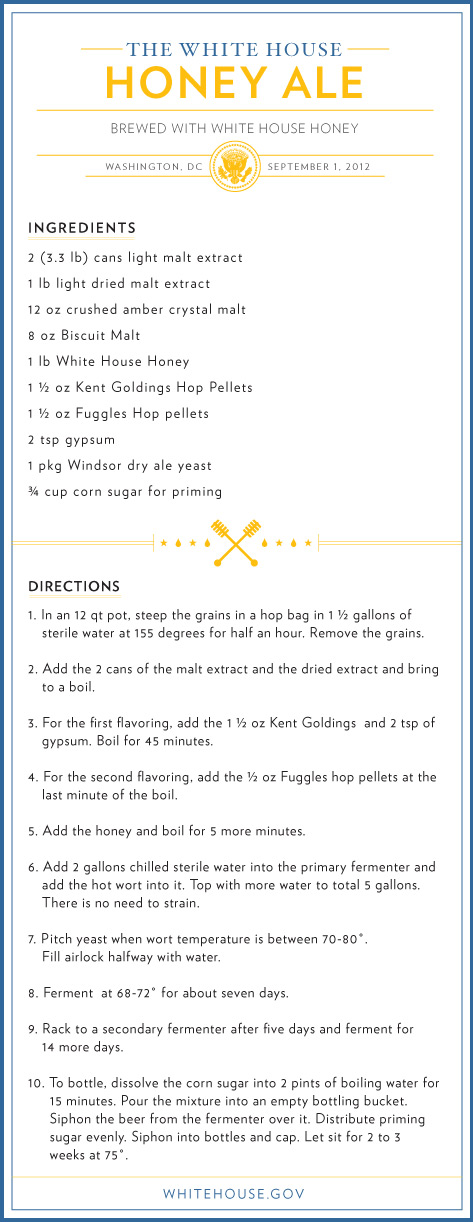
And here’s the recipe for the Honey Ale:

wh_beer_recipe_honey_ale

The White House also created a short video about the homebrew project.

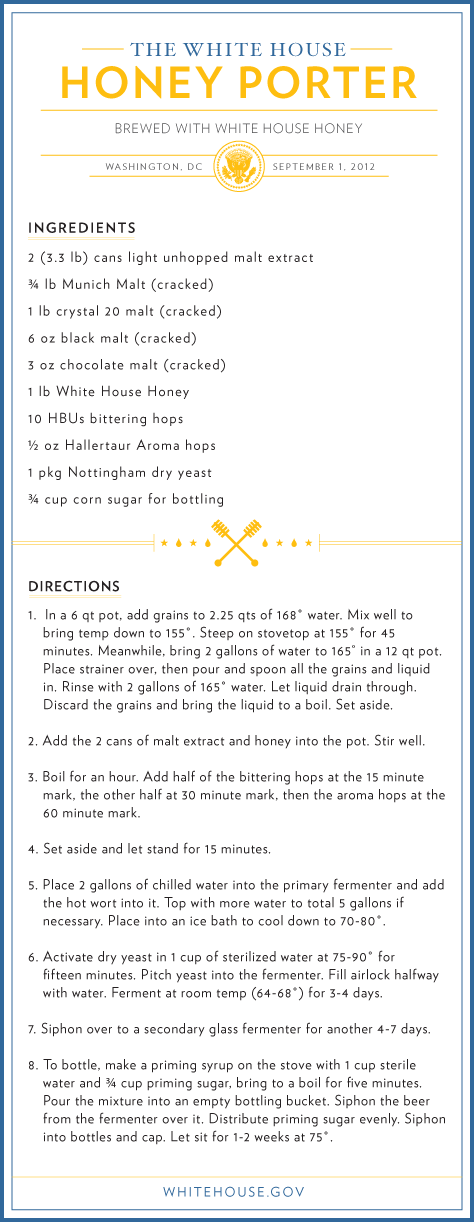
And here’s the recipe for the Honey Porter:

wh_beer_recipe_honey_porter

Wondering how the recipe might work out? Garrett Oliver, brewmaster at Brooklyn Brewing expressed his opinion in the New York Times, in White House Beer: A Brewer Weighs In.

Filed Under: Beers, Just For Fun, News, Politics & Law Tagged With: Homebrewing

Three Decades Of Beer Containers

August 29, 2012 By Jay Brooks

trending-chart
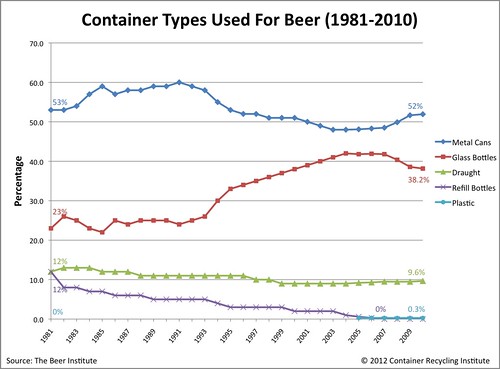
Here’s an interesting little snapshot of the various containers beer comes in over the last thirty years from the Container Recycling Institute. In Container Types Used For Beer in the U.S., 1981-2010 , they detail how beer in bottles have increased steadily 15% over that time and now make up almost 40% of how beer is sold. At the same time, draft beer has receded. Cans are still on top, but dipped significantly beginning in the 1990s, but in recent years have started to rebound.

beer-container-types-1981-2010

Filed Under: Beers, Just For Fun, Politics & Law, Related Pleasures Tagged With: Bottles, Cans, Draft Beer, Statistics, United States

Beer In Political Advertising Spoof 2012

August 25, 2012 By Jay Brooks

republicans
Regardless of your political leanings, I think the beer aspects of this are pretty funny. Thanks to Ed Chainey for sending me the link. I suspect Republicans won’t be as amused as Democrats, but it’s true that alcohol is not allowed under Mormonism, along with coffee, tobacco and other items. I don’t know about above-ground swimming pools or truck nuts, but it wouldn’t surprise me. Still, from a strictly beer-centric point of view, the choice is clear.

Filed Under: Beers, Just For Fun, Politics & Law Tagged With: Humor, Religion & Beer, Video

College Drinkers Are Happier & Cooler

August 21, 2012 By Jay Brooks

humor
This has just got to cheese off Alcohol Justice and the other neo-prohibitionist wingnuts, but Time magazine is reporting the results of a recent study that found the unpleasant truth that students who binge drink in college are actually happier and enjoy higher status among their peers. In Why College Binge Drinkers Are Happier, Have High Status, they began with a bang:

College binge drinkers say they’re happier with their social lives than those who don’t indulge — but it’s probably the boost in social status, not the booze itself that lifts their mood, according to new research presented at the annual meeting of the American Sociological Association.

“Binge drinking is a symbolic proxy for high status in college,” said study co-author Carolyn Hsu, an associate professor of sociology at Colgate University in a statement, noting that it’s what the wealthy, powerful and happy students on campus do.

The study found that rich white frat boys reported having the greatest social satisfaction at school and were considered the big men on campus by others. They were not only happier than students in low-status groups — women, minorities and people who were less financially well-off — but also more likely to binge drink. “Binge drinking then becomes associated with high status and the ‘cool’ students on campus,” said Hsu.

Low-status students in turn reported being happier if they binged than if they didn’t. Indeed, alcohol seemed to be the great social equalizer, bringing members of low-status groups to happiness levels similar to those of greater social power if they binged. “Students in all groups consistently liked college more when they participated in the campus’ binge drinking culture,” Hsu said.

The results are still preliminary, but it’s still notable for at least trying to better understand why binge drinking persists, despite endless efforts to curb it. Though to be fair, most of those efforts are misguided bludgeons like “just say no” and other ideas doomed to fail by neo-prohibitionist groups.

Other interesting tidbits included the fact that “the most stressed and highly anxious students were the least likely to binge, suggesting that the negative emotions that often drive alcoholism are not influencing many of these bingers.” And in a related study, it was found that College Men Who Post About Alcohol Have More Facebook Friends. In a way, it’s not surprising, as social status is pretty important at that age, possibly more important than at any other time. College students, often on their own for the first time in their young lives, trying to find themselves and become their own adults, have the added burden of having virtually no education regarding alcohol and having to obtain it through illegal means thanks to the anti-alcohol efforts of the past several decades. So when the study concludes “that the social advantages of binge drinking do not mitigate its negative consequences on health and academic performance,” I can only say, well, duh.

But it’s the final paragraph that contains the most important wisdom, totally lost on neo-prohibitionists and especially people who do not drink.

Surprisingly little research is conducted on the positive effects sought by drug users and what they actually achieve via their drug consumption; the assumption is that alcohol and other drugs are always bad and their users are irrational. But until more studies like this are conducted, prevention programs are unlikely to improve. We can’t prevent what we don’t understand.

Just say know.

Filed Under: Editorial, News, Politics & Law Tagged With: Science, Statistics

Why Is This News? Beer Beats Wine!

August 20, 2012 By Jay Brooks

beer-vs-wine
I never quite understand why this is even considered news at all? The L.A. Times is reporting that “Beer beats out wine as Americans’ booze of choice.” Their source for this so-called news is a new Gallup Poll entitled Majority in U.S. Drink Alcohol, Averaging Four Drinks a Week. But that’s not exactly news insofar as it’s been that way since the dawn of time, or thereabouts. The gallup poll is just a survey, of course, and prone to people’s prejudices and perceptions. So when they report that “Beer edges out wine by 39% to 35% as drinkers’ beverage of choice,” it’s hard not to laugh, and even harder to take it seriously. This is what people tell pollsters, and it’s pretty divorced from reality.

If you want a truer, more accurate picture of peoples’ tastes, look at what they buy. The World Health Organization, at their website, gives the following data, collected in 2005 (though it rarely changes by much):

Alcohol Consumption By Type:

  • Beer: 53%
  • Wine: 16%
  • Spirits: 31%

And the Ginley USDC 2010 reports that for 2009, the volume of alcohol sold in the U.S. — 3.3 billion cases — is divided as follows, giving beer an 85 share:

Alcohol Sales By Volume:

  • Beer: 85%
  • Wine: 6%
  • Spirits: 9%

And by retail dollars — a total $1.89 billion — beer still has a commanding lead:

Alcohol Sales By Dollars:

  • Beer: 52%
  • Wine: 14%
  • Spirits: 34%

It doesn’t really matter what people tell the voice on the other end of the phone when Gallup calls asking for peoples’ preferences, this is what they really drink. And while it does fluctuate over time, it’s been roughly like this as long as anybody can remember. Trying to turn it into something newsworthy takes a certain amount of opportunistic forgetfulness, ignorance and a willingness to ignore history.

And while somewhat petty, this also struck me in a way I couldn’t ignore, like someone slapped me. The author of the L.A. Times piece, Tiffany Hsu, refers to men as floozies, when she reports. “Men tend to be the biggest floozies, downing 6.2 drinks a week on average compared with 2.2 drinks for women.” Now I assume she owns a dictionary, and I was pretty sure what the definition of a floozy was. So after checking at least six dictionaries to confirm my suspicions — like it or not — a floozy is always described as a woman. It’s an old, archaic word you rarely hear these days, but it doesn’t mean someone who drinks too much, as she appears to believe.

There’s also other findings in the Gallup Poll results, part of their annual Consumption Habits poll, and some are interesting, if not altogether showing anything particularly novel or new. But toward the end of Gallup’s press release, they make this obnoxious statement in the conclusion, which they title “The Bottom Line.”

With drinking comes overdrinking, and despite possible reluctance by some respondents to admit problems, one in five drinkers — representing 14% of all U.S. adults — say they sometimes drink too much.

Okay, first of all, WTF! “With drinking comes overdrinking?” No it doesn’t. It’s hardly a fait accompli. Even by their own numbers, that’s twisted logic. 86% of the people polled say they don’t drink too much so one clearly does not follow from the other, now does it? And how about this for twisting; “one in five” is 20%, not even close to 14%. You can’t even say that’s rounding, it’s simply inflating the numbers. So much for even the illusion of accuracy.

And just the idea that one alcoholic beverage has “beat” the other is annoying, too. I may prefer beer, but as a cross-drinker — like most people, frankly — I don’t feel that they’re competing in an us vs. them kind of way. It seems only news outlets hungry for headlines pit the two against one another. The first sentence of the article is “Score one for beer.” What was the contest?

There are plenty of positive stories from the world of beer that mainstream media could be covering. As Garrett Oliver recently wrote in Food & Wine magazine, one of the Crimes Against Beer is its continuing lack of media coverage. Oliver writes. “The public is yearning for more knowledge about beer, and nobody’s giving it to them. Even though craft beer is more popular than wine in the US, every major newspaper has a wine column, and almost nobody has a beer column. What’s wrong with this picture?”

What’s wrong, indeed.

UPDATE: An interesting side discussion came out of my linking Garrett Oliver’s piece, Crimes Against Beer, in which he casually mentions that “craft beer is more popular than wine in the US.” I confess that when I first read that, I thought it couldn’t be correct, but since it wasn’t relevant to the broader point I was trying to make in this post, I didn’t dwell on it. Alan, from A Good Beer Blog, however, did, and used it as a launching point for his own post, Is All That Made Up Stuff A Problem With The Dialogue?. He also did a little digging this morning to get at the actual numbers, and between the two of us, here’s what we found. Alan looked at statistics gathered by the Brewers Association and the Wine Institute. He found that in 2011, there were 347 million cases of wine and 11,468,152 barrels of craft beer sold in the U.S. From that he concluded that craft beer volume is roughly one-third of wine. Being lazier than Alan, I looked at retail dollars from the same sources and saw that there was an “estimated $8.7 billion” in craft beer sales and $32.5 billion in U.S. wine sales. That works out to craft beer selling about 26.8% — just over one-quarter — of wine sales. So no matter how you slice it, craft beer sales are nowhere near that of wine sold in America. That number could be slightly higher, as my one quibble with this is that the Brewers Association definition of what it means to be a craft beer is fine for their purposes (which is membership-based) but is not practical in the real world where what makes a beer crafty is, to my mind at least, how it’s made and how it tastes. I do, for example, consider Blue Moon a craft beer. And that would change the numbers to some degree, but I suspect not enough to alter the fact that wine still outsells craft beer, at least for now.

Filed Under: Beers, Editorial, News, Politics & Law Tagged With: Mainstream Coverage, Poll, Statistics

“Craft Beer” Added To Webster’s Dictionary

August 14, 2012 By Jay Brooks

webster
The interwebs are all abuzz with the news this morning that the term “craft beer” has been added to the Merriam-Webster Dictionary. I know very few people who are happy with the term already, so this is probably not going to help. The definition they chose doesn’t seem to quite work. I know they were trying to generalize a term that itself has struggled to be defined, and there are already many differences of opinion about what the term means, so it was no easy task. Even so, it seems like a fail. It will apparently be in the next print edition of the dictionary, but has already been added online. Here’s the entry:

craft beer noun

Definition of CRAFT BEER

: a specialty beer produced in limited quantities : MICROBREW

First Known Use of CRAFT BEER

1986

That definition suffers from the vagueness of what it means to be “a specialty beer” — which itself needs to be defined — and that it includes only beers that are brewed “in limited quantities.” As opposed to those beers in unlimited quantities? Does that mean year-round beers cannot be considered “craft beer?” Probably not, but my point is this is a pretty inelegant attempt at defining craft beer. It’s simple, at least, but hanging what it means to be a craft beer on it being “special” and “in limited quantities” is not exactly doing anybody any favors.

But other dictionaries have also tackled “craft beer” with mostly the same uninspired results. Here’s a few others.

American Heritage Dictionary: A distinctively flavored beer that is brewed and distributed regionally. Also called craft brew, microbrew.

Dictionary.com: an all-malt or nearly all-malt specialty beer usually brewed in a small, regional brewery.

Oxford English Dictionary: a beer with a distinctive flavour, produced and distributed in a particular region.

Stan had a post a couple of years ago about Craft beer: The 1986 definition that explores its origins. A lot of terms have come and gone, picked up and fallen out of favor, and there’s a twitter discussion swirling about what the next term will be, with Ray Daniels suggesting “Artisan Brewer” as the “next big thing.” Here are a few that have been, and continue to be, used to describe beer that’s not “good old macrobrew made in vats the size of Rhode Island” (however we define that, too), and at least one suggested this morning just in jest:

  • Artisan Beer
  • Authentic Beer
  • Boutique Brewer
  • Cool Brewer
  • Cottage Brewery
  • Craft Beer
  • Craft Brew
  • Flavor Beer
  • Hand-Crafted Beer
  • Handmade Beer
  • Microbrewery
  • Nanobrewery
  • Picobrewery
  • Real Beer
  • Regional Brewery
  • Small Batch Beer
  • Small Brewer
  • Specialty Beer
  • True Beer

Did I miss any? Are there any you think should be added for consideration? What do you think we should call this stuff we all love? Maybe just call it “beer” and be done with it?

Filed Under: Editorial, Just For Fun, News, Politics & Law Tagged With: Words

« Previous Page
Next Page »

Find Something

Northern California Breweries

Please consider purchasing my latest book, California Breweries North, available from Amazon, or ask for it at your local bookstore.

Recent Comments

  • Bob Paolino on Beer Birthday: Grant Johnston
  • Gambrinus on Historic Beer Birthday: A.J. Houghton
  • Ernie Dewing on Historic Beer Birthday: Charles William Bergner 
  • Steve 'Pudgy' De Rose on Historic Beer Birthday: Jacob Schmidt
  • Jay Brooks on Beer Birthday: Bill Owens

Recent Posts

  • Beer In Ads #5219: Good Old Point Special Bock Beer April 12, 2026
  • Beer In Ads #5218: The “Butter-In” Of The Season April 12, 2026
  • Beer In Ads #5217: The King Of All Beers April 11, 2026
  • Historic Beer Birthday: Gambrinus April 11, 2026
  • Beer In Ads #5216: The Finest Bock, As Usual April 11, 2026

BBB Archives

Feedback

Head Quarter
This site is hosted and maintained by H25Q.dev. Any questions or comments for the webmaster can be directed here.