Brookston Beer Bulletin

Jay R. Brooks on Beer

  • Home
  • About
  • Editorial
  • Birthdays
  • Art & Beer

Socialize

  • Dribbble
  • Email
  • Facebook
  • Flickr
  • GitHub
  • Instagram
  • LinkedIn
  • Pinterest
  • RSS
  • Twitter
  • YouTube

Powered by Genesis

Patent No. 2855969A: Ladies’ Handbag (Shaped Like A Keg)

October 14, 2016 By Jay Brooks

patent-logo
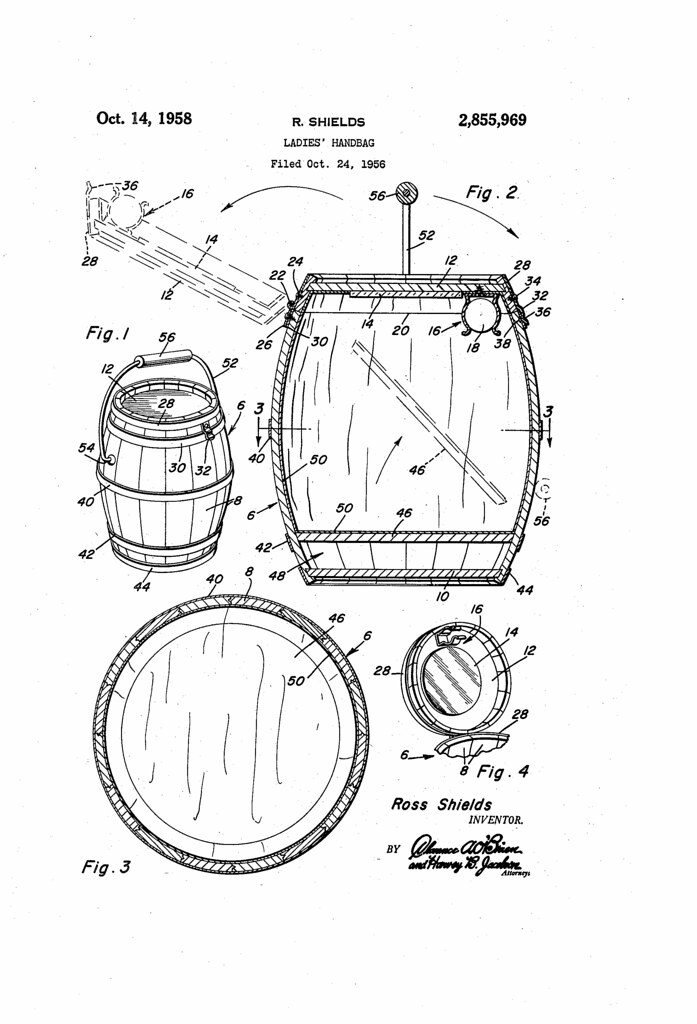
Today in 1958, US Patent 2855969A was issued, an invention of Edward Fitch, for his “Ladies’ Handbag” (Shaped Like A Keg). There’s no Abstract, although in the description it includes these claims:

This invention relates to a novel handbag for use by women and girls and has reference to a handbag which is original in that it is constructed to represent a miniature barrel.

Needless to say, handbags are designed and constructed in almost every conceivable shape and form. Current trends have, however, led to styles which are in representation of boxes, baskets, and all sorts of rigid type containers. With a view toward extending and enhancing the appearance of uniquely styled handbags, it is an object in the present matter to embark on a newer line of thought. To this end, the instant concept has to do with a handbag which is singularly distinct and different in that it takes the form of a miniature barrel and which lends itself to eye appeal by reason of the fact that it is a replica of a genuine keg or barrel and is, at the same time, practical and useful.

Briefly and somewhat broadly the improved handbag is characterized by a container having a given exterior shape. The container is characterized by a rigid, hollow body portion and rigid top and bottom wall. Thus constructed, the container serves to provide a fixed interior receptacle portion which may be appropriately lined using suitable material which lends itself to use in ones handbag. The upper or top portion of the container is separate from and hingedly mounted on the upper part of the body portion and constitutes a lid or cover. As a general rule, this is provided on its interior side with a face mirror and at least one article holding clip which may be employed to support a readily accessible lipstick. Handle means is also appropriately mounted on the body portion and is such in construction that it adds to the over-all distinctive appearance of the handbag.

More specifically, the container in its preferred embodiment is constructed to represent a miniature barrel, and to this end the body portion is constructed from longitudinally bowed staves with their abutting lengthwise edges connected by inter-fitting tongues and grooves. Ornamental hoop-like bands encircle and are fixedly mounted on the body portion as well as the end portions in somewhat customary fashion and these may be made of highly polished brass, copper or the like. Although not absolutely necessary, the handle takes the form of a bail and this is fashioned in representation of a carrying handle used, for example, on a pail or bucket.

The invention also features a removable partition mounted adjacent the bottom and cooperating with the main bottom wall and defining a false bottom as well as a so-called secret compartment between itself and the bottom wall.

This is easily one of the oddest patents I’ve come across in two years looking through the patent records. I can’t imagine this was a popular design for a ladies’ purse, especially in 1958. Maybe if it was today and/or if it was meant to be ironic. I wonder if it was ever sold commercially, and if so, if many women bought one.
US2855969-0

Filed Under: Just For Fun, Politics & Law, Related Pleasures Tagged With: History, Humor, Law, Patent

Patent No. 220595A: Improvement In Tapping And Venting Barrels

October 14, 2016 By Jay Brooks

patent-logo
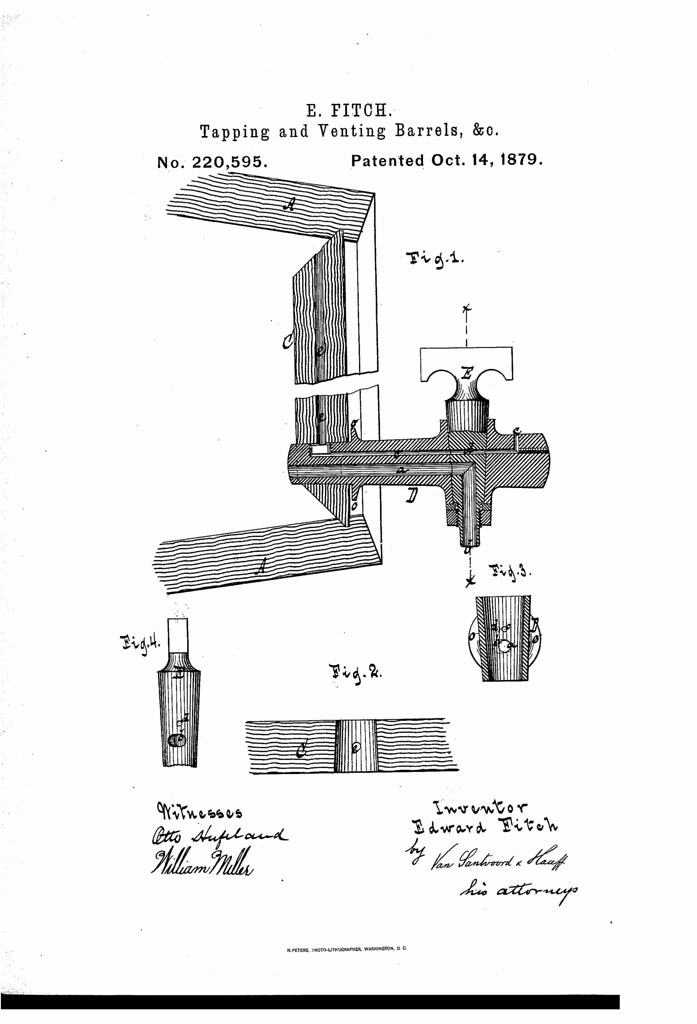
Today in 1879, US Patent 220595 A was issued, an invention of Edward Fitch, for his “Improvement in Tapping and Venting Barrels.” There’s no Abstract, although in the description it includes these claims:

This invention relates to an improved method or process of tapping and venting barrels, casks, or other vessels containing liquids, and consists- First. Of a faucet provided with an air-duct passing partly through the same lengthwise, preferably near the upper side thereof, and terminating near the inner end of the faucet in an opening upon the side of the faucet.

Second. This air-duct is controlled by the spigot of the faucet, and is opened or shut by turning the spigot. The spigot is provided with two openings, one above the other-the upper one for the admission of air to the airduct, and the lower one for the emission of the liquid contents of the barrel. The lower opening is made larger than the upper one, and in such position in the spigot that by partially turning the spigot the liquid will flow while the air-duct remains closed, and by further turning the spigot the air-duct will also be opened. The spigot can thus be made to open both passages at the same time, or to close both passages at the same time, or to open the lower passage for the flow of the liquid while the upper or air passage or duct remains closed.

Third. The head of the barrel,’cask, or other vessel to be tapped and vented is provided with an air duct or passage passing in a straight line through the substance of the head at right angles with the axis of the barrel, and opening at the lower end of the said air duct or passage in the upper side of the orifice in the said head through which the liquid is to be drawn, and at the other end thereof into the barrel at or near the junction of the head with the staves of the barrel, thus opening a duct or passage from the orifice in said head to the air-chamber in the upper side of the barrel when the same is placed upon its side in position for drawing the liquid.

US220595-0

Filed Under: Beers, Just For Fun, Politics & Law, Related Pleasures Tagged With: Barrels, History, Kegs, Law, Patent

Patent No. 2057347A: Beer Barrel

October 13, 2016 By Jay Brooks

patent-logo
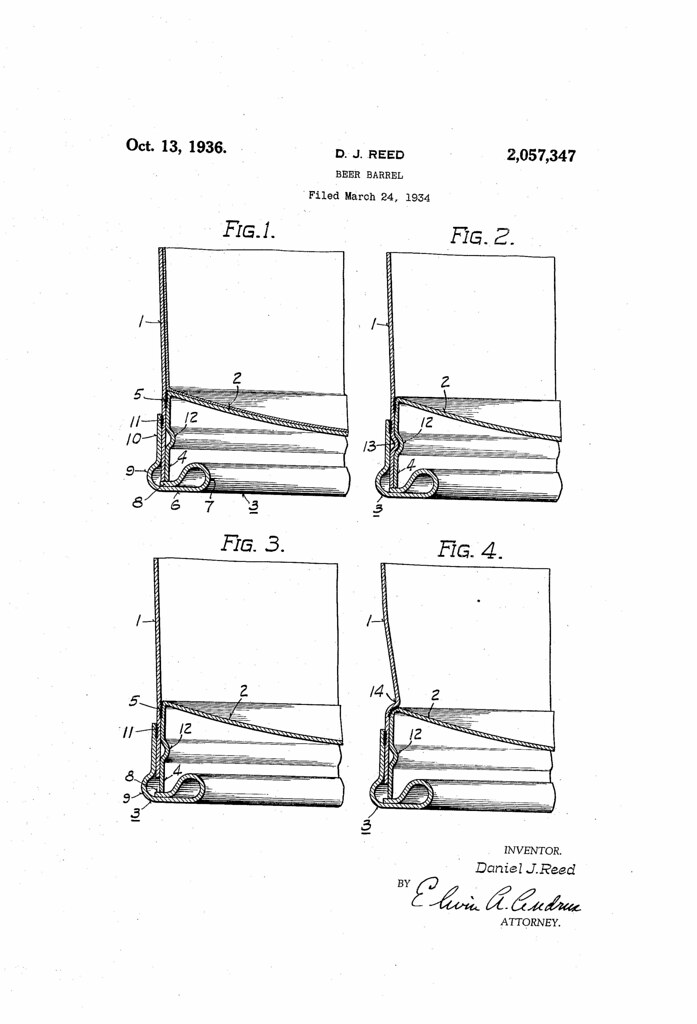
Today in 1936, US Patent 2057347 A was issued, an invention of Daniel J. Reed, for his “Beer Barrel.” There’s no Abstract, although in the description it includes these claims:

This invention relates to a metal beer barrel.

The principal object of the invention is to provide means for absorbing blows and sudden shocks delivered longitudinally of the barrel on 5 the end edge, thereby preventing injury to the body of the barrel and to the lining material therein.

US2057347-0

Filed Under: Beers, Just For Fun, Politics & Law, Related Pleasures Tagged With: Barrels, History, Kegs, Law, Patent

Patent No. 2451156A: Process And Apparatus For Producing Alcohol By Fermentation

October 12, 2016 By Jay Brooks

patent-logo
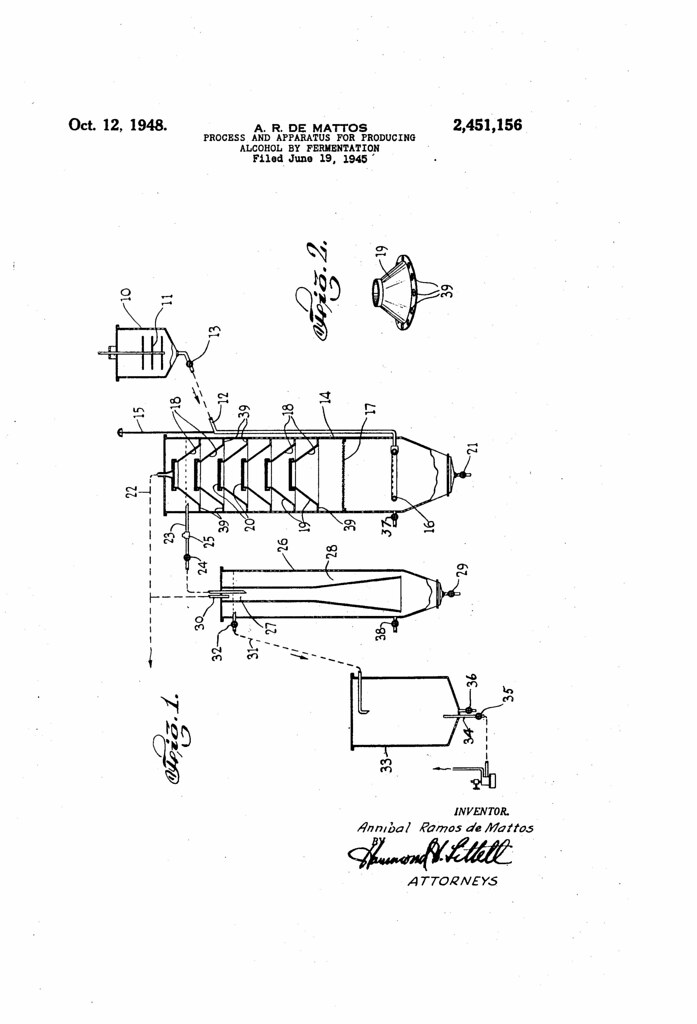
Today in 1984, US Patent 2451156 A was issued, an invention of Annibal Ramos De Mattos, for his “Process and Apparatus for Producing Alcohol by Fermentation.” There’s no Abstract, although in the description it includes these claims:

This invention relates to a process and apparatus for yeast fermentation and, more particularly, for producing alcohol by fermentation.

Commercially, alcohol is customarily produced by a batch or a modified batch process. In such processes the yeast necessary to convert the nutrient medium or wort into alcohol must be grown on the wort or on an outside nutrient medium. Yet as the conversion of the wort to alcohol takes place and the concentration of alcohol increases, the medium becomes toxic to the yeast. As a result, the alcohol ultimately present in high concentration kills a certain portion of the yeast, and the wort consumed in the production of this yeast is lost. Additionally, in such processes the concentration of yeast and its contact with the nutrient medium is seldom best adapted for optimum rate of alcohol conversion.

In the production of alcohol by conventional fermentation processes, it is usually necessary to kill or prevent the growth of bacteria which are deleterious to the propagation of the yeast or impede the conversion of the nutrient medium to alcohol. These deleterious bacteria are controlled either by subjecting the wort to heating at sterilization temperatures or by the introduction of chemical bactericides such as sulfuric acid, hydrochloric acid, fluorides, copper sulfate, and the like. It is also known that nutrients suitable for conversion to alcohol by fermentation, particularly cheaper nutrients such as low grade sugar, seldom contain all the elements necessary for the nutrition and propagation of the yeast which convert the nutrient into alcohol. As a result, the conventional nutrient medium must be complemented by the addition of so called stimulants such as the various mineral salts including, for instance, sulfates and nitrates of ammonia, calcium super-phosphates, and the like, or organic substances such as urea, malt, peptone, and the like.

The known commercial processes of producing alcohol by yeast fermentation may be divided roughly into four types; namely, progressive filling, division, continuous feeding, and a fourth process in which the yeast is recovered and reused in subsequent fermentation vats.

In the first-mentioned process a group of vats is placed in series and fermentation initiated in one of the vats. When the fermentation has reached a desired point, a portion of the fermenting wort in the first vat is transferred to a second vat to initiate the fermentation therein and so on for any desired number of vats.

In the second-mentioned process the contents of one vat is used for the purpose of inoculating other vats. For instance, after a group of vats has been used for fermenting wort to alcohol, one of the group is not discharged but is retained for the purpose of distribution to the vats which have been discharged for the purpose of initiating the fermentation of fresh wort.

The third-mentioned continuous feeding process is a very old process introduced by Guillaume, involving inoculating a multiplicity of fermentation vats from a culturing vat.

The fourth process is of more recent origin and was patented by Melle and Bolnot. In this last-mentioned process the pH of the fermenting wort is carefully controlled to approximate a pH of 3. When the fermentation is nearly complete, the partially spent wort and yeast are passed into a centrifuge where the yeast is recovered in the form of a liquid containing a high concentration of yeast. This liquid is used for the purpose of initiating the fermentation of a new charge of wort. This latter process has a number of disadvantages involving, as it does, the necessity for controlling pH of the fermentation mass and requiring the addition of conventional stimulants and the like used in other fermentation processes. The centrifuging device involves added equipment costs. The process makes possible some saving in fermentation equipment but not nearly so much as is possible in accordance with my continuous process described in detail hereinafter.

US2451156-0

Filed Under: Beers, Breweries, Just For Fun, Politics & Law, Related Pleasures Tagged With: Brewing Equipment, History, Law, Patent, Science of Brewing

Patent No. EP0091322A2: A Brewing Unit

October 12, 2016 By Jay Brooks

patent-logo
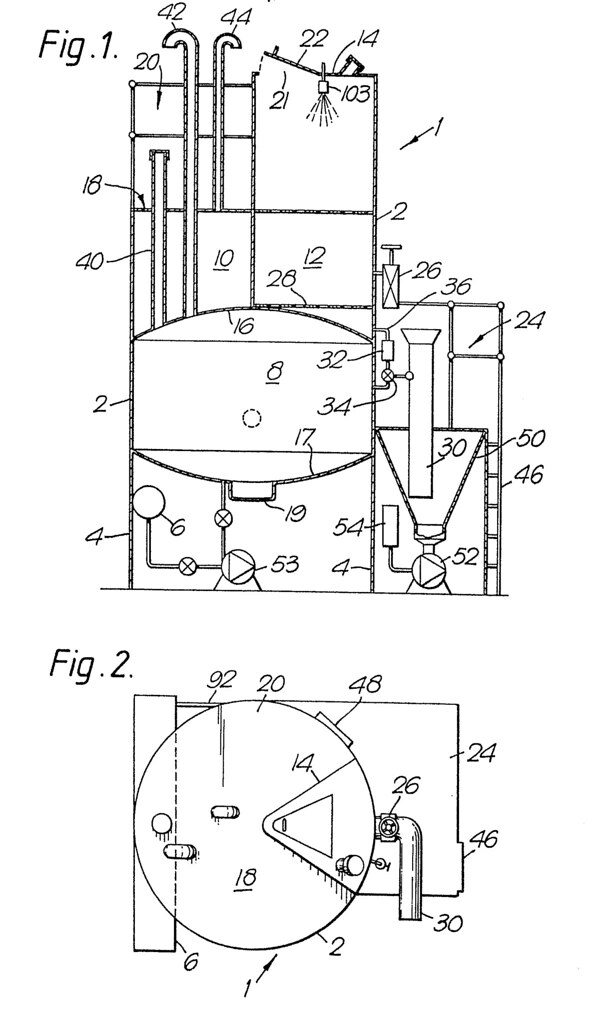
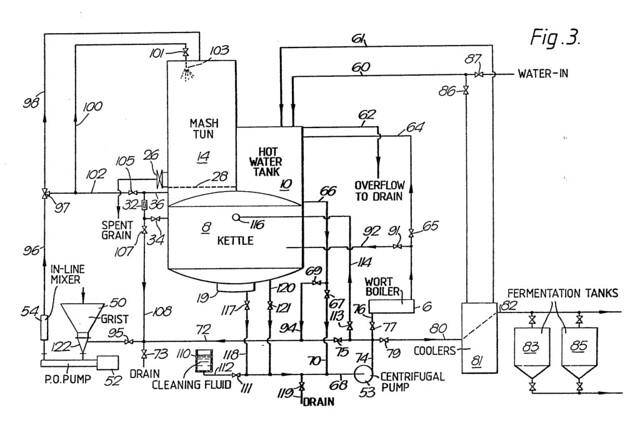
Today in 1983, US Patent EP 0091322 A2 was issued, an invention of Noel Roy Wilkinson, for “A Brewing Unit.” Here’s the Abstract:

An improved brewing unit in which energy is saved by providing a mash tun (14), hot water tank (10) and kettle (8) in a single unit (1), by partially enclosing the mash tun with the tank and if necessary pre-heating the water supply to the tank by using the heat from wort coolers provided between the unit (1) and fermentation tank (83, 85); further improvements are provided by constructing the kettle as a combined kettle and whirlpool in a single chamber having a circular wall (2) and a tangential inlet (92) to the wall, a pump (53) and wort boiler (6) being in circuit with the kettle so that wort is continuously circulated through the boiler and tangential inlet to the kettle whilst the worts are boiled. The combined kettle and whirlpool saves space and enables the process of brewing to be shortened with resultant savings in both energy and brewing time.

0091322-imgf0001

0091322-imgf0002

Filed Under: Beers, Breweries, Just For Fun, Politics & Law, Related Pleasures Tagged With: Brewing Equipment, History, Law, Patent, Science of Brewing

Patent No. 4409246A: Yeast Strain For Fermenting High Plato Value Worts

October 11, 2016 By Jay Brooks

patent-logo
Today in 1983, US Patent 4409246 A was issued, an invention of Graham G. Stewart, Thomas E. Goring, and Ingeborg Russell, assigned to the Labatt Brewing Company, for their “Yeast Strain For Fermenting High Plato Value Worts.” Here’s the Abstract:

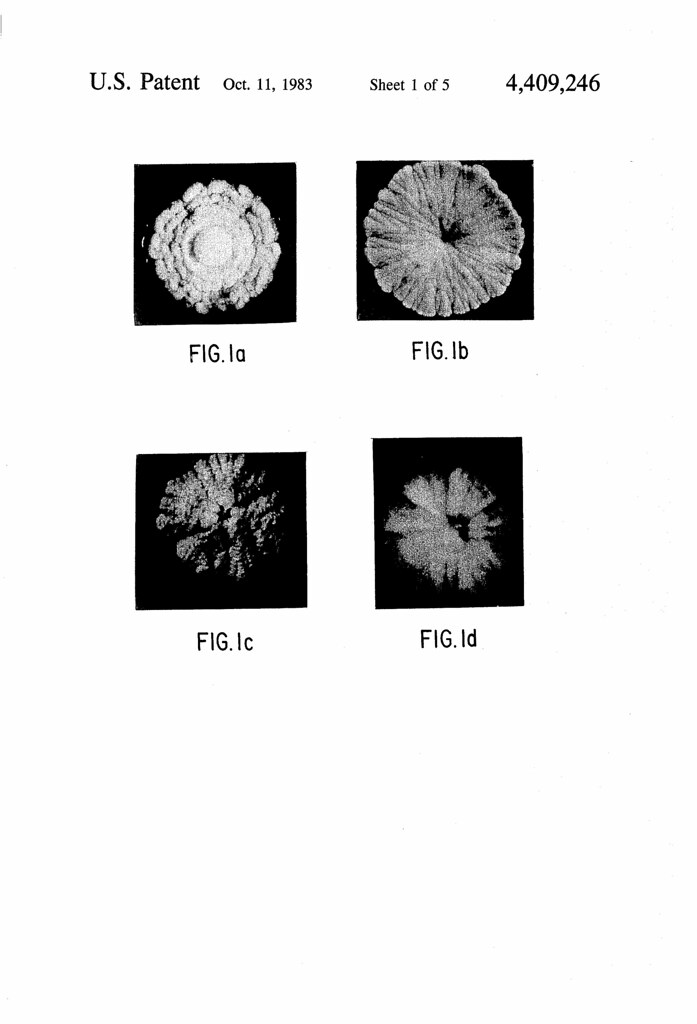
The specification discloses a novel brewers’ yeast strain and a method of manufacturing the same. The yeast is a strain of Saccharomyces cerevisiae and has been deposited at the National Collection of Yeast Cultures, Norwich, England under the number 962. Morphologically the giant colony of the novel strain can be described as a circular colony having a slightly serrated periphery, a convex surface topography with a central, globular dome and exhibiting primary concentric convolutions and secondary radial convolutions which, in combination, impart a rough appearance to the surface. The novel ale strain has the advantages that it is effective in worts having high plato values and is a bottom-cropping strain.

US4409246-1

Filed Under: Beers, Breweries, Just For Fun, Politics & Law, Related Pleasures Tagged With: History, Law, Patent, Science of Brewing, Wort, Yeast

Patent No. 527123A: Means For Transporting Beer

October 9, 2016 By Jay Brooks

patent-logo
Today in 1894, US Patent 527123 A was issued, an invention of Valentin Oppl, for his “Means For Transporting Beer.” There’s no Abstract, although in the description it includes these claims:

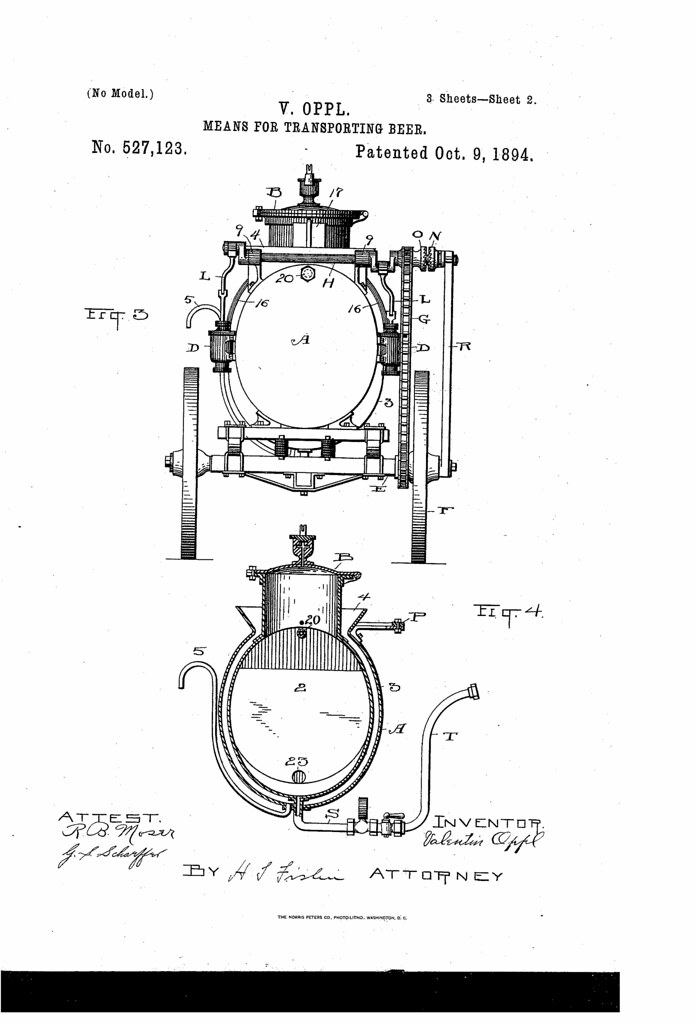
My invention relates to means for transporting beer, and the invention consists in a four-wheeled vehicle having a tank permanently thereon, pumps connected with the tank and power mechanism to operate the pumps.

US527123-0
US527123-1
US527123-2

Filed Under: Beers, Breweries, Just For Fun, Politics & Law, Related Pleasures Tagged With: History, Law, Patent

Patent No. 3106522A: Hop Separation Flights

October 8, 2016 By Jay Brooks

patent-logo
Today in 1963, US Patent 3106522 A was issued, an invention of Florian F. Dauenhauer, for his “Hop Separation Flights.” There’s no Abstract, although in the description it includes these claims:

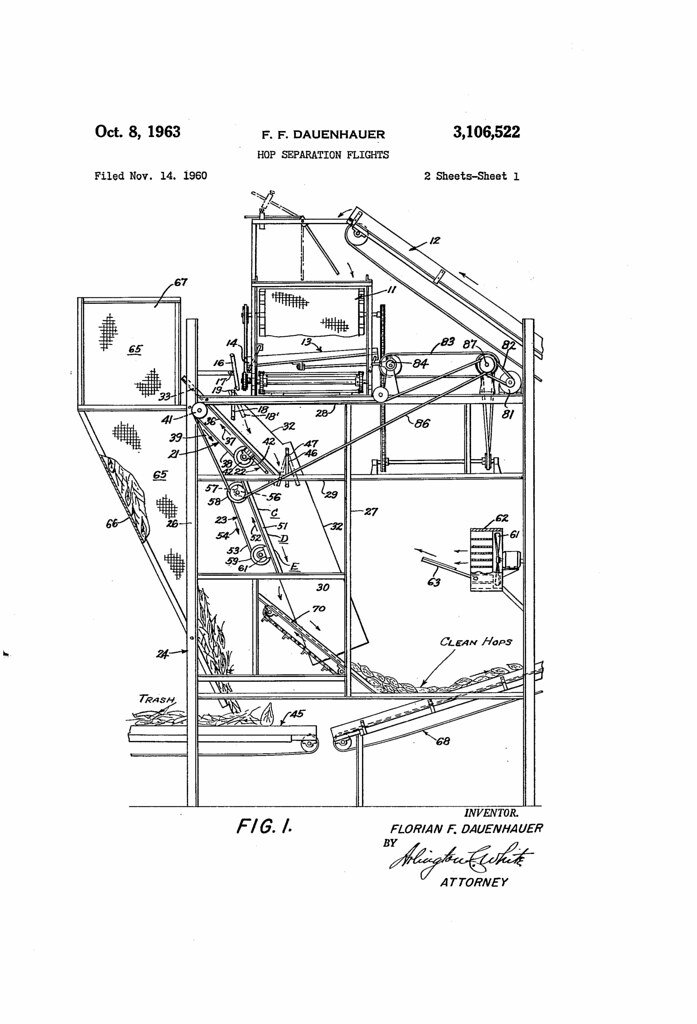
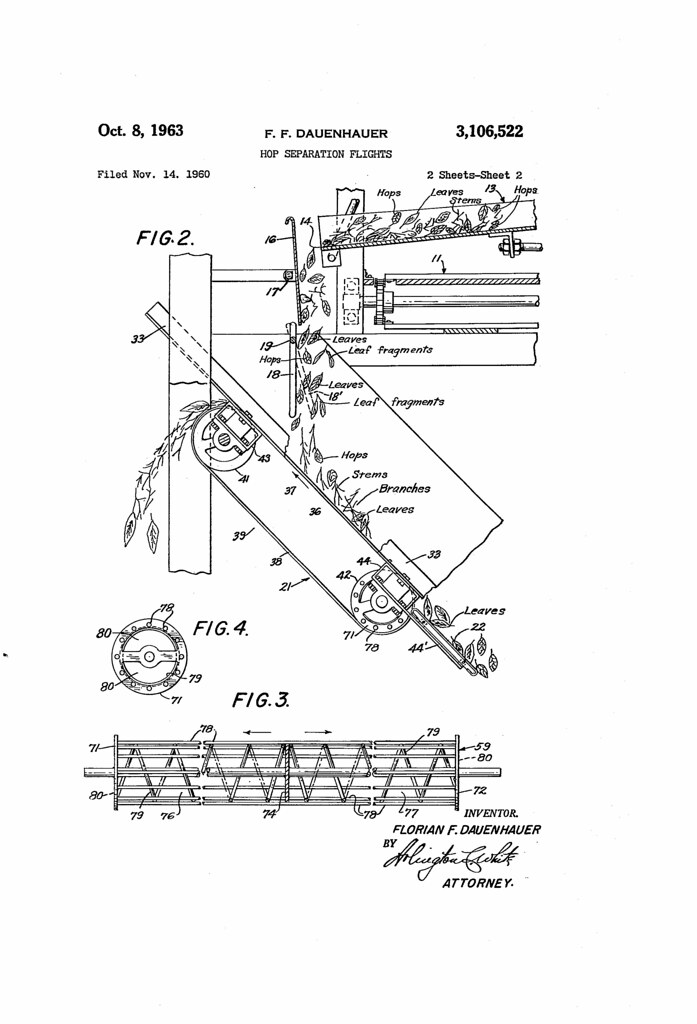
The stripping of hops from hop vines by mechanical means results in the by-product of mixtures of considerable foreign material and stripped hops; such foreign material including vine fragments, branches, leaves and leaf fragments as Well as long and short stems all comrningled with individual hops. And, it has continuously been a problem in the art to reduce such foreign material to a minimum in order to avoid deleterious factors in beverages utilizing hop. The present invention is directed to the provision of means for effecting the separation of an appreciably increased quantity of leaves and leaf fragments at a hop-cleaning stage prior to the final cleaning stage so that the end result is appreciably cleaner hops having much less than 1% of foreign material intermingled or commingled therewith.

A primary object of the present invention is to provide hop separation flights capable of effecting the removal of substantial quantities of leaves and leaf fragments from moving mixtures of hops intermingled and commingled with foreign material, including leaves and leaf fragments.

Another important object of the invention is to provide improved hop separating flights of the indicated nature which are additionally characterized by their ability to relieve the load on the final cleaner or clean-up separating equipment and make the latter more effective in reducing the quantity of foreign material in mixtures of hops and foreign material.

A still further object of the present improvement is to provide hop separation flights of the aforementioned character which can readily be installed at a minimum of expense for utilization with hop separating machines of any type.

US3106522-0
US3106522-1

Filed Under: Beers, Just For Fun, Politics & Law, Related Pleasures Tagged With: Brewing Equipment, History, Hops, Law, Patent

Patent No. 40200A: Improved Apparatus For Cooling Beer

October 6, 2016 By Jay Brooks

patent-logo
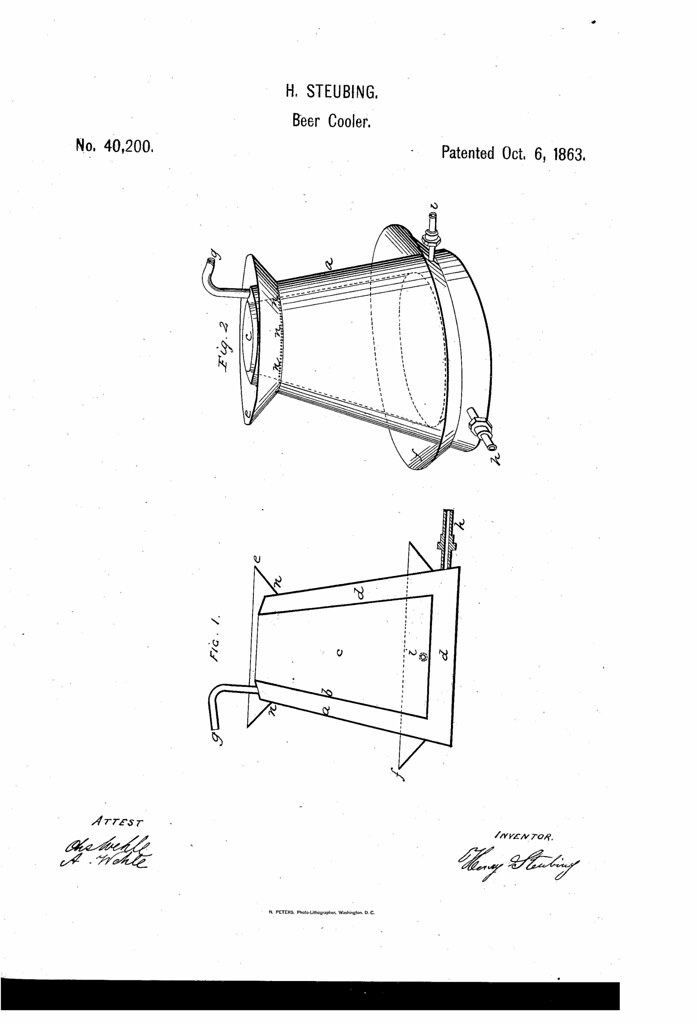
Today in 1863, US Patent 40200 A was issued, an invention of Henry Steubing, for his “Improved Apparatus For Cooling Beer or Other Liquids.” There’s no Abstract, although in the description it includes these claims:

The said apparatus is used in the following manner: Cold water or iced water is introduced into the space d from a reservoir, until the space d is filled with it and during the whole time of cooling. Then the ale, beer, or other liquid to be cooled is admitted into the hollow cylinder c steadily and continuously, when the same Will overflow into the space formed by the flange e, and will 110W down through the holes n n’ n on the outer mantel, a, into the space formed by the lower flange, j’, after which it flows out of the apparatus through the pipe i. Thus it will be seen that a certain quantity of iced water or cold water cools the ale, beer, or other liquid, rst by its contact on the inside b of the cooler, and then by its contact on the outside c of said cooler, thereby effecting `a great saving of the cooling material.

US40200-0

Filed Under: Beers, Breweries, Just For Fun, Politics & Law, Related Pleasures Tagged With: Brewing Equipment, History, Law, Patent

Patent No. 936011A: Apparatus For Making Malt

October 5, 2016 By Jay Brooks

patent-logo
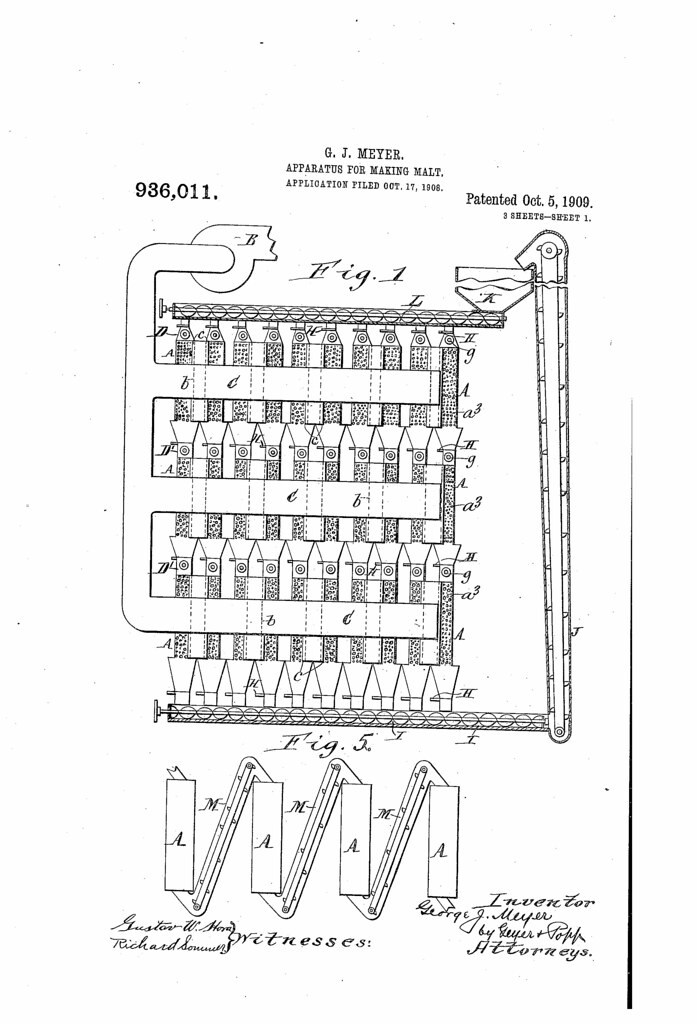
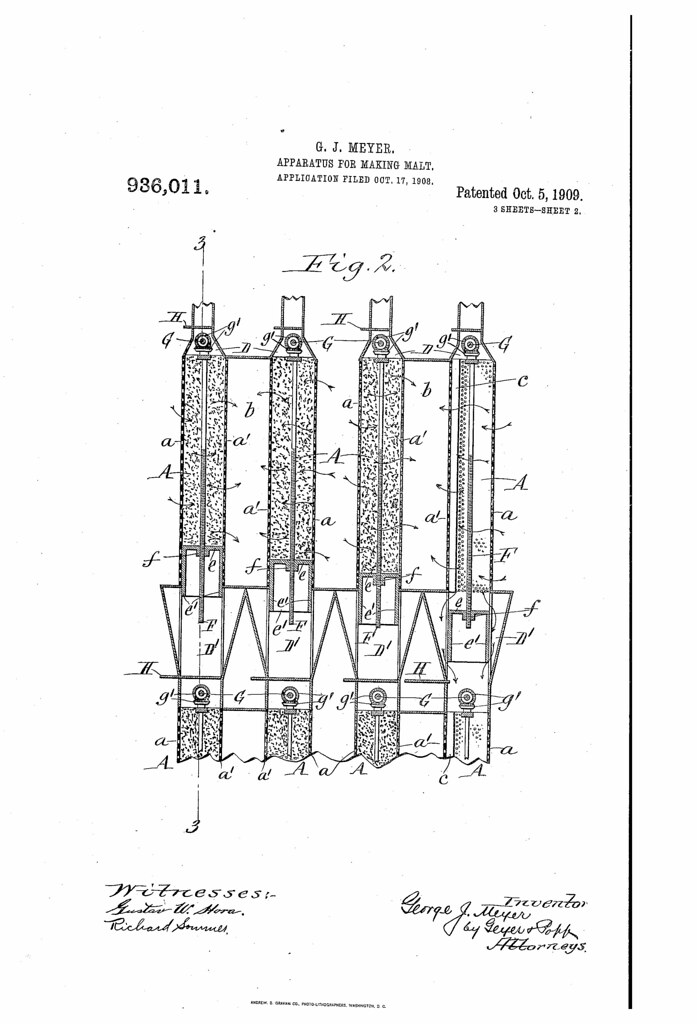
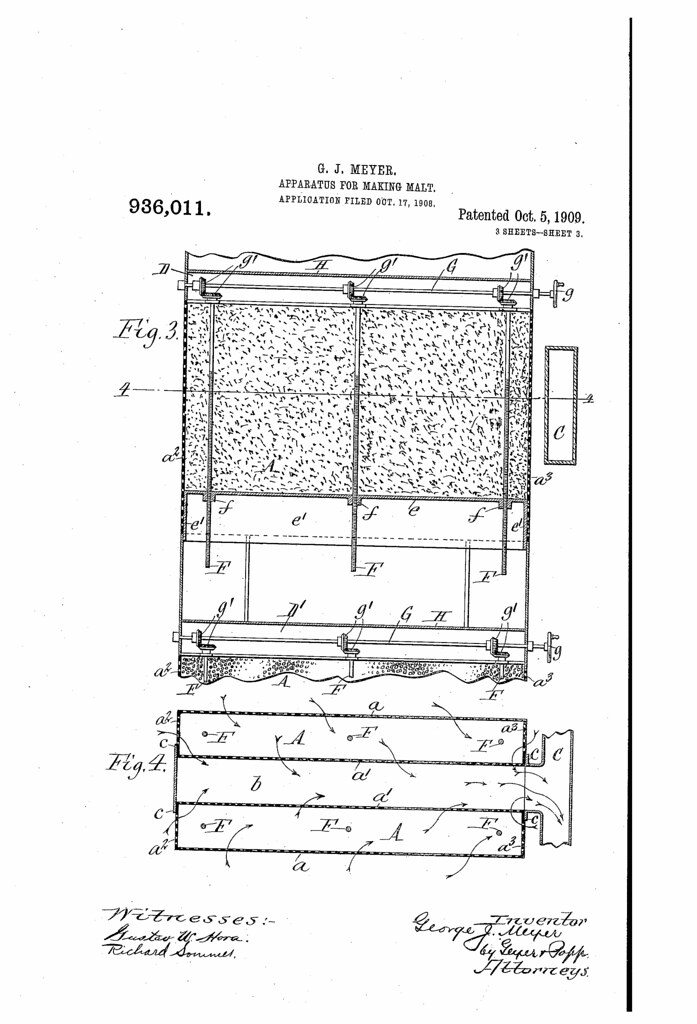
Today in 1909, US Patent 936011 A was issued, an invention of George J. Meyer, for his “Apparatus For Making Malt.” There’s no Abstract, although in the description it includes these claims:

Heretofore malting has usually been effected by tumbling barley or other grain around in rotatable drums or turning the same over periodically by hand or mechanical shovels while the same is supported in thin horizontal layers on a floor or in shallow boxes. None of these systems utilize the overhead space in the rooms of malt houses and therefore are not economical in this respect,

One of the objects of this invention is to utilize this overhead space to the fullest extent and thereby increase the malting capacity of a building of certain dimensions.

My invention has the further object to simplify the means whereby malting is effected so as to reduce the cost thereof and also insure a more thorough mixing of the barley from time to time during the malting operation so as to insure a more uniform product.

US936011-0
US936011-1
US936011-2

Filed Under: Beers, Just For Fun, Politics & Law, Related Pleasures Tagged With: barley, History, Law, Malt, Patent

« Previous Page
Next Page »

Find Something

Northern California Breweries

Please consider purchasing my latest book, California Breweries North, available from Amazon, or ask for it at your local bookstore.

Recent Comments

  • Ernie Dewing on Historic Beer Birthday: Charles William Bergner 
  • Steve 'Pudgy' De Rose on Historic Beer Birthday: Jacob Schmidt
  • Jay Brooks on Beer Birthday: Bill Owens
  • Steve 'Pudgy' De Rose on Beer Birthday: Charles Finkel
  • Steve 'Pudgy' De Rose on Beer Birthday: Bill Owens

Recent Posts

  • Beer Birthday: Chuck Silva February 14, 2026
  • Beer Birthday: Lew Bryson February 14, 2026
  • Beer In Ads #5201: Metzger’s Bock Beer February 13, 2026
  • Historic Beer Birthday: Mary of Burgundy February 13, 2026
  • Historic Beer Birthday: Henry C. Haefner Jr. February 13, 2026

BBB Archives

Feedback

Head Quarter
This site is hosted and maintained by H25Q.dev. Any questions or comments for the webmaster can be directed here.