Brookston Beer Bulletin

Jay R. Brooks on Beer

  • Home
  • About
  • Editorial
  • Birthdays
  • Art & Beer

Socialize

  • Dribbble
  • Email
  • Facebook
  • Flickr
  • GitHub
  • Instagram
  • LinkedIn
  • Pinterest
  • RSS
  • Twitter
  • YouTube

Powered by Genesis

Session #42: A Special Place, A Special Beer

August 6, 2010 By Jay Brooks

location
Our 42nd Session is hosted by Derrick Peterman, from Ramblings of a Beer Runner. He’s chosen “A Special Place, A Special Beer” as his topic, which Derrick describes geographically, as follows:

The Session provides a unique opportunity to explore this connection between the beer in our glasses and the place it comes from with perspectives from all over the world.

So I ask for this 42nd Session that you write about a special place in your life, and a beer or brewery that connects you to that place. It can be the beer from your childhood home, a place you once lived, your current hometown, a memorable vacation you once took, or a place you’ve always wanted to go to but never had the chance. Please take a few moments to think about the how the beer connects you to this place, and share this with us. Of course, the definition of “place” is rather open ended, and in some cases, highly debatable, so it will be interesting to see the responses on what constitutes a place.
session_logo_all_text_200

This was actually a simpler question than I expected, once I stopped to think about it. For me, I believe the most special place to have a beer, any beer, is at the source. The place where it was created — the brewery — I always find is my favorite place to try their beer, especially for the first time. Plus, in certain places the brewery has beers available that can’t be found anywhere else.

A number of years ago, for example, I visited the Radeberger Brauerei just outside Dresden, Germany. Their pilsner is one of the best in the world, at least in my opinion. But even better is the unfiltered zwickel version that they have only at the brewery. To be fair, they also used to sell it at one bar in downtown Dresden but last I heard a flood had closed it.

I love drinking beer at home, at the bar, at the restaurant — okay, anywhere — but not quite as much as in the brewery itself. That’s hallowed ground, in a sense. I’m not really a “ticker,” so I have no idea how many breweries I’ve visited over the years but it’s certainly a fair number. And they’re almost always where I’ve had the most memorable experiences. I don’t know if it’s the setting — I do love the feeling of being in a brewery — or being with the brewer, or some other intangible, but I inevitably get the sense that that’s the beer’s home. And things just always taste better when they’re home.

Filed Under: Breweries, The Session Tagged With: Germany

Like Real Estate, Next Session About Location, Location, Location

July 6, 2010 By Jay Brooks

session-the
Our 42nd Session will be hosted by Derrick Peterman, from Ramblings of a Beer Runner. He’s chosen “A Special Place, A Special Beer” as his topic, which Derrick describes geographically:

The Session provides a unique opportunity to explore this connection between the beer in our glasses and the place it comes from with perspectives from all over the world

So I ask for this 42nd Session that you write about a special place in your life, and a beer or brewery that connects you to that place. It can be the beer from your childhood home, a place you once lived, your current hometown, a memorable vacation you once took, or a place you’ve always wanted to go to but never had the chance. Please take a few moments to think about the how the beer connects you to this place, and share this with us. Of course, the definition of “place” is rather open ended, and in some cases, highly debatable, so it will be interesting to see the responses on what constitutes a place.

So look around the world and then bring home your own post for the next Session, on Friday, August 6.

Filed Under: The Session Tagged With: Announcements

Session #41: Craft Beers Inspired By Homebrew

July 2, 2010 By Jay Brooks

homebrewing
Our 41st Session about how homebrewing has, and continues, to influence and inspire commercial brewing. Hosted by the Wallace Brothers, Jeff and Tom, at Lugwrench Brewing. Jeff describes their topic, Craft Beers Inspired by Homebrewing, as follows:

Session topics typically come from the host’s area of passion — something they have a strong affinity towards. For Tom and I, the real pathway in our appreciation of Craft Beer has been through the hobby of homebrewing. Not only has this hobby fostered yet another reason for two geographically-separated brothers to collaborate (the core concept for the Lug Wrench blog being “a fraternal bond over beer”), it was through homebrewing where we learned what makes a marginal beer and what makes an exceptional beer. It was the lauching pad for how we came to admire (and sometimes fanaticize) about “good” beer. So during our discussions of potential topics, the debate kept coming back to homebrewing and how craft beer is connected to the amateur brewing community.

The chosen topic: Craft Beers Inspired By Homebrewing. How has homebrewing had an affect on the commercial beer we have all come to love? Feel free to take the topic in any direction your imagination leads you.

Write about a beer that has its roots in homebrewing. Write about a commercial beer that originated from a homebrew.

Write about a professional brewer you admire who got their start in homebrewing before they went pro. Write about a professional brewer who still homebrews in their free time.

Write about a Pro-Am beer tasted either at a festival or a brewpub. Write about an Amateur / Professional Co-op you’ve had the pleasure of experiencing (such as The Green Dragon Project).

Write about commercial brewers using “Homebrewing” as part of the marketing. Write about the Sam Adams LongShot beers, whether good or bad.

session_logo_all_text_200

While there are many, many positive contributions I think homebrewing has made to commercial brewing and the wider beer community, the one that always resonates with me is the way in which the sharing of knowledge and technical assistance that is the hallmark of the homebrewing community has translated to commercial brewing, as well. It’s something I think we take for granted, but which is almost unique around the world. A few years ago, I did an article about collaboration beers, Brewing Togetherness, for All About Beer magazine and a little later took a trip to New Zealand, which resulted in another article, Kiwi Kerveza. One thing I learned while working on those two pieces is that one of the factors that allowed the rapid growth of our microbrewery scene stems from the fact that many, if not most, of the brewers who entered the field early on came to it from being homebrewers themselves. So they were used to the homebrew culture — and especially homebrew clubs — that invite and encourages people to share with one another, offer constructive criticism and assistance and simply be supportive. When those same homebrewers turned pro, so to speak, they continued to be as open with their fellow commercial brewers as they’d been in their homebrewing communities.

That was nearly a unique situation where in most other places that did not happen. In nations with older, more traditional brewing heritage, like Germany or England, most breweries were larger and their brewers came out of trade schools. They acted like most industries do, and trade secrets and other proprietary information was protected, and not freely shared. In New Zealand, I learned that its remoteness itself served to make people distrustful and unwilling to take or give advice or help. The effect of that in those places is it seems to have stunted a vibrant small brewery explosion. Those explosions are now taking place in most countries, especially those with rich brewing heritages. Any many I’ve spoken to credit the American craft beer scene for inspiration or influence. And that leads back to the openness of our craft brewers.

One brewer I interviewed for the collaboration article related a story from the Craft Brewers Conference, when it was in San Diego two times ago. He presented a seminar in which he shared brewing techniques with the audience, and the audience participated openly sharing their own experiences with the same techniques. After the seminar, a couple of German brewers came up to him and explained that such openness would never happen in Germany. Of course, they don’t have the homebrewing culture that America does.

So while homebrewing was the path most took to starting a craft brewery, it was that very culture of homebrewing that made them successful. Almost without exception, the early breweries that have not only lasted, but flourished, are the ones that were the most open and helped out their fellow small brewers. While counter-intuitive for most industries, it is one of the most important factors in turning our brewing reputation as a nation from laughingstock to one of envy in less than three decades, a remarkable achievement. And I believe it was thanks to homebrewing that it happened, and that it continues to be true. Thank you, homebrewers.

Filed Under: Beers, The Session Tagged With: Homebrewing

Next Session Tackles Homebrew Inspirations

June 7, 2010 By Jay Brooks

session-the
Our 41st Session will be hosted by the Wallace Brothers, Jeff and Tom, from Lugwrench Brewing. They’ve chosen “Craft Beers Inspired by Homebrewing” as their topic, which Jeff describes like so:

Session topics typically come from the host’s area of passion – something they have a strong affinity towards. For Tom and I, the real pathway in our appreciation of Craft Beer has been through the hobby of homebrewing. Not only has this hobby fostered yet another reason for two geographically-separated brothers to collaborate (the core concept for the Lug Wrench blog being “a fraternal bond over beer”), it was through homebrewing where we learned what makes a marginal beer and what makes an exceptional beer. It was the lauching pad for how we came to admire (and sometimes fanaticize) about “good” beer. So during our discussions of potential topics, the debate kept coming back to homebrewing and how craft beer is connected to the amateur brewing community.

The chosen topic: Craft Beers Inspired By Homebrewing. How has homebrewing had an affect on the commercial beer we have all come to love? Feel free to take the topic in any direction your imagination leads you.

Write about a beer that has its roots in homebrewing. Write about a commercial beer that originated from a homebrew.

Write about a professional brewer you admire who got their start in homebrewing before they went pro. Write about a professional brewer who still homebrews in their free time.

Write about a Pro-Am beer tasted either at a festival or a brewpub. Write about an Amateur / Professional Co-op you’ve had the pleasure of experiencing (such as The Green Dragon Project).

Write about commercial brewers using “Homebrewing” as part of the marketing. Write about the Sam Adams LongShot beers, whether good or bad.

So brew up your own post, at home, for the next Session, on Friday, July 2.

Filed Under: Beers, The Session Tagged With: Announcements

Session #40: Session Beers

June 4, 2010 By Jay Brooks

session
Our 40th Session is, ironically, about Sessions themselves. Not drinking sessions per se, but Session beers, perhaps the best choice for drinking during a drinking session. Our host, Erik Lars Myers from Top Fermented has chosen a topic near and dear to Lew Bryson’s heart — as well as many other beer lovers — session beers, which he describes as follows.

There are a thousand ways to approach this.

What is your definition of a session beer? Is it, as Dr. Lewis suggested at the Craft Brewers Conference this year, “a pint of British wallop” or is your idea of a session beer a crisp Eastern European lager, a light smoky porter, a dry witbier, or even a dry Flemish sour?

Is it merely enough for a beer to be low alcohol to be considered a session beer, or is there some other ineffable quality that a beer must hold in order to merit the term? And if so, what is that quality? Is it “drinkability”? Or something else?

What about the place of session beer in the craft beer industry? Does session beer risk being washed away in the deluge of extreme beers, special releases, and country-wide collaborations? Or is it the future of the industry, the inevitable palate-saving backlash against a shelf full of Imperial Imperials?

What are some of your favorite session beers? When and where do you drink them? If you’d like, drink one and review it.

session_logo_all_text_200

I tend to think of Session beers loosely as any beer under 5% a.b.v. and which can withstand an evening of leisurely paced drinking without reducing one to belligerence, sloppiness or incoherence. In other words, it’s a beer that allows you to stay lucid and keep up your end of the conversation throughout a drinking session, however long (within reason, of course) as the evening waxes and wanes or the discussion meanders. That’s it for my definition.

Lew Bryson at his wonderful Session Beer Project adds that it must also be flavorful, balanced and priced reasonably. And while I agree that to be a “good” session beer those qualities are desirable, I must respectfully disagree with my learned colleague that it ought to be a requirement. Just as there are bad Imperial Stouts and good Imperial Stouts, I believe there can be bad session beers, too, but either can still be considered a session beer. An expensive low-alcohol beer that’s unbalanced and not too flavorful, to my mind, is still a session beer. It’s just not one I’d drink.

But perhaps that’s just me. What I’m actually more interested in thinking about is the sessions themselves. There just aren’t enough of them. I’m in the middle of reading Kingsley Amis’ book Everyday Drinking. Actually it’s a collection of three short books by Amis that he wrote throughout his career: On Drink (1973), Every Day Drinking (1983), and How’s Your Glass? (1984). In the first, written in the early 1970s, Amis complains mightily about the demise of pub atmosphere brought upon by loud music, among other things. I can’t say why the switch began then in the UK, but for our purposes I’ll take his word for it. What struck about this is that the main reason he disliked this so intensely was not because of the music itself, but its volume. It killed conversation. It killed drinking sessions because people had to shout to be heard and often just gave up trying. He speculates that this may be because when people couldn’t talk, they drank more, which if your livelihood depends on people drinking more then that indeed might provide sufficient incentive for publicans to crank up the music.

Throughout this and the second book, it’s clear to me that Amis valued entertaining and the sharing of ideas, conversation, friendship, etc. that went along with an evening of drinking and eating above all else. His entire philosophy seemed aimed at creating the perfect party atmosphere in which all those things might flourish. In essence, he wanted to dissect and identify the elements to do just that.

And while I have had my share of uplifting drinking sessions in a pub or bar, the noise factor can make them less enjoyable or impossible altogether. Sometimes that’s okay, other times it feels like a missed opportunity. I love music wholeheartedly. I’m a former musician. One of my favorite quotes, by Friedrich Nietzsche, is “without music, life would be a mistake.” But there are times when a little quiet can go a long way, too. Whether turning it down or eliminating it completely, sometimes it’s just more enjoyable to hear your own voice and those of your friends without straining to hear them over the din.

Not all the time, of course. Sometimes listening to a great band is also the stuff of a wonderful evening. But whether there are quiet conversation rooms — the aural equivalent of smoking or non-smoking; “would you like the high-decibel section or would you prefer to be seated in the low-decibel area?” — or even certain designated quiet evenings at a bar, it might go a long way to bring back the fading art of conversation. I’d certainly be more inclined to go to a more quiet bar if my aim was to meet friends and enjoy one another’s company, not just drink in the same vicinity, as sometimes happens when a room is too loud.

Maybe it’s because I’m getting older, or maybe it’s because I just prefer talking too much, but I’d certainly like to see more opportunities to drink and talk, which to me is what a session is all about. If we don’t have the session to go with the session beers, than for me the session beer loses some of its purpose, its raison d’être.

I’ve been thinking about this a lot lately, and my modest plan to change this situation, at least for myself, started two months ago when I finally launched my own regular drinking sessions. I founded what I’m calling the Philopotes Society, and we’re having “meetings” the last Tuesday of every month. A “meeting” consists of an evening of friends getting together at my house, drinking some beer (usually about 30 bottles), eating some food (usually bread, cheese, chocolate and charcuterie) and talking about life, the universe and everything, but especially the beer. We’ve met twice so far and I think it’s been a resounding success. It also helps me clean out my refrigerators and try new samples that are sent to me during the prior month.

Tasting in a group has always been preferable to me than sampling alone for work. I have about 40-odd people — I’m fortunate to have friends who are brewers, chefs, writers, suppliers, retailers, homebrewers and curmudgeons like myself — and if 8-10 show up each month, we have the makings of a pretty cool evening. So far that’s the way it’s working.

The word philopotes is a great word I learned reading Iain Gaitley’s fabulous book, Drink: A Cultural History of Alcohol. Essentially it means “lover of drinking sessions.” And I chose the holy grail as our symbol (actually it’s the grail from Indiana Jones and the Last Crusade, but never mind) because, like the grail, it’s not about actually finding the cup. What’s most important is the search for it. It’s the journey that really matters. The quest for the perfect beer. To me, that’s high adventure. That’s a session. For that, we need more session beers.

philo-banner

Who knows, perhaps one day they’ll be Philopotes Society chapters all over the world. For now, I’m content to have a drinking session I can count on where I know I can enjoy my own session beers. And Lew, you’re welcome anytime.

Filed Under: Beers, Editorial, Related Pleasures, The Session Tagged With: Philopotes Society, Session Beers

Session Beers For The Next Session

May 10, 2010 By Jay Brooks

session-the
Our big 40th Session will be hosted by Erik Lars Myers from Top Fermented. He’s chosen a topic near and dear to Lew Bryson’s heart — as wll as many other beer lovers — session beers, which he describes as follows.

There are a thousand ways to approach this.

What is your definition of a session beer? Is it, as Dr. Lewis suggested at the Craft Brewers Conference this year, “a pint of British wallop” or is your idea of a session beer a crisp Eastern European lager, a light smoky porter, a dry witbier, or even a dry Flemish sour?

Is it merely enough for a beer to be low alcohol to be considered a session beer, or is there some other ineffable quality that a beer must hold in order to merit the term? And if so, what is that quality? Is it “drinkability”? Or something else?

What about the place of session beer in the craft beer industry? Does session beer risk being washed away in the deluge of extreme beers, special releases, and country-wide collaborations? Or is it the future of the industry, the inevitable palate-saving backlash against a shelf full of Imperial Imperials?

What are some of your favorite session beers? When and where do you drink them? If you’d like, drink one and review it.

So join us for the next Session, all about sessions, on Friday, June 4.

Filed Under: Beers, The Session Tagged With: Announcements

Session #39: Collaboration Beers

May 7, 2010 By Jay Brooks

collaboration
Our 39th Session is hosted by Mario Rubio who writes at both Brewed For Thought and, collaboratively at Rate Beer’s Hop Press. It’s appropriate then that he’s chosen Collaboration Beers as this month’ session topic, which he described in his announcement.

Feel free to have fun with the topic. Drink a collaborative beer. Who’s brewed some of your favorite collaborations? Who have been some of your favorite collaborators? Who would you like to see in a future collaboration?

As the topic is collaborations, working with each other is encouraged.

session_logo_all_text_200

As time is short for me, what with being overwhelmed with work of late and leaving later this afternoon for the Boonville Beer Festival, I’ll turn to an article I wrote for the January 2009 issue of All About Beer magazine. Entitled Brewing Togetherness, it was essentially on this very topic, with the subtitle “Collaboration Beers: The Natural Evolution of Craft Beer.” Here are the opening paragraphs:

Aristotle observed, in his classic work Metaphysics, that “the whole is more than the sum of its parts.” He may not have been talking about beer when he said that, but then again, he was on to something. Over the past decade or so, there’s a trend that’s been slowly building as craft brewers are increasingly making metaphysically delicious beers, in pairs or in groups, with the results often tastier than the sum of their part-iers’ efforts alone.

This recent trend of collaboration beers represents the next logical step in building relationships that brewers began thirty years ago at the dawn of modern craft brewing. Since then, an unprecedented sharing of knowledge and resources has led to an industry mature beyond its years. This is arguably the reason that American craft beer has built its excellent reputation in such a short time, and also why collaboration beers feel like such a natural extension of that success.

Of course, since trade guilds began in the United States, shortly after the start of the Civil War, brewers have been sharing technical information and basic advancements in brewing techniques. But today’s craft brewers have gone further. The kind of assistance they gave one another—early on and continuing through the present day—was unequivocal and without reservation.

When all the small breweries combined brewed such a tiny fraction of the total beer sold, nobody worried about market share, competition or trade secrets. Brewers in the craft industry were simply very open with one another, freely offering each other help, and freely asking for it, too, in a way that earlier generations and larger businesses wouldn’t dream of doing.

As several brewers noted, many early brewers came from a homebrewing background, and took their hobby and “went pro” at a time when there were few books available and hardly any readily available body of knowledge. Most brewers learned their craft in the kitchen, not in a formal school setting. As a result, brewers were already used to turning to other homebrew club members or on forums to fill in gaps in their knowledge.

But a curious thing happened once the size and number of small brewers increased and their market share grew bigger, too. Those close relationships endured as did their willingness to share, as brewers eschewed conventional business thinking and continued to help each other as often as needed. You’d be hard-pressed to find another business where people don’t protect their most valuable trade secrets and operational knowledge. Most industries employ corporate espionage to find out their competitors’ secrets and the threat of lawsuits to keep their own employees from defecting and taking their institutional knowledge with them to a competing firm.

You might be tempted to think that so cavalier an attitude could doom such businesses to failure or, at the very least, to not staying ahead of their competition. By any measure, however, you’d be deeply wrong. It may be counter-intuitive, to say the least, but by and large the breweries that have been the most open and helpful have also been the most successful.

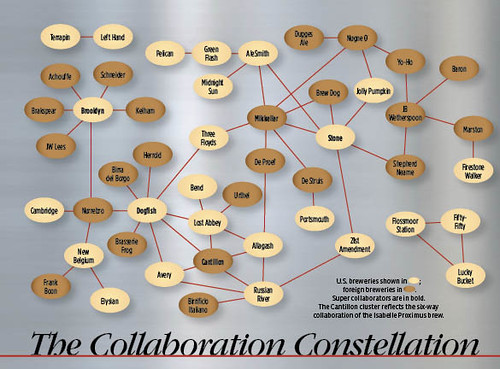
After that, I attempted to detail as many collaborations as I could, with eye toward documenting some early collaborations, both domestic and internationally, and describing the many different kinds of collaborations that brewers were doing. There were so many that a graphic was created for the article showing all the connections that I mentioned.

Collabrographic

And here’s how I concluded, with how the many brewers participating in collaborations feel about them.

The Future of Brewing Together

While there is no doubt that collaboration beers are a growing trend, not everyone is convinced they’re here to stay. Everyone seems to have a different reason for doing them and perceives their value differently.

Some people fear that collaborative brews may simply be a way to generate publicity. Before doing his own jointly-brewed beer, Ron Jeffries admitted to feeling “a little cynical about them.” But after being involved in one, he’s had to rethink that assumption. For him, “the collaboration experience was spiritual,” as well as educational. “It was great to spend time with people I respected, but didn’t really know that well. It was great to see a little bit more of how and why they do what they do.”

Many people echo the sentiment that a collaboration must be more than just a marketing exercise. Collaborations are, by necessity, compromises. Jeffries feels that if it goes too far it becomes more marketing-driven instead of being all about creating a great beer. “That’s the danger,” he says.

Tomme Arthur makes a musical analogy: “There must be a point. You can put Mötley Crüe and Guns N’ Roses on the same stage, but there’s no guarantee the results will be beautiful music.” Continuing the musical metaphors, Cilurzo adds, “Collaborations are like musician’s side projects, where you can gain inspiration. But it doesn’t mean the band breaks up.”

Arthur believes “there will continue to be a need for ambassadors overseas” providing an “opportunity to reach out. We all use the same ingredients, but there’s a world of difference.” Cilurzo adds, “In collaborations, you see things you might never have thought of on your own, and that’s the ultimate reward.” Calagione sees the trend as “a microcosmic symbol of how promiscuous the beer industry is, where we all share secrets with one another, where the consumer is generally catholic with their drinking habits, celebrating the breadth of styles available in the world.”

Todd Ashman sees collaborations as “a natural evolution” of the brewer’s networking experience and offers a way “to stay in touch with people you might not otherwise deal with regularly.” He adds, “It’s also a way to get your customers into the fold and keeps it interesting” for both them and the brewers. And that may be the truest test of all, that the consumers ultimately like and are willing to buy the collaboration beers.

While there is certainly competition among American craft brewers, it is a healthy competition, borne of trying to outdo one another, to show off, to push the envelope just a little bit farther. As Stone’s Mitch Steele says, “Craft brewers feed on what each other is doing.” Or as Calagione puts it, collaborations “remind everybody how creative and exciting the craft beer world is. Not only do we let our freak flag fly, but we also let it mingle.”

Undoubtedly, consumers can count on seeing and tasting more collaboration beers in the coming years. As long as brewers keep approaching the collaborations with their fellow brewers, whether at home or abroad, in the right spirit, then they’ll continue to create unique beers, often in limited quantities, that will keep the beer world continually excited about each new beer. As Dustin Watts, co-creator of the Midnight Project, sees the ultimate point of collaborations, they just scream, “Welcome to the world of craft beer, this is what it’s all about.”

The entire article is online, so you can read it at All About Beer’s online archive. Since then, one of my favorite collaborations has been the Life & Limb project between Sierra Nevada and Dogfish head.

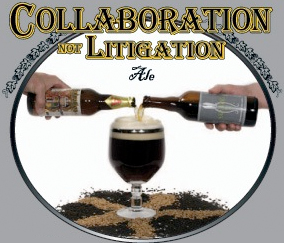
But the story behind the Collaboration Not Litigation between Russian River and Avery expresses the spirit of craft brewers best.
collab-not-lit

Filed Under: Beers, Breweries, The Session Tagged With: Collaborations, International

Collaborating On The Next Session

April 7, 2010 By Jay Brooks

session-the
May’s Session should not be a lonely affair, but instead should bring more of us together to collaborate. That’s because the next Session’s host, Mario Rubio, has chosen as the theme, Collaborations, which he describes as follows.

Feel free to have fun with the topic. Drink a collaborative beer. Who’s brewed some of your favorite collaborations? Who have been some of your favorite collaborators? Who would you like to see in a future collaboration?

As the topic is collaborations, working with each other is encouraged.

So alone, or in groups, join us in collaborating on the Session Friday, May 7. Afterward, group hug.

Filed Under: News, The Session Tagged With: Announcements

Session #38: Cult Beers

April 2, 2010 By Jay Brooks

beer-kool-aid
Our 38th Session is hosted by Sean Inman at Beer Search Party, is cult beers; those beers that are in short supply, high demand and often require going to great lengths to acquire.

Here’s Sean’s thoughts on the cult of beers:

I started thinking about what beer or beers that I would get up at 4:00 in the morning, drive across state lines, stand in a long unmoving line in the cold and rain for the chance to taste with a crowd the size of Woodstock.

So here is my question to you (with a couple addenda).

What beer have you tasted recently (say, the last six months or so) that is worthy of their own day in the media sun?

And to add a little extra to it, how does “great” expectations affect your beer drinking enjoyment?

AND If you have attended one of these release parties, stories and anecdotes of your experience will be welcomed too.

So that’s the assignment, so to speak. While I’m not big on actually standing in lines, if anything might so motivate me, it’s the promise of a truly extraordinary beer for my trouble.

session_logo_all_text_200

But what makes a cult beer? Scarcity seems to be a factor. An intangible hype also sees to be part of the legend. Of course, Coors was once a cult beer, at least East of the Mississippi. Some people think of PBR as a cult beer even though it’s hardly difficult to find. So beers that were once cult favorites can lose that peculiar appeal to become more pedestrian beers. Years ago Mendocino Brewing’s Eye of the Hawk was considered a cult beer and its biannual release was highly anticipated, but they foolishly decided to make it all year round. As a result, it’s really lost virtually all its cache.

Of course, it better taste good to back up the hype or it’s going to lose its cult status pretty quickly. All but a couple of the beers on my list were pretty damn good. So perhaps the real question is does having to work to get a cult beer to try bias one toward rating it higher, in effect giving it points just for the effort involved? I think that can be a factor. Human nature being what it is, most of us don’t want to admit that all that effort wasn’t worth it. In a sense, like many quests, it’s really the journey that’s important.

Every geeky discipline has it’s holy grails that its most ardent fans will seek out. I also collect View-Master reels and there’s one reel among the early single reels (before packets — never mind, V-M geek talk) that always commands the highest price in auctions. It’s Reel #1305 and the last time it was auctioned, it fetched over $800. I think it’s title will explain, at least in part, why: “President Kennedy’s Visit To Ireland.” And indeed, the late John F. Kennedy is in several of the reel’s seven pictures. View-Master geek that I am, I’ve had the reel for a number of years and while it’s certainly a highly-prized part of my collection, there are countless reels with more stunning 3-D photography that I like to look at far more often.

But one thing you can say about geeks is that they’re never satisfied, always restless and in search of the next thing, big or small. And so cult beers will always be a part of the craft industry. Making too little beer for demand is something small brewers can easily excel at. All they need to do is make sure the demand is high enough, sprinkle some hype around and a quick sell out is all but assured, which in turn makes its cult status only grow. And, naturally, they need to brew a beer that can live up to the hype, something most seem readily able to do.

I frankly think the scarce beers are great for the industry. They provide a creative outlet for the brewers, beers for the most ardent fans and make reputations for the breweries themselves while simultaneously allowing them to concentrate on their core brands that make the majority of their profits for them. The most successful breweries seem to me the ones that can both have a flagship or stable of beers that everybody loves and a few stand-outs that appeal primarily to the beer geeks. That’s real multitasking, brewery style. Think New Belgium’s Fat Tire/La Folie. Deschutes’ Black Butte Porter/The Abyss. New Glarus’ Spotted Cow/Everything Else. Sam Adams Boston Lager/Utopias. Sierra Nevada Pale Ale/Bigfoot, Celebration and quite a lot more. I don’t think it’s an accident those are some of the most successful modern era breweries.

beer-koolaid
Drink the cult beer Kool-aid.

But which beers are cult beers? Which ones belong on a list of cult beers? I’ve made a list below off the top of my head Without putting too much thought into it, these are a few that immediately came to mind.

  • Black Albert (De Struise)
  • Black Tuesday (The Bruery)
  • Cable Car (Lost Abbey)
  • Cuvee de Tomme (Lost Abbey)
  • Dark Lord (Three Floyds)
  • Exponential Hoppiness (Alpine beer)
  • Kate the Great (Portsmouth Brewery)
  • Leviathan Barleywine (Fish Brewing)
  • Local 1 (Brooklyn Brewery)
  • O.B.A. (Anchor Brewery)
  • 120 Minute IPA (Dogfish Head)
  • Pliny the Elder (Russian River Brewing)
  • Pliny the Younger (Russian River Brewing)
  • Poseidon Imperial Stout (Fish Brewing)
  • Raspberry Tart (New Glarus)
  • Sink the Bismarck! (BrewDog)
  • Speedway Stout (AleSmith)
  • Tactical Nuclear Penguin (BrewDog)
  • Toronado 20th Anniversary Ale (Russian River Brewing)
  • Westvleteren Blond, 8 and 12 (Westvleteren)
  • Wisconsin Belgian Red (New Glarus)

These seem like no brainers, for the most part. Of course, I’ve tried all of them. I assume there’s plenty of ones I can’t think of simply because I’ve never tried them, or perhaps even heard of them. What else should be on the list? Anchor’s Christmas Ale? Sierra Nevada Bigfoot?

As it happens, I recently sampled a number of the beers on this list at this year’s Keene Tasting at Brouwer’s Cafe in Seattle. I’ll have my report from that tasting posted shortly and will update it here with a link.

Pliny-the-Younger
The original cult figure Pliny the Younger.

Filed Under: Beers, Editorial, The Session Tagged With: Strange But True

The Cult of Beers Next Session Topic

March 15, 2010 By Jay Brooks

session-the
Our next Session is a little less than three weeks away, but it’s not to early to start thinking about it. The topic chosen by our host, Beer Search Party, is cult beers; those beers that are in short supply, high demand and often require going to great lengths to acquire.

Here’s how our host, Sean Inman, describes the topic:

With Kate the Great Day a recent memory and the day of the Dark Lord fast approaching, I started thinking about what beer or beers that I would get up at 4:00 in the morning, drive across state lines, stand in a long unmoving line in the cold and rain for the chance to taste with a crowd the size of Woodstock.

So here is my question to you (with a couple addenda).

What beer have you tasted recently (say, the last six months or so) that is worthy of their own day in the media sun?

And to add a little extra to it, how does “great” expectations affect your beer drinking enjoyment?

AND If you have attended one of these release parties, stories and anecdotes of your experience will be welcomed too.

So get cracking, get yourself a cult beer and start working on your own cult of personality. Then reveal it and get found on Friday, April 2 over at the Beer Search Party.

Filed Under: Beers, News, The Session Tagged With: Announcements

« Previous Page
Next Page »

Find Something

Northern California Breweries

Please consider purchasing my latest book, California Breweries North, available from Amazon, or ask for it at your local bookstore.

Recent Comments

  • Bob Paolino on Beer Birthday: Grant Johnston
  • Gambrinus on Historic Beer Birthday: A.J. Houghton
  • Ernie Dewing on Historic Beer Birthday: Charles William Bergner 
  • Steve 'Pudgy' De Rose on Historic Beer Birthday: Jacob Schmidt
  • Jay Brooks on Beer Birthday: Bill Owens

Recent Posts

  • Beer In Ads #5148: Ach Himmel Mr. Goat March 6, 2026
  • Historic Beer Birthday: Conrad Windisch March 6, 2026
  • Historic Beer Birthday: Samuel Wainwright March 6, 2026
  • Beer In Ads #5147: Frankenmuth Is Michigan’s Largest Selling Bock March 6, 2026
  • Historic Beer Birthday: John Bird Fuller March 6, 2026

BBB Archives

Feedback

Head Quarter
This site is hosted and maintained by H25Q.dev. Any questions or comments for the webmaster can be directed here.