
Our 22nd Guinness poster by John Gilroy features another zoo setting, this one with a new Gnu to the zoo, who knew that “Guinness is good for you,” using a nice group of homonyms.
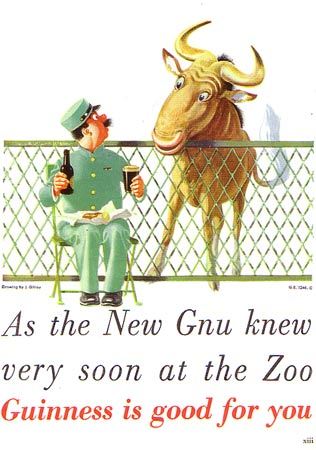

Our 22nd Guinness poster by John Gilroy features another zoo setting, this one with a new Gnu to the zoo, who knew that “Guinness is good for you,” using a nice group of homonyms.

As my Philadelphia theme comes to an end, as does my time at Philly Beer Week, Friday’s ad is for Gretz Beer, never a big force in Philadelphia market, but by 1957 were still hanging on as the smallest brewery left in Philly. You can read below what they were trying to do with their “small car series” of ads, but the exchange between the two men in the Fiat feels forced. It doesn’t feel like a natural conversation, it screams adspeak.
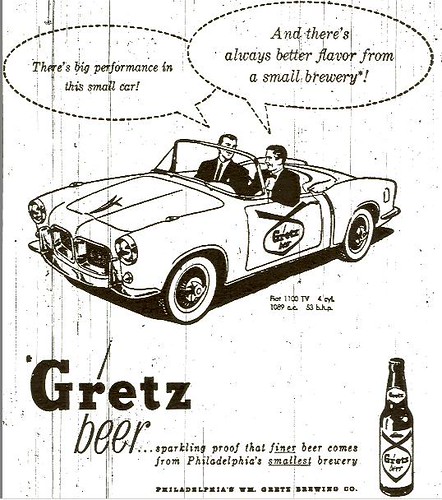
According to Rusty Cans:
The Gretz car series was issued starting in late 1957 by the Gretz Brewing Company in Philadelphia. The smallest of the last four breweries in Philadelphia, Gretz decided to make its small size a selling point by comparing its beer to a sports car. Small cars were better, they argued, and so was a beer from a small brewery! As part of the promotion Gretz bought 11 of the latest sport cars and painted them yellow and black to match the Gretz label colors, with a Gretz logo on the sides. The cars were introduced at the Army-Navy Game in Philadelphia at the end of November 1957 (Navy won 14-0).
And here’s another:
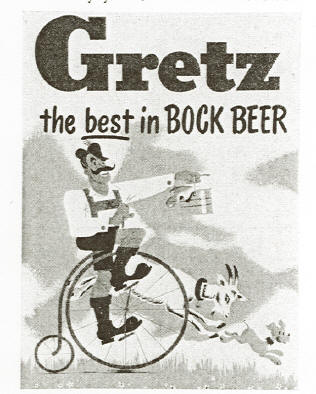
It’s for their bock using the iconic brewery character from 1951.
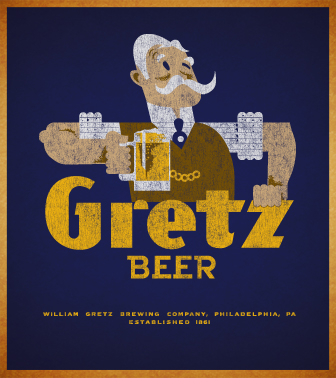
I love this image of the Gretz guy, and in fact have a t-shirt of it I got from Yesterbeer. I also say an original tray with the same image behind the bar at the Kite & Key last night.
Tuesday night in Philadelphia, I was fortunate to get an invitation from Tom Peters to attend his Lambic Dinner at Monk’s Cafe. The dinner included three of the best lambic brewers from Belgium: Frank Boon, from Brouwerij Boon; Armand Debelder, from Brouwerij 3 Fonteinen; and Jean Van Roy, from Brasserie Cantillon. It was an awesome dinner with some just spectacular beers.
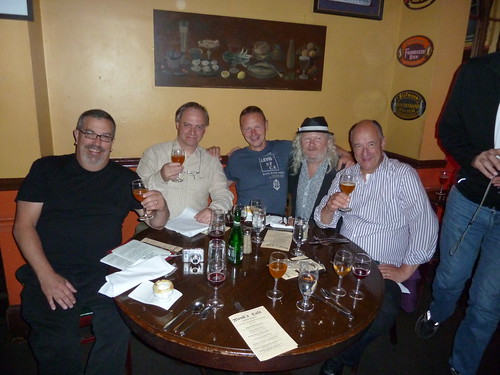
Tom Peters, Frank Boon, Jean Van Roy, Fergie Carey and Armand Debelder at the main table.
It was an eight course beer dinner prepared by guest chef Brian Morin, who cooks at the beer bistro in Toronto, Canada.
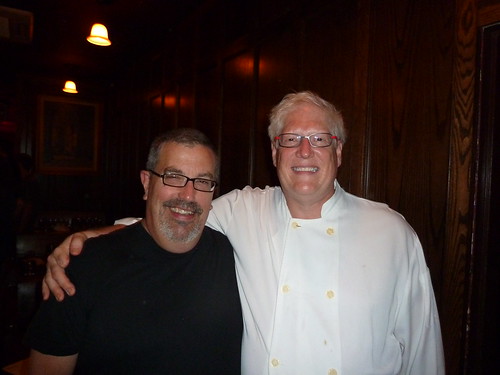
Tom Peters with guest chef Brian Morin.
You can see each of the eight courses below in the slideshow of the Monk’s Lambic beer dinner. This Flickr gallery is best viewed in full screen. To view it that way, after clicking on the arrow in the center to start the slideshow, click on the button on the bottom right with the four arrows pointing outward on it, to see the photos in glorious full screen. Once in full screen slideshow mode, click on “Show Info” to identify each photo.
Continuing my Philadelphia theme for Philly Beer Week, Thursday’s ad is old one, from 1873. The brewery is Bergner & Engel’s, which used to be located on 32nd and Thompson. I just love these old posters showing off the brewery at its best that were common in the latter half of the 19th century.
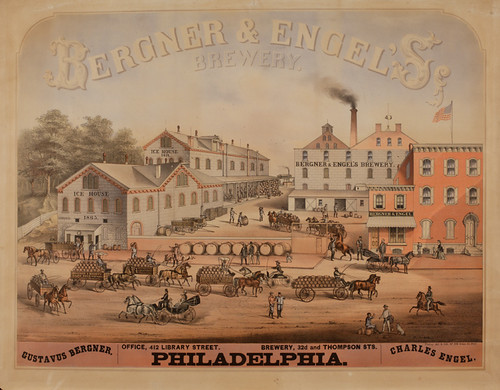
Here’s a description of the poster from the Library Company of Philadelphia:
Since the erection of the first brewery in Philadelphia circa 1683, beer making has been a near steady Philadelphia industry. Following the introduction of lager beer to the Philadelphia market in the mid-19th century, German-American brewers dominated the field. The firm of Bergner & Engel, formed in 1870 between longtime brewers Gustave Bergner and Charles Engel, symbolized the best of the best of that era’s nearly one hundred, mostly German-American run breweries. Operating from a plant built for Bergner in 1858 at 32nd and Thompson streets, the brewery served as the forerunner in the establishment of the industrial neighborhood known as Brewerytown.
This circa 1875 print, a chromolithograph by German-born lithographer Charles P. Tholey, evokes the vitality of the brewing industry and documents the eye-catching imagery of advertising for the city during the 19th century. The advertisement conveys the expanse of the Bergner & Engel plant that included ice houses, a brew room, fermenting and cooling rooms, store rooms, offices, and dwellings. The numerous factory wagons loaded with kegs of beer to be delivered, the visible construction dates of the ice houses, and the several returned and cleaned barrels demonstrate the success of the company. To catch and keep the viewer’s eye, Tholey also employed subtle details such as the excited dogs, the probable job seeker soliciting a worker on break, and one of the proprietors, Bergner, conversing with an employee in front of his office.
Unlike advertisements of today, the product for sale does not serve as the focus of the print. Rather, the factory comprises the image. Competition for consumers was not based on the quality of the good, but the quality of the establishment in which the product was produced. Regarding the circulation of such prints, rather than posting them publicly in stations, on buildings, or fences, businesses probably enclosed the advertisements with product shipments sent to their distributors throughout the country. Enterprises such as Bergner & Engel anticipated that their retailers would display the prints in the public spaces of their establishments to promote their products to a broader base of consumers.
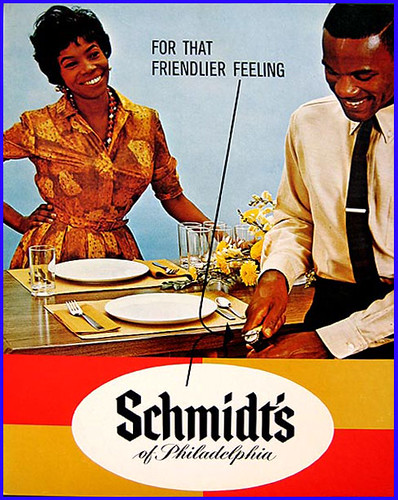
Continuing my Philadelphia theme for Philly Beer Week, Wednesday’s ad is for Schmidt’s. Again, I’m not sure, but my guess is it’s from sometime in the 1970s. I’m not sure about those lines and arrows at all, or what the slogan “For That Friendlier Feeling” has to do with the man opening the bottle.
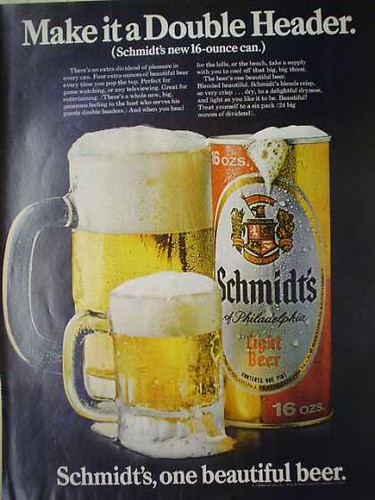
Continuing my Philadelphia theme for Philly Beer Week, Tuesday’s ad is for Schmidt’s. I’m not sure, but my guess is it’s from the mid-1960s. I love how the foam is spilling out from everywhere, both mugs and the can, too.

I arrived in Philadelphia on the train yesterday afternoon not sure what to expect. My first event wasn’t until Tuesday so I had a wide open evening. So I called a few people, including the wonderful Jennie Hatton — my agent — and also with the P.R. firm for Philly Beer Week. She was two blocks away at Misconduct with Eric Wallace from Left Hand Brewing and encouraged — no insisted — I join her there. It’s been my personal experience that nobody ever says no to Jennie Hatton, so there I went. Eric handed me his terrific barley wine and the evening began, not with a whimper but a bang. The bang, it turned out, was the now legendary “Hammer of Glory,” which Jennie had just retrieved from McGillin’s. I was even honored to carry the Hammer a time or two, which being an organizer of SF Beer Week, almost felt a little subversive. But as a Pennsylvania native and big supporter of PA beer, it also felt right at home in my hands.

Me holding the legendary Hammer of Glory.
From there, we went to Local 44, scene of the scandalous PLCB raid by state troopers a few months back, where the fame of the Hammer of Glory spread and they were pouring more Lost Abbey beers than I’d ever seen in one place before.

Local 44 owner Brendan Hartranft, the Hammer and Jennie.
After a quick stop at the City Tap House, we crawled over to Standard Tap, where their Bear Ninja Cowboy contest was about to get under way. In case you’re confused, essentially it’s beerchambeau: Bear beats Ninja, Ninja beats Cowboy and Cowboy beats Bear.

Bear Ninja Cowboys, refs the Hammer and Jennie.
Knowing (and apparently sharing) my love for all things fried and potato, Jennie took me to the North Bowl Lounge & Lanes, just a short walk from the Standard Tap for some tater tots. This very cool bowling alley also has an amazing menu of tater tot dishes, on the order of Totcho’s but with a dizzying variety of choices. We went with the Wakin’N Bacon, tots with cheddar, bacon and a hard fried egg. I also ordered a special hot dog that was also cheese, bacon and a fried egg. Holy moley, they were good, some of the best tots I’ve ever had.

Tots, a dog, some eggs, bacon, cheese and Jennie.
The last stop of the night was Doobie’s, a wonderfully unpretentious neighborhood bar. It was great quiet spot to end such a great night. Plus, there was a number of people there I’d hadn’t seen in a while. They were also pouring some of the last of the elusive Standard Porter, a collaboration beer for Philly Beer Week.
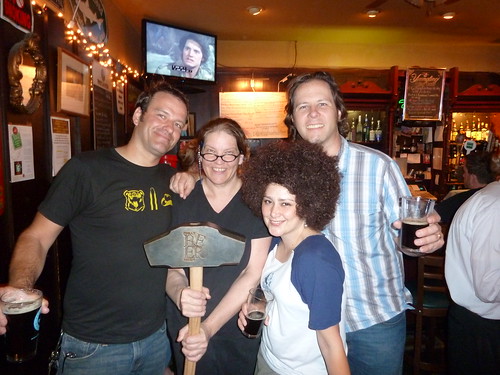
Standard Tap owner William Reed, Doobie’s owner Patty with the Hammer, Suzy Woods and Brian O’Reilly, both from Sly Fox Brewing.
Below is a slideshow of my Hammer Time evening. This Flickr gallery is best viewed in full screen. To view it that way, after clicking on the arrow in the center to start the slideshow, click on the button on the bottom right with the four arrows pointing outward on it, to see the photos in glorious full screen. Once in full screen slideshow mode, click on “Show Info” to identify each photo.
All this week I’ll be featuring ads from Philadelphia breweries since I’ll be there most of the week for Philly Beer Week. Monday’s ad is for Ortlieb. The ad is from 1959 and shows a couple loading beer onto their boat, with this deliciously goofy tagline. “It’s the he-man brew — that the gals love too!” The logo at the bottom also includes this curious slogan, “Ortlieb’s, the wet beer.” Hilarious.

This event just looks awesome. After whetting my appetite at the Monk’s Cafe’s lambic dinner Tuesday night, Shelton Brothers is putting on The Great Lambic Summit at the University of Pennsylvania the following evening, Wednesday June 9, beginning at 7:00 p.m.
Here’s a description of the event:
The Lambic World is more divided, politically charged, and fraught with danger than the Middle East. So it’s a really big deal when you get Armand Debelder (3 Fonteinen) Frank Boon (Brouwerij Boon), and Jean Van Roy (Brasserie Cantillon) together at the same table. In fact, it’s never been done before.
On Wednesday evening, June 9th, as part of Philly Beer Week, these three greats — indisputably the three most traditional and authentic producers of real lambic in Belgium — will be gathered first to celebrate and praise each others’ work. Liberal quantities of special beers from each producer will be passed around, including some rare items being flown over to the U.S. for the very first time for the occasion. There will be some artistically prepared foods, naturally, including cheeses made with Gueuze from 3 Fonteinen and Cantillon. But there will also very likely be some fireworks. Even at the top, not everyone sees eye to eye, to say the least. And there will probably some discussion, and some dirt dished, about what’s going on in the darker corners of Lambic World. Dan Shelton, beer importer, lambic fan, and well-known pain-in-the-ass, will be hosting the discussion and doing his ugly best to make sure that the evening is not without controversy, just the way you like it!
It all happens under the wise and watchful eye of the Sphinx, in the Lower Egyptian Room in the depths of the University of Pennsylvania Museum of Art. The ancient inhabitants of the Nile River Valley were of course the first great civilization to make an art and religion of brewing beer — relying on unseen and then unknown wild yeasts to ferment their brew, just as the famous brewers and blenders of lambic beer in Belgium’s Senne River valley do today.
You really can’t afford to miss once in a lifetime chance to drink some extremely rare lambic beers with the people who have dedicated theirs lives to the art.
Here’s the lineup:
Frank Boon, Brouwerij Boon
Armand Debelder, 3 Fonteinen
Jean Van Roy, Brasserie Cantillon
The world’s best lambic beer, and good food, served.
Tickets are $50 person, cheap at twice the price. See you there!

Our 41st Session will be hosted by the Wallace Brothers, Jeff and Tom, from Lugwrench Brewing. They’ve chosen “Craft Beers Inspired by Homebrewing” as their topic, which Jeff describes like so:
Session topics typically come from the host’s area of passion – something they have a strong affinity towards. For Tom and I, the real pathway in our appreciation of Craft Beer has been through the hobby of homebrewing. Not only has this hobby fostered yet another reason for two geographically-separated brothers to collaborate (the core concept for the Lug Wrench blog being “a fraternal bond over beer”), it was through homebrewing where we learned what makes a marginal beer and what makes an exceptional beer. It was the lauching pad for how we came to admire (and sometimes fanaticize) about “good” beer. So during our discussions of potential topics, the debate kept coming back to homebrewing and how craft beer is connected to the amateur brewing community.
The chosen topic: Craft Beers Inspired By Homebrewing. How has homebrewing had an affect on the commercial beer we have all come to love? Feel free to take the topic in any direction your imagination leads you.
Write about a beer that has its roots in homebrewing. Write about a commercial beer that originated from a homebrew.
Write about a professional brewer you admire who got their start in homebrewing before they went pro. Write about a professional brewer who still homebrews in their free time.
Write about a Pro-Am beer tasted either at a festival or a brewpub. Write about an Amateur / Professional Co-op you’ve had the pleasure of experiencing (such as The Green Dragon Project).
Write about commercial brewers using “Homebrewing” as part of the marketing. Write about the Sam Adams LongShot beers, whether good or bad.
So brew up your own post, at home, for the next Session, on Friday, July 2.