Brookston Beer Bulletin

Jay R. Brooks on Beer

  • Home
  • About
  • Editorial
  • Birthdays
  • Art & Beer

Socialize

  • Dribbble
  • Email
  • Facebook
  • Flickr
  • GitHub
  • Instagram
  • LinkedIn
  • Pinterest
  • RSS
  • Twitter
  • YouTube

Powered by Genesis

Oldest Brewery In Ireland Closes

June 4, 2009 By Jay Brooks

I’m a little behind on this one, but thought it worth mentioning all the same. Last Friday, a week ago, the oldest brewery in Ireland was shut down. Heineken, who’s owned the Beamish & Crawford Brewery in Cork since last October, decided in December to close the brewery and move production elsewhere to cut costs. The brewery, located on South Main Street, has been making beer since 1690, making it Ireland’s oldest brewery. There had been talk of turning it into a museum, a plan endorsed by Cllr Brian Bermingham, The Lord Mayor of Cork. Its mock-Tudor counting house is already a “protected structure” and, according to The Independent, “the National Conservation and Heritage Group (NCHG) argued that the existing Beamish site offers an opportunity to create a tourism-heritage complex similar to the Guinness Storehouse in Dublin.” Heineken decided instead to sell it “on the commercial market” since they obviously couldn’t care less about the history of the place. Like any multinational corporation, they only care about short-term profit.

British beer writer Roger Protz has a nice summary of who’s owned Beamish over the past few decades, and how those events led to Heineken acquiring it last year.

While Murphy’s fell into the hands of Heineken, Beamish also had a turbulent life in the 20th century. In 1962 it was bought by the Canadian group Carling O’Keefe, which in turn was bought by the Foster’s lager group of Australia. This allowed Beamish Stout to be sold through Courage pubs in Britain as Courage was owned by Foster’s. Eventually Courage was taken over by S&N, which gave the brand little promotion in Britain but, incongruously, marketed it in France alongside its French subsidiary Kronenbourg.

Abut 120 jobs will be lost and production will be moved across town, to what for most of its existence was known as the Lady’s Well Brewery, also owned by Heineken, where they make Murphy’s Irish Stout.

 

Filed Under: Uncategorized Tagged With: Uncategorized

Cross-Border Beer Buying

June 1, 2009 By Jay Brooks

While looking through the information at the Tax Foundation today I came across a very interesting article and a study about cross-border sales of beer and tobacco and how it effects tax revenues. It’s not something I thought much about or figured had that much impact but the study, done ten years ago, seems to suggest otherwise. Essentially, what happens is that between state borders, people either living near them or happen to be traveling through them will purchase items in the other state, the one where the taxes are less, making the products themselves less expensive. I hadn’t thought about this phenomenon in a long time, but I recall that as a kid, my stepfather — a heavy cigarette smoker — had people bring him cartons of cigarettes back from southern states where, presumably, the taxes were so much cheaper that the cost of a carton of smokes was worth the effort of buying them in another state and hauling them back to Pennsylvania. And I’ve heard in some states, particularly on the east coast where they’re closer together, people would travel across state lines to buy a car for the same reason though as I understand it most states have enacted laws to make that practice not work anymore.

How this relates to beer is that in states where the excise tax differs greatly from a state bordering it, the price of beer can likewise be pretty dramatically different between those states, primarily because the base tax gets marked up along the distribution chain so the difference in the tax is magnified. That makes it susceptible to cross-border buying resulting in lost sales and tax revenue for the state with the higher tax rate. How much of a problem could this be? I confess I was initially skeptical, but the study, How Excise Tax Differentials Affect the Cross-Border Sales of Beer in the United States, done by the Tax Foundation in 1999 found that nationally it resulted in nearly $35 million in “lost sales & excise tax revenue.” That certainly sounds like enough that it should give any state pause before jacking of their state’s excise tax rate on beer. It’s just one more reason why raising a state’s beer tax might be a losing proposition economically.

Here’s an excerpt from the abstract for the study:

Cross-Border Shopping for Beer

While the study measures cross-border shopping in every state, the results are naturally most dramatic along borders where the tax differential is high. For example, Washington state, which levies a statewide 6.5 percent sales tax, additional local sales taxes and a $7.172 per barrel beer excise tax, shares a border with Oregon, which levies no state or local sales taxes and has a state beer excise of just $2.60 per barrel.

Huge quantities of beer cross the border in these circumstances, but this migration of economic activity affects more than just sales and product-specific excise tax collections. Cross-border shopping affects income and property tax collections, license fees, and a host of other sources of government revenue.

Policymakers are frequently surprised by the magnitude of the revenue effects, and such surprises can be particularly unnerving when the government in question is required to maintain a balanced budget.

According to the study, California alone lost $5,248,466 for the year studied. The conclusion seems fairly unambiguous, here are the last two paragraphs:

The per capita sale of packaged beer varies widely by state. It has long been suspected that these differences are due in part to cross-border shopping. Building on earlier work in this area, this study sought to explain differences in packaged beer sales among the states. A model of demand for beer and its supply by source was constructed. This model was created in a manner that allowed it to capture the effects of both interstate and Canadian cross-border shopping on beer sales in the states.

The model was then tested empirically using data from 1990–1997. Cross-border shopping was found to have significant effects on packaged beer sales in the states. In particular, the study found that in 1997, 18.1 million cases of beer, on net, moved from low- to high-tax states. Such exports accounted for approximately 2.0 percent of sales in net exporting states and allowed them to export $18.8 million in sales and beer excise taxes to their high-tax neighbors. In addition, states along the U.S.-Canadian border were able to export 10.9 million cases of beer and $14.6 million in sales and beer excise taxes to Canada. The study clearly shows that high sales and excise tax differentials lead to significant increases in cross-border beer sales.

The pull-quote that lawmakers should pay attention to is that by being too heavy-handed with imposing higher excise taxes on beer, it just might backfire to the point where it’s actually counter-productive and even reduces the amount of taxes collected. It could, it appears, actually wreck a state’s economy

Policymakers should be aware that the effects of cross-border shopping on income taxes, property taxes, and license fees can match or even exceed the revenue changes in state and local sales and excise taxes measured by the model.

The study is long and complex, but worth your time if you’re in a position to speak with or write to a state lawmaker, or if you’re a geek for this stuff like me. It’s 24 pages and is available as a pdf file.


Filed Under: Uncategorized Tagged With: Uncategorized

Beer Excise Taxes By State

June 1, 2009 By Jay Brooks

tax
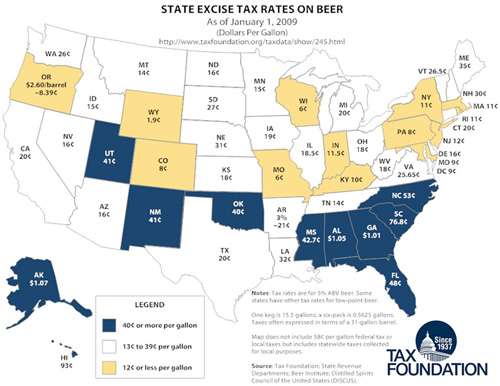
I found this nice map of the 50 states with the individual beer excise tax brewers in each state has to pay in addition to the federal excise taxes at Charlie Papazian’s blog, too. It’s originally from Don’t Tax Our Beer, a website maintained by the Tax Foundation.

The map provides an interesting snapshot of all the states. It’s worth noting that all the southern states have high excise taxes on beer, where the idea of drinking being sinful is, I think, more prevalent.

excise-taxes-2009

Filed Under: Beers, Politics & Law, Related Pleasures Tagged With: Taxes, United States

Sin Tax Tyrannies

June 1, 2009 By Jay Brooks

There’s an interesting opinion piece at the Christian Science Monitor by Patrick Fleenor, who’s the chief economist for the Tax Foundation. It’s called The Tyranny of Taxing ‘Sin’. There’s some good stuff there, but here’s my favorite part:

Fleecing the minority is made much easier by an army of busybodies who make a comfortable living feeding “studies” to the media, proclaiming that Americans eat the wrong foods, drink the wrong beverages, don’t exercise enough, and are generally sinful. These modern-day Carrie Nations’ denunciations of nearly every commonplace pleasure — from Girl Scout Cookies to movie theater popcorn — are fodder for the nightly news.

To dispel the notion that their sin taxes go too far, the nanny-staters rely on a clever sleight-of-hand: Instead of pitching the tax as a punishment for sin, they claim they’re merely compensating society for costs imposed by bad habits. These claims are often unsupported by science, but many media repeat them without question.

That’s certainly true of the neo-prohibitionists, who keep insisting that vague alcohol-related “stuff” accounts for an enormous cost burden for taxpayers, but the supporting evidence I’ve seen for that is either non-existent or ludicrous at best. Yet the media repeats that endlessly and people comment here trying to asset is as a fact, too.


Filed Under: Uncategorized Tagged With: Uncategorized

Montana’s Victory & More

June 1, 2009 By Jay Brooks

montana
There’s a nice round-up on Charlie Papazian’s blog about some current state legislation around the country, for example some good news out of Montana, similar to Alabama’s news two weeks ago:

Montana just passed a law which will allow beer to be up to 14% alcohol by volume (before it was max at 7% by weight, about 8.75 % by volume), effective in October. That new limit is conditional.The beer must be built 75% from malted cereal grains, if above 8.75% by volume. If over the 8.75% and less than 75% from malted cereal grains, the beer must be sold in liquor stores.

That’s followed by a summary of pending issues at various states and some interesting tax information, too.


Filed Under: Beers, News, Politics & Law Tagged With: Montana

Beer Bottles Galore Recycled Art

May 31, 2009 By Jay Brooks

beer-bottle-brown
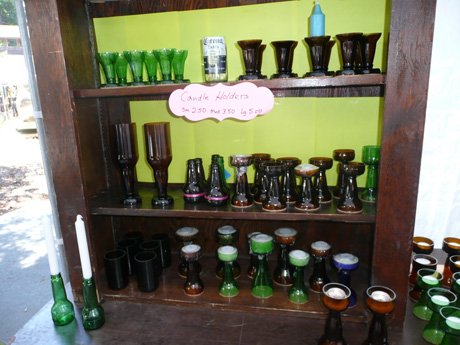
Last weekend, the family and I spent the holidays in northern California, near Gualala. As we’re inveterate art nuts, we couldn’t resist the Fine Arts Fair that was taking place at the Gualala Art Center. We found a cool black walnut bowl to compliment the Kauri bowl we picked up last year in New Zealand. Alice made a beaded necklace and we generally had a nice time looking at art among the redwoods. But perhaps the most interesting thing we stumbled upon was the “Bottles Galore” recycled art of Pamela Wheatley, who makes “usable objects from beer, wine and fruit juice bottles.”

btls-galore-1
The main display showing her candle holders and drinking glasses made from recycled beer bottles.

btls-galore-2
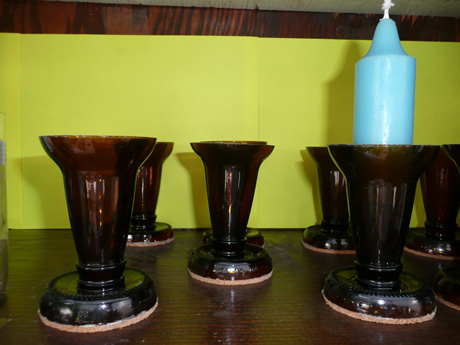
Candle holders from brown bottles with cork bottoms.

btls-galore-3
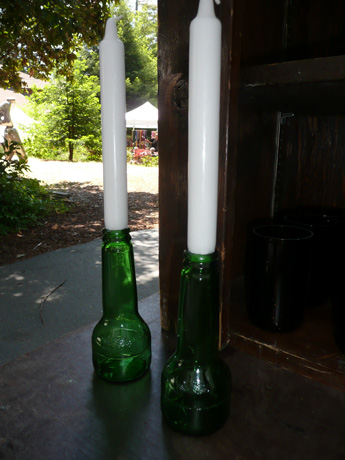
A design for tapered candles using green glass. The middle was cut out, and the bottom and top sections glued back together.

btls-galore-4
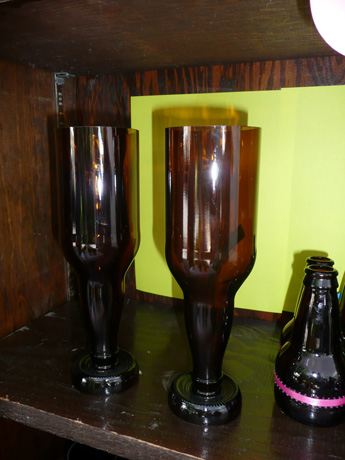
Glass tumblers and tea light candle holders (I bought a pair of them in brown).

btls-galore-5
And a tall vase using a 22 oz. beer bottle (I bought one of these, too.) They’re very inexpensive and when I remarked about that as I was paying for my purchases, Ms. Wheatley remarked that she was “just selling fun.” What a great attitude. She told us that she only uses bottles she finds or that friends give her, which she says happens more and more once they see what she’s doing with them. She lives in Manchester, California, which is a little farther north from Gualala along the Pacific coast but still about 40 miles south of Fort Bragg, where North Coast Brewing is located. She doesn’t seem to have a website, but if you want to know where she’ll be selling her wares, you could probably ask her via e-mail, which is pam4mom (@) hotmail (.) com.

Filed Under: Art & Beer Tagged With: Recycling

Beer In Art #30: Emblem of Beer Carriers Guild from Jerusalem Chapel

May 31, 2009 By Jay Brooks

art-beer
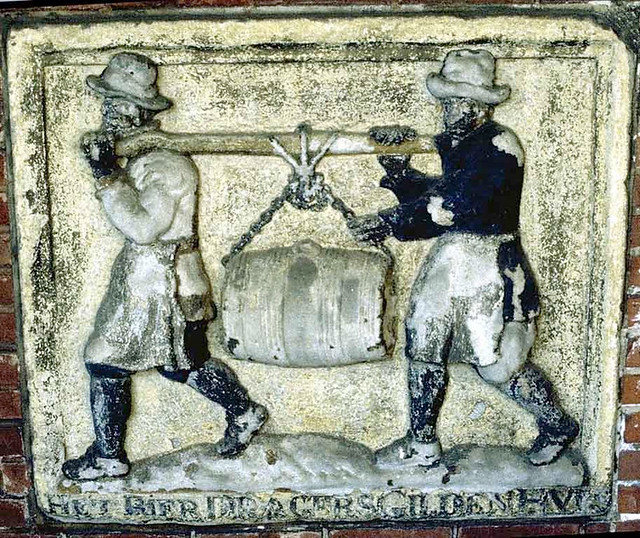
Today we’re heading into the Wayback Machine again, this time to circa 1778 in Leiden, which is in the Netherlands. Back then, the town was spelled “Leyden,” and “like many other cities, had a Jerusalem Chapel, maintained by citizens who had returned from a pilgrimage to the Holy Land.” The Chapel is no longer standing, but part of it was preserved and today can be seen at the Stedelijk Museum De Lakenhal in Leiden. The particular bit from the chapel highlighted today is a Baroque sculpture showing the emblem of the Dutch Beer Carriers Guild.

Dutch-beer_guild-lg

There’s not much information about the work itself or even who created it. But the notion of a guild for a profession whose only job was transport beer I thought might of interest. Though not Dutch, here’s a description of “The Beer Carriers of Bruges,” from the website of Global Beer, who import several Belgian beers to the U.S.:

It was in 1477 that the municipal authorities forbade breweries from transporting beer within the boundaries of Bruges. At the same time, they created the guild of ‘biervoerders’ (beer carriers). The purpose was to control tax evasion. Tax on beer was the main source of income for a city. For example, at the end of the 16th century, these taxes
represented more than 60 % of the receipts of the city of Antwerpen. Because beer was the normal beverage for every one, with an average consumption of more than a half gallon per head per day, taxing beer was a guaranteed source of income for a city.

It must have been a picturesque spectacle in the streets of the inner cities, two men carrying a cask of beer, fixed to long poles resting on their shoulders. Not only the local brewers had to use their services, also the brewers from surrounding areas and the importers, who delivered beer to Bruges, stopped at the gates of the city and gave their loads to the carriers. The carriers had a typical uniform, with the logo of their guild, two casks, embroidered on the front and the back. The president of the guild was named ‘king’.

He had 5 deputies, one for every section of Bruges. Every month, a drawing of lots indicated to which section of the city each beer carrier-team was appointed. Each member of the guild was constrained to face certain obligations, that won them the appreciation of the brewers for their efficiency and their strict neutrality in respect of the different beers that they were appointed to transport. For the carriers, beer was only a merchandise like any other, and they were wise enough to remain outside the rivalries which prevailed between their clients.

A document of 1650 teaches us that a new member of the guild had to pay a certain sum of money, and had to donate a cask of beer during a feast he had to organize to celebrate his entry in the trade. The organization of trades in brotherhoods or guilds, was an early form of social security. Each day, work completed, the carriers met together in their local ‘thuyscken op de markt’ (the little house on the marketsquare) to submit to the paymaster the receipts of their deliveries. At the end of the month, the distribution of profits took place, and all carriers received an identical sum, even those who had been forced to interrupt their work during the month on account of illness.
It was only at the beginning of the 20th century, that the independent carriers disappeared and were replaced by the lorries of the breweries. The guild of the beer carriers was one of the rare guilds, holding a monopoly, that had survived the French Revolution

There’s some more fascinating information about Dutch beer carriers at the genealogical page, Barent Jacobsen Kool and Marritje Leendertse De Grauw, from which there are some interesting tidbits below.

Under the Court Minutes for 1654 (for the Burgomasters and Schepens of this City of New Amsterdam):

And in order to prevent all fraud and smuggling in the one and the other, the Burgomasters and Schepens aforesaid with the approbation of the Honble Director General and Council have appointed and accepted as sworn Wine and Beer Carriers Barent Jacobsen Cool and Pieter Caspersen van Naerden and no person, be he who he may, except such Beer Carriers, shall be at liberty to work at, lay in, or remove any wines or beer from one warehouse, cellar, or brewery to another or to bring foreign beer within this City’s gates on pain of forfeiting said wines or beer and arbitrary correction at the direction of the Court.

And here’s a table of how much they could charge for their services:

The appointed Wine or Beer Carriers for what they may convey here within the walls of this City from one Brewery house or cellar into the other, shall not be permitted to receive more than the following.

For one pipe of brandy………………………………………..24 stivers
one pipe of wine…………………………………………………Twenty stivers
one hogshead of wine…………………………………………Twelve stivers
one Aam (40 gallons) ………………………………………..Ten stivers
one half-aam……………………………………………………..Five stivers
one anker…………………………………………………………Three stivers
half anker…………………………………………………………Two stivers
one tun of strong or small beer…………………………..Eight stivers
one half-barrel………………………………………………….Four stivers
one anker…………………………………………………………Three stivers

And according to the “History of the City of New York in the Seventeenth Century: Volume I: New Amsterdam” by Mariana Griswold Van Rensselaer, there were beer carriers in New York City in the mid-1600s, too.

Filed Under: Art & Beer Tagged With: History

The Personality Of Pint Glasses

May 30, 2009 By Jay Brooks

pint
The Walkabout pub chain, consisting of fifty Australian-themed bars in Great Britain, hired psychologist Dr. Glenn Wilson to research the drinking habits of their patrons. While I’d never heard of him (hardly a measure of fame), he’s apparently “best known for his work on attitude and personality measurement, sexual attraction, deviation and dysfunction, partner compatibility, and psychology applied to performing arts. In 2001, Wilson was ranked among the 10 most frequently cited British psychologists in scientific journals.”

For the project, Wilson observed 500 people drinking in a pub, and specifically the way they held their glass, and from that “divided them into eight personality types.” Despite his apparent credentials and success in his field, the study hardly seems scientific. It was done at the behest of a pub chain, most likely to create publicity, which it’s no doubt dones as it’s been covered by the BBC, the Daily Mail and the Telegraph.

Dr Wilson said: “The simple act of holding a drink displays a lot more about us than we realise – or might want to divulge.

“When Hillary Clinton was on the campaign trail in the US, commentators picked up on the fact that she used her left hand to raise a pint, even though she’s right-handed.

“She might just have been posing for a shot but some people suggested that it was an insincere gesture.

“The next time you’re in a bar, it might be worth thinking about what you’re saying to the people around you just by the way you’re holding your glass.”

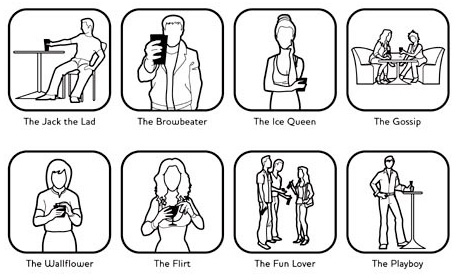
So it’s a little silly, and not exactly well-settled, peer-reviewed, tested science despite being done by a psychologist of good repute. Still, it’s not without interest. Below are the eight personality types and how each are described.

The Pint Glass Personality Types

  1. The Jack the Lad
  2. The Brow Beater
  3. The Ice Queen
  4. The Gossip
  5. The Wallflower
  6. The Flirt
  7. The Fun Lover
  8. The Playboy

glass-holds

1. The Jack the Lad: This “peacock” is conscious of his image and will drink a bottled beer, or cider. Inclined to be confident and arrogant, he can be territorial in his gestures, spreading himself over as much space as possible, for example, pushing the glass well away from himself and leaning back in his chair. If he’s drinking with his mates, he would be unlikely to welcome approaches from outside the group, unless sycophantic and ego-enhancing.

Celebrities: Peter Andre, David Cameron, Jason Statham. The “ladette” (e.g. Lily Allen) is a female approximation to this male archetype.

2. The Browbeater: This rather pugnacious type is again mostly male. He prefers large glasses, or bottles, which he uses as symbolic weapons, firmly grasped, and gesticulating in a threatening, “in the face” kind of way. Something of a know-it-all, he comes across as slightly hostile, even if only through verbal argument, or jokes targeted at others. He should be approached with great care, or not at all.

Celebrities: John Prescott, Russell Crowe (with Naomi Campbell as a female equivalent), Gordon Brown.

3. The Ice Queen: This is a mainly female type whose natural style is cold and defensive. She drinks from a wine glass, or a short glass, which is held firmly in a barrier position across the body so as to deter intimate approaches. It is usually a waste of time approaching this woman; she may be ready with a castrating put-down.

Celebrities: Victoria Beckham, Debra Barr (from The Apprentice)

4. The Gossip: This (mainly female) drinker tends to cluster in all-female groups talking about other people, and can be critical. She holds a wine glass by the bowl and uses it to gesticulate and make points in conversation. She is inclined to lean over her drink, in towards others so as to speak confidentially. This person already has a close-knit social group with little inclination to extend it, therefore advances from outsiders are not usually welcome.

Celebrities: Kate Moss, Sadie Frost.

5. The Wallflower: This is a shy, submissive individual who holds the glass protectively, not letting go, as though afraid somebody will take it away. Palms are kept hidden and the glass is used as a social crutch – the drink is never quite finished, with a mouthful left in case of emergency. The drink is small (maybe half a pint of lager for a man). It may be drunk through a straw, which is fidgeted with, and used to stir the drink between sips. The style and pace of drinking is an echo of those around them (very little is initiated). This individual needs to be approached in a gentle, sensitive way, with perhaps a few understated compliments to build self-confidence, but may eventually warm to overtures.

Celebrities: Scarlett Johansson, Natalie Portman

6. The Flirt: Usually a woman, who holds her glass with dainty, splayed fingers and uses it in a provocative way. She may position it over her cleavage so as to draw attention to her attributes or peer over the rim to make eye contact when taking a sip. She may “tease” the rim of the glass with her finger, perhaps dipping it into the drink and sucking it dry. Assuming her agenda is appealing, the best way to approach is with reciprocal flirtatious gestures.

Celebrities: Jordan, Paris Hilton, Kate Walsh (from The Apprentice)

7. The Fun Lover: This type of drinker may be a man or a woman, who drinks to be sociable and values togetherness. A convivial individual, he / she enjoys being with their friends, and likes a laugh. Swigs taken from bottled drinks are short, so they don’t miss out on chipping in with the conversation. The bottle is held loosely at its shoulder for ease. This type of person is always happy to extend their social circle. The best way to approach them therefore is to leap directly into light, good-humoured conversation and make them laugh.

Celebrities: Sarah Harding, Helen Chamberlain (from Soccer AM)

8. The Playboy: This man is the active, self-confident, Don Juan-type seducer. He uses his (usually long) glass or bottle as a phallic prop, playing with it suggestively. He is inclined to be possessive, and can be tactile with his female companions.

Celebrities: Russell Brand, David Walliams

Filed Under: Uncategorized Tagged With: Bars

Stop The Presses! People In H.S. Drink!

May 29, 2009 By Jay Brooks

There’s a tempest in a teapot brewing at New Trier Township High School, located a little over 22 miles north of Chicago along Lake Michigan. In the newly published senior yearbook for the class of 2009, apparently somebody slipped in an unauthorized photo of two girls hugging. But look closer and you can just barely see — gasp — a can of Pabst Blue Ribbon held behind the back of one of the girls.

 
Oh, the humanity. You’d think they just witnessed a murder to see the hue and cry this “incident” has caused. The local news is painting the story as if a serious crime had been committed. Talk about overreacting. Sheesh. There are even discussions in the press about the contrast in photo quality between the offending snapshot and other more professional looking photos found elsewhere in the yearbook. Geez, it’s the smoking photo, the Zapruder picture. “School spokeswoman Laura Blair told the Chicago Tribune that the photo was not in the yearbook when the adviser cleared it for publication, indicating someone sneaked it in afterwards. Blair says ‘it’s clearly defiant and subversive and intentional.'” Really, it’s clearly intentional? I don’t think it’s much of a stretch to imagine focusing on the girls’ faces and not even noticing the can at all.

From an article on the website of Chicago NBC affiliate:

“Clearly, the content of the picture and its inclusion in the yearbook are contrary to our principles and values as a school community. Administrators are investigating how and why the inappropriate picture was included, and we will take appropriate disciplinary action when we find the responsible individuals,” said Supt. Lina Yonke of the New Trier Township High School District. Possible consequences for the students involved could range from a school suspension to charges of underage possession of alcohol.

“Contrary to our principles and values as a school community,” what does that even mean? If teenagers drink — and obviously they do — isn’t that a part of the true values of the school community? In another story, the superintendent told a reporter it essentially ruined the whole yearbook. Really? It’s as if the school officials just discovered that the little angels in their charge might not be exactly as obedient and subservient as they believed, I guess preferring the fantasy that the kids in their school never did anything they weren’t supposed to do. For them, I have tell them that teenagers do drink, sorry to burst your bubble. It’s hardly newsworthy.

At least one Chicago Tribune columnist was able to keep it in perspective. Eric Zorn wrote a short piece, entitled Memo to New Trier High School administrators: Chill, concluding, “I have an idea: How about a wag of the finger and a reproachful shake of the head? They deserve it and so, actually, do you.”

But this story is all over the internet, especially in the local area. It must have been a very slow news day. But this is also a prime example of how the media overplays covering alcohol in society. A non-story is turned into a media circus. There was another photo also “sneaked” into the yearbook of a student shooting the finger, but that barely got a mention in only a fraction of the total stories on this incident.


View more news videos at: http://www.nbcchicago.com/video.


Filed Under: Uncategorized Tagged With: Cans

Why Alcohol Doesn’t Get A Pass

May 29, 2009 By Jay Brooks

As many of you probably know, I recently started writing at the Bottoms Up blog, specifically the On Beer portion. You probably also know that I often find myself in the position of defending the moderate use of beer as part of a healthy lifestyle. I don’t know many of my fellow writers there, so when a reader sent me a piece called “Why does alcohol get a pass?” by Oakland Tribune columnist Tammerlin Drummond, I didn’t quite know what to think. I must not have been the only person to react strongly to it, because the next day she changed the title and perhaps made other changes, I can’t be sure. But the gist of it is that she believes that while we tax cigarettes because of, as she states, “the medical research the past four decades that has linked smoking to lung cancer and other deadly illnesses,” alcohol inexplicably gets a “pass.”

Well, not only does alcohol not get a pass from my perspective — even though in some ways it probably ought to — but also Ms. Drummond ignores certain facts about alcohol and essentially considers only one side of the debate raging between people who enjoy to drink in moderation and those would prefer another prohibition. So I’d like to present some information from the other side of the aisle, to hopefully give you a more balanced view of alcohol in society. As I said, I don’t know Tammerlin Drummond personally, though I’m sure she’s a fine lady. I do want to discuss some of her arguments and the information she appears to base them on, but I want to stress she’s as entitled to her opinion as anyone else, and it’s her opinion and ideas that I’m disagreeing with.

She begins by talking about how the perception of smoking as cool has declined as medical research uncovered more and more health risks and how the state has heaped taxes on tobacco as a result. She finds that acceptable given that tobacco appears to provide no real health benefits and that generally “smoking-related illnesses cost all of us, in higher insurance premiums,” etc.

She then takes that argument and applies it to alcohol, and asks why alcohol seemingly gets a pass, since, as she states it, it “contributes directly or indirectly to so many deaths.” She goes on to say that “[a]lcohol overconsumption is, after all, one of the leading lifestyle-related causes of death in this country, according to the CDC.” But “moderate consumption,” which is how the vast majority of Americans enjoy beer, wine or spirits, is not the same as “overconsumption.” Those are two separate arguments. But that even assumes that the figures are correct, which I do not believe for a second. It has been pointed out the way in which “alcohol-related” is defined is not necessarily an accurate portrayal of what’s going on. For example, if a passenger in a car has been drinking but the driver was not and there’s an accident, that’s considered an alcohol-related accident.

Ms. Drummond tells us the tales of two unfortunate incidents that took place locally, one, where a high school student died after drinking too much at a friend’s house, and the other where a young woman and her family died after a car accident in which the woman had been “intoxicated.” Those are both terrible incidents to be sure, and there’s obviously no excuse for them and the people who were involved or allowed them to happen. But we could also look at those individually and say that poor judgment was shown and not simply reflexively blame alcohol, as we so often do as a society.

High school students have been drinking unsupervised for as long there have been high schools. While I’m not condoning such behavior, I engaged in it as a teenager and so did millions of other people without any unfortunate consequences. We could go on and on about how the parents should have been there, that they should not have been able to obtain alcohol if they were underage, etc. but this incident should not be used to suggest that if there were no alcohol, that teens would never manage to get into trouble. That’s no comfort to the parents, I realize, and I too would be devastated if it happened to either of my two children, but I’m convinced that we can’t create a functioning society by over-protecting our children to the point where they can’t grow and learn how to function on their own. As it is, we seem to be heading in that direction as we give our children far fewer liberties than in my generation.

In the other incident, the young woman who was driving intoxicated had a suspended license and neither of the 3-year old twin boys she was driving with were in a child seat or had on a seat belt. As the kids’ mother and her brother, also passengers, were killed instantly, it’s likely they didn’t have on their seat belts either. Only the driver survived, and she has a broken neck. I agree with Drummond that it’s a tragic incident, but, and I hope I don’t sound too callous here, there are other non-alcohol-related factors that contributed to the deaths in that car accident. Who let the person with the suspended license drive? Why were there no car seats? Why weren’t the kids at least wearing seat belts? You can’t honestly blame alcohol for those stupid decisions. Most parents, even the ones who drink alcohol, do have car seats, do wear their seat belts, do have a valid license, and know when not to get behind the wheel of an automobile.

But these make effective cautionary tales, and so we hear about them in the news. What we don’t hear about are the thousands of people who had a drink or two and drove home without incident. We don’t hear about the thousands more who had a few too many and knew it was best to call a cab or take the bus home. There’s a saying in the news business that “if it bleeds, it leads,” meaning that stories of a certain kind will get reported because people are interested in reading them. Stories where nothing happens do not often make the front page. It would be great to see a headline that reads “young man drinks too much and takes bus home safely,” but nobody would buy that newspaper. And so we get a skewed perspective of the problem. And neo-prohibitionist groups use such emotional stories to persuade people that the problem is much worse than it might really be.

As a society, we love our statistics and will lump this accident into every other marginally similar one and say this is just one of many and, therefore, something needs to be done. Studies a few years ago showed that using a mobile phone while driving is the equivalent of driving drunk, but where was the mad rush to ban cellphones in cars. It took a few years before even the bluetooth law could be passed. Every day I see people talking on their mobile phones while driving, seemingly oblivious to the fact that they’re breaking the law. And far more people talk and drive than drink and drive, so where are the organizations dedicated to making the roads safer from this abuse? Where is MAC, Mothers Against Cellphones?

The seemingly scary statistic from the World Health Organization “that there are 2 million alcohol-related deaths worldwide each year” that is in Ms. Drummond’s editorial only represents just under 0.03% of the world population. Not 3%, but three-hundredth of a percent. By contrast, the number one cause of death worldwide is heart disease, which claims over 11 million lives each year, or 0.16%. That’s 5 1/2 times as many people as alcohol, so where is the hue and cry about all the unhealthy food producers that are getting a pass?

That’s even assuming the alcohol-related percentage is truly an accurate figure, something that many do not. Many of the statistics that say how terrible the alcohol problem is were created and funded by organizations that let’s say charitably are not interested in showing alcohol in the best light. To combat these, groups funded by alcohol companies have begun doing their own research which, to the surprise of no one, finds very different results. Yet the industry results are largely discarded as being biased while the statistics created by neo-prohibitionist groups are not usually given the same scrutiny and are often accepted as free from bias. Why?

Drummond points to Mothers Against Drunk Driving, saying that they’ve “fought to reduce alcohol-related fatalities. The group’s aggressive national campaign has led to stricter DUI laws in many states, with heavy penalties for DUI offenders.” What she doesn’t mention is that MADD founder Candy Lightner left the organization years ago because she believes that she may have been wrong and in any case believes the organization she started has veered far from its original and intended purpose. And it doesn’t even appear to be working as unfortunately drunk-driving fatalities are not going down.

Perhaps we’ve been taking the wrong approach. Maybe investing in public transportation would be a more effective way to combat drunk driving? If our mass transit actually worked the way it does in most European cities, where it’s all linked together and people can actually get where they want to go, perhaps far less people would get in their cars after drinking too much. Building such an infrastructure would stimulate the economy and create jobs. Everybody wins.

Then, of course, we should be educating our kids about the use of alcohol. There’s no reason why sex education couldn’t be expanded to include information about alcohol. Perhaps a better name would be “lifestyle education,” and could include health education of various types, such as alcohol, tobacco, in addition to sex. But even if that was not possible, then why shouldn’t education begin at home? Unfortunately, in many states it’s actually illegal for a parent to teach their own children about alcohol. And many events like beer festivals are “adults only” making it impossible for families to attend and for kids to see what responsible drinking looks like through modeling behavior. The more we separate and divide society into areas with alcohol for adults only and kid-friendly with no alcohol whatsoever, the worse we’re making it for our youth, in effect having the opposite of the intended result. The more we make alcohol a taboo, the more attractive we make it for many teenagers. Neo-prohibitionist groups continue to claim that raising the drinking age to 21 has been a rousing success, but as former college dean John McCardell argues persuasively, it has not stopped underage drinking and in fact has driven it underground, causing more binge drinking and dangerous behavior. His Choose Responsibility organization is trying to encourage a less one-sided debate on this issue and at his Amethyst Initiative, 135 college and university deans have signed on in support of lowering it back to 18.

Perhaps the most important distinction between tobacco and alcohol is that the moderate consumption of alcohol, unlike cigarettes, has many proven health benefits. Study after study around the world has shown that people who abstain, that is never touch alcohol, are usually less healthy than people who drink in moderation. There are now a myriad of well-settled health benefits associated with moderate drinking, which is how the vast majority of American enjoy their drink. So when it’s actually healthier to drink than not, that’s what I mean when I say maybe alcohol should get a pass.

In case you didn’t know, alcohol was among the first things our government ever taxed, way back at the beginning of the Civil War, before there was the I.R.S. or income tax. To pay for the war, Congress levied the first income tax on the remaining Northern states in order to raise money to fight the war with the Southern states. By the end of the year, Congress realized it wasn’t enough and they needed a way to raise more funds for the war. In a special session in December 1861, Congress reviewed a request by the Secretary of the Treasury, Salmon P. Chase, to raise the percentage of income tax slightly and levy “excise taxes” on a number of goods, including beer, distilled spirits, cotton, tobacco, carriages (the automobiles of the day), yachts, pool tables and even playing cards, to name a few. After the war ended, most were rescinded, except, of course, for tobacco and alcohol. To this day, cigarettes and booze are the only two goods that have to pay an excise tax in the U.S. That means that alcoholic beverages already pay more taxes than any other consumer good you can buy. And since both the state of California (as does every state) and the federal government both impose an excise tax, that means it’s significantly more already. Currently, the taxes on beer are 68% higher than the average for goods sold in the U.S. Roughly 40.8% of the price of a beer is taxes, whereas it’s 24.2% for all other products sold. In 1992, the federal government doubled the excise tax from $9 to $18 per barrel, which caused the total taxes collected to go down because of reduced sales from higher prices, and it took years before the sales (and tax revenue) rebounded.

That brings us to Drummond’s final argument. “Why aren’t lawmakers — so keen to gouge cigarette smokers — clamoring for a $1.50 tax on shots of Patron?” Simply put, they are. Besides already gouging tobacco as well as alcohol with excises taxes, many states across the country in dire economic straits are looking at raising their state excise taxes, looking to alcohol companies to help foot the bill instead of raising taxes equally, essentially punishing one specific industry. Here in California, a state legislator from San Jose last year proposed raising the taxes on beer 1400%. He tried again last month to impose a 535% increase. The federal Senate Finance Committee just last week proposed nearly tripling the federal excise tax on beer to pay for President Obama’s health care initiative. Beer, and alcohol, is most definitely NOT getting a pass and is in fact under attack all across this land, despite having health benefits and contributing positively to the economy. The beer industry alone (that is, not including the wine and spirits segments) contributes $24,646,539,216 to California’s $1.6 trillion economy, and the beer industry alone represents just over 1.5% of our state economy. California employees of beer businesses pay annually over $3 billion in federal, state and local taxes ($3,408,824,767) and over $240 million ($242,183,691) in Consumption Taxes.

In our recent special election earlier this month, California voters said they want no new taxes. Of course they did. With so many out of work and so many in danger of losing jobs, homes and pensions, it was foolish to expect that people would accept the long term reality that taxes will have to go up. But cuts in services alone will not get us fiscally solvent again. People rarely will choose a path, even if it’s in their best interests, if it means paying more taxes. So lawmakers look for alternatives that their constituency will accept, and often those take the form of taxing luxury goods or excise taxes. And because of the way our media sensationalizes the worst drinking offenders in our society, rarely giving a voice to both sides of the debate, and because of the way in which neo-prohibitionist groups spread propaganda, many people have a skewed opinion about alcohol, formed without knowing all the facts or knowing about all the positive factors that do, I believe, balance much, if not all, of the harm.

I recently participated in a telephone poll, where the pollster asked me the seemingly innocuous question “how much do you think alcohol consumption harms society,” with the only answers available being a range of five from “very little” to “a lot.” But I don’t believe mere consumption causes any societal problems and in fact provides many benefits, both tangible and intangible, from health benefits to an improved quality of life. Overconsumption may cause problems, but that’s very different. The problem as I see it is that the poll presumed that consumption, any consumption, is harmful. And that’s something I think a lot of people do believe, because of how drinking is so often portrayed.

Historically, though, it’s worth reminding people that civilization was likely founded upon early man’s desire to make beer. Originally it was thought bread — the two are quite similar — was the catalyst but more and more scientists are leaning toward beer as the reason hunter-gathers settled down to grow barley and other grains. But whether it was first or second, it was certainly one of the earliest features of our ancestors’ earliest attempts to build civilizations that led all the way up to the present. That you and I are here most likely is a direct result of your ancestors’ genes having a tolerance for alcohol, which not coincidentally is often referred to as “liquid bread.” In a column by political pundit George Will last year, entitled Survival of the Sudsiest, Will passed along a fascinating idea that he learned from a 2006 book by Steven Johnson entitled “The Ghost Map: The Story of London’s Most Terrifying Epidemic — and How It Changed Science, Cities, and the Modern World” (a book I’ve since read and heartily recommend). In Johnson’s book, he discusses how at the dawn of civilization, survival often depended on how a person’s body reacted to and could tolerate the beer that was generally safer to drink than water. Over time, only people who were genetically predisposed with the ability to drink large quantities of beer survived, passing that trait down to their children so that perhaps today most of us have such an ancestor as evidenced simply by the fact that we’re here. As Will (and Johnson) explains.

The gene pools of human settlements became progressively dominated by the survivors — by those genetically disposed to, well, drink beer. “Most of the world’s population today,” Johnson writes, “is made up of descendants of those early beer drinkers, and we have largely inherited their genetic tolerance for alcohol.”

So it’s not a stretch to say we owe our very existence to beer. Obviously, society has changed dramatically since then and that life is far more complex than it was at the dawn of civilization. But throughout most of the rest of history, alcohol played a positive role, only becoming a target of scorn in the 19th century when the modern temperance movement began.

Many of the often moral objections to drinking we still hear today owe their existence to the movement that eventually brought upon our national Prohibition from 1920-1933, a failed experiment by any measure. Much of the propaganda against alcohol we hear today is the same as used by those early temperance groups. But today we know better, or should. Research has shown that responsible drinking in moderation has many health benefits and is part of healthy lifestyle far more than abstinence. Yet many people who don’t drink continue to believe there’s no difference between having a drink or two with a meal and guzzling out of a beer bong at a frat party kegger. Some even view all drinking as “a sin,” which I believe is at the heart of why it’s treated differently. There’s a thread of anti-alcohol sentiment running through our history that doesn’t exist in most other countries. Despite the fact that early settlers like the Pilgrims and others were in fact beer drinkers, many Americans tend to view alcohol as inherently bad or even evil, even unconsciously, so that we tend to accept certain arguments against alcohol as fact because of this strange notion underlying any discussion that it’s taken for granted that alcohol is bad, it must be heavily regulated, we must vigorously protect our children from it, and that it’s responsible for every evil unleashed on the world. It’s strange really. I have a drink most days of the week, so do many, if not most, of the people in my circle of friends. We’re probably a lot like you. We hold down jobs, we pay our taxes and we manage to have a positive impact on our community while at the same time drinking responsibly. We’re the majority, really. But you never hear our story.

Most people take the beer they buy for granted. It’s just a part of their overall lifestyle. They don’t have to think about. That’s my job so I tend to see the positive side of alcohol as balancing the negative. Not everybody will agree with that. I’m no stranger to being insulted and even threatened for even suggesting that not all drinking is bad. But most people, I contend, don’t think it is inherently bad, just that a small minority have the potential to abuse it. I hate those people, because they’re ruining it for the rest of us. I grew up with an alcoholic stepfather who made my life miserable. But even as a child I knew it was him, and not the alcohol that was to blame for his behavior. Alcohol has the potential to enhance our lives and make them better, but some people give it the power to do the opposite. Those people should be responsible for their actions. They should be punished appropriately if they break the law. Blaming alcohol for peoples’ actions is wrong. People who use the excuse of being drunk as a justification for their actions are deluded.

If you’ve read this far — and God bless you if you managed it — chances are you already know all that. You probably have a drink from time to time and have managed not to sink into ruin, become an alcoholic or destroy your life. You probably enjoy a glass of beer or wine with your dinner or with friends over a barbecue. Alcohol isn’t all bad. That it can and does effect some people negatively should not be a reason to demonize it for everyone. Let’s drink a toast to that.


Filed Under: Uncategorized Tagged With: Uncategorized

« Previous Page
Next Page »

Find Something

Northern California Breweries

Please consider purchasing my latest book, California Breweries North, available from Amazon, or ask for it at your local bookstore.

Recent Comments

  • Bob Paolino on Beer Birthday: Grant Johnston
  • Gambrinus on Historic Beer Birthday: A.J. Houghton
  • Ernie Dewing on Historic Beer Birthday: Charles William Bergner 
  • Steve 'Pudgy' De Rose on Historic Beer Birthday: Jacob Schmidt
  • Jay Brooks on Beer Birthday: Bill Owens

Recent Posts

  • Beer In Ads #5215: Another Load Of “Milwaukee’s Choicest” April 10, 2026
  • Beer Birthday: Alexandre Bazzo April 10, 2026
  • Beer In Ads #5214: Poth’s Bock Beer April 10, 2026
  • Historic Beer Birthday: Rudolf Brand April 10, 2026
  • Beer In Ads #5213: Bock Beer Cascade Quality April 9, 2026

BBB Archives

Feedback

Head Quarter
This site is hosted and maintained by H25Q.dev. Any questions or comments for the webmaster can be directed here.