Brookston Beer Bulletin

Jay R. Brooks on Beer

  • Home
  • About
  • Editorial
  • Birthdays
  • Art & Beer

Socialize

  • Dribbble
  • Email
  • Facebook
  • Flickr
  • GitHub
  • Instagram
  • LinkedIn
  • Pinterest
  • RSS
  • Twitter
  • YouTube

Powered by Genesis

Nature’s Brewery

July 29, 2008 By Jay Brooks

The science news outlets on the web were all abuzz with an odd discovery yesterday involving the symbiotic relationship between the Pentail Tree Shrew and the Bertram Palm, whose flower acts essentially as a natural brewery, creating a 3.8% abv concoction that’s closest to beer in strength and is fermented using wild yeast. My friend and colleague Rick initially sent me the NPR version of the story (thanks Rick) but it seems every science website has a version of it.

The Pentail Tree Shrew

The Pentail Tree Shrew, a native of Malaysia, seems to be the major focus of the story. The shrew is a lightweight at about 4 inches long and weighing a scant few ounces soaking wet. According to biologists studying the newly found mammals, they look like a cross between a mouse and a squirrel, with a birdlike tail that resembles a feather at the tip. They have large eyes and developed fingers and toes. Biologists believe that they are evolutionary cousins to the primates.

And like us, they spend their evenings drinking beer. In fact, they may be the only other animal to regularly drink alcohol. Scientists believe the shrew imbibes the equivalent of nine glasses of wine each night, yet would pass the average roadblock sobriety test. According to Bayreuth University biologist Frank Weins, “[t]here’s no sign of motor incoordination or other odd behaviors. They just move as efficiently as they would on any other tree.” Because being drunk would put the Pentail Tree Shrew at risk for being eaten by other jungle predators, they believe the shrew has a metabolism that very quickly detoxifies the alcohol. That would keep the concentration in the shrew’s brain low enough so that it could effectively avoid predators. And here’s the capper from Weins. “As a result, the tree shrew is able to detoxify alcohol more efficiently than its primate cousins: humans.”

The focus of almost every one of these stories is about the wonders of the shrew (because they’re the one being closely watched), but according to Scientific American, there are at least seven animals nourishing themselves from the beer made by the Bertram Palm. There’s also the Slow Loris, who also “quaff[s] alcohol nightly, sometimes going back for seconds and thirds in a single evening.”

But frankly I’m more amazed by the flower that can naturally create a beer in the wild. To me, that is simply awe-inspiring. It’s the Bertram Palm, and it’s flowers have a very pungent and distinctive smell. As Weins puts it. “They smell like a brewery.”

From the NPR story from All Things Considered:

In fact, the flower buds function as brewing chambers — they have been invaded by previously unknown species of yeast, which ferment the nectar into frothy alcohol.

“The maximum alcohol concentration that we recorded was 3.8 percent,” Weins says. “That’s in the range of a beer.

Or explained another way, “sugars in the palm’s floral nectar ferment in the warm, moist environment, producing alcohol in concentrations up to a beer-like 3.8%.”

Nature’s Brewery: The Bertram Palm

There’s also a description in Germany’s idw:

‘This palm is brewing its own beer with the help of a team of yeast species, several of them new to science,’ explains Wiens. The highest alcohol percentage the scientists could measure in the nectar was an impressive 3.8 %. ‘It reaches among the highest alcohol contents ever reported in natural food.’ The palm tree keeps its nectar beer flowing from specialised smelly flower buds for a month and a half before the pollen is ripe, probably to keep a guaranteed clientele of potential pollinators visiting. In contrast to most plants the bertam palm flowers almost year-round.

And here’s yet another version of how the tree makes beer, from Science News:

Bertam palms (Eugeissona tristis) don’t observe a strict season, so at any given time plants will be flowering somewhere in the forest. The stemless palms send up a tall spike with more than 1,000 flowers, some with just male sexual organs and the others hermaphroditic. For weeks before a particular sexual phase, the flower buds dribble nectar. Yeasts inside the buds typically raise the nectar’s alcohol content mildly, to around 0.06 percent, but can punch it up to as high as 3.8 percent.

“This is an astonishing story,” says John Dransfield, a palm specialist at the Royal Botanic Gardens, Kew in Richmond, England. He says he doesn’t know of another palm offering such a beer bash, but perhaps the other species secreting abundant nectar just haven’t been studied yet.

Since the Pentail Tree Shrew has been drinking beer daily for millions of years, a German science website declared that “Boozing Is Older Than Mankind.” They continue.

A wild mammal closely resembling the earliest primates is drinking palm beer on a daily basis since maybe millions of years. Nevertheless, this Malaysian treeshrew is never drunk. This suggests a beneficial effect, and sheds a whole new light on the evolution of human alcoholism.

From the New Scientist account:

“It’s a beautiful example of the natural biology of alcohol consumption, which people have totally neglected in alcohol research,” says Robert Dudley of the University of California at Berkeley.

Dudley has previously suggested that our taste for alcohol may be an “evolutionary hangover” from our fruit-eating primate ancestors, who developed a taste for fermented fruit.

And idw also tackles this contradiction:

Alcohol use and abuse can no longer be blamed on the inventors of brewing of about 9,000 years ago. So far, the current theories on alcoholism have stated that mankind and its ancestors were either used to take no alcohol at all or maybe only low doses via fruits – before the onset of beer brewing. As brewing is such a recent event on the evolutionary time scale, we were not able to develop an adequate defence against the adverse effects of alcohol and the partly hereditary addiction. Mankind is suffering from an evolutionary hangover, as they say. Contrary to this belief, chronic high consumption of alcohol already occurred early on in primate evolution, [according to this new study].

The beery nectar on the Bertram Palm.

The stories themselves all stem from a new study published July 28, 2008 in the Proceedings of the National Academy of Sciences of the United States entitled Chronic intake of fermented floral nectar by wild treeshrews.

From the Abstract:

For humans alcohol consumption often has devastating consequences. Wild mammals may also be behaviorally and physiologically challenged by alcohol in their food. Here, we provide a detailed account of chronic alcohol intake by mammals as part of a coevolved relationship with a plant. We discovered that seven mammalian species in a West Malaysian rainforest consume alcoholic nectar daily from flower buds of the bertam palm (Eugeissona tristis), which they pollinate. The 3.8% maximum alcohol concentration (mean: 0.6%; median: 0.5%) that we recorded is among the highest ever reported in a natural food. Nectar high in alcohol is facilitated by specialized flower buds that harbor a fermenting yeast community, including several species new to science. Pentailed treeshrews (Ptilocercus lowii) frequently consume alcohol doses from the inflorescences that would intoxicate humans.

Yet, the flower-visiting mammals showed no signs of intoxication. Analysis of an alcohol metabolite (ethyl glucuronide) in their hair yielded concentrations higher than those in humans with similarly high alcohol intake. The pentailed treeshrew is considered a living model for extinct mammals representing the stock from which all extinct and living treeshrews and primates radiated. Therefore, we hypothesize that moderate to high alcohol intake was present early on in the evolution of these closely related lineages. It is yet unclear to what extent treeshrews benefit from ingested alcohol per se and how they mitigate the risk of continuous high blood alcohol concentrations.

Fascinating stuff, and yet more evidence that alcohol is far more natural than the neo-prohibitionists would like. It will be interesting to see what further study reveals.


Filed Under: Uncategorized Tagged With: Uncategorized

OBF Thursday

July 28, 2008 By Jay Brooks

Whoops, I forgot about Thursday evening and posted Friday first. After the parade and ceremony was over, the Oregon Brewers Festival officially began.

The Beer Tent North just after the festival started.
 

For more photos from Thursday during this year’s OBF, visit the photo gallery.
 

Filed Under: Uncategorized Tagged With: Uncategorized

OBF Friday

July 28, 2008 By Jay Brooks

Whew, that was a great weekend in Portland for the Oregon Brewers Festival. Look for posts throughout the next week with photos from the weekend, starting with Friday. The last few years at OBF on Friday, there have been so many side events that it’s been hard to even make to the festival and this year was no exception.

I started the day at the Glen Hay Falconer Foundation Brew-Am Golf Tournament. The foundation honors the memory of brewer Glen Hay Falconer and the event raises money to send two brewers each year to the Siebel Institute. For the past three years I’ve sponsored a hole at the tourney and here’s the “foursome” I played with at my hole.

Later that afternoon, Hair of the Dog hosts an open house at the brewery. Alan Sprints, owner of the terrific Hair of the Dog Brewery, with Portland beer writer Fred Eckhardt at the Hair of the Dog event.
 

For more photos from Friday during this year’s OBF, visit the photo gallery.
 

Filed Under: Uncategorized Tagged With: Uncategorized

The Official Start Of OBF

July 25, 2008 By Jay Brooks

Once the OBF parade reached the festival grounds at Governor Tom McCall Waterfront Park, the “official” wooden festival keg was wheeled into place for the ceremonial tapping by the mayor of Portland, signifying the official opening of the 21st annual Oregon Brewers Festival.

Portland Mayor Tom Potter, on hand to open the festival.


For more photos from this year’s OBF keg tapping, including a short video, visit the photo gallery.
 

Filed Under: Uncategorized Tagged With: Uncategorized

Oregon Brewers Parade

July 24, 2008 By Jay Brooks

The now annual Oregon Brewers Festival parade and brunch took place the morning the festival begins. This year it was held at PGE Park, the home of the Portland Beavers, a minor league baseball team. Widmer Brothers Brewing has a beer garden at the ballpark and they served a hearty breakfast washed down with Widmer beer. From there, the 300 paraded to the Tom McCall Waterfront Park, where the festival was opened, with Tom Potter, Portland’s mayor leading the way.

The Oregon Brewers Festival parade.


For more photos from this year’s OBF Parade, visit the photo gallery.
 

Filed Under: Uncategorized Tagged With: Uncategorized

BA Board Chairman Not Optimistic Over ABIB Deal

July 23, 2008 By Jay Brooks

The Brewers Association, of course, has a board of directors made up of brewery owners. The current chairman, Rich Doyle, owns Harpoon Brewing in Massachusetts. In a recent article in the Patriot Ledger, Doyle ruminates on what the InBev takeover of Anheuser-Busch will mean for smaller brewers. (And I’m going to adopt Harry Schuhmacher’s “ABIB” to refer to the new company.)

Like me, Doyle doesn’t think the ABIB merger will do small brewers any favors. “When you read in the paper that 80 percent of the beer sold in the United States is now controlled by two companies, that’s a pretty sobering fact.”

From the Patriot-Ledger article:

Doyle said most independent beer distributors in the U.S. have a contractual arrangement with one of the big brewing companies. He said that as those companies gain clout, small craft brewers worry they could be squeezed out by the big conglomerates if they provide financial incentives to the distributors to focus on their big-name beers.

“The small brewers are concerned that these contracts will be even more constraining on the somewhat independent wholesalers to be able to handle products like ours,” Doyle said. “Ultimately, this is about the consumer having access to the brands they want and the choice they want.”

The article goes on to quote Jim Koch, founder of the Boston Beer Co. (who makes Samuel Adams beers) as not being nearly as concerned. Of course, Boston Beer is the largest craft brewer in the country and is already well-established in virtually every market. But I continue to believe that for smaller, newer and less middle-of-the-road brewers, the challenges in getting their beer to market will only increase.
 

Rich Doyle, leading a toast after giving the keynote address at the Craft Brewers Conference in San Diego earlier this year.


Filed Under: Uncategorized Tagged With: Uncategorized

21A Can Release Party

July 23, 2008 By Jay Brooks

Next month is the 21st anniversary of the Toronado and last night they hosted the release party for the new cans from 21st Amendment Brewery & Restaurant.

21st Amendment’s Chief Hop Head Shaun O’Sullivan and Chief Watermelon Officer Nico Freccia show off their cans.

In 21 years, this was the first tome the Toronado ever sold beer from a can.

“Big Daddy” Dave Keene enjoying a can of Hell or High Watermelon.

Shaun O’Sullivan, Dave Keene and Nico Freccia.


Filed Under: Uncategorized Tagged With: Cans

Happy International Brewers Day

July 18, 2008 By Jay Brooks

ibd-circle100
Today is the first International Brewers Day. If you see a brewer today, remember to give him or her a hug. Or you could just buy him a beer or drink a toast to her honor, if that’s more your style. I’ve heard from people as far away and as far afield as New Zealand, Australia and Lithuania that are hosting IBD events today.

And hopefully, bloggers and beer writers will likewise take up the cause and write something today about a favorite brewer. If you haven’t already written me to tell me about your participation, please leave a comment here or at the International Brewers Day website. Or if you prefer, just send me an e-mail. Please give me the specific URL or address to your post about a brewer, or, if it’s event, give me the details (or even better send photos of the event and I’ll post them on the IBD website).

As it happens, I’ll be away until Sunday, so in reality you have through the weekend to write something about a brewer. As soon as I get back I’ll start posting links, photos and information about how everybody’s been celebrating the first International Brewers Day.

Filed Under: Events, Just For Fun, Related Pleasures Tagged With: Holidays

Brewers Day Profile: Brian Hunt

July 18, 2008 By Jay Brooks

moonlight
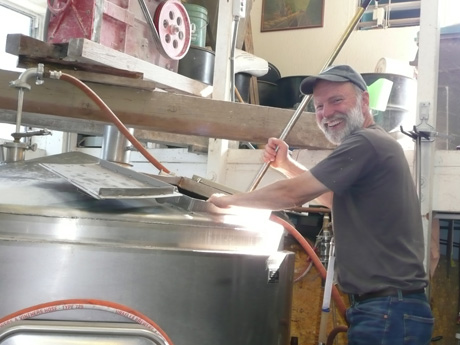
Shortly after I launched the website for International Brewers Day, I got an appropriately curmudgeonly comment disdaining the idea from my friend Brian Hunt, who owns Moonlight Brewing. Here’s what he had to say.

Let’s all just make good beer and drink it. The Brewer’s Association will log acres of forests for special posters and mailings. I can see Hallmark jumping on this one big time, and before long you’ll have to wade through all the K-Mart “holiday” ads looking for that right something for the brewers in your life. I vote no on this.

While hardly shy, I think having worked in the moonlight for so many years has made Brian shy away from the limelight. That alone made him the perfect choice for my first IBD profile. He is, to my mind, one of the truly unsung heroes of brewing, quietly making some of the nation’s best beers.

And happily I’m not the only one. In an article entitled Czech Mate, published in Forbes, the author reveals that of all the beers rated on Beer Advocate, Moonlight’s Reality Czech is the only golden lager on their list of the “Top Beers on Planet Earth.” Unfazed, Hunt explains.

“We have almost no concept in this country that we can have a beer that is light but also flavorful and vibrant,” explains Brian Hunt, Moonlight Brewing’s owner (and sole employee). “Making a great lager like that requires more time, more skill and more expense than making an ale.”

moonlight-ibd2

Brian Hunt was, of course, born in a log cabin near Sacramento, and walked ten miles to school, uphill — both ways — through blizzards in winter and punishing heat in summer. Alright, everything in that last sentence, except Sacramento, I made up. But Brian’s past just cries out to be remade as mythic fable.

ibd-vertical-red-grunge

Brian started college at U.C. San Diego as a biochemistry major, but soon realized that most of his fellow students were pre-med, a path he decidedly was not interested in pursuing. So he transferred to U.C. Davis to study fermentation sciences with an eye toward becoming a winemaker. But fate stepped in when he was randomly assigned Michael Lewis as his advisor. Needing income, he found himself working in Lewis’ laboratory and found it was easy to be persuaded to concentrate on beer instead of wine. He found his fellow brewing students much closer to his own temperament, more down to earth and fun. “Beer just seemed more enjoyable.” Hunt remarked.

After graduating with a degree in Fermentation Sciences in 1980, Hunt relocated to the heart of early brewing — Milwaukee, Wisconsin — to take a job at the Schlitz Brewery. He loved the history of the place. Everywhere you looked it was there. Hunt spent about eighteen months working for Schlitz. There were no computers in the place. Every step they took was done manually, so you learned the reason why you did certain things, and you could extrapolate those to subsequent steps, too. As a result, he learned a lot in that year and a half, crediting that experience with setting the tone for the rest of his career.

He moved back to California in 1981, brewing at the now long gone Berkeley Brewing Co., making ales and lagers on a 40-bbl system. After that venture went belly-up, he consulted on several brewing projects throughout the Bay Area, before ending up at Acme Brewing in Santa Rosa, California in 1985. He was there two years, but the brewery never had much of a chance owing to financial issues that the owners had not anticipated. The majestic 100-bbl brewhouse finally made its first batch of beer on March 2, 1987, but it was too late. Hunt says of his time there that it was a great MBA project and he learned most of what he needed (whether he wanted to or not) about the business side of the brewing industry.

When the Santa Rosa brewery finally shuttered its doors, Brian spent some time working for the other team at Grgich Hills Winery before a brief stint formulating two beers (whose recipes have since changed) and helping layout the brewery itself at the early Anderson Valley Brewing Co. in Boonville.

In 1988, Brian finally opened his own place in Napa with a descendant of the Hamms brewing family. He had a 1/3-share of Willett’s Brewing Co. (now Downtown Joe’s) from sweat equity and $1,100 of his own money. But by 1992, a get-rich-quick lawsuit brought by one of the brewpub’s employees forced Willett’s into bankruptcy. Brian Hunt saw the writing on the wall, and when someone phoned him to offer 100 Hoff-Stevens kegs, he bought them for himself and began … well, moonlighting.

moonlight-ibd3

The original Moonlight brewery was built in a barn behind the house he was renting. He built the entire system himself using equipment cobbled together from a variety of sources. Brian bought old kettles from a winery that couldn’t boil water, and so had to be adapted. Quite a number of items from Sierra-Nevada’s yard sale (when they opened their own larger brewery in Chico) found their way into Moonlight’s brewery barn, including fermenters and a keg washer. The whole enterprise was financed with credit cards and a $20,000 personal loan. The initial brewhouse included a 7-bbl system.

The original name was going to be Old Barn Brewery, but it never sounded quite right. New Moon Brewing was also an early contender of the hundreds of names that were brainstormed. But once the name Moonlight was floated, there was no turning back. It just worked on so many levels and it seemed to mean different thing to different people, a quality Hunt relished.

For the first two-and-a-half years, beginning in 1992, Brian literally slept 5-1/2 nights out of every seven. He was working two jobs, one at the newly opened Downtown Joe’s (where the bankrupt Willett’s brewpub had been) and at his own place in the barn. This continued until he could afford to concentrate just on Moonlight Brewing. But just a few years into the new venture, another monkey wrench was thrown Hunt’s way. His landlord decided he wanted the house Hunt and his family lived in for his own son and told Brian they had to go. Luckily, they let him keep the brewery in the barn until it could be moved. In 1999, Hunt and his family moved to their present location. It would take another four years until all he permits were in place and the new brewery was built. The new system was 21-bbl and was the original Hart Brewing system, which Brian bought from the Thomas Kemper brewery on Bainbridge Island in Washington. The present set-up has pieces from at least fifty different breweries, either ones that went out of business or upgraded.

stained-hops

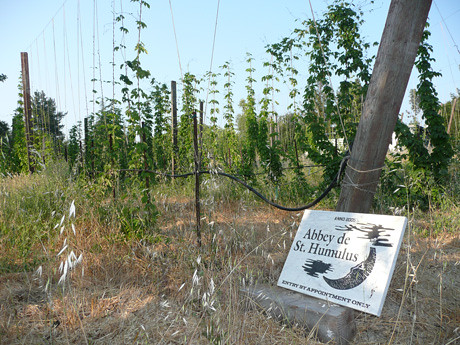
Neither the original brewery now the new one has a computer of any kind in it, and that’s by design. It’s because of one of Hunt’s favorite quotes, this one by Albert Einstein. “Imagination is more important than knowledge.” Hunt sees one of the most important aspects of brewing as creativity and thinks of himself more as a tinkerer or toymaker of sorts. And, as he puts it, “you can’t see what’s happening if you’re just pushing buttons.” He believes that many young brewers don’t understand how to make “delicious” because of what he terms “a failure of imagination.” This is because, he says, “many are not taught how to think for themselves.

moonlight-ibd1

The first three beers Moonlight brewed are all still being made: Lunatic Lager, Death & Taxes, and Twist of Fate. Lunatic Lager’s original name, though, was Moonlight Pale Lager, so named because Hunt thought it would translate better to consumers already aware of the newly popular pale ales. The fourth beer Hunt made was Bombay by Boat IPA, also in 1992, and it was one of the first IPAs made in America. At that time, nobody really made one and certainly those few who did, did not call it an IPA.

moonlight-ibd4

Hunt believes that being small also allows him a flexibility that bigger breweries can only dream about. He can follow market trends and turn on a dime. Because he not only brews the beer, but also delivers it (he’s a one man operation, most of the time) he’s not removed from his customer but mingles and converses with them almost every day of the week.

His original plan was to hope that he could make a living in Sonoma selling whatever he brewed. Though his net is spread slightly wider than he originally thought, it’s not by much, and he’s remained true to initial vision. “I don’t find success by selling a lot, I find it by selling to people who respect it or appreciate it.” So long as that’s the case, we won’t be seeing Moonlight beer in grocery stores nationwide or even bottle locally. Brian’s just not looking for that kind of success. He’s content doing what he wants in his own way, an iconoclast to the end. As you’d expect, Hunt also doesn’t think much of competitions either. “Fame is empty.” He says. “Good beer should not be.” So while that may be a loss for the people who can’t find Moonlight beer in their neighborhood, it does make the Bay Area just that much more of special place for beer and provides yet another reason for beer fans around the world to make the pilgrimage to taste California beer.

moonlight-ibd5

Or put another way — as his pint glasses used to read — “good beer is as good beer does.”

Filed Under: Breweries, Just For Fun, News, Related Pleasures Tagged With: California, Interview, Northern California

I Have A Dream …

July 18, 2008 By Jay Brooks

My friend Pete sent me this cartoon by editorial cartoonist Ben Sargent. Thanks, Pete. To most Americans this might seem like a nightmare, and in fact I think that may have been his point. The cartoon plays to the fears of many Americans, but it’s so unlikely that InBev would alter the taste of Bud to such a degree that it’s preposterous. But for many of us who do not revere the taste of Budweiser, it may inadvertently seem more like a dream.


Filed Under: Uncategorized Tagged With: Uncategorized

« Previous Page
Next Page »

Find Something

Northern California Breweries

Please consider purchasing my latest book, California Breweries North, available from Amazon, or ask for it at your local bookstore.

Recent Comments

  • Bob Paolino on Beer Birthday: Grant Johnston
  • Gambrinus on Historic Beer Birthday: A.J. Houghton
  • Ernie Dewing on Historic Beer Birthday: Charles William Bergner 
  • Steve 'Pudgy' De Rose on Historic Beer Birthday: Jacob Schmidt
  • Jay Brooks on Beer Birthday: Bill Owens

Recent Posts

  • Beer In Ads #5224: Harvard Bock Beer April 16, 2026
  • Historic Beer Birthday: William H. Biner April 16, 2026
  • Historic Beer Birthday: Alan Eames April 16, 2026
  • Historic Beer Birthday: Mathias Leinenkugel April 16, 2026
  • Historic Beer Birthday: Emil Schandein April 16, 2026

BBB Archives

Feedback

Head Quarter
This site is hosted and maintained by H25Q.dev. Any questions or comments for the webmaster can be directed here.