Brookston Beer Bulletin

Jay R. Brooks on Beer

  • Home
  • About
  • Editorial
  • Birthdays
  • Art & Beer

Socialize

  • Dribbble
  • Email
  • Facebook
  • Flickr
  • GitHub
  • Instagram
  • LinkedIn
  • Pinterest
  • RSS
  • Twitter
  • YouTube

Powered by Genesis

Catholic Irony vs. Miller

September 28, 2007 By Jay Brooks

miller-art
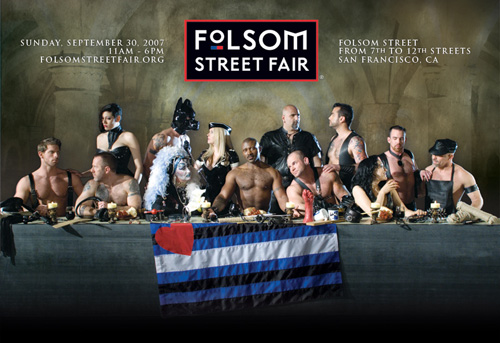
There’s a festival in San Francisco every year, the Folsom Street Fair, that celebrates sexual diversity, fetishes and leather lifestyles. The event has a rich history of fighting conventional wisdom and poverty, as well. It’s a registered non-profit organization and also has all the things that typical street fairs have: music, food, beer and sponsors. One of the four main event sponsors this year, known as “presenting sponsors,” is Miller Brewing Co. Which is all well and good, or at least it was until the fair organizers unveiled this year’s poster for the event.
folsomstfair

It’s an obvious parody of Leonardo Da Vinci’s painting The Last Supper, which along with his Mona Lisa, Edward Hopper’s Nighthawks, Grant Wood’s American Gothic and Edvard Munch’s The Scream, is undoubtedly one of the most parodied works of art in the world. Do a Google Image’s search for “last supper parody” and no less than 6,360 images pop up. The poster is meant to show diversity in many forms; racial, gender, sexual preference and lifestyle. If you’re deeply religious it’s possible that you won’t like the image but that’s the price you pay for living in a free society. Everybody wants tolerance in the first person, such as “tolerate my beliefs” but it’s gets harder for those same people in the third person, as in “tolerating his beliefs.” Enter the Catholic League, which bills itself as a “Catholic civil rights organization” and states its purpose is to “defend the right of Catholics – lay and clergy alike – to participate in American public life without defamation or discrimination.” Their mission also includes working “to safeguard both the religious freedom rights and the free speech rights of Catholics whenever and wherever they are threatened.” All laudable goals, except that it appears the free speech rights of non-catholics count for naught. Since Tuesday the Catholic League has put out five press releases “calling on more than 200 Catholic, Protestant, Jewish, Muslim, Buddhist and Hindu organizations to join with [them] in a nationwide boycott of Miller beer.”

Yesterday, SABMiller released the following statement:

Statement Regarding Folsom Street Fair

While Miller has supported the Folsom Street Fair for several years, we take exception to the poster the organizing committee developed this year. We understand some individuals may find the imagery offensive and we have asked the organizers to remove our logo from the poster effective immediately.

Not good enough, sayeth the Catholic League, calling Miller’s press release a “lame statement of regret.” Then they kicked things into high gear. “We feel confident that once our religious allies kick in, and once the public sees the photos of an event Miller is proudly supporting, the Milwaukee brewery will come to its senses and pull its sponsorship altogether. If it doesn’t, the only winners will be Anheuser-Busch and Coors.” See, even Catholics aren’t aware of the craft beer movement and believe there are only three breweries in the U.S. And certainly imports were overlooked, too. Some kidding aside, this is certainly a quagmire for Miller, and this has been receiving a lot of media attention, as stories involving sex usually do in our society. There’s nothing like titillation to increase reader- and viewer-ship.

Locally, at least, not everybody agrees as one gay member of the clergy had this to say via the Bay Area Reporter.

“I disagree with them I don’t think that [Folsom Street Events] is mocking God,” said Chris Glaser, interim senior pastor at Metropolitan Community Church – San Francisco. “I think that they are just having fun with a painting of Leonardo da Vinci and having fun with the whole notion of ‘San Francisco values’ and I think it’s pretty tastefully and cleverly done.”

Glaser added, “I think that oftentimes religious people miss out on things because they don’t have a sense of humor. That’s why being a queer spiritual person we can laugh at ourselves and laugh at other people.”

Even Speaker of the House Nancy Pelosi, herself a Catholic, issed the following through her press secretary, Drew Hammill. “As a Catholic, the speaker is confident that Christianity has not been harmed.” Exactly. And while the people Fox News interviewed called it a “mockery of religion,” “blasphemy” and suggested that it’s “bad for society,” I can’t see the Catholic League’s point.

First of all, they don’t own the image of Da Vinci’s Last Supper and it’s already been parodied countless times. The event itself has been painted by numerous artists over the centuries. Honestly, I don’t see how the “religious freedom rights and the free speech rights of Catholics” have been infringed upon or how catholics have been in any way defamed. The Last Supper even as an idea is not the exclusive province of Catholicism. If they had left it alone, it would have been a minor event in a local community.

And why pick on Miller? There are dozens of other sponsors, too, including SF Environment, an environmental group, and the San Francisco Bay Guardian, a local weekly newspaper. I almost hate to wonder, might this also be a little bit because it’s beer? Many neo-prohibitionist groups are also religiously based. But really, what did Miller do wrong? They sponsored a local event that’s perfectly legal, has the support of the local community and government. They’ve been sponsoring it for years. Then suddenly the event does something that the Catholic League doesn’t like. They’re offended. So what? Miller tries to soothe the situation, obviously seeing it for the powderkeg it is and asks to have their logo taken off the offending poster, but bravely continues to sponsor the event. Good for them. Why shouldn’t they? How is that in any way the “corporate arrogance” the Catholic League accuses them of? What’s arrogant about that? If you want to talk arrogance, then we need to look at the Catholic League. Being arrogant is defined as “making claims or pretensions to superior importance or rights,” which is exactly what they’re doing by asserting that their “right” to not have their religion criticized or challenged — if indeed that’s really what’s being done, which I seriously doubt — is above the free speech rights of the criticism or challenge. I doubt many in the Catholic League have read Richard Dawkin’s The God Delusion, but one of the book’s soundest arguments is that religion has become the only idea, concept, belief, whatever that can’t be criticized. That we’re taught we must respect one another’s beliefs and not question them. Why? Why is every single other idea in the world able be talked about critically but not religion? It just doesn’t make sense to me. Obviously, the Catholic League believes that or they wouldn’t be misreading this so badly. It seems obvious to me that the Folsom Street Fair poster isn’t attacking or criticizing religion and certainly isn’t targeting the Catholic religion. It’s obviously parody, which is protected speech under the First Amendment of our Constitution. Even the Supreme Court has said so, thanks to an unlikely person, Larry Flynt, publisher of Hustler, whose story is chronicled in the film The People vs. Larry Flynt.

But again, why pick on Miller? They didn’t make the poster. They didn’t print the poster. They didn’t approve the poster. All they did was sponsor the event. The Catholic League is the bully in this passionate play, and they’re the ones that deserve to be crucified, not Miller. It’s one thing to disagree with another point of view or not like what you perceive as criticism of your own, but it’s quite another to attack it and try to harm their business over that disagreement. That’s what bullies do. But there’s one more bit of irony in all this that needs saying. Obviously, many catholics and other religious conservatives have a great deal of difficulty dealing with non-traditional sexual lifestyles, some of which are center stage in the Folsom Street Fair. But the Catholic Church is no stranger to non-traditional sexual practices among its own clergy and has systematically been suppressing its own sexual misconduct literally ruining the lives of hundreds, maybe thousands, of children in the process. Check out the film Deliver Us From Evil for just the tip of iceberg. That’s really offensive, worthy of people being offended, not like this fake controversy and complaints of being wounded simply by an image they don’t like.

Frankly, I thought I’d never utter these words, but “It’s Miller Time.”

Filed Under: Editorial, Politics & Law Tagged With: Business, California, Law, National, Prohibitionists, San Francisco

Shuck and Jive

September 26, 2007 By Jay Brooks

There is little doubt that hops are or soon will be in short supply. I heard it at “Hop School” in Ralph Olson’s “state of the hop crop” report and I’ve heard it from almost every other quarter, as well. Belmont Station’s blog has a good summary of what Ralph had to say via Dave Wills at Freshops and Rick Sellers at Pacific Brew News has another summary from Deschutes brewer Larry Sidor, as well as a summary of world hop news. There have even been two recent fires at hop kilns, and while crop damage was minimal (though the kilns were destroyed) it still further reduced an already thin harvest. Lew Bryson also posted David Edgar’s summary from today’s Brewers Forum. Overall, there’s some good but mostly foreboding on the future availability of hops, and most notably prices may skyrocket. There simply isn’t enough hops to meet current demand and acreage has been declining for several years.

Enter corn into the mix. When George Bush started touting ethanol he increased incentives and subsidies for farmers to grow corn to make the alternative fuel. If you’re barely getting by growing a difficult and fragile crop like hops, switching to corn with all that federal moola looks mighty attractive. I’ve heard that now from a variety of sources. According to an Iowa State University study, food prices have risen an average of $47 per person as a result of the ethanol surge since last year. So it’s not just hops, but farmers are replacing a number of other crops with corn, too. This has been widely reported to be effecting food prices across the board. But once on a gravy train, few will voluntarily jump off, no matter that the train may be headed for a collision. And corn has been riding those amber waves for quite some time, especially once high fructose corn syrup made its debut in 1980. HFCS is now in what seems like every processed food you could name. So if government policy makes their situation even better, you would expect the corn industry to be overjoyed.

There’s a little interview today at Retail News online (subscription required) with S. Richard Tolman, CEO of the National Corn Growers Association, trying to allay fears that the corn subsidies are having unintended consequences. And if you want to lay such fears to rest, who better to ask than someone with a totally vested interest in convincing you that black really is the new white. Here’s the forthright honesty he employs to counter numerous claims and studies that suggest “ethanol production is exacerbating environmental impact problems.” Tolan’s answer: “Those claims are simply not true.” Deny, deny, deny.

To the final question, “Critics contend that American farmers will be unable to keep up with demand for corn needed to produce ethanol. What’s the short-term and long-term thinking on this from corn growers?” he answers:

Short-term the question has already been answered. Farmers have planted more acres of corn this year than any time since World War II. If we have merely an average yield, there will not only be enough corn for all current food, fuel and export markets, we will build our carryover (surplus) stocks.

It’s that “planted more acres of corn this year than any time since World War II” line that should concern beer lovers everywhere. More acres of corn means less acres of something else. Believe it or not, when I was in the nation’s “hopbasket” — The Yakima Valley, Washington — last month I saw several large fields of corn.

Ethanol production has doubled over the last three years, and in 2006 accounted for almost 5 billion gallons. But that’s still only around 5% of total gasoline needs, and corn growers are hoping to increase that to 10%. Doubling again the acreage for ethanol would mean a pretty substantial amount of land on which one thing — hops perhaps — would be converted to grow corn. It seems naive to think that’s not going to raise the price of whatever is no longer being grown on the land that’s now growing corn. So while it may seem odd to blame corn for the hop shortage, it is at least one of the factors that’s contributing to it. I’m certainly no energy expert, but I haven’t seen anything to convince me that ethanol is the panacea so many seem to believe it is. Even if planting all that new corn provides us with 10% of our fuel needs, we’ll pay for it somewhere else, either in higher food prices or a potential beer shortage. Frankly, I’d rather walk, bike or take mass transit than give up beer.

But nothing’s going to change if people continue to give a voice to industry stooges like Tolman with so obvious an axe to grind. Why would anyone, and especially people in the retail business, believe such pernicious propaganda? He’s telling retailers the goods they sell will not go up in price if there is less acreage of land to grow the ingredients needed to make or grow the things they sell. On top of that, he represents the very people changing the way that land is used. That’s shuckin’ and jivin’ of the first order.


Filed Under: Editorial, Politics & Law Tagged With: Business, Hops, National

NorCal Beer Dinner Menu Finalized

September 26, 2007 By Jay Brooks

Over the last year I’ve gotten to know the “Homebref Chef,” Sean Paxton, and he was kind enough to invite me to his 10th annual beer dinner at the Northern California Homebrewer Festival which will take place October 5. The festival itself is the 5th and 6th and takes place at the Lake Francis Resort in Dobbins, California. Sean recently finalized the menu, and even though it is my sad duty to reveal that the dinner is already sold-out, I though I’d share what sounds like a pretty spectacular dinner. The theme for the dinner is “Sour Ales Inspired by Belgium.”


The Menu:

First Course

Belgian Endive Salad: Slightly Bitter Leaves of Endive Mixed with Pomegranate Seeds, Red Beets, Watercress, Chives and Chervil Tossed in a Watermelon Funk Vinaigrette

Beer
: 21st Amendment Watermelon Funk: A collaboration beer involving Shaun O’Sullivan’s Watermelon Wheat and Fresh Watermelon added to Vinnie Cilurzo Barrel and Spiked with Brettanomyces and Aged 2 Years in Santa Rosa

Second Course

Steamed Mussels in Beer: Prince Edward Island Mussels, Shallots, Thyme Steamed in Homebrewed Wit

Pumpkin in Green Herb Sauce: Steamed Fall Squash in Homebrewed Wit, Topped with a Spinach, Sorrel, Mint and Parsley Sauce

Pomme Frites: Twice Fried Kennebec Potatoes, Belgian Style Served with a Duvel Shiso Aioli and Fou’ Foune Aioli

Beer: The Brewing Network’s Dr. Scott Homebrewed Wit

Third Course

Les Carbonnade Flamandes: A Flemish Stew Cooked with Beef, Lamb, Dark Candi Syrup Cured Bacon, Leeks, Shallots, Thyme and Belgian Strong Dark

Flemish Style Root Vegetable Stew: Parsnips, Yukon Gold Potatoes and Carrots Braised in Belgian Strong Dark and Herbs, Served with a Smoked Garlic Aioli

Beer: 21st Amendment The Beer Hunter: Jamil Zainasheff Award Winning Belgian Strong Dark made at 21st Amendment for the GABF Pro-Am 2007

Fourth Course

Waterzooi: A Classic Ghent Milk Stew made with Cod, Leeks, Fennel, Onions, Shallots, Saison, Milk and Herbs

Tofu Waterzooi

Beer: Sacramento Brewing Saison: Peter Hoey’s Sour Mashed Farmhouse Style Saison

Fifth Course

Duck Legs Cooked in a Brett Blonde: Cinnamon Scented Parsnips Stewed in Sanctification

Beer Braised Veal Cheeks: Leeks, Carrots, Celery Root, Fresh Thyme Cooked in Chardonnay Barrel Aged Temptation Sour Ale

Bier Risotto: Pearl Barley cooked “Risotto Style” in a Roasted Heirloom Tomato Temptation Broth With Lobster Mushroms and Roasted Thyme Shallots

Brussels Sprouts: Blanched Sprouts cooked in Brown Butter and Nutmeg

Cauliflower Gratin: A Twist on a Classic, Cauliflower Blanched in Ale and Topped with a Gruyere Cheese Sauce

Beers:

Russian River Temptation: A Blonde Ale Fermented with Brettanomyces, Aged in French Oak Chardonnay Barrels

Russian River Sanctification: a 100% Brettanomyces Fermented Blonde Ale

Sixth Course

Dark Chocolate Framboise Truffles: Where Dark Chocolate meets Brenden’s Whisky Barrel, filled with Porter, spiked with Brettanomyces, Aged for 7 Months, then blended with “The Golden Hallucination” and “Brown Bear”

Vanilla Bean Tripel Infused Pot de Creme: Starting with Todd Ashmans Sage Honey and Thai Palm Sugar spiced Tripel and infusing Vanilla Beans into Cream, slowly cooked in a water bath to make an ultra creamy decedent dessert

Beers:

Thirsty Bear Menage a Framboise

Fifty Fifty Brewing Co. Trifecta Belgian Style Tripel

 
10.5

Northern California Hombrewer Festival Beer Dinner

Lake Francis Resort, 13919 Lake Frances Road, Dobbins, California
[ website ]
 

Filed Under: Food & Beer Tagged With: Announcements, California, Homebrewing, Northern California

Legendary Drinkers

September 25, 2007 By Jay Brooks

The online version Ask Men magazine does a weekly top 10 list on a wide variety of subjects, such as “Chill Out Movies” and “Father-Daughter Activities.” This week the list is the Top 10 “Legendary Drinkers.” It’s an interesting list and they at least explain why they chose each person.

Here’s who made the list.

  1. John Barrymore
  2. Hank Williams
  3. Andre the Giant
  4. Dylan Thomas
  5. Winston Churchill
  6. Ernest Hemingway
  7. Richard Harris
  8. Edgar Allen Poe
  9. Benjamin Franklin
  10. Dean Martin
  • Honorable Mention: Judy Garland


It’s a fine list and I don’t really want to quibble with it too much. Dylan Thomas, a great poet, is responsible for one of my favorite quotes. “An alcoholic is someone you don’t like who drinks just as much as you do.” But I do think there are some glaring omissions. Chief among them has to be “W.C. Fields.” But other famous drunks that come to mind are Charles Bukowski, Charles McCabe, Dorothy Parker and Hunter Thompson.

Who would you put on the list?


Filed Under: Just For Fun Tagged With: Websites

New Beer Magazine Covers Pacific Northwest

September 25, 2007 By Jay Brooks

According to the Portland Beer Blog Guest on Tap there’s another new beer magazine that’s hit the street. It’s Beer Northwest and will focus primarily on the Pacific Northwest. I met the publisher, Megan Flynn, at this year’s Oregon Brewers Festival and she seems like she has a good shot at succeeding with the new quarterly. Of course I may be slightly biased, I wrote the Washington Hops story listed on the cover. Go ahead, subscribe. You know you want to.


Filed Under: News Tagged With: Oregon, Washington

Beer’s Spiritual Problem?

September 24, 2007 By Jay Brooks

Apparently liquor and wine are divine, beer … not so much. That’s the apparent take of Wisconsin columnist Joe Orso who in a recent column, concludes that issues with people drinking beer in his local community are a “spiritual problem,” whatever that even means.

Admittedly, his community does appear to have had a spate of bad luck recently, as he relates.

In the past two weeks, a 19-year-old woman has died after drinking alcohol and falling off Grandad Bluff, Miss America has been to the area to speak to high school and college students about underage drinking and drunken driving, and a concert was held at Viterbo University to raise awareness about responsible drinking habits.

That’s a tragic event to be sure, but Grandad Bluff (pictured here) doesn’t look like the sort of place one should go to while drinking. I don’t want to sound cold, but not only did she show poor judgment but so did her friends. How that’s a spiritual problem or the fault of the beer I find somewhat baffling. As for Miss America, her cause celebre is children. I’m sure she’s on a tour of colleges making the same speech, she wasn’t targeting one community. The concert was a benefit for “Safe La Crosse” promoting responsible drinking behavior at the start of the new term. I’m willing to bet almost every campus has an organization like this one. So what?

My point is you can find or make connections wherever you want to find them. There doesn’t appear to be anything remarkable about these three events that would cause a reasonable person to conclude that the youth of today are in spiritual crisis and beer is the bogeyman responsible for it. But our amateur spiritualist isn’t finished. In his own personal life, he once lived with an alcoholic and he recently visited a friend who’s in detox. Oh my god! Two people he’s known throughout his life have problems with alcohol! Alert the media. Oh, wait he is the media. Why not focus on the maybe hundreds of people he knows or has known who aren’t alcoholics? Why try to connect dots that simply may not be there?

He’s heard anecdotally that young people are drinking simply because “there’s nothing else to do,” claiming to hear this excuse over and over again across the country. I have a hard time understanding why both his own lack of imagination and the similar dullness of the people he’s talking to leads to a conclusion that spirituality has anything to do with this. It sounds more like his community may have a problem. But instead his thinking goes like this. “When you look at a society and see so many of us spending weekends between 15 and 22 years old getting drunk, and then saying we do it because there’s nothing else to do, this becomes a spiritual problem.” Huh? When Orso asks “[h]ow are we treating our young people to make them feel like this?” you’d think the answer would be obvious, but apparently it isn’t.

Why say things like “[s]omething seems to be going on here with beer.” The author says he enjoys beer and has a favorite — Busch (ugh) — and he “look[s] forward to drinking it around a backyard fire every Christmas when [his] brothers and neighbors return home and [they] all catch up on each other’s lives.” In other words, he enjoys it in a social setting that creates conversation and a sense of togetherness. Does he not realize that’s precisely what goes on at teenage parties, too. Kids get together, drink, talk and bond as they struggle to figure out how to become adults. Teenagers struggle with all kinds of adult and quasi-adult behaviors and fumble their way through most of them. They’re supposed to, it’s through their failures and mistakes that they learn. But with our present taboos and draconian alcohol laws they have no positive role models for responsible drinking and many kids’ first experiences with beer may indeed be negative. They don’t have to be, but adults have created an environment that all but guarantees such a result. There will always be people who can’t handle certain things, be they alcohol, drugs, food, cigarettes or what have you. With alcohol the problem is exacerbated because of a criminal lack of education and misinformation, which in many places even forbids parents from teaching their own children about alcohol in the home. Such places presuppose that the state should be the ones to teach kids about alcohol but then they do absolutely nothing by way of educating them.

Orso concludes his column by suggesting that “we might shift the message a bit from ‘Drinking can hurt you, maybe kill you’ to ‘Why are you drinking so much?'” Well, for me such simplistic nonsense is what’s making me drink so much. He’s looking for easy answers to complex questions. But if you think the path to spiritual enlightenment is not paved with beer bottles, then I suppose no amount of logic will convince you otherwise. But could we please stop blaming beer for everything that’s wrong with the world? There are undoubtedly numerous reasons for drinking by teenagers (or anyone for that matter), but I seriously doubt that chief among them is a lack of spirituality. Frankly, I’d be shocked if it made the top hundred. But let’s ask all of the Orders of Monks who have been making truly inspired beers for centuries if they believe beer has caused them to be spiritually parched.


Filed Under: Editorial Tagged With: Mainstream Coverage, Midwest, Prohibitionists

Big Brewers Spending Less on Traditional Advertising

September 24, 2007 By Jay Brooks

According to a article at Advertising Age today, the three biggest brewers are spending less these days on traditional advertising, such as television, print and radio.

From the article:

According to TNS Media Intelligence, top brewers cut measured media spending a whopping 24%, about $131 million, during the first six months of 2007, following a 12% cut during 2006. At the same time, the brewers insist they haven’t cut spending at all — and in many cases have increased it.

What that means is that the dollars they are spending are being spent on things that traditional media folks don’t usually keep track of, such as sponsorships, promotional activity, product placement, bar events, concerts, stadium signage, specific sports promotions and local media. Part of that is simply to focus advertising on the dozens of test brands, the stealth micros and the alternative products that all three, though particularly Anheuser-Busch, have been experimenting with lately to compete with the craft segment, which is the only beer segment that’s been showing robust growth over the last few years.

So is this the traditional advertising world starting to panic? They talked to death about the big brewer’s forays into advertising on the internet and what that’s meant for them. They’re also equating trying to reach a younger demographic as another reason for the sharp declines in traditional ad buys. Does that mean since the younger generation has gotten wise to advertising, we’ll see traditional forms of it decline as a whole as they age? Somehow that seems doubtful, especially since in my humble opinion people aren’t really getting any smarter and advertising is certainly becoming more scientifically based. As a result, it’s hard to swallow the notion that young people are too savvy for advertising to work on them.

Citing a Beer Marketer’s Insights statistic that beer shipments from the big guys rose 2% at the same time traditional ad revenue fell, AdAge concludes that the non-traditional advertising must be working and even may be the key to that growth. They do qualify the 2% figure as “healthy,” at least “by the mature beer industry’s modest standards.”

But I seem to recall that the shipments figure is almost always around 1 to 2%, every year, no matter what. Maybe somebody has those figures in hand, but that’s certainly my memory. Other statistics like revenue, market share, and others have been fluctuating more, but not shipments, which have been fairly steady. At any rate, it seems hard to draw a conclusion from that statistic, even if my memory is faulty.

What really concerns me, if indeed what the article is suggesting is true — and the big three are throwing their massive resources at local media and cheaper, more targeted marketing — then they’ll be infringing on the only kinds of advertising and marketing craft brewers have been able to afford. Only a very few of the biggest microbreweries have been able to afford television advertising and even then it’s been limited and on cable networks. Regional and smaller breweries have only been able to afford the occasional print ad or radio spot, relying instead on guerrilla marketing, word-of-mouth and local community involvement. It will be very hard for them to compete with the big brewers’ ad budgets if they adopt a similar strategy.


Filed Under: Editorial Tagged With: Business, National, Statistics

Hunt’s Hop Tea

September 24, 2007 By Jay Brooks

teapot
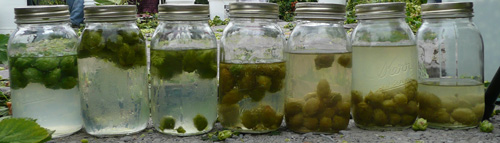
A few weeks ago while helping Moonlight with their hop harvest, owner/brewer Brian Hunt broke out something I’d never seen before: hop tea. Now I’ve seen regular hop tea before, I’ve even bought some at the health food store and tried it, but this was something totally different. Brian told me the idea grew out of an experiment he was doing to see how hops reacted at different temperatures, which he presented at “Hop School” a few years ago. He discovered in the process that he could make a delicious hop tea and that it varied widely depending on the temperature of the water. Here’s how it works:

  1. Put approximately two-dozen fresh hop cones in a 16 oz. mason jar.
  2. Heat water to __X__ temperature.
  3. Fill jar with heated water and seal cap.
  4. Let the water come down to ambient room temperature.
  5. Refrigerate.
  6. Drink.

There appears to be four main factors that change depending on the temperature of the water. These are:

  1. Color
  2. Float
  3. Bitterness
  4. Tannins

hop-tea-1

Intrigued by all of this and quite curious, Brian brought out seven examples of his hop tea made with water of different temperatures: 60°, 120°, 130°, 140°, 160°, 180° and 185°. They’re shown above from lower to higher temperature, left to right.

As you can see, the lower the temperature, the more green the hops are and the water remains less cloudy. At the higher temperatures, the hops are stripped of their green, becoming brown, and the water also becomes more brown. Also, as the temperature increases, the hops lose their buoyancy and begin to sink in the water. Although you can’t see it in the photo, the hotter the water, the more hop bitterness and at the upper range, tannins begin to emerge. Here’s what I found:

  • 60°: Fresh, herbal aromas with some hop flavors, but it’s light.
  • 120°: Bigger aromas, less green more vegetal flavors.
  • 130°: Also big aromas emerging, flavors beginning to become stronger, too, but still refreshingly light.
  • 140°: More pickled, vinegary aroma, no longer subtle with biting hop character and strong flavors.
  • 160°: Very big hop aromas with strong hop flavors, too, with a touch of sweetness. Tannins are becoming evident but are still restrained.
  • 180°: Big hop and vinegary aromas, with flavors becoming too astringent and tannins becoming overpowering.
  • 185°: Vinegary aromas, way too bitter and tannins still overpowering.

hop-tea-2
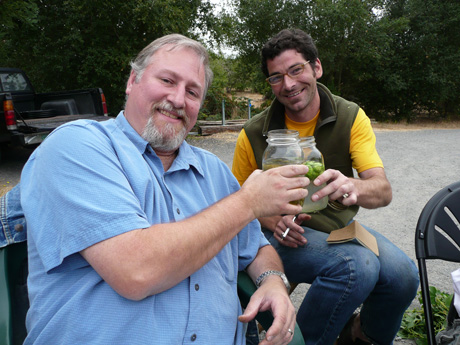
Trying each of the tea samples with Tim Clifford, who writes for Northwest Brewing News.

hop-tea-3

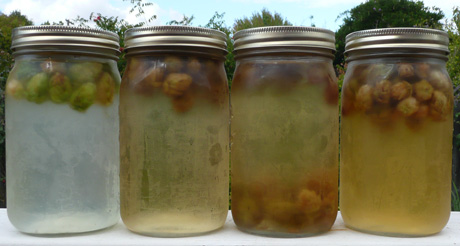
Brian was kind enough to let me take a small bag of fresh hops with me so I could recreate his experiment at home. I had enough for four samples and made tea at 100°, 140° and 160°. Using two dozen hop cones made the jars look light so I used three-dozen in the last jar, also using 160° water. I tasted them with my wife, hoping to get a civilian opinion, too. Here’s what we found:

  • 100°: Hops still green and floating. The nose was very vegetal and reminded my wife of the water leftover in the pot after you’ve steamed vegetables like broccoli or Brussels sprouts. The mouthfeel is somewhat gritty with light, refreshing flavors and only a little bitterness, which dissipates quickly.
  • 140°: Hops turned brown, but still floating. Light hop aromas with some smokey, roasted aromas and even a hint of caramel. Fresh hop flavors with a clean finish. My wife, however, made that puckering bitter face signaling she found it repugnant.
  • 160°: Hops turned brown, but most has sunk to the bottom of the jar. Strong hop aromas and few negatives, at least from my point of view. My wife was still making that face, cursing me for dragging her into this. Hop bitterness had become more pronounced and tannins were now evident, with a lingering finish.
  • 160° Plus: This sample had 50% more hops. The hops had also turned brown but, curiously, they were still floating. The nose was vegetal with string hop aromas. With a gritty mouthfeel, the flavors were even more bitter covering the tannins just slightly, but they were still apparent, and the finish lingered bitterly.

It seems like either 140° or 160° is the right temperature. Lower than that and you don’t get enough hop character (I’m sure that’s why the hops remain green) but above that the tannins become too pronounced. It appears you have to already like big hop flavor or you’ll hate hop tea. I found it pretty enjoyable and even refreshing though it’s still probably best in small amounts. You do seem to catch a little buzz off of it, which doesn’t hurt. I’m sure the amount of hops is important and more research may be needed on that front. Brian tells me that hop pellets can also be used though I doubt the jar of tea looks as attractive using them. They have the advantage of being available year-round, of course. If you use pellets, you need only about a half-ounce for each pint jar.

If you try to make Hunt’s Hop Tea on your own, please let me know your results. And please do raise a toast to Brian Hunt’s ingenuity.

Filed Under: Food & Beer, Just For Fun Tagged With: Bay Area, California, Hops

Men’s Journal Picks Their Favorite Beers Again

September 23, 2007 By Jay Brooks

Last year, the magazine Men’s Journal published in their October issue a list they called the “25 Best Beers in America.” This year marks the fourth annual list but this time it’s a departure from their standard list. Instead they chose their five favorites in five broad style categories and a further list of their choice of a beer for a specific occasion. As usual, there are some good beers on the list but probably just as many or more great beers that didn’t grace the list. This year the list also includes beers imported from Europe.

Last year I wrote the following about the list, and it seems just as true today.

It’s great news, of course, for the beers on the list. Hopefully they’ll get more attention and even possibly more sales generated from the article. But it doesn’t mean the beers not on the list aren’t in many cases every bit as good as those who made the cut this year. For those of us who judge beer regularly there are so many factors that come into play that a list like this one can never be truly taken serious for a variety of reasons. But the novelty of it appeals to all of us, myself included, and I imagine I scanned the list with as much interest as the average reader. Anything that shows craft beer in a positive light can’t be all bad, and this annual list is certainly another good way to spread the message of how many good beers are being made all over the country. Now if we can just get more people to start drinking them, that would be really something.

Here’s this year’s introduction from Men’s Journal:

THE DRINKING MAN’S GUIDE TO THE WORLD’S BEST BEERS

Provided it’s not the shakes that makes you reach for that cold one, there’s never been a better time to be a beer drinker. Delicious craft beer – roughly and imperfectly defined as high-quality brew made in smallish batches from the best possible ingredients, instead of corn syrup and generic grain – is everywhere. The average American now lives within 15 miles of a brewery making a fresh, local product. Imports from such beer-mad nations as Belgium and Norway previously unseen here are making their way into stores across the country. Even Anheuser-Busch wants in on the action; why else would the mega-brewer have released more than 85 experimental beers in the past two years? Which raises a fine question: What should you drink next? We canvassed brewers, importers, tavern-keepers, and chefs to find the best of the best.

However, how they really “did it” is explained later as follows. “We surveyed a Rolodex full of prominent beer industry players, asking them to name their favorite beers in several major categories, and tallied the results.” Well how scientific. Now I know these things are largely popularity contests already, but that strikes me as a pretty poor way to go about choosing what is presented as the “world’s best beer.” World’s “favorite” beers, possibly, but even that would be incorrect since they’re only the favorite beers of whoever was in their address book. Yes, I’m a curmudgeon to the end, but for these kinds of lists to be in any way meaningful there should be some kind of standards to get on the list in the first place. Otherwise, it’s just a beauty contest. But playing devil’s advocate, at least there are some very fine beers on the list and that’s a good thing for them, at least. There’s very few here that shouldn’t be enjoyed or sampled if they’re unfamiliar.

So with a few comments (in italics) that I couldn’t resist making, here is the Men’s Journal list for 2007:


The Best Pale Ales

  1. Firestone Walker Pale Ale
  2. Sierra Nevada Pale Ale
  3. Deschutes Mirror Pond
  4. Dogfish Head 60 Minute IPA (I guess this means by pale ale they mean any beer that’s pale in color, not the style?)
  5. Ridgeway Bitter (Ditto.)

The Best Stouts & Porters

  1. Deschutes The Abyss
  2. Guinness (Which one?)
  3. Stone Smoked Porter
  4. Bell’s Kalamazoo Stout
  5. Brooklyn Black Chocolate Stout

The Best Belgians (Presumably they mean Belgian-style?)

  1. Saison Dupont
  2. Rochefort 10
  3. Ommegang Three Philosophers
  4. Russian River Damnation
  5. St. Bernardus Triple

The Best Wheat Beers

  1. Aventinus Doppel Weizen-Bock
  2. Ayinger Brau-Weiss
  3. Allagash White
  4. Penn Weizen
  5. Widmer Hefeweizen

The Best Lagers & Pilsners

  1. Lagunitas Pils
  2. Victory Prima Pils
  3. Stoudt’s Pils
  4. Trumer Pils
  5. New Belgium Blue Paddle


BEST BEERS FOR EVERY OCCASION

“Best Beer” rankings rarely answer the most important question: What’s the best beer for right now? Here’s what to sneak into the ballpark, tow behind your canoe, drink in the morning, give to the babysitter (kidding!), and more.
 

  • In Case of Natural Disaster: Ommegang Hennepin
  • For Ballpark Hecklers: Miller High Life (Maybe to use as projectile, certainly not for drinking.)
  • Global-Warming Summer Beer: Thiriez Extra
  • Airport Layover Beer: Samuel Adams Boston Lager (Is that because it’s the only one at every airport?)
  • Marijuana Substitute: Deschutes Hop Trip
  • Liquid Courage: Stone Double Bastard
  • Mass Market “Microbrew”: Blue Moon
  • For an All-Nighter: North Coast Red Seal Ale (I’d think a lower alcohol true Session beer would be a better choice.)
  • For a One-Nighter: Celebrator Doppelbock
  • Oktoberfest Beer: Great Lakes Oktoberfest (Nothing against this fine beer, but why wouldn’t a German example be here?)
  • For the Scotch Lover: Lost Abbey Angel’s Share
  • Best with a Shot of Whiskey in It: Harp Irish Lager
  • Best “Light” Beer: Mahr’s Leicht (As light beers go, maybe, but why even bother? It’s like choosing the best way to be executed.)
  • Best Before Noon: North Coast Scrimshaw Pilsner
  • With a Good Cigar: Goose Island Bourbon County Stout
  • River Trip Beer: Dale’s Pale Ale
  • For the Goldman Sachs Broker: Samuel Adams Utopia
  • Hair-of-the-Dog Beer: Southampton Double White
  • Barbecue Beer: Aecht Schlenkerla Helles
  • To Impress a Beer Geek: Cantillon Lou Pepe
  • For Ice Fishing: Brooklyn Black Chocolate Stout
  • For the Earth-Firster: Butte Creek Organic Pilsner
  • Only Decent Mexican Beer: Negra Modelo (There are plenty of awful Mexican beers — with Corona probably the worst — but they’re not all bad.)
  • Ski Town Beer: Avery 14er ESB
  • To Buy with Spare Change: Pabst Blue Ribbon (Why?)


Filed Under: Editorial Tagged With: Mainstream Coverage, National

On Drinking Well

September 23, 2007 By Jay Brooks

I got this press release from Diageo and Zagat last week and was only able to glance at it because of some article deadlines, and I also saw that Stan Hieronymus wrote about this over at Appellation Beer. The two companies have launched a new website, Drinkwell, that uses the Zagat survey format but for restaurants serving drinks.

From the press release:

In an innovative industry collaboration, Diageo, the world’s leading premium drinks business with hallmark brands including Smirnoff, Guinness, Johnnie Walker, Baileys, J&B, Cuervo, Captain Morgan and Tanqueray, announced today that it has joined with Zagat Survey, the world’s leading provider of consumer survey-based content, to launch drinkwell(TM) (www.idrinkwell.com), the first online resource guide to restaurants that are dedicated to serving the highest quality drinks and drink service.

“When people go out they often start the evening with cocktails, and that experience — good or bad — can set the mood for the entire night,” said Steve Wallet, vice president of Channel Marketing for Diageo. “At Diageo our leadership and knowledge in the area of spirits, beer and wine is second to none. drinkwell(TM) combines Diageo’s expertise with Zagat’s, and the industry’s foremost mixologists, to create a one-of-a-kind online resource for consumers seeking a complete quality dining and drinks experience.”

Visitors to www.idrinkwell.com will have free access to the ratings that Zagat surveyors have given to the hundreds of drinkwell(TM) establishments across the country, based on the quality of drinks, service, atmosphere and cost.

“Eating is only one part of the consumer experience when visiting a restaurant,” said Tim Zagat, Co-chair and CEO of Zagat Survey. “The creation of drinkwell(TM) gives consumers a new way to make informed decisions about where to find the best drinks and service.”

drinkwell(TM) has partnered with several world-renowned beverage experts including Dale DeGroff, Steve Olson, Paul Pacult, Dave Wondrich and Doug Frost, to develop the drinkwell(TM) Academy Staff Training Program for participating establishments. drinkwell(TM) — accredited establishments are identified by a special black and brushed metal plaque, in the same way the burgundy Zagat Survey decal denotes a Zagat-rated restaurant.

That’s all well and good, but apparently by “world-renowned beverage experts” they mean people who know wine and spirits but precious little about beer. You’d think that would not be the case given that Diageo also owns the Guinness brand, but since acquiring it they’ve essentially squandered away all its respectability. I’ve never been entirely sure why Diageo bought Guinness, because they seem to have little feeling for the original Irish Stout, its history or even its customers. They’ve insulted consumers everywhere with such abominations as the widget-bottle, Red Guinness and Extra Cold Guinness.

Stan knows a lot of the initial fifteen cities that Drinkwell launched with better than I do and he notes that the Chicago listings are missing some of the Windy City’s best beer destinations. His nutshell take on Drinkwell?

The good news is it free. The bad news is there’s dang little beer.

Their listings for my local area include not just San Francisco but the entire Bay Area. Only 61 places are listed — I know they’re just getting started but that still feels like an infinitesimally small number — not one has much of a beer selection, though the cynic in me is willing to bet they all carry Guinness. In California, there are two main types of restaurant alcohol licenses, a Type 41 allows a restaurant to carry just beer and wine and a Type 47 allows beer, wine and spirits. There are others, of course, but for discussion purposes that’s the main difference: just beer and wine or both with spirits, too. All 61 of the Drinkwell’s Bay Area listings are “full bar” places, meaning they sell all three kinds of alcohol.

It would take forever to list what’s missing here but what’s wrong will take considerably less time. It’s not a bad idea to rate drinks selection, service, and the like but “drinks” should really mean all of the drinks, not just cocktail-friendly places. There’s more than a whiff of this being a self-serving promotion by Diageo to sell more of its spirits portfolio, which ends up cheapening Zagat, in my opinion.

Zagat bills itself as “the world’s leading provider of consumer survey based content about where to eat, drink, stay and play. With more than 300,000 surveyors worldwide, Zagat Survey rates and reviews restaurants, hotels, nightlife, movies, music, golf, shopping and a range of other entertainment categories and is lauded as the “most up-to-date,” “comprehensive” and “reliable” guide ever published.” Maybe, but I can’t help but thinking pairing with Diageo makes them much less independent. This “partnership” probably means Zagat is trading on their unbiased reputation for a large fee from Diageo to increase their business. That may be untraditional or even cutting-edge but it still smacks of old-fashioned crass advertising and marketing. Plus, there’s no reason I can think of why Zagat couldn’t include drinks information as a part of its regular survey information without Diageo’s biased assistance. If, as Tim Zagat says in the press release, “[e]ating is only one part of the consumer experience when visiting a restaurant,” why didn’t he conclude they should have added that to their current survey model? Why would they need to “partner” with a company that has such an obvious agenda?

But the real tragedy is beer is once again ignored as a part of a fine dining experience. It may be that many or even most of the 300,000 Zagat restaurant reviewers are biased with regard to their perceptions of beer, wine and spirits and it seems Diageo’s rationale for doing this is perfectly transparent: it’s to increase their business. Zagat had an opportunity to make their ratings more complete and with a broader appeal, including people looking for good beer in a restaurant setting along with wine and spirits. Instead it appears they decided to take the money and run. Maybe I’m overreacting as I’m so often accused and things will improve with time, but with Diageo driving the bus, so to speak, I can’t see how they’ll ever include good beer destinations as one of their stops. And that makes Zagat ultimately less useful to me, and perhaps many other lovers of great beer. In the end, the experience of eating and “drinking well” should be about all of the available choices to enhance that culinary adventure.


Filed Under: Editorial Tagged With: Business, National, Press Release, Promotions

« Previous Page
Next Page »

Find Something

Northern California Breweries

Please consider purchasing my latest book, California Breweries North, available from Amazon, or ask for it at your local bookstore.

Recent Comments

  • Bob Paolino on Beer Birthday: Grant Johnston
  • Gambrinus on Historic Beer Birthday: A.J. Houghton
  • Ernie Dewing on Historic Beer Birthday: Charles William Bergner 
  • Steve 'Pudgy' De Rose on Historic Beer Birthday: Jacob Schmidt
  • Jay Brooks on Beer Birthday: Bill Owens

Recent Posts

  • Beer Birthday: Julia Herz May 31, 2026
  • Historic Beer Birthday: Adolph G. Bechaud May 30, 2026
  • Historic Beer Birthday: John Gilroy May 30, 2026
  • Beer Birthday: Adam Avery May 30, 2026
  • Beer Birthday: Ben Love May 30, 2026

BBB Archives

Feedback

Head Quarter
This site is hosted and maintained by H25Q.dev. Any questions or comments for the webmaster can be directed here.