Brookston Beer Bulletin

Jay R. Brooks on Beer

  • Home
  • About
  • Editorial
  • Birthdays
  • Art & Beer

Socialize

  • Dribbble
  • Email
  • Facebook
  • Flickr
  • GitHub
  • Instagram
  • LinkedIn
  • Pinterest
  • RSS
  • Twitter
  • YouTube

Powered by Genesis

Coors’ Ice Cold Obsession

April 9, 2007 By Jay Brooks

All of the big beer companies and many of the bigger imported ones have at one time or another emphasized “ice cold” as the ideal temperature to enjoy their products. It’s no secret that the closer to freezing you serve your beer, the less of it you can actually taste. So they’re quite right to market their products this way, as for me the less I can taste of them the more I enjoy them. All three of the big U.S. players have used this tactic at one time or another, and then there was the fad for “Ice Beer” a number of years ago. Some imports, like Guinness and Foster’s, have even gone so far as to re-brand line extensions like Guinness Extra Cold and Foster’s Extra Cold, as if changing the temperature makes it a different style. In London, I have seen both Guinness and the Extra Cold version side-by-side in the same pub. It may be a great way to monopolize two taps, but in every other was it’s a travesty.

Many servers still cock their head to one side in the manner of a dog just shown a card trick when I ask them to re-pour my beer into a beer glass that hasn’t been frosted in the freezer. I find this especially troubling when I didn’t ask for a frosted glass or wasn’t informed — or more properly warned — it came in one. A waitress once told me they didn’t have any non-frosted glasses in which to serve me my Chimay. I can only imagine she’d never heard of hot water to warm up the glass. But it’s very, very bad for the beer to be frozen in that manner so I’ve never really understood why so many clueless bars even do it. I’ve written about this before here, to wit:

Now generally when beer dips below freezing ingredients begin to break down, primarily the proteins which come out of solution. This causes them to separate and form small flakes that swim around in the beer and make it cloudy. Of course, because of the alcohol beer freezes at a point that’s already slightly below freezing, the exact point depending on the percentage of alcohol. Alcohol itself freezes at -173° F.

This is also the reason frosted, frozen glasses stored in the freezer are such a terrible idea. They also chemically alter the beer and change its taste. The reason you generally don’t notice it is simply because drinking any liquid at that temperature also numbs many of your taste buds. Several volatile components in the beer aren’t released in your mouth and disappear undetected down your throat. The beer’s flavor profile is considerably narrowed and some tastes disappear completely. Cold beer also effects the beer’s balance because hop character survives better than malt or fruity esters. This is the reason bland lagers, which are generally less well-hopped, do better at cold temperatures and explains why ales are generally served at warmer temperatures. A good rule of thumb is the colder the beer, the less of it you can actually taste.

So it’s a bit confusing why so many of the larger beer companies that make their products on such massive scales also tend to be the ones that promote the idea that colder is better, until you remember that they’re pretty savvy marketeers. And if you want the largest possible market share, it’s a lot easier to change peoples’ tastes than actually go to the trouble of educating them about why beer tastes the way it does and that the bitterness is actually a good thing. But if you take steps to insure your product is indistinguishable for your competitor, then you can simply market the brand instead of the beer. The science of advertising and marketing knows far more about branding and how to make people loyal to a particular brand than how to teach a wide range of people something as arcane as beer styles and why beers taste differently. Make them a commodity through marketing and you reduce a lot of your costs because you only have one or two products in many different packages.

But Coors approach to coldness is positively obsessive and for several years it seems all of their big marketing pushes have been geared toward ice cold beer. I believe they’re the only big brewer who ships their beer in refrigerated trucks to wholesalers and distributors, but that may only be anecdotal. Some of their current slogans even include “Taste the Cold” and “Rocky Mountain Cold Refreshment.” The fact that cold doesn’t actually have a particular taste is, apparently, irrelevant. I once had a journalism class in college where we had to read a essay on McDonald’s marketing practices, and there was a part of it that’s always stuck with me. The author visited the plant in New England where all of Mickey D’s Fillet-O-Fish patties are made. After seeing the whole operation from start to finish, he’s handed a cooked one to sample. As he bites into, his tour guide remarks. “Tastes crispy, doesn’t it?” The essayist then thinks to himself that he doesn’t know how to tell his host that “crispy” is not a flavor.

And the same is true for cold, especially in beer where if cold has any taste, it’s the absence of any flavor. But the images and messages we’re inundated with by marketeers are replete with such non-sequitors of logic, and most of us don’t even bat an eye or think about them very much. But it is as effective as it is insidious. The reason we take a shower, wash our hair and make the effort to insure our underarms are odor-free is entirely the work of marketing early in the last century in an effort to sell more soap, shampoo and deodorant. Prior to that time, Americans bathed far less often. Believe me, I’m not arguing we should return to a less hygienic time, my point is only that we take for granted now what once had to be suggested to us was a problem none of us knew we had through marketing and advertising. A particularly pervasive modern example is how big pharma creates a drug you didn’t need and then invents a disease you didn’t know you had that their new drug can magically treat. So instead of creating a drug to cure a disease that already exists, they create a disease and then sell you on the drug that treats it, rather than cures it. There’s far less money in cures than in lifelong treatments. Whoever heard of ADHD before there was Ritalin, or Erectile Dysfunction before Viagra.

Now recently Coors appears to turning all of its R&D money into finding high-tech solutions to keep their beer as cold as possible. The first of these was last year’s “Stay Cold Glassware,” which used a double-paned design to keep the beer away from your warm hands thus keeping beer colder longer. Here’s how Coors sold it to the public. “Beer pulled at 35 degrees and served in a room temperature glass will warm to 45 degrees when held for 20 minutes. The Stay Cold Glassware only allows a mere three degree increase in temperature in 20 minutes, thus keeping the beer colder and more refreshing longer.” Then there was this frightening sounding “ice-ready” package innovation, from a Coors press release:

Back by popular demand in retail stores nationwide is the Coors Light Plastic Bottle Cooler Box, the industry’s first ice-ready bottle package that can go just about anywhere. Introduced last summer, the innovative design was recognized by Convenience Store News Magazine as the Best New Packaging Innovation in 2005. Essentially a single use portable cooler, consumers need only add ice to the box to enjoy cold beer anytime. The Plastic Bottle Cooler Box includes 18 break-proof 16-ounce plastic bottles, allowing consumers to take beer where glass isn’t allowed.

In England, where Molson-Coors also owns Bass, to combat the Extra Cold versions of Guinness and others, they spent over $18 million dollars developing the technology for Coors Sub-Zero, a device that chills beer down below freezing, to -2.5° C (27.5° F). It seems little more than a gimmick on display at bars throughout England. When it first came out, my friend and fellow beer writer Stephen Beaumont tried it in Canada and came to the same conclusion in a feature he called “Hey Molson-Coors, What Do You Have Against Taste?”

Then there was more money spent developing “Cold Wrap” labels that are designed to absorb the heat from your hand rather than warm the beer to a temperature where you might be able to actually taste it. These debuted on bottles last year. On cans, they spray painted the epoxy linings blue — over the gentle protests of the can manufacturers — and called it “frost brew lining.” Both schemes seem to me a perfect illustration that technology is not always a good thing.

Now AdAge is reporting the next step in Coors cold marketing is “Coors Light Super Cold Draft,” a new “glacier tap” mechanism (pictured above) that delivers beer at 6-10° colder than ordinary taps. In the article, a Coors PR flack is actually quoted as saying they own cold, whatever that means.

“We can own [cold] because of our heritage and our brewing process,” said Sara Mirelez, brand director for the Coors Light and Coors brands.

Hilarious. I think I’ll claim to own sarcasm because of my heritage of using it and my writing process. Okay, people, nobody else better use sarcasm without checking with me first, because I f$@&ing own sarcasm.

But really, there’s a low-tech solution I think Coors is overlooking. I could save them literally millions of dollars per annum if they’d just take my simple suggestion. Ready? Here goes nothing. Hey Coors, how about taking all that R&D money and use it to spend incrementally more on your ingredients to make an all-malt beer and maybe create a pilsner that still tastes good when it’s a little warmer? Then you wouldn’t need all the cold temperature gadgets, saving untold buckets full of money every year that would more than offset the margin loss from using more expensive ingredients. Now that will get me a chilly reception.
 

UPDATE 4.10: Coors has even set up a separate website for Super Cold Draft.
Filed Under: Editorial Tagged With: Brewing Equipment, Business, Science of Brewing, Western States

Homemade Beer Shampoo

April 8, 2007 By Jay Brooks

I’ve always heard that beer is good for your hair and can be used as a shampoo, but I’ve never actually tested that theory. But I recently stumbled across this fairly easy-to-make recipe for making your own beer shampoo a health food blog, the Natural Holistic Health Blog. Dr. Dee claims that the beer “coats the hair,” helping to repair damaged hair and give it “wonderful body.” The doc also claims there are proteins in both malt and hops which are good for your hair. Here’s the recipe in its entirety.

Take a 3/4 cup of beer — any cheap brand will do — plus one cup of inexpensive shampoo. Boil the beer until it reduces to 1/4 cup. Cool the beer and add it to the 1 cup of inexpensive shampoo.

That’s it. Lather up. Rinse. Repeat.

Filed Under: Just For Fun Tagged With: Health & Beer

Fantastic Fourth Firkin Fest

April 7, 2007 By Jay Brooks

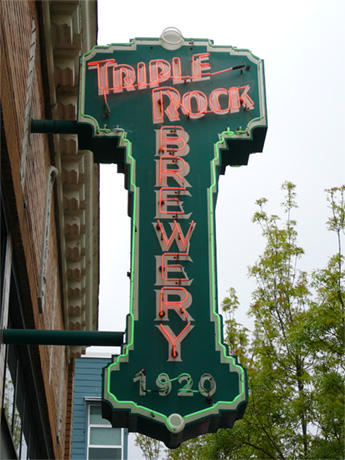
Today one of the most fun festivals in the Bay Area took place, the Firkin Gravity Festival at the Triple Rock Brewery & Alehouse in Berkeley. This is the fourth year for this event and it’s great to have an event like this that spreads awareness of these beers. There were two dozen firkin beers from around California. A firkin is a cask that’s the size of a quarter keg, but measured in British volume, meaning it’s 9 imperial gallons (which is roughly 10.81 U.S. gallons). All the beer was cask conditioned and dispensed using gravity taps rather than hand pumps.

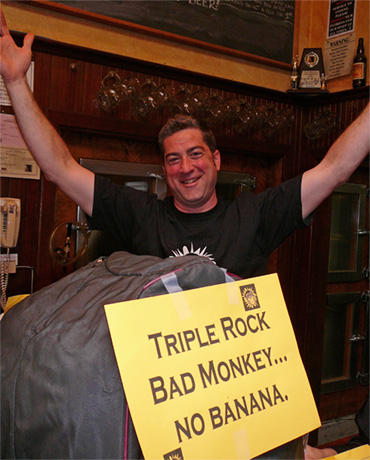
There were some mighty fine real ales there today, not least of which was the one brewed by our host Christian Kazakoff, Triple Rock’s Bad Monkey … No Banana. Some other stand-outs included a cask Pliny the Elder, Firestone-Walker’s Bourbon Barrel Stout and Stone’s Russian Imperial Stout. Iron Spring’s Casey Jones Imperial IPA and Marin’s IPA on cask were both also memorable, as was Grant Johnston’s English-style beer. Farmhouse had a nice cask Porter and Lagunitas put last year’s Gnarlywine to the wood.

Outside Triple Rock in Berkeley.

Triple Rock’s head brewer Christian Kazakoff.

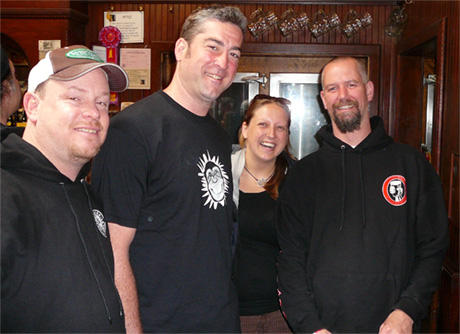
Shane, Steve and Melissa, brewers one and all.

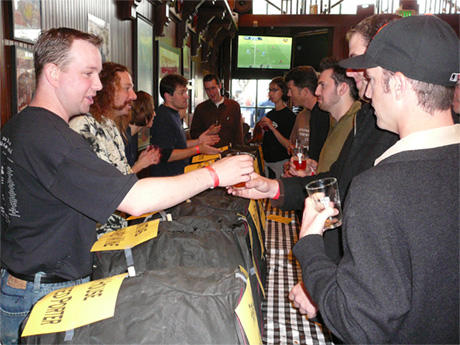
A row of firkins at the fest.

Arne Johnson (Marin Brewing), Christian Kazakoff (Triple Rock) and newlyweds Claudia and Rodger Davis (21st Amendment & Drake’s)

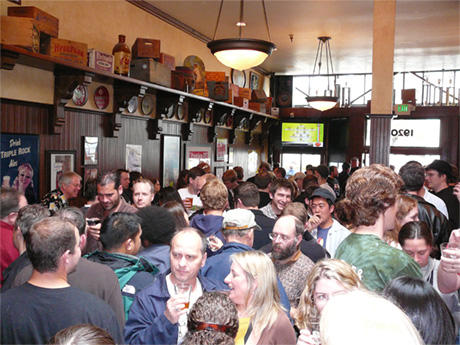
By early afternoon, the alehouse was truly packed. It was a great turnout and nice to see so many people supporting real ale.

Christian again with a trio from 21st Amendment.

Filed Under: Events Tagged With: Bay Area, California, Festivals, Photo Gallery

American Brew on A&E Tonight

April 7, 2007 By Jay Brooks

Tonight on the A&E cable network, they’re airing Roger Sherman’s documentary, The American Brew. The first showing is at 10:00 p.m. (Eastern and Pacific)/9 Central and Mt. and then again on Sunday, April 8 at 2:00 a.m./1 Central/Mt.

I was fortunate enough to get an advance rough cut of the film a little while ago, and have watched it a couple of times, including the excellent bonus features on the DVD. Assuming my rough cut is substantially similar the final edit, which I presume it is, I can heartily recommend watching it. The film was sponsored and paid for by Anhesuer-Busch through their P.R. project Here’s to Beer. I saw about a quarter of it in teaser form last fall at GABF, too. Back then, Bob Lachky jokingly mused that he’d have to answer to Augie for how little A-B was represented in story. In the final show, that has been rectified, and my biggest criticism is that it feels now like they’re a little over-represented. When I spoke to an A-B rep. about that, he replied that it was appropriate given their market share and relative importance in the history of American brewing. Maybe, I won’t quibble about either points, but if the goal of Here’s to Beer is to raise the status and awareness of all beer, than I’m not so sure that’s a valid argument. But that aside, it’s well worth watching, and aside from a couple of the segments that I thought ran a little too long, was nicely done. The production values, special effects and storytelling are all a cut above the usual television documentary and, nothing against A&E but, it certainly would have felt just as right at home on PBS.

The history is well-done, though I thought the older history was dwelled upon a little long while the more recent history given shorter shrift. I would liked to have seen even greater emphasis placed on changes to the industry over the last 25 years, because most beer histories simply ignore this period of recent growth. So while it was great seeing even a little more about the birth of craft beer, the film left me hungry for much more. It was great fun seeing a film in which I knew practically everybody being interviewed. Outside of my own home movies, that almost never happens.

I think this overview of America’s brewing history is ideal for the beginner who wants to learn more. But it’s also great fun for those of us who are already intimately familiar with beer’s story, not least of which because the passions of the people on-screen come through with wild abandon. So despite a few quibbles here and there, it’s a thoroughly enjoyable film and a great calling card for the industry. But everyone should really go ahead and buy themselves a copy of it on DVD. Not only is it a mere $5.49 from the Here’s to Beer Website, but for that paltry sum you also get double the fun, with almost a full hour of extra and extended interviews with several beer luminaries.

The poster for American Brew.

Filed Under: Reviews Tagged With: History

Triple Rock Firkin Fest

April 7, 2007 By Jay Brooks

4.7

Triple Rock Firkin Fest (4th annual)

Triple Rock Brewery, 1920 Shattuck, Berkeley, California
510.THE.BREW [ website ]

Filed Under: Uncategorized Tagged With: Uncategorized

Triple Rock Firkin Festival Today

April 7, 2007 By Jay Brooks

Don’t miss the 4th annual Firkin Festival today at Triple Rock in Berkeley. The festival starts at 11:00 a.m. and will continue until 10:00 p.m.

Filed Under: News Tagged With: Announcements, Bay Area, California

Brew Years Eve

April 7, 2007 By Jay Brooks

At 12:01 a.m., 74 years ago, beer became legal for the first time in thirteen years. Though it would be eight more months until Prohibition officially ended (on December 5), President Franklin D. Roosevelt kept his first campaign promise by encouraging Congress to modify the Volstead Act and they passed the Cullen-Harrison bill, which FDR signed it into law on March 23. The bill allowed the sale and manufacture of low-alcohol beer (3.2% alcohol by weight/4.0% by volume), along with light wines, too. For brewers, it represented a return to brewing and those that had remained opening making non-alcoholic products quickly retooled. Those that had been shuttered for over a decade had a harder time re-opening, but some did manage it. Ultimately Prohibition did irreparable harm the industry as a whole and less than half of America’s breweries did not survive.

And we’re still waiting for an apology from all the temperance nutcases who thought making alcohol illegal would turn society into a utopia. If anything, it made things much, much worse. Virtually every societal ill temperance nutjobs believed prohibition would fix were only made worse. Instead of a more civil, crime-free world, crime actually increased significantly, not least of which directly is directly attributable to bootlegging and bathtub gin. An entire new enforcement agency was created to deal with all the new criminalized behavior by the Volstead Act, made famous by Elliot Ness and his “Untouchables.” And that was in part because corruption became rampant especially among law enforcement and local officials who took bribes and looked the other way while speakeasies operated with homemade and illegal booze. This corruption in turn made the average citizen’s respect for the law evaporate.

All those people who used to work at breweries, wineries, distilleries along with their salesmen, advertisers, marketers, distributors, delivery men, and on and one were suddenly out of a job, causing much economic harm. It’s no mere coincidence that our worst economic depression took place during this same period of time. In every sense this experiment was ignoble and failed to achieve any of its goals.

Originally, and for many years after, brewers referred to April 7 as “New Beer’s Eve” Although the fortunes of many breweries and the industry as a whole ebbed and flowed, overall the number of breweries continued to plummet until the early 1980s, when the microbrewery revolution began to reverse that trend.

The Brewers Association, a trade organization for small and regional breweries, is reviving the holiday under the name “Brew Years Eve” and encouraging their members to host celebrations all over the country. Their website lists hundreds of events by state

From their press release:

While the full repeal of Prohibition came on December 5, 1933, a modification of the Volstead Act legalized beer with 3.2 percent alcohol by weight (4.0 percent by volume) starting on April 7 of that year. In fact, one of the first public delivery of beer went to the White House to honor Franklin Delano Roosevelt who had won the presidency in part because he favored repeal. From April 7 on, the country’s brewers were back in business and Americans enjoyed legal beer for eight months before wine and spirits were once again legitimate.

Today, brewers bring Americans a lot more than just beer. Since the 1970s, the ranks of brewers have grown to include more than 1400 small, traditional and independent craft beer makers. Each contributes jobs and a variety of local and federal taxes to the economy.

To learn more about the history of Prohibition, here are some interesting links:

  • Alcohol Prohibition Was A Failure, Policy Analysis from the Cato Institute
  • Alcohol, Temperance & Prohibition, from Brown University
  • April 7 is NOT the 74th Anniversary of the End of National Prohibition, by Bob Skilnik, with an excerpt from his wonderful book Beer & Food.
  • Prohibition: A Lesson in the Futility (and Danger) of Prohibiting, from the book Ain’t Nobody’s Business If You Do
  • Schaffer Library of Drug Policy History of Alcohol Prohibition
  • Temperance & Prohibition History, from Ohio State
  • Thinkquest’s Prohibition — The “Noble Experiment”
  • Wikipedia

Filed Under: Editorial, Events, News Tagged With: Business, History, Other Events, Prohibitionists

Session #2: Dubbel Your Pleasure

April 6, 2007 By Jay Brooks

For our second session of Beer Blogging Friday I went a little farther from home and chose an old favorite, Westmalle Dubbel. Dubbel, of course, doesn’t mean the beer is double anything, but merely that it’s stronger than the single and not as strong as the tripel. It’s all relative, meaning the strength of dubbels can vary widely. Nor should the dubbel be based on the single but is more often its own and very separate style, as opposed to an Imperial or Double IPA (which is at least based on an IPA).

Westmalle undoubtedly made the first modern dubbel shortly after World War Two, and based it on a heavier beer they began making in 1926, which itself was based on a darker beer pioneered around 1856. So there’s quite a bit of history in every sip, though I don’t know if the brewer originally had a limp or not. I make that comment in reference to a Publican article by British beer writer Ben McFarland where he essentially excoriates amateur beer snobs, going so far as to call them “condescending clowns” and other rather insulting word portraits of his vision of the classic beer snob. One of these was the beer snobs “patronising dismissal of any beer that isn’t brewed by a 16th century monk with a limp.” In a later rebuttal of sorts on Rate Beer, McFarland indicated he intended the piece to be a “light-hearted article” but also that he was trying to make the point that “beer snobs are damaging beer’s appeal by taking it too seriously.” I frankly thought his article was in fact damaging to beer enthusiasts and enthusiasm, and said so. Though I more often very much enjoy McFarland’s writing style — his piece in the new issue of the Celebrator, for example, is priceless — this one seemed more vindictive and spiteful than it did tongue-in-cheek or funny.

But Westmalle Dubbel is without question, if not a beer snob’s beer, certainly a beer for the enthusiast or aficionado rather than McFarland’s “everyday chap.” That’s too bad, really, as it should be more of an everyday beer. The monks assuredly don’t view it as anything too special, just another beer in the mix, though perhaps reserved for a particular day, Good Friday for example. But compared with so much of what passes for beer, it really is quite extraordinary.

Some form of this beer was indeed more than likely brewed in the 16th century by a Trappist monk — though the limp remains purely speculative. It was revived again during the 19th century’s industrial revolution when many Abbey breweries began to modernize and then revived yet again in its present form some sixty years ago.

Happily, I’ve got the right glass for this beer and it’s finally warmed up enough to open it. It’s quiet in my office, and I can hear the bubbles crackle as I pour it down the center to release the CO2. The tan head recedes after a couple of minutes, revealing a deep mahogany color. I grandiosely swirl the glass to enhance the aroma and inhale ostentatiously (note: in case you missed it, this last bit is sarcasm, it was a regular swirl and I used my everyday nose). The nose is sweet and malty with some underlying fruitiness — raisins? — with a hint of characteristic nuttiness. The first sip is a jolt of sweetness with a raisiny, prune-like character. In subsequent tastes, the beer dances on my tongue with a pleasant effervescence. The malt character continues to change with time and chocolate notes become more common, as do tiny hints of banana and some kind of berry or fig that I can’t quite put my finger on. The finish is clean and dry.

Westmalle’s Tripel deservedly gets a lot of attention, in the manner of a favorite son or daughter. But the dubbel is no Jan Brady, and has plenty of secret and not-so-secret admirers, of which I am unabashedly one. I’m sure I’m not the only person who will write about this beer today, as it is one of the truly great dubbels around.

But back to this question of beer snobs and how taking themselves too seriously might be “damaging beer’s appeal.” Westmalle’s Dubbel is, I think, a perfect example of a beer worthy to be taken seriously. Should that fact be off-putting to the novice or uninitiated? Must I tone down my enthusiasm for this beer so as not to scare off “potential drinkers?” Frankly, if anyone won’t try a Westmalle Dubbel because I waxed too lyrically about it or used “absurd verbal acrobatics” to describe it, then that person wasn’t ready yet anyway. I want to bring people over to the cause of better beer at least as much as McFarland does, possibly even more so, but I don’t think discouraging or disparaging a beer geek who’s stepped over the line into snobbery is a very helpful or effective tactic.

Like it or not, the people McFarland so disdains are the very people who can and will carry the message of good beer in their own personal missions. Will they always carry out their missionary work in a way we’d like, in the way we might do it, or even in a way that brings honor to the cause? Probably not, and at least not all the time.

But maybe, just maybe, those of us in the public eye as brewers or beer writers didn’t always know as much as we do today. Perhaps we once were empty vessels waiting to be filled, too. As I learned about better beer and began homebrewing, I tried to talk to anyone and everyone I knew about how good this stuff was, especially compared to the popular bile of the day. Did I make mistakes, overstep myself beyond what I really knew or make a fool of myself. Why yes, yes, I did. Was I a beer snob? Yes, from time to time I was insufferably so. Thank goodness nobody gave me the advice to just “shut up and drink it.” Because over time I learned more and more and made a fool of myself less and less. And I have personally introduced better beer to scores of people, who are today telling two friends, who in turn will tell two more, and so on and so on, dubbeling our pleasure at every turn.

Filed Under: Editorial, Reviews, The Session Tagged With: Belgium, Europe

Budvar to Privatize

April 6, 2007 By Jay Brooks

Czech brewer Budejovicky Budvar — from the Bohemian town of Budweis — announced today that it will be transformed into a joint-stock company as the first step toward privatization. Currently, Budvar (whose beers are marketed in the U.S. under the name Czechvar) is a state-owned company.

Agriculture Minister Petr Gandalovic, whose ministry controls Budvar, also said today that privatization will depend largely on any outcome in the long-standing trademark dispute with Anheuser-Busch, whose beer brand “Budweiser” was inspired by the town of Budweis. The speculation is that this move, along with several other proposed similar privatizations of other nationally held companies, is being taken to assist the government in dealing with a recent budget crisis.

Filed Under: News Tagged With: Business, Europe

Greene King Visits the Clue Farm

April 5, 2007 By Jay Brooks

The Publican is reporting that Greene King is going to subject its decision to remove the locally brewed Harvey’s Best Bitter from the Lewes Arms to an “internal review” where most expect that decision to be reversed. Though no timetable has been set, Harveys will once more be sold at the pub most likely within the next few weeks.

From the Publican article:

Adam Collett, marketing director for Greene King’s managed pubs, acknowledged his company had “underestimated the strength of feeling which led to many locals boycotting what was once a great British pub. As a result, it has lost some of its character and greatness.”

Although he defended Greene King’s right to remove the beer from the pub “and, where we choose, not to sell rival beers”, he admitted the group “did not fully appreciate its special position in Lewes as the former ‘Brewery Tap’, or take into account its history and traditions”.

Sure they did, just a simple misunderstanding. They’ve been completely belligerent and intractable throughout this episode, to say now that they just didn’t “fully appreciate” how locals felt about their local beer is more spin control. They knew exactly what they were dealing with from almost the beginning, but they believed they could outlast the boycott and they also didn’t count on the publicity the story generated. The PR backlash was so bad that it probably led to former marketing director Mark Angela leaving over his handling of what became a “public relations nightmare” and the restructuring of the managed pubs division. Collett, who replaced him, was undoubtedly tasked with fixing the Lewes problem. Naturally, Greene King denies this scenario. It was just a coincidence is what they’ll probably say. I guess Angela just wanted to spend more time with his family, that’s a common reason given by exiting executives.

Notice that even within the conciliatory reversal of position, Greene King retains the bullying language that they will do whatever they want and “where [they] choose, [will] not [to] sell rival beers.” To me that signals a company desperately wanting to fix its negative public image but without changing its corporate culture in any meaningful way. They may have bought a clue in this particular instance, but it probably won’t help them if they face similar opposition at another location.

I’m certainly happy for the people of Lewes who fought for their local heritage. Getting a big company to see reason and be a better corporate citizen is no easy feat. It’s proof once more that sufficiently motivated groups of organized people can successfully challenge institutions, and that makes the world a slightly less depressing place. Congratulations to the Friends of the Lewes Arms. Next time I’m across the pond, I’d like to stop in the Lewes Arms and have myself a pint of Harveys.

Filed Under: Editorial, News Tagged With: Business, Europe, Great Britain

« Previous Page
Next Page »

Find Something

Northern California Breweries

Please consider purchasing my latest book, California Breweries North, available from Amazon, or ask for it at your local bookstore.

Recent Comments

  • Bob Paolino on Beer Birthday: Grant Johnston
  • Gambrinus on Historic Beer Birthday: A.J. Houghton
  • Ernie Dewing on Historic Beer Birthday: Charles William Bergner 
  • Steve 'Pudgy' De Rose on Historic Beer Birthday: Jacob Schmidt
  • Jay Brooks on Beer Birthday: Bill Owens

Recent Posts

  • Beer In Ads #5231: A Sign Of Spring April 26, 2026
  • Historic Beer Birthday: Henry Hoerl April 26, 2026
  • Historic Beer Birthday: John Toohey April 26, 2026
  • Beer In Ads #5230: The Original Old German Bock Beer, GOT IT? Get It! April 25, 2026
  • Historic Beer Birthday: Al Levy April 25, 2026

BBB Archives

Feedback

Head Quarter
This site is hosted and maintained by H25Q.dev. Any questions or comments for the webmaster can be directed here.