Brookston Beer Bulletin

Jay R. Brooks on Beer

  • Home
  • About
  • Editorial
  • Birthdays
  • Art & Beer

Socialize

  • Dribbble
  • Email
  • Facebook
  • Flickr
  • GitHub
  • Instagram
  • LinkedIn
  • Pinterest
  • RSS
  • Twitter
  • YouTube

Powered by Genesis

Beer In Ads #4528: Miss Rheingold 1960 Finalists Sell Savings Bonds

August 13, 2023 By Jay Brooks

Sunday’s ad is for “Rheingold Beer,” from 1959. This ad was made for the Rheingold Brewery, which was founded by the Liebmann family in 1883 in New York, New York. At its peak, it sold 35% of all the beer in New York state. In 1963, the family sold the brewery and in was shut down in 1976. In 1940, Philip Liebmann, great-grandson of the founder, Samuel Liebmann, started the “Miss Rheingold” pageant as the centerpiece of its marketing campaign. Beer drinkers voted each year on the young lady who would be featured as Miss Rheingold in advertisements. In the 1940s and 1950s in New York, “the selection of Miss Rheingold was as highly anticipated as the race for the White House.” The winning model was then featured in at least twelve monthly advertisements for the brewery, beginning in 1940 and ending in 1965. Beginning in 1941, the selection of next year’s Miss Rheingold was instituted and became wildly popular in the New York Area. In this newspaper item, one from November 16, 1959, the six finalists for Miss Rheingold 1960 are doing a promotional ad for the U.S. Government promoting Series E Savings Bonds. The finalists here are Jane Langley, Pat McCloskey, Judi Turner, Carol Christensen, Emily Banks, and Anne Newman.

Filed Under: Art & Beer, Beers Tagged With: Advertising, History, Rheingold

Beer In Ads #4527: Miss Rheingold 1960 Finalists

August 12, 2023 By Jay Brooks

Saturday’s ad is for “Rheingold Beer,” from 1959. This ad was made for the Rheingold Brewery, which was founded by the Liebmann family in 1883 in New York, New York. At its peak, it sold 35% of all the beer in New York state. In 1963, the family sold the brewery and in was shut down in 1976. In 1940, Philip Liebmann, great-grandson of the founder, Samuel Liebmann, started the “Miss Rheingold” pageant as the centerpiece of its marketing campaign. Beer drinkers voted each year on the young lady who would be featured as Miss Rheingold in advertisements. In the 1940s and 1950s in New York, “the selection of Miss Rheingold was as highly anticipated as the race for the White House.” The winning model was then featured in at least twelve monthly advertisements for the brewery, beginning in 1940 and ending in 1965. Beginning in 1941, the selection of next year’s Miss Rheingold was instituted and became wildly popular in the New York Area. In these two newspaper items, one from August 6, 1959, and the other fro the next day, August 7, 1959, they’re revealing the six finalists for Miss Rheingold 1960. The first one is from the Boston Globe and shows, as the headline indicates, “Miss Rheingold Finalists,” who are Anne Newman, Jane Langley, Emily Banks, Carol Christensen, Judi Turner, and Pat McCloskey.

In the second ite, from the next day, from The Herald News, it’s a full-length photo of the finalists, but wearing the same dresses and standing in the same order so it’s undoubtedly from the same photo session.

Filed Under: Art & Beer, Beers Tagged With: Advertising, History, Rheingold

Beer In Ads #4526: Miss Rheingold 1960 Contest Hopefuls

August 11, 2023 By Jay Brooks

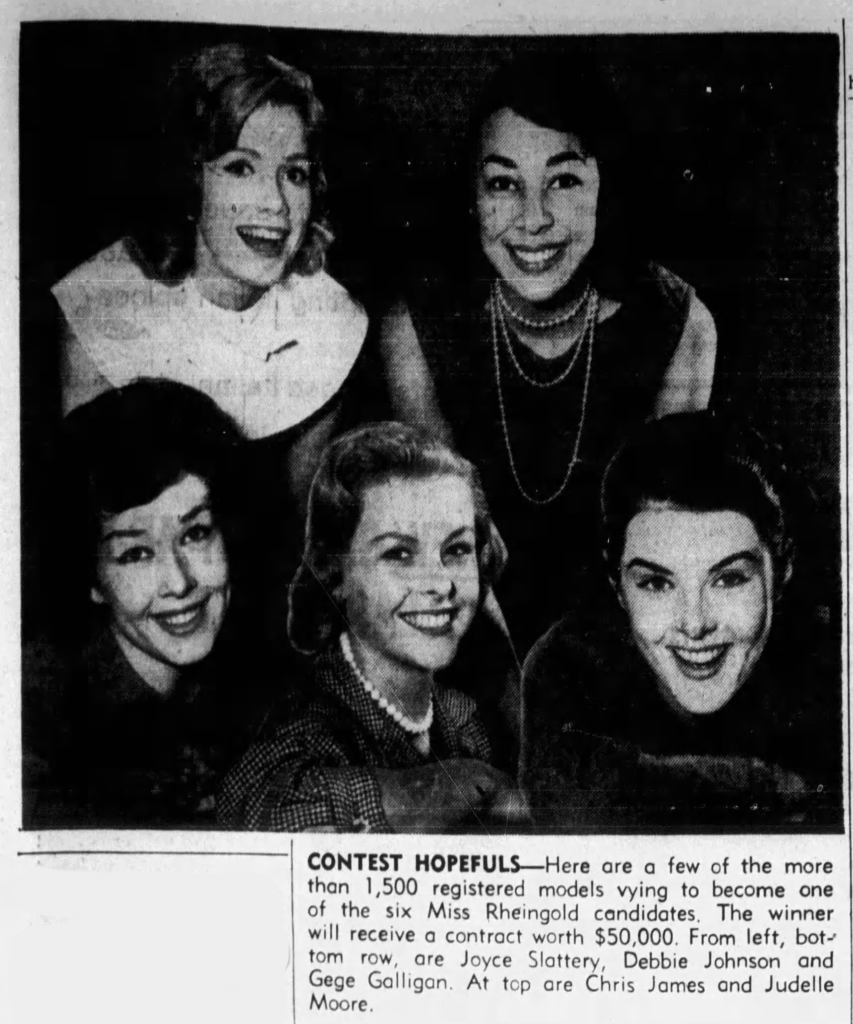
Friday’s ad is for “Rheingold Beer,” from 1959. This ad was made for the Rheingold Brewery, which was founded by the Liebmann family in 1883 in New York, New York. At its peak, it sold 35% of all the beer in New York state. In 1963, the family sold the brewery and in was shut down in 1976. In 1940, Philip Liebmann, great-grandson of the founder, Samuel Liebmann, started the “Miss Rheingold” pageant as the centerpiece of its marketing campaign. Beer drinkers voted each year on the young lady who would be featured as Miss Rheingold in advertisements. In the 1940s and 1950s in New York, “the selection of Miss Rheingold was as highly anticipated as the race for the White House.” The winning model was then featured in at least twelve monthly advertisements for the brewery, beginning in 1940 and ending in 1965. Beginning in 1941, the selection of next year’s Miss Rheingold was instituted and became wildly popular in the New York Area. In these two newspaper items, both from April 30, 1959, they’re showing candidates for Miss Rheingold 1960. The first one is from the Boston Globe and shows, as the headline indicates, “Candidates For Miss Rheingold 1960,” leaving Logan Airport bound for the Waldorf-Astoria and the semi-finals where the six finalists will be chosen.

In the second article from April 30, entitled “Contest Hopefuls,” five candidates for Miss Rheingold 1960 are pictured. Spoiler Alert: None of them make it to the finals.

Filed Under: Art & Beer, Beers Tagged With: Advertising, History, Rheingold

Beer In Ads #4525: Clicking The Chicks For Miss Rheingold 1960

August 10, 2023 By Jay Brooks

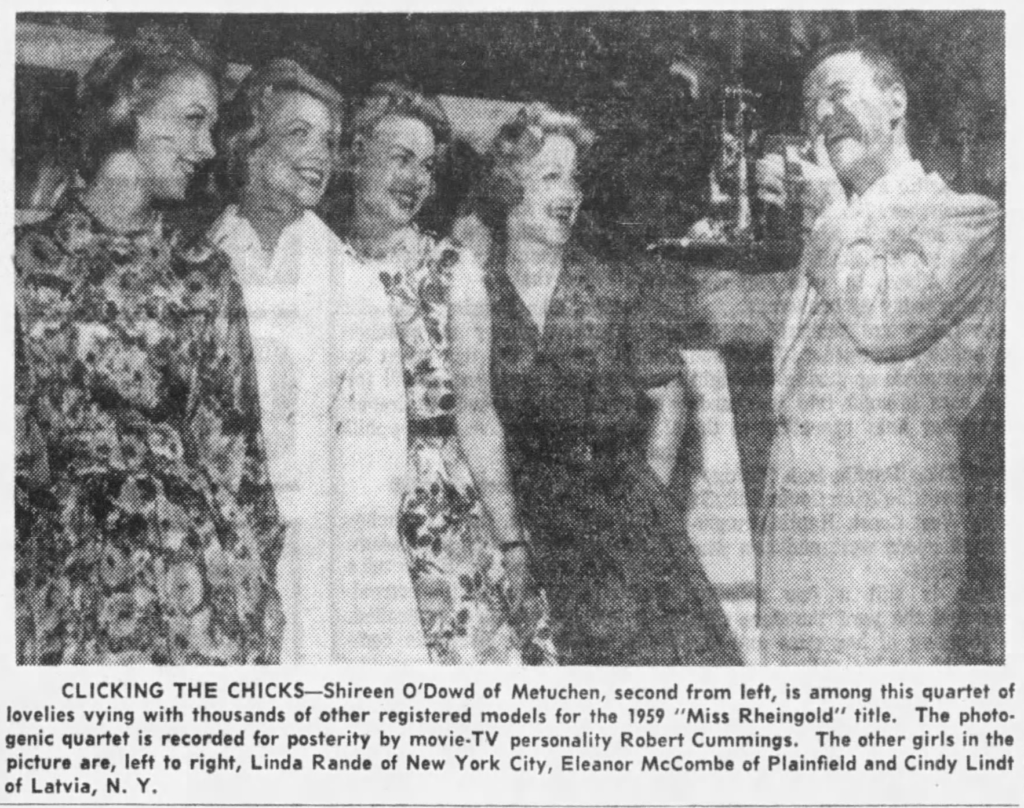
Thursday’s ad is for “Rheingold Beer,” from 1959. This ad was made for the Rheingold Brewery, which was founded by the Liebmann family in 1883 in New York, New York. At its peak, it sold 35% of all the beer in New York state. In 1963, the family sold the brewery and in was shut down in 1976. In 1940, Philip Liebmann, great-grandson of the founder, Samuel Liebmann, started the “Miss Rheingold” pageant as the centerpiece of its marketing campaign. Beer drinkers voted each year on the young lady who would be featured as Miss Rheingold in advertisements. In the 1940s and 1950s in New York, “the selection of Miss Rheingold was as highly anticipated as the race for the White House.” The winning model was then featured in at least twelve monthly advertisements for the brewery, beginning in 1940 and ending in 1965. Beginning in 1941, the selection of next year’s Miss Rheingold was instituted and became wildly popular in the New York Area. Robbin Bain was Miss Rheingold for 1959. She was born in August of 1938, in Flushing, New York, and grew up in Bronxville. Before being elected, she was a successful model, appearing on the covers of national magazines and on television. She was also commercial artist, portrait painter and aspiring actress, performing in summer stock She appears to have been married three times, first to Arno Schefler in 1962, then to Alexander Gaudier, and finally to Edward V. Mele, whom she remained married to until his death in 2003. He started a manufacturing company that became the largest maker of jewel boxes in the world. As far as I can tell, she’s still alive and living in North Palm Beach, Florida. She also did some TV, appearing on To Tell the Truth and the Today Show. In this newspaper item, from April 26, 1959, with the headline “Clicking the Chicks,” shows four of the aspiring models at the Waldorf-Astoria where a panel of judges will choose six finalists to become Miss Rheingold in 1960. Also in the picture, pretending to take a photo of the women is popular actor Robert Cummings. (Note: There appears to be a typo in text saying it’s for the 1959 title, but this was published in April of 1959 so it’s obviously for 1960.)

Filed Under: Art & Beer, Beers Tagged With: Advertising, History, Rheingold

Beer In Ads #4524: Miss Rheingold 1960 On Tap

August 9, 2023 By Jay Brooks

Wednesday’s ad is for “Rheingold Beer,” from 1959. This ad was made for the Rheingold Brewery, which was founded by the Liebmann family in 1883 in New York, New York. At its peak, it sold 35% of all the beer in New York state. In 1963, the family sold the brewery and in was shut down in 1976. In 1940, Philip Liebmann, great-grandson of the founder, Samuel Liebmann, started the “Miss Rheingold” pageant as the centerpiece of its marketing campaign. Beer drinkers voted each year on the young lady who would be featured as Miss Rheingold in advertisements. In the 1940s and 1950s in New York, “the selection of Miss Rheingold was as highly anticipated as the race for the White House.” The winning model was then featured in at least twelve monthly advertisements for the brewery, beginning in 1940 and ending in 1965. Beginning in 1941, the selection of next year’s Miss Rheingold was instituted and became wildly popular in the New York Area. Robbin Bain was Miss Rheingold for 1959. She was born in August of 1938, in Flushing, New York, and grew up in Bronxville. Before being elected, she was a successful model, appearing on the covers of national magazines and on television. She was also commercial artist, portrait painter and aspiring actress, performing in summer stock She appears to have been married three times, first to Arno Schefler in 1962, then to Alexander Gaudier, and finally to Edward V. Mele, whom she remained married to until his death in 2003. He started a manufacturing company that became the largest maker of jewel boxes in the world. As far as I can tell, she’s still alive and living in North Palm Beach, Florida. She also did some TV, appearing on To Tell the Truth and the Today Show. In this newspaper item, from April 25, 1959, with the headline “On Tap,” shows aspiring models at the Waldorf-Astoria where a panel of judges will look at hundreds of women and choose just six finalists to become Miss Rheingold in 1960.

Filed Under: Art & Beer, Beers Tagged With: Advertising, History, Rheingold

Beer In Ads #4523: Screening Models For Miss Rheingold 1960

August 8, 2023 By Jay Brooks

Tuesday’s ad is for “Rheingold Beer,” from 1959. This ad was made for the Rheingold Brewery, which was founded by the Liebmann family in 1883 in New York, New York. At its peak, it sold 35% of all the beer in New York state. In 1963, the family sold the brewery and in was shut down in 1976. In 1940, Philip Liebmann, great-grandson of the founder, Samuel Liebmann, started the “Miss Rheingold” pageant as the centerpiece of its marketing campaign. Beer drinkers voted each year on the young lady who would be featured as Miss Rheingold in advertisements. In the 1940s and 1950s in New York, “the selection of Miss Rheingold was as highly anticipated as the race for the White House.” The winning model was then featured in at least twelve monthly advertisements for the brewery, beginning in 1940 and ending in 1965. Beginning in 1941, the selection of next year’s Miss Rheingold was instituted and became wildly popular in the New York Area. Robbin Bain was Miss Rheingold for 1959. She was born in August of 1938, in Flushing, New York, and grew up in Bronxville. Before being elected, she was a successful model, appearing on the covers of national magazines and on television. She was also commercial artist, portrait painter and aspiring actress, performing in summer stock She appears to have been married three times, first to Arno Schefler in 1962, then to Alexander Gaudier, and finally to Edward V. Mele, whom she remained married to until his death in 2003. He started a manufacturing company that became the largest maker of jewel boxes in the world. As far as I can tell, she’s still alive and living in North Palm Beach, Florida. She also did some TV, appearing on To Tell the Truth and the Today Show. In this newspaper item, from April 18, 1959, with the headline “Screening Models,” shows aspiring models trying to become Miss Rheingold 1960, and specifically mentions Emily Banks, who was a finalist in 1959, was giving it another go.

Filed Under: Art & Beer, Beers Tagged With: Advertising, History, Rheingold

Beer In Ads #4522: Miss Rheingold 1959 Stationary

August 7, 2023 By Jay Brooks

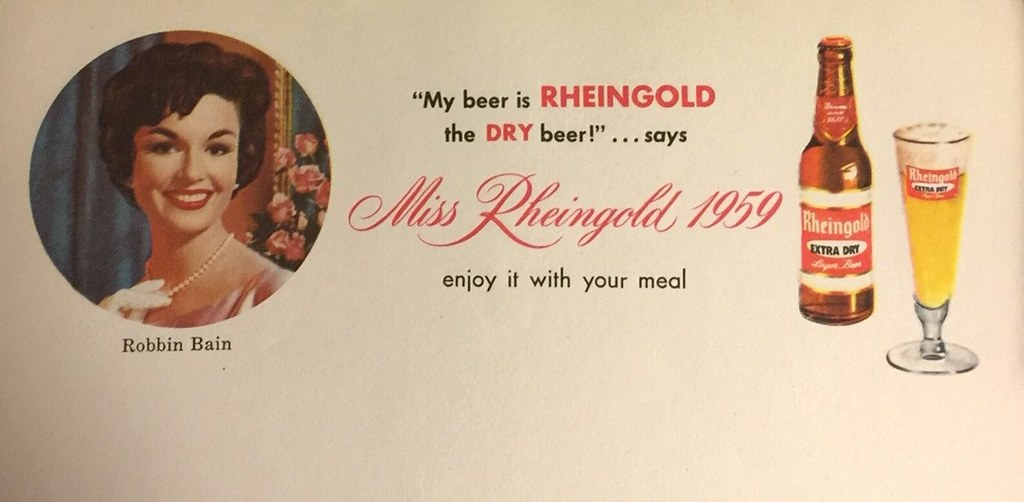
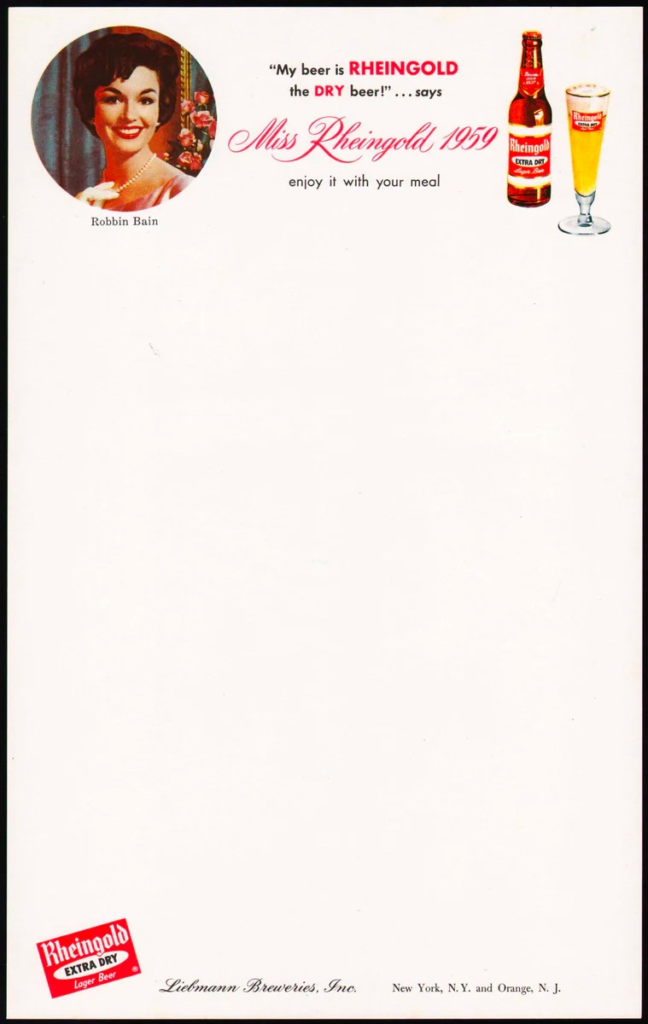
Monday’s ad is for “Rheingold Beer,” from 1959. This ad was made for the Rheingold Brewery, which was founded by the Liebmann family in 1883 in New York, New York. At its peak, it sold 35% of all the beer in New York state. In 1963, the family sold the brewery and in was shut down in 1976. In 1940, Philip Liebmann, great-grandson of the founder, Samuel Liebmann, started the “Miss Rheingold” pageant as the centerpiece of its marketing campaign. Beer drinkers voted each year on the young lady who would be featured as Miss Rheingold in advertisements. In the 1940s and 1950s in New York, “the selection of Miss Rheingold was as highly anticipated as the race for the White House.” The winning model was then featured in at least twelve monthly advertisements for the brewery, beginning in 1940 and ending in 1965. Beginning in 1941, the selection of next year’s Miss Rheingold was instituted and became wildly popular in the New York Area. Robbin Bain was Miss Rheingold for 1959. She was born in August of 1938, in Flushing, New York, and grew up in Bronxville. Before being elected, she was a successful model, appearing on the covers of national magazines and on television. She was also commercial artist, portrait painter and aspiring actress, performing in summer stock She appears to have been married three times, first to Arno Schefler in 1962, then to Alexander Gaudier, and finally to Edward V. Mele, whom she remained married to until his death in 2003. He started a manufacturing company that became the largest maker of jewel boxes in the world. As far as I can tell, she’s still alive and living in North Palm Beach, Florida. She also did some TV, appearing on To Tell the Truth and the Today Show. In this one, it’s a promotional piece featuring Miss Rheingold 1959, Robbin Bain. This is the top portion of stationary, pads of paper given out to anyone who sold Rheingold beer.

And here’s another look at a full sheet:

Filed Under: Art & Beer, Beers Tagged With: Advertising, History, Rheingold

Beer In Ads #4521: Season’s Greetings From Miss Rheingold 1959

August 6, 2023 By Jay Brooks

Sunday’s ad is for “Rheingold Beer,” from 1959. This ad was made for the Rheingold Brewery, which was founded by the Liebmann family in 1883 in New York, New York. At its peak, it sold 35% of all the beer in New York state. In 1963, the family sold the brewery and in was shut down in 1976. In 1940, Philip Liebmann, great-grandson of the founder, Samuel Liebmann, started the “Miss Rheingold” pageant as the centerpiece of its marketing campaign. Beer drinkers voted each year on the young lady who would be featured as Miss Rheingold in advertisements. In the 1940s and 1950s in New York, “the selection of Miss Rheingold was as highly anticipated as the race for the White House.” The winning model was then featured in at least twelve monthly advertisements for the brewery, beginning in 1940 and ending in 1965. Beginning in 1941, the selection of next year’s Miss Rheingold was instituted and became wildly popular in the New York Area. Robbin Bain was Miss Rheingold for 1959. She was born in August of 1938, in Flushing, New York, and grew up in Bronxville. Before being elected, she was a successful model, appearing on the covers of national magazines and on television. She was also commercial artist, portrait painter and aspiring actress, performing in summer stock She appears to have been married three times, first to Arno Schefler in 1962, then to Alexander Gaudier, and finally to Edward V. Mele, whom she remained married to until his death in 2003. He started a manufacturing company that became the largest maker of jewel boxes in the world. As far as I can tell, she’s still alive and living in North Palm Beach, Florida. She also did some TV, appearing on To Tell the Truth and the Today Show. In this ad, from December, Miss Rheingold 1959, Robbin Bain, has finished trimming her Christmas tree and has wrapped her last present, and is wishing everyone a Season’s Greetings.

Filed Under: Art & Beer, Beers Tagged With: Advertising, Christmas, History, Holidays, Rheingold

Beer In Ads #4520: Miss Rheingold 1959 Wraps Her Last Gift

August 5, 2023 By Jay Brooks

Saturday’s ad is for “Rheingold Beer,” from 1959. This ad was made for the Rheingold Brewery, which was founded by the Liebmann family in 1883 in New York, New York. At its peak, it sold 35% of all the beer in New York state. In 1963, the family sold the brewery and in was shut down in 1976. In 1940, Philip Liebmann, great-grandson of the founder, Samuel Liebmann, started the “Miss Rheingold” pageant as the centerpiece of its marketing campaign. Beer drinkers voted each year on the young lady who would be featured as Miss Rheingold in advertisements. In the 1940s and 1950s in New York, “the selection of Miss Rheingold was as highly anticipated as the race for the White House.” The winning model was then featured in at least twelve monthly advertisements for the brewery, beginning in 1940 and ending in 1965. Beginning in 1941, the selection of next year’s Miss Rheingold was instituted and became wildly popular in the New York Area. Robbin Bain was Miss Rheingold for 1959. She was born in August of 1938, in Flushing, New York, and grew up in Bronxville. Before being elected, she was a successful model, appearing on the covers of national magazines and on television. She was also commercial artist, portrait painter and aspiring actress, performing in summer stock She appears to have been married three times, first to Arno Schefler in 1962, then to Alexander Gaudier, and finally to Edward V. Mele, whom she remained married to until his death in 2003. He started a manufacturing company that became the largest maker of jewel boxes in the world. As far as I can tell, she’s still alive and living in North Palm Beach, Florida. She also did some TV, appearing on To Tell the Truth and the Today Show. In this ad, from December, Miss Rheingold 1959, Robbin Bain, has finished trimming her Christmas tree and has wrapped her last present.

Filed Under: Art & Beer, Beers Tagged With: Advertising, History, Rheingold

Guy de Maupassant’s “Waiter, A Glass Of Beer!”

August 5, 2023 By Jay Brooks

book
Today is the birthday of French writer Guy de Maupassant. He was a prolific writer, very popular during his lifetime, and “considered one of the fathers of the modern short story and one of the form’s finest exponents.” He wrote half-a-dozen novels and around 240 short stories. One of them was entitled “Waiter, A Glass of Beer!,” although since the original was in French, it’s sometimes translated as “Waiter, A Bock!” It’s a somewhat melancholy tale, but there’s a couple of great quotes in the story, like how the barfly describes his life:

I get up out of bed at noon. I come here, I have a meal, I drink beer, I wait for the evening, I have dinner, I drink beer, and then, about half-past one in the morning, I go home to bed again, because, you see, they close at that hour—which is a nuisance. I have probably spent six years out of the last ten on this seat, in this corner, and the rest of the time in bed—none of it anywhere else. Occasionally I have a chat with some of the guests.

And in the “Bock” version of the story, the barfly is referred to as a “regular” in the beer bar, but in the “glass of beer” version they use an interesting term I hadn’t heard before: a “beerite,” which he describes as “one of those habitual frequenters of beer-palaces who come in the morning when the doors open, and leave when they close for the night.” I may have to try to get that word back into common usage, if indeed it ever was.

Because it’s in the public domain, several versions are available online. I’ve reprinted the Bartelby version below, but you can see others, such as one of the Bock versions at Classic Short Stories or at Google Books’ version at The Complete Short Stories of Guy de Maupassant. Enjoy.

Guy_de_Maupassant_fotograferad_av_Félix_Nadar_1888
A photograph of Guy de Passant taken in 1888.

‘Waiter, a Glass of Beer!’

I WAS going nowhere in particular. I was merely taking a stroll after dinner. I passed the Lyonnais Bank, the Rue Vivienne, and other streets besides. Suddenly I halted before a half-empty beer-palace. With no special object in view—for I was not thirsty—I went in.

Casting a glance about for a comfortable place, I took a seat next to a man who looked rather old, and was smoking a cheap clay pipe, which was as black as coal. Half a dozen glass saucers piled up on the table in front of him indicated the number of glasses he had already consumed. I paid no closer attention to my neighbor, recognizing him at once for a “beerite,” one of those habitual frequenters of beer-palaces who come in the morning when the doors open, and leave when they close for the night. He was untidy, and bald on the top of his head, a shock of long, greasy, pepper-and-salt hair falling upon his coat collar. His clothes, which were too loose, had apparently been made at a time when he was stouter. One suspected that his trousers were not fastened on tight, and that every ten yards the wearer would have to stop and pull up that erratic garment. Had he a waistcoat on? The bare thought of his boots, and of what they might contain, made me shudder. His frayed cuffs were a deep black all round the edges—just like his nails.

No sooner had I sat down beside this individual, than he coolly addressed me:

“How are you?”

I turned toward him in surprise, and looked him over. Then he resumed:

“You don’t recognize me?”

“No.”

“Des Barrets.”

I was dumfounded. It was Count Jean des Barrets, an intimate friend of college days. I shook hands with him, but was too much perturbed to bring out a syllable. At last I stammered:

“And you—how are you?”

To which he placidly replied:

“I might be worse.”

That was all he said. I tried to be civil, and racked my brain for an observation to make. At last I put the question:

“And—er—what are you doing at present?”

He answered in a tone of resignation:

“As you see.”

I felt myself blushing. Nevertheless, I braved it out:

“But every day, I mean?”

After puffing out an enormous cloud of smoke, he replied:

“It’s the same thing every day.”

Thereupon, giving the marble surface of the table a rat-tat-tat with a copper coin, he exclaimed:

“Waiter, two glasses of beer!”

A distant voice repeated, “Two glasses of beer!” A voice still more distant shouted a strident “Here you are!” Then appeared a man in a white apron, carrying two glasses, from which he spilt a few yellow drops as he shuffled speedily across the sanded floor.

Des Barrets emptied his glass at a single draft, and put it back on the table, sucking off the foam which had remained on his mustache. After this he inquired:

“Anything new?”

I really had nothing new to tell him, and so I muttered:

“No, old chap, nothing that I know of. I—I’m in business.”

In the same even tone he asked me:

“Oh! And do you find that amusing?”

“No. But it can’t be helped. A fellow must do something or other.”

“Why so?”

“Well—er—so as to have his time occupied.”

“What’s the use of that? I never do anything, as you see—no, not a thing. If one is poor, I understand that one must work. But as long as one has anything to live upon, then it’s quite unnecessary. Work—why work? Are you doing it for yourself or for others? If you are doing it for yourself, I suppose you enjoy it, and then it’s all right; if you do it for somebody else, you’re an idiot!”

Then, resting his pipe on the marble slab, he again cried out aloud:

“Waiter, a glass of beer!”

Turning back to me, he continued:

“Talking makes me thirsty. I am not used to it. No, I have no occupation; I do nothing but simply grow old. I shall have nothing to grieve for when I die. This beer-palace will be my only parting memory. No wife—no children—no cares—no worry. That’s the best way.”

He drained the tall glass brought him, wiped his mouth with the back of his hand, and took to his pipe once more.

I was stupefied. Presently I said:

“But you have not always been like this?”

“I beg your pardon, always; ever since I left college.”

“But this is no life for you, my dear fellow! Why, it’s horrible! Surely you have something to do—you must have friends—you must be attached to somebody or something?”

“Not at all. I get up out of bed at noon. I come here, I have a meal, I drink beer, I wait for the evening, I have dinner, I drink beer, and then, about half-past one in the morning, I go home to bed again, because, you see, they close at that hour—which is a nuisance. I have probably spent six years out of the last ten on this seat, in this corner, and the rest of the time in bed—none of it anywhere else. Occasionally I have a chat with some of the guests.”

“But when you first came to Paris, what did you do, to start with?”

“I took my degree—at the Café de Médicis.”

“And what did you do next?”

“Next? Oh, I crossed the river, and came here!”

“Why did you take that much trouble?”

“Well, you know, a fellow can hardly stay in the Latin Quarter all his life. The students are too noisy. I shall never move again, now. Waiter, a glass of beer!”

I thought he was making game of me, and so persisted:

“Now, look here, tell me the truth! You have had some great sorrow, haven’t you? some unfortunate love-affair perhaps? You certainly look like a man who has been hard hit by fate. Tell me—how old are you?”

“Thirty-three; but I look at least forty-five.”

His wrinkled face, which was none too clean, might indeed almost have belonged to an old man. From the top of his skull fluttered a wisp or two of hair above some skin of a doubtful color. He had enormous eyebrows, a heavy mustache, and a thick, shaggy beard. There appeared to my vision—I can scarcely tell why—a basin full of dark water, in which he had attempted to wash.

“Yes,” said I, “you look older than you are. Surely you must have had some trouble.”

“None in the world, I tell you. I have aged because I never take any exercise. There’s nothing worse for people than this life in cafés.”

Still I could not believe him:

“Ah, then you’ve been a bit gay! One doesn’t get bald like that without running after the women a good deal.”

He tranquilly shook his head, sowing his coat collar with little white particles that fell from his last remaining locks.

“No,” he remarked, “I have always behaved myself.” And raising his eyes to the chandelier overhead, he added, “If I’m bald, the gas is to blame. It’s frightfully bad for the hair. Waiter, a glass of beer!—You don’t seem thirsty?”

“No, thanks. But really, your case is interesting. When did this—er—apathy set in? It isn’t normal; it isn’t natural. There’s something beneath all this.”

“Well, yes—it dates back a long way. I’ll tell you about it.”…

“Waiter, a glass of beer!”

The glass that was brought him he gulped down at one swallow. Only, in taking up his pipe again, as his hand trembled, he let it drop, and it broke. This caused him a gesture of despair, and drew from him the complaint:

“Well, now, that’s really a tragedy, that is. It’ll take me a month to color another.”

And through the immense room, now full of tobacco-smoke and beer-drinkers, resounded again his everlasting cry:

“Waiter, a glass of beer!” Only this time he added, “And a new pipe!”

Filed Under: Beers, Just For Fun, Related Pleasures Tagged With: Literature

« Previous Page
Next Page »

Find Something

Northern California Breweries

Please consider purchasing my latest book, California Breweries North, available from Amazon, or ask for it at your local bookstore.

Recent Comments

  • Bob Paolino on Beer Birthday: Grant Johnston
  • Gambrinus on Historic Beer Birthday: A.J. Houghton
  • Ernie Dewing on Historic Beer Birthday: Charles William Bergner 
  • Steve 'Pudgy' De Rose on Historic Beer Birthday: Jacob Schmidt
  • Jay Brooks on Beer Birthday: Bill Owens

Recent Posts

  • Beer In Ads #5203: Now’s The Time To Say … Blitz Weinhard Bock For Me! April 3, 2026
  • Beer Birthday: Dave Bonighton April 3, 2026
  • Historic Beer Birthday: Frederick Hinckel Jr. April 3, 2026
  • Beer In Ads #5202: The Bock Beer Time Is Near, And It Comes But Once A Year April 3, 2026
  • Historic Beer Birthday: Henry Pierre Heineken April 3, 2026

BBB Archives

Feedback

Head Quarter
This site is hosted and maintained by H25Q.dev. Any questions or comments for the webmaster can be directed here.