Brookston Beer Bulletin

Jay R. Brooks on Beer

  • Home
  • About
  • Editorial
  • Birthdays
  • Art & Beer

Socialize

  • Dribbble
  • Email
  • Facebook
  • Flickr
  • GitHub
  • Instagram
  • LinkedIn
  • Pinterest
  • RSS
  • Twitter
  • YouTube

Powered by Genesis

Beer In Ads #2280: Three Rings, Spilled Milk

May 18, 2017 By Jay Brooks


Thursday’s ad is for Ballantine, from 1940. In this ad, part of a series progressing from one, to two, to three rings, this one shows a cat knocking over a milk bottle, creating a ring of the floor. I guess the cat keep playing with the bottle, causing it to roll and keep spilling, creating a second and then a third ring until there’s a Ballantine logo in milk on the floor and a cat who knows he’s done a good job making the “okay” sign with three raised fingers to “order the ‘handy’ way.”

Ballantine-1940-cat

Filed Under: Art & Beer, Beers Tagged With: Advertising, Ballantine, History

Beer In Ads #2279: Three Rings, Winter Sled

May 17, 2017 By Jay Brooks


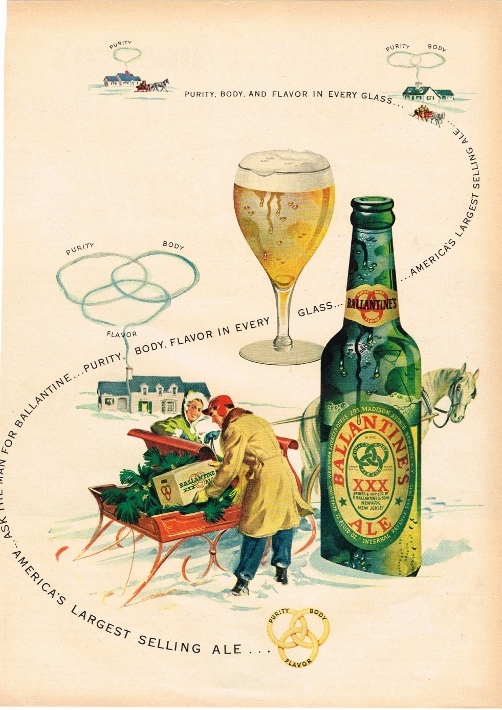
Wednesday’s ad is for Ballantine, from 1948. In this ad, part of a series progressing from one, to two, to three rings, this one shows a sled pulled through the snow by a white horse. It’s obviously Christmastime and the couple appears to be delivering Ballantine, but it seems to be that each house they visit adds one more smoke ring from their chimney so that by the third home it’s the Ballantine logo in fireplace smoke rings.

Ballantine-1948-rings-xmas-sled

Filed Under: Art & Beer, Beers Tagged With: Advertising, Ballantine, Christmas, History, Holidays

Beer In Ads #2278: Three Rings, Unicycles

May 16, 2017 By Jay Brooks


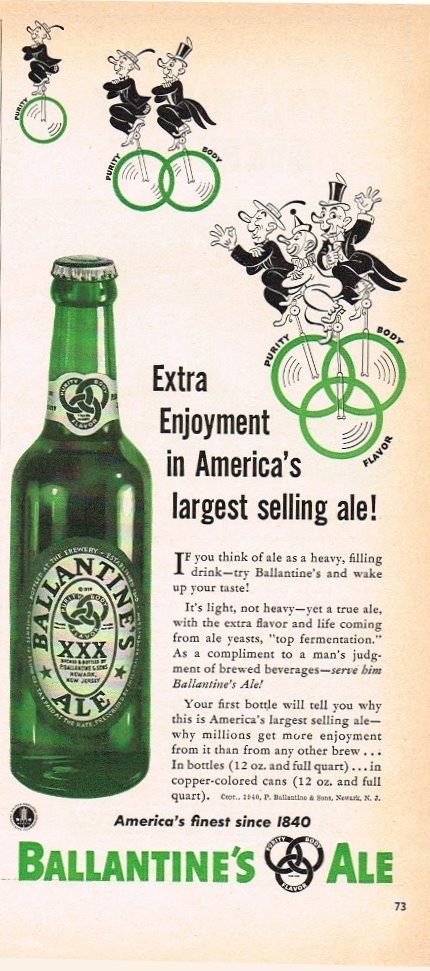
Tuesday’s ad is for Ballantine, from 1940. In this ad, part of a series progressing from one, to two, to three rings, this one shows three clowns riding unicycles. Eventually they ride close enough together to make the Ballantine logo in spinning wheels.

Ballantine-1940-cycles

Filed Under: Art & Beer, Beers Tagged With: Advertising, Ballantine, History

Beer In Ads #2277: Three Rings, Jumping Frogs

May 15, 2017 By Jay Brooks


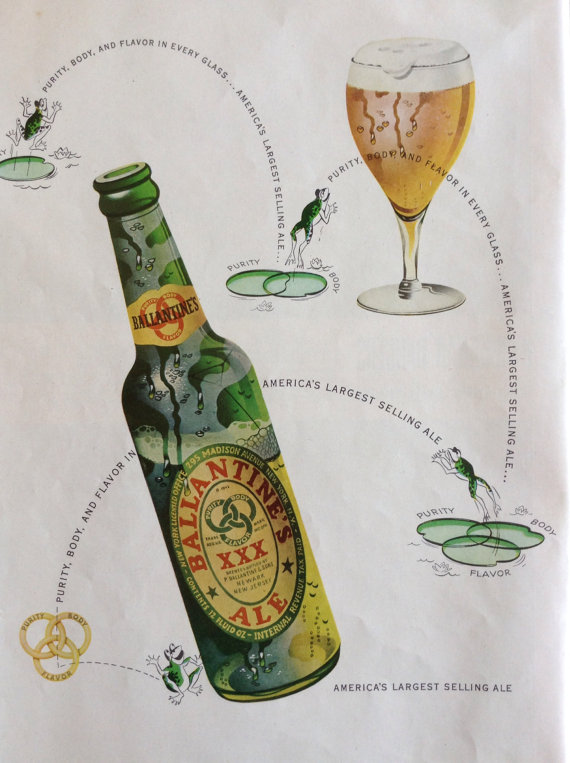
Monday’s ad is for Ballantine, from 1940. In this ad, part of a series progressing from one, to two, to three rings, this one shows a for jumping from one lily pad to the next until he’s jumped to three of them, pulling them together to form the Ballantine logo, of course.

Ballantine-1948-jumping-frogs

Filed Under: Art & Beer, Beers Tagged With: Advertising, Ballantine, History

Beer In Ads #2276: Three Rings, At The Sphinx

May 14, 2017 By Jay Brooks


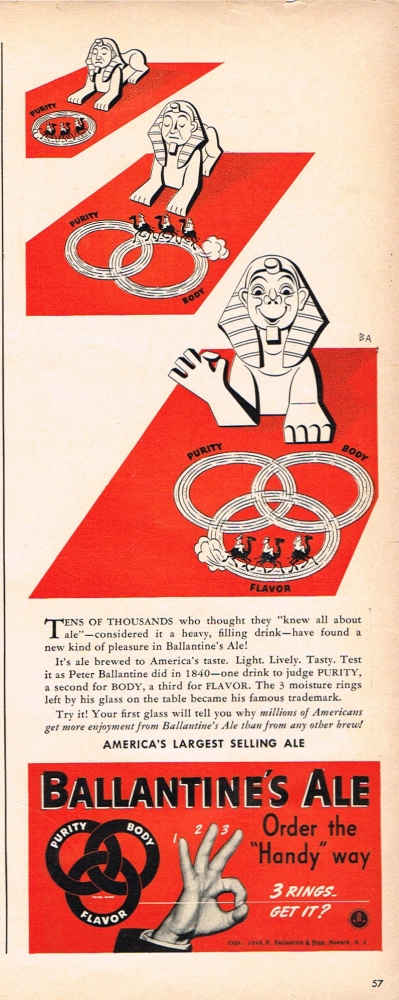
Sunday’s ad is for Ballantine, from 1940. In this ad, part of a series progressing from one, to two, to three rings, this one shows a trio of camels riding in circles in front of the Sphinx in Egypt. Their path first makes one circle in the sand, then a second, with no reaction, as you’d expect, from the statue. But after they make a third one, mirroring the Ballantine three-ring logo, the Sphinx smiles and waves to them. Personally, I think they’ve just had one too many Ballantines.

Ballantine-1940-sphinx

Filed Under: Art & Beer, Beers Tagged With: Advertising, Ballantine, History

Beer In Ads #2275: Three Rings, Polar Bears

May 13, 2017 By Jay Brooks


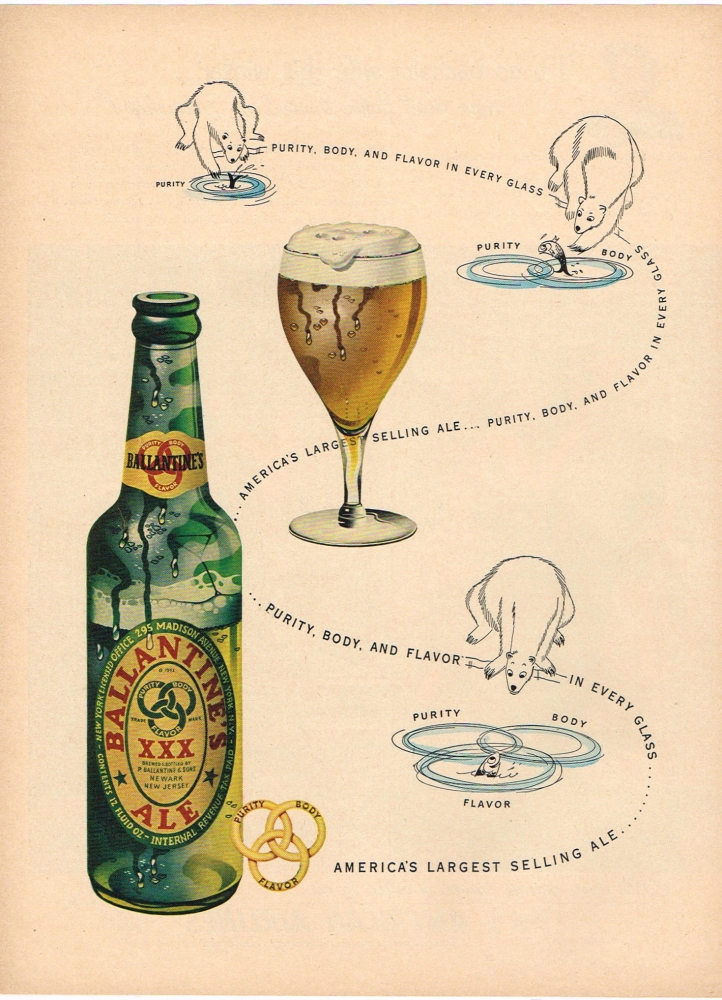
Saturday’s ad is for Ballantine, from 1949. In this ad, part of a series progressing from one, to two, to three rings, this one shows a polar bear fishing in a stream. With each failed attempt reaching his paw into the water, creating a ring. Three times he tried and failed, the fish is seemingly laughing at the bear; but at the least, his efforts created the Ballantine logo.

Ballantine-1949-rings-polar-bear

Filed Under: Art & Beer, Beers Tagged With: Advertising, Ballantine, History

Beer In Ads #2274: Three Rings, Cannon Shots

May 12, 2017 By Jay Brooks


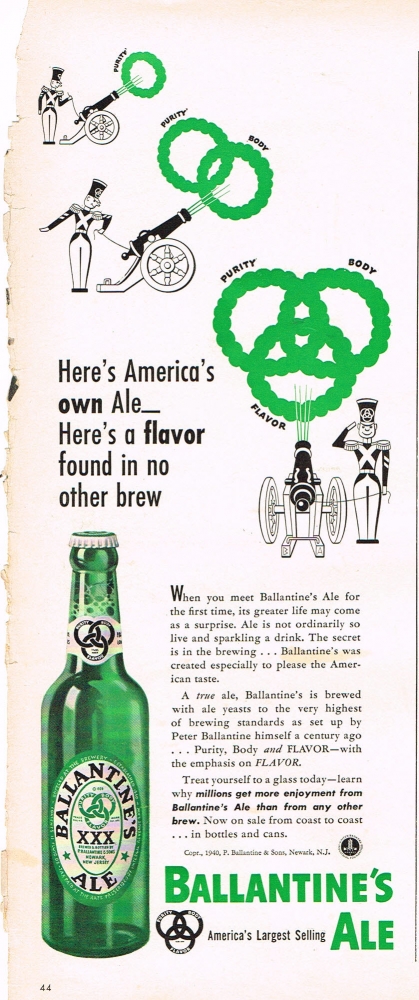
Friday’s ad is for Ballantine, from 1940. In this ad, part of a series progressing from one, to two, to three rings, this one shows a man in a fancy military dress uniform, looking vaguely colonial except for the Ballantine logo on his hat, firing a cannon. Each shot creates a ring of smoke, and by the time he’s fired the cannon three time, he’s created Ballantine’s logo.

Ballantine-1940-cannon

Filed Under: Art & Beer, Beers Tagged With: Advertising, Ballantine, History

Beer In Ads #2273: Three Rings, Ice Skating

May 11, 2017 By Jay Brooks


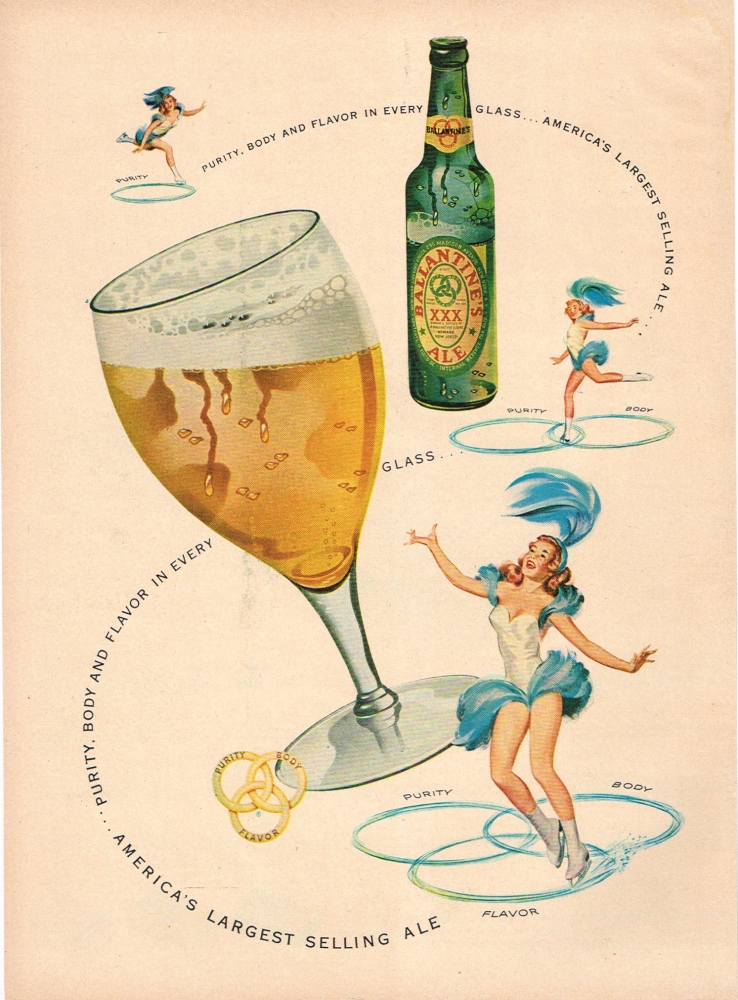
Thursday’s ad is for Ballantine, from 1949. In this ad, part of a series progressing from one, to two, to three rings, this one shows an ice skater for what’s surely called “Ballantine on Ice” (or maybe the “Beer-Capades?). Anyway, she’s skating rings around the ice, eventually creating the Borromean rings of Ballantine’s logo.

Ballantine-1949-rings-skating

Filed Under: Art & Beer, Beers Tagged With: Advertising, Ballantine, History

Jean Verdenal’s Letter To T.S. Eliot

May 11, 2017 By Jay Brooks

reading-book
This will probably only be of interest to the most hardcore literati among you, but if you like poetry, literature or weird history, read on McDuff. According to Wikipedia, Jean Jules Verdenal “(May 11, 1890–May 2, 1915) was a French medical officer who served, and was killed, during the First World War. Verdenal and his life remain cloaked in obscurity; the little we do know comes mainly from interviews with family members and several surviving letters.”

Verdenal was born in Pau, France, the son of Paul Verdenal, a medical doctor. He had a talent for foreign languages. He was athletically inclined. Verdenal as a student was interested in literature and poetry and possessed copies of Stéphane Mallarmé’s Poésies and of Jules Laforgue’s Poésies and Moralités Légendaires. It was perhaps Verdenal’s literary inclinations that led him to become friends with American poet T.S. Eliot, whom he met in 1910 at the Sorbonne. After they parted ways, Verdenal and Eliot corresponded through letters. Verdenal was killed on May 2, 1915, while treating a wounded man on the battlefield. This was just a week into the Gallipoli Campaign and a few days shy of his twenty-fifth birthday.”

ts-eliot

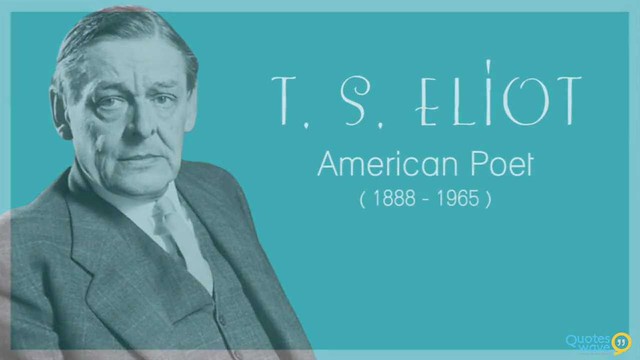
T.S. Eliot, of course, was an American-born poet, who most people know of because his 1939 collection of poems, “Old Possum’s Book of Practical Cats,” was later adapted by Andrew Lloyd Webber into the popular musical, “Cats,” which debuted in 1981. But here’s the basics, again from Wikipedia:

Thomas Stearns Eliot (September 26, 1888–January 4, 1965) was a British essayist, publisher, playwright, literary and social critic, and “one of the twentieth century’s major poets”. He moved from his native United States to England in 1914 at the age of 25, settling, working, and marrying there. He eventually became a British subject in 1927 at the age of 39, renouncing his American citizenship.

Eliot attracted widespread attention for his poem “The Love Song of J. Alfred Prufrock” (1915), which was seen as a masterpiece of the Modernist movement. It was followed by some of the best-known poems in the English language, including The Waste Land (1922), “The Hollow Men” (1925), “Ash Wednesday” (1930), and Four Quartets (1943). He was also known for his seven plays, particularly Murder in the Cathedral (1935) and The Cocktail Party (1949). He was awarded the Nobel Prize in Literature in 1948, “for his outstanding, pioneer contribution to present-day poetry.”

There is also speculation that Verdenal was the inspiration for the character “Phlebas the Phoenician” in Eliot’s long-form poem “The Wasteland,” which he published in 1922. Eliot certainly dedicated some of his works to Verdenal, including “his first volume of poetry, ‘Prufrock and Other Observations,’ which was published two years after Verdenal’s death, in 1917.

Here’s another account of their meeting and friendship:

In 1910 T.S. Eliot, then a graduate student studying philosophy at Harvard University, went to Paris to study a year at the Sorbonne. He took a room at a pension where he met and befriended Jean Verdenal, a French medical student who had another room there.

Eliot returned to Harvard in the autumn of 1911 to continue his work toward a doctorate.

Eliot and Verdenal carried on a correspondence at least through 1912. Seven letters from Verdenal to Eliot (written in French) are archived at Harvard University’s Houghton Library. The Verdenal letters have also been published in The Letters of T.S. Eliot: 1898-1922 (Vol 1). Apparently no copies of Eliot’s letters to Verdenal survive.

So why I bring this is up is the following passage, from a letter that Verdenal wrote to T.S. Eliot in July of 1911.

“My dear friend, I am waiting impatiently to hear that you have found some notepaper in Bavaria, and to receive an example of it covered with your beautiful handwriting, before German beer has dulled your wits. As a matter of fact, it would have some difficulty in doing so, and we see that even few natives of the country escaped its effects; history tells us that the formidable Schopenhauer was a great beer-lover. He also played the clarinet, but perhaps that was just to annoy his neighbours. Such things are quite enough to make us cling to life. The will to live is evil, a source of desires and sufferings, but beer is not to be despised — and so we carry on. O Reason!”

Verdenal has an interesting take on German beer. ANd the clarinet, which I used to play, too.

Phlebas-the-Phoenician

And this is passage from “The Wasteland,” about which some scholars believe Verdenal was the inspiration for Phlebas the Phoenician. You can read more about why at this page about T.S. Eliot and Jean Verdenal.

          IV. Death by Water

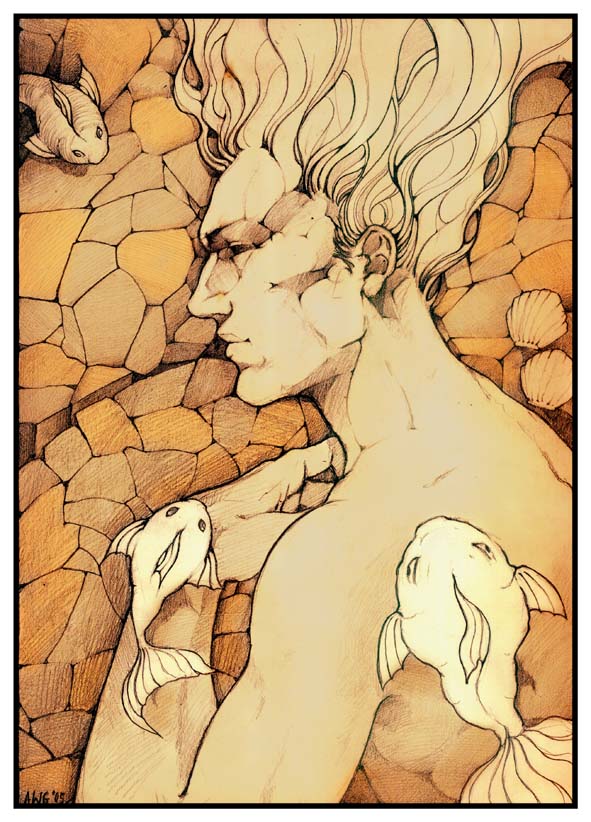
Phlebas the Phoenician, a fortnight dead,
Forgot the cry of gulls, and the deep sea swell
And the profit and loss.
                                 A current under sea
Picked his bones in whispers. As he rose and fell
He passed the stages of his age and youth
Entering the whirlpool.
                               Gentile or Jew
O you who turn the wheel and look to windward,
Consider Phlebas, who was once handsome and tall as you.

Filed Under: Beers, Just For Fun, Related Pleasures Tagged With: Germany, History, Literature, Poetry

Beer In Ads #2272: Three Rings, The Strongman

May 10, 2017 By Jay Brooks


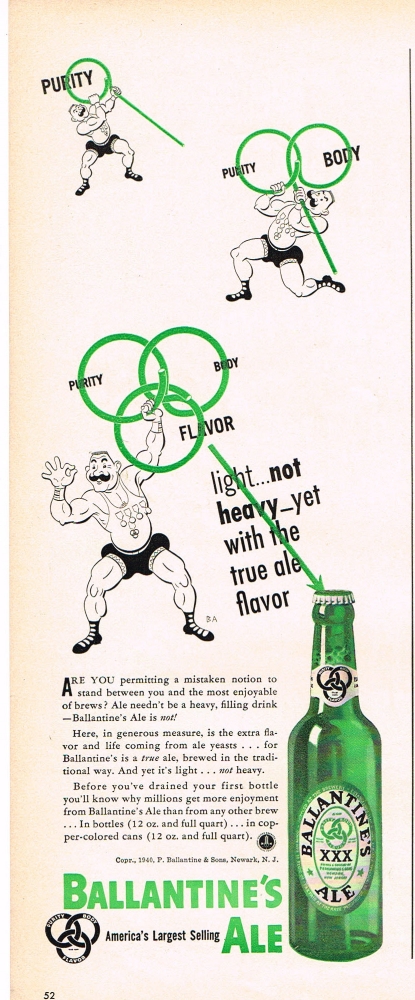
Wednesday’s ad is for Ballantine, from 1940. In this ad, part of a series progressing from one, to two, to three rings, this one shows a circus strongman with a long piece of metal which he proceeds to bend into three rings, one ring at a time.

Ballantine-1940-strongman

Filed Under: Art & Beer, Beers Tagged With: Advertising, Ballantine, History

« Previous Page
Next Page »

Find Something

Northern California Breweries

Please consider purchasing my latest book, California Breweries North, available from Amazon, or ask for it at your local bookstore.

Recent Comments

  • Bob Paolino on Beer Birthday: Grant Johnston
  • Gambrinus on Historic Beer Birthday: A.J. Houghton
  • Ernie Dewing on Historic Beer Birthday: Charles William Bergner 
  • Steve 'Pudgy' De Rose on Historic Beer Birthday: Jacob Schmidt
  • Jay Brooks on Beer Birthday: Bill Owens

Recent Posts

  • Beer In Ads #5213: Bock Beer Cascade Quality April 9, 2026
  • Historic Beer Birthday: Otto Schinkel Jr. April 9, 2026
  • Historic Beer Birthday: Johann Sedlmayr April 9, 2026
  • Beer In Ads #5212: Metz Bock Beer April 9, 2026
  • Historic Beer Birthday: Ralph Thrale April 9, 2026

BBB Archives

Feedback

Head Quarter
This site is hosted and maintained by H25Q.dev. Any questions or comments for the webmaster can be directed here.