Brookston Beer Bulletin

Jay R. Brooks on Beer

  • Home
  • About
  • Editorial
  • Birthdays
  • Art & Beer

Socialize

  • Dribbble
  • Email
  • Facebook
  • Flickr
  • GitHub
  • Instagram
  • LinkedIn
  • Pinterest
  • RSS
  • Twitter
  • YouTube

Powered by Genesis

Beer In Ads #1977: Showing Off The New Power Mower

July 19, 2016 By Jay Brooks


Tuesday’s ad is entitled Showing Off the New Power Mower, and the illustration was done in 1955 by Fred Siebel. It’s #108 in a series entitled “Home Life in America,” also known as the Beer Belongs series of ads that the United States Brewers Foundation ran from 1945 to 1956. In this ad, suburban manly men stand in the yard, oohing and awing over a new power mower, that to 2016 eyes looks positively old-fashioned. Despite two out of three of them doing actual yard work, they all have beers in their hands, and one of the woman back at the house looks to be delivering a tray of more beer, which certainly seems like a good idea if he’s going to mow the lawn.
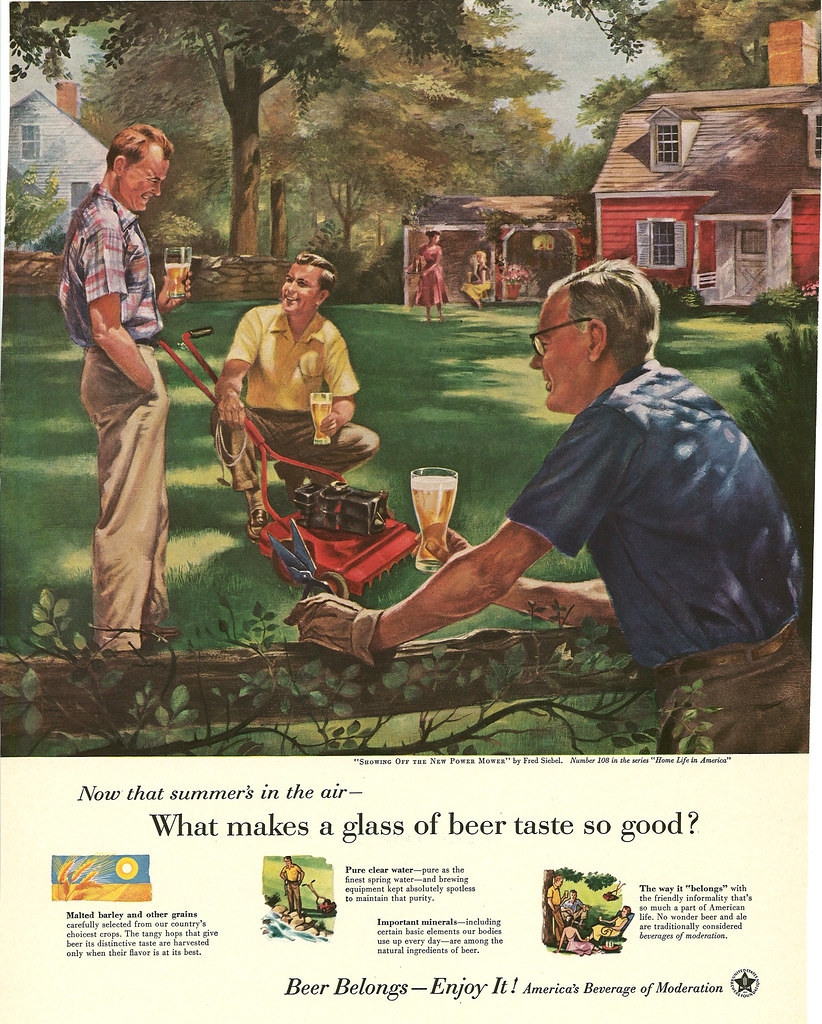
108. Showing Off the New Power Mower by Fred Siebel, 1955

Filed Under: Art & Beer, Beers, Just For Fun Tagged With: Advertising, History

Patent No. 2124308A: Device For Instantaneously Cooling Beer And Dispensing Same

July 19, 2016 By Jay Brooks

patent-logo
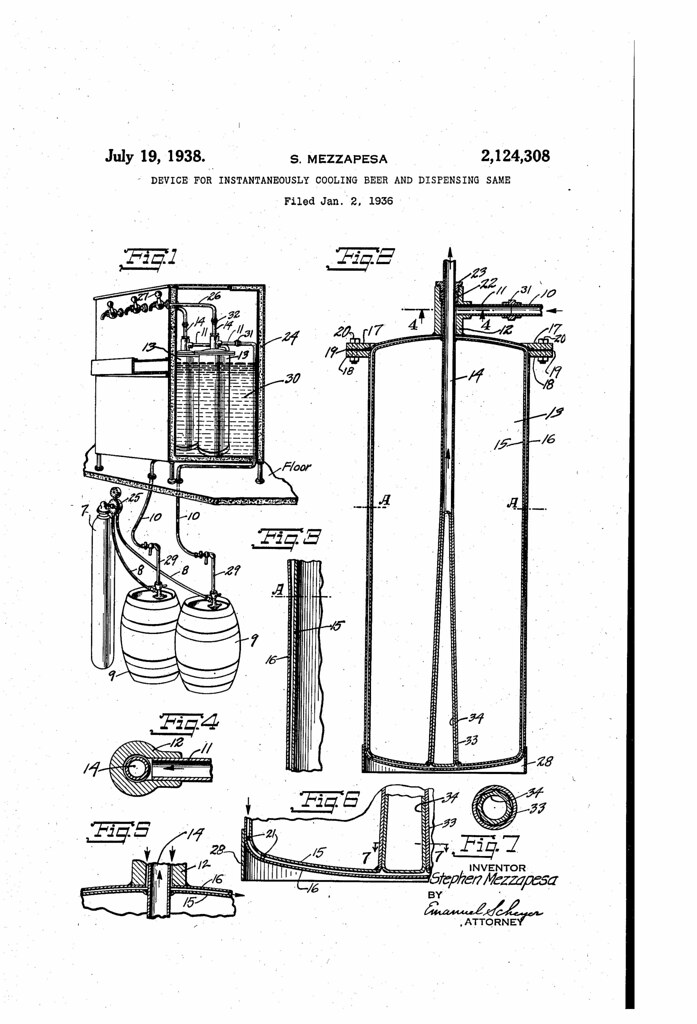
Today in 1938, US Patent 2124308 A was issued, an invention of Stephen Mezzapesa, for his “Device For Instantaneously Cooling Beer and Dispensing Same.” There’s no Abstract, although in the description it includes these claims:

It is a defect of present systems and methods off dispensing, that when the faucet is first opened there is often a squirt of gas and foam-spattering the beer and wasting it; The excess foam filling the glass’ held under the faucet must be removed and displaced by beer; causing a Waste of the been forming the-foam, Also the gas lost this way tends to leave the remaining beer flat. Some of the present systems have relief valves for the gas, to obviate the above noted defect. This also tends to leave the dispensed beer flat.

invention-consists in a device for forcing the beer from the storage receptacle or barrel into a thin sheet by passing it between closely spaced walls and then causing the beer after it has-passed between the walls to pass through an exceedingly fine orifice from whence it passes through’a length of the standard size beer tubing’ to its place of discharge at the “faucet. Experiment has shown that this causes the undissolved’ gas or air in the system to be evenly distributed throughout the discharged liquid in small bubbles. It breaks up the large bubbles into small ones, and reduces the foam to liquid. It permits the use of greatly increased pressure with the-resultant solution of more gas-in the beer, giving; rise tok a more zestful and tangy beer; The” closeness of the walls is such that the-force-of–capillarity is brought into play to help reduce the foam. There is also a straining action obtained by the closeness of the walls, 40 and smallness of the orifice largely preventing the foam which leaves the storage receptacle or” barrel with the beer from passing through the space between; the walls to the place of discharge; At the place Where the beer is formed into a thin sheet” it is preferably passed through a refrigerating medium; the thinness of the sheet effecting a rapid and thorough cooling of the beer.- The cooling at” this location further helps the reduction of foam and the elimination of large bubbles by the increased solubility of the gas in the colder beer.

US2124308-0

Filed Under: Beers, Just For Fun, Politics & Law, Related Pleasures Tagged With: History, Kegs, Law, Patent

Patent No. 607770A: Apparatus For Pasteurizing Beer

July 19, 2016 By Jay Brooks

patent-logo
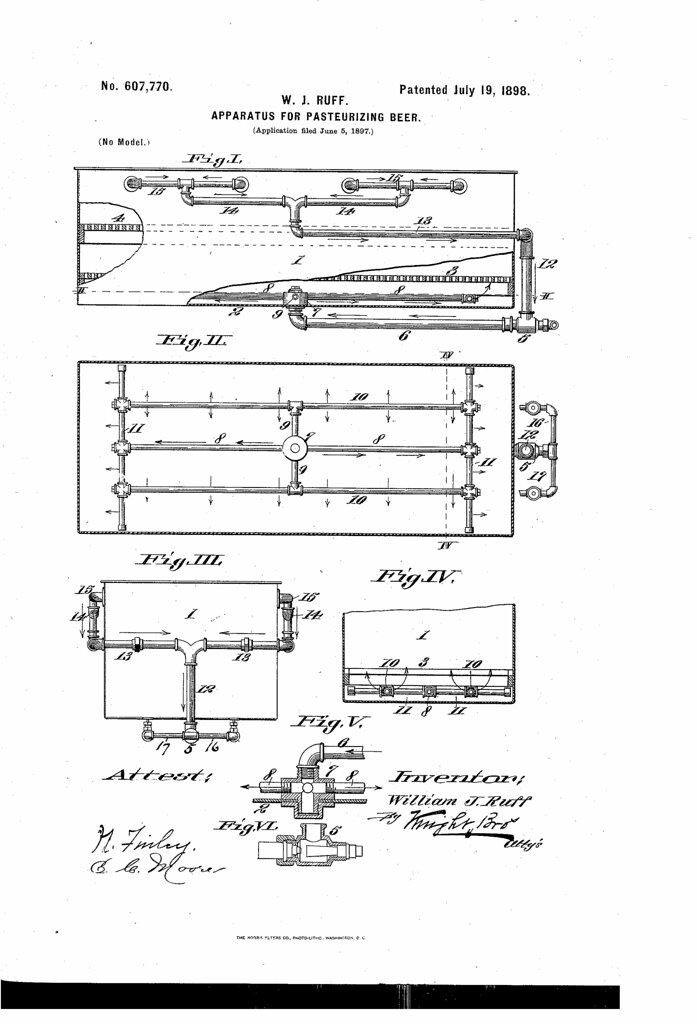
Today in 1898, US Patent 607770 A was issued, an invention of William J. Ruff, for his “Apparatus For Pasteurizing Beer.” There’s no Abstract, although in the description it includes these claims:

My invention has for its object an improved apparatus to be utilized in pasteurizing beer, whereby the operation is more perfectly carried out and the beer more effectually and uniformly treated and its chemical properties preserved.

US607770-0

Filed Under: Beers, Breweries, Just For Fun, Politics & Law, Related Pleasures Tagged With: Brewing Equipment, History, Law, Patent, Science of Brewing

Beer In Ads #1976: Love At First Sight

July 18, 2016 By Jay Brooks


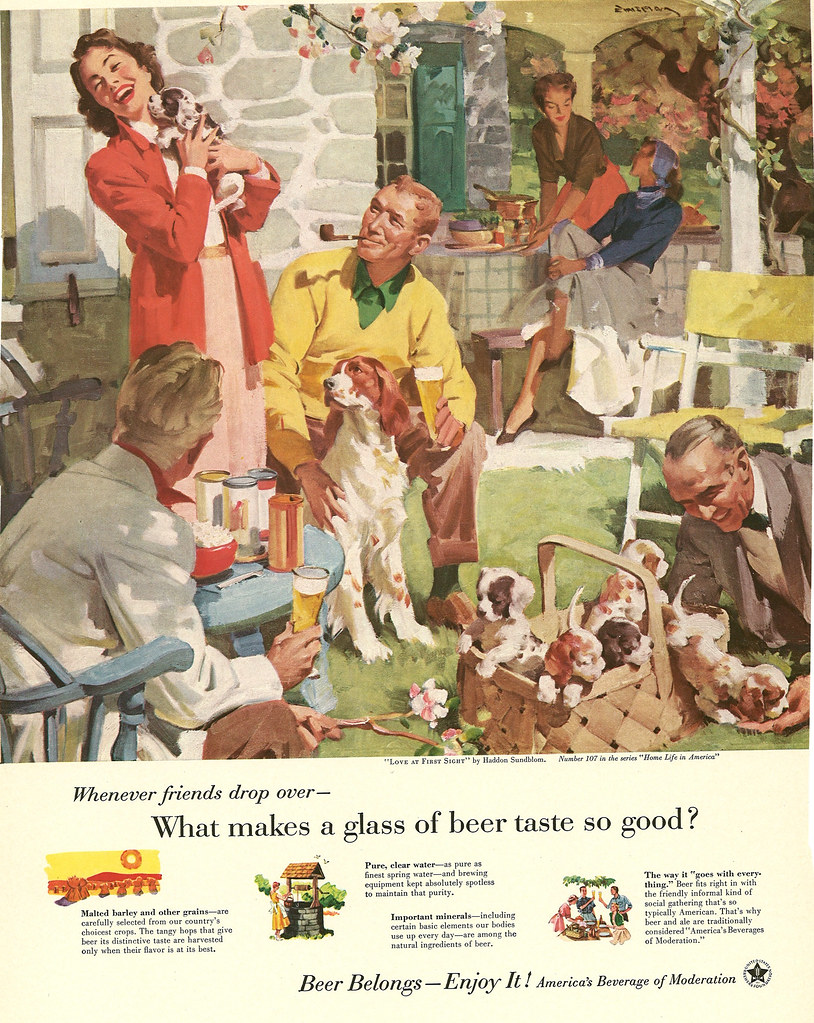
Monday’s ad is entitled Love at First Sight, and the illustration was done in 1955 by Haddon Sundblom. It’s #107 in a series entitled “Home Life in America,” also known as the Beer Belongs series of ads that the United States Brewers Foundation ran from 1945 to 1956. In this ad, someone brought a basket full of puppies to a backyard party. I suspect the owner is now plying them with beer in the hopes that the guests will drink enough that they’ll take one of the puppies home with them.

107. Love at First Sight by Haddon Sundblom, 1955

Filed Under: Art & Beer, Beers, Just For Fun Tagged With: Advertising, History

Patent No. 2354092A: Art Of Brewing Beer, Ale, Or Near-Beer

July 18, 2016 By Jay Brooks

patent-logo
Today in 1944, US Patent 2354092 A was issued, an invention of Berthold Stein, for his “Art Of Brewing Beer, Ale, Or Near-Beer.” There’s no Abstract, although in the description it includes these claims:

The present invention includes both the process of brewing as hereinafter described, and the beverage or resulting product thereof, and when referring to beer it is intended to include ale and near-beer, and analogous beverages of the same class Beer as well as ale is generally described as a fermented malt liquor with an average percentage of alcohol of from three to four per cent. by weight, or sometimes less, as in near beer, which may have about one-half per cent. It has a mildly bitter and aromatic flavor and odor. The brewers have. always attempted to give the beer an aromatic hop flavor and odor. Up to date, they have not succeeded in doing so. The bitter and so-called aromatic flavor is to be derived from. the hops. which are used in the brewing process. While all kinds of beer and` ales taste more or less bitter, there are no beers brewed which really have an aromatic hop flavor and odor. This is due to the processes and apparatuses which are employed in the brewing of beer and ale. All beers and ales have a more or less pronounced bitter taste, and they often have a disagreeable taste and odor as well. The latter is derived principally from the cellulose matter of the husks of the grain, and the fatty oils contained in the grain, such as barley, corn or rice. These bitter tastes and disagreeable odors are the principal reasons why so many people do not drink beer. It is generally understood that beer and ale is made from malt, and hops. In this country, however, beer and ale is brewed mostly from a mixture of barley malt (about 70%), and cereals unmalted (about 30%), namely, corn, rice, corn. Syrups or sugars, and hops. The hops in the brewing of beer and ales are used as a spice or condiment with a view to overcoming the above-mentioned bad taste and odor.

US2354092-0

Filed Under: Beers, Breweries, Just For Fun, Politics & Law, Related Pleasures Tagged With: Brewing Equipment, History, Law, Patent, Science of Brewing

Patent No. 3677458A: End Loading Twin Beverage Carton

July 18, 2016 By Jay Brooks

patent-logo
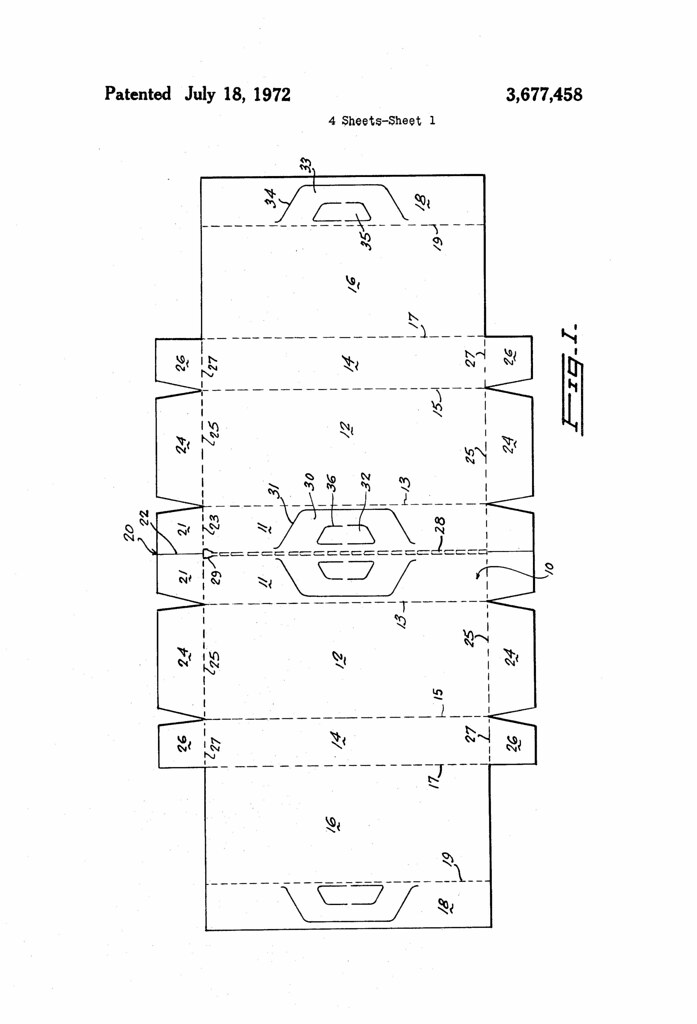
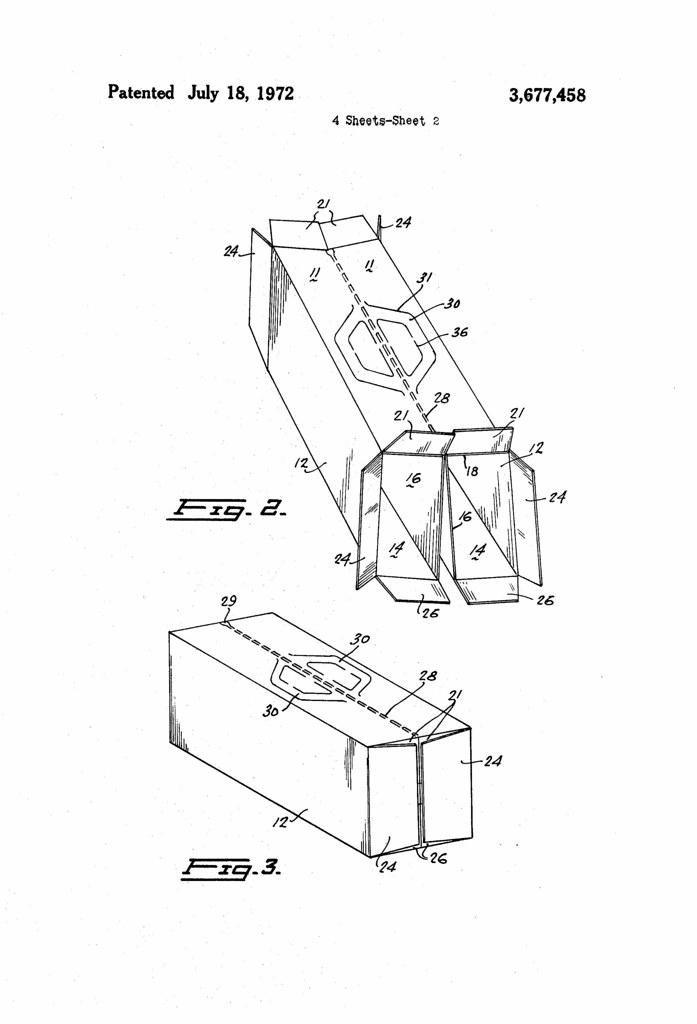
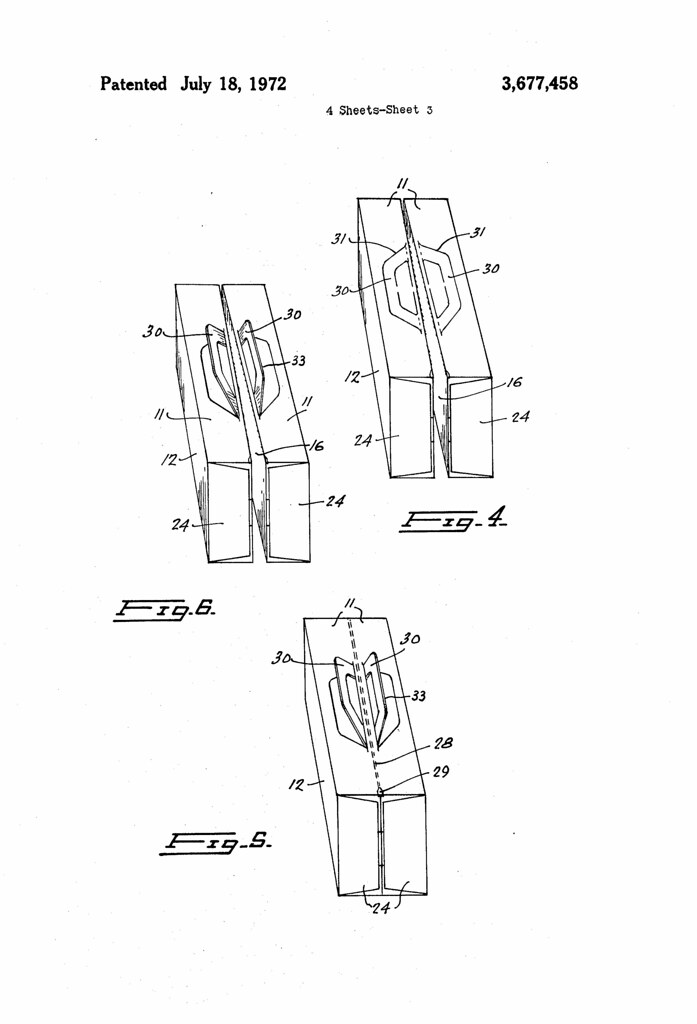
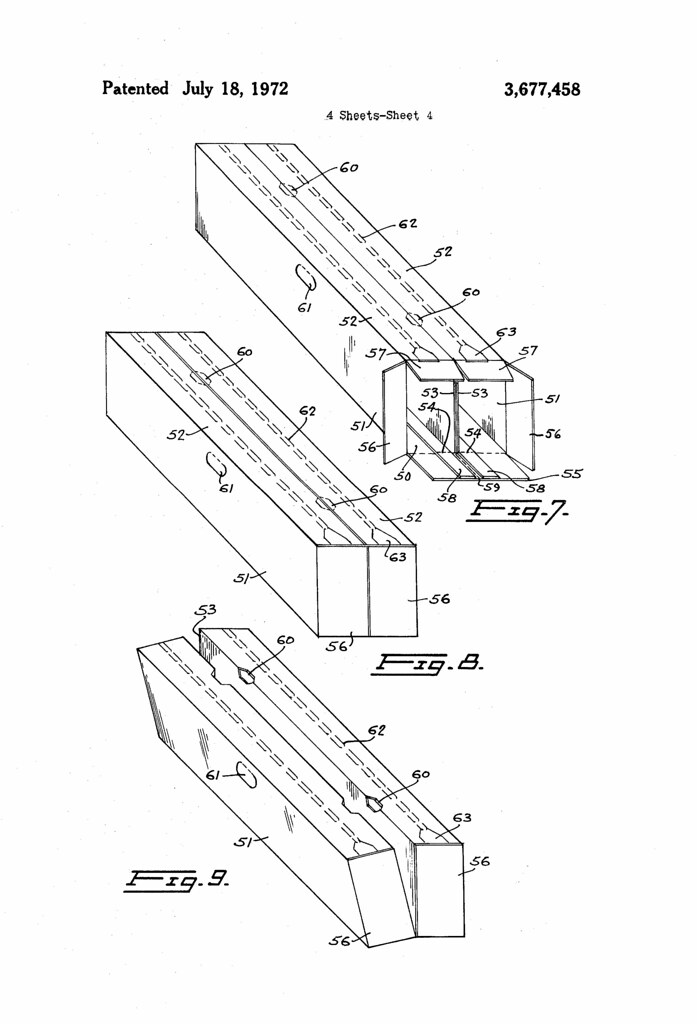
Today in 1972, US Patent 3677458 A was issued, an invention of Dickinson Gosling, assigned to John Labatt Ltd, for his “End Loading Twin Beverage Carton,” which is fancy way of saying a 12-pack carton. Here’s the Abstract:

An end loading, twin carton separable into two cartons, embodying folded handles usable in the twin and also the separated mode. A blank for the carton is also disclosed.

US3677458-1
US3677458-2
US3677458-3
US3677458-4

Filed Under: Beers, Just For Fun, Politics & Law, Related Pleasures Tagged With: Cans, History, Law, Packaging, Patent

Patent No. 795237A: Bung

July 18, 2016 By Jay Brooks

patent-logo
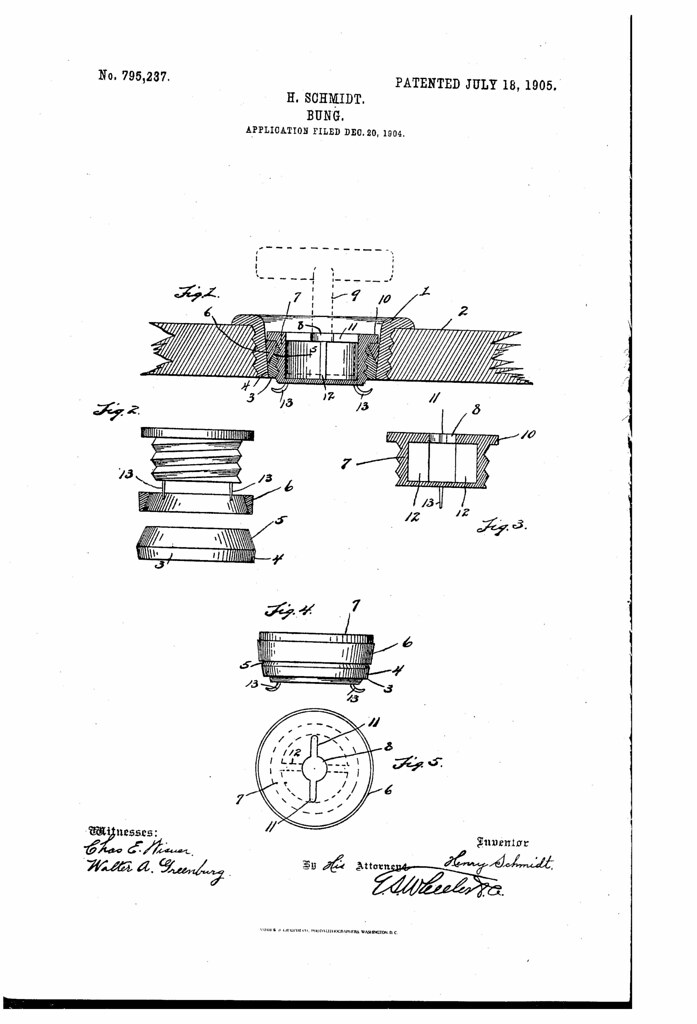
Today in 1905, US Patent 795237 A was issued, an invention of Henry Schmidt, for his “Bung.” There’s no Abstract, although in the description it includes these claims:

This invention relates to new and useful improvements in bungs especially designed for use in connection with beer-kegs, beer-barrels, and similar vessels or packages; and it consists in the construction and arrangement of parts hereinafter fully set forth, and point ed out particularly in the claims.

The object of the invention is to provide simple and efficient means for closing the bung-hole or the aperture through the bung bushing in a manner to prevent the escape of the contents, to protect the rubber or other compressible washer from the deleterious action of the beer or similar liquid, and to enable the bung to be quickly and easily removed and readily replaced, the same bung being adaptable for use many times.

US795237-0

Filed Under: Beers, Just For Fun, Politics & Law, Related Pleasures Tagged With: Barrels, Cask, History, Law, Patent

Beer In Ads #1975: Showing Off The New Kitchen

July 17, 2016 By Jay Brooks


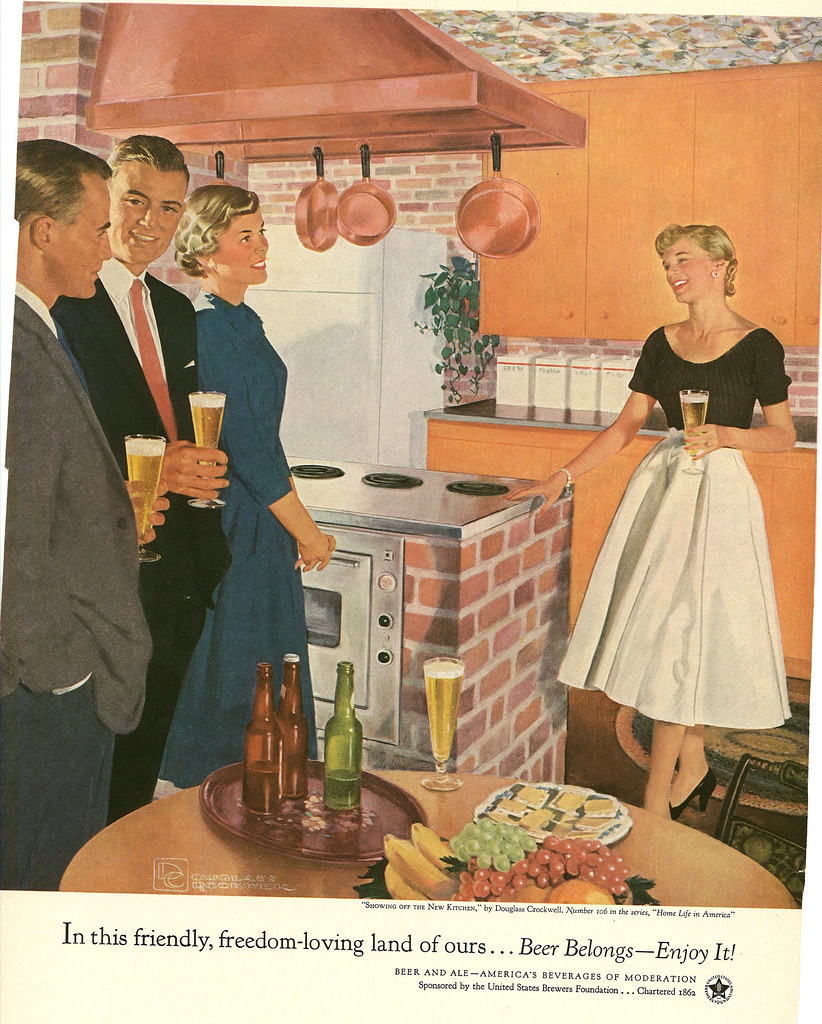
Sunday’s ad is entitled Showing Off the New Kitchen, and the illustration was done in 1955 by Douglass Crockwell. It’s #106 in a series entitled “Home Life in America,” also known as the Beer Belongs series of ads that the United States Brewers Foundation ran from 1945 to 1956. In this ad, they almost look like they could be twin sisters. A woman is showing off her new kitchen to another woman, while their husbands ignore the kitchen, beers in hand, and look as if they’re talking about anything else. It’s weird to see the center island made of brick.

106. Showing Off the New Kitchen by Douglass Crockwell, 1955

Filed Under: Art & Beer, Beers, Just For Fun Tagged With: Advertising, History

Patent No. 3044879A: Anactinic Malt Product And Hop Extract Therefor

July 17, 2016 By Jay Brooks

patent-logo
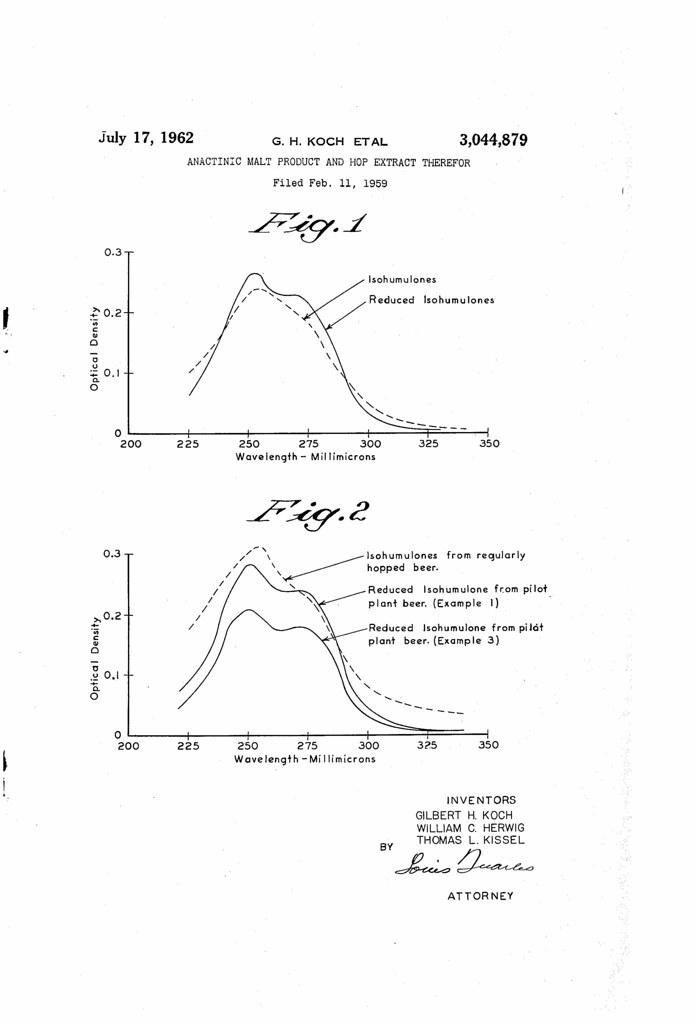
Today in 1962, US Patent 3044879 A was issued, an invention of William C. Herwig, Thomas L. Kissel, and Gilbert H. Koch, assigned to Miller Brewing, for his “Anactinic Malt Product and Hop Extract Therefor.” There’s no Abstract, although in the description it includes these claims:

This invention relates to manufacture of anactinic malt beverages such as beer and ale, and to intermediate products.

It is well known that beer and ale and similar malt beverages are produced from water, barley malt, adjuncts and hops. The malt and adjuncts furnish the carbohydrates and other growth essentials which make up the wort. This wort, boiled with hops, in turn forms the basic substance for fermentation in the fermenting tanks. The hops give the characteristic bitter flavor and pleasant aroma to the beer. They assist in preserving the beer and improve its foam holding capacity.

Unfortunately, beer and ale and other similar malt beverages are not stable to light. Light of both visible and-invisible wave lengths affects them adversely producing actinic damage in the form of a characteristic skunky odor. Such a beer is commonly known as light struck. The actinism is caused by chemical changes, producing compounds probably mercaptans in nature. Tests show that the olfactory threshold level of odoriferous compounds of this character is very low, in the range of a few parts per billion. This shows clearly the acute nature of the problem. 7 Many efforts have been made in the past to overcome this difficulty. Much time has been expended on packaging of beer and ale to exclude light. Colored bottles have been used and opaque packages are common. It is not uncommon to label them Do Not Expose to Light.

To compete with modern day merchandising, a malt beverage has to be removed from the case and put on the shelf, or at least a portion of the container is exposed for easy vision and access. Modern reach-in coolers have clear glass windows and fluorescent lights which aggravate the problems. Even canned beer or keg beer can be adversely affected by sunlight if, as is usually the’ case, it is drunk from a glass. glass to direct sunlight for a short a time as a few minutes will result in the impairment of the taste and production of the characteristic skunky odor. Beer at picnics and sporting events is often exposed for hours to direct sunlight. In such cases, the deleterious effects can be very marked.

q We have discovered a way to overcome the hazard of product exposure to light which forms the basis of our invention, and have thereby achieved a substantially anactinic malt beverage. The term anactinic is intended The exposure of beer in the 3,044,879 Patented July 17, 1962 bitterness in the finished product, but eliminate the photoactive elements thereof.

A still further object of the, present invention is to provide a method of treating hop extract in the presence of a reducing agent to provide a concentrated product having particular application in malt beverages production, whereby its use will not affect the desired characteristics of the beverage, but will eliminate photoactive elements therein.

The soft resins and oils, which are contained in the glands produced on the hops and known as lupulin glands, are valuable constituents of the hops as used ,in the brewing process. The soft resins consist principally of (a) the alpha acids, (b) the beta acids, and (c) the uncharacterized soft resins. The alpha acids are known as humulones and the beta acids are known as lupulones. The alpha acids are the source of antiseptic and bitter substances in beer. The beta acids or lupulones have low solubility in kettle wort and beer, thus do not appreciably enter into the brewing process.

It is known that chemical changes are made in the humulones during brewing resulting in the compounds known :as isohumulones, i.e. isohumulone, isocohumwlone, isoadhurnulone, and isoprehumulone. These isocompounds are formed in the kettle during the boiling stage of the brewing process, and we have discovered that these compounds are the ones that cause the beer to become sensitive to light in the presence of sulfhydryl comhumulone, and prehumulone, is isomerized to the corresponding isohumulones. It is known that during the isomerization of the humulones to isohumulones, a new side chain is formed which now contains a carbonyl group.

It is these isohumulones-isohumulone, isocohumuloue isoadhumulone, and isoprehumulone which we have found to be involved in the photochemical reaction with sulfhydryl compounds to produce the ‘actinic damage resulting in the characteristic light struck aroma.

to succinctly describe a beverage which will not be subject to actinic damage. The word is herein coined and is derived from the word -actinic plus the prefix an, meaning not. This is the Greek equivalent to the Latin in and consists of alpha privative plus nu movable.

We have found that three factors are necessary for the reaction causing malt beverages. to become light struck. They are photo energy in the wave length region of 1,000 to 10,000 angstroms, a sulfhydryl bearing compound, and a chemical component derived from the raw materials, hops, during the brewing process.

The primary object of the invention is to provide a hop extract and malt beverage that is stable to light and will not produce unpleasant olfactory characteristics.

A further object of the invention is to so treat the hops in malt beverages so as to retain the aroma, bouquet and We are of the belief that when the isohumulones are group can be altered by means of reduction to a secondary alcohol, and by such alternation, be prevented from reacting with the sulfhydryl groups normally present in beer components.

US3044879-0

Filed Under: Beers, Just For Fun, Politics & Law, Related Pleasures Tagged With: History, Hops, Law, Patent, Science, Science of Brewing

Ballantine’s Literary Ads: Erle Stanley Gardner

July 17, 2016 By Jay Brooks

ballantine
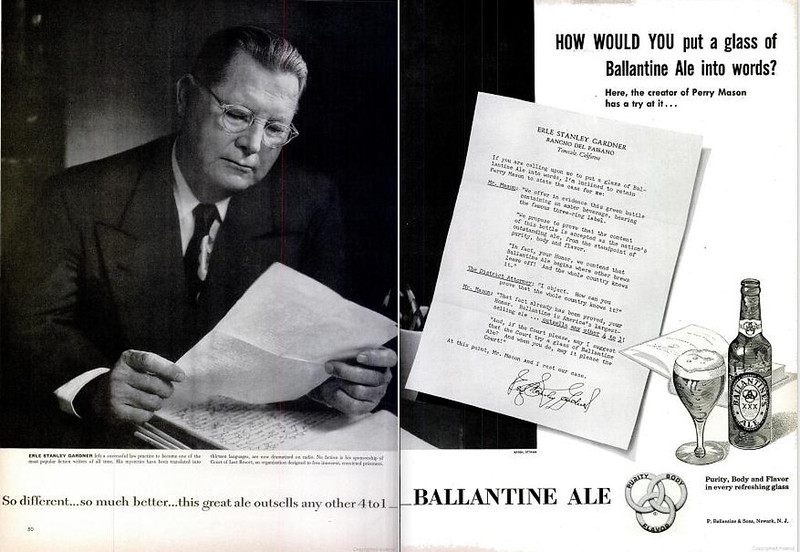
Between 1951 and 1953, P. Ballantine and Sons Brewing Company, or simply Ballentine Beer, created a series of ads with at least thirteen different writers. They asked each one “How would you put a glass of Ballantine Ale into words?” Each author wrote a page that included reference to their beer, and in most cases not subtly. One of them was Erle Stanley Gardner, whose most well-known character was Perry Mason.

Today is the birthday of Erle Stanley Gardner (July 17, 1889–March 11, 1970). He “was an American lawyer and author. Though best known for the Perry Mason series of detective stories, he wrote numerous other novels and shorter pieces, as well as a series of non-fiction books, mostly narrations of his travels through Baja California and other regions in Mexico.” His Ballantine ad ran in 1952.

ballantine-1952-Gardner

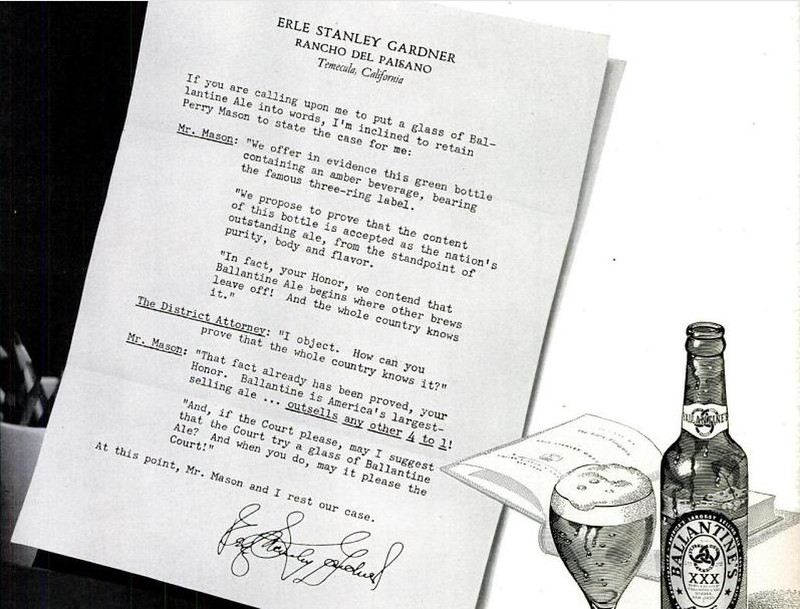
His piece for Ballantine was done in the form of a Perry Mason script, written on his personal stationary from his home in Temecula, California:

If you are calling upon me to put a glass of Ballantine Ale into words, I’m inclined to retain Perry Mason to state the case for me:


Mr. Mason:

“We offer in evidence this green bottle containing an amber beverage, bearing the famous three-ring label.

“We propose to prove that the content of this bottle is accepted as the nation’s outstanding ale, from the standpoint of purity, body and flavor.

“In fact, your Honor, we contend that Ballantine Ale begins where other brews leave off! And the whole country knows it.”

The District Attorney:

“I object. How can you prove that the whole country knows it?”

Mr. Mason:

“That fact already has been proved, your Honor. Ballantine Ale is America’s largest-selling ale … outsells any other 4 to 1!

“And, if the Court please, may I suggest that the Court try a glass of Ballantine Ale? And when you do, may it please the Court!”


At this point, Mr. Mason and I rest our case.

ballantine-1952-Gardner-text

This one is definitely one of the cheesier ones in the series. I’ll feature the rest on their respective authors’ birthdays throughout the year.

Filed Under: Art & Beer, Beers, Just For Fun, Related Pleasures Tagged With: Advertising, History, Literature

« Previous Page
Next Page »

Find Something

Northern California Breweries

Please consider purchasing my latest book, California Breweries North, available from Amazon, or ask for it at your local bookstore.

Recent Comments

  • Bob Paolino on Beer Birthday: Grant Johnston
  • Gambrinus on Historic Beer Birthday: A.J. Houghton
  • Ernie Dewing on Historic Beer Birthday: Charles William Bergner 
  • Steve 'Pudgy' De Rose on Historic Beer Birthday: Jacob Schmidt
  • Jay Brooks on Beer Birthday: Bill Owens

Recent Posts

  • Beer In Ads #5225: Fabled Ambrosia Of The Ancients April 17, 2026
  • Historic Beer Birthday: William O. Poth April 17, 2026
  • Beer In Ads #5224: Harvard Bock Beer April 16, 2026
  • Historic Beer Birthday: William H. Biner April 16, 2026
  • Historic Beer Birthday: Alan Eames April 16, 2026

BBB Archives

Feedback

Head Quarter
This site is hosted and maintained by H25Q.dev. Any questions or comments for the webmaster can be directed here.