Brookston Beer Bulletin

Jay R. Brooks on Beer

  • Home
  • About
  • Editorial
  • Birthdays
  • Art & Beer

Socialize

  • Dribbble
  • Email
  • Facebook
  • Flickr
  • GitHub
  • Instagram
  • LinkedIn
  • Pinterest
  • RSS
  • Twitter
  • YouTube

Powered by Genesis

Patent No. 258664A: Process Of Making Brewers Yeast

May 30, 2016 By Jay Brooks

patent-logo
Today in 1882, US Patent 258664 A was issued, an invention of Friedrich Meyer, for his “Process of Making Brewers Yeast.” There’s no Abstract, though it’s described this way in the application:

This invention has relation to a process for compounding brewers yeast; and it consists in forming from hops, malt, and water under certain degrees of heat a first yeast, which is afterward used in certain proportions in another step or series of steps, wherein malt, water, and hops are again employed and subjected to heat at varying temperatures to form a second yeast, which is again employed with malt, water, and hops, subjected to heat as before and tested by a saccharometer, to form a third or stock yeast, which will last from four to six months, and from which, together with malt, hops, and water, a present use yeast, which will last about one month, may be formed by compounding therewith malt, hops, and water at certain temperatures, all of which will be hereinafter fully pointed out in the body of the specification and claim.

In carrying out this process I take the proportions of about one-half ounce of hops to one-half gallon of boiling water, throw the hops into the yeast-can, and add the boiling water, and stir this mixture until the heat recedes to 190 Fahrenheit. I then add three quarts of cracked barley-malt and mash it well, after which 1 add one quart of boiling water and stir the mixture until the heat recedes to 160 Fahrenheit, when I cover the can and let the contents stand for five minutes. I then increase the heat by adding as little boiling water as possible until 176 Fahrenheit has been reached, when I again cover the can and let it stand for one hour, then cool the contents of the can by stirring them until the heat has receded to 90 Fahrenheit. I then put the liquid thus formed into a stone jar and place the jar into warm water at a temperature of about 80 or 90 Fahrenheit, and keep the heat of the Water up to that point by using boiling water until the liquid has ceased to ferment, which will be from thirty-six to forty-eight hours. As this yeast will last only from six to eight hours, the preparations for the formation of the second yeast should be completed at this time.

To make the second yeast, I take one gallon (dry measure) of cracked barley-malt and put it in the yeast can, and pour one-half gallon of boiling water thereon, and mash well together. This should be permitted to stand ten minutes, and then raised to a temperature of 176 Fahrenheit by adding boiling water to the amount of about three gallons. It should be then covered and permitted to stand for about one hour, after which it should be strained through a brass sieve into a clean tin can and placed 011 the stove, where it should boil for one hour and be skimmed during the operation of boiling. If one hours boiling should prove to be insufficient, it may be boiled a little longer. It, should register, when properly boiled, about 20 saccharometer, and the test should be made at 90 Fahrenheit. About two ounces of hops should then be added by stirring them in until the hops are thoroughly wetted, and the cover should be again replaced and the contents of the can boiled from three to five minutes longer. Remove the can from the stove and let it stand fifteen minutes, and then strain the contents of the can through a brass sieve into a stone jar, and cool it to about 94 Fahrenheit by setting the stone jar into cold water in the winter season. In summer it should be reduced to 90 Fahrenheit, as the natural temperature at this season will cause the temperature of the liquid to rise in a short time. Then add to the liquid thus produced one pint of the first yeast to each gallon of the liquid. Then wrap the jar in cloth, and set it away in a place where the temperature may be maintained at from to Fahrenheit until it is done fermenting, which’ will be about thirty-six hours. Then be ready to proceed to the formation of the third yeast, as this, which is termed the second yeast, will not keep longer than from ten to twelve hours.

To form the third yeast, I place four gallons of boiling water in the yeast-can and permit the heat to recede to 180 or 176 Fahrenheit. I then add about sixteen pounds of cracked barley-malt and mash well. The can is then rinsed down with about one-half gallon of boiling water and stirred until the temperature is about 150, and then left to stand about ten minutes. Boiling water should then be added and the contents of the can stirred until the heat reaches 176 Fahrenheit, after which it should be covered and left to stand for one hour, and should then be strained through a brass sieve. Then take this liquid and place it in a clean tin can and set it on the stove and boil it from three to five hours, skimming it during the operation of boiling, until it be comes of a consistency of 38 saccharometer under a test at 90 Fahrenheit. Then put in one-half pound of hops and stir until the hops are thoroughly wetted, and then boil from three to five minutes longer. Remove the can from the stove, stir the contents, cover the can, and let it stand covered for about fifteen minutes, during which time it should be stirred occasionally, and then strained through a brass sieve into a clean yeast-can, and reduce its temperature to 91 Fahrenheit by placing the yeast-can into cold water. Then add one quart of the second yeast above described and stir well. The temperature during this stirring should be maintained at about 00 Fahrenheit. Then wrap the can in cloth and place it in a place where the temperature may be maintained at between and Fahrenheit until fermentation ceases, which will be about forty-eight hours. This yeast, called the third yeast, will then be lit for use. This third or stock yeast will keep from four to six months, and should always be thoroughly shaken before using. This stock yeast is intended for shipment for use in making a fourth or pre-cut use yeast, which, when made as herein after described, will keep about one month.

To make the fourth or present-use yeast, I take fifteen quarts of boiling water and place it in the tin yeast-can and let it reach a temperature of 170 Fahrenheit, and then place in it about sixteen pounds of cracked barley malt, mash well, and rinse down with about one quart of boiling water and stir until the temperature is about 150 Fahrenheit, then cover the can and let it stand about ten minutes. I then add boiling water until the temperature reaches 176 Fahrenheit, which requires about sixteen quarts of boiling water. I then let it stand on the stone and boiled for about three hours to thicken it, care being taken to skim the contents during the operation of boiling. The proper consistency should be about 30 saccharometer under a test at 90 Fahrenheit. When at this consistency about six ounces of hops should be thoroughly stirred in, and the contents should be boiled from three to five minutes longer. The can should then be removed from the stove and left to stand for about fifteen minutes, during which time it should be stirred occasionally. It should then be strained through a brass sieve into a yeast-can, which should be placed in cool water, stirred, and reduced to a temperature of 90 Fahrenheit. One quart of the third or stock yeast should then be added by stirring it in under a temperature of 90 Fahrenheit, and the can wrapped up and placed in a position where a temperature of from 60 to 70 Fahrenheit can be maintained until fermentation ceases, which will be about forty-eight hours, after which it will be fit for use.

The superiority of this stock yeast over the yeast now employed lies in this, that it may be kept in stock for a period of six months, and from it a present-use yeast may be made that will last for a period of about one month, while the yeasts now employed will keep but a few hours at the furthest.
Beer_brewing_bubbles

Filed Under: Beers, Breweries, Just For Fun, Politics & Law, Related Pleasures Tagged With: History, Law, Patent, Science of Brewing, Yeast

Patent No. 498657A: Beer Tap

May 30, 2016 By Jay Brooks

patent-logo
Today in 1893, US Patent 498657 A was issued, an invention of Harvey P. Jacoby, for his “Beer Tap.” There’s no Abstract, though it’s described this way in the application:

This invention relates to taps or fittings which are inserted in the heads of beer kegs to receive the faucets through which the beer is drawn. A beer tap usually comprises a tubular shank, which is driven into the head of the keg, and a socket in the outer portion of the shank for the reception of the ordinary faucet. The tap is provided with some means for preventing the escape of the beer before the faucet is inserted, the common means being a cork or plug driven into the tap and adapted to be forced inwardly into the barrel, to permit the beer to flow into the faucet when the latter is inserted. In some instances the tap has been provided with a valve at the inner end of the faucet socket, said valve being arranged to yield to the faucet when the latter is inserted, the valve being held closed until the insertion of the faucet.

US498657-0.png

Filed Under: Beers, Just For Fun, Politics & Law, Related Pleasures Tagged With: History, Kegs, Law, Patent

Beer In Ads #1926: Treasures From The Auction

May 29, 2016 By Jay Brooks


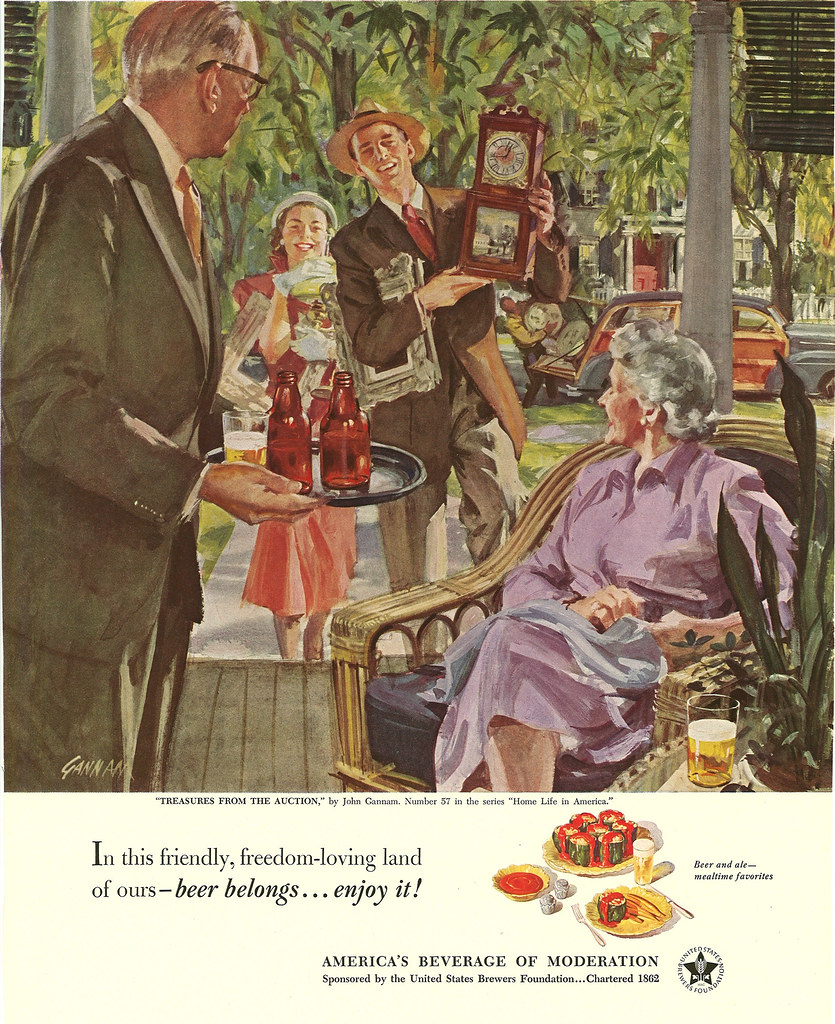
Sunday’s ad is entitled Treasures From the Auction, and the illustration was done in 1951 by John Gannam. It’s #57 in a series entitled “Home Life in America,” also known as the Beer Belongs series of ads that the United States Brewers Foundation ran from 1945 to 1956. In this ad, a couple shows up at one of their parents’ homes laden down with crap they apparently just acquired at an auction. And while there hands are full, that’s not the half of it. On the street behind them, another person is unloading even more, and larger, crap from a station wagon. Mom and Dad will be thrilled.

057. Treasures From the Auction by John Gannam, 1951

Filed Under: Art & Beer, Beers, Just For Fun Tagged With: Advertising, History

Patent No. EP19840307773: Valved Closure For Kegs Or Casks

May 29, 2016 By Jay Brooks

patent-logo
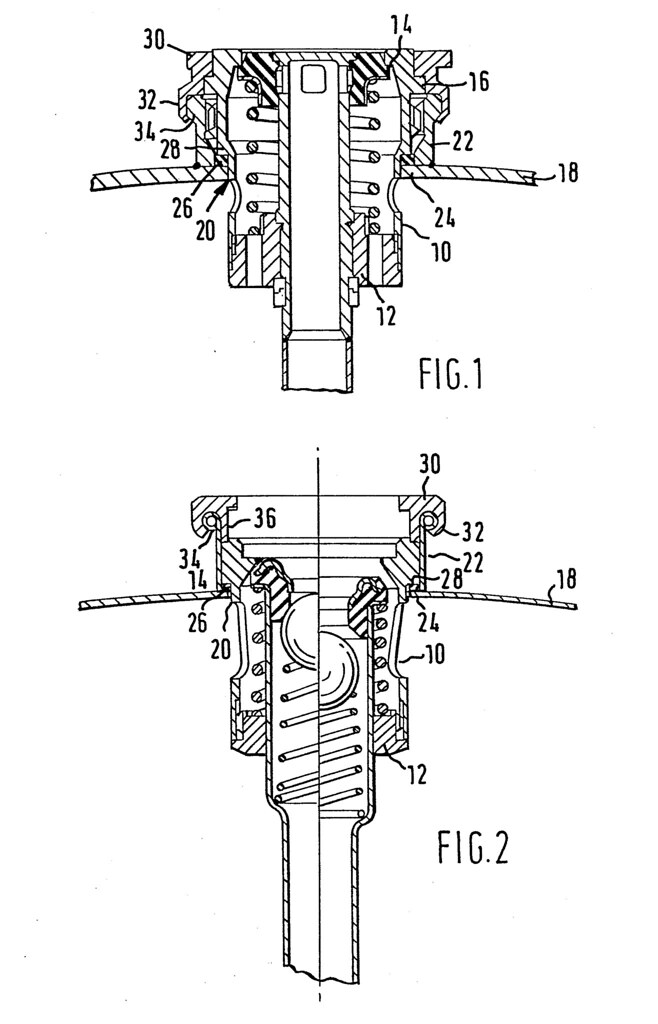
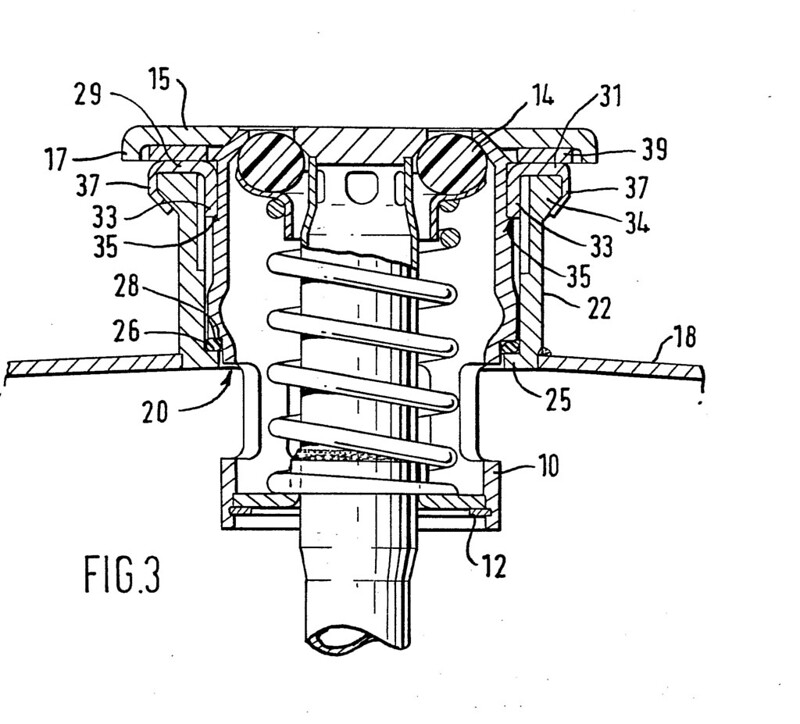
Today in 1985, US Patent EP 19840307773 was issued, an invention of Roger John Hyde, for his “Valved Closure for Kegs or Casks.” Here’s the Abstract:

A valved closure for a pressure vessel, such as a cask or keg (18). having a neck (22), for rigid attachment as a mounting ring to the mouth (24) of a tap hole (2) in the vessel and a valve-containing tubular body (10) inserted co-axially in the neck: has a rigid ring (30) engaging the tubular body and the keg neck, the ring being of malleable metal and having an inner periphery (33) shaped to engage the tubular body and a relatively thin outer peripheral skirt (32) shaped to be deformed, by a power tool, into fitting engagement about the neck rim (34), to provide securing means for preventing unauthorised axial removal of the valved closure, the so formed securing collar being accessible by a tool to cut the collar off the neck to release the valved closure: the securing collar may be split into two or more parts (29 and 31) to enable it to be fitted about a large diameter flange (15) at the top of the tubular body.

19840307773-imgf0001
19840307773-imgf0002

Filed Under: Beers, Just For Fun, Politics & Law, Related Pleasures Tagged With: History, Kegs, Law, Patent

Beer In Ads #1925: Welcoming The New Neighbors

May 28, 2016 By Jay Brooks


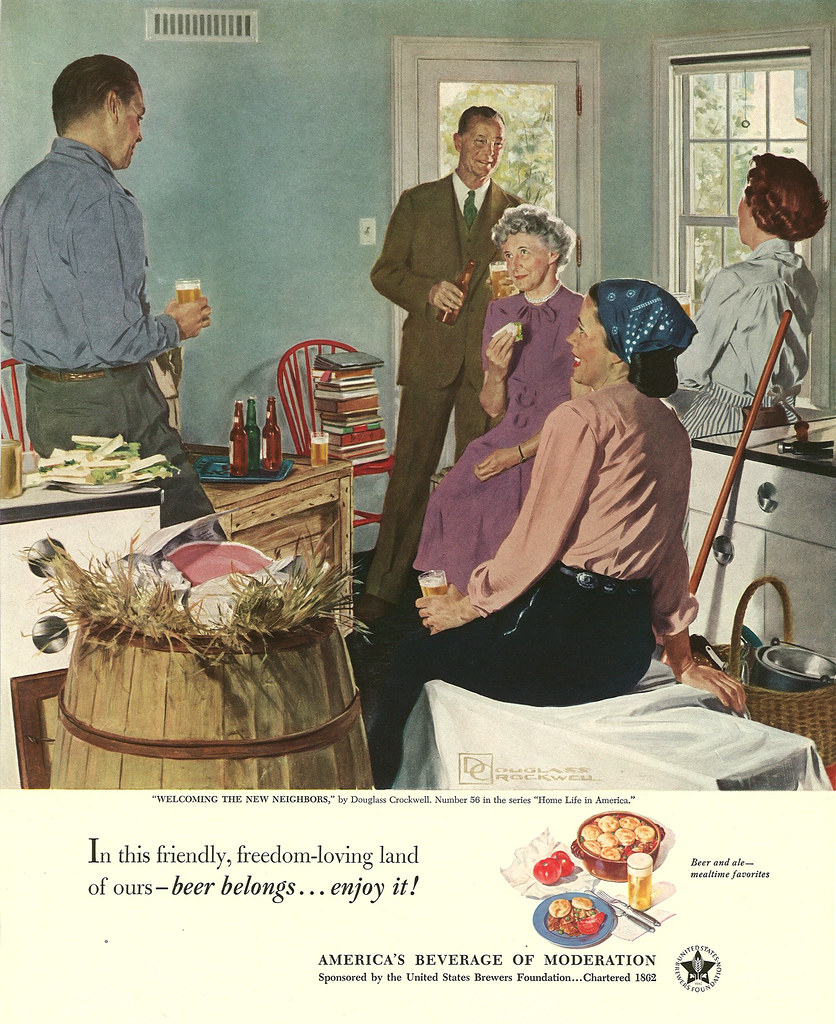
Saturday’s ad is entitled Welcoming the New Neighbors, and the illustration was done in 1951 by Douglass Crockwell. It’s #56 in a series entitled “Home Life in America,” also known as the Beer Belongs series of ads that the United States Brewers Foundation ran from 1945 to 1956. In this ad, a couple is moving to a new home, and thoughtfully the neighbors have stopped by to welcome them, and possibly are the one that brought the sandwiches and the beer. If so, that sounds like a pretty good neighborhood.

056. Welcoming the New Neighbors by Douglass Crockwell, 1951

Filed Under: Art & Beer, Beers, Just For Fun Tagged With: Advertising, History

Patent No. 3812996A: Bottle Carrying Case

May 28, 2016 By Jay Brooks

patent-logo
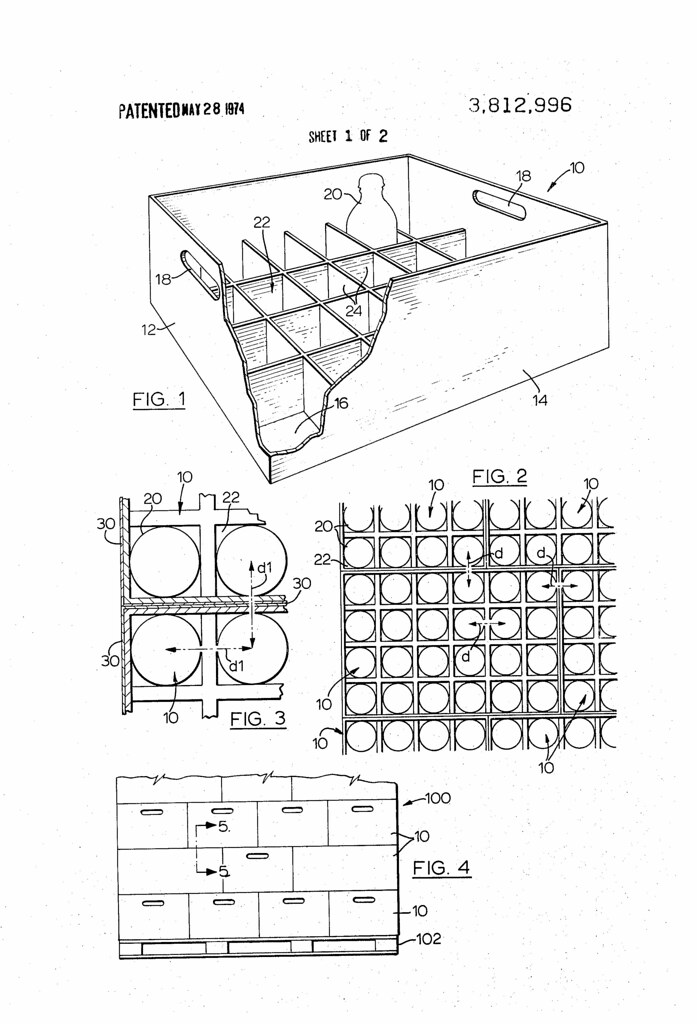
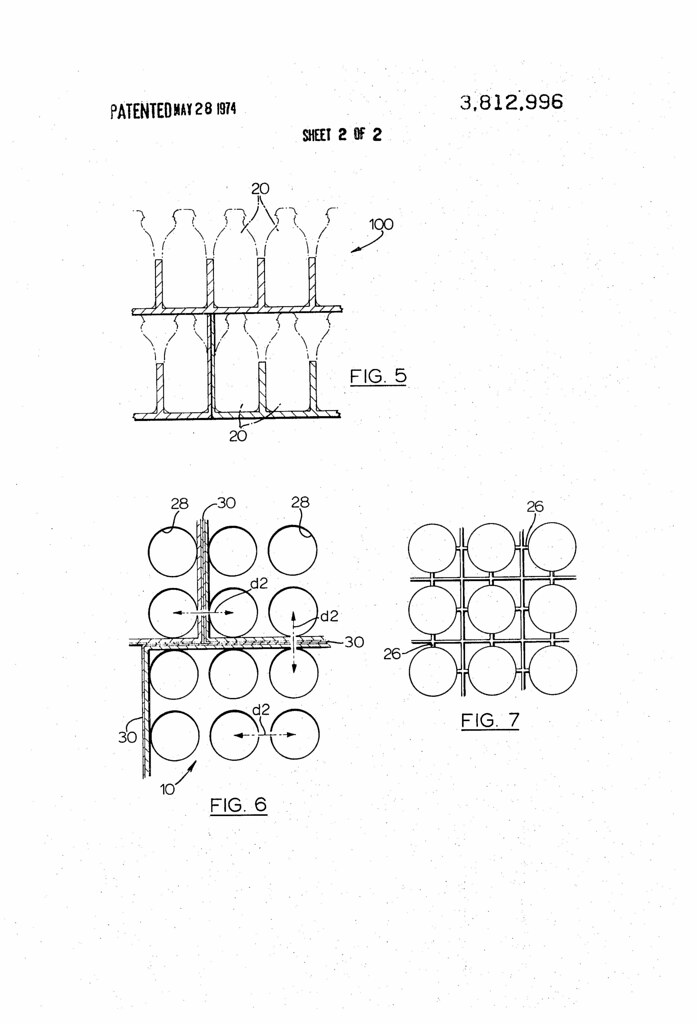
Today in 1974, US Patent 3812996 A was issued, an invention of Arthur Bunnell, assigned to Carling O’Keefe Ltd., for his “Bottle Carrying Case.” Here’s the Abstract:

Plastic carrying cases for bottles, especially beer bottles, are provided of a structure, in which, when the cases are stacked with bottles therein the tops of the bottles in one case engage the underside of the next upper case so that the load of the stack is supported through the bottles.

US3812996-1
US3812996-2

Filed Under: Beers, Just For Fun, Politics & Law, Related Pleasures Tagged With: Bottles, History, Law, Packaging, Patent

Beer In Ads #1924: St. Louis — “Barbecue On The Terrace”

May 27, 2016 By Jay Brooks


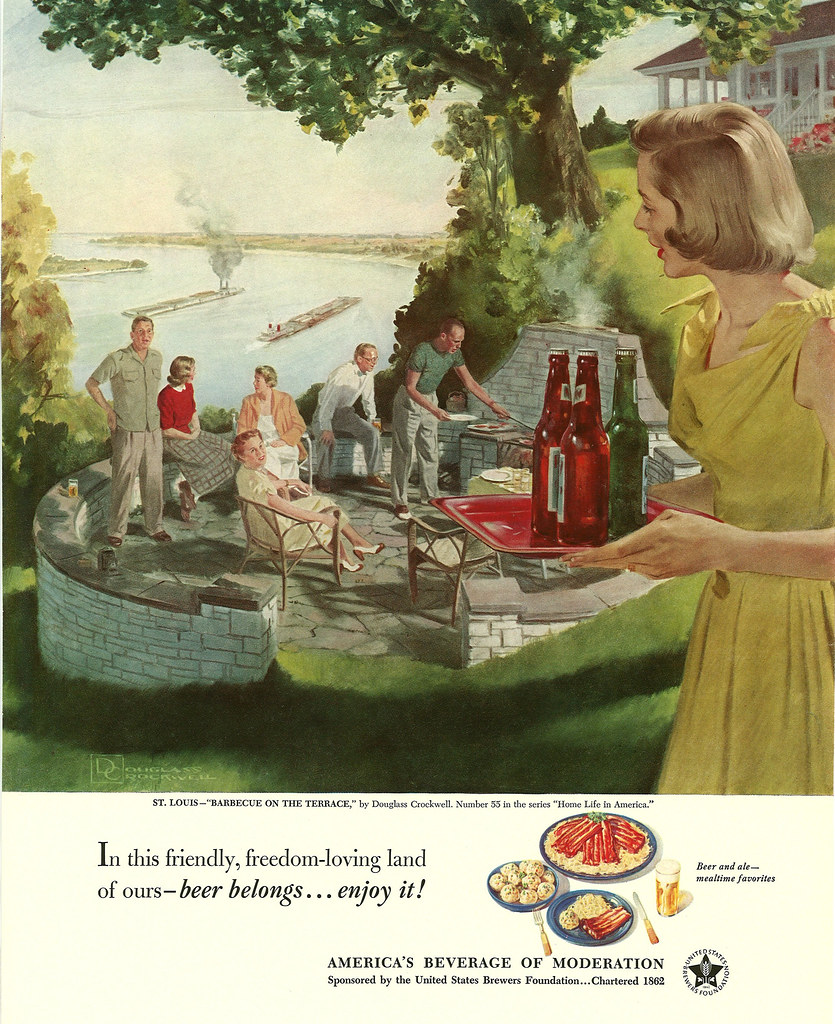
Friday’s ad is entitled Picnic at the New Homesite, and the illustration was done in 1951 by Douglass Crockwell. It’s #55 in a series entitled “Home Life in America,” also known as the Beer Belongs series of ads that the United States Brewers Foundation ran from 1945 to 1956. In this ad, an obviously well-to-do family has some choice real estate along the Mississippi River in St. Louis, with a tricked out stone barbecue terrace overlooking a bend in the river. Dad’s making burgers and Mom’s bringing more beer down from the house. Ah, the good old days.

055. St. Louis — "Barbecue on the Terrace" by Douglass Crockwell, 1951

Filed Under: Art & Beer, Beers, Just For Fun Tagged With: Advertising, History

Patent No. 700833A: Manufacture Of Fermented Liquors

May 27, 2016 By Jay Brooks

patent-logo
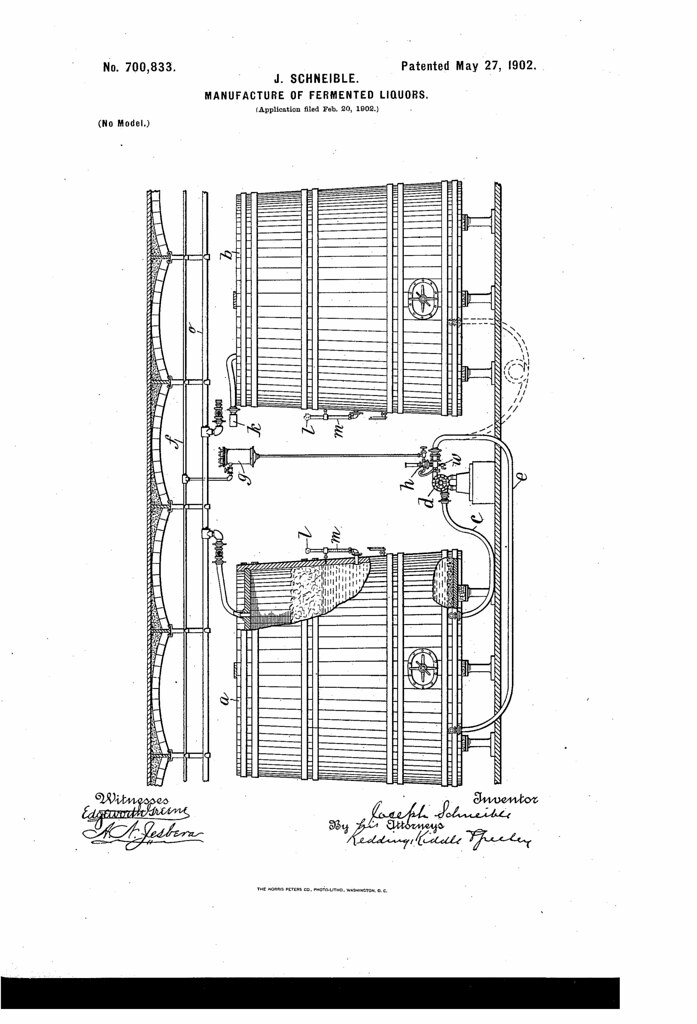
Today in 1902, US Patent 700833 A was issued, an invention of Joseph Schneible, for his “Manufacture of Fermented Liquors.” There’s no Abstract, though it’s described this way in the application:

This invention relates particularly to the carrying on of the fermentation of liquors such as malt beverages, for example and to the culture, propagation, and separation of yeast for further use As the fermentation of such liquors is now commonly practiced the yeast propagated for further use is separated and collected under conditions which are liable to result in contamination of the yeast by contact with air,usually teeming with wild ferments and very often with fungi, and in subsequent injury to the finished product.

It is the object of this invention to provide for the carrying on of the fermentation and the separation of the yeast in such a manner as to avoid exposure of either yeast or liquor to such contaminating and injurious influences, while at the same time the fermentation is carried on under practically normal conditions as to pressure.-

In accordance with this invention the newly-fermented liquor containing the yeast in suspension for further inoculation is transferred from the vessel in which the fermentation was carried on to a clean vessel, in which the separation of the yeast intended for further work from the liquor takes place and from which the liquor is withdrawn, thereby leaving the yeast in the clean vessel. The further quantity of liquor to be fermented is then introduced into the vessel containing the yeast and is inoculated thereby,thus avoiding altogether the removal of the yeast from the vessel in which the same has been allowed to separate from the fermented liquor and avoiding its exposure to the contaminating influences above referred to. This process is carried on successively in the manner referred to, the newly-fermented liquor being transferred from the vessel in which the inoculation has taken place and the main fermentation was carried on to a clean vessel, as before.

US700833-0

Filed Under: Beers, Breweries, Just For Fun, Politics & Law, Related Pleasures Tagged With: Brewing Equipment, History, Law, Patent, Science of Brewing

Patent No. 1760071A: Centrifugal Separator

May 27, 2016 By Jay Brooks

patent-logo
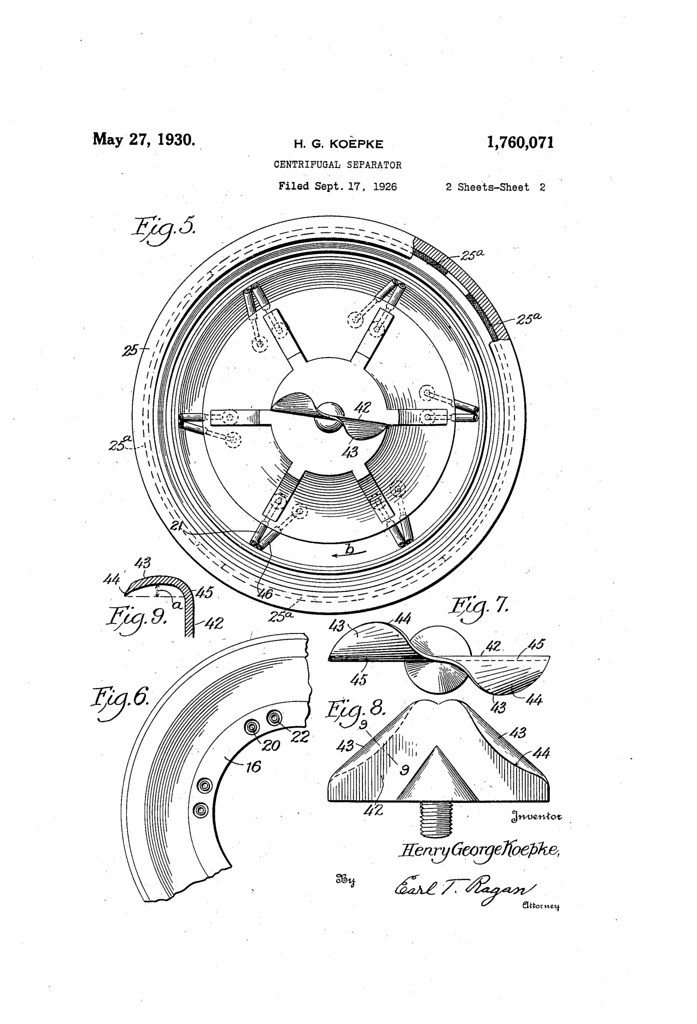
Today in 1930, US Patent 1760071 A was issued, an invention of Henry George Koepke, for his “Centrifugal Separator.” There’s no Abstract, though it’s described this way in the application:

My invention relates to centrifugal separators of the discharge nozzle conical type, primarily constructed for the separation of yeast from most of the associated liquids in which it has been’ propagated.

US1760071-0
US1760071-1

Filed Under: Beers, Breweries, Just For Fun, Politics & Law, Related Pleasures Tagged With: Brewing Equipment, History, Law, Patent, Science of Brewing

Beer In Ads #1923: Picnic At The New Homesite

May 26, 2016 By Jay Brooks


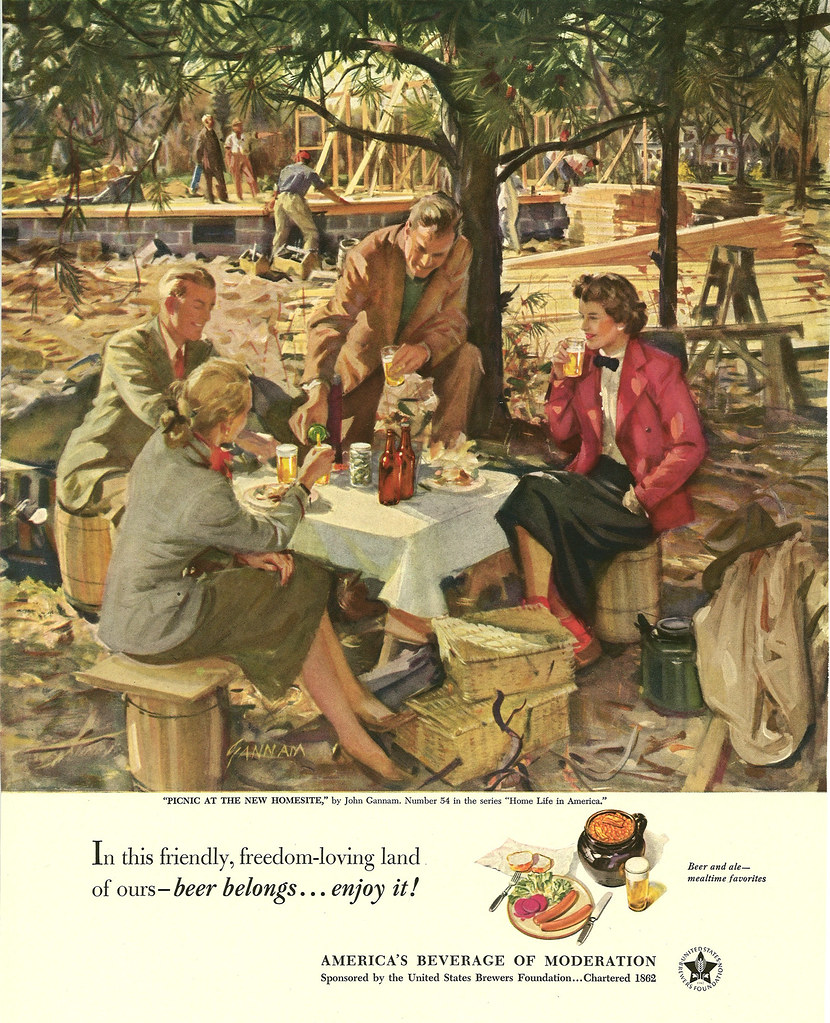
Thursday’s ad is entitled Picnic at the New Homesite, and the illustration was done in 1951 by John Gannam. It’s #54 in a series entitled “Home Life in America,” also known as the Beer Belongs series of ads that the United States Brewers Foundation ran from 1945 to 1956. In this ad, two couples are having a picnic in an unlikely spot. At a construction site, where presumably one of their homes is being built, they’re having beer and food while other people are working. It’s the weirdest spectator sport ever.

054. Picnic at the New Homesite by John Gannam, 1951

Filed Under: Art & Beer, Beers, Just For Fun Tagged With: Advertising, History

« Previous Page
Next Page »

Find Something

Northern California Breweries

Please consider purchasing my latest book, California Breweries North, available from Amazon, or ask for it at your local bookstore.

Recent Comments

  • Bob Paolino on Beer Birthday: Grant Johnston
  • Gambrinus on Historic Beer Birthday: A.J. Houghton
  • Ernie Dewing on Historic Beer Birthday: Charles William Bergner 
  • Steve 'Pudgy' De Rose on Historic Beer Birthday: Jacob Schmidt
  • Jay Brooks on Beer Birthday: Bill Owens

Recent Posts

  • Beer In Ads #5259: Be Hospitable During The Smeltania June 4, 2026
  • Historic Beer Birthday: Frank Leonard Eppig June 4, 2026
  • Historic Beer Birthday: August Schmid June 4, 2026
  • Historic Beer Birthday: David & Louis Kuntz June 4, 2026
  • Beer In Ads #5258: Enjoy Delicious Bock Beer June 3, 2026

BBB Archives

Feedback

Head Quarter
This site is hosted and maintained by H25Q.dev. Any questions or comments for the webmaster can be directed here.