![]()
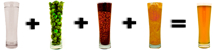
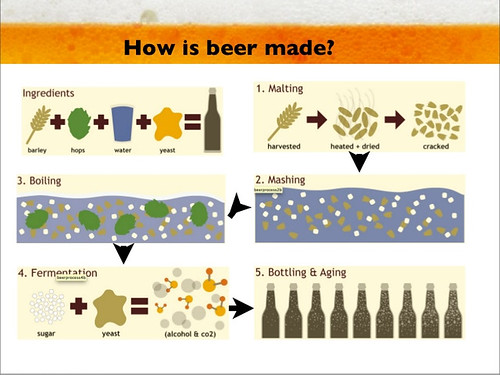
Today’s infographic is slick animated graphic showing the brewing process. It’s a pretty cool graphic. There’s different panels for brewing, basic types of beer, production by European countries, and some beer history. The only thing that would make it cooler would be if I could read Czech. But click on the image below to see it in all its glory.
Beer In Ads #995: Night Grilling
GABF 1982 Vs. 2011

Today’s infographic, on the first day of this year’s Great American Beer Festival, is a comparison of statistics from GABF in 1982 vs. 2011, two years ago on the festival’s 30th anniversary. It was created by Joey McDaniel, one-half of the Bay Area blog Wet Your Whistles.

Beer In Ads #994: Feeding The Squirrels
It’s October: Time To Make The Beer Community Feel Guilty
![]()
Ah, it’s October again, Breast Cancer Awareness Month, and right on cue, it’s time to be insulted once more by the anti-alcohol bunch that can’t let any good deed go unpunished. This time around it’s Alcohol Justice — boy, have they been busy lately — who’s telling us how hypocritical we are for wanting to do anything to support the quest to find a cure for breast cancer. Alcohol Justice calls any such efforts a “mockery of public health, breast cancer advocacy, and alcohol policy,” and most importantly, a “mockery of breast cancer survivors and their loved ones.” Well, given that I lost my own mother to breast cancer and I love the fact that so many breweries, many of whom are my friends, take the time and effort to raise money for that cause, I have only two words for Alcohol Justice: “fuck you.”
You don’t get to decide how people spend their money, where they make their charitable donations or how. In the example highlighted in “If It Makes You Wealthy: Sheryl Crow & Treasury Wine Estates Sell Out Women’s Health,” the promotion they’re objecting to is a large wine conglomerate raising money for breast cancer research with Sheryl Crow’s support and participation, something that was announced this past July. Crow herself is a breast cancer survivor so they’re really thumbing their nose at her, too. If a cancer survivor chooses to try and do some good to raise money for a cause she feels personally invested in, it’s pretty shameless of you to try to grab headlines by calling her names and publicly telling her not to support that cause unless she does it the way they think it should be done.
They also take issue with Crow because the promotion is promising to “donate up to $100,000 to breast cancer charities,” an amount that Alcohol Justice derisively has decided is not nearly enough. I guess their first choice would be for her not to raise any money for breast cancer, but if she does, it had better be a large enough amount to satisfy them. They’re taking this page out of the playbook of Breast Cancer Action, who a few years ago declared that everyone of us in the alcohol industry trying to do good, and raise money for breast cancer, should be “ashamed of ourselves.” I wrote about that when they went on television and insulted us, in Biting the Hand That Feeds You.
In the paragraph before Alcohol Justice calls me, and the rest of us in the alcohol industry who care about breast cancer, a mockery, they claim that “[p]romoting alcohol as a healthy product is a harmful public relations tactic,” and suggest that the problem is “cancer advocate Crow is applying her considerable celebrity capital to increase sales of a product that contributes to the incidence of breast cancer in women.” The study they cite is from 2011, Moderate alcohol consumption during adult life, drinking patterns, and breast cancer risk, which did indeed conclude that “[l]ow levels of alcohol consumption were associated with a small increase in breast cancer risk,” which other studies have also shown, but that’s not the entire story, of course. One thing these incidents tend to have in common is relying on just one particular study as the foundation for why we in the alcohol industry should be feeling guilty for trying to help raise awareness or money for breast cancer. But what about the bigger picture? Here’s what I wrote about this three years ago.
[A]t least one [study] done by Kaiser Permanente shows that it’s the amount that matters, the higher the intake the greater the risk, meaning moderate drinking has less risk.
Still others show just the opposite. For example, a 2008 study at the Universidade do Porto, Porto, Portugal showed that Compounds in Beer and Wine Slow Breast Cancer Cell Growth. Still another suggests that “xanthohumol found in hops [has] the potential to lower the risk of prostate cancer, [and] researchers believe it could also reduce breast cancer risk in a similar manner — by binding to the receptors on breast cancer cells and blocking the effects of estrogen which stimulates the growth of certain types of breast cancer.” That’s about the discovery that xanthohumol, a Cancer-fighting agent found in beer.
In a fact sheet about the relationship between Alcohol and the Risk of Breast Cancer at Cornell University, there’s this sage advice:
Researchers have reported that women who consume light to moderate amounts of alcohol have a decreased risk of developing and dying from cardiovascular disease. Since more women are affected by and may die from cardiovascular diseases than breast cancer, the recommendations regarding alcohol and breast cancer may seem to contradict the reports regarding cardiovascular disease. The 1996 Guidelines on Diet, Nutrition and Cancer Prevention from the American Cancer Society suggest that most adults can drink, but they should limit their intake. Given the complex relationship between alcohol consumption and different diseases, any recommendations should be based on information about all health risks and benefits.
Exactly. Of course women should make individual decisions based upon their family history and/or other personal factors, but making a pronouncement for everyone is wrong. The overall positive effects of moderate alcohol consumption have to be weighed against individual risk factors. For example, total mortality is effected positively by moderate alcohol consumption, that is numerous studies and meta-studies have shown that people who drink in moderation will most likely live longer than people who abstain completely or who regularly binge drink. And that’s taking into account both the negative and positive risks and rewards.
So once again Alcohol Justice is bending the truth for their own purposes, and making the world black and white, in which it’s their way or the highway. They know best. You don’t have to worry about thinking for yourself, not when they can do the thinking for you. I love that they refer to the wine company as “posing as a health advocate,” as if anyone is “anti-health.” As if the people, and yes those of us in the alcohol industry are indeed people, even if Alcohol Justice paints us as less than human, wanted people to get breast cancer. Even if it were true that everyone who drank alcohol would get cancer (it’s not) why would anyone object to us donating money to finding a cure for it or helping to build awareness? So many people’s lives have been touched by cancer generally, and breast cancer in specific, but the way Alcohol Justice frames it, none of us should have anything to do with alcohol, or we’re mocking our loved ones. How many other professions or industries would they want to ban people from engaging in if they might result a potential danger. Should people who work for gun companies be ashamed of themselves because others may use a gun in a crime or to murder someone? Should fast food workers feel guilty because the people who buy their food might be eating the wrong kinds of food, leading to health problems, obesity and disease, and might place a burden on the healthcare system. Do you know what the ultimate cause of death is? Living. As R.D. Laing quipped. “Life is a sexually transmitted disease and the mortality rate is one hundred percent.” We all make choices about how we use the time that’s afforded each of us. And Alcohol Justice can jump down off their high horse and stop telling the rest of how to live our lives. That would certainly improve the time I have left on this world, so I can get back to enjoying myself with a good beer.
The Magnificent Multitude of Beer
![]()
Today’s infographic is the latest from Pop Chart Lab, this time it’s The Magnificent Multitude of Beer. The poster features “ales and lagers into over 100 delicious styles from hoppy IPAs to fruity lambics, and including over 500 individual beers as notable examples of each style as well as glassware recommendations. The Magnificent Multitude of Beer captures the proud work of hundreds of breweries around the world, clocks in at a staggering 60 inches by 40 inches, and is the perfect finishing touch for your man cave or lady lair.” You can buy the poster for $90 at Pop Chart Lab.

Click here to see the poster full size.
Beer In Ads #993: Early Morning Duck Hunting
How Much Does The Government Make From Alcohol?

Today’s infographic shows How Much Does The Government Make From Alcohol? It was created by Inuit, the makers of Turbo Tax. It “illustrates how much money individuals are being taxed to consume alcohol, and subsequently how much the Federal and State governments are generating in tax revenue. There is also a breakdown of how different types of alcohols are taxed in the various states, as well as international comparisons — to put thing in perspective.”

Click here to see the infographic full size.
Beer In Ads #992: Pick Another Pair
The Idea Of Alcohol As A “Sin”

Ah, language. It’s often so important how issues are framed and the words used to promote agendas and positions. One of the basic anti-alcohol tactics is in the very idea of taxes on alcohol, and other so-called “vices.” The very notion of them is that they’re acceptable precisely because they’re “sin taxes.” That doing those things, despite being legal for adults, is a “sin.” You’d think in the 21st century such out-dated, parochial ideas would no longer exist. Apparently you’d be wrong.
Today, Alcohol Justice tweeted the news that “Big Alcohol lobbyists kill state tax increases by re-framing issue from sin to hospitality.” The tweet links to a Pew Charities blog post entitled Liquor Lobby Fights Off Tax Increases On Alcohol.
In the Stateline article, reporter Elaine S. Povich frames the story that alcohol’s a sin, saying. “Another ‘sin’ tax — on alcohol — has largely escaped change in recent years thanks to a strong liquor lobby which reframed the liquor tariff conversation from ‘sin’ to ‘hospitality.'” One might think that author Elaine S. Povich, who in addition to years as a reporter is also “an adjunct professor of journalism at Maryland,” would know better than to refer to drinking as a “sin,” but I guess old habits die hard, and such is the nature of successful propaganda that many people continue to believe that drinking is a sin.

A “sin,” in case you missed that day in Sunday school, or might not be terribly religious, is defined as the “act of violating God’s will.” That’s from Wikipedia, which makes it clear that it’s a religious construct, although not every religion sees sin the same way, and a few don’t even recognize it. Plenty of other sources make the connection to religion obvious. Merriam-Webster defines as “an offense against religious or moral law,” while Dictionary.com defines it as a “transgression of divine law.” But regardless of your own faith, in the United States, the right to free worship is one of our most cherished tenets. It’s right in the First Amendment, arguably the most important one, where it states “Congress shall make no law respecting an establishment of religion, or prohibiting the free exercise thereof.”
But even beyond that, our government recognizes the ‘Separation of church and state,’ “a phrase used by Thomas Jefferson and others expressing an understanding of the intent and function of the Establishment Clause and Free Exercise Clause of the First Amendment to the Constitution of the United States. The phrase, and its underlying meaning, has since been repeatedly confirmed by the Supreme Court of the United States.” Essentially, it means we live in a secular, non-denominational society in which one religion should not dictate its views to the rest of us. My own faith is irrelevant here, what’s important is that as long as not everyone thinks drinking is a “sin,” and as long as it is permitted by law, then it cannot be considered a sin. Not in our society, at least. If you believe it’s a sin, feel free to abstain. But you can’t tax it for that same belief, especially when I don’t share that belief, nor do many millions of other people. The fact that she even can write that seems remarkable in this day and age.
I’m far less surprised to see Alcohol Justice gleefully refer to alcohol taxes as “sin taxes,” that fits with their anachronistic platform. For them, it is still Salem in 1693, and they’re on a witch hunt to eradicate the “sin” of drinking alcohol. That it’s not, and can’t be, a sin doesn’t even enter into the conversation.