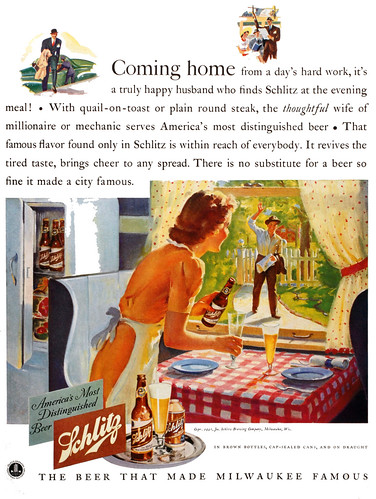
Tuesday’s ad is a 1958 ad for Rheingold Beer, featuring Miss Rheingold for that year, Madelyn Darrow. In the ad, Miss Darrow is apparently trying to figure out how many hats she can fit into a three-wheeled precursor to the smart car.

Tuesday’s ad is a 1958 ad for Rheingold Beer, featuring Miss Rheingold for that year, Madelyn Darrow. In the ad, Miss Darrow is apparently trying to figure out how many hats she can fit into a three-wheeled precursor to the smart car.

Today in 1788, New York became the 11th state.
New York

New York Breweries
New York Brewery Guides
Guild: New York State Brewers Association
State Agency: New York State Division of Alcoholic Beverage Control


Package Mix:
Beer Taxes:
Economic Impact (2010):
Legal Restrictions:
Some counties may retain the Sunday morning beer prohibition which the state discontinued as of July 30, 2006. Twelve dry towns, mostly in western region of state. All liquor stores must be owned by a single owner, who owns that store and lives within a certain distance of it — effectually banning chain liquor stores from the state. New York City law does not allow open containers of alcohol in public. Thus, having a beer on the stoop of a building may draw a citation. However, practically, bagged containers of alcohol are consumed in violation of the rule, since opaque bags conceal evidence necessary to prosecute a citation and it is difficult to warrant a search of the bag without other evidence (evidence discovered due to an improper search is inadmissible in court).
Data complied, in part, from the Beer Institute’s Brewer’s Almanac 2010, Beer Serves America, the Brewers Association, Wikipedia and my World Factbook. If you see I’m missing a brewery link, please be so kind as to drop me a note or simply comment on this post. Thanks.
For the remaining states, see Brewing Links: United States.
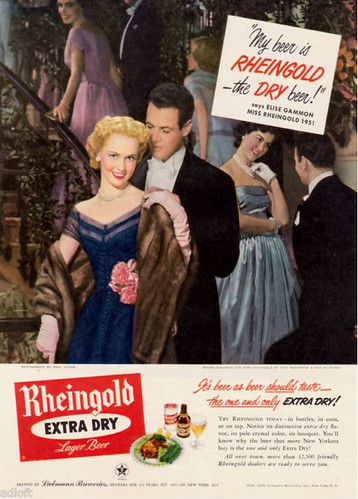
Monday’s ad is a 1951 ad for Rheingold Beer, featuring Miss Rheingold for that year, Elise Gammon. In the ad, Miss Gammon is arriving — or leaving? — a cocktail party and is either taking her mink off or putting on — it could be either, maybe that was the point?

Our 54th Session turns sour … sour beer, that is. Jon Abernathy, who writes The Brew Site, has chosen the topic Sour Beer, which he describes like so:
Instead we’ll be in the heat of the summer and while we’ve had Sessions covering Summer Beers, Fruit Beers, and Wheat Beers already (all which could suitably cover summertime beer enjoyment), it occurred to me that the topic of Sour Beers fits well within the season and (surprisingly!) hasn’t come up yet.
I’ve been gradually exploring Sour Beer and finding myself seeking out and trying various beers which fit into the “sour” realm (yes, I’m purposefully avoiding the word “style” here as it is entirely too loaded): beers inoculated with wild yeasts, soured with fruit (often in conjunction with those wild yeasts and barrel-aging), lactic acid beers like Berliner Weisse-influenced beers and the rare Gose, and so on. It’s a challenging area, both in acquiring a taste for soured beer and in brewing them—fortunately many brewers are being adventurous and branching out these days, giving us many more options.
So that’s our topic for August: Sour Beer. I’ll leave the implementation up to you, but here are some suggestions: seek out and review a sour beer of some kind; write about your experiences with brewing a sour beer; talk about your first sour beer experience; who’s brewing the better sours—Belgians or Americans (or somebody else)?; perhaps a contrary approach—what you don’t like about sour beers. Or if you have the perfect sour beer idea you want to write about, I can’t wait to read it!
Personally, I LOVE sour beer, so this one should be fun. So practice your pucker face and get ready to write all about it for the next Session on Friday, August 5.

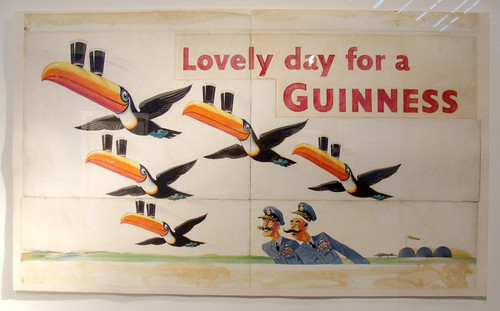
Our 78th Guinness is the scan of an original mock-up using the tagline “Lovely day for a Guinness.” Most likely it was meant for the time period during World War II given the military men and the Toucans flying in formation.

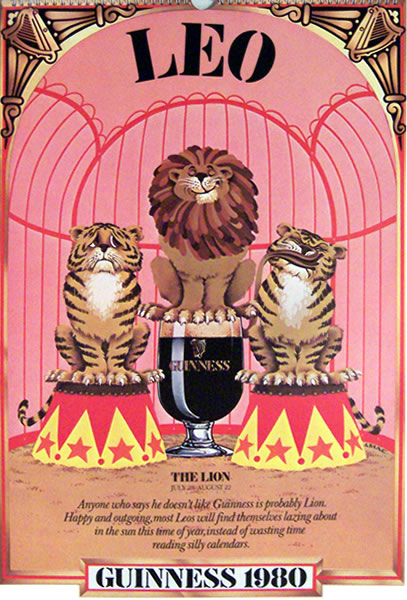
While I don’t put any stock in astrology, in 1980 Guinness put out a calendar with each month representing one of the zodiac signs, and I thought it would be fun to share these throughout the year.
Leo, the lion, is from July 23-August 23. To learn more, see:
Friday’s ad is the 420th beer ad I’ve posted so in honor of that number, today’s ad is for a beer festival, the 420 Fest put on by SweetWater of Atlanta, Georgia. It was done by artist R. Marx for the 2008 festival. Happy 420!

Thursday’s ad is another one for Schlitz, this time much later, from 1968. Using their popular “When you’re out of Schlitz, you’re out of beer” slogan. The image, though, is a less-than-flattering angle.


Charlie Papazian had an interesting series of posts (See Part 1, Part 2 and Part 3) a few years back that I thought was worth revisiting about what he refers to as “heritage breweries,” a term that he used to describe the few small breweries that not only survived prohibition but are still in business today, over 75 year later. According to his research, when prohibition summarily closed down thriving businesses in 1919, at a stroke 1,179 breweries were out of business, or at least no longer allowed to make their primary product: beer.
Of the ones that reopened thirteen years later, when prohibition was repealed only a handful managed to make it into the present, braving untold challenges, merger-manias, fickle consumers and ever more oppressive attacks by neo-prohibitionists unconvinced of prohibition’s massive failure. Papazian divides the heritage brewers into four types:
Of the first type, those still owned by the original family, only four remain.
For the second type, breweries still considered independent but no longer owned by their original founders or their family, there are a mere seven left.
Of the third type, breweries “no longer owned by the original family, nor independent of a large brewing company,” only one remains, and I’m not sure if it really does fit in the third group.
I say that because it seems to me that while MillerCoors does own the brewery outright, the family, led today by Jake Leinenkugel, does maintain a certain amount of autonomy and makes a lot of their own decisions about the business. I interviewed Jake a number of years ago for an article I wrote for American Brewer magazine, and that was certainly the impression I was left with. It may not be “owned” by the family any longer, but they do seem to control their own destiny, and that has to count for something.
The fourth, and final category, as outlined by Papazian, is one in which the “original family ownership and location is far removed from the current operation.” Of this type, there are only two remaining.
Totaled up, there are only thirteen breweries still in existence that were in business 92 years ago, when prohibition began. Twelve, if you discount brands that are contract brewed, such as Dixie is now post-Katrina. Now that’s just small breweries, but the picture’s not much rosier even if you include everybody, big and small.
Even pulling everybody, big or small, contract beer company or actual brewery, that’s still only 18 remaining from the original 1,179 left. That’s only 1.5% still in business after 82 years. Back out the big guys, and it’s 1.2%. I’m an inveterate pessimist, so I find that sad. I know that’s business in general, and many of the brewery mergers are the result of the cannibalistic nature of many of the big brewers (and corporate business more generally), but I’m a romantic pessimist, the worst kind. As much as I don’t really like the beers so many of the fallen breweries (and many of the remaining big ones, too) make, I still think we lose some part of our history every time yet another one closes or is bought out.
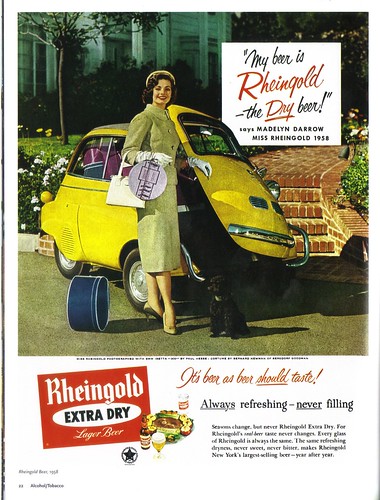
Wednesday’s ad is from 1941 for Schlitz, and is certainly a product of its time. Showing a housewife pouring glasses of Schlitz as her work-weary husband waves through the window as he walks home from work. The ad copy is great. “Coming home from a day’s hard work, it’s a truly happy husband who finds Schlitz at the evening meal!”