Brookston Beer Bulletin

Jay R. Brooks on Beer

  • Home
  • About
  • Editorial
  • Birthdays
  • Art & Beer

Socialize

  • Dribbble
  • Email
  • Facebook
  • Flickr
  • GitHub
  • Instagram
  • LinkedIn
  • Pinterest
  • RSS
  • Twitter
  • YouTube

Powered by Genesis

Beer In Ads #5274: Spaten Helles Lagerbier

June 20, 2026 By Jay Brooks Leave a Comment

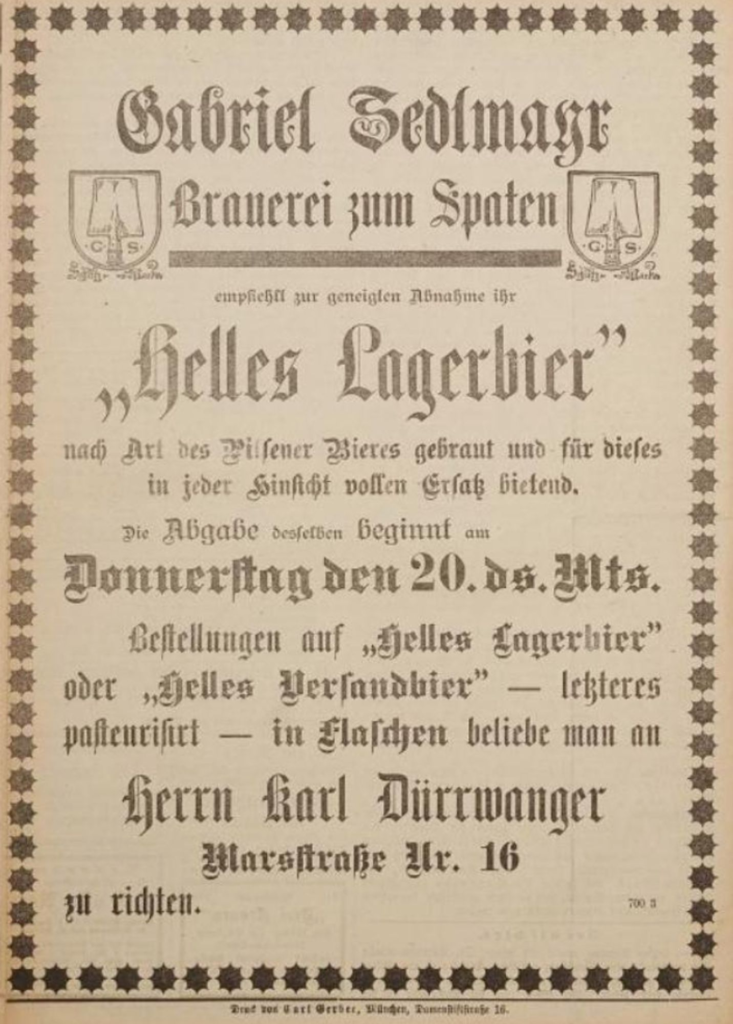
I’m taking a one-day break from posting Bock ads because today is the day Spaten released what today we simply call Helles in Munich and the rest of Germany. They had test-marketed it in Hamburg beginning March 21, 1894, but waited until the following summer for a full roll out, which began on June 20, 1895.

Saturday’s ad is for an “Spaten Helles Lagerbier,” or more fully “Helles Lagerbier nach Art des Pilsener Biers” (pale lager beer in the style of Pilsener beer) which was published on or around June 20, 1895. This ad ran in the “Das Bayerische Vaterland” (The Bavarian Fatherland), which was a daily newspaper published in Munich from 1869 to 1934. I believe it’s one of the earliest ads, if not the earliest ad, for Helles beer.

Filed Under: Art & Beer, Beers, Breweries, Just For Fun Tagged With: Advertising, Bavaria, Germany, History

Historic Beer Birthday: Henry Uihlein

May 13, 2026 By Jay Brooks

schlitz-globe
Today is the birthday of Henry Heinrich Johann Uihlein (May 13, 1844-April 22, 1922). He was born in Bavaria, but moved to the U.S. when he was eighteen, in 1862, having learned the brewing trade in Germany. He joined his uncle, August Krug, and his brothers, working for the Joseph Schlitz Brewing Company. He was president of Schlitz from 1875 until he retired in 1916.

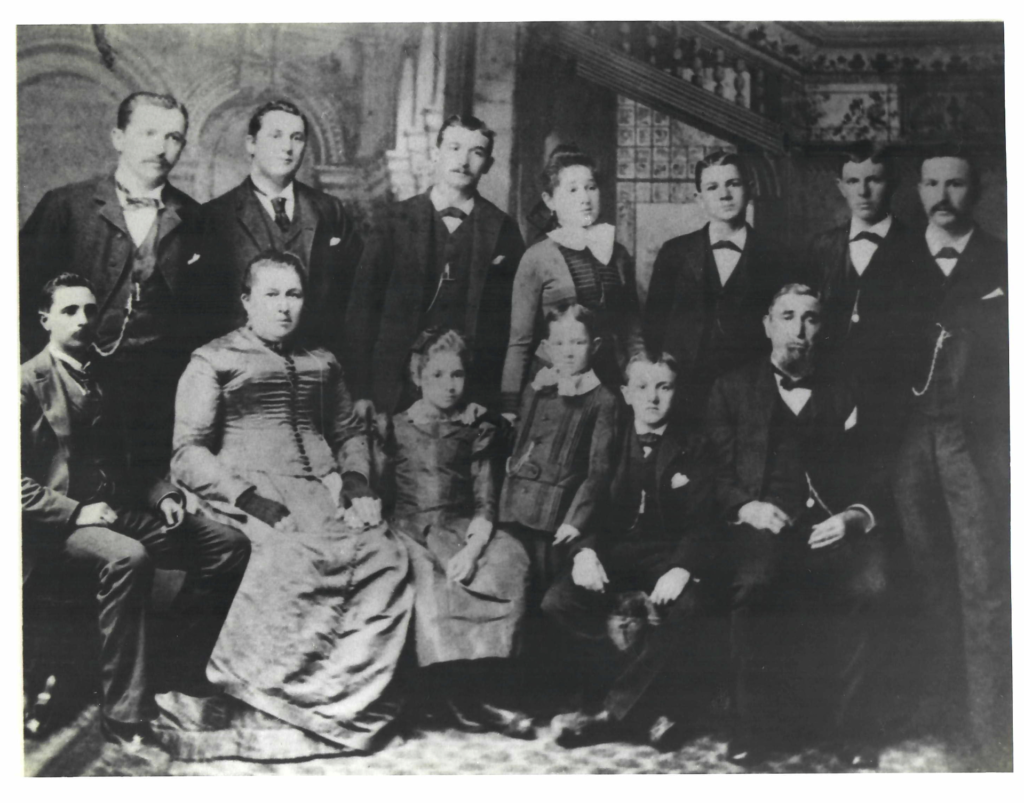
This is one of the few photos I could find of Henry, in this Uihlein family photo from the early 1880’s.

Bottom row, from left; Charles, superintendent of the bottling works; Edward, vice president in charge of developing the Chicago markets; Henry, president. Top row, from left; William J., assistant superintendent of the brewery; Alfred, superintendent and brewmaster; August, secretary and chief operating officer.

Schlitz-Beer-Paper-Ads-Jos-Schlitz-Brewing-1900


This Schlitz ad is from around 1900, when Henry was president of the brewery.

This is the Google translation of his German Wikipedia page:

Henry Uihlein was the second eldest of six sons of Joseph Benedict Ühlein and his wife Katharina Krug born in Wertheim, the restaurant, the Gasthaus zur Krone operated.

In Bavaria, Henry Uihlein learned the brewing trade before emigrating to the United States in 1862. There he worked for several years for various breweries in St. Louis and for the Kunz Brewing Company in Leavenworth. In 1871 he moved to Milwaukee and began working with his brothers August, Alfred and Edward for the Joseph Schlitz Brewing Company. Henry’s brewing expertise contributed significantly to the company’s success. He led the company between 1875 and 1916 as president. He also worked in finance, real estate and other industries.

This is Uihlein’s obituary from the Beverage Journal (f.k.a. The Western Brewer) from 1922:

Filed Under: Birthdays, Breweries, Just For Fun Tagged With: Bavaria, Germany, History, Wisconsin

Historic Beer Birthday: Henry Becker

April 19, 2026 By Jay Brooks

indiana

Today is the birthday of Henry Becker (April 19, 1851-April 20, 1906). He was born in Bavaria, and emigrated to the U.S. when he was 21, coming first to New Orleans, and two years later settling in Terre Haute, Indiana. At some point, he became involved with the Seventh Street Brewery, which had been founded in 1848 (although another source seems to dispute that believing they are unrelated and that Becker’s was founded independently in the 1870s, which actually makes some sense to me). Its name was changed to the Terre Haute Weiss Beer Brewery in 1898 (if related to Seventh Street), but after Becker’s death in 1906, his son took it over, renaming it the Henry J. Becker Brewery. Becker’s son then sold it two years later, in 1908. The buyer, Charles J. Graf, closed it for the good the same year.

Henry-Becker-obit-abr
Obituary of Becker from the American Brewers’ Review in 1906.

There’s very little information I could find on Becker or his brewery. It appears to have been very small, with capacity below 500 bbl, making it something of a proto-nano in its day. I could also not find any photos of Becker or the brewery and no breweriana whatsoever, aprt from the bottle below, which must be from between 1906-09. One unusual fact I did find is that they brewed a Berliner Weiss.

henry-becker-bottle

Filed Under: Birthdays, Breweries, Just For Fun Tagged With: Bavaria, Germany, Indiana

Historic Beer Birthday: Gabriel Sedlmayr II

February 26, 2026 By Jay Brooks

spaten-hops
Today is the birthday of Gabriel Sedlmayr II, sometimes referred to as Gabriel Sedlmayr the Younger (February 26, 1811-October 1, 1891). He was, of course, the son of Gabriel Sedlmayr the Elder, who acquired the Spaten brewery in 1807, when “at the time was the smallest brewery in Munich.” When his father died in 1839, the brewery passed to Gabriel and his brother Joseph, and the two ran the brewery for three years, until Joseph bowed out to start his own brewery, and Gabriel became the sole owner of the Spaten brewery. By 1867, it became the largest brewery in Munich, a position it held until the 1890s. In 1874, Sedlmayr retired, and three of his four sons, Johann, Carl and Anton, began running the company. During his tenure at Spaten, he played a major role in the development of lager fermentation.

Here’s a short biography from the Entrepreneur Wiki:

Gabriel Sedlmayr II was born in Munich on February 26, 1811. He is often called Gabriel Sedlmayr the Younger. While in high school, he was given private lessons by Professor Johann Baptist Hermann in chemistry and physics. He graduated from high school and then began training in a brewery.

He also traveled to European to visit and learn from different breweries, as well as local scientists. In Vienna he attended lectures at the Polytechnic of Vienna and in Berlin he attended chemistry lectures at the University of Berlin. He then took over his father’s brewery with help from his brother.

In 1842, when Joseph, his brother, left the business, he became the sole owner of the brewery. In 1866 he then opened up the Bavaroise Brasserie in Paris. Then he helped at and then eventually took over the Spanenbrau Brewery. He is responsible for developing a dark lager called Dunkel at his Spaten Brewery. He was known for using science, microbiology, and cultivation to develop new beers. In 1874, he passed his business to his sons Johann, Carl, and Anton because of his poor health. In 1881 he was awarded the Gold Medal of the City if Munich and then on October 1, 1891 he died.

This is his entry in the Oxford Encyclopedia of Beer, written by Ian Horsey:

Sedlmayr, Gabriel the Younger

was a brewer who took over the reins of the Spaten Brewery of Munich, with his brother Josef, upon the death of his father, Gabriel Sedlmayr the Elder, in 1839. The two brothers inherited their father’s innovative zeal and, over the next few years, modernized the brewery at the same pace as their father had done before them. In 1844, Spaten became the first brewery outside England to adopt steam power. A year later, Gabriel bought out his brother and became the sole proprietor of Spaten, which would continue to be a center of brewing innovation. Already during his student days, Gabriel had been an innovator. As part of the requirement for his Master Diploma, young Gabriel embarked upon an extensive grand tour of noted European brewing centers in the early 1830s. On one of his trips, he met fellow brewer Anton Dreher, whose mother owned a small brewery in Klein-Schwechat, just outside Vienna. The meeting, in 1832, marked the beginning of a life-long friendship and business association. The two travelers visited Great Britain in 1833 to learn more about fermentation—and engaged in what can only be described as a classic case of industrial espionage. By using a specially modified hollow walking cane, they furtively gathered wort and beer samples during their brewery visits und subsequently analyzed them in their hotel. They put the data thus collected to good use after they had returned home by developing two new malts and two new beer styles: Dreher came up with Vienna malt and Vienna lager; Sedlmayr invented Munich malt and märzen beer.

In those days it was difficult to brew lagers in the summer; the hot central European climate was inhospitable to brewing in general and lager brewing in particular. Brewers used ice blocks cut from frozen lakes and ponds in the winter and stored them underground for use as coolant in the summer. This was costly and inefficient. So Sedlmayr looked around for a technological solution, which he found in the work of a young Munich engineering professor, Carl Linde. Linde had been tinkering with refrigeration machines, and in 1873, Sedlmayr persuaded Linde to install one of his experimental devices in the Spaten fermentation and lagering cellars. This was, as best as anybody knows, the first time that mechanical refrigeration had been used in a brewery, and Spaten was from then on uniquely equipped to brew bottom-fermented beer reliably year-round. With this new technology in place, Spaten had become the largest of the Munich breweries. Spaten’s superb lager-making ability allowed it to experiment with ever more delicate brews, especially one that could compete with the rising popularity of the Bohemian pilsner from just east of the Bavarian border. The result was the introduction, in 1894, of a straw blond beer, the delicate lager that was to become the signature brew for Bavarian beer garden and beer hall lagers for the next century, Helles.

gabriel-sedlmayr-coin

Spaten-Werbung

Filed Under: Birthdays, Just For Fun Tagged With: Bavaria, Germany, History

Historic Beer Birthday: Philip Zorn

February 21, 2026 By Jay Brooks

ph-zorn
Today is the birthday of Philip Lewis Zorn (February 21, 1837-January 4, 1912). Zorn was born in Wűrzburg, Bavaria, and learned brewing from his father, how was a brewer in Germany. In 1855, when he was eighteen, he emigrated to the U.S., and initially settled in Illinois, where he worked in breweries in Blue Island, Illinois. In 1871, he moved to Michigan City, Indiana and opened the Philip Zorn Brewery. Twenty years later, he incorporated it as the Ph. Zorn Brewing Co. After prohibition, his sons Robert and Charles, who had worked for the brewery beginning as young men, reopened the brewery as the Zorn Brewing Co. Inc., but it in 1935 it became known as the Dunes Brewery, before closing for good in 1938. He was also a city councilman and a co-founder of Citizens Bank of Michigan City.

philip-zorn-pic

This account is from the Indiana Bicentennial:

Philip Zorn Jr. was the son of a brewer in Wűrzburg, Bavaria who immigrated at the age of 18. He worked at a brewery in Illinois from 1855 until he started his own in Michigan City. By 1880 he was making 3,000 bbls annually. He became a prosperous man, a city councilman and the founder of the Citizens Bank of Michigan City.

The company passed to Philip’s sons Robert and Charles who built a new brewhouse in 1903 and reached almost 15,000 bbls by the time of Prohibition. During the dry years they made the Zoro brand of soda pop. After Prohibition they changed the name to Dunes Brewing, possibly because of a court action against Zorn in 1935 for selling beer to unlicensed companies. They made Grain State, Golden Grain and Pilsenzorn brands.

Zorn-beer
Zorn beers.

philip-zorn-obit-1
philip-zorn-obit-2
philip-zorn-obit-3

Golden-Grain-Beer--Labels-Dunes-Brewery

And this excerpt is from “Hoosier Beer: Tapping into Indiana Brewing History,” by Bob Ostrander and Derrick Morris:

zorn-hoosier-beer
zorn-michigan-pride

Filed Under: Birthdays, Breweries, Just For Fun Tagged With: Bavaria, Germany, History, Illinois, Indiana

Historic Beer Birthday: John Frederick Wiessner Sr. 

December 14, 2025 By Jay Brooks

Today is the birthday of John Frederick Wiessner (December 14, 1831-January 1, 1871). He was born in Bavaria, but emigrated to the U.S. and settled in Baltimore, Maryland. He founded the John F. Wiessner Brewery in 1863, renaming it the John F. Wiessner & Sons Brewing Co. after his sons joined he business in 1888. It remained that name until closed by prohibition in 1920. It reopened after repeal in 1933 as the American Brewery, and went through a variety of name changes until closing for good in 1973.

Here’s a newspaper story about his will after he passed away.

Baltimore History Bits has a short history of the brewery, and cartoonist from California, Chendi Xu, created a short comic about the history of Wiessner’s brewery, although she claims he went to Bavaria to learn brewing and came back from there rather than New York. There’s also a pdf online with a history of the brewery from a breweriana perspective by David Hagberg.

The brewery building is still standing, though it’s been through a lot, according to Wikipedia:

The American Brewery, located in the Broadway East, Baltimore community, is an historic former brewery located at 1701 North Gay Street in northeast Baltimore, Maryland, United States. Formerly abandoned and left to decay for four decades, it has been recently repaired, renovated / restored and beautified. It is currently the headquarters of Humanim Inc., a regional social services agency.

Filed Under: Birthdays, Breweries, Just For Fun Tagged With: Baltimore, Bavaria, Germany, History, Maryland

Historic Beer Birthday: Georg Schneider

November 26, 2025 By Jay Brooks

schneider-weisse
Today is the birthday of Georg Schneider (November 26, 1817-1890) who co-founded G. Schneider & Son along with his son Georg Schneider II in 1872. Georg leased the royal ‘Weisse Brauhuas’ Hofbräuhaus in Munich in 1855 and purchased from King Ludwig II the right to brew wheat beer in 1872. Georg, along with his son acquired the so-called Maderbräu Im Tal 10′ in 1872.

georgschneider1

Both he and his son passed away in 1890, and his grandson, Georg III, took over the brewery even though he was barely 20 at the time, and today George VI still owns and runs the brewery.

six-generations-schneider

Here’s what the brewery website has about their history:

The history of wheat beer is also the history of the Schneider brewing family and its famous Schneider Weisse. Georg I Schneider, as the wheat beer pioneer and creator of the Schneider Weisse Original recipe (which is still used today), is revered by all wheat beer connoisseurs.

Two-hundred years ago, wheat beer could only be brewed by the Bavarian royal family in their reweries. In 1872, King Ludwig II discontinued brewing wheat beer due to a steady decline in sales.

That same year, he sold Georg I Schneider the exclusive right to brew wheat beer. Thus, the Schneider Family saved wheat beer from extinction. Today, Georg VI Schneider is running the brewery in Kelheim, which the family acquired in 1927 and has remained the Schneider Weisse brewery to this day. It is the oldest wheat beer brewery in Bavaria; wheat beer has been brewed there without interruption since its founding in the year 1607.

Georg-Schneider-coaster

The Schneider Brauhaus has a slightly different history of the Schneider story:

Georg Schneider I was a tenant of the Königlich Weissen Hofbräuhaus in Munich between 1855 and 1873. On the basis of the prevailing narrow conditions, the production of white beer was to be abandoned. The victory of the lower-fermented beers (at that time known as brown beer) could no longer be stopped in Bavaria.

Georg Schneider I believed, however, that the old top-breed brewing method had a future. Therefore, during the reign of King Ludwig II, he negotiated with the Bavarian court brethren about the replacement of the Weissbierregal (the right to brew Weissbier). The latter believed that he could give the request, since Weissbier was no longer allowed any chance.

At the same time Georg Schneider I had the opportunity to purchase the abandoned Maderbräu. After about a year of conversion, he began to produce his own white beer together with his son Georg Schneider II. The “Schneider Weisse” was born and the “Weisse Bräuhaus G. Schneider & Sohn” from the original Maderbräu became. Georg Schneider I himself was responsible for the business and found in his wife Maria Anna, born Hettel, an efficient cook and economist.

Overall, the acquisition of Georg Schneider I was a speculation with a high level of commitment. The success did not fail. The influx of guests, who wanted to enjoy a “delicious mouth beer” soon surpassed all expectations. George Schneider I is rightly referred to as the Weissbierpionier, who has rescued the superior brewing methods in their original form into modern times.

pianonvirittäjät_g.schneidersohn_1000

The “Weisses Bräuhaus” in Munich, Tal (or Thal) is the founding place of their brewery. It’s the place where Georg Schneider I brewed his first Schneider Weisse Original in 1872.

schneider_munichbrewery

“In 1927 the owners, who to this day are descendants of Georg Schneider I, expanded their brewing operations into Kelheim and Straubing. After the breweries in Munich were destroyed in 1944 by aerial bombardment by the Allies of World War II, the entire production was relocated to Kelheim.”

Schneiderbrewery

Filed Under: Birthdays, Just For Fun Tagged With: Bavaria, Germany, History

Historic Beer Birthday: William IV, Duke of Bavaria

November 13, 2025 By Jay Brooks

bavaria
Today is the birthday of William IV, Duke of Bavaria (November 13, 1493-March 7, 1550). William IV “was Duke of Bavaria from 1508 to 1550, until 1545 together with his younger brother Louis X, Duke of Bavaria. He was born in Munich to Albert IV and Kunigunde of Austria, a daughter of Emperor Frederick III.”

Bartel-wilhelm-iv
Portrait by Barthel Beham.
Here’s a short account of William IV’s life:

Though his father had determined the everlasting succession of the firstborn prince in 1506, his younger brother Louis refused a spiritual career with the argument that he was born before the edict became valid. With support of his mother and the States-General, Louis forced William to accept him as co-regent in 1516. Louis then ruled the districts of Landshut and Straubing, in general in concord with his brother.

William initially sympathized with the Reformation but changed his mind as it grew more popular in Bavaria. In 1522 William issued the first Bavarian religion mandate, banning the promulgation of Martin Luther’s works. After an agreement with Pope Clement VII in 1524 William became a political leader of the German Counter reformation, although he remained in opposition to the Habsburgs since his brother Louis X claimed the Bohemian crown. Both dukes also suppressed the peasant uprising in South Germany in an alliance with the archbishop of Salzburg in 1525.

The conflict with Habsburg ended in 1534 when both dukes reached an agreement with Ferdinand I in Linz. William then supported Charles V in his war against the Schmalkaldic League in 1546. William’s chancellor for 35 years was the forceful Leonhard von Eck.

William was a significant collector and commissioner of art. Among other works he commissioned an important suite of paintings from various artists, including the Battle of Issus by Albrecht Altdorfer. This, like most of William’s collection, is now housed in the Alte Pinakothek in Munich. With his order to expand the Neuveste with the so-called Rundstubenbau and to set up the first Court Garden began the history of the Munich Residence as a representative palace. To the history cycle of the garden pavilion belonged Albrecht Altdorfer’s painting. In 1546 he ordered to upgrade Dachau Palace from a Gothic ruin into a renaissance palace. In 1523 with the appointment of Ludwig Senfl began the rise of the Bavarian State Orchestra.

On 23 April 1516, before a committee consisting of gentry and knights in Ingolstadt, he issued his famous purity regulation for the brewing of Bavarian Beer, stating that only barley, hops, and water could be used. This regulation remained in force until it was abolished as a binding obligation in 1986 by Paneuropean regulations of the European Union.

William died in 1550 in Munich and was succeeded by his son Albert. He is buried in the Frauenkirche in Munich.

Reinette-duke-wilhelm
Duke Wilhelm IV of Bavaria by Hans Schwab von Wertinger.

William IV, Duke of Bavaria, wrote and signed the Reinheitsgebot, also known as the Bavarian Beer Purity Law, and later the German Beer Purity Law.

reinheitsgebot

In the Bavarian town of Ingolstadt on April 23, 1516, William IV, Duke of Bavaria wrote and signed the law, along with his younger brother Louis X, Duke of Bavaria. That 1516 law was itself a variation of earlier laws, at least as early as 1447 and another in independent Munich in 1487. When Bavaria reunited, the new Reinheitsgebot applied to the entirety of the Bavarian duchy. It didn’t apply to all of Germany until 1906, and it wasn’t referred to as the Reinheitsgebot until 1918, when it was coined by a member of the Bavarian parliament.

wilhelm_iv_herzog_bayern
Another painting by Barthel Beham.

Filed Under: Birthdays, Just For Fun Tagged With: Bavaria, Germany, History, Law

Historic Beer Birthday: Jacob Schmidt

October 9, 2025 By Jay Brooks

schmidt-mn
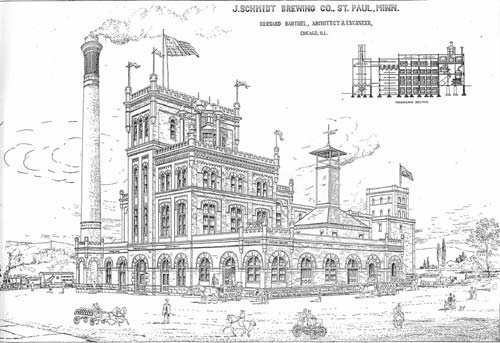
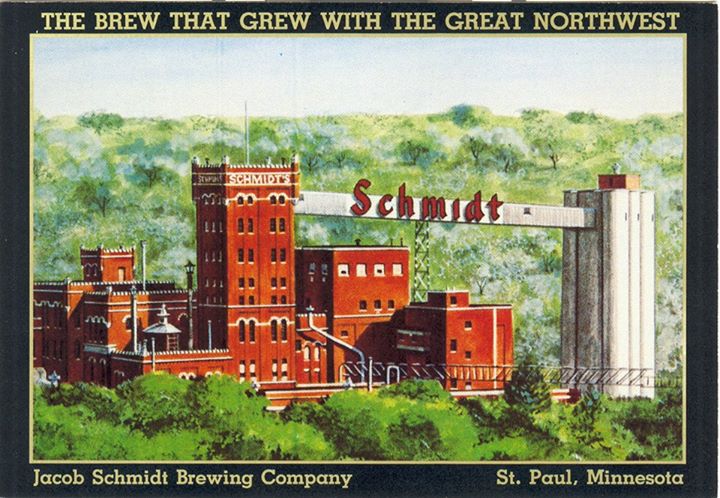
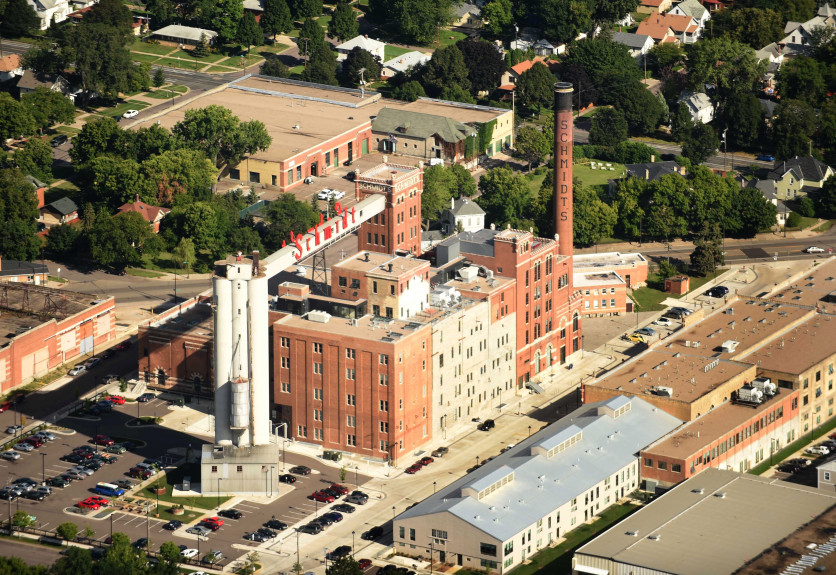
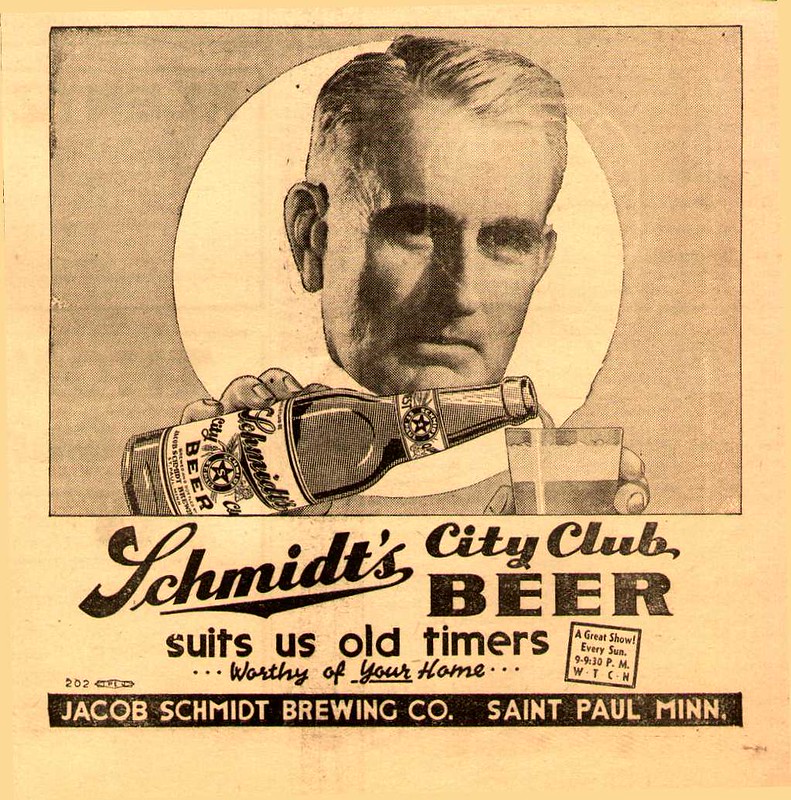
Today is the birthday of Jacob Schmidt (October 8, 1846-September 2, 1910). He was born in Bavaria, Germany, but moved to America, worked at breweries in New York and Milwaukee, then settling in Minnesota, in 1866. In St. Paul, he was brewmaster at Hamm’s, and later left to brew for August Schell and some breweries in the midwest. In 1884, he returned to St. Paul and bought a 50% share of the North Star Brewery, but it burned to the ground, a total loss, in 1899. With his daughter and son-in-law Adolph Bremer, he acquired the Christopher Stahlmann, Cave Brewery, and in 1900 completely remodeled it turning into the iconic “Castle” brewery with the help of Chicago brewery architect Bernard Barthel. They also renamed it the Jacob Schmidt Brewing Co., and after Prohibition, it became the nation’s seventh largest brewery. The brewery continued until 1972, when the brand was bought by G. Heileman. The Castle brewery in St. Paul was abandoned and only recently was renovated into the Schmidt Artist Lofts. Today the Schmidt Brewery brands are owned by Pabst.
schmidts-face

Surprisingly, I could find very little biographical information about Jacob Schmidt himself, not even a photo. Here’s a short biography from Find-a-Grave:

Businessman. Born in Bavaria, Germany, he arrived in America at the age of 20 and after working at several breweries for five years, he settled in St. Paul, Minnesota. In St. Paul, he was the Brewmaster for the Theodore Hamm’s Brewing Company, when he left this position in 1900, to become owner and founder of the Jacob Schmidt Brewing Company. He became one of the first brewers to sell more than 10,000 barrels in Minnesota, along with being one of the first brewers to bottle his own beer. He died at age 63 in St. Paul, Minnesota.
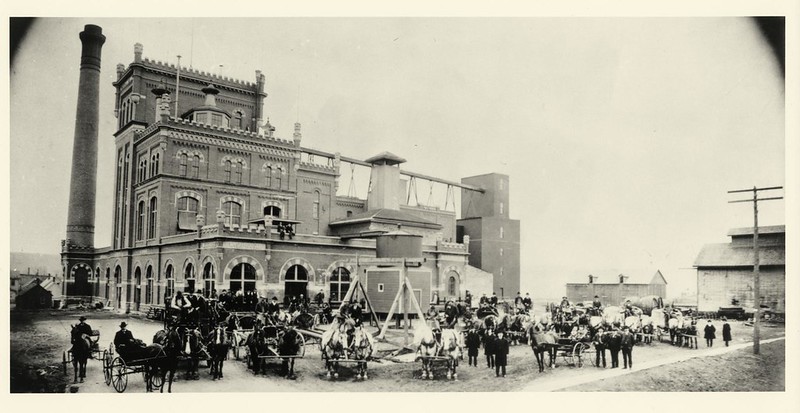
schmidt-brewery-1905-lg
The Schmidt “Castle” brewery in 1905.

Here’s the brewery history from the current brand website:

In 1884, Jacob Schmidt moved to St. Paul, Minnesota and purchased a half interest in the North Star Brewery located at Commercial St. & Hudson Rd. Jacob retired in 1899, turning over the operation to his daughter and son-in-law. The following year the brewery burned to the ground and a new location was immediately found. In 1901, the brewery was incorporated as the Jacob Schmidt Brewing Company and a new plant and malt house were erected next to the existing structures.

Jacob died in 1910, but the brewery continued to enjoy success until Prohibition struck. After a failed attempt at producing soft drinks, a non-alcoholic malt beverage was created and became extremely popular.

After considerable success following the repeal of Prohibition, the company continued to prosper under the Schmidt name until 1955. Most of the original buildings still stand today, looming proudly above the Mississippi River.

Schmidt beer is known as the “Official Beer of the American Sportsman”…a slogan that capitalizes on the exciting, rugged appeal of the Pacific Northwest. The quality and brewing tradition instilled by Jacob Schmidt, continues today.
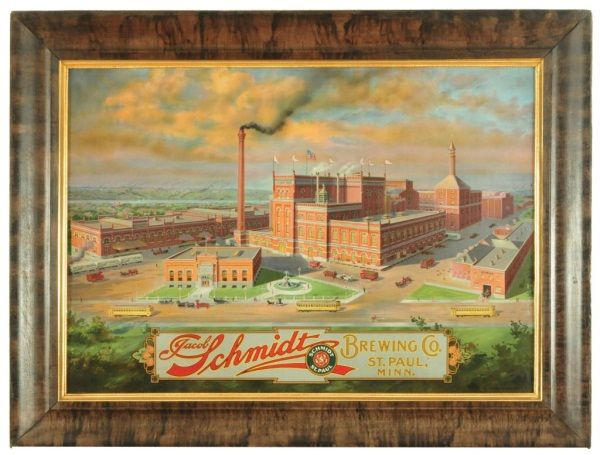
jacob-schmidt-brewery-framed
And here’s the portion of Schmidt’s Wikipedia page that deals with the brewery’s namesake:

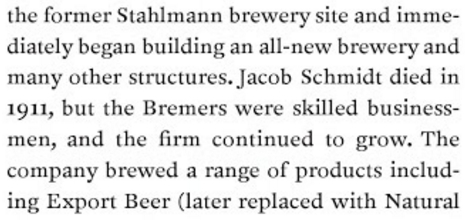
Jacob Schmidt started his brewing career in Minnesota as the Brewmaster for the Theodore Hamm’s Brewing Co. He left this position to become owner of the North Star Brewing Co. Under Schmidt’s new leadership the small brewery would see much success and in 1899 Schimdt transferred partial ownership of his new brewery to a new corporation headed by his son in law Adolph Bremer, and Adolph’s brother Otto. This corporation would later become Bremer Bank. With the new partnership the Jacob Schmidt Brewing Company was established. In 1900 the North Star Brewery would suffer a fire that would close it for good. With the new management team in place a new brewery was needed, the new firm purchased the Stahlmann Brewery form the St. Paul Brewing Co. and immediately started construction on a new Romanesque brewery incorporating parts of Stahlmann’s original brewery along with it including the further excavation of the lagering cellars used in the fermentation process to create Schmidt’s Lager Beer.
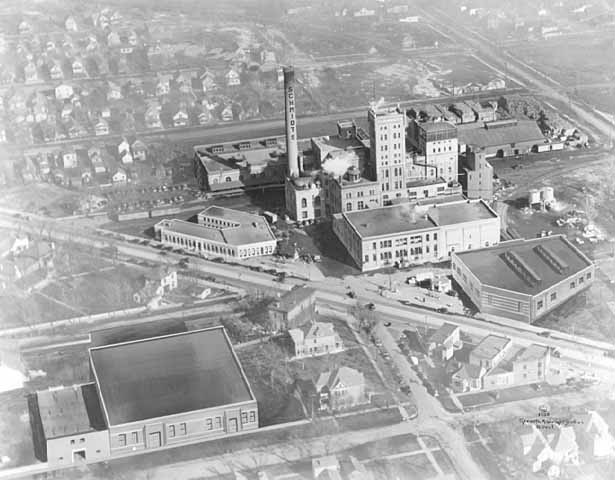
schmidt-aerial
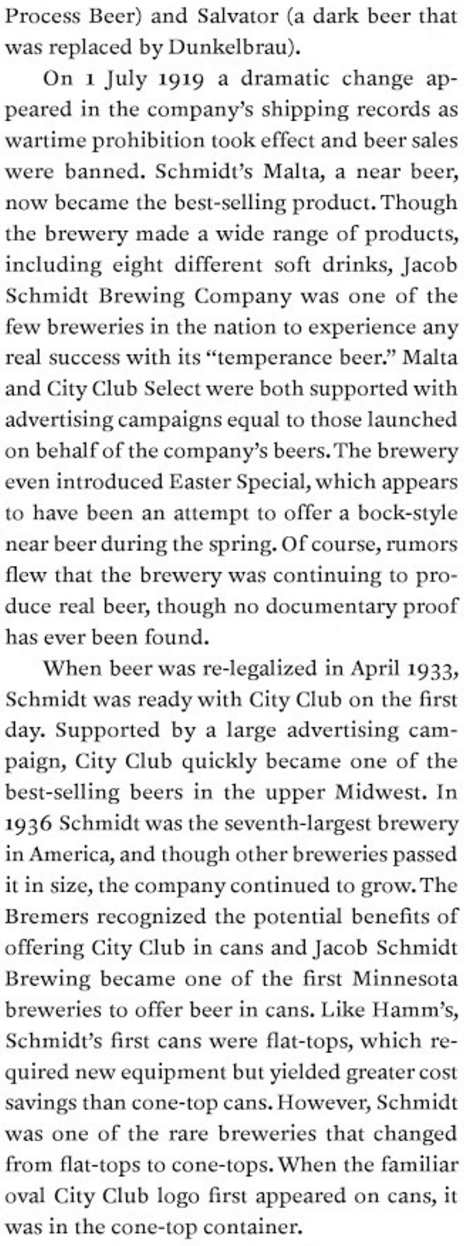
This account is excerpted from the Land of Amber Waters: The History of Brewing in Minnesota, by Doug Hoverson:

jacob-schmidt-hist-1
jacob-schmidt-hist-2
B-Barthel-Schmidt_Brewery_drawing
jacob-schmidt-hist-3
schmidt-postcard

Here’s a portion of a lengthier, more thorough account of the brewery’s history, from Substreet:

He came to the United States in 1865 at the age of 20 and worked in brewhouses as he moved westward. He worked in Rochester, Chicago, and Milwaukee, before coming to Minnesota, where he found a position at Schell’s brewery in New Ulm, before moving to Minneapolis’ Heinrich’s and then to Banholzer’s and Hamm’s of St. Paul.

At Theodore Hamm’s brewery, the biggest of its kind in the state, Schmidt became not just the chief brewer, but also a personal friend of the firm’s powerful owner and namesake.

Ultimately, Jacob Schmidt wanted his own brewery.

On the other end of Swede Hollow, in 1860, Edward Drewry and George Scotten founded what would become the North Star Brewery, then just called ‘Drewry & Scotten’. Though it featured a brewhouse large enough to compete with Stahlmann’s operation on the other side of St. Paul, and had adequate—though far from extensive—underground cellars to match, this brewery produced ale, not lager beer, and therefore did not compete with Stahlmann’s brand.

After changing hands several times, it was clear by the early 1880s that North Star required a talented master brewer. The owners of that humble brewery, William Constans (grocer and brewery supply dealer) and Reinhold Koch (brewer and Civil War veteran), hired Jacob Schmidt, and the former Hamm’s brewer rapidly expanded production below the bluff.

Together, Schmidt, Constans and Koch grew North Star Brewery to the point it competed directly with Hamm’s.

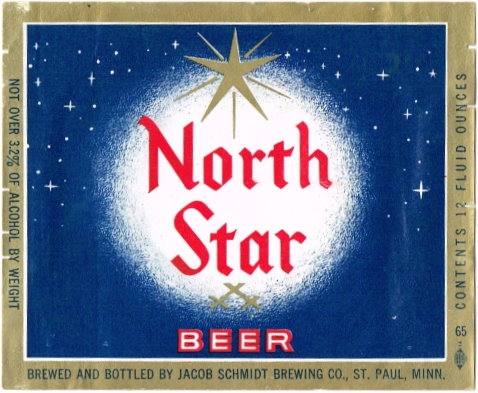
North-Star-Beer-Labels-Jacob-Schmidt-Brewing-Co--Aka-of-Pfeiffer-Brewing-Co-DBA-Jacob-Schmidt-Brewing-Co
In a few years, the Dayton’s Bluff brewhouse became the second greatest producer of beer west of Chicago by some estimates, sending out 16,000 barrels annually as far as Illinois. In 1884, Constans and Koch decided to leave the business, thereby leaving Schmidt as sole owner. In 1899, Schmidt took down the ‘North Star Brewery’ sign and replaced it with ‘Jacob Schmidt Brewing Company’.

The next year, it all burned.

Today, all that remains of the brewery are its aging cellars, which are a part of the new Bruce Vento Nature Sanctuary in Lowertown off Commercial Street.

As he considered the cost of rebuilding, Schmidt received a proposal from St. Paul Brewing: they wanted to sell him their troubled brewery. The brewmaster accepted the offer and moved his operation into the former Cave Brewery, which had been only slightly modified since Stahlmann built it almost 50 years prior. Facilities were inadequate, but he would fix that.

Interestingly, Jacob Schmidt had all the bottles salvaged from the ruined brewery shipped to his new location. The glasses still bore the mark of the North Star brand, a large five-pointed star—a feature the brewer would ultimately opt to keep.

Stars cover the Schmidt brewery to this day, in signs and ironwork, hearkening to Jacob Schmidt’s time at, and the destruction of, North Star Brewery.

Observing the lowly state that Stahlmann’s brewery was in, Schmidt hired a rising Chicago architect, Bernard Barthel, to design a totally new complex to replace what was left of the Christopher Stahlmann Brewing Company, and St. Paul Brewing Company’s brash modifications to it.

It would be medieval on the outside, but totally modern and streamlined inside.

Soon, imposing red brick towers were rising on Fort Road, with obvious influences borrowed from feudal era castles, replacing the modest remains of Cave Brewery. Construction of Jacob Schmidt Brewing Co. was completed in 1904, followed in the next decade by its more significant outbuildings, notably ending in 1915 with the Bottling Department. Schmidt beer was some of the first to be bottled on-site in the state.

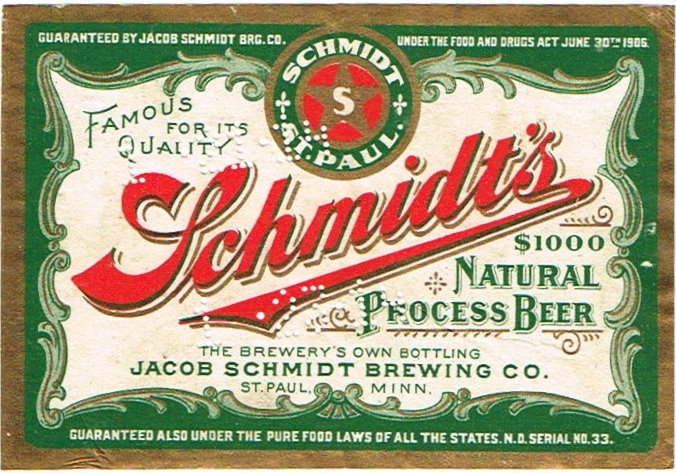
Schmidts--1000-Natural-Process-Beer-Labels-Jacob-Schmidt-Brewing-Co--Pre-Prohibition

The new brewery complex was designed to compete with the biggest brewers in the country, and it did.

When Jacob died in 1911, his brewery was an icon of the West Side and the employer of more than 200 people. More importantly, the beer continued to flow, unlike the bust that followed the Stahlmanns. Though the man himself was gone, the name Schmidt was becoming ever more prominent across the country.
cst 07217 aerial shot of Schmidt Brewery

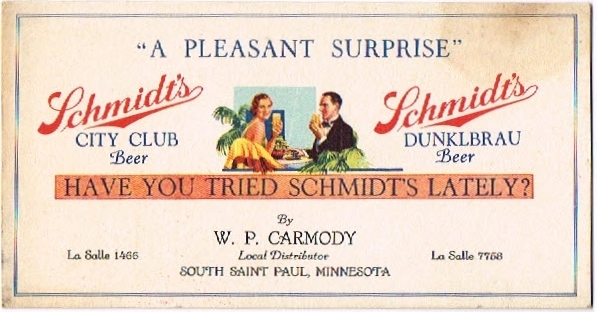
Schmidts-City-Club-BeerDunkelbrau-Beer--Blotters-Jacob-Schmidt-Brewing-Co
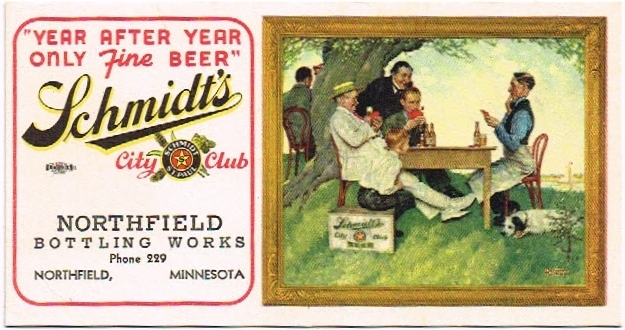
Schmidt’s also hired famed artist Norman Rockwell to do one of my favorite pieces of advertising art for them.

Schmidts-City-Club-Beer--Blotters-Jacob-Schmidt-Brewing-Company
It’s a pretty awesome piece, but not the only work in beer he did. For more, see Norman Rockwell’s Beer.

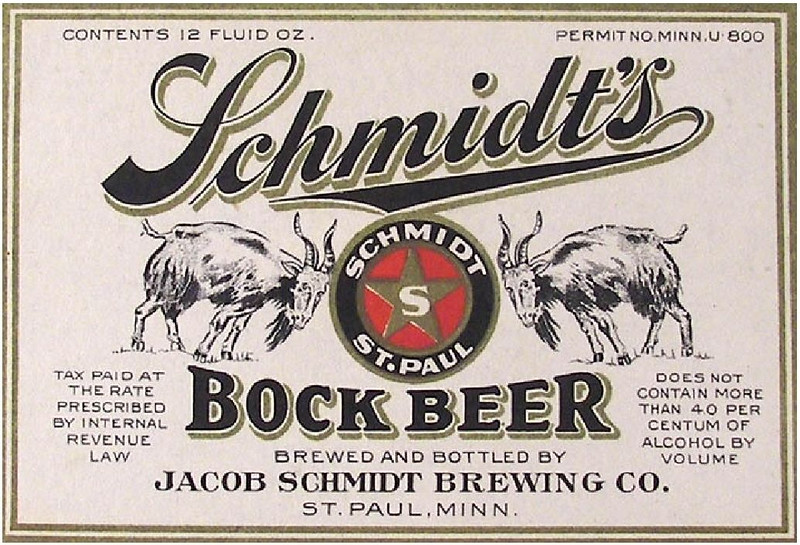
schmidts-bock

The thing I personally remember about Schmidt’s was their collectible cans which were all over the place when I was a kid. There was a seemingly endless variety of their can designs, and I have read that it really helped keep the business afloat, at least for a time.
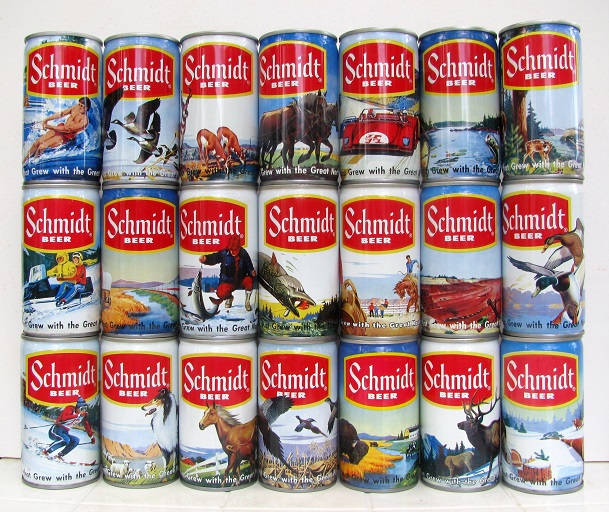
schmidt-beer-cans
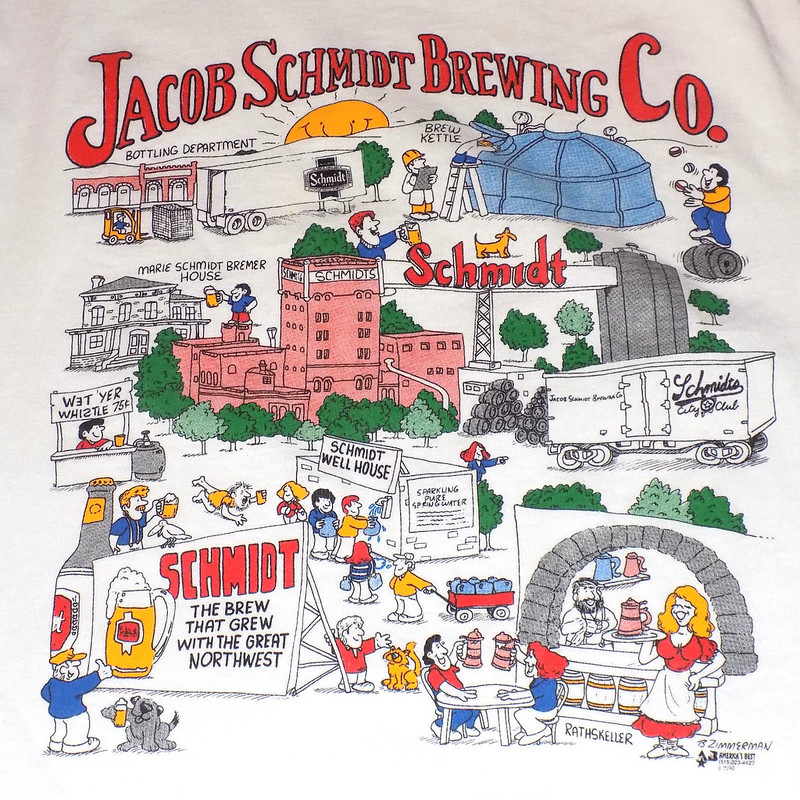
Jacob-Schmidt-Brewing-Company-T-Shirt-XL-Beer-Vintage

Filed Under: Birthdays, Just For Fun Tagged With: Bavaria, Germany, History, Minnesota

Historic Beer Birthday: Paul Reising

October 7, 2025 By Jay Brooks

paul-reising
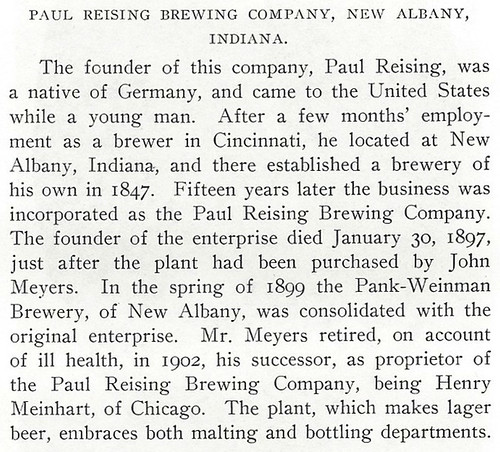
Today is the birthday of Paul Reising (October 7, 1819-January 30, 1879). He was born in Bavaria, Germany, but moved to the United States when he was 35, in 1854. In 1857, he bought the City Brewery of New Albany, Indiana, from Joseph Metcalfe, and renamed it the Paul Reising & Co. Brewery, and a few years later the Paul Reising Brewing Co. It kept going after his death in 1879, but the business declared bankruptcy in 1915, and was sold.

paul-reising-brewery

This account is from a History Forum:

Paul Reising was born in the village of Hoerstein, Bavaria in 1819. He married Susanna Stadtmueller, also a native of Hoerstein in 1842 and came to America on board the ship Juventa bound from Havre de Grace to New York in 1854 (for more information on him and his family see Paul Reising Family History).

He purchased the City Brewery in New Albany in 1861. When he purchased it, it was a mere 20×60 feet with a capacity of 1500 barrels of beer annually. In 1873 the Paul Reising Brewing Company was incorporated with a capital stock of $100,000. By 1891, the capacity had been increased to 12000 barrels. Fred Kistner, Reising’s son-in-law was to have inherited the brewery, but he predeceased Reising and the brewery was sold to John Meyer. By 1913 the president of the company was H. L. Meinhardt. In 1914 financial disaster overtook the company, when some apparently bad beer was distributed without quality control. The company was forced into bankruptcy in 1915.

After the bankruptcy the company was sold to Michael Schrick, and was eventually renamed the Southern Indiana Ice and Beverage Company during Prohibition. This company closed in 1935. The old brewery site was reopened as the Polar Ice Company. This was razed in 1969 when the Holiday Inn which occupies this location now was constructed. No Brewery buildings remain.

Reisling-brewers
Employees of the Paul Riesing Brewery.

This brief history of the brewery is from “100 Years of Brewing:”

reising-history

Reising-rathskeller-brew

Reisings-Kaiser-Beer-Labels-Paul-Reising-Brewing-Co-Inc_31932-1

Filed Under: Birthdays, Breweries, Just For Fun Tagged With: Bavaria, Germany, History, Indiana

Next Page »

Find Something

Northern California Breweries

Please consider purchasing my latest book, California Breweries North, available from Amazon, or ask for it at your local bookstore.
Recent Comments

  • Bob Paolino on Beer Birthday: Grant Johnston
  • Gambrinus on Historic Beer Birthday: A.J. Houghton
  • Ernie Dewing on Historic Beer Birthday: Charles William Bergner 
  • Steve 'Pudgy' De Rose on Historic Beer Birthday: Jacob Schmidt
  • Jay Brooks on Beer Birthday: Bill Owens

Recent Posts

  • Historic Beer Birthday: William F. Weber July 2, 2026
  • Beer In Ads #5281: New Lebanon’s Special Brew Of Bock Beer For The 4th Of July July 1, 2026
  • Historic Beer Birthday: James Younger July 1, 2026
  • Beer Birthday: Chris White July 1, 2026
  • Beer In Ads #5280: Don’t Argue With A “Hot-Dog” Thirst — Drink Rainier Bock! It Goes Right To The Thirsty Spot! June 30, 2026

BBB Archives

Feedback

Head Quarter
This site is hosted and maintained by H25Q.dev. Any questions or comments for the webmaster can be directed here.