Brookston Beer Bulletin

Jay R. Brooks on Beer

  • Home
  • About
  • Editorial
  • Birthdays
  • Art & Beer

Socialize

  • Dribbble
  • Email
  • Facebook
  • Flickr
  • GitHub
  • Instagram
  • LinkedIn
  • Pinterest
  • RSS
  • Twitter
  • YouTube

Powered by Genesis

Higher Alcohol Taxes Reduce Tax Revenue

October 24, 2012 By Jay Brooks

beer-tax
Given that the anti-alcohol folks, and especially my churlish neighbors Alcohol Justice, are continually beating the drum about alcohol taxes being too low, this news is not going to be particularly welcomed with open arms. A British think tank, the Institute of Economic Affairs (IEA), recently took a close look at the effect of higher taxes in alcohol and their report, Drinking in the Shadow Economy, found that the British “Treasury is losing as much as £1.2 billion every year to the illegal alcohol industry.” That, they conclude, is one of the effects of higher taxes on alcohol, because it creates an incentive for people to go outside the law and the safe world of regulated alcohol to make a quick buck. They found that “the illicit alcohol market is also closely associated with high taxes, corruption and poverty. The affordability of alcohol appears to be the key determinant behind the supply and demand for smuggled and counterfeit alcohol.” So place too high taxes on alcohol, and you invite in the wrong element, which we’ve seen in the U.S. before during Prohibition, and which we’re seeing right now with the war on drugs. If that futile policy was reversed, we’d save as much $13.7 billion annually by legalizing, regulating and taxing just marijuana, not to mention we’d remove the criminal element, make it safer and drastically reduce burdens on police, the justice system and prisons.

But back across the pond, the study also notes that the “demand for alcohol is relatively inelastic,” meaning people generally don’t drink less when prices go up, they instead find new ways to address the rising prices. As study after study has concluded, tax hikes are regressive and almost always hit poorer families the hardest, while not eliminating the problem the proponents of such measures claim they will fix.

But here’s that again, said another way:

Our analysis indicates that the affordability of alcohol does not have a strong effect on how much alcohol is consumed. Once unrecorded alcohol is included in the estimates, it can be seen that countries with the least affordable alcohol have the same per capita alcohol consumption rates as those with the most affordable alcohol.

I suspect that’s the case here, too. We know that price hikes cause people living near borders with other states to simply buy their alcohol in the next state over, causing further economic erosion. I don’t know if we have the same issue with counterfeit or illegal beer. Certainly there’s still Moonshine, but beer is probably not profitable enough on its own to warrant illegal breweries flaunting the tax code, not to mention how labor intensive and technology-dependent it is.

Another interesting portion of the report, answering the question “Why Tax Alcohol?”

Temperance and public health campaigners typically dismiss the black market as a problem that can suppressed through rigorous enforcement and tougher sentencing. At worst, they view a growing unofficial market as a price worth paying for a more sober society. This view is rooted in the belief that affordability is the main driver of alcohol consumption and that increasing prices by raising excise duty is therefore the single most effective way of reducing alcohol sales.

Ceteris paribus, economists would expect there to be some truth in this assertion, but there is too much real world evidence to the contrary for it to be taken as an iron rule. For example, alcohol consumption has fallen in most European countries since 1980 despite alcohol becoming significantly more affordable (OECD, 2011: 275).19 In Denmark, Sweden and Finland, the sudden drop in alcohol prices that resulted from EU accession did not bring about the kind of surge in alcohol consumption that the price elasticity models predicted.

A comparison of European countries suggests that affordability has a negligible and statistically insignificant negative effect on recorded alcohol consumption (see Figure 12). Moreover, as Figure 13 shows, when unrecorded alcohol consumption is included in the analysis, affordability does not appear to be a decisive factor in determining alcohol consumption from one country to the next.

Then there’s this long passage addressing some of the philosophy behind taxation which seems to fly in the face of much of the neo-prohibitionists propaganda playbook:

Contrary to temperance rhetoric, high alcohol taxes are not necessarily good for public health because, although excessive alcohol consumption undoubtedly carries risks to health, so too does moonshine. Counterfeit spirits and surrogate alcohol frequently contain dangerous levels of methanol, isopropanol and other chemicals which cause toxic hepatitis, blindness and death. These are the unintended consequences one associates with prohibition, albeit at a less intense level than was seen in America in the 1920s.

It should not be surprising that excessive taxation encourages the same illicit activity as prohibition since the difference is only one of degrees. As John Stuart Mill noted in 1859: ‘To tax stimulants for the sole purpose of making them more difficult to be obtained is a measure differing only in degree from their entire prohibition, and would be justifiable only if that were justifiable. Every increase of cost is a prohibition to those whose means do not come up to the augmented price’ (Mill, 1974: 170-171).

But in a less frequently quoted passage, Mill appears to approve of taxing alcohol to the apex of what we now call the Laffer Curve. Appreciating that governments need to raise funds and that these politicians must decide ‘what commodities the consumers can best spare’, Mill argues that taxation of stimulants ‘up to the point which produces the largest amount of revenue (supposing that the State needs all the revenue which it yields) is not only admissible, but to be approved of’ (Mill, 1974: 171).

This message tends to resonate more powerfully with politicians than Mill’s more libertarian pronouncements. Drinkers generally prefer low alcohol prices. Temperance campaigners nearly always demand higher prices. The politician, however, usually seeks to maximise tax revenues and will only react to the shadow economy when it becomes a serious threat to state finances. Nordlund and Österberg summarise the politician’s dilemma as follows:

‘Domestic economic actors can, of course, support the rules and regulations imposed by the state for controlling unrecorded alcohol consumption, but for these actors a better solution in combating unrecorded alcohol consumption would be the lowering of alcohol excise taxes… In most cases the state is not willing to follow this policy, as lower alcohol excise taxes in most cases mean lower levels of alcohol-related tax incomes. However, if the state is no longer able to control the amount of unrecorded alcohol consumption by different kinds of legal administrative restrictions the only remaining way to counteract, for instance, huge increases in travellers’ border trade with alcoholic beverages or an expansive illegal alcohol market is to lower the price difference between unrecorded and recorded alcohol by decreasing excise taxes on alcoholic beverages.’ (Nordlund, 2000: S559)

It scarcely matters to the politician whether unrecorded alcohol comes from legal or illegal sources. In either case, the treasury loses out on revenue. In Britain, HMRC estimates that the alcohol tax gap could be as much as £1.2 billion per annum, plus the costs of enforcement, and that this is largely because ‘duty rates on alcohol are far higher in the UK than in mainland Europe’ (National Audit Office, 2012: 2, 10). This is the price the state must pay for excessive taxation, but the politician is also aware that these high alcohol taxes raise £9 billion a year (Collis, 2010: 3). Being in possession of these facts he may conclude that reducing the illicit alcohol supply through tax cuts will probably reduce net alcohol tax revenues.

We argue that such a focus on maximising tax revenues is short-sighted and carries significant risks. Failing to deal with alcohol’s shadow economy threatens not only the public finances, but also public health and public order. Unrecorded alcohol has, as Nordlund and Österberg note, ‘the potential to lead to political, social and economic problems’ (Nordlund, 2000: S562). In addition to the health hazards presented by unregulated spirits, alcohol fraud in the UK is, according to the HMRC, ‘perpetrated by organised criminal gangs smuggling alcohol into the UK in large commercial quantities’ (HMRC, 2012: 8). Alcohol smuggling and counterfeiting is linked to other illegal activities, including drug smuggling, prostitution, violence, money-laundering and — in a few instances — terrorism.

Incidentally, you can download a pdf of the entire report here, and at the IEA website.

In the press release, the IEA concludes:

“The government’s focus on maximising tax revenues is short-sighted and dangerous. Aside from losing money by encouraging consumers to find cheaper illicit alternatives, public health and public order are also being put at risk by high prices. Policy-makers ought to take the threat of illicit alcohol production seriously when considering alcohol pricing in the future.”

“There is a clear relationship between the affordability of alcohol and the size of the black market. Politicians might view the illicit trade as a price worth paying for lower rates of alcohol consumption, but this research shows that the amount of drink consumed in high tax countries is exactly the same as in low tax countries.”

“Minimum alcohol pricing might seem like a quick fix to tackle problem drinking, but it is likely to cause many more problems by pushing people towards the black market in alcohol.”

While a fairly emphatic statement against higher taxes on alcohol, I assume that many will still wonder how applicable it is to the United States economy and society. Honestly, I’m sure there are differences, but the overall concept seems sound, at least to me. We can haggle over some of the details, but the idea that higher taxes isn’t always the answer just has the ring of truth to it.

Filed Under: Beers, Editorial, News, Politics & Law Tagged With: Anti-Alcohol, Business, Prohibitionists, Statistics, Taxes, UK

Two Is Better

October 23, 2012 By Jay Brooks

woot-2
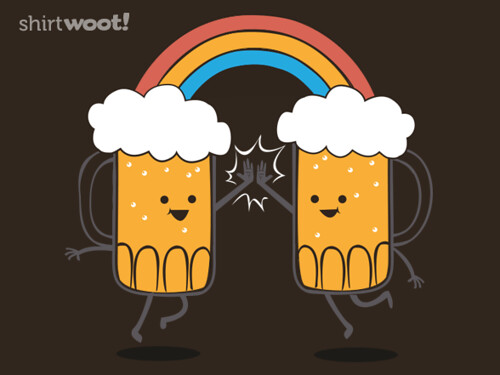
I’m a fan of the website Woot!, which offers special deals, one each day. They’ve since added additional daily deals, such as tech woot!, sport woot!, home woot!, and even kids woot!. Most days, it’s not something I’m interested in or need, but every now and then it’s totally worth it and I buy the daily deal. They also have shirt woot!, where they sell daily t-shirts, too. Generally, those are pretty interesting, a few funny ones, some clever. Today’s is a beer shirt. I personally wouldn’t wear it, but I thought it was interesting. And it’s nice to see beer shown in a positive light, even if just on a silly t-shirt. The shirt is called Two is Better and shows two full mugs of beer high-fiving with a rainbow connecting them. They’re the twin pots of gold, so to speak. Hard to argue with that.

hi-5-beers

Filed Under: Art & Beer, Beers, Just For Fun Tagged With: Business, Websites

65 Major Brewery Projects In The Works

September 27, 2012 By Jay Brooks

factory
According to a press release by the Industrial Info Resources, there are at least “65 major capital and maintenance projects in the beer brewing segment that are under development or recently have started construction.” The public press release is very short, more of a tease really, as they want you to become a member and subscribe to their information. For just $5.95, I could read the terse 290-word press release, or instead I can tell you what they’re willing to tell is for free.

SUGAR LAND–September 27, 2012—Researched by Industrial Info Resources (Sugar Land, Texas)—Beer brewers, both large and small, are pouring investments into building new facilities and expanding existing operations to the tune of more than $800 million. Industrial Info has uncovered more than 65 major capital and maintenance projects in the beer brewing segment that are under development or recently have started construction. Project investment values range from $1 million to just more than $100 million.

Filed Under: Breweries, News Tagged With: Business, Statistics

Craft Beer Grows 14% In First Half Of 2012

August 6, 2012 By Jay Brooks

ba
More great news for craft beer. The Brewers Association announced today that dollar growth for craft beer is up 14% over the first half of this year. For the same period, volume was also up 12%.

From the press release:

“Generally, most craft brewers are continuing to see strong growth in production, sales, brewing capacity and employment, which is to be celebrated during challenged times for many of today’s small businesses,” said Paul Gatza, director, Brewers Association. “Plus it’s a fact that beer drinkers are responding to the quality and diversity created by small American brewing companies. India pale ales, seasonal beers, Belgian-inspired ales and a range of specialty beers are just a few of the beer styles that are growing rapidly.”

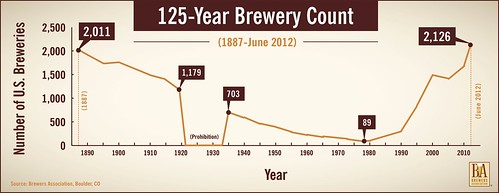
The other piece of great news is the rising number of breweries, with new ones opening seemingly every day. The American brewery count now stands at 2,126, representing 350 new brewery openings since June 2011!

125_Brewery_Count

More from the press release:

The BA also tracks breweries in planning as an indicator of potential new entrants into the craft category, and lists 1,252 breweries in planning today compared to 725 a year ago. Additionally, the count of craft brewers was at 2,075 as of June 30, 2012 showing that 97 percent of U.S. brewers are craft brewers.

“Beer-passionate Americans are opening breweries at a rate faster than at any time since the day Prohibition ended for the beverage of moderation,” Gatza added. “There is nearly a new brewery opening for every day of the year, benefiting beer lovers and communities in every area across the country.”

Filed Under: Breweries, News Tagged With: Brewers Association, Business, Statistics

Firestone Walker Sells Nectar Ales

July 16, 2012 By Jay Brooks

nectar
Yesterday, Firestone Walker Brewing announced that it’s selling Nectar Ales to Total Beverage Solution of South Carolina.

Nectar Ales was originally a line of beers brewed by Humboldt Brewing Company. The brewery was founded by Mario Celotto in 1987 in Humboldt County, California. Celotto was a linebacker with the Oakland Raiders. Shortly after being part of the 1980 Super Bowl team, he retired from football and used his Super Bowl bonus to start the brewery. Steve Parkes, who now owns and runs the brewing school, American Brewers Guild, created the original Red Nectar Ale.

Over lunch with Celotto around 1997, shortly after Frederick Brewing’s Hempen Ale became the first hemp beer, I suggested that Humboldt Brewing should make a hemp ale, it seemed like such a natural given Humboldt County’s reputation. I’m sure I wasn’t the only person to suggest such an obvious idea, but shortly thereafter, Humboldt’s Hemp Ale debuted and has proved very popular ever since. After some financial hardships, Firestone Walker Brewing bought the label in 2003, and has brewed them in Paso Robles ever since.

From the press release:

“It is sad to let these beers go, but production and operational demands will require us to focus on our core line of Firestone beers in the years ahead,” said co-proprietor Adam Firestone.

Added co-proprietor David Walker, “Nectar Ales was always a labor of love and our nod to keeping a pioneer of the California craft revolution healthy. It’s now time, however, for this iconic family of beers to become something more than we are able to provide.”

Total Beverage Solutions (TBS) is primarily an importer and distributor. Their current beer portfolio includes Affligem, Czech Rebel, Fischer, Gosser, Greene King, Maes Pils, Moretti, Mort Subite, Sea Dog, Shipyard, Southampton and Weihenstephan. So I’m still a little confused about the brand’s fate. Will Firestone Walker continue to brew the line, or will TBS take over that aspect of the brand. They don’t own a brewery as far as I can tell so will they have it contract brewed, or what? I made a few calls to Firestone Walker but it is a Monday morning, so I’ll update this when I find out more details.

UPDATE: I spoke to Adam Firestone yesterday and for the near term, Firestone Walker will continue to brew the Nectar Ales line. At some point in the future, he believes that TBS will most likely make other arrangements and will move production but for now, the brewing will remain the same.

Filed Under: Beers, Breweries, News Tagged With: Business

Welcome To The World ABInBevMo

June 29, 2012 By Jay Brooks

abim
By now you’ve already seen the news that Anheuser-Busch InBev has taken another step closer to realizing their quest for world domination in the beer business. They’d already owned half of Mexican powerhouse brewer Grupo Modelo — makers of Corona, among other brands — but it was non-voting stock and they asserted very little control over them. In fact, Corona is often a competitor in the U.S., usually with non-Bud distributors. The irony, of course, is whether you bought Bud or Corona, eventually at least some of that money still made its way to ABI. The phrase “laughing all the way to the bank” springs to mind. Hard as it to believe, they already have a new website up even though the merger’s only been finalized in the last twenty-four hours. The name of the new site is Global Beer Leader. Does anybody else think that sounds ominously close to North Korea’s “dear leader?”

ABI is paying Grupo Model $20.1 billion to become ABIM, making it the second-biggest deal ever brokered in the beer world. The first was the $52 billion InBev paid to merge with Anheuser-Busch in 2008. The deal still needs government approval, and will likely be addressed and decided in the first quarter of next year.

According to the deal, Crown Imports — the current importer of Corona and other Grupo Modelo brands under the Constellation Brands umbrella — will continue to be the importer to the U.S. In fact, part of the deal includes the sale of the half of Crown Imports owned by Grupo Modelo to Constellation Brands, who had owned the other half, for $1.85 billion. That gives them 100% control over the distribution of the Modelo brands in America. ABIM head honcho Carlos Brito told Harry Schumacher this morning that they’re looking at this as a golden opportunity primarily to combine Bud and Corona outside the U.S. in the global beer market.

Adam Nason at Beer Pulse has a helpful chart showing that the merger gives ABIM control over 8 of the top 15 global beer brands, just over half.

Full details of the deal can be found at the new website Global Beer Leader.

abim
NOTE: This NOT their official new logo, I made this up as a parody.

Filed Under: Breweries, Editorial, News Tagged With: Anheuser-Busch InBev, Big Brewers, Business, Modelo

Diageo’s Anti-Competitive Bullying Tactics Revealed

May 9, 2012 By Jay Brooks

Diageo vs. brew-dog
Wow! Just wow. Anyone paying attention knows that the corporate world doesn’t like to play fair if they can get away with it, and they usually can. They bigger they are, the more resources they command, the easier it is to bully, cajole and generally get their way. It gives them an unfair advantage, of course, but that’s the way of the world, from the playground bully to the largest multi-national. Obviously, that behavior is not restricted to the alcohol industry, but since that’s the world I’m most familiar with, that’s where I see it the most. From free t-shirts, tickets to the 49ers and even free kegs, it’s been an underlying current in the beer business for at least the twenty years I’ve been paying attention to it, and undoubtedly far longer. It’s one of those things that everybody knows about but few people talk about openly. But this one is pretty hard to ignore.

This past weekend, while much of the beer world was listening to the World Beer Cup awards being announced, over the pond in Glasgow, Scotland, another award show was taking place. This one was the 2012 British Institute of Innkeeping Scotland Annual Awards, which celebrates “success in the license [pub] trade in Scotland.” BrewDog, whose pubs have been making quite a splash, were up for the “Bar Operator of the Year” award. When it came time for the announcement, the award went to another company. But one of the BII judges was seated at the BrewDog table and cried foul. According to BrewDog’s blog, the surprised judge said “this simply cannot be, the independent judging panel voted for BrewDog as clear winners of the award.” When the alternate winner went up on stage to accept the award, they found that “BrewDog” had already been engraved on the award and refused to accept it.

Yesterday, BrewDog received a call from the BII explaining where and how things went awry:

We are all ashamed and embarrassed about what happened. The awards have to be an independent process and BrewDog were the clear winner.

Diageo (the main sponsor) approached us at the start of the meal and said under no circumstances could the award be given to BrewDog. They said if this happened they would pull their sponsorship from all future BII events and their representatives would not present any of the awards on the evening.

We were as gobsmacked as you by Diageo’s behaviour. We made the wrong decision under extreme pressure. We were blackmailed and bullied by Diageo. We should have stuck to our guns and gave the award to BrewDog.

Wow, right? I give credit to the BII for at least admitting what happened and taking whatever consequences will likely come their way. Diageo, on the other hand, is claiming it was a “rogue agent,” an employee who went too far. The makers of Guinness released this statement today:

Diageo has provided the following statement in response to communications from independent brewer, BrewDog, in relation to the British Institute of Innkeeping Scottish Awards on Sunday 6 May 2012.

A Diageo spokesperson: “There was a serious misjudgement by Diageo staff at the awards dinner on Sunday evening in relation to the Bar Operator of the Year Award, which does not reflect in any way Diageo’s corporate values and behaviour.

We would like to apologise unreservedly to BrewDog and to the British Institute of Innkeeping for this error of judgement and we will be contacting both organisations imminently to express our regret for this unfortunate incident.”

So somebody probably had to fall on their sword and be the patsy for what is more likely business as usual. Pete Brown asked Diageo for a statement, and they responded with the same one that now appears on their website. Pete also added the following:

I’ve got more to say about the increasingly shameless bullying and anticompetitive tactics employed by some (but not all) big brewers, but this one really takes the biscuit. Diageo, having been caught red handed, had no option but to blame it on a rogue element, and we must take them at their word. But does this reveal something deeper about the attitudes of some global brewing corporations?

Since he’s closer to the British (and Scottish) beer business than I am, it will be interesting to hear his take on things in the near future as he promised to expound on this incident and talk about the larger issue of institutionalized influence by the global beer companies. But still, I can’t help but shake my head and just keep repeating, “wow.”

Filed Under: Breweries, Editorial, News, Politics & Law Tagged With: Big Brewers, Business, Guinness

The Top 50 Annotated 2011

April 17, 2012 By Jay Brooks

ba
This is my sixth annual annotated list of the Top 50 so you can see who moved up and down, who was new to the list and who dropped off. So here is this year’s list again annotated with how they changed compared to last year.

  1. Anheuser-Busch InBev; #1 last six years, no surprises
  2. MillerCoors; ditto for #2
  3. Pabst Brewing; ditto for #3
  4. D. G. Yuengling and Son; Same as last year
  5. Boston Beer Co.; Same as last year
  6. North American Breweries; 2nd year on the list, up 2 from #8 last year
  7. Sierra Nevada Brewing; Down 1 from #6 last year
  8. New Belgium Brewing; Down 1 from #7 last year
  9. Craft Brewers Alliance; Same as last year, after dipping down 1 the previous two years
  10. Gambrinus Company; Same as last year, though now listed as Gambrinus instead of Spoetzl
  11. Deschutes Brewery; Same as last year
  12. Matt Brewing; Up 1, after moving down 1 last year
  13. Bell’s Brewery; Up 2 from #15 last year
  14. Minhas Craft Brewery; Same as last year, after dropping 2 the prior year
  15. Harpoon Brewery; Up 1 from #16 last year
  16. Lagunitas Brewing; Jumped up 10 from #26 last year, their second such jump in 2 years, having been at #36 two years back
  17. Boulevard Brewing; Same as last year
  18. Stone Brewing; Up 5 from #23 last year
  19. Dogfish Head Craft Brewery; Same as last year, after shooting up 5 from #24 last year, being up 9, 5 and 4 the three previous years
  20. Brooklyn Brewery; Up 5 from #25 last year
  21. Alaskan Brewing; Down 1 from #20 last year
  22. Long Trail Brewing; Down 1 from #21 last year, after leaping up 14 from #35 the previous year
  23. August Schell Brewing; Down 1 from last year
  24. Shipyard Brewing; Up 4 from #28 last year
  25. Abita Brewing; Down 1 from last year
  26. World Brew/Winery Exchange; Up 11 from #37 last year
  27. Great Lakes Brewing; Up 4 from #31 last year
  28. New Glarus Brewing; Up 2 from #30 last year
  29. Full Sail Brewing; Down 2 from #27 last year
  30. Pittsburgh Brewing (fka Iron City); Up 3 from #33 last year
  31. Summit Brewing; Down 2 from #29
  32. Anchor Brewing; Same as last year
  33. Firestone Walker Brewing; Up 3 from #36 last year
  34. Cold Spring Brewing; Jumped up 13 from #47 last year
  35. SweetWater Brewing; Up 3 from #38 last year
  36. Rogue Ales Brewery; Down 1 from #35 last year
  37. Mendocino Brewing; Up 2 from #39 last year
  38. Flying Dog Brewery; Up 2 from #40 last year
  39. Victory Brewing; Up 2 from #41 last year
  40. CraftWorks Breweries & Restaurants (Gordon Biersch/Rock Bottom); Now combined, last year Gordon Biersch brewpubs were #42 and Rock Bottom was #48
  41. Oskar Blues Brewing; Up 8 from #49 last year
  42. Odell Brewing; Up 3 from #45 last year
  43. Stevens Point Brewery; Up 1 from #44 last year
  44. Ninkasi Brewing; Not in Top 50 last year
  45. BJs Restaurant & Brewery; Down 2 from #45 last year
  46. Blue Point Brewing; Not in Top 50 last year
  47. Bear Republic Brewing; Not in Top 50 last year
  48. Goose Island Beer; Plummeted 30 from #18 last year, after selling their production brewery to Anheuser-Busch InBev
  49. Lost Coast Brewery; Not in Top 50 last year
  50. Narragansett Brewing; Not in Top 50 last year

Some new companies made the list, one from a merger — Gordon Biersch and Rock Bottom — now CraftWorks Breweries & Restaurants, along with Bear Republic, Blue Point, Lost Coast (which had been on the list two years ago), Narragansett and Ninkasi.

Off the list was Straub, Independent Brewers United (IBU), which was swallowed up by North American Breweries, Kona Brewing, which was folded into the Craft Brewers Alliance, and individually Gordon Biersch and Rock Bottom were combined into CraftWorks Breweries & Restaurants.

If you want to see the previous annotated lists for comparison, here is 2010, 2009, 2008, 2007 and 2006.

Filed Under: Breweries, Editorial, News Tagged With: Big Brewers, Business, Statistics, United States

Top 50 Breweries For 2011

April 17, 2012 By Jay Brooks

ba
The Brewers Association has also just announced the top 50 breweries in the U.S. based on sales, by volume, for 2011. This includes all breweries, regardless of size or other parameters. Here is the new list:

  1. Anheuser-Busch InBev; St Louis MO
  2. MillerCoors; Chicago IL
  3. Pabst Brewing; Woodridge IL
  4. D. G. Yuengling and Son; Pottsville PA
  5. Boston Beer Co.; Boston MA
  6. North American Breweries; Rochester, NY
  7. Sierra Nevada Brewing; Chico CA
  8. New Belgium Brewing; Fort Collins CO
  9. Craft Brewers Alliance, Inc.; Portland, OR
  10. Gambrinus Company; San Antonio TX
  11. Deschutes Brewery; Bend OR
  12. Matt Brewing; Utica NY
  13. Bell’s Brewery; Galesburg MI
  14. Minhas Craft Brewery; Monroe WI
  15. Harpoon Brewery; Boston, MA
  16. Lagunitas Brewing; Petaluma CA
  17. Boulevard Brewing; Kansas City MO
  18. Stone Brewing; Escondido CA
  19. Dogfish Head Craft Brewery; Lewes DE
  20. Brooklyn Brewery; Brooklyn NY
  21. Alaskan Brewing; Juneau AK
  22. Long Trail Brewing; Burlington VT
  23. August Schell Brewing; New Ulm MN
  24. Shipyard Brewing; Portland ME
  25. Abita Brewing; New Orleans LA
  26. World Brews/Winery Exchange; Novato CA
  27. Great Lakes Brewing; Cleveland OH
  28. New Glarus Brewing; New Glarus WI
  29. Full Sail Brewing; Hood River OR
  30. Pittsburgh Brewing; Pittsburgh PA
  31. Summit Brewing; Saint Paul MN
  32. Anchor Brewing; San Francisco CA
  33. Firestone Walker Brewing; Paso Robles CA
  34. Cold Spring Brewing; Cold Spring MN
  35. SweetWater Brewing; Atlanta GA
  36. Rogue Ales Brewery; Newport OR
  37. Mendocino Brewing; Ukiah CA
  38. Flying Dog Brewery; Frederick MD
  39. Victory Brewing; Downington PA
  40. CraftWorks Breweries & Restaurants (Gordon Biersch/Rock Bottom); Chattanooga TN/Louisville KY
  41. Oskar Blues Brewery; Longmont CO
  42. Odell Brewing; Fort Collins CO
  43. Stevens Point Brewery; Stevens Point WI
  44. Ninkasi Brewing; Eugene OR
  45. BJs Restaurant & Brewery; Huntington Beach CA
  46. Blue Point Brewing; Patchogue NY
  47. Bear Republic Brewing; Cloverdale CA
  48. Goose Island Beer; Chicago IL
  49. Lost Coast Brewery; Eureka CA
  50. Narragansett Brewing; Providence RI

Here is this year’s press release.

Filed Under: Breweries, News Tagged With: Big Brewers, Business, Statistics, United States

The American Beer Revival

February 9, 2012 By Jay Brooks

usa
Regular Bulletin readers know how much I love infographics, a marriage of data and graphic illustration that shows information in a beautiful and understandable way. So I was thrilled when I got an e-mail this morning from a new Silicon Valley start-up, Visual.ly, whose mission is just that, to create and help others create cool visual charts, infographics and videos.

One of their latest works is The American Beer Revival, created by Nate Whitson. Here’s how they describe it:

Over the last hundred or so years, the brewing industry in the United States has changed dramatically. From the saloon era through consolidation to today’s flourishing craft beer culture, it’s been quite a ride. Take a look at how the small brewer is making quite a comeback after nearly a half century of decline.

But better yet, just watch.

Filed Under: Just For Fun Tagged With: Business, History, Statistics, Video

« Previous Page
Next Page »

Find Something

Northern California Breweries

Please consider purchasing my latest book, California Breweries North, available from Amazon, or ask for it at your local bookstore.

Recent Comments

  • Bob Paolino on Beer Birthday: Grant Johnston
  • Gambrinus on Historic Beer Birthday: A.J. Houghton
  • Ernie Dewing on Historic Beer Birthday: Charles William Bergner 
  • Steve 'Pudgy' De Rose on Historic Beer Birthday: Jacob Schmidt
  • Jay Brooks on Beer Birthday: Bill Owens

Recent Posts

  • Historic Beer Birthday: Conrad Pfeiffer March 7, 2026
  • Beer In Ads #5148: Ach Himmel Mr. Goat March 6, 2026
  • Historic Beer Birthday: Conrad Windisch March 6, 2026
  • Historic Beer Birthday: Samuel Wainwright March 6, 2026
  • Beer In Ads #5147: Frankenmuth Is Michigan’s Largest Selling Bock March 6, 2026

BBB Archives

Feedback

Head Quarter
This site is hosted and maintained by H25Q.dev. Any questions or comments for the webmaster can be directed here.