
Last week, USA Today profiled Anchor Brewery in their Inside Money section as a stellar example of a successful small company with no desire to grow larger and larger like the trap so many other successful companies fall into. The story is in conjunction with the publication of a business book on small companies, Small Giants: Companies That Choose to Be Great Instead of Big by Bo Burlingham, an editor at Inc. magazine. On the same day as the Anchor profile, USA Today also has an article about Burlingham’s new book entitled To grow or not to grow? Some companies decide to stay put. Both are written, naturally, from a business perspective but are a good, positive pieces for craft beer. It’s certainly nice to see that for a change.
AP’s Beer by the Numbers
Last week, quite a number of papers ran a short little filler item from the Associated Press that just listed the following statistics regarding the beer industry and U.S. consumption.
- 1,409: The number of breweries — ranging from brewpubs to national brewers — operating in the United States.
- 306: The number of breweries in California last year, putting the state first in the country. Mississippi was last with one.
- $82 billion: The U.S. sales volume for beer last year. Craft beer — beer typically made in small batches by regional or local brewers — accounted for $4.3 billion.
- 21.3 gallons: The amount of beer consumed per capita last year in the United States. New Hampshire led all states with 31.1 gallons. Nevada, North Dakota, Montana and Wisconsin rounded out the top five. Utah was last at 12.2 gallons.
- 48: The percent of all beer sold in metal cans last year in the United States. Glass bottles followed at 42 percent and draft beer was at 10 percent.
- 84.1: The market share held by major U.S. breweries and noncraft regional brewers. Imports have 12.4 percent and craft brewers hold 3.4 percent.
Beer Goes Wireless
Heineken and IBM, along with a few other companies, have partnered together to test wireless tracking of beer shipments. Dubbed “The Living Beer Lab,” the scheme will allow Heineken to know the exact location of any shipment of its beer, even in the middle of the ocean, using “triangulation techniques of both satellites and cellular base stations to locate exactly where the cargo is.”
The first test is currently underway, with ten containers of Heineken in the water and in transit from both the Netherlands and Great Britain en route to the United States.
According to ZDNet UK, “Integration has been completed with IBM WebSphere service oriented architecture (SOA) to maintain a paperless trail of the beer’s journey from customs in Europe through US customers and into the distribution centre on the other side of the Atlantic. The process will eliminate the need to fill in up to 30 documents on each journey, and could vastly decrease the amount of time the beer spends in transit.”
Here’s a more thorough explanation of how it all works, complete with impenetrable business jargon from The Retail Bulletin:
IBM’s Secure Trade Lane solution will provide real-time visibility and interoperability through an advanced wireless sensor platform and Services Oriented Architecture (SOA), based on IBM’s WebSphere platform. The project’s SOA, called the Shipment Information Services, leverages the EPCglobal network and EPCIS (Electronic Product Code Information Services) standards, so rather than build and maintain a large central database with huge amounts of information, distributed data sources are linked, allowing data to be shared in real time between Heineken, Safmarine and customs authorities in the Netherlands, England and The United States.
In this project, Safmarine will ship ten containers of Heineken beer from locations in both Netherlands and England, through their Customs Authorities, to the Heineken distribution center in United States. Vrije Universiteit Amsterdam will coordinate the project and provide best practices documentation to share across the European Union.
“The Beer Living Lab is setting a roadmap for the next generation e-Customs solutions. We test innovative solutions, based on IBM’s Tamper Resistant Embedded Controller (TREC) and SOA developed by IBM that could revolutionize customs,” said Dr. Yao-Hua Tan, professor of Electronic Business, Vrije Universiteit Amsterdam. “Companies using these solutions could benefit greatly due to less physical inspections by customs; thus these e-customs solutions greatly facilitate international trade.”
According to the Organisation for Economic Co-operation and Development, more than 30 different documents are associated with one single container crossing a border, which equals roughly five billion documents annually. The findings of the project will provide a viable alternative to manufacturers, shippers, retailers and customs administrations as they look to move to a paperless trade environment. Once accepted and implemented widely, paperless trade will support initiatives such as Green Lane, which will eliminate most inspections on arrival, thus significantly speeding up ocean fright shipments and improving the profit margins for shippers.
“Because efficient collaboration is a paramount requirement to making this work, IBM built the Shipment Information Services to address interoperability. If governments around the world are serious about electronic customs and paperless trade, they need to encourage each country to adopt open standards environments to enable collaboration and data sharing throughout the trade lane,” said Stefan Reidy, Manager, Secure Trade Lane, IBM. “The Beer Living Lab project is the first step in building the Intranet of Trade, which will help to substantially improve efficiency and security in the global supply chain.”
Now if only they’d stop using those green bottles that result in Heineken being such a skunked beer most of the time.
Giving the Bishop the Finger
Did you know sex sells? Yeah, me neither. The late comedian and social critic Bill Hicks used to say that the advertisement that big business wants to run is simply a photograph of an attractive woman fully naked and the text “Drink Coke” (or any other company’s slogan). Unlike me, he made it sound funny, of course, but the point is that it’s not really a secret that sex is used to sell almost every imaginable kind of product or service. I had a whole semester on this subject in college, where we were even shown the word s-e-x spelled out in an older version of KFC’s Colonel Sanders logo, along with much else.
Among beer advertisements, especially those of the big breweries, sex is a frequent sales tool from the Coors Twins to St. Pauli Girl. A review of older beer ads will quickly reveal that this is not a new phenomenon, either. Many early breweries used attractive women in their advertising. I’m not necessarily opposed to seeing an attractive woman per se, but when it’s used merely to pander to base instincts and outmoded stereotypes then it’s bad for the beer industry, at least in my opinion. Most of the worst examples of this — Miller’s mud wrestling “cat fight” ad was a particularly bad one — essentially take the position that their target audience is all but exclusively male or certainly male enough that they can safely alienate half the total population. And not just any male, but a certain kind of unenlightened male, the ones for whom Jackass, Beavis and Butthead, Dumb and Dumber, and Beerfest are all high art. Does that make me elitist? Maybe, but I’d rather that than see beer’s image continue to be so unceasingly tarnished.
Not surprisingly, that is outmoded thinking, because the demographics of beer are changing and beer drinking among women is on the rise. Some recent studies show that of the total beer consumed in America, women drank 25% of it. And while it may be no surprise that the age group with the most women beer drinkers is 21-30, the number of women drinking beer who are over age 50 is growing significantly.
But I wouldn’t argue that sexual imagery should never be used in advertising (or art or anywhere else). I don’t think that’s the right solution and frankly I don’t think it possible. Despite fundamentalist attempts globally to suppress sexual awareness and expression, it is a potent part of human nature. Without the sexual urge, we might never procreate and continue as a species so it certainly fills a very vital role in the life cycle.
I would suggest, however, that common sense and a sense of perspective and context might be employed in how sexual images are used, not least of which because we’ll never evolve if advertising continues to keep us wallowing (and literally wrestling) in the mud of our basest primal instincts. The people whose products are being advertised in these ways should have a bit more respect for themselves and their product. Why the big beer companies want to associate themselves with mud wrestling, talking frogs, man law, flatulent horses, etc. is beyond me because it does nothing to elevate the image of their product. Interestingly, when Miller tried to change that carefully created image by using the tagline “Beer: Grown Up,” hardly anyone was buying it. USA Today polls showed a majority of people didn’t like the ads and didn’t think they were effective. Despite Terry Haley, the brand manager for Miller Genuine Draft, saying “[w]e believe in what we’re doing, [w]e’re tapping into a true social trend, and we’re going to stay the course,” Miller quickly dropped the ads, and switched ad agencies, who presumably will return to the puerile.
But the other side of this debate is one of easy offense and our willingness to censor should even only a sole complaint be lodged. Advertisers, advertising and the media generally beat a very hasty retreat when faced with criticism, which is a powerful wedge for organizations and individuals with agendas and an axe to grind. (The media, of course, is paid for by advertising — you may think that you are TV, the magazine and the newspaper’s customer but you are not. Their customer is the advertiser.) For years, organizations with a small, minority membership have caused havoc for the rest of us when they cried offense at one imagined slight after the other. The media landscape for a time was (and probably still is) rife with stories of letter writing campaigns from citizen’s groups in which television shows (and other media) were deemed by these yahoos to be too provocative, too sexy, used too much bad language, showed different morals then their own, and on and on. Basically, much like neo-prohibitionist groups, some people cannot rest until the world is remade in their own image, indeed they cannot tolerate any difference of opinion or alternative (to their own) lifestyle being on display, especially if their children might furtively glance longingly at such imagined hedonism. Worse still, entire entertainment programs have been altered, changed or canceled, books have been banned, and songs have been censored all on the basis of a few complaints or even a single complaint. That 299,999,999 people in the U.S. do not complain seems to carry no weight, or at least far less weight than the single whiner who does. This is literally the very opposite of a democracy, in which the desires of the many are circumvented and denied by a tiny handful of individuals, or in some cases a single person.
This is, of course, true of advertising as well. The hue and cry against much advertising is loud and shrill and seems never to cease. And while I may not disagree with all of it — I’m no fan of a lot of advertising — I find truly reprehensible the impulse to inflict one’s beliefs on the rest of society, as if any person could be certain of the one, true moral compass and way to live one’s life. That anyone pays attention to these nutjobs is a sad commentary indeed on the way our world is heading, but that’s a debate for another day and another forum.
What prompted all of what preceded, is an item reported yesterday by the BBC News in an article titled ‘Provocative’ beer ad criticized. According to the report, a complaint was filed with the UK’s Advertising Standards Authority, an organization that is paid for by the advertising industry and which acts essentially as an ombudsman. That means that people offended by advertising may file complaints and have their cases adjudicated by the ASA. In this instance, a print ad for Bishop’s Finger, a popular beer brewed by the Shepherd Neame Brewery of Kent, England had a complaint filed against it. The ad that prompted the complaint has been removed from Bishop’s Finger’s website, but here is a similar one:
In the offending one, which apparently ran in the magazine Time Out, the woman was seated on a bale of hay and the text read, “I love a good session on the Bishops Finger.” And here are all seven print ads, after the offending one was quickly removed. The name “Bishop’s Finger” has it’s origin in the “ancient finger-shaped signposts that showed the Pilgrims the way to Canterbury Cathedral” that are unique to the Kent area of southeastern England.
It is overtly sexual? Sure. Is it offensive? Not to me, I find it mildly amusing. It does play on the origin of the beer’s name and hearkens back to Chaucer’s time. It uses a pretty obvious double entendre, of course, but it is in context. According to the BBC article, Bishop’s Finger is known for running humorous ads. At least it’s not a scantily clad bikini gal holding a beer for no discernible reason other than to titillate.
The ASA examined the ad for four breaches of the UK’s advertising guidelines and only found that they had violated one, and ruled as follows:
We considered that the text “I love a good session on the Bishops Finger” played on the connotations of drinking and sexual activity. We considered that the woman’s pose was suggestive and concluded that, in combination with the headline text, it was likely to be seen as linking alcohol with seduction and sexual activity.
On this point, the ad breached CAP Code clause 56.9 (Alcoholic drinks).
Here’s 56.9 in its entirety:
Marketing communications must neither link alcohol with seduction, sexual activity or sexual success nor imply that alcohol can enhance attractiveness, masculinity or femininity.
Based on their ruling, the the “Advertising Standards Agency told the beer maker in future to adopt an approach that did not link alcohol with sexual activity.” Okay, I’m sure they’ll get right on that. And given that alcohol and sexual activity are, in fact, linked insofar as sexual activity can be linked with practically anything, I’m not even sure how you could possibly enforce such a perniciously vague standard. Right or wrong, alcohol has been called a “social lubricant” for centuries. That’s one of its roles in society, to pretend otherwise seems dishonest.
But here’s the thing, and perhaps the point of all this — finally — only ONE person in all of England complained about this ad. Only One. Out of a population of more than 60 million people, only ONE person was offended enough to complain. That one person being offended by the ad prompted a full-scale investigation involving who knows how many people, a news article in the BBC, and a major brewer to withdraw an ad from the market. Does that seem reasonable? It sure doesn’t seem so to me. Like many issues of censorship, the person who lodged this complaint could have asked a few friends before starting this ball rolling. Perhaps some friend’s support or non-support might have changed or strengthened their resolve. But even if a 100 people had complained, a hundredfold increase, I would still be skeptical that justice had been served. Perspective has to play in role in looking at issues of censorship and people being offended. I’m sorry this person felt as badly as she (or possibly he, I suppose) claims to have, but that doesn’t mean the whole of England should have to sit up and take notice. Is there anything published in the world today that you couldn’t argue might be offensive to somebody? It’s one thing to be sensitive to the views of others, but quite another to insist the world be inoffensive to all. Every time we pander to such an extreme minority view, however well-intentioned, we fan the flames of intolerance and make it harder for all of us to co-exist. Why can’t we all just have a beer and get along?
Crossing the Red Bridge
I have an article coming out next month in New Brewer magazine about gluten-free beers, so I’ve been watching what’s been going on with this kind of beer for many months. In case you’ve missed this growing phenomenon, celiac disease now effects close to 1% of the U.S. population and people with the disease can’t properly digest glutens, a protein in many common grains, including wheat and barley. This means no bread, pizza, pasta or, most importantly, beer. Here and abroad, there is increasing interest in producing a beer that’s both gluten-free and tastes similar to beer. To date, only a handful of American brewers are making one, with several more in Europe and Australia.
My son, Porter, is autistic and many kids with ASD also have some stomach problems similar to those associated with celiac sufferers. As a result, both are put on gluten-free diets with generally positive effects. Over the past summer, I was talking with Dr. Michael Lewis, who pioneered the brewing sciences program at U.C. Davis, about these beers. He mentioned that Anheuser-Busch was also working on a gluten-free beer and suggested a few people there I should talk to about it. Try as I might, I could not penetrate A-B’s bureaucracy beyond a tersely-worded statement from their P.R. department. They seemed genuinely surprised that I even knew about, despite the fact that Miller’s BrewBlog broke the story in early August that A-B had filed a label registration in Missouri for the beer, called Red Bridge Sorghum Beer, and test batch bottles reportedly had been quietly sampled at MBAA meetings. All Anheuser-Busch was willing to say on the matter was the following:
Our goal at Anheuser-Busch is to make sure every consumer can enjoy the kind of beer they feel best about — it’s that simple. That’s why our brewmasters are continually exploring and brewing a variety of beer styles year round. We are currently brewing a beer made with sorghum and without barley, wheat or oats and we’re still developing the final product.
They were unwilling to provide a sample, show me a label, allow me to speak to the person I knew to be working on it, nada. Needless to say, I wasn’t able to include much in the article. This despite the fact that I had seen and tasted a test bottle, seen a label mock-up, and knew they’d both registered the name and picked up the domain name redbridgebeer.com on July 12. To hear the P.R. flacks tell the tale, it was years away from being on store shelves, if ever.
So it was with a gentle smirk that I received the news today — a rumor at best, from an anonymous source — that A-B would be rolling out Red Bridge Sorghum Beer nationally (not in a test market) on December 18. Is it true? I’ll let you know in just under two months.
This mock-up may or may not be the label for A-B’s new gluten-free beer, Red Bridge.
How Craft Beer Can Save the World
The world’s cup runneth over with living beer traditions. But this vast repository of cultural brewing capital is under attack by global corporations. The top five brewing companies, all of which are American- or European-owned, control 41% of the world market. Perversely, economists and politicians calculate the conquest by industrial breweries as economic growth while the value of small-scale traditional brewing goes uncounted. Much will be lost if this global “beerodiversity” is lost to the forces of corporate-led homogenization.
So begins a very interesting essay at Foreign Policy in Focus (FPIF), a think tank, which, according to it’s website, “brings together scholars, advocates, and activists who strive to make the United States a more responsible global partner.” The essay, The Perils of Globeerization, is by Chris O’Brien, who first contacted me a few months ago to tell about his beer activism at his cleverly titled Fermenting Revolution website. The essay is heavy on foreign policy, big business, history and local traditions of alcohol. It may seem somewhat radical to the more conservative, but it certainly agrees with my own view of how the world works. His take on the history and economics of brewing, and especially how the dominant breweries are effecting brewing traditions across the globe is fascinating. And perhaps most importantly, there are obvious parallels to the craft beer industry in America, as well.
O’Brien also has just published a new book, Fermenting Revolution, too, which is available from the publisher, New Society Publishers, or from Amazon. The subject matter seems pretty interesting, I’m looking forward to reading and reviewing it.
First Stop at The Alembic
Last night after the Anchor event, a dozen or so of us went over to Dave McLean’s new bar, The Alembic, on upper Haight. The address is 1725 Haight Street and their phone number is 415.666.0822. Dave also owns the Magnolia brewpub a few blocks away. It’s a very small place but also cozy and even a little homey. The have a full bar, all of the Magnolia beers and several guest taps from local breweries. The Alembic’s chef, Eddie Blyden, started bringing us out dishes to sample. What terrific food! Good beer, good food, good spirits, good friends and great atmosphere! I look forward to spending more time at the Alembic.
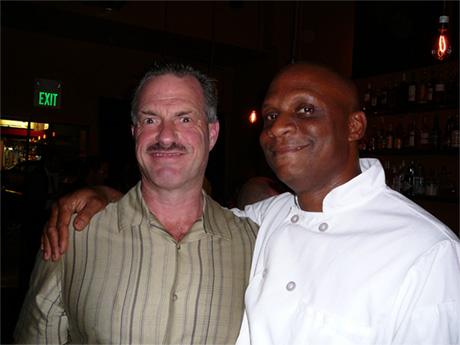
Cathedral Hill Hotel beer chef Bruce Paton and Alembic chef Eddie Blyden, arguably two the best beer chef’s anywhere.

Me with the delicious lemongrass fries, which are done in a Belgian frittes style. My other favorite of the evening were the lamb sliders. Yum!
From the Chronicle:
Small plates from chef Eddie Blyden (of 21st Amendment and now-closed Sneaky Tiki) include charred Monterey Bay squid, and mushroom and autumn squash cassoulet, which vie for a customer’s attention with bar snacks like sage roasted nuts, jerk chicken wings with yogurt sauce, and lemongrass french fries.
The cocktail menu features stripped-down classics like a bourbon old-fashioned and an “old style” Manhattan, and the bar spotlights many Northern California small-craft artisan liquors, a handful of sakes and a rotating selection of local microbrews.
Even the sturdy bar is locally inspired — it’s made from old Kezar stadium bleachers.
Carlsberg to Import Faux Micros
Denmark’s Carlsberg Brewery was founded in 1847 by J. C. Jacobsen. It’s the largest brewery in Denmark by a wide margin, with something like 75% of the market, and is the fifth largest brewer worldwide. Carlsberg beers are sold in over 50 countries. In addition to the flagship Carlsberg brand, they also make Elephant, Tuborg and many others. That makes them the Budweiser of Denmark, in terms of size, market share and dominating business practices.
|
But craft breweries are slowly gaining a toehold throughout the Denmark with over 40 of them currently in operaion plus around 17 brewpubs sharing 2% of the total market. So last year in response, Carlsberg set up the Jacobsen Brewhouse as a separate entity within the main brewery in Valby. As reported earlier this year, by 2008 Carlsberg will be moving all of its production to its Frederica facility, which now mainly brews Tuborg and a few others, and will close the Valby plant. But the Jacobsen line along with the administrative offices will remain in Valby. The new venture is “located in a building dating from 1878 in the old part of the Carlsberg brewery” and part of the Carlsberg Visitors Centre. Undoubtedly this was done to create positive PR for the brewing giant. So like Pacific Ridge, Plank Road and Blue Moon before them, Carlsberg is making “specialty beers” under the brand name Jacobsen Brewhouse. To their credit, they make no secret of this fact and proudly display the Carlsberg logo alongside the newer Jacobsen one. The unique shape of the bottle is based on the old lighthouse building at the entrance to the old brewery and no expense appears to have been spared on packaging and marketing, which is one of the dangers of these type of beers, in my opinion. Currently four styles are being made: Bramley Wit, Brown Ale, Saaz Blonde and Original Dark Lager. And so far three seasonals have been made under the name “Jacobsen Limited Edition” with more to follow. The initial seasonals were Chocolate Mint Stout, Golden Christmas Ale and Imperial Barley Wine. And according to the website, they “will also produce four beers from Carlsberg’s successful Semper Ardens series: Criollo Stout, IPA First Gold, Abbey Ale, Winter Rye and Christmas Ale.” |
Carlsberg just announced that two of the Jacobsen Brewhouse beers, Saaz Blonde and Bramley Wit, will be imported to England this year, and no doubt America may follow. I’ve never tried any of these beers, so I can’t knock their taste. They may very well be fine, well-made and tasty beers.
Here’s how Carlsberg describes these two beers on the Jacobsen Brewhouse website:
|
Jacobsen Bramley Wit Jacobsen Bramley Wit is inspired by the Belgian wheat beer tradition, but with a North European touch in the form of Bramley apples for a flesh, sour flavour and Belle de Boskoop apples for a rounded finish. The Belgian wheat beers use dried orange peel, but we have preferred fresh orange peel for a less bitter impression. Jacobsen Bramley Wit has a light colour, an attractive creamy head and a muted bouquet of cloves and coriander. |
Jacobsen Saaz Blonde Jacobsen Saaz Blonde is brewed according to Belgian traditions for light, top-fermented beers. “Blonde” is the traditional French word for light-coloured beers, while the distinguished Czech malt Saaz with its character of pine needles gives a rounded, aristocratic flavour. Extract of angelica adds a juniper flavour to complement the fruity taste of the yeast. The colour derives from the Pilsner malt characteristic of the Belgian “blonde” tradition, and from a touch of caramel malt to add a slight sweetness. |
But all of this brings up the larger issue of big breweries competing with smaller ones on an uneven playing field. Because not only do they try to compete by imitation but also with their larger resources, bigger marketing budgets and a host of other advantages that make the fight anything but fair.
I have no problem with the big breweries making flavorful beers instead of the same old insipid industrial light lagers that dominate the market worldwide, especially when they disclose who’s making them. I have equally no doubt that the big breweries are technically capable of making flavorful beers.
But the heart of the problem is often that the big breweries are big businesses, very big businesses. And all big businesses share a similar ethos and culture that chant the same mantras. Keep costs (ingredients, labor, etc.) low, manipulate the public through advertising and marketing, grow the business every quarter, and the main one (especially for corporations), keep the share price up no matter what.
So it begs the question why in 2005 did Carlsberg feel the need to create a “specialty line of beer” to compete with a handful of tiny breweries catering to very small segment of the market? Why after almost 150 years of making primarily the same products was this decision made now? According to the propaganda, it was “to give people new taste experiences, and we want to challenge and develop beer culture. It’s about making the most of what nature has to offer.” Uh, huh. Sure it is. But let’s assume brewmaster Jens Eiken, head of the new brewhouse (whose quote that is), really believes that — which indeed he probably does — why now? Why not ten years ago, or 50?
In Carlsberg’s the press release when they initially opened the Jacobsen Brewhouse, Nils S. Andersen, Carlsberg’s President, had the following to say:
“In keeping with Carlsberg’s traditions, this is a full and wholehearted venture. This is not some overgrown microbrewery or an exhibition centre — it’s a state-of-the-art brewery where our brewers’ ideas can be brought to fruition with consistently high standards of quality. After all, this is Carlsberg — which means that we have an obligation to maintain the highest quality even when it comes to specialty products and experiments.
“Naturally the Jacobsen brewhouse can draw on all of our expertise at Carlsberg and on the research results from our laboratories, but Jacobsen is to be its own brewery with both the freedom and a duty to create and produce the best and most exciting specialty products in the world — or at least ‘probably the best’, given that these things are always a matter of taste!”
If you’re a regular reader of the Bulletin, you no doubt already know I view large corporations with a great deal of cynicism. I question their ability to make moral or even fair and honest choices when their legal duty to the shareholders is so strikingly singular. They are bound by legal precedent to do only what is in the best interests of the company, and everything and everyone else be damned. Taken to its logical conclusion, that’s how we ended up with so many Enrons, Adelphias, WorldComs and so on. Institutionalized greed with a legal mandate creates environments that cannot tolerate any competition or any erosion of market share. And last year, many larger breweries began to see their customers abandoning their core brands for craft beer, imports (at least here in the U.S.) and even wine and spirits. So as many countries around the world begin to follow the American model and start their own microbrewery revolutions, the status quo big breweries will react in much the same way as they have here in the U.S.
That’s almost certainly the reason why a multi-national company like Carlsberg, with three-quarters of the market in their home country, would feel threatened by 2% of the beer market shifting to craft brewers. They’re incapable of perspective. It’s not permitted any more than losing even an infinitesimal portion of the market can be tolerated. All of the lofty ideals expressed in their marketing is just propaganda, which is what almost all marketing is in reality. In the early days, pioneers like Edward Bernays called it what it was, propaganda. But Hitler had been very impressed with the U.S. War Department’s Office of Public Information (which was headed by Bernays) and its amazing ability to sway public opinion for war just before and during World War One. In fact, so much so, that he adopted many of the same techniques after seizing power in Germany and as a result the term propaganda took on negative connotations and was superseded by the less tainted “Public Relations,” of which marketing is just one part. But as they say, “a rose by any other name …”
So it’s hard not to view the world’s fifth largest brewer waltzing down the same garden path as A-B, SABMiller and Molson Coors (2nd, 3rd and 6th largest, respectively) with anything but suspicion. The beer may, indeed, be good. It may use no adjuncts and be quite delicious. And, if so, I would not hesitate to drink it or support it as I might any well-made craft beer. By the real underlying reasons for making the beer, propaganda aside, are to maintain control and domination of the market and I believe these Goliaths will try to crush every one of their David-like competitors however they can. They may appear to hold out the olive branch of cooperation, tolerance and even support but look behind their back and in the other hand is very large hammer. The only uncertainty is when the hammer will fall.
The Jacobsen Brewhouse at the Carlsberg Visitors Centre in Valby, Denmark.
Hip Trip Trips Up on Beer Pairings
The Sunday edition of the Philadelphia Inquirer ran a syndicated feature news service for daily newspapers called the Rand McNally Travel News. As near as I can tell, a division of Rand McNally produces travel pieces for a number of prominent newspapers, including the Chicago Tribune, the Dallas Morning News and others. With dwindling readership and severe under-staffing at many daily newspapers as most struggle to remain economically viable these days, they’re increasingly turning to syndicated content to supplement original staff-generated stories. It’s a bit of a self-fulfilling prophecy, in my opinion. As less and less people get their news from newspapers, they turn increasingly to AP, Reuters and other wire services, especially for their national and regional coverage, which has the effect of making them all look more and more the same. This homogenization loses them more readers which in turn causes them to layoff more staff and generate still less original content, which again causes a drop in readership.
Yesterday’s example of this cheap excuse for original content was by Mary Lu Laffey for the Rand McNally Travel News and the name of her monthly series is called “Hip Trip.” It’s apparently travel tips for younger people and presumably younger people with money since they would be the only ones who would plan their vacations. The “Hip Trip’s” tagline advice is simple. “Time and money may be in short supply for many younger travelers. Each month, Hip Trip brings you advice on how not to waste either.”
But whether by accident or design, her article is nothing short of an infomercial where in some cases she acts as a foil to corporate propaganda and at other times displays total ignorance for the subject at hand. It’s as if she took a press release, did no research or fact-checking, added a few sentences to personalize it and then added her byline. Of course, she appears to be writing in the first person as if she actually attended a beer dinner, but what we get is her impressions of the experience, what her host tells her and little else. There’s certainly no questions from Laffey as misinformation and laughable advice flows freely from Brent Wertz, chief executive chef at Kingsmill Resort. The Williamsburg, Virginia resort is, of course, an Anheuser-Busch company, a fact Laffey fails to disclose (or perhaps she’s not even aware of it). But it certainly makes what follows more understandable, if no less absurd. She undoubtedly had her beer dinner at the Eagles Restaurant, which lists three beer dinner menus on their website, one with Budweiser, one with Michelob Ultra Light and one with World Select.
So without further ado, let’s begin the show.
Laffey’s first few paragraphs are doozies, and they set an unquestioning tone that permeates the whole article. Here they are, in their entirety.
Brent Wertz doesn’t flinch as he twists open a bottle of ultra light, low-carb beer and pours it straight down the middle of a chardonnay glass. He tilts his head only slightly as he watches it splash big at the bottom. Wertz says the big splash is necessary to break the carbonation and to open the nose of the beer.
Stemmed glass? Nose? Beer?
That’s a big “yes” from Wertz, chief executive chef at Kingsmill Resort. He plans menus around beer, marinates and cooks with it, and passionately recommends beer whether you’re dining plain or fancy.
That’s a big “whoa” from me. In the bigger picture, does drinking beer with dinner mean I have to put keggers behind me?
Just out of curiosity, do many people “flinch” when opening a twist-off cap? Or is the pouring it into a chardonnay glass that should cause the twitch in her mind? Her next reaction — her quizzical “Stemmed glass? Nose? Beer?” aside — is becoming the standard neophyte knee-jerk in virtually every one of these type of pieces. Some ignorant journalist is shown beer in a different light for the first time (where were all these people living for the last 25 years, in a box? The Moon? Prison?) and their first reaction is always one of great surprise that someone might even be capable of taking beer seriously. Worldwide, people have been drinking beer from stemmed glassware for centuries. And did it never occur to anyone that at least the people making the beer would be smelling it, checking it’s “nose,” to insure they were making a consistent product? How out-of-touch with the real world and common sense do you have to be in order to be surprised that people might smell beer to gauge it’s quality? And finally there’s the kicker reaction, that it’s beer and that someone might think of it as more than cheap swill with no discernible flavors worth talking about. The pervasiveness today of this manufactured stereotype of beer as unworthy is frankly quite astonishing, especially from presumably educated journalists who one would assume would be paying a little more attention to the news than the average person that good craft beer has been around for over 25 years? How could anyone have completely missed that phenomenon to present actual shock when confronted with better beer? But here it is on display again, proving once again that the depths of ignorance in the press know no bounds.
When she gets her “big yes” from Kingsmill’s chef she responds with a “big whoa” and wonders whether she has to give up her apparently precious keggers, I feel like I’ve fallen into “Mary Lu’s Excellent Adventure” and I’m reading the term paper of a failing high school student. How bogus is that? Why she thinks that you can’t have fine beer with a meal and also enjoy beer from a keg in a totally different context is beyond my grasping. Perhaps she thinks there’s only one way to do anything, who knows? And the sentence seems to infer that this is the very first time she’s ever had a beer with dinner! How is that even possible?
Of course, I’m using the term “fine beer” here metaphorically since the only beers mentioned in the article by name are Michelob Ultra Light, Budweiser, and Michelob Amber Bock, not exactly “big” beers by any stretch of the imagination. But to our intrepid author, in her “90-minute sojourn into silver-placed settings on table linen, with stemmed glasses, haute cuisine – and beer” she does just that. She describes “swirling the contents of [her] burgundy glass” with its full-bodied Bud coat[ing] the sides of the glass” and imagined herself “talking about how the big flavor of this big beer exhaled deeper with each twirl.” Stop, stop, my sides are aching with laughter. Okay, no matter how much you love Budweiser it can’t reasonably be called “full-bodied.” Its flavor — if you can even call it that — is so light as to be almost non-existent. But to Mary Lu, this is “big beer” with “big flavor.” I wonder what she’d think of an Old Rasputin Imperial Stout? Or even Sierra Nevada Pale Ale?
For dessert, chef Wertz suggested that they needed “a lager big enough to stand up against chocolate” and gave them Michelob Amber Bock. I hope the double-fudge brownie torte they had for dessert wasn’t too chocolately, because that’s not a beer that can stand up to very much flavor and hold its own. She claims to have “found a rich, full lager that smelled a lot like coffee and caramel.” Uh-huh, that’s not my memory of this beer’s nose. And while I’m generally cautious about using the beer rating websites as a source, I think the Beer Advocate reviews of Michelob Amber Bock are pretty amusing and show a great disparity between the inexperienced beer drinker vs. the more experienced ones. Frankly, her description sounds like it came from a sale sheet provided by A-B.
But let’s turn now to her finale:
What a finale, I thought as I turned my attention to my double-fudge brownie torte. The dessert would put my taste buds to the test. Would they dare use beer in brownies? I bit into the brownie and tasted the caramel sauce that was hiding beneath it. I should have known that even a chef like Wertz would not mess with brownies.
That you’d have to “dare” to use beer in making brownies, implying more broadly that dessert really shouldn’t have beer it, once again demonstrates that we’re back to a high school mentality. Wow, what a revelation. I guess I’ll have to take back all the wonderful desserts I’ve enjoyed over the years made with beer in them. Because beer chef Bruce Paton, among many others, have made some amazing dishes using chocolate and beer. This spring he did an entire chocolate and beer dinner with Chimay and Scharffen Berger chocolate. And chef Eddie Blyden, when he was at 21st Amendment (he’s now at Magnolia), did a terrific multi-course meal in which every dish used both beer and chocolate, including the soup, salad and dessert with Cocoa Pete’s chocolate. And that’s just a small sampling in one city. All across the nation — and the world — people are and have for many years been cooking with beer, including desserts. Beer cook Lucy Saunders, for example, has two recipes for chocolate and beer dishes on her website. This is only news to the monumentally myopic and uninformed.
To be fair, her piece is aimed at young travelers, who apparently in the author’s mind would be as ignorant as she is, and there may be some element of truth to that. I’m no expert on youth culture. But with craft beer’s sales on the rise and a generation of young people turning 21 never having known a time when there wasn’t craft beer, such a position seems harder and harder to maintain. Come on, Rand McNally, why not get some writers who know about beer to write about beer. I double dare you.
Reading About Reading Beer
Don Russell, a.k.a. Joe Sixpack, had a startling piece of news in his latest Philadelphia Daily News column, my hometown beer is making a comeback! Reading (that’s pronounced “red-ding“) Beer’s advertising and merchandising stuff were about as ubiquitous as it gets for me growing up because I spent a lot of my youth in bars with my alcoholic stepfather (there, now you know). My memory of the beer is that it wasn’t any better or worse than most of what was available at that time. And by the time I was paying attention, it was already being brewed outside Reading, in Fogelsville, which at that time was still a Schaefer brewery, if memory serves.
The Reading Brewery opened in 1886 on South 9th and Little Laurel Streets and closed ninety years later in 1976, when I was a junior in high school. As Don points out, it had a very loyal following in the area. As recently as the late 1990s, I was home for a visit around the winter holidays and went bar-hopping with some old friends who were also in town. Most of the bars we went to not only still had quite a bit of Reading Beer breweriana on their walls but several still used Reading Beer and other local brewery coasters. I must confess I even pocketed a couple of them for myself, I was so taken aback that they were still using them and wanted proof.
So the new Legacy Brewing Co. (who are the same folks that previously owned Pretzel City Brewery) have announced that they will be bringing back Reading Beer in all its adjunct glory. (I confess I’d prefer if it was all-malt, but I won’t quibble.) They’ve even set up a new company just to handle the Reading Beer and keep it separate from the Legacy craft beers. Initially it will be draft only but if it proves popular — and quite frankly I can’t see how it won’t be — then bottles (or better still, cans) will follow in wider distribution. According to Russell’s article, since it was first announced in the local paper, The Reading Eagle, last week, the brewery has been inundated with inquiries.
And I must agree with Jack Curtin when he writes “I definitely like the way these guys think” about brewer Scott Baver’s rationale for bringing back Reading Beer.
“Look, we’re brewers. For me, I just love making beer and being part of the beer industry. But we’re business people, so why not make a product that covers every end of the spectrum?
“If my customer wants it, what am I, an idiot for not doing it?”
I know this was just a regional beer even in its heyday, and that very few people are likely to get worked up about it. But since I’m one of them, you’re reading about Reading here.
The can of Reading Beer that sits on a shelf next to where I typed these very words.