

In an effort to promote Vancouver Beer Week, which is set to take place May 10-16 throughout the Vancouver, Canada area, the organizers have created a wonderful video, I Am A Canadian Craft Brewer.
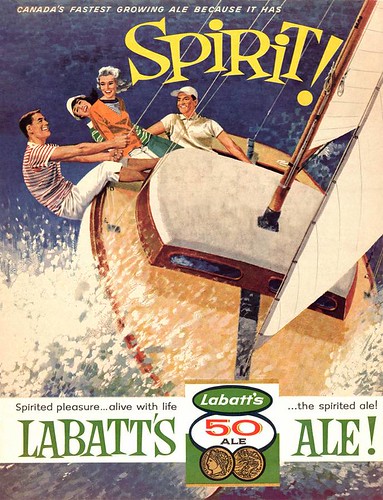
Beer In Ads #89: Labatt 50’s Spirit

Friday’s ad is for a Canadian beer from Labatt’s. Labatt’s 50 Ale debuted in 1950 “to commemorate 50 years of partnership” and until 1979 was their best-selling beer. According to Labatt’s website:
John and Hugh Labatt, grandsons of founder John K. Labatt, launched Labatt 50 in 1950 to commemorate 50 years of partnership. The first light-tasting ale introduced in Canada, Labatt 50 was Canada’s best-selling beer until 1979 when, with the increasing popularity of lagers, it was surpassed by Labatt Blue. Labatt 50 is fermented using a special ale yeast, in use at Labatt since 1933. Specially-selected North American hops and a good balance of dryness, complemented by a fruity taste, provide Labatt 50 with all the distinguishing features of a true ale.
According to the ad copy, it was “Canada’s fastest growing ale because it has Spirit!” I’m not even sure what that means. The artwork looks typical of North American beer ads from the 1950s and so I suspect the ad is from that decade.
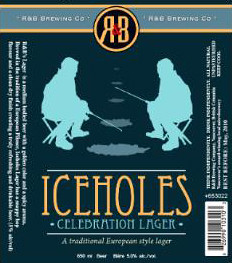
Canadian Iceholes
If you’re a regular viewer of Comedy Central’s Colbert Report, then you’re probably already aware of his mock feud with Canada over ice time for the U.S. speed skating team, which the show sponsored after the team lost its long-time previous supporter due to the economy. The Colbert Nation stepped up and donated thousands of dollars so the show could become the new sponsor. Colbert has featured the team on the show repeatedly. He also featured a story that the Canadian team was in some way keeping the U.S. team off the practice ice, though I can’t recall the exact details of the dispute. At any rate, in response, Colbert launched the Don’t Be An Ice-Hole campaign and even set up a Facebook page.

Now a Vancouver microbrewery, R&B Brewing, has released a new one-off beer, just in time for the Winter Olympics and playing up the feud. The new beer is Iceholes Celebration Lager.
According to Vancouver’s Scout:
For limited release only, Vancouver’s Local Microbrewery, R&B Brewing Co. introduces Iceholes Celebration Lager in response to the recent “Don’t be an Ice-Hole” campaign against Canada started by Stephen Colbert, of Comedy Central’s Colbert Report. Barry Benson, co-owner of R&B Brewing Co. says “ We are proud syrup-sucking Canadian iceholes. In celebration of our icehole-ish behaviour we have decided to get even rather than get mad. Canadians can wreak their revenge against Stephen Colbert in a truly Canadian way and have a beer.”
R&B Brewing Co. Iceholes Celebration Lager is a medium bodied beer, gold in colour with a spicy aroma. Brewed in the tradition of a European Pilsner, Iceholes Lager has a snappy hop flavour and a clean dry finish creating a truly refreshing beer. Iceholes Celebration Lager will be available in 650ml bottles for a limited time only starting February 2, 2010. Consumers can purchase the specialty beer at independent beer stores and local Vancouver restaurants during the month of February.
To which I can only add, as Stephen Colbert would, U-Ice-A! U-Ice-A! Now that’s great marketing.
Beer In Ads #21: Molson’s Crown & Anchor
Wednesday’s ad is from Canada, and was published in 1955. After opening their Toronto brewery the same year, Molson debuted their first lager beer, Crown and Anchor. This ad, featuring dancing sailors, was one of the first ads for the new beer. I wonder what “sparkling light” is?
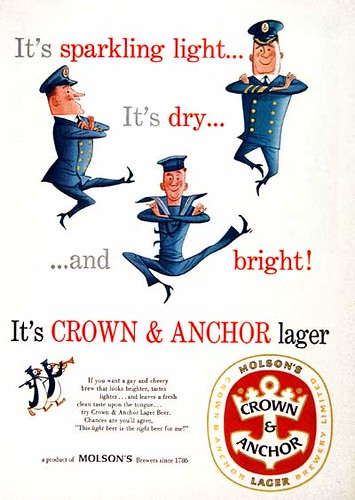
If you can’t read the text, either click on the ad for a larger view or read the transcription below.
If you want a gay and cheery
brew that looks brighter, tastes
lighter … and leaves a fresh
clean taste upon the tongue …
try Crown & Anchor Lager Beer.
Chances are you’ll agree,
“This light beer is the right beer for me.”
Session #33: Don’t Think Of A Pink Elephant

I’ll Have a Beer, a.k.a. Andrew Couch, our host for the 33rd monthly Session, begins his explanation of this month’s topic — framing beer — with a compelling story:
My sister once told me a story she had heard about a sculpture exhibit: on the winter day it opened, the artist placed a coat rack next to the door. Predictably, the patrons hung their coats on it. Each day the artist moved the rack a bit closer to the rest of the exhibit, until the day came when the visitors chose not to use the “piece of art” for their coats. That day the artist placed a sign on the coat rack that stated simply, “Art begins here.”
Framing as a concept has been around a long time in academia as a part of such disciplines as linguistics, communications theory and similar social sciences. But it became more mainstream in 2004 with the publication of UC Berkeley professor George Lakoff’s book on the subject of framing in politics, Don’t Think of an Elephant.
Delirium Tremens’ pink elephant is my allusion to Lakoff’s book, and the idea of framing with regard to beer. But everything we write and say is framed, to one degree or another, as our language is very contextual. What words we choose and how we phrase our communications with one another gives a great deal of information, in some cases as much as the words themselves. The Republican Party is quite skilled at framing their agenda, calling an act that restricts people’s civil liberties “The Patriot Act” or a tax that falls disproportionally on the very rich a “Death Tax.” By calling it essentially the opposite of what it really is — as in say the Clear Skies Initiative that does little to make our skies any clearer — it’s easier to gain support for it since few people bother to look more closely at the substance. Take another example in the news lately: socialized medicine. Opponents of health care reform bandy this term around safe in the knowledge that people have a negative reaction to it. But it is almost meaningless. The term was crated by a PR firm on behalf of the American Medical Association in the late 1940s when Harry Truman had the temerity to try to reform health care then. The Cold War was just heating up and the PR firm correctly figured that by calling it “socialized” people with associate it with communism. This despite the fact that in school we all learned that we’re a social democracy and that the police department, fire department, post office, medicare, social security, unemployment and all manner of programs that make our lives better and few people would want to do without are forms of socialism. No matter, the framing of it has everything to do with how people react to it.
Framing isn’t necessarily as sinister as that suggests, and in fact more often than not it does accurately reflect the intentions of the communicator, especially outside politics. It’s only when framing is misused to manipulate that it takes a more sinister turn. When it comes to beer, not so much. But almost everything about a beer can be described in those terms, from the packaging to the beer’s name, style designation and label.
Couch describes this phenomenon with regard to beer:
Imagine persuasively describing craft beer to someone who has until now entirely missed out, maybe in a sales situation. Perhaps it’s a brown ale and you can can describe the caramel and toast flavors, or it’s a pale ale and you have fruit or herbs from the hops. You might start having to defend yourself if it’s an IPA and those hops taste earthy, resiny, or particularly bitter. You’ll definitely meet some resistance if your favorite is an imperial anything, brimming with intensity and a sharp kick, or if you’d like to convince a person of the credibility of a sour beer or anything for which you must use the word ‘funky’. Each of these descriptions is inevitably an attempt to ‘frame’ the beer, putting the consumer in the proper state of mind to drink it.
For better or worse, in everyday situations beer comes with a label. This label very really ‘frames’ the beer inside. The fact that the beer comes commercially-produced signals the presence of investment (if not skill). A style name or tasting notes indicates the general characteristics to expect. If you know the brewery the beer is framed with your past experiences. Even the label art will affect your expectations for the beer.

Then Couch goes on to the assignment at hand:
What role does this framing play in beer tasting, especially for ‘professional evaluators’? Relate an amusing or optimistic anecdote about introducing someone to strange beer. Comment on the role a label plays in framing a beer or share a label-approval related story. I have not done much blind tasting, and I would be intrigued to hear about this ‘frameless’ evaluation of beer.
And drink a beer. Ideally drink something that you don’t think you will like. Try to pick out what it is about that brew that other people enjoy (make sure to properly frame the beer!).
As for tasting blind, it’s virtually a necessity for competitive judging. Being human, we all bring our prejudices and bias to the tasting table, no matter how much we try to avoid it. I can’t tell you how many times I’ve been surprised to discover what a beer I tasted blind was, freed from expectations and even faulty memories. One of the things that’s stressed at GABF judging is that if you think you can identify a beer you’re sampling blind, keep it to yourself. Not only are you usually wrong, but you’ll unduly influence others at the table. Memory is a curious thing, and I’ve read a great deal about it in the context of courtroom testimony where it’s not nearly as reliable as one might expect. More recent scientific inquiry is revealing just how poorly our memories can be. So anything we can do to remove those and any other bias, goes a long way toward making beer judging better and more fair for the beers being judged.
One of my favorite beers to get people thinking differently about beer and what beer is and can be is Unibroue’s Quelque Chose. When it was more widely available, I used to serve it each year at an annual Christmas party we’d throw before the kiddles came along. Quelque Chose is French for “something different” and that it is. If you’re not familiar with it, Quelque Chose is an 8% abv dark beer fermented with wild cherries and intended to be served hot, around 160° F. Essentially you mull the beer in a pot filled with water. It was originally created to service the ski regions northwest of Montreal and it’s absolutely divine on a cold night.
But what makes it is seeing people’s faces the first time they try a hot beer that also tastes good. It’s priceless because it’s so far removed from their normal experiences with beer. In a sense, they’re so far outside the frame that they’re forced to see beer in a whole new way and, hopefully, it will be difficult for them to go back to the old view. As a result, this beer is perfect for turning people on their head. It can’t fit into the frames of colder and colder beer that the big breweries have been crowing about and the experience should suggest that cold beer is not always better. Actually, I’d argue it’s rarely, if ever, better, but then I feel most American bars serve their beer too cold already, robbing people of all the flavor they should be enjoying.
I think the usual frames — beer styles, labels and reputations — are double edged swords that are equal parts good and bad, depending on specific circumstances. All we can really do is be aware of them and how they influence us.
Beer Without Borders?
There was an interesting little piece in Canada’s McGill Daily today, about their alcohol laws. I knew about them to some degree and was at least aware that beer from one province couldn’t necessarily be sold in another without a high tariff. Essentially it’s the same as if you couldn’t sell beer from Oregon in California without a ridiculously high tax that made, for example, Deschutes Black Butte Porter as expensive as Westmalle or Chimay. Naturally, it was done this way to protect local and regional businesses from outside competition but it seems weird that Canada would feel that way about their own provinces. But perhaps we just take the interstate commerce laws we have here for granted. Are the majority of other countries set up with porous state borders or are they protectionist? I’ve never really looked at that, does anybody know? I’ll be interested to hear what my Canadian friends think about this. Stephen? Alan? Greg? Anyone else?
Planting a Beer Garden
There was an amusing little spoof on the Canadian humor site The Toque called “Plant Your Own Beer Garden.” They suggest simply planting the bottles in the ground, but caution against “over-planting. Too many beers in one garden will result in a watery, low-alcohol “lite” beer.”
It’s Raining Men … and Beer
UPI has a funny story that happened Saturday night — where else but in Canada — in which a woman was saved from serious injury by beer. At an NHL match between the Calgary Flames and the Vancouver Canucks, Glennis Bradshaw felt beer splatter on her head, which understandably caused her to bolt upright in her seat and look up. As she did, a man fell from the balcony above, landing on her lap instead of her head as would have happened only a split second before. Apparently two men in the upper level both slipped while carrying beer back to their seats and fell over the railing. One landed on Bradshaw, breaking an ankle and knocking himself unconscious, while the other landed two rows ahead without injury. Glennis Bradshaw’s thigh was bruised but was otherwise okay, noting “it’s not often young men fall in my lap. Thing is, normally I’d like them conscious.”
Faux Canada
According to an article in today’s Montreal Gazette, Canadians are increasingly looking to buy better tasting beer. And like their American cousins, the big Canadian breweries are flooding the market with faux or stealth microbrews in order to compete with craft brewers. With these faux craft beers, they’re trying to fool customers into thinking they’re getting just want they want, a beer that’s been hand-crafted to taste great.
Labatt has a line called Alexander Keith, named for an early brewer in Nova Scotia. MolsonCoors, likewise, has Rickard’s family of brands. Both Rickard’s and Keith’s are listed on their respective company websites and acknowledged as their brands. Alexander Keith’s own website does disclose that it’s a Labatt brand, but only in the legal stuff like “terms of use.” They certainly don’t go out of their way to associate themselves with the parent company.
An interesting parallel, though the article goes on to discuss tarrifs between provinces and what their removal will mean for small players. I don.t know enough about the market to form an opinion, but it’s an interesting read.
Alexander Keith’s IPA, owned by Labatt; and Rickard’s Red, owned by MolsonCoors.
Canadian Brewery to Donate Beer to Compatriots in Afghanistan
The Steam Whistle Brewery, of Toronto, Canada, has announced its employees have decided to send a week’s worth of their beer rations, an employee benefit, to Candian soldiers stationed in Afghanistan. The company has stated that they’ll match the employee donations. According to the The Canadian Press, “troops are allowed to have liquor on the base three times during the year, including Christmas,” even though as a Muslim nation beer is hard to come by.
Canadian troops will receive limited edition Steam Whistle pilsner holiday twelve-packs like the one pictured here.