Brookston Beer Bulletin

Jay R. Brooks on Beer

  • Home
  • About
  • Editorial
  • Birthdays
  • Art & Beer

Socialize

  • Dribbble
  • Email
  • Facebook
  • Flickr
  • GitHub
  • Instagram
  • LinkedIn
  • Pinterest
  • RSS
  • Twitter
  • YouTube

Powered by Genesis

Greene King Visits the Clue Farm

April 5, 2007 By Jay Brooks

The Publican is reporting that Greene King is going to subject its decision to remove the locally brewed Harvey’s Best Bitter from the Lewes Arms to an “internal review” where most expect that decision to be reversed. Though no timetable has been set, Harveys will once more be sold at the pub most likely within the next few weeks.

From the Publican article:

Adam Collett, marketing director for Greene King’s managed pubs, acknowledged his company had “underestimated the strength of feeling which led to many locals boycotting what was once a great British pub. As a result, it has lost some of its character and greatness.”

Although he defended Greene King’s right to remove the beer from the pub “and, where we choose, not to sell rival beers”, he admitted the group “did not fully appreciate its special position in Lewes as the former ‘Brewery Tap’, or take into account its history and traditions”.

Sure they did, just a simple misunderstanding. They’ve been completely belligerent and intractable throughout this episode, to say now that they just didn’t “fully appreciate” how locals felt about their local beer is more spin control. They knew exactly what they were dealing with from almost the beginning, but they believed they could outlast the boycott and they also didn’t count on the publicity the story generated. The PR backlash was so bad that it probably led to former marketing director Mark Angela leaving over his handling of what became a “public relations nightmare” and the restructuring of the managed pubs division. Collett, who replaced him, was undoubtedly tasked with fixing the Lewes problem. Naturally, Greene King denies this scenario. It was just a coincidence is what they’ll probably say. I guess Angela just wanted to spend more time with his family, that’s a common reason given by exiting executives.

Notice that even within the conciliatory reversal of position, Greene King retains the bullying language that they will do whatever they want and “where [they] choose, [will] not [to] sell rival beers.” To me that signals a company desperately wanting to fix its negative public image but without changing its corporate culture in any meaningful way. They may have bought a clue in this particular instance, but it probably won’t help them if they face similar opposition at another location.

I’m certainly happy for the people of Lewes who fought for their local heritage. Getting a big company to see reason and be a better corporate citizen is no easy feat. It’s proof once more that sufficiently motivated groups of organized people can successfully challenge institutions, and that makes the world a slightly less depressing place. Congratulations to the Friends of the Lewes Arms. Next time I’m across the pond, I’d like to stop in the Lewes Arms and have myself a pint of Harveys.
Filed Under: Editorial, News Tagged With: Business, Europe, Great Britain

Snobs, Geeks and a Pinch of Hypocrisy

April 3, 2007 By Jay Brooks

A Bulletin reader (thanks Garrett) sent me this article by Ben McFarland from the British trade magazine, the Publican. McFarland is a two-time recipient of the title, “Beer Writer of the Year,” an honor bestowed on him by the British Guild of Beer Writers. If you’re in America you probably haven’t heard of him, because he writes primarily in England and in trade magazines, rather than consumer publications.

I recently invited him and some colleagues to join me in judging Imperial IPAs at the Bistro’s annual Double IPA Festival. He seemed an affable enough chap, though I didn’t get a chance to talk with him at length. He was in America working on a CAMRA book for British tourists wanting to visit our west coast beer scene. So I confess I was more than a little surprised by the tone of this recent article, “Look out for the beer snobs.” I think my first reaction was something along the lines of worry. As in, oh dear, did he recently suffer a blow to the head?

This is a subject somewhat near and dear to me, as I only recently wrote an article on beer geeks for the new Beer Advocate magazine. Since I use words on a daily basis, like any writer, I probably pay more attention to them, their meanings and how they’re used than the more normal person does. As a result, I became fascinated by the uses of the terms “beer geek” and “beer snob.”

The origin of snob, for example:

Originally, a snob was someone who made shoes, a cobbler, before migrating to a person of the lower classes who wants to move up and then on to its present meaning of a person who places too much emphasis on status or “a person who believes that their tastes in a particular area are superior to others.”

Occasionally, you hear beer fanatic, beer enthusiast, beer aficionado or hophead, but for me they never seem to quite strike the right chord. Despite my personal feeling that a new term needs coining, geek still appears to be the preferred term. Quoting myself, again:

Most of us prefer to be known simply as beer geeks though, oddly enough, the word geek meant originally a fool and later referred to the lowest rung of circus performer, one who may even have bitten the heads off of live chickens, as popularized in a 1946 novel, “Nightmare Alley,” by William Gresham, about the seedy world of traveling carnivals. In that book, to be a “geek” was to be so down and out that you’d do virtually anything to get by, no matter how distasteful or vile.

Like many old words that were primarily derogatory, its meaning has now been turned on its head. Beginning probably with the original new nerd, the computer geek, it was taken back as a source of pride. So today there are band geeks, computer geeks, science geeks, film geeks, comics geeks, history geeks and Star Wars geeks, to name only a few, all of them proud to call themselves geek, because of the shared passion that is so central to its modern meaning. Today a geek is an obsessive enthusiast, often single-mindedly accomplished, yet with a lingering social awkwardness, at least outside the cocoon of their chosen form of geekdom.

But while there may be some general disagreement about the preferred term to call ourselves, most would agree, I think, that geek is the more gentle term and snob more derisive. At least all my anecdotal research seems to suggest that. I find that I’m most often a beer geek but consider that when I veer into obnoxiousness — oh, yes, it happens more often than I’d like — that I’m acting like a snob. For me, that seems the general distinction though there are certainly times I feel just as proudly snobbish as geeky.

Given that McFarland is by all accounts a good writer, he begins his little screed by admitting that although “beer is undoubtedly a truly wonderful drink there’s really no need to wax quite so lyrical.” “Quite so lyrical?” Quite so lyrical as whom? Who gets to decide how far is too far? Ben McFarland? Are we all to use his gauge of what is gong too far, because he offers no other or more general rules of thumb by which to police ourselves. Is Stephen Beaumont, Fred Eckhardt or Michael Jackson’s writing too flowery, too imbued with nuance or introspection? Do we who take money for our words get a pass for being lyrical or is everyone so cautioned? Or is he simply taking a cue from the Mike Seate playbook of inflammatory journalism where it’s enough to simply be outrageous without really being able to back it up? Where it’s enough to simply wind people up and watch the hit counts soar.

McFarland continues:

Beer, thankfully, has always lacked wine’s academic airs. Beer is the solace of the everyday chap and, quite frankly, can’t be doing with such excessive introspection. OK, so beer education is important, but there’s never been and still isn’t such a thing as a ‘Master of Beer’. Quite right too — anything that requires holding a pen or scratching a chin is using a hand that could be clutching a pint.

There’s a difference between academic airs and being able to describe how something tastes — no easy feat — by just grunting. He seems to be suggesting that beer writers must stick to unlyrical terms or else he’s saying we should say nothing at all. And that helps who exactly? And as for this “solace of the everyday chap” bullshit, I am sick to death of this insulting argument. Mass-produced beer-like industrial products may indeed be the drink of a large portion of the masses, but that’s not the only thing beer is. Beer is not just one thing. It’s not the same to every person, nor should it be.

He goes on:

That’s not to say that beer is entirely without its pomp and pretentiousness. As beer has climbed the social drinking ladder, so too has the number of self-important beer snobs whose lexicon is becoming increasingly ludicrous.

You know the type: grandiose swirling of the glass; ostentatious inhalations; unnecessarily opaque and absurd verbal acrobatics; haughty guffawing at the word ‘lager’; and patronising dismissal of any beer that isn’t brewed by a 16th century monk with a limp.

We all apparently know the type he’s referring to:

  1. grandiose swirling of the glass: By all means, let’s not swirl the glass to release aromas. That wouldn’t be cricket apparently, especially not for the everyday chap. Let’s keep those aromas locked inside. Good plan. Or perhaps it’s just the “grandiosity” he objects to. If so, I’ll have to watch my swirling arm very carefully for fear of descending into the realm of a circus freak. I wonder where the point is where swirling becomes “grandiose?”
  2. ostentatious inhalations: Uh, oh. We’ve got the same problem here. When does smelling the beer become too ostentatious for Ben? I won’t be able to sleep tonight if I risk upsetting his delicate sensibilities of smelling propriety
  3. unnecessarily opaque and absurd verbal acrobatics: Again, who gets to decide when a description is too dull or unintelligent or when the words turn absurd.
  4. haughty guffawing at the word ‘lager’: This must be a British thing, because I’ve never heard anyone guffaw haughtily or otherwise.
  5. patronising dismissal of any beer that isn’t brewed by a 16th century monk with a limp: Sure the limp is important, but I think anyone who’s been dead for five centuries would probably have a limp of some kind. I know McFarland’s merely waxing poetic to make a point, albeit a labored, somewhat unnecessarily opaque one, and therein lies the rub, and the pinch of hypocrisy.

And on:

The fact of the matter is, these condescending clowns are, so far as I can tell, incapable of describing what’s in their mouth or on their nose with any degree of accuracy.

Hmm, now that sounds like “a person who believes that their tastes in a particular area are superior to others.” Because in order to so definitively know that such people are “incapable of describing what’s in their mouth or on their nose with any degree of accuracy” one would have to be a snob, wouldn’t one?

And that’s why this whole things seems laced with hypocrisy on several fronts. First, most beer writers, McFarland included, simply by virtue of doing so much tasting over time probably do have better palates than the “everyday chap” who sticks to one brand his whole life. So that alone makes him something of a snob already, even without the disdain.

Then there’s the desire to keep beer descriptions simple and without lyrical prose. Clearly, any description of anything can go so far in trying to be clever that its meaning is obfuscated … sorry, becomes unclear. Does that mean we should only use short, simple one-syllable words in our descriptions, only describe a beer by comparing it to another beer, or dumb it down for the “everyday chap” he assumes the reader to be? To me, that seems a huge mistake that takes us back several steps. There should be beginner’s books that use simple terms for the inexperienced but a developed palate demands better, more thorough descriptions that also include the beer’s more subtle complexities. Not all sports writing assumes the reader knows nothing, but is written for different levels of understanding in different contexts. The same is true for business writing in the evening paper versus a business magazine, or even in USA Today versus the Financial Times. The writing is tuned to the presumed sophistication of the average reader. Since McFarland admits that “beer has climbed the social drinking ladder” (a condescending remark if ever there was one) why would anyone think the way beer is talked about or written about would not change, too? That he finds the beer snob’s “lexicon is becoming increasingly ludicrous” is entirely his own problem.

Then let’s not forget the irony of the initial complaint that “[w]hile beer is undoubtedly a truly wonderful drink there’s really no need to wax quite so lyrical” as he proceeds to wax this way and that way throughout the article. Using phrases like “ostentatious inhalations” for sniffing or “unnecessarily opaque” for dull or unintelligent is not waxing lyrical? McFarland may indeed be a terrific writer who uses, ironically, very lyrical prose. I just wish he’d come up with something more constructive to write. I feel like I’m attacking a colleague and it causes me no small amount of pain to do so. So Ben, if you ever do read this, I’m truly sorry but I felt it necessary to write this strong rebuttal. Perhaps I went to far, but as reasonable men may differ, I sincerely believe your words are damaging to the idea that beer is worthy of respect in how it’s enjoyed, perceived and talked about. That it’s discussed at all in print and in the pub is why you and I have a job. I don’t always agree with the way people talk or write about beer, either, but I’m content that they are.

McFarland ends his piece with this final thought.

Sure, beer is just as complex as wine in its aromas and flavours but let’s just shut up and drink it, shall we?

Good idea. You first.

Filed Under: Editorial Tagged With: Europe, Great Britain, Tasting

Heineken in Takeover Bid for Scottish & Newkie

March 31, 2007 By Jay Brooks

According to today’s Scotsman, Heineken is the leading contender in a takeover bid for the world’s tenth largest beer company, Scottish & Newcastle. According to S&N’s website, in Europe they’re the fourth largest brewer in volume terms and the number two in profit terms. I believe Heineken is number one in both.

The article relates some interesting history of breweries in Edinburgh and though it alludes to pictures of these old breweries, does not include them in the online version. Though S&N no longer operates a brewery in Edinburgh, they do still employ around 1,000 people there locally. The Scots, naturally are not thrilled at losing so large a company, but S&N long ago lost sight of any sense of community to the areas where they originated and eventually built their empire so it’s hard to get too worked up about this one.

The old Scottish & Newcastle brewery in Fountainbridge, Edinburgh, taken in 1992. The brewery was closed in 2005. This cool photograph was taken by Peter Stubbs and can be found on EdinPhoto, a website dedicated to photographs of Edinburgh and Scotland.

Filed Under: News Tagged With: Business, Europe, Great Britain, International

Vending Beer

March 29, 2007 By Jay Brooks

Two years ago, two business entrepreneurs had an idea to get beer into the hands of more people, 24 hours a day, 7 days a week. They talked to Pilsner Urquell, who agreed to bankroll the pair. The idea was simple enough. Vending machines currently dispense almost every thing under the sun already, from a pack of gun to expensive iPods. Why not beer? And actually beer is already dispensed in vending machines in some places, Japan for example, as shown below. Notice they even dispense beer bottles, too.

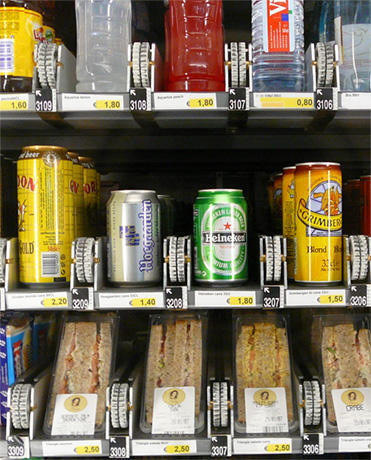
And in other places in Europe, such as the train station in Brussels, where I snapped this picture in January. Along with a wide array of food and other beverages, for a few Euros you could get a can of Hoegaarden, Heineken or Grimbergen beer.

And when I was in the Army in the late 70s, stationed in New York City, we had a vending machine in our day room that dispensed cans of beer for a few coins, something like 50 or 75 cents. But that’s a relative rarity here in the U.S., where we’re completely out of step with the rest of the civilized world in our approach to alcohol. For example, we have no problem showing bloody scene after scene of violent murder and death on television, yet it’s illegal to show someone drinking a beer. The idea is, as I understand it, showing people drinking might lead kids to take up drinking. So using that logic, does that mean it’s okay if our youth turn into murdering psychopaths? It does say something profound, I think, about our priorities as a society though, and especially how screwed up they are. Death, murder, and crime: perfectly acceptable as entertainment. Alcohol: gasp, oh no, not that. Don’t show that. People might get the idea that having a good time is okay.

In the Czech Republic, where per capita beer consumption is the highest in the world, the only problem with a beer vending machine is how to keep people under the age of eighteen from buying it, so Karel Stibor and David Polnar came up with a solution, a card reader that solves this basic problem. From the Prague Post report:

“We’ve developed a special reading device that can scan buyers’ IDs and passports, in order to determine their age,” Stibor explains. “If a buyer is under 18, coins inserted in the machine’s slot are returned and the machine does not dispense the beer can.”

The scanner recognizes not only Czech IDs and passports, but also all EU cards.

The developers have applied for Czech and international patents and would like to offer the technology to other businesses where the age of customers is a factor.

“This technology can also be applied to door systems, turnstiles, gaming machines, Internet terminals or cigarette vending machines,” Polnar says.

Curiously, the most obvious American objection isn’t even mentioned. If someone tried this here, the hue and cry would undoubtedly be about how easy it would be for kids to borrow or steal their parents or another adult’s I.D. In the Czech Republic (and most of the rest of Europe) that’s not even an issue because alcohol is not the stigmatized taboo it is in the U.S. So this might actually work in Europe, but it would requite a paradigm shift in thinking before it would be viable here.

Filed Under: Editorial, News Tagged With: Business, Europe, International, Law

Lewes Arms Boycott Reaches 100 Days, Greene King Still Clueless

March 27, 2007 By Jay Brooks

I wrote about this before, the residents of Lewes, in East Sussex, England, have been boycotting their historic local pub, the Lewes Arms, because the new owner, Greene King, stopped serving Harveys beer, which is brewed just a few blocks away. The locals have set up a protest website, the Friends of the Lewes Arms. According to the British newspaper, Argus, the boycott today has been going on for 100 days and shows no signs of slowing down. In a prepared statement, Greene King shows how clueless they really are. And mind you, that means it’s not just a spokesman responding to an Argus reporter’s inquiry extemporaneously, off the top of his head. Somebody actually thought long and hard about what to say, probably going through several drafts before being satisfied with the final language to represent the company’s position. So let’s examine what the spin doctors came up with:

“All over the country, brewers sell their own beer in their own pubs — it’s a practice as old as the pub itself.

We recognise that some of our customers at the Lewes Arms don’t accept this practice but we are proud of our wonderful beers and proud to sell them.

Greene King is one of the biggest supporters of community pubs in this country. Last year we invested nearly £40 million on improvements to our pubs.

The direct feedback we receive on a daily basis is central to the way that we shape our service and our pubs.

We have been serving communities by running great pubs for more than 200 years and intend to carry on doing so for another 200 whatever challenges are thrown our way.”

So let’s look at this so-called statement:

  1. Brewers selling their own beer in their own pubs — “it’s a practice as old as the pub itself.” So what? I’m all for tradition when it’s a good tradition but the tied house rule is a terrible tradition and what’s more is why the English pub scene is so dire today. Because large companies are buying up pub chains and turning them into the fern bars of England: they all look the same and have the same beers in them. Yawn. I talked to Roger Protz about this in January when I was in London and he was adamant that these big chains were killing the good pubs.
  2. “We are proud of our wonderful beers and proud to sell them.” Go ahead, be proud, but don’t be stupid. Can Greene King really be so thick as to think this argument carries any weight whatsoever in Lewes? Is it really possible so shrewd a business could actually be this monumentally stupid? Doubtful, but this arrogant and clueless, well there you have me. When not biblically excessive, pride can be a wonderful thing that shows one’s own dignity, importance, and civic loyalty. So what should the people of Lewes be proud of? Hmm, let’s see. How about the local brewery that has been there for over 200 years, employing local residents and bringing all manner of economic benefits to the town. Should a small town support their local businesses that in turn make where they live a good place to be? I guess to Greene King, pride is only useful if it’s their kind of pride, the first person kind. Third person pride, as in what others might be proud of, well that just gets in their way.
  3. They’re the “biggest supporters of community pubs in this country” and spent almost “£40 million on improvements to our pubs.” Talk about a disconnect. They spent 80 million dollars to fix up their own places that they own. Well, whoop de f-in’ do! I bought flowers and planted them in my front yard. Does that make me a community supporter? I can’t really see how spending money maintaining their vast property holdings of pubs can equate to supporting communities. They’re spending the money on themselves, to improve their business. They’re not spending that money on the communities where those pubs are located. As this episode so nicely illustrates, they don’t give a rat’s arse about the local communities where Greene King pubs happen to be.
  4. Daily “Direct feedback” shapes their “service and [their] pubs.” And not just peripherally, but it’s “central” to how they run their pub business. There are kinder, gentler words for what this kind of language is; propaganda, PR, spin. But I think we can dispense with such euphemisms given how insulting this rhetoric is and call it by it’s true name, a lie. And not a little white one, but a great big whopper of a lie. I’d say they’ve been getting some pretty direct feedback about their service and their pub in Lewes for the past 100 days. Their response has not exactly been to listen carefully to their customer and shape their service there accordingly. Even with an estimated 90% drop in business at the Lewes Arms, Greene King refuses to give in to consumer demand. Now that’s customer service.
  5. For 200 years, Greene King has been “serving communities by running great pubs” and they will continue to do so “for another 200 whatever challenges are thrown our way.” Which is another way of saying F-you, Lewes, we’ll do whatever the hell we want. It’s pretty hard to accept that the community is best served by doing exactly what the community (including the mayor, the local MP and many prominent townspeople) does not want them to do and has quite explicitly asked them not to do. And as for this 200 years proclamation, I suspect that’s utter nonsense. I’m sure Greene King the brewery has been around that long, but for most of those years they owned local pubs around the Suffolk area. It probably wasn’t until around the 1980s that they started expanding rapidly to the point where today they “employ nearly 11,000 people, have a pub estate of around 1,700 houses, and operate distribution depots in Abingdon near Oxford, Crayford in Kent, and Northampton.” So “serving communities” outside their home area is most likely a relatively new phenomenon. According to their website, their “objective is to become the leading pub retailer-brewer, in terms of profitability and market share, in the south of England.” Notice there’s no mention of communities in that mission statement. Greene King pubs were all but ubiquitous during my last trip to London this January, and the city was much the poorer for it. We had to actively look for pubs with a decent and varied selection, and it was not an easy task. In recent years, they have bought out brewery/pub chains Belhaven, Morland, Ruddles, Ridley’s and Hardys and Hansons. Of these, only the Belhaven Brewery is still operating, meaning they shut down at least four historic breweries in their drive for domination. CAMRA has frequently lambasted them for their business practices.

So at every line of Greene King’s response to the Lewes Arms boycott they have not been truthful or even shown any understanding. This is the way of modern corporations, and it’s more than a little sad to see it so nakedly on display. I have nothing personal against Greene King or their beers, but this whole thing leaves a bad taste in my mouth. And I don’t think it can be washed down with a Greene King beer anytime soon.

Filed Under: Editorial, News Tagged With: Business, Europe, Great Britain

Lewes Arms Boycotts Greene King

March 8, 2007 By Jay Brooks

The small town of Lewes, England (population @16,000) is located near the southern coast, due south from London in the district of East Sussex. It’s also home to Harvey’s Brewery, which has been there along the Ouse River since the late 1700s. According to an e-mail I received from Florrie, a Lewes resident, Greene King‘s Pub Company, which bought the Lewes Arms eight years ago, has dropped local brewer Harvey’s from the pub. A website has been set up by the “Friends of the Lewes Arms” to help bring back the local beer to the local pub. Here’s what the locals have to say:

The Friends of the Lewes Arms are campaigning to have Harveys beer, brewed in Lewes, restored to their local pub.

Greene King own the pub and after eight years of failing to sell their own beers in competition with Harveys defied the regulars by withdrawing Harveys completely. This was despite a 1,200-signature petition and a campaign led by the local MP, Norman Baker, and the Town Mayor, Merlin Milner.

The campaign includes a successful boycott which has cut trade to a fraction of previous levels. Volunteers maintain a vigil outside the pub at what used to be peak times.

We continue to appeal to Greene King to restore Harveys to the Lewes Arms and save the remarkably diverse group which used the pub as a communal living room.

As recently as last November, the Lewes Arms was a vibrant, quirky pub, crammed to the rafters at busy times and no doubt highly profitable.

The campaign has nothing to do with the company which brews Harveys. It has everything to do with local communities, genuine local pubs, and consumer choice and all things Greene King claims to support.

We are keen to make contact with other pubs and communities who feel they have suffered at the hands of Greene King, for whatever reason.

The Harveys Brewery in Lewes.
 

This is one of the reasons that the landscape of authentic British pubs is fast becoming a distant memory. The tied house system that exists in the UK is undermining communities and diversity. It makes perfect sense that a small town would want to support one of their local businesses by drinking their beer. Undoubtedly Harvey’s employs a number of the local residents and pours money back into the local economy. That a large corporation could care less about that is an unfortunate facet of our modern business-dominated society. One has to wonder why Greene King cannot understand the local loyalties at work here and accept that fact as a part of doing business in a town with a local brewery.

Or perhaps they can indeed understand it but ignore it in the drive for ever more growth and profits as irrelevant. But it’s this very insistence of profits before people that so undermines what’s really important in our world. I think it’s a sad fact that most people see work as a necessary evil that must be done to further more important ends, such as putting food on the table, raising and educating their children, and putting a roof over their heads. Few people, I think, truly love what they do for a living. It may be a cliche, but it’s still true that nobody ever said on their deathbed that they wished they’d spent more time at the office. Yet business increasingly sets the agenda of how are lives are shaped and managed in a bewildering array of ways.

Otherwise, how is it possible that an entire community, including the local government, can come together and make their wishes known only to have them completely ignored by a business entity wanting to business in that community? It’s not as if the pub wasn’t profitable (at least according to what I’ve read), but as far as I can tell, Greene King simply wanted to make more money by offering only their own beer instead of having to buy the Harvey’s locally. Plus, their own beer hadn’t been selling in the pub, either, which was undoubtedly costing them money in spoilage. Now a smart Publican might think the way to run a successful business is to offer the products that his customer wants. But I guess that’s not the British way and it’s certainly not the corporate way. Greene King is large enough that they could just shut down the pub rather than give in to local pressure. And the Friends of the Lewes Arms acknowledges that possibility, too. I think it says something about how askew our priorities are that Greene King’s hegemony is more important than customer happiness which leads to profitability. It simply isn’t enough that Greene King turn a profit, they have to do it the way they want to, everyone else be damned. And I’m certain Greene King is well with their legal rights, because the court system favors business, too. Corporate citizenship is as much a joke in the UK as it is here, hollow words bandied about to get positive PR whenever necessary. But the longer we forget that corporations are made up of people and hold them as accountable as we would would anyone else, the more frequently these sort of incidents will become.

The Friends of the Lewes Arms website has many suggestions on how to help them in their struggle and includes links to the many ties their plight has been chronicled by the British press.

Local residents outside their local, the Lewes Arms.

Filed Under: Editorial, News Tagged With: Business, Europe, Great Britain

EU Court Upholds Price Fixing Verdict

February 8, 2007 By Jay Brooks

The European Court of Justice upheld a 2005 price fixing verdict against the French company Danone. A fine of €42.4 million ($54.2 million U.S.) was imposed after being found guilty of participating in a Belgian beer cartel in which one of their subsidiaries — Alken-Maes — colluded with InBev (then still Interbrew) to control pricing in the Belgian beer market. According to the EU’s prosecution, the two companies “struck a general non-aggression pact to fix retail prices, to share information on sales volumes and to limit investments and advertising in hotels, restaurants and cafes from 1993 to 1998.”

This was Danone’s second such fine, the first being in 2004 when the EU fined them €1.5 million ($1.95 million U.S.) for a similar scheme in France with Heineken (who owned 30% of the French market). At that time, Danone also owned Kronenbourg, which had 40% of the French beer market.

In 2000, Danone sold off all of it’s breweries, French and Belgian, to the British Scottish & Newcastle.

Filed Under: News Tagged With: Belgium, Business, Europe, Law

Photos from Abroad

February 3, 2007 By Jay Brooks

In case you missed it, I went to London and Brussels last week with a couple of Bay Area brewers, Shaun O’Sullivam from 21st Amendment and Christian Kazakoff from Triple Rock. Photos from the trip were posted back to the date when we were there so, unless you were looking for them, you probably missed them. Here are the photo gallery links from the trip.

1.24 London Pub Tour
1.25 Fuller’s Griffin Brewery Tour
1.26 Brussels in January
1.26 Cantillon Brewery Tour
1.27 The Old Ale Festival at the White Horse
 

Filed Under: Events Tagged With: Belgium, Europe, Festivals, Great Britain, Photo Gallery

The Old Ale Festival at the White Horse

January 27, 2007 By Jay Brooks

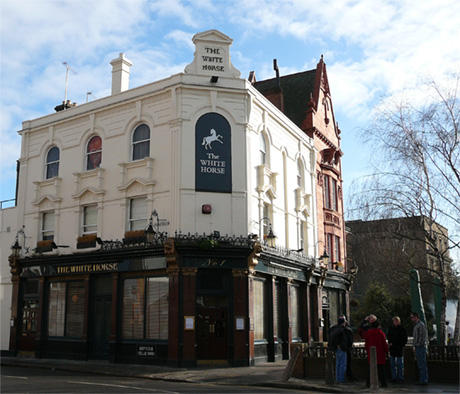
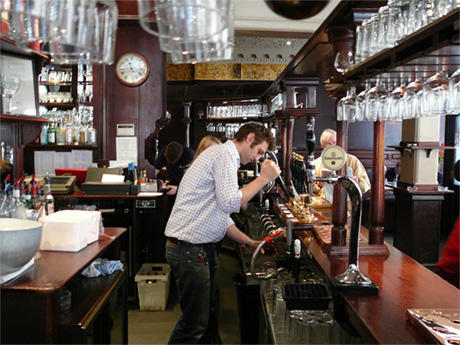
Our primary reason for the trip to London was to attend the 24th annual Old Ale Festival at the White Horse on Parson’s Green, which is located in southwest London. Landlord and cellerman Mark Dorber, who’s been at the pub for decades, is leaving this year and we wanted to visit him at the bar while we still could. He was, as always, a gracious host and we spent a fabulous full twelve hours there at the festival, from 11 a.m. until 11 p.m. Of the 47 beers listed for the festival, we tried all but eight, and that’s because those beers were not yet on tap while we were there.

The White Horse on Parson’s Green.

Pulling a pint behind the bar.

Our little corner of the world for the day.

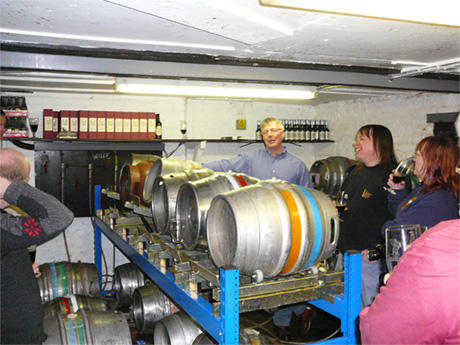
Mark Dorber conducted a tour/tasting of the cellars.

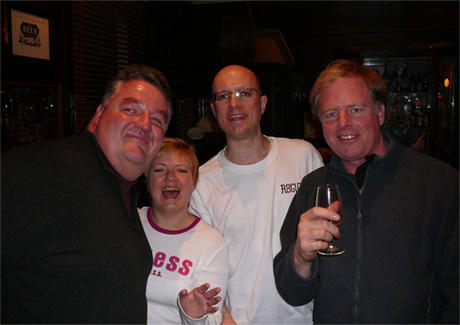
Motor and Shaun O’Sullivan with a couple of Burgundian Babble Belt members at the festival.

Roger Protz and me toward the end of the evening.

For more photos of the day’s events, visit the photo gallery.

Filed Under: Events Tagged With: Europe, Festivals, Great Britain, Photo Gallery

Brussels in January

January 26, 2007 By Jay Brooks

On Friday, we left England and took the Chunnel train under the English Channel to Brussels for a quick day trip.

The Eurostar train in Brussels.

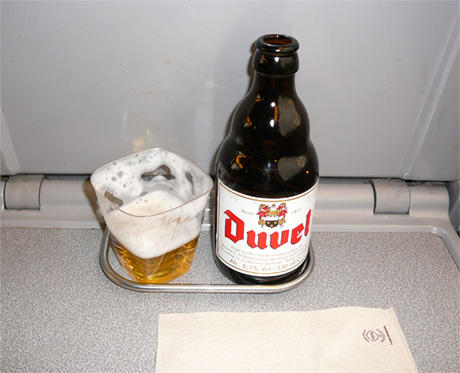
Where you can get a Duvel to enjoy on board.

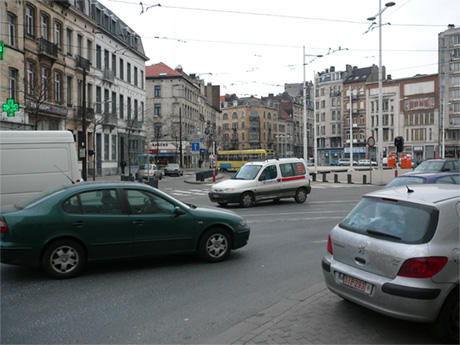
Downtown Brussels near the Midi train station.

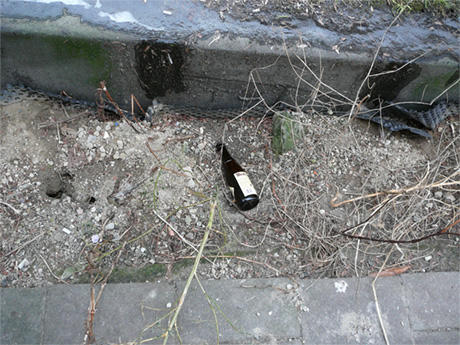
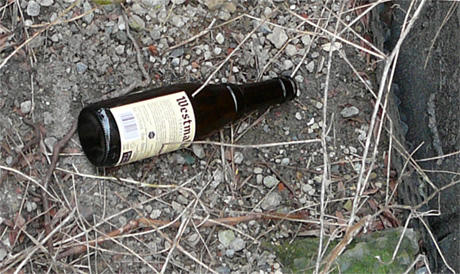
Where even their beer trash is better.

That’s a discarded bottle of Westmalle Tripel.

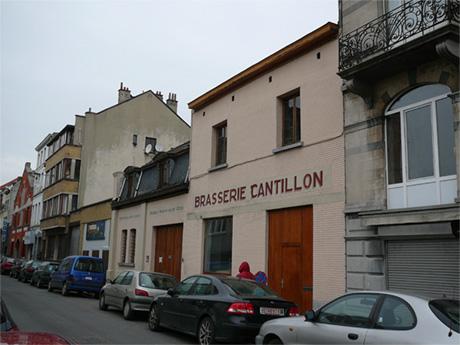
First stop was a tour of Brasserie Cantillon, the last remaining brewery in Brussels.

For the full brewery tour, visit the photo gallery.

Cantillon owner Jean-Pierre Van Roy and me after our tour.

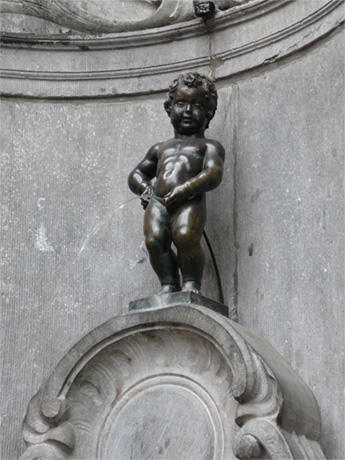
After our tour, we did some quick sightseeing. This, of course, is the famous Manneken-Pis.

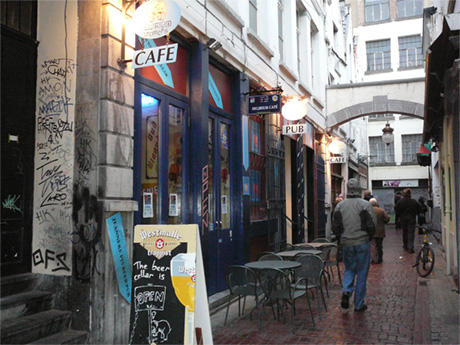
Across the street from which was the Poechenellekelder, a bit touristy but with a decent beer selection.

The nearby Grand Place.

Including the Brewers Union building.

And, of course, the Delirium Cafe, also packed with tourists.

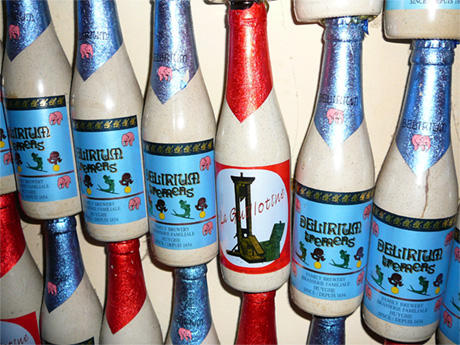
With a spiral staircase lined with Delirium Tremens bottles.

The Floris Absinthe bar across the alley was closed until eight, by the Delirium Cafe had one type of absinthe so I could try some with my beer.

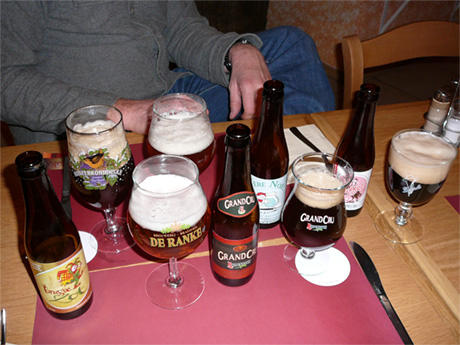
Afterwards, we had a quick dinner at Bier Circus. Here Shaun shows off his steak and the ubiquitous plate of frittes.

And our beer selection with dinner.

Back at the train station to return to London there was an interesting selection of canned beer in the vending machines. All in all, the trip was too quick to do anything but scratch the surface of the city, but at least we had a chance to do that. I’m certainly looking forward to returning and spending a little more time there.

Filed Under: Food & Beer Tagged With: Belgium, Europe, Photo Gallery

« Previous Page
Next Page »

Find Something

Northern California Breweries

Please consider purchasing my latest book, California Breweries North, available from Amazon, or ask for it at your local bookstore.

Recent Comments

  • Ernie Dewing on Historic Beer Birthday: Charles William Bergner 
  • Steve 'Pudgy' De Rose on Historic Beer Birthday: Jacob Schmidt
  • Jay Brooks on Beer Birthday: Bill Owens
  • Steve 'Pudgy' De Rose on Beer Birthday: Charles Finkel
  • Steve 'Pudgy' De Rose on Beer Birthday: Bill Owens

Recent Posts

  • Historic Beer Birthday: Jacob Knecht January 25, 2026
  • Beer In Ads #5181: Turn Winter Into Spring January 24, 2026
  • Historic Beer Birthday: Philip Bissinger January 24, 2026
  • Historic Beer Birthday: Gottlieb Muhlhauser January 24, 2026
  • Beer Birthday: Ted Vivatson January 24, 2026

BBB Archives

Feedback

Head Quarter
This site is hosted and maintained by H25Q.dev. Any questions or comments for the webmaster can be directed here.