Brookston Beer Bulletin

Jay R. Brooks on Beer

  • Home
  • About
  • Editorial
  • Birthdays
  • Art & Beer

Socialize

  • Dribbble
  • Email
  • Facebook
  • Flickr
  • GitHub
  • Instagram
  • LinkedIn
  • Pinterest
  • RSS
  • Twitter
  • YouTube

Powered by Genesis

Patent No. 3271162A: Process For Segregating Lupulin From Dried Hops

September 6, 2015 By Jay Brooks

patent-logo
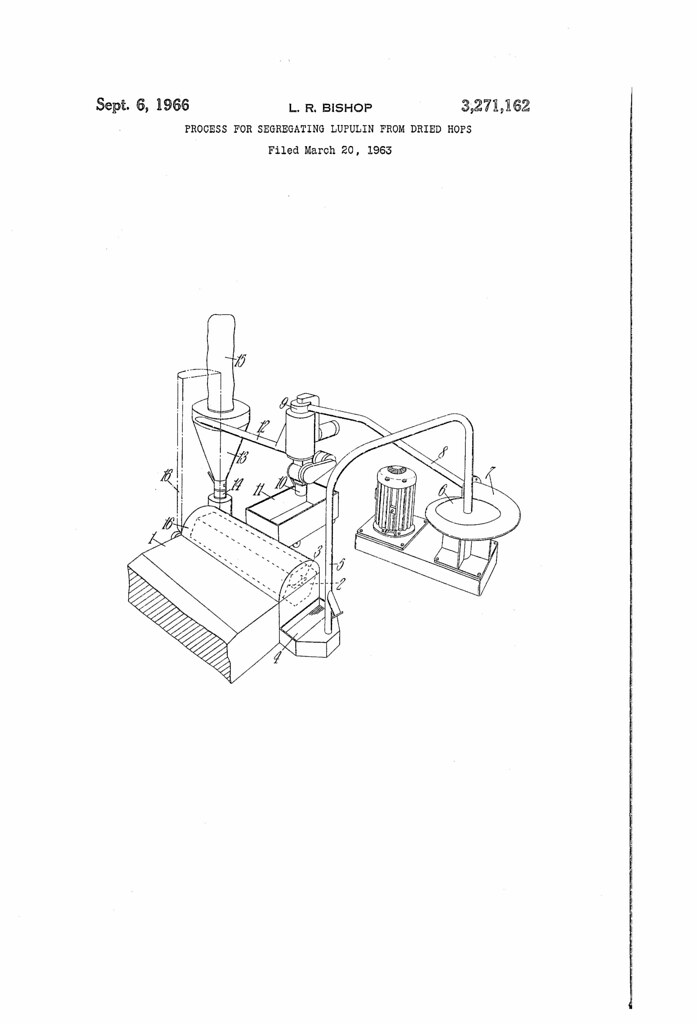
Today in 1966, US Patent 3271162 A was issued, an invention of Laurence R. Bishop, assigned to Watney Combe Reid & Company Ltd., for his “Process For Segregating Lupulin From Dried Hops.” There’s no Abstract, although in the description it includes this summary:

It is a principal object of the invention to enable a relatively concentrated form of lupulin to be separated from the dried hops. This concentrated material can then either be used as such, for boiling with wort or for adding to the brewed beer, or it can be subjected to extraction processes for the isolation of the respective active ingredients which can then be stored, with or without stabilization, until they are required for use. By isolating the lupulin in a relatively concentrated form, its storage under conditions which will preclude or minimize spoilage becomes very much easier and less expensive, while at the same time the large storage space hitherto required is freed for other purposes.
Untitled

Filed Under: Beers, Just For Fun, Politics & Law, Related Pleasures Tagged With: History, Hops, Law, Patent

Patent No. PP14127P2: Hop Plant Named “VGXP01” (a.k.a. Amarillo)

September 2, 2015 By Jay Brooks

patent-logo
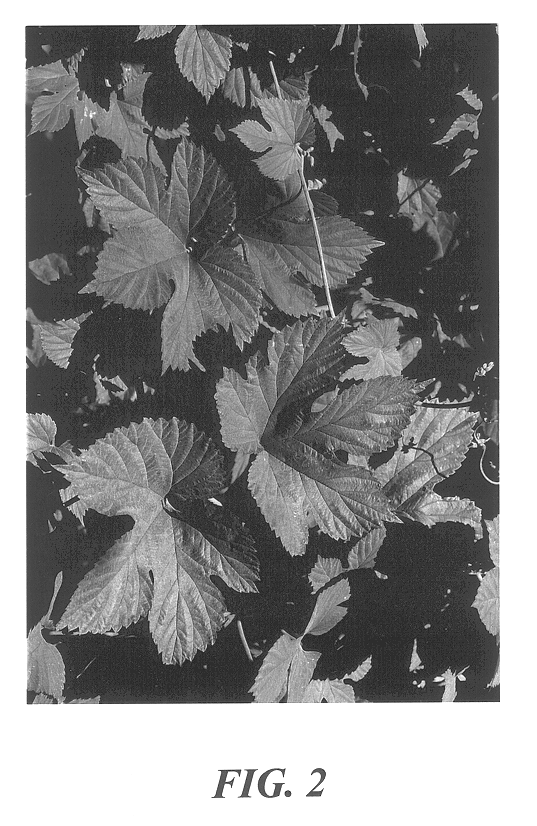
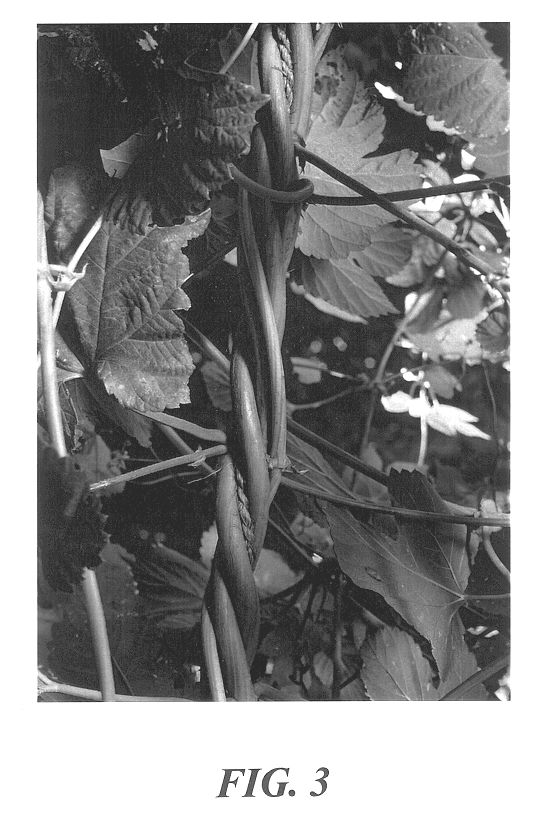
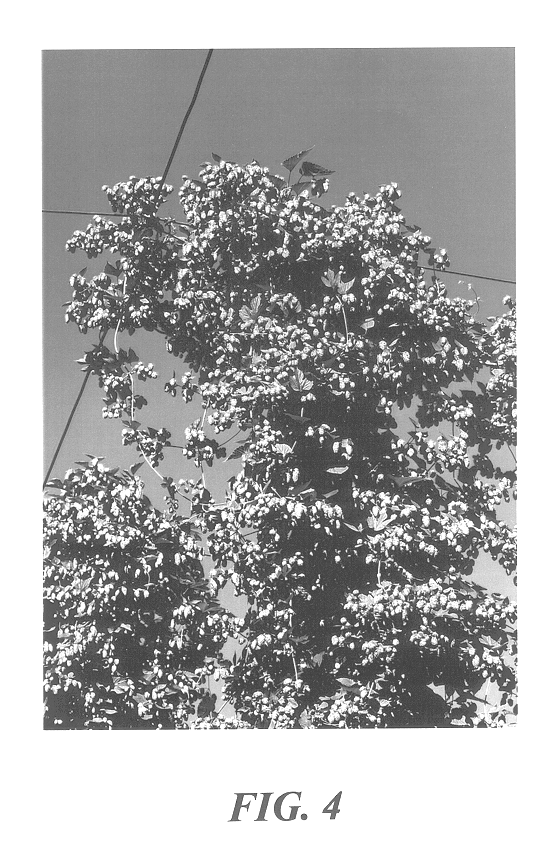
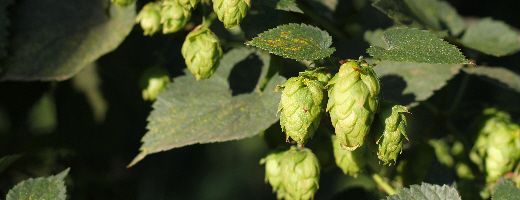
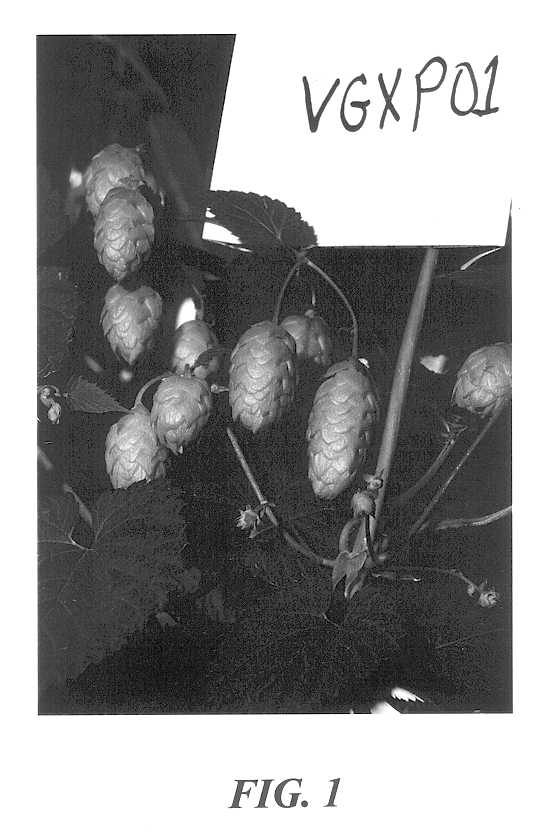
Today in 2003, US Patent PP14127 P2 was issued, an invention of Paul A. Gamache, Bernard J. Gamache, and Steven J. Gamache, for their “Hop Plant Named ‘VGXP01.'” Here’s the Abstract:

The new hop plant variety named ‘VGXP01’ is notable for its unique, pleasant aroma and relatively high alpha content. The cones of the new variety are small and compact, and grow abundantly on the mature plant.

This is the hop plant that became known as “Amarillo.” It’s hard to believe it’s only been around since 2003. According to Wikipedia, Amarillo “was discovered by Virgil Gamache Farms Inc. in one of their hop yards in Washington State and propagated and introduced by them as Amarillo. Unlike most varieties of hops, which may be acquired and propagated by the purchase of rhizomes, Amarillo hops are privately grown only by Virgil Gamache Farms; also the organization holds a trademark on the name “Amarillo” for hops.”

Untitled
Untitled
Untitled
Untitled
Untitled

Filed Under: Beers, Just For Fun, Politics & Law, Related Pleasures Tagged With: History, Hops, Law, Patent

Patent No. 2448063A: Machine For Stripping Hops From Vines

August 31, 2015 By Jay Brooks

patent-logo
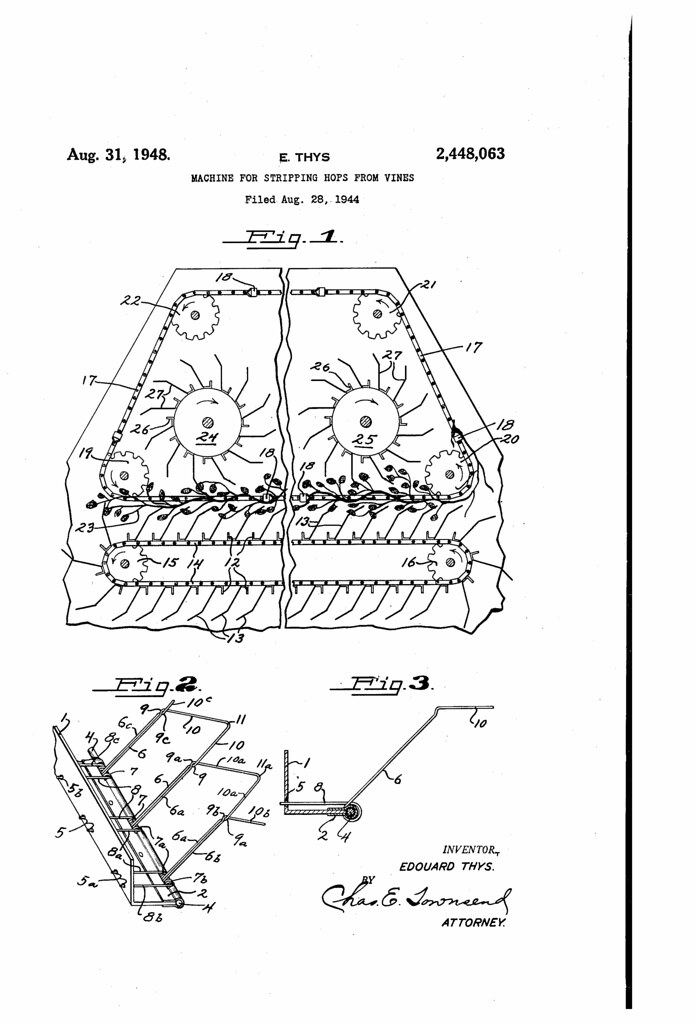
Today in 1948, US Patent 2448063 A was issued, an invention of Edouard Thys, for his “Machine For Stripping Hops From Vines.” There’s no Abstract, although in the description it includes this summary:

This invention relates to means for mechanically picking hops and has particular reference to the picker fingers and bars for supporting the same, by which the hop blossoms and clusters are mechanically removed from the vines when the latter pass through the machine.

Untitled

Filed Under: Beers, Just For Fun, Politics & Law, Related Pleasures Tagged With: Brewing Equipment, History, Hops, Law, Patent

Patent No. 4767640A: Light Stable Hop Extracts And Method Of Preparation

August 30, 2015 By Jay Brooks

patent-logo
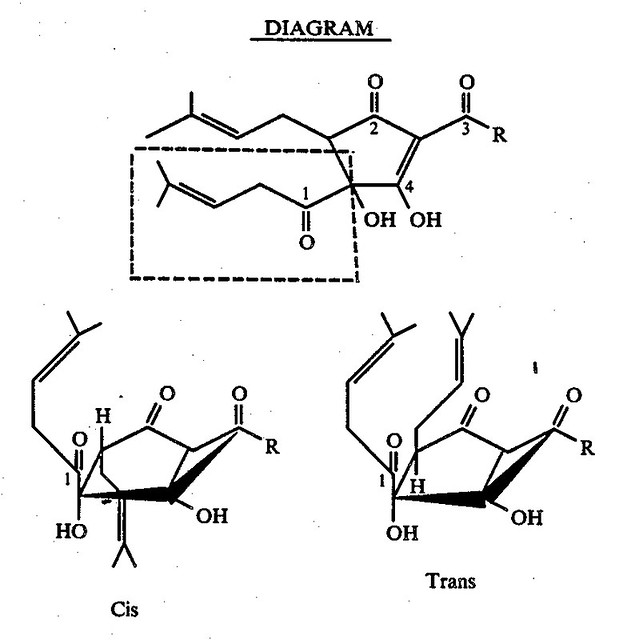
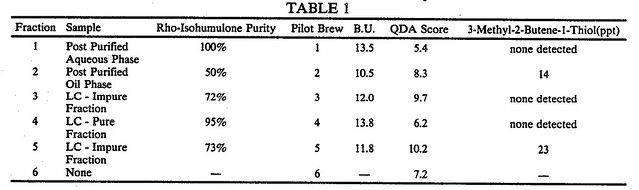
Today in 1988, US Patent 4767640 A was issued, an invention of Henry Goldstein, Patrick L. Ting, Etzer Chicove, Gary Goetzke, and John M. Cowles, assigned to Miller Brewing Company, for their “Light Stable Hop Extracts and Method of Preparation.” Here’s the Abstract:

A method of preparing anactinic hop extracts comprising three stages: pre-purification of a liquid CO2 hop extract using liquid-liquid extraction to isolate pure humulones or alpha acids; isomerization/reduction of the humulones to obtain a mixture consisting of reduced isohumulones and non-isohumulone light unstable products (NILUPS); then adding alkali and water to the mixture of reduced isohumulones and NILUPS, heating and stirring to extract the reduced isohumulones into an aqueous phase and to leave the NILUPS in an oil phase. The aqueous phase is an anactinic hop extract which can be used to prepare light stable malt beverages.

Untitled
This is one of a multitude of patents that Miller received in order to maintain their image, using a clear bottle for Miller High Life. It seems like it would have been far less expensive to just re-brand the beer with a brown bottle, but I guess that’s why I’m not in marketing.
Untitled

Filed Under: Beers, Breweries, Just For Fun, Politics & Law, Related Pleasures Tagged With: History, Hops, Law, Patent, Science of Brewing

Pliny Buried By Vesuvius

August 25, 2015 By Jay Brooks

pliny
While no one is sure when Pliny the Elder was born — it was sometime around 23 CE — we do know exactly when he died: it was August 25, 79 CE. How can we be so sure? Well, because the day before, August 24, Mount Vesuvius in the Gulf of Naples in southwest Italy, erupted, completely destroying the town of Pompeii. “Pompeii, along with Herculaneum and many villas in the surrounding area, was mostly destroyed and buried under 13 to 20 feet of ash and pumice in the eruption.” We know about this catastrophic event because of a letter by Pliny the Elder’s nephew, Pliny the Younger, “who saw the eruption from a distance and described the death of his uncle, an admiral of the Roman fleet, who tried to rescue citizens.” It’s sounds like it was a pretty awful event, here described on Wikipedia:

That eruption ejected a cloud of stones, ash and fumes to a height of 33 km (20.5 mi) [another source said 27 miles!], spewing molten rock and pulverized pumice at the rate of 1.5 million tons per second, ultimately releasing a hundred thousand times the thermal energy released by the Hiroshima bombing. An estimated 16,000 people died due to hydrothermal pyroclastic flows. The only surviving eyewitness account of the event consists of two letters by Pliny the Younger to the historian Tacitus.

pliny-the-elder-ill

Although known as Pliny the Elder, he was born Gaius Plinius Secundus and studied law and worked as a naval and army commander during the early Roman Empire. But he’s known today more for his writing, specifically “his encyclopedic work, Naturalis Historia, which became a model for all other encyclopedias.” Apparently he spent most of his time off “studying, writing or investigating natural and geographic phenomena in the field,” and the Naturalis Historia was his last work, and ran to 37 volumes, essentially the accumulation of everything he studied over his lifetime.

Pliny-1472
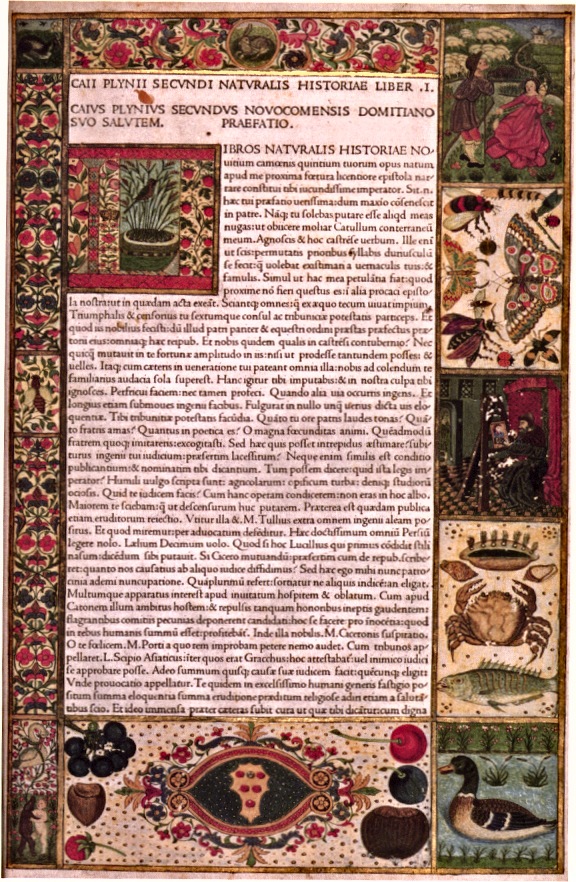
A page from a 1472 printing of Pliny’s Natural History.

This is the famous book where Pliny may have first mentioned wild hops, using his own term, “Lupus salictarius,” or “willow wolf,” to describe the plant. The brief mention of hops occurs in Book XXI, in Chapter 50.

Here’s the original Latin text of Pliny from the Teubner editions of the text:

secuntur herbae sponte nascentes, quibus pleraeque gentium utuntur in cibis maximeque Aegyptus, frugum quidem fertilissima, sed ut prope iis carere possit. tanta est ciborum ex herbis abundantia. in Italia paucissimas novimus, fraga, tamnum, ruscum, batim marinam, batim hortensiam, quas aliqui asparagum Gallicum vocant, praeter has pastinacam pratensem, lupum salictarium, eaque verius oblectamenta quam cibos.

This version is from the Second English translation, by John Bostock and Henry Thomas Riley, 1855:

CHAP. 50. (15.)—PLANTS WHICH GROW SPONTANEOUSLY: THE USE MADE OF THEM BY VARIOUS NATIONS, THEIR NATURE, AND REMARKABLE FACTS CONNECTED WITH THEM. THE STRAW- BERRY, THE TAMNUS, AND THE BUTCHER’S BROOM. THE BATIS, TWO VARIETIES OF IT. THE MEADOW PARSNIP. THE HOP.

We now come to the plants which grow spontaneously, and which are employed as an aliment by most nations, the people of Egypt in particular, where they abound in such vast quantities, that, extremely prolific as that country is in corn, it is perhaps the only one that could subsist without it: so abundant are its resources in the various kinds of food to be obtained from plants.
In Italy, however, we are acquainted with but very few of them; those few being the strawberry,1 the tamnus,2 the butcher’s broom,3 the sea4 batis, and the garden batis,5 known by some persons as Gallic asparagus; in addition to which we may mention the meadow parsnip6 and the hop,7 which may be rather termed amusements for the botanist than articles of food.

And here’s Note 7:

7 “Lupus salictarius,” the “willow wolf,” literally; the Humulus lupulus of Linnæus. It probably took its Latin name from the tenacity with which it clung to willows and osiers.

Here’s Book XXI, Chapter 50 translated from the 10 volume edition published by Harvard University Press, 1949-54.

L. There follow the plants that grow wild. Most peoples use these for food, especially the people of Egypt, a land very fruitful in crops, yet about the only one that could manage without them, so great an abundance of food does it get from plants. In Italy however we know few such, strawberries, wild vine, butcher’s broom, samphire, and garden fennel, which some call Gallic asparagus; besides these there are meadow parsnip and willow wolf, though these are delicacies rather than foods.

As you can see, what Pliny says is hardly definitive, and it seems not at all clear that what he’s mentioned in passing may or may not be the same thing as the hops used to make beer today. That’s been the conventional wisdom for a long time, but as we learn time and time again, that doesn’t make it true. Happily, Martyn Cornell looked at this question a few years ago, finding some of the answers to So what DID Pliny the Elder say about hops?

Here’s where the trouble begins:

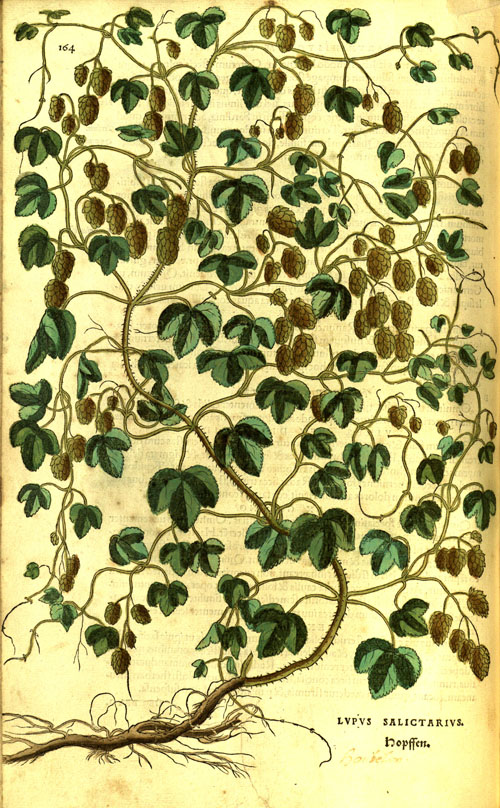
The first person to identify Pliny’s lupus salictarius as the plant that Italians call lupulo, the Spanish lúpulo, Germans Hopfen and English-speakers hops seems to have been a 16th century Bavarian botanist called Leonhart Fuchs, in a book called De historia stirpium commentarii insignes, or Notable commentaries on the history of plants. But Fuchs (after whom, apparently, the fuchsia is named), had made a big effort to try to match up “modern” plants with those mentioned by classical authors, and may have made a mistake in deciding that lupulo was derived from, and identical with, Pliny’s lupus salictarius. At least one writer has suggested that the word lupulo, far from being derived from the earlier term, may simply be an Italian error for “l’upulo“, via the French for hop, houblon, and nothing to do with lupus salictarius.

Fuchs-hops
Humulus lupulus (Cannabaceae) by Leonhart Fuchs,
published in “De historia stirpium commentarii insignes”, 1542

A lot has been made of Pliny’s mention of lupus salictarius, some of it reasonable, and some of quite a stretch. “Never let the truth get in the way of a good story,” observed Mark Twain. But this one is a bit trickier than some. It’s certainly seems possible that Pliny was talking about wild hops, and for all one knows just as likely as unlikely. It’s one of those things that you want to be true, though of course wishing for something doesn’t make it so. We may never know. Cornell concludes his article with his opinion on the matter:

I think it’s somewhere between possible and probable that lupus salictarius WAS the wild hop plant: Pliny puts it among other wild plants from which the fresh shoots were harvested for cooking, like asparagus, and hop shoots are still cooked today, while “willow wolf” is a good description of what hops are capable of in the wild as they grow up trees for support. But that’s a long way from “definite”, and to write as if Pliny’s lupus salictarius was unequivocally the hop plant is wrong.

When the great Swedish botanist Carl von Linné attached a scientific name to the hop in 1753 he gave it the genus name Humulus, from the Swedish for “hop”, humle, and the species name lupulus from the medieval Latin word for “hop”. Even if lupus salictarius WERE the origin of lupulus, therefore, it would be wrong to say, as many websites do, that Pliny “is credited with inventing the botanical name for hops.” He didn’t: Linnaeus did.

It looks like this, and many other great Strange Tales of Ale will be contained in Martyn’s latest book, which will be published in a few weeks, on September 19, 2015. Pre-order a copy on Amazon before you forget.

Luckily, true or not true, the beer Pliny the Elder tastes just as good. But on the anniversary of Pliny’s death at Pompeii, it seems as good a day as any to pour of bottle of hoppy beer. Vive la Pliny.

pliny-the-elder-roman-naturalist-sheila-terry

Filed Under: Birthdays, Just For Fun, Related Pleasures Tagged With: History, Hops

Patent No. 968001A: Machine For Picking Hops

August 23, 2015 By Jay Brooks

patent-logo
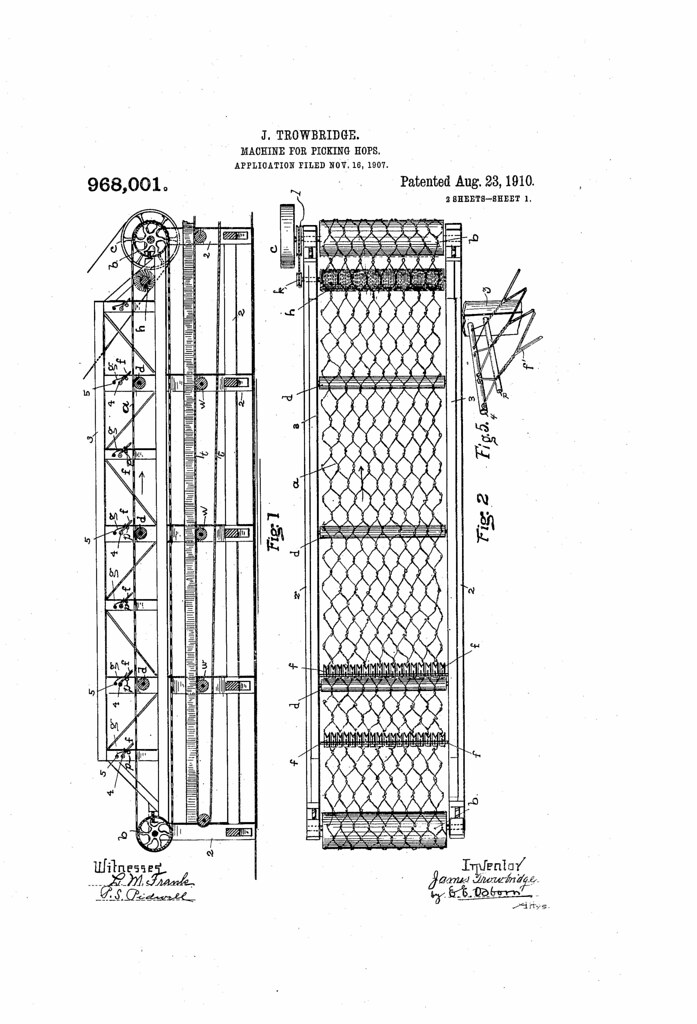
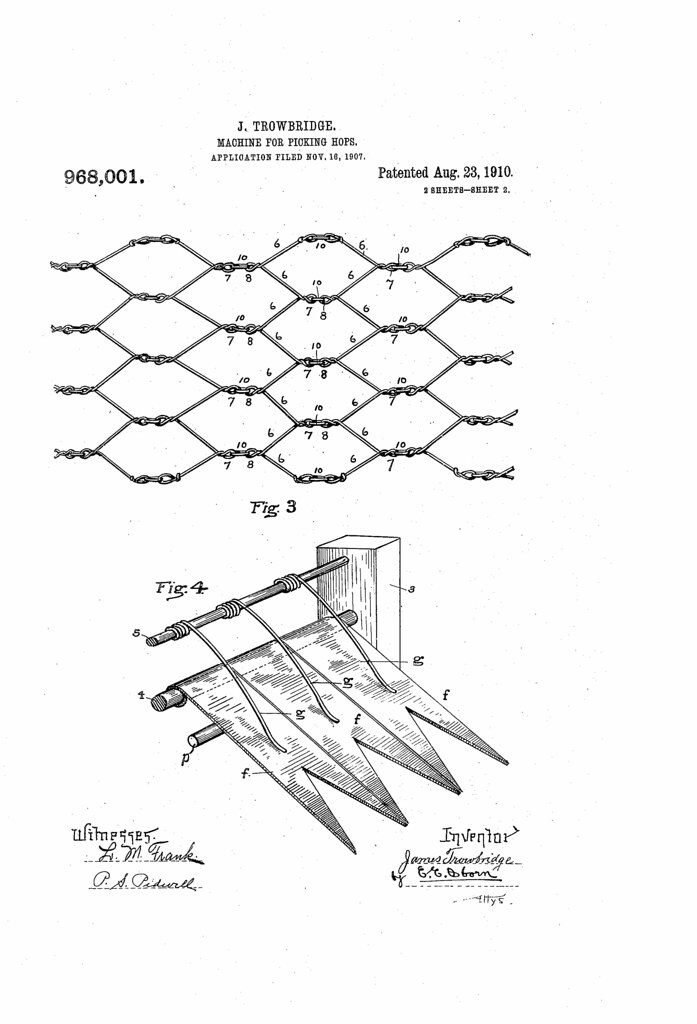
Today in 1910, US Patent 968001 A was issued, an invention of James Trowbridge, for his “Machine for Picking Hops.” There’s no Abstract, although in the description it includes this summary:

This invention has for its object to provide simple and practically operating machinery or appliance for removing hops from the vines, and the invention consists in certain novel parts, and combination of parts as hereinafter set forth in the following description and pointed out in the claims, producing an improved machine for picking or stripping hops from the vine.

Untitled
Untitled

Filed Under: Beers, Just For Fun, Politics & Law, Related Pleasures Tagged With: History, Hops, Law, Patent

Patent No. 2356545A: Method And Apparatus For Cropping Hops

August 22, 2015 By Jay Brooks

patent-logo
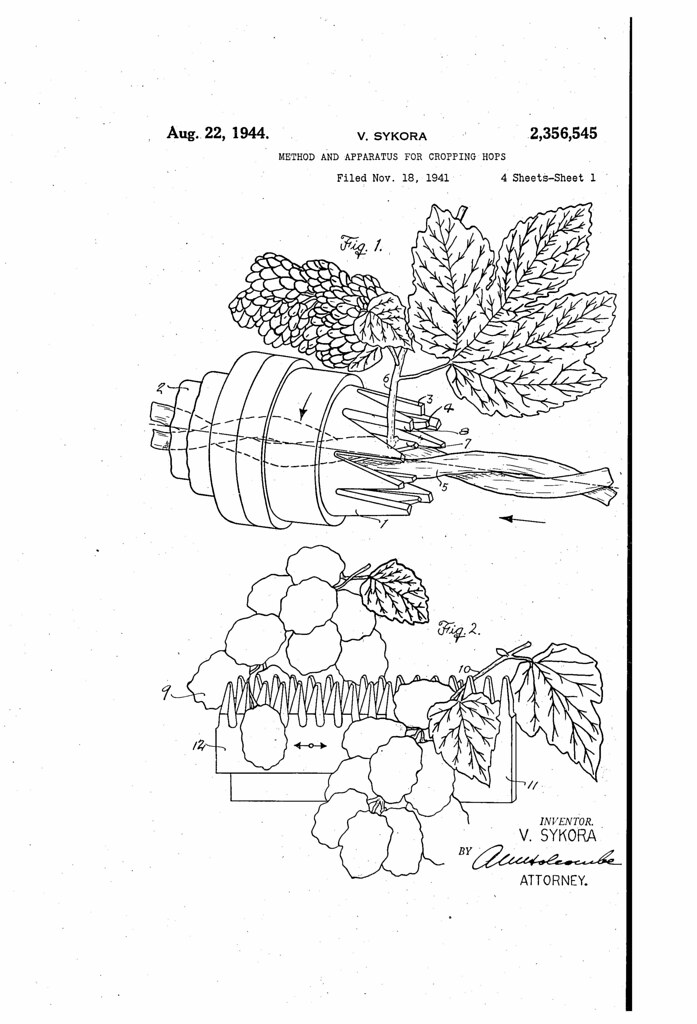
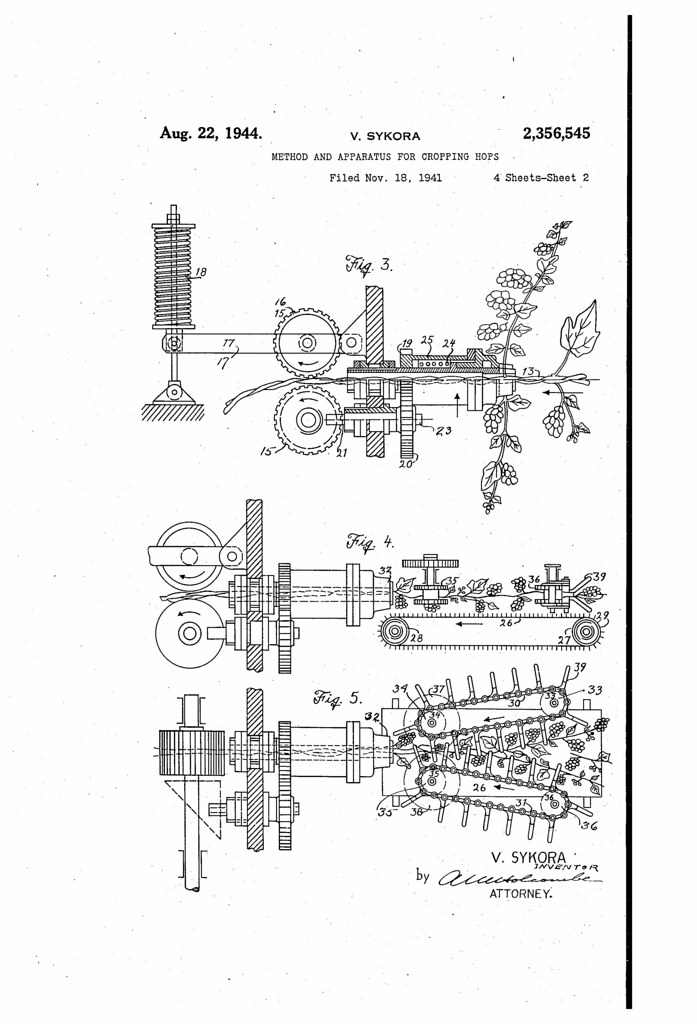
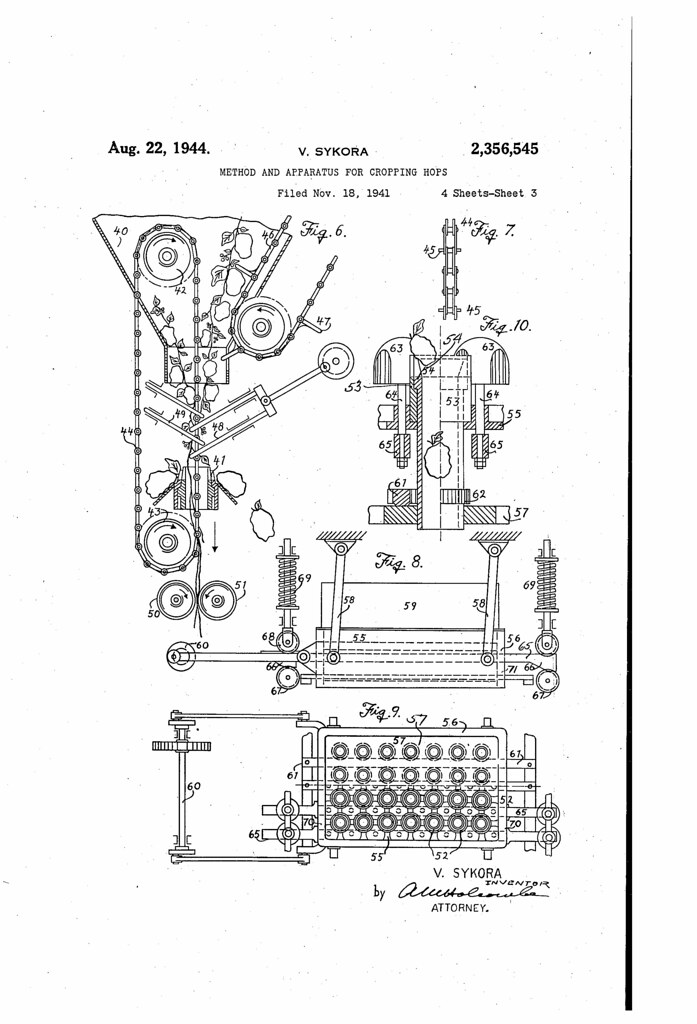
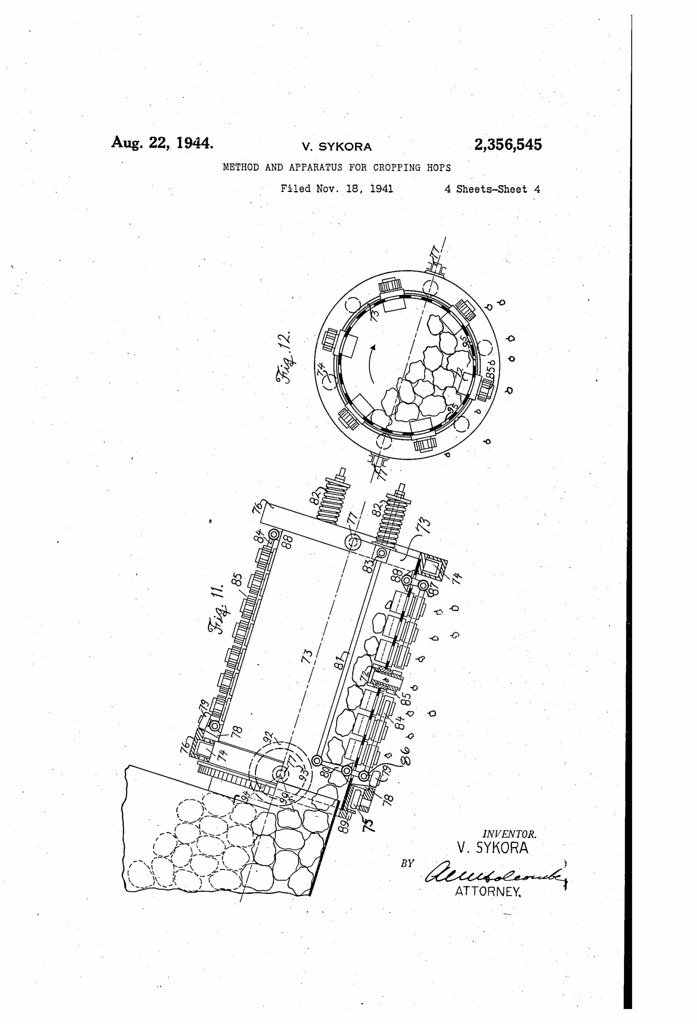
Today in 1944, US Patent 2356545 A was issued, an invention of Vladislav Sykora, for his “Method and Apparatus for Cropping Hops.” There’s no Abstract, although in the description it includes this summary:

The present invention consists in a mechanical shearing of the hop and offers, in addition to a high yield, the further advantage that the very important short stalk pieces as above mentioned, are left undamaged on the strobiles. The method and the devices required therefor, being the subject-matter of the present invention, will be described hereinafter. The hop parts shorn apart may, as will also be disclosed, be separated from each other in a clean manner by known means and may then easily be treated for further use.

Untitled
Untitled
Untitled
Untitled

Filed Under: Beers, Just For Fun, Politics & Law, Related Pleasures Tagged With: History, Hops, Law, Patent

Patent No. 20140234480A1: Enhancement Of Beer Flavor By A Combination Of Pichia Yeast And Different Hop Varieties

August 21, 2015 By Jay Brooks

patent-logo
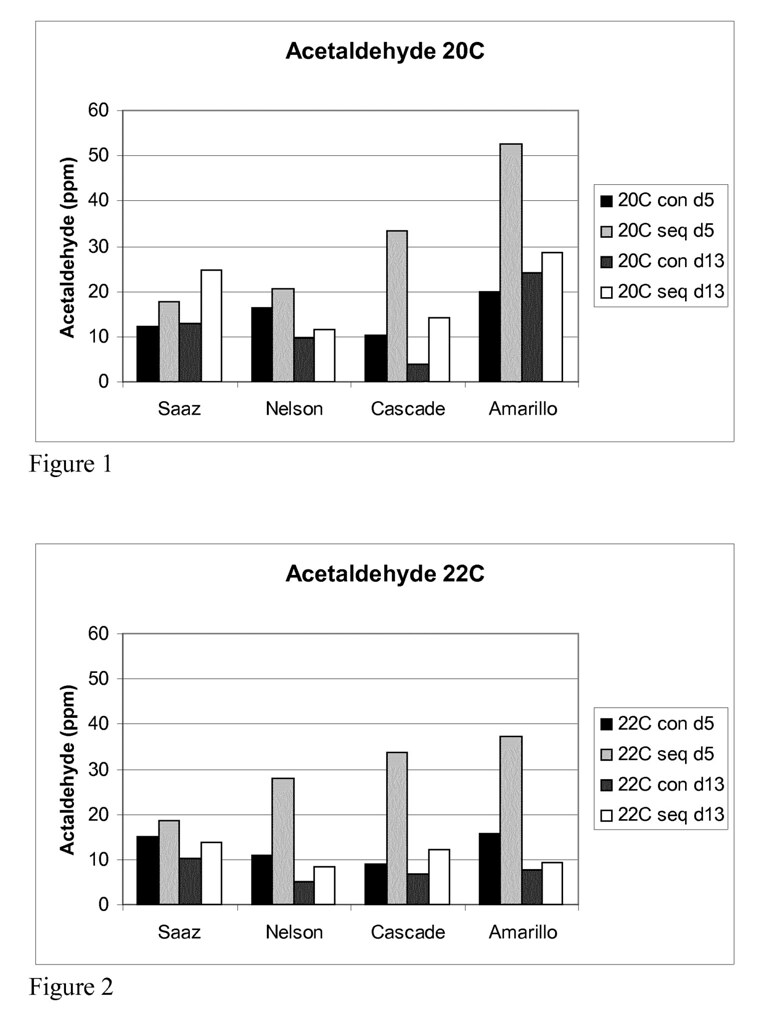
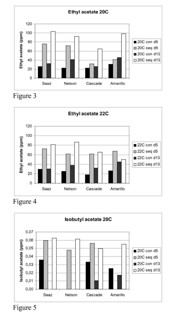
Today in 2014, US Patent 20140234480 A1 was issued, an invention of Sofie Sarens and Jan Hendrik Swiegers, assigned to Chr. Hansen A/S, for their “Enhancement of Beer Flavor by a Combination of Pichia Yeast And Different Hop Varieties.” Here’s the Abstract:

In the beer fermentation process, Pichia spp. yeast strains can be combined with normal beer yeast strains and with different hop varieties to produce synergistic effects, including the increased production in the fermentation product of esters, e.g., increased levels of isoamyl acetate, isobutyl acetate, ethyl propionate, ethyl valerate, ethyl butyrate, ethyl decanoate, and ethyl octanoate. Additionally, the Pichia spp. strain interacts differently with different hop varieties, such that the flavor profile of beer can be tuned by employing different combinations of Pichia spp. strains and hops.

Untitled

Untitled Untitled

Filed Under: Beers, Breweries, Just For Fun, Politics & Law, Related Pleasures Tagged With: Hops, Law, Patent, Science of Brewing, Yeast

Patent No. 57381A: Improvement In Hop-Vine Supports

August 21, 2015 By Jay Brooks

patent-logo
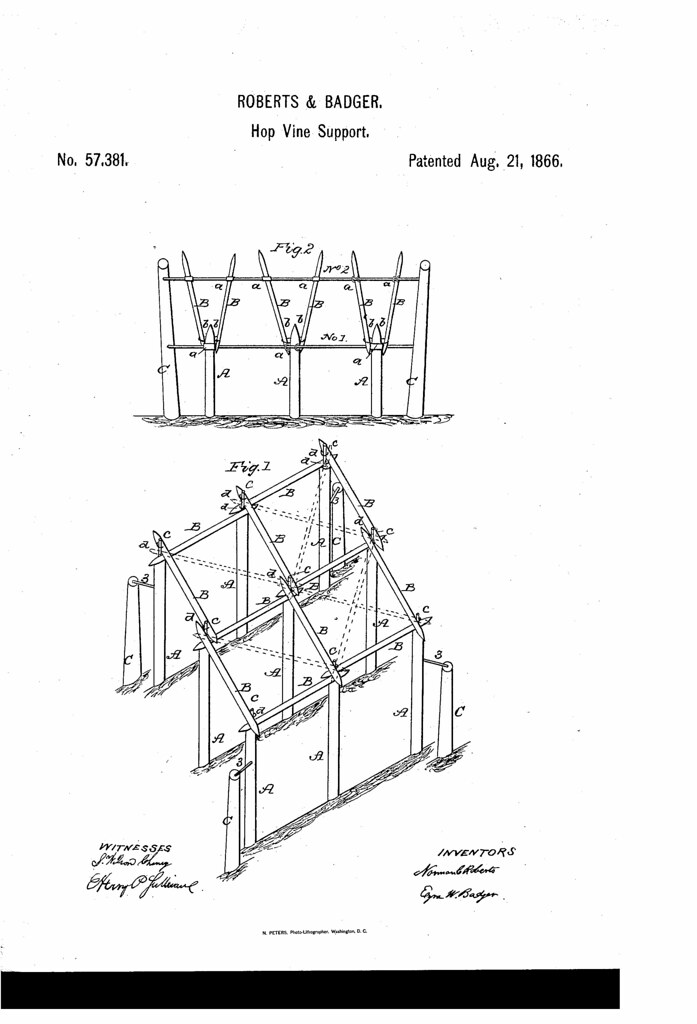
Today in 1866, US Patent 57381 A was issued, an invention of Norman C. Roberts and Ezra V. Badger, for their “Improvement in Hop-Vine Supports.” There’s no Abstract, although in the description it includes this summary:

[We] have invented a new and Improved Mode of Constructing Hop-Rods, to be used in the culture of hops, which we call Portable Sectional Hop-Rods and we do hereby declare that the following is a full, clear, and exact description of the said invention, reference being had to the accompanying drawings, and to the letters of reference marked thereon, in which- Figure 1 is a perspective view of a hop-yard with the upper section or rods placed horizontal. Fig. 2 is a view of the same with the upper section or rods placed on an angle.

The nature of our invention consists in setting one rod in each hill of hops, and of having other rods or sections suitably connected and supported either horizontally or at any desired angle, by which we are enabled to save a great amount of expense in the raising of hops.

Untitled

Filed Under: Beers, Just For Fun, Politics & Law, Related Pleasures Tagged With: History, Hops, Law, Patent

Patent No. 7258887B2: Preparation Of Light Stable Hops

August 21, 2015 By Jay Brooks

patent-logo
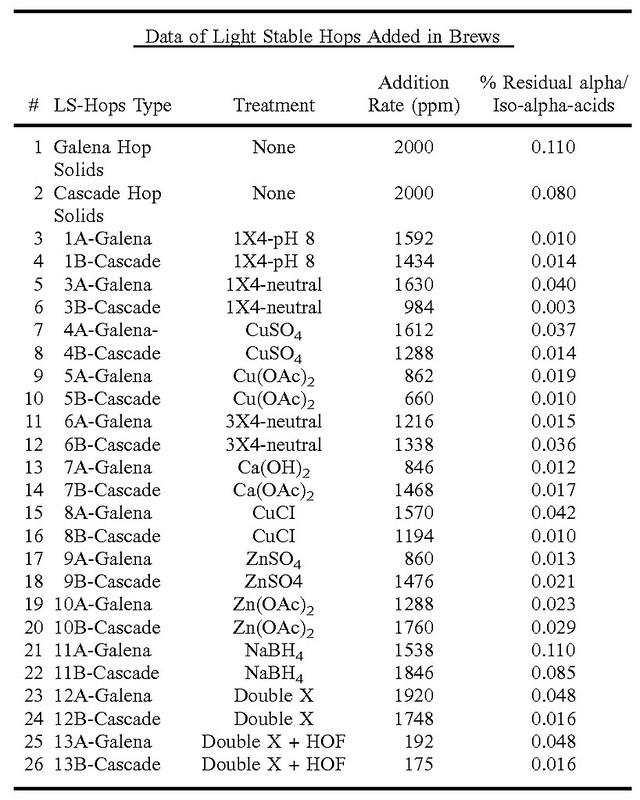
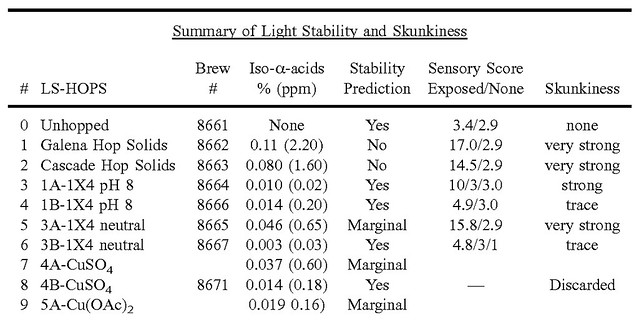
Today in 2007, US Patent 7258887 B2 was issued, an invention of Patrick L. Ting, Henry Goldstein, Aki A. Murakami, Michael VanSanford, Jay R. Refling, John R. Seabrooks, and David S. Ryder, assigned to Miller Brewing Company, for their “Preparation of Light Stable Hops.” Here’s the Abstract:

Disclosed are methods for the production of light stable hops, useful for the brewing of beer or ale to be stored in clear or green glass containers, which beer or ale will not develop objectionable flavor as a result of exposure to light. Light stable hops are prepared by double extraction of liquid/supercritical CO2 extracted hop solids with ethanol to remove alpha/iso-alpha-acids. Such alpha/iso-alpha-acids may be further removed from the ethanol extraction liquor obtained in the double extraction process by subjecting such liquor to an ion exchange medium, or precipitation by a metal ion, heavy metal ion, or alkali metal ion, to provide an alpha/iso-alpha-acid is free extraction liquor which may be added to the light stable hops residue obtained in the initial double extraction process.

Wanting to continue using their distinctive clear bottle for Miller High Life, at least since 1962, Miller started coming with preparations to make certain hops less subject to becoming lightstruck. In 1962, they patented a Anactinic malt product and hop extract therefor and since then at least eight newer patents improves aspects of the same idea.
Untitled
Untitled

Filed Under: Beers, Breweries, Just For Fun, Politics & Law, Related Pleasures Tagged With: History, Hops, Law, Patent, Science of Brewing

« Previous Page
Next Page »

Find Something

Northern California Breweries

Please consider purchasing my latest book, California Breweries North, available from Amazon, or ask for it at your local bookstore.

Recent Comments

  • Ernie Dewing on Historic Beer Birthday: Charles William Bergner 
  • Steve 'Pudgy' De Rose on Historic Beer Birthday: Jacob Schmidt
  • Jay Brooks on Beer Birthday: Bill Owens
  • Steve 'Pudgy' De Rose on Beer Birthday: Charles Finkel
  • Steve 'Pudgy' De Rose on Beer Birthday: Bill Owens

Recent Posts

  • Historic Beer Birthday: Joseph Ibach February 17, 2026
  • Beer In Ads #5206: What Is Rainier Bock Beer? February 17, 2026
  • Historic Beer Birthday: John A. White Jr. February 17, 2026
  • Historic Beer Birthday: Ernest Davis February 17, 2026
  • Beer In Ads #5205: Bock Time Is Schmidt’s Time February 16, 2026

BBB Archives

Feedback

Head Quarter
This site is hosted and maintained by H25Q.dev. Any questions or comments for the webmaster can be directed here.