Brookston Beer Bulletin

Jay R. Brooks on Beer

  • Home
  • About
  • Editorial
  • Birthdays
  • Art & Beer

Socialize

  • Dribbble
  • Email
  • Facebook
  • Flickr
  • GitHub
  • Instagram
  • LinkedIn
  • Pinterest
  • RSS
  • Twitter
  • YouTube

Powered by Genesis

Patent No. 1348139A: Stem Picker

July 27, 2016 By Jay Brooks

patent-logo
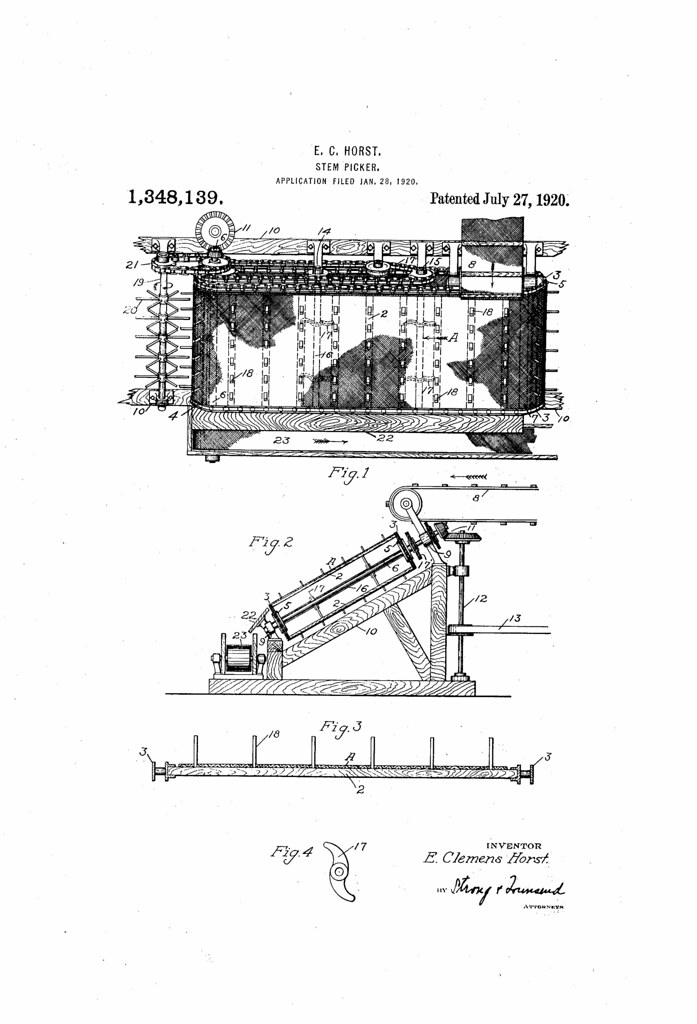
Today in 1920, US Patent 1348139 A was issued, an invention of Horst Emil Clemens, for his “Stem Picker.” There’s no Abstract, although in the description it includes these claims:

This invention relates to a stem picker and especially to a machine for separating stems from hops and the like.

Picking of hops by machinery is resorted to at the present time in several of the larger hop; growing districts and is becoming more and more a necessity due to the scarcity of labor and troubles connected therewith. Hops picked in this manner contain a considerable quantity of leaves and stems and other foreign matter, the major portion of which are removed by separators of various types. It happens however that while the leaves are comparatively easily removed that there still remains a considerable quantity of stems and it is the purpose of the present invention to provide a machine which is particularly adapted for removing the stems. The invention briefly stated involves a longitudinally extending inclined draper belt from the surface of which projects the hops, from which it is series of pins are delivered desired to remove the stems, to one end of this draper belt and will, during the travel of said belt, tend to roll off the belt and to a conveyer which removes them from the stem picking machine, stems` and other similar material being hung up on the pins and later removed as will hereinafter be described.

The invention also involves a mechanism for maintaining the draper in a state of continuous vibration thereby insuring a perfect removal of the hops deposited thereon While in no way impairing the action of the stem separating mechanism.
US1348139-0

Filed Under: Beers, Just For Fun, Politics & Law, Related Pleasures Tagged With: Brewing Equipment, History, Hops, Law, Patent

Patent No. 2124959A: Method Of Filling And Closing Cans

July 26, 2016 By Jay Brooks

patent-logo
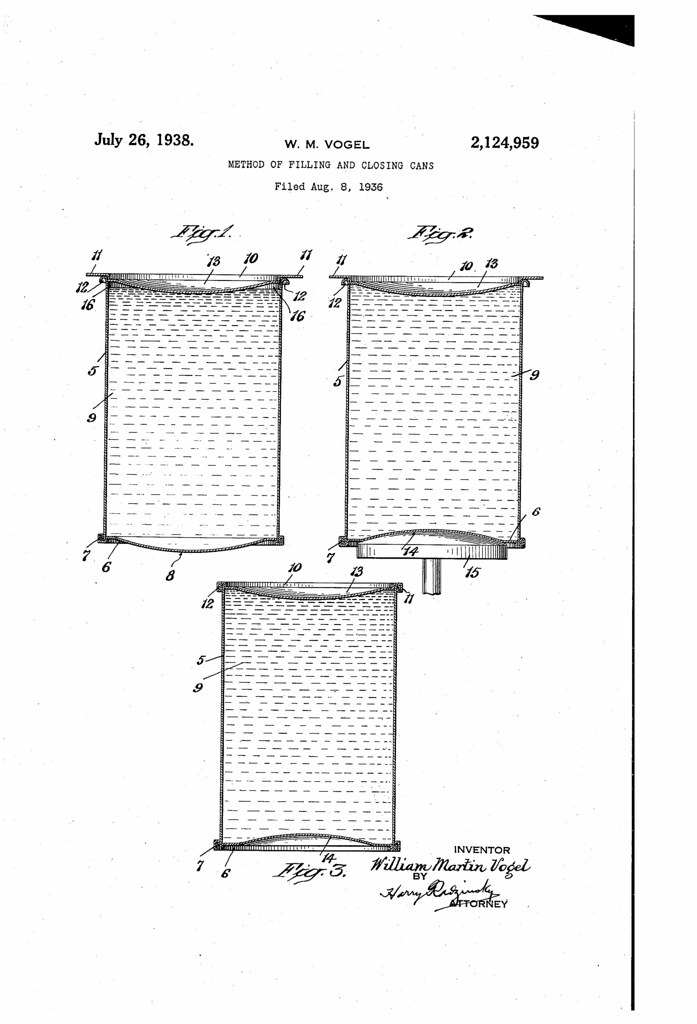
Today in 1938, US Patent 2124959 A was issued, an invention of William Martin Vogel, for his “Method Of Filling And Closing Cans.” There’s no Abstract, although in the description it includes these claims:

This invention relates to cans and a method of making and filling the same, and has for its object the provision of means whereby a maximum quantity of air may be evacuated from the can prior to the sealing operation.

At the present time beer is being packed in cans and one of the greatest difficulties encountered is that of completely or at least nearly completely evacuating the maximum quantity of air from the can. The failure to uniformly evacuate the air results in lack of uniformity of the contents of the can. In some cases an opened can produces beer of a decidedly fiat appearance and taste; while in other cases, an extremely frothy, aerated fluid emanates. Experiments have shown that this lack of uniformity in canned beer is apparently due to the failure to eliminate or evacuate the greatest possible amount of air from the can during or after the filling operation, and prior to the sealing of the can.

The primary object therefore, of this invention, is to provide a can of such a construction, together with a method of filling and sealing such a can, which will eliminate the maximum quantity of air from the can, thereby completely, or nearly completely, filling the can with the liquid contents only. More particularly, the invention contemplates the provision of a can initially formed with an outwardly distended or dished bottom,

arranged to be reversely curved or distorted under pressure after the can is filled, thereby causing the liquid contents of the can to be bodily shifted toward the top of ‘the can, causing said contents to displace and eject the air out of the can just prior to the sealing of the top of the can.

US2124959-0

Filed Under: Beers, Breweries, Just For Fun, Politics & Law, Related Pleasures Tagged With: Brewing Equipment, Cans, History, Law, Packaging, Patent

Patent No. 2124565A: Liquid Container

July 26, 2016 By Jay Brooks

patent-logo
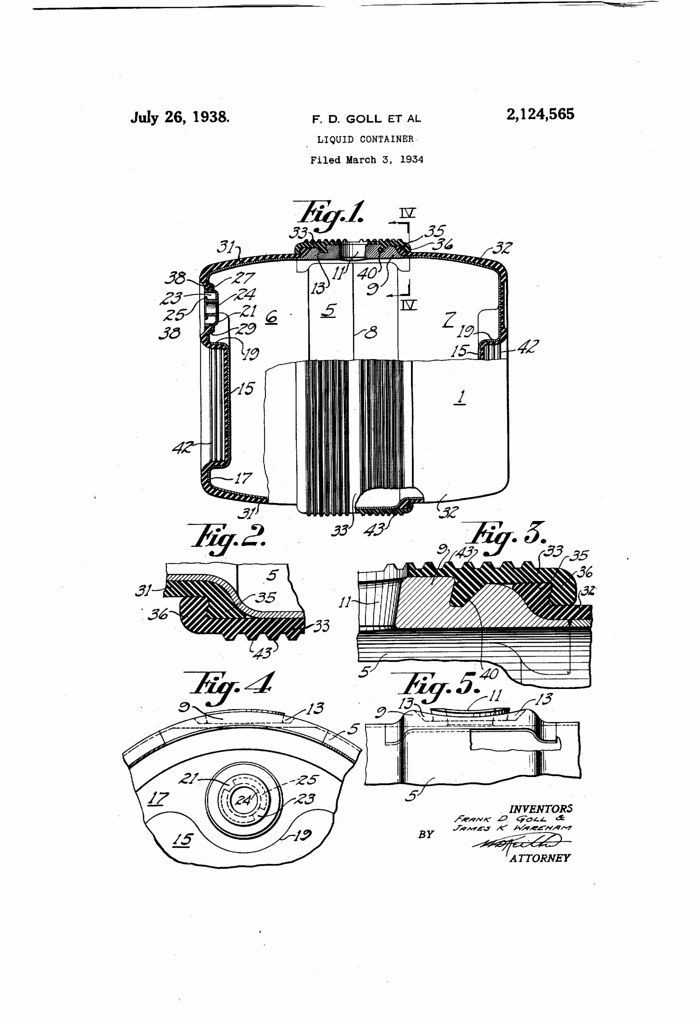
Today in 1938, US Patent 2124565 A was issued, an invention of Frank D. Goll and James K. Wareham, assigned to the Aluminum Co. Of America, for their “Liquid Container,” essentially a keg. There’s no Abstract, although in the description it includes these claims:

This invention relates to metal vessels for storing and shipping liquids. It relates especially to the construction of metal barrels and similar vessels for the storage and transportation of liquids, such as beer and the like.

The primary object of the invention is to provide an improved metal barrel. Another object is to provide a strong but light metal barrel which may be used either with or without an insulating cover of rubber or other material. A further object of this invention is to provide improved fittings for metal barrels of the type specified.

US2124565-0

Filed Under: Beers, Just For Fun, Politics & Law, Related Pleasures Tagged With: History, Kegs, Law, Patent

Patent No. 3332779A: Neutral Tasting Alcoholic Malt Beverage

July 25, 2016 By Jay Brooks

patent-logo
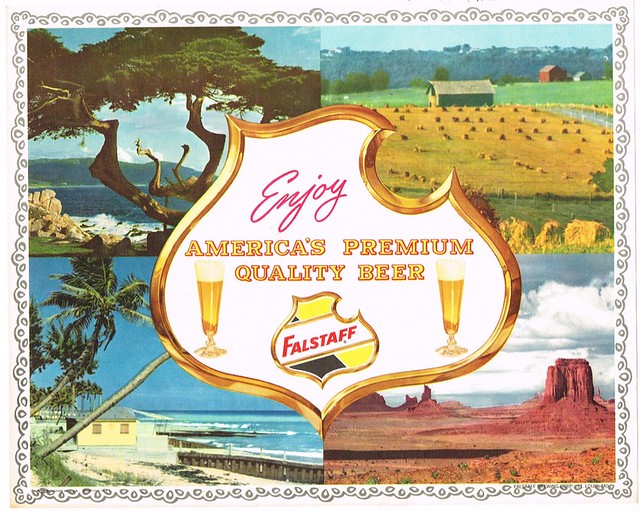
Today in 1967, US Patent 3332779 A was issued, an invention of Erik Krabbe, Webster Groves, and Cavit Akin, assigned to the Falstaff Brewing Corp., for their “Neutral Tasting Alcoholic Malt Beverage.” There’s no Abstract, although in the description it includes these claims:

The preparation of a neutral tasting alcoholic substrate by yeast fermentation of unboiled, unhopped wort containing fermentable sugar.

This invention relates to alcoholic malt beverage and more particularly to formation of an alcoholic malt beverage or substrate or base. which has a relatively neutral taste. More specifically the invention relates to the formation of a neutral alcoholic substrate from malt and cereal products and thereafter flavoring the neutral substrate with various flavoring substances.

Recently, various proposals have been made to provide flavored alcoholic beverages of various descriptions such as Tom Collins, coffee, mint, cherry, etc. The technique of trying to achieve such flavored alcoholic products by the use of fermented liquor have resulted in a rather. undesired feature of having the undesired normal beer or malt liquor flavor superimposed with a second desired flavor as those heretofore mentioned. So tar one proposal is to ferment the normal beer and then eliminate the flavor of the beer by charcoal filtration. Another technique is to add the flavor agent into boiling wort at which time activated carbon is added to the kettle to remove color from the wort. When sufficient time has been allowed for extracting the flavor, the wort was filtered and then fermented.

In contrast to previous techniques, the present invention briefly contemplates preparing a neutral fermented substrate for an alcoholic malt beverage which does not require the step of attempting to remove the’malt liquor or beer taste. Such an ideal neutral substrate or base alcoholic liquor is achieved by fermenting an extract of 10 to 35 weight percent unboiled, unhopped wort and 90 to 65 weight percent fermentable sugar (cerelose for example), based on the extract being water free. On a volumetric basis, one volume of unboiled, unhopped wort at 10 percent solids is added to three volumes of cerelose solution at 10 percent solids. Four grams of yeast (wet cake) per liter is suitable. The yeast may be the normal brewery yeast which has been washed to prevent carry over of hop bitter substances. The wort and cerelose are fermented preferably at a constant temperature of 13 C. After the fermentation is complete, the fermented extract is cooled to 3 C. and remains at that temperature for two or three days to end fermentation. Thereafter, the fermented extract is centrifuged and/.or filtered to obtain the neutral base which then is ready for carbonation and flavoring. At this stage of processing the flavor of the fermented substrate is substantially neutral with no organoleptic impression of malt liquor.

Falstaff-Beer-Coasters-Placemats-Falstaff-Brewing-Corp-Plant

Filed Under: Beers, Breweries, Just For Fun, Politics & Law, Related Pleasures Tagged With: Falstaff, History, Law, Patent, Science of Brewing

Patent No. 1919665A: Bottle Filling Machine And Method

July 25, 2016 By Jay Brooks

patent-logo
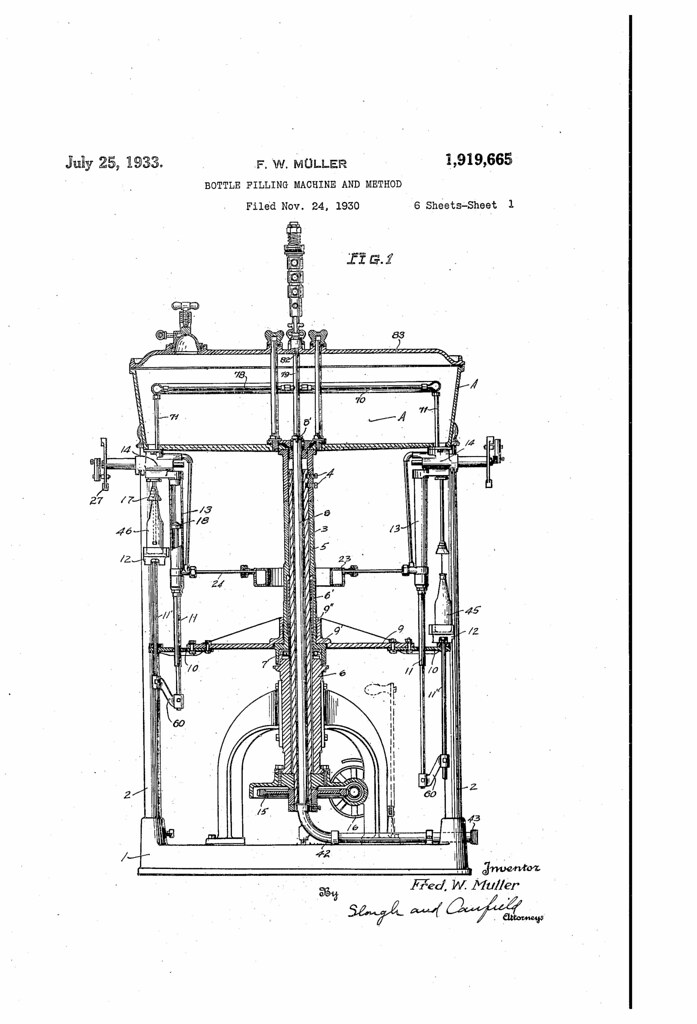
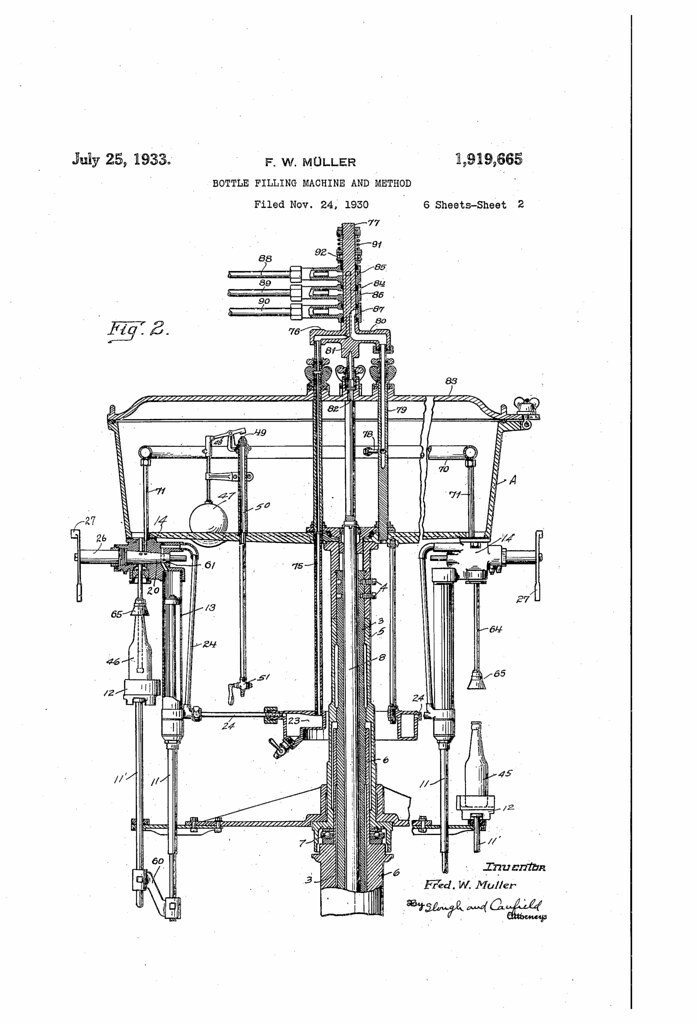
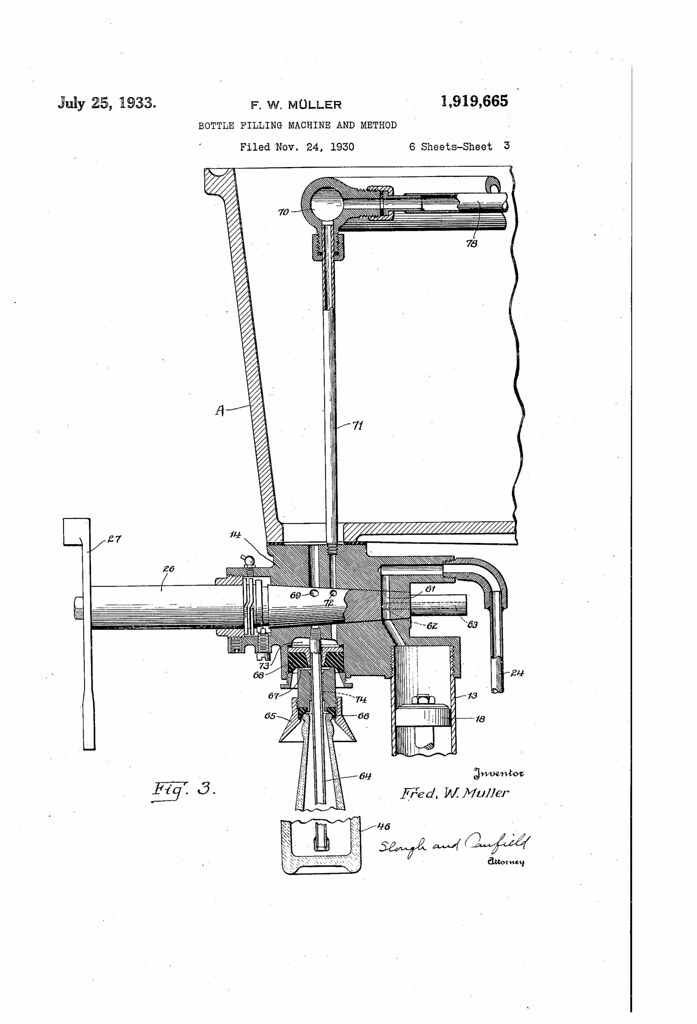
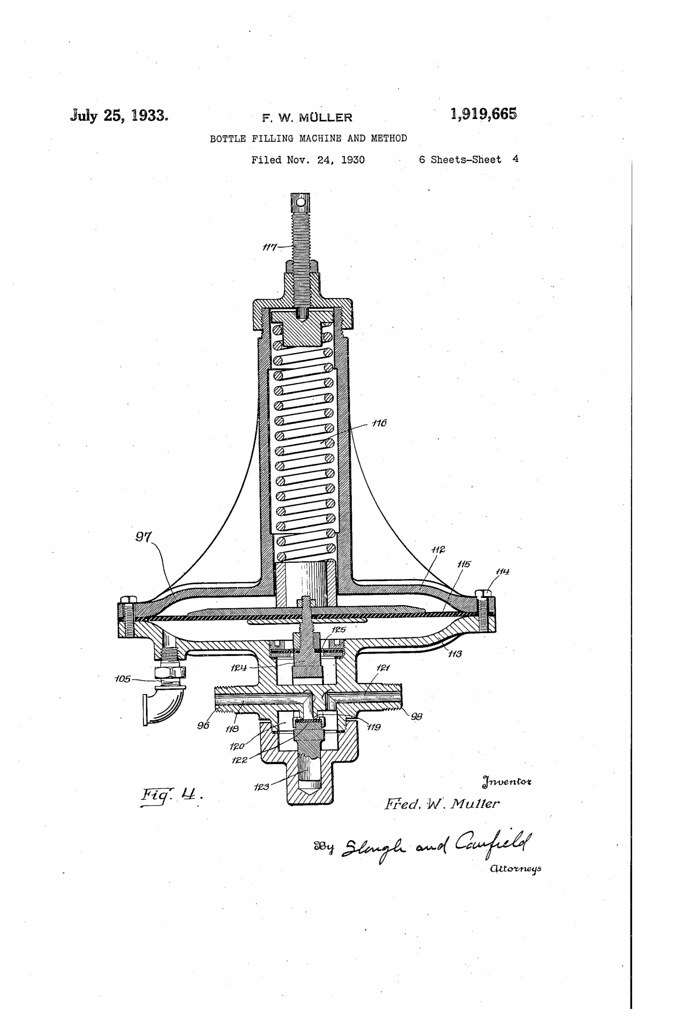
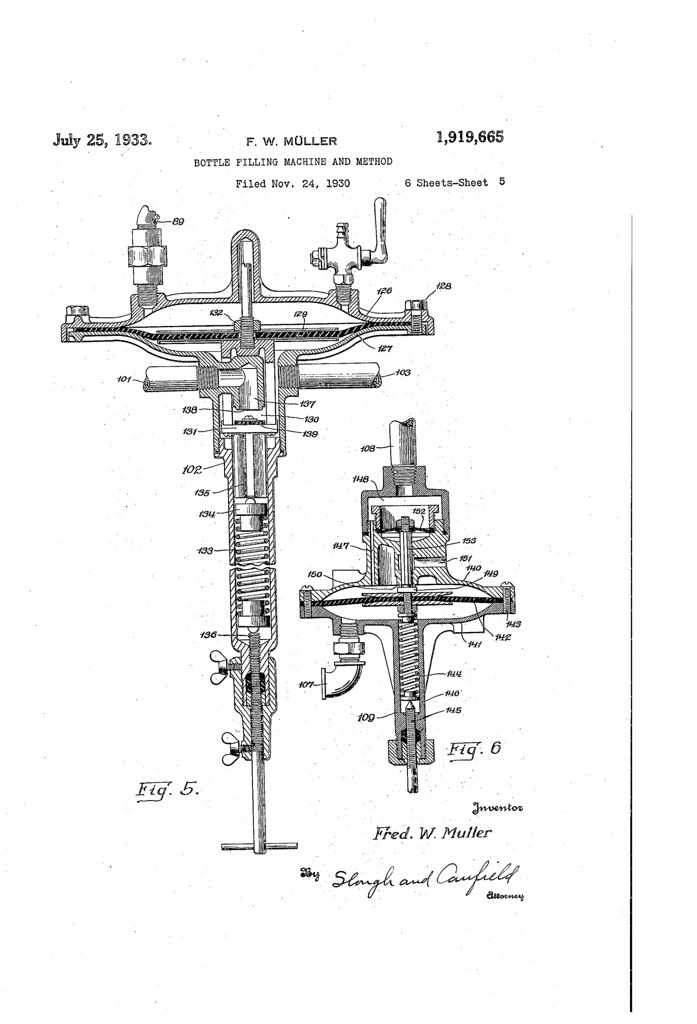
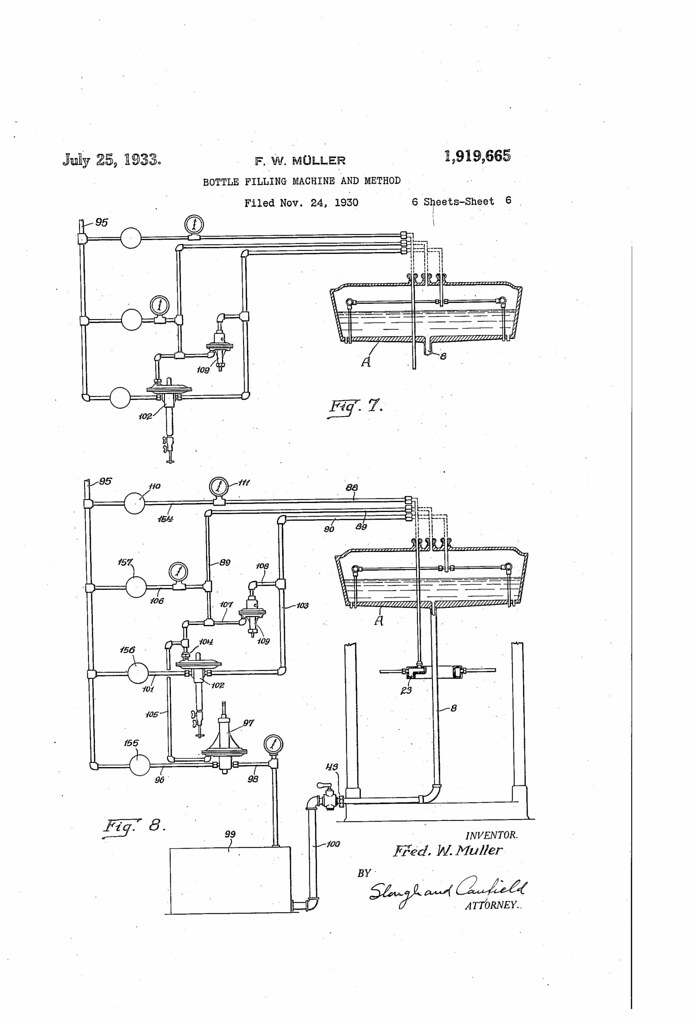
Today in 1933, US Patent 1919665 A was issued, an invention of Frederick W. Muller, for his “Bottle Filling Machine and Method.” There’s no Abstract, although in the description it includes these claims:

This invention relates to bottle filling machines and methods and relates particularly to bottle filling machines of the type wherein a plurality of bottles continuously fed to the machine are automatically and successively filled with a beverage such as beer.

US1919665-0
US1919665-1
US1919665-2
US1919665-3
US1919665-4
US1919665-5

Filed Under: Beers, Breweries, Just For Fun, Politics & Law, Related Pleasures Tagged With: Bottles, Brewing Equipment, History, Law, Packaging, Patent

Patent No. 3679431A: Wort Production

July 25, 2016 By Jay Brooks

patent-logo
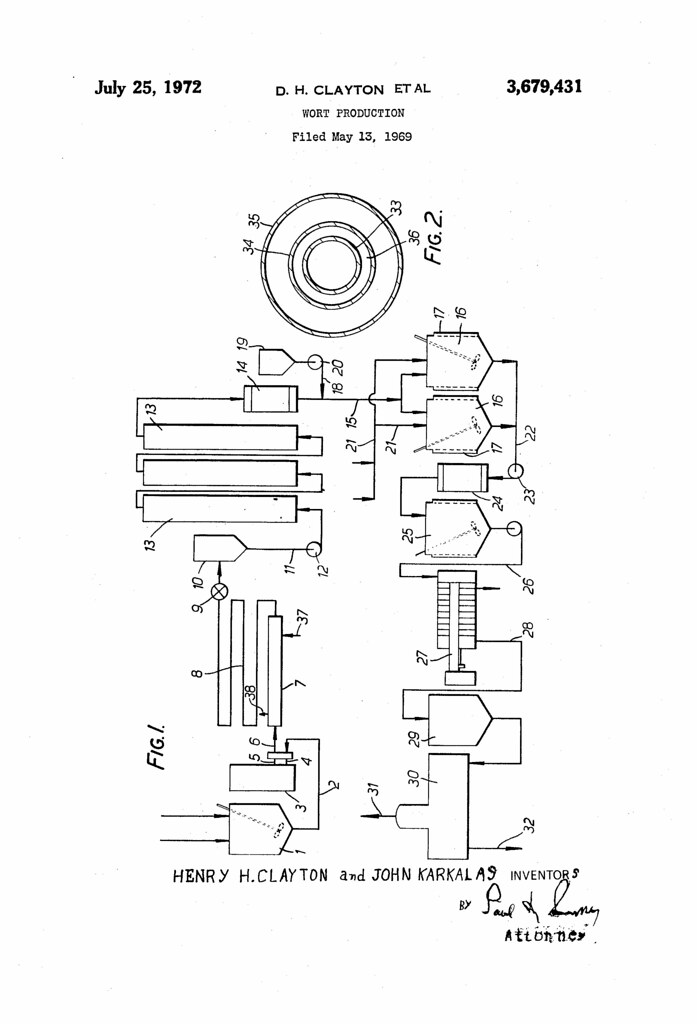
Today in 1972, US Patent 3679431 A was issued, an invention of David Henry Clayton and John Karkalas, for their “Wort Production.” There’s no Abstract, although in the description it includes these claims:

This invention is concerned with improvements in or relating to wort production.

– Wort contains in addition to fermentable carbohydrates, soluble nitrogeneous compounds. Barley malt is the traditional raw material for the production of wort since it provides a source of carbohydrates and “nitrogen com pounds and in addition provides the enzymes capable of degrading the carbohydrates and nitrogen compounds to the soluble components of wort.

Malt is manufactured from e.g. barley by the process of malting. This consists of first germinating and then drying barley grain under controlled conditions.

The manufacture of malt is expensive because (1) large capital investments are necessary for the malting machinery, (2) a skilled labour force is required to operate the malting machines, (3) malt can only be made successfully from the higher qualities of barley which are expensive and (4) during the malting process a physical loss in dry matter occurs; this is known as the malting loss.

It is an object of the invention to provide an improved method of producing a wort in which the use of barley malt is reduced or virtually eliminated.

We have found that wort may be produced by treating an aqueous slurry of starch and protein-containing plant material for example unmalted cereal grain e.g. It appears that said hydrodynamic conditions result in the formation of a homogeneous mass very suitable for the action of the starch liquefying enzyme. Examples of starch and protein-containing plant materials other than cereals include roots, fungi material and by-products of processes to which ‘cereals have been subjected.

Examples of suitable materials include tapioca and rice, as well as wheat, barley and maize.

The invention provides a method of producing wort from an aqueous slurry of starch and protein-containing plant material comprising the steps of liquefying starch by treating the slurry with a commercial starch liquefying enzyme subjecting the slurry to hydrodynamic conditions such that a substantial thixotropic reduction of viscosity is produced by shearing forces in the slurry to facilitate the action of the starch liquefying enzyme prior to any substantial reduction of viscosity resulting from the enzymatic liquefaction converting starch to sugar by treatment with a saccharifying enzyme and converting protein to soluble nitrogen-containing compounds by treatment with a proteolytic enzyme.

The invention also provides wort when produced by a method as set out in the last preceding paragraph.

The invention also provides a process for brewing beer including such a method.

The invention also provides beer when produced by such a process.

The invention also provides a process of producing a concentrated wort syrup by concentrating wort produced by such a method.

The invention also provides a concentrated wort syrup when produced by such a process.

US3679431-0

Filed Under: Beers, Breweries, Just For Fun, Politics & Law, Related Pleasures Tagged With: adjuncts, barley, History, Law, Malt, Patent, Science of Brewing, Wort

Patent No. 3045679A: Hop Picker

July 24, 2016 By Jay Brooks

patent-logo
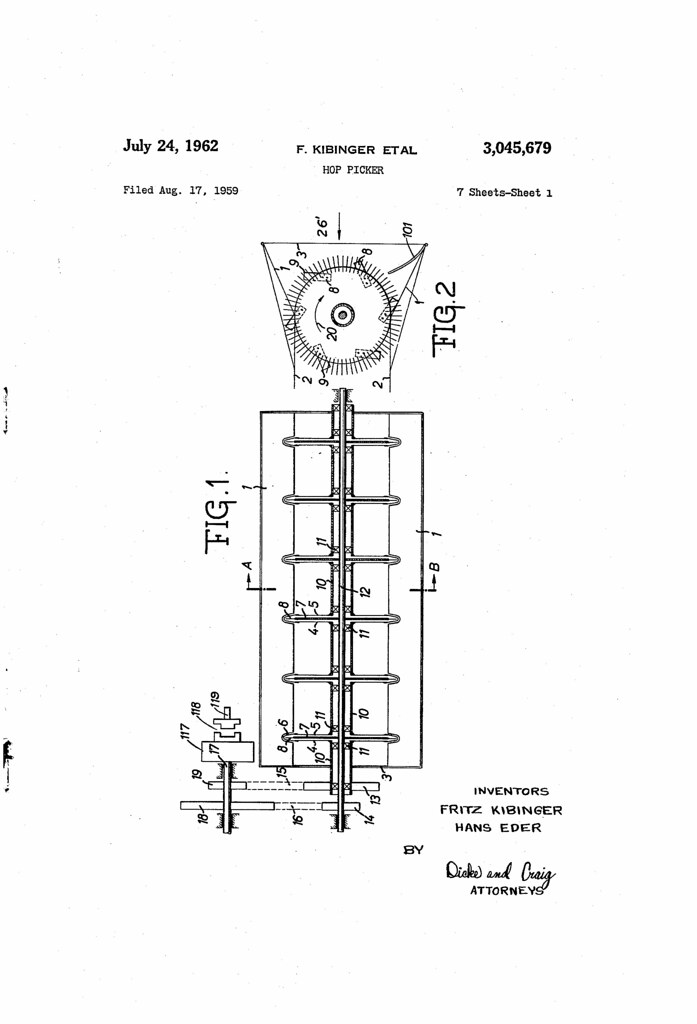
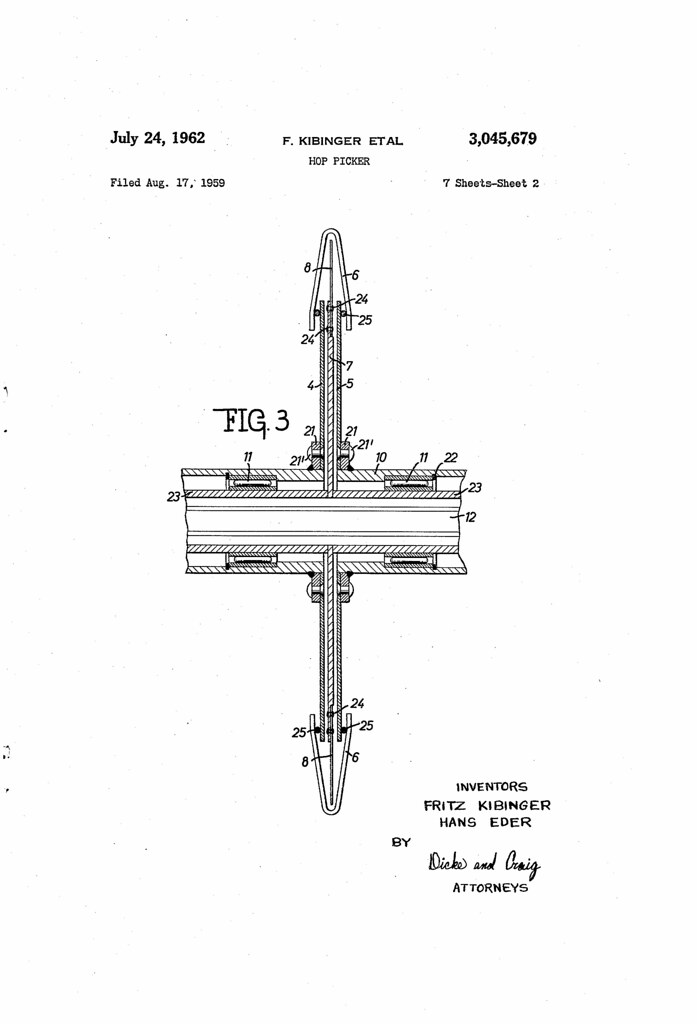
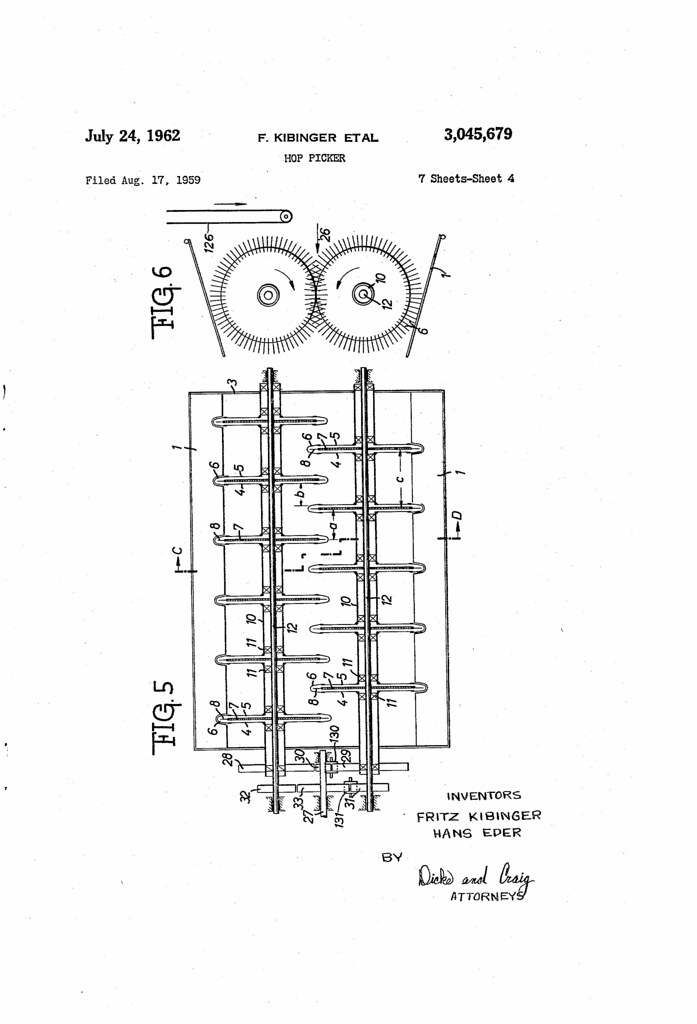
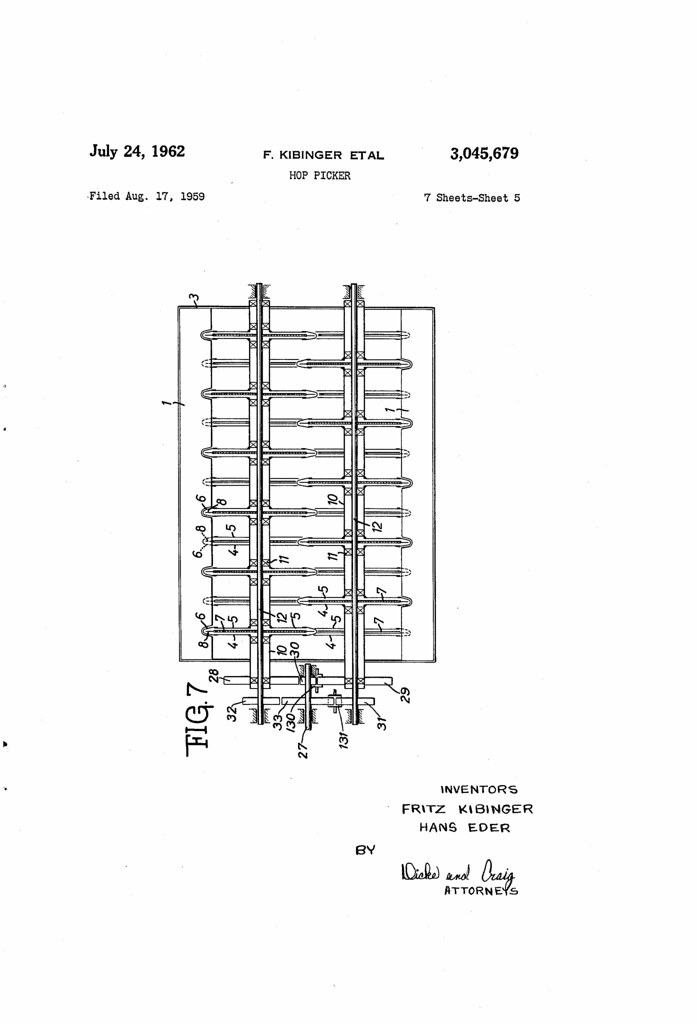
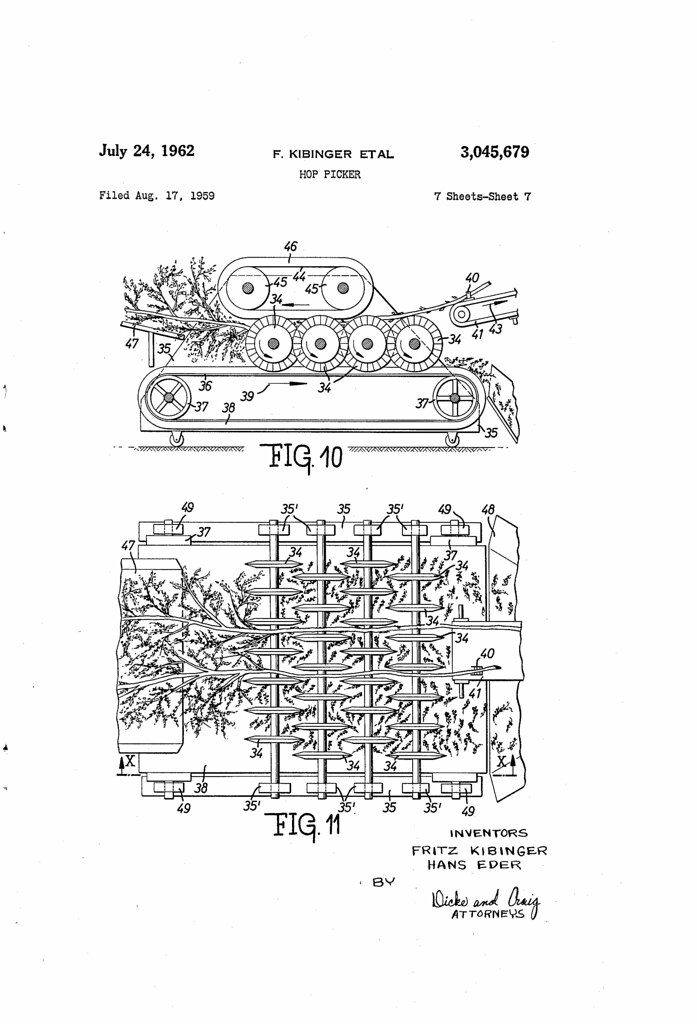
Today in 1962, US Patent 3045679 A was issued, an invention of Fritz Kibinger and Hans Eder, for his “Hop Picker.” There’s no Abstract, although in the description it includes these claims:

The present invention relates to a device for the harvesting of hops.

In order to sever the strobiles of hops from the branches carried by the bines, a picking device has been proposed having driven shafts on the periphery of a rotary disc, perpendicular to the plane faces thereof, with revolving cutter tools, to which tools gratings were associated fixed to the said disc as supporting means for the material to be separated and as deflectors for the strobiles, the material to be separated being thrown into the space enclosed by the gratings.

Each of the gratings associated with such a rotating cutter tool consisted of two wires, bars or the like, partly curved in the shape of circular arcs, arranged one above the other, the lower being below the plane of the cutter tools. The radius of curvature of each wire, bar or the like in its arcuate range was smaller than the largest radius of the cutter tool, and both wires, bars or the like were connected to one another by deflector bars, preferably of V-shape, extending substantially radially to the axes of the cutter tools. The bends of the deflector bar-s had a distance from the axis of rotation of the associated cutter tool which exceeded the radius of the cutter tool. The spacing between the wires, bars or the like forming the grating, which are to be considered as fixed relative to the axes of rotation of the cutter tools, was so dimensioned that even the smallest strobile could not pass between these wires, bars or the like. A second disc was also associated with the rotary disc above which deflector means and severing means were arranged. Both of these discs were rigidly connected to one another by stays and were mounted on an axle. Between these two discs driving means were provided for the shafts of the cutter tools. Each rotating shaft was provided with several cutter tools arranged one above the others and having associated gratings, and provision was made for varying the spacing of the cutter tools arranged one above the others from one another. Additionally, bars taking part in the rotation may be arranged between any two adjacent cutter tools, which bars move the out material outward.

The use of such a picking device is based on the assumption that the branches severed from the bines are cut into pieces so that the branches had to be cut into pieces either by hand or by a special cutting device before being inserted into the device. This picking device has proved successful as such, but has the disadvantage that the danger of jamming exists when too much of the mate rial is thrown into the picking device.

The present invention has the main object of providing a device for the harvesting of hops which can be used not only for the dividing of branches into pieces, but also for the picking, depending on how its associated components are arranged relative to one another. It is also an object of the present invention to use in a pure severing device the same components as in a picking device. It is yet another object of the invention to effect an improved, and particularly a quicker supply of the material.

US3045679-0
US3045679-1
US3045679-2
US3045679-3
US3045679-4
US3045679-5
US3045679-6

Filed Under: Beers, Just For Fun, Politics & Law, Related Pleasures Tagged With: Brewing Equipment, History, Hops, Law, Patent

Patent No. 654369A: Apparatus For Pasteurizing Beer

July 24, 2016 By Jay Brooks

patent-logo
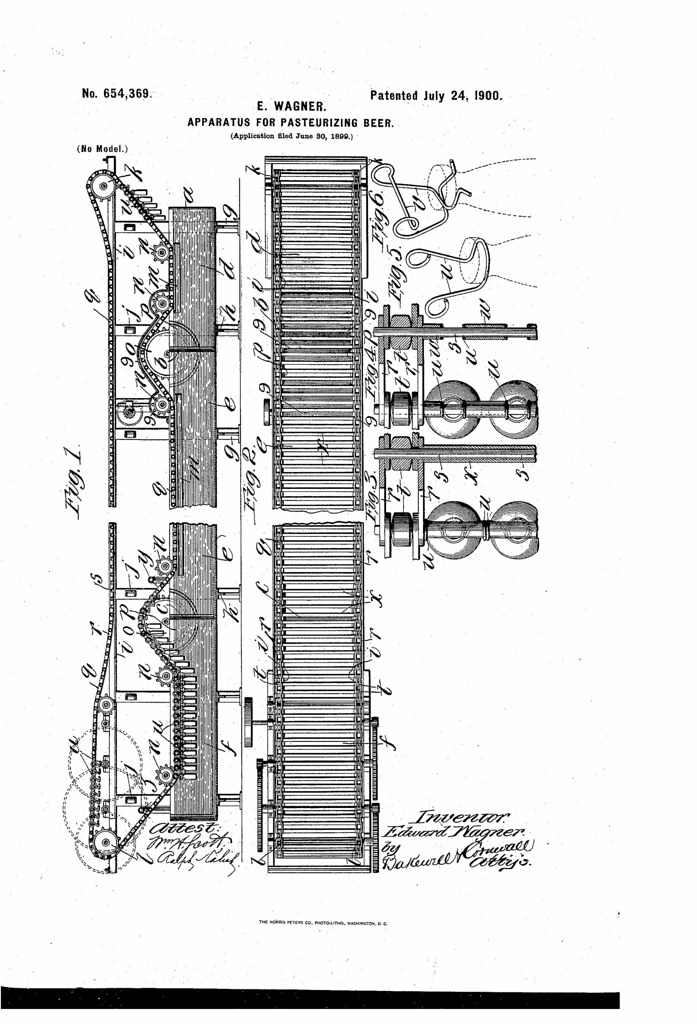
Today in 1900, US Patent 654369 A was issued, an invention of Edward Wagner, assigned to the Model Bottling Machinery Company, for his “Apparatus For Pasteurizing Beer.” There’s no Abstract, although in the description it includes these claims:

This invention relates to an improved apparatus for pasteurizing beer, the’object being to provide a simple, cheap, and convenient apparatus for treating the bottled beer to destroy the yeast molecules and germs contained therein, whereby further fermentation is prevented.

US654369-0

Filed Under: Beers, Breweries, Just For Fun, Politics & Law, Related Pleasures Tagged With: Brewing Equipment, History, Law, Patent, Science of Brewing

Patent No. 860936A: Bottle Carrier For Bottling Establishments

July 23, 2016 By Jay Brooks

patent-logo
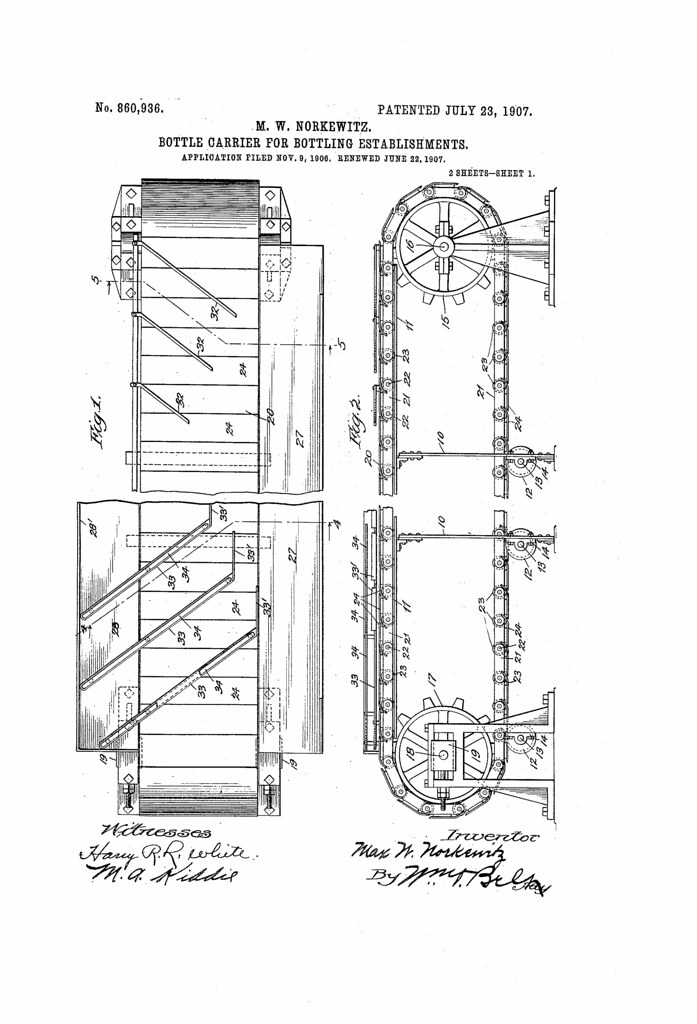
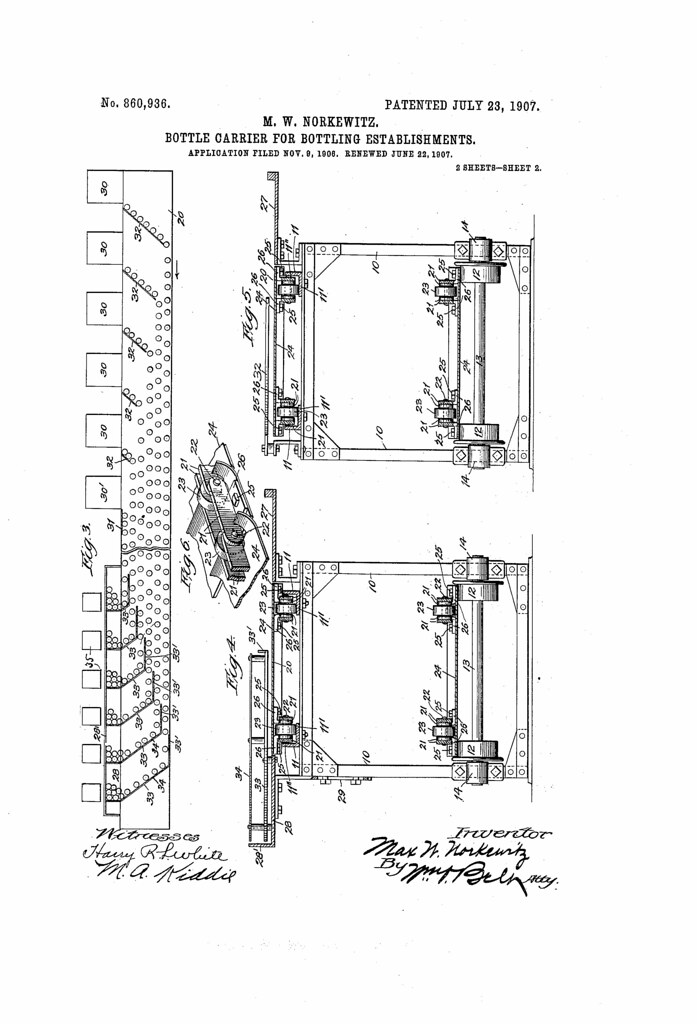
Today in 1907, US Patent 860936 A was issued, an invention of Max W. Norkewitz, for his “Bottle Carrier For Bottling Establishments.” There’s no Abstract, although in the description it includes these claims:

This invention relates particularly to machinery for bottling establishments and it is’ intended primarily to dispose of the bottles expeditiously from a gang of labeling machines and facilitate the operation of packing them in cases.

My invention is intended for use principally in those bottling establishments where a number of brands of beer or other liquid are bottled and labeled at the same time and its object is to provide means for carrying the bottles away from a gang of labeling machines to the packing tables and without mixing them.

US860936-0
US860936-1

Filed Under: Beers, Breweries, Just For Fun, Politics & Law, Related Pleasures Tagged With: Bottles, Brewing Equipment, History, Law, Patent

Patent No. 860746A: Frame For Hop-Scoops

July 23, 2016 By Jay Brooks

patent-logo
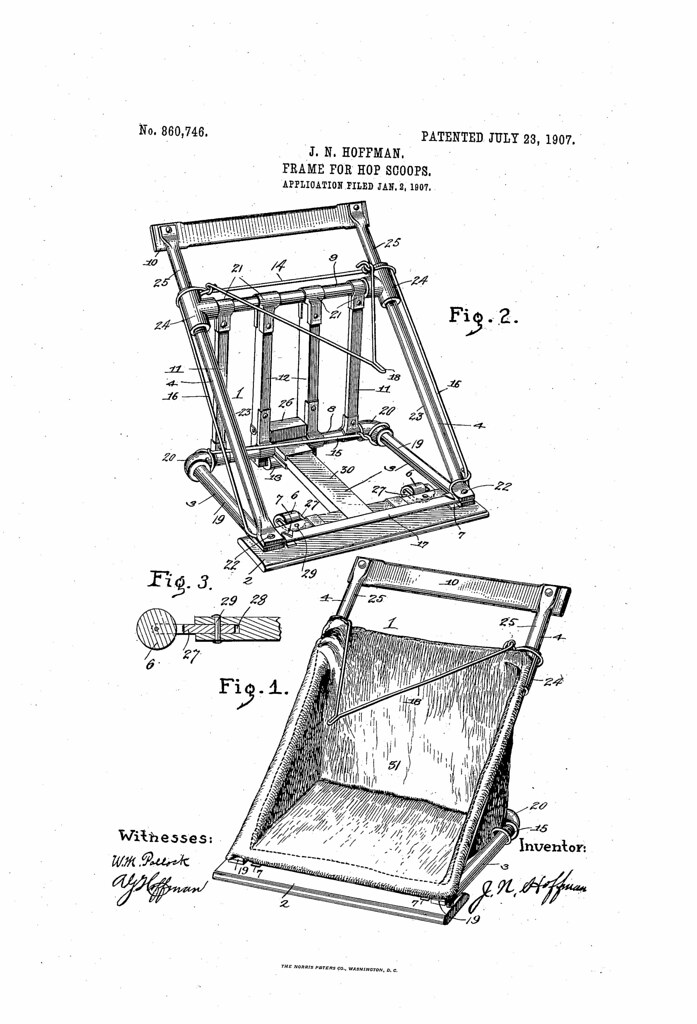
Today in 1907, US Patent 860746 A was issued, an invention of John N. Hoffman, for his “Frame For Hop-Scoops.” There’s no Abstract, although in the description it includes these claims:

My invention relates to improvements in scoops for picking up and conveying hops, or the like, and it consists in the features of novelty hereinafter described and claimed.

The object of the invention is to provide a hop scoop of simple, strong and durable construction and one which may be conveniently operated.

US860746-0

Filed Under: Beers, Just For Fun, Politics & Law, Related Pleasures Tagged With: Brewing Equipment, History, Hops, Law, Patent

« Previous Page
Next Page »

Find Something

Northern California Breweries

Please consider purchasing my latest book, California Breweries North, available from Amazon, or ask for it at your local bookstore.

Recent Comments

  • Steve 'Pudgy' De Rose on Historic Beer Birthday: Jacob Schmidt
  • Jay Brooks on Beer Birthday: Bill Owens
  • Steve 'Pudgy' De Rose on Beer Birthday: Charles Finkel
  • Steve 'Pudgy' De Rose on Beer Birthday: Bill Owens
  • Steve "Pudgy" De Rose on Beer Birthday: Pete Slosberg

Recent Posts

  • Beer In Ads #5130: Bishop And Smitty Says Bock Beer December 2, 2025
  • Beer Birthday: Bob Pease December 2, 2025
  • Beer In Ads #5129: Call For Gem Bock Beer December 1, 2025
  • Beer Birthday: Susan Boyle December 1, 2025
  • Historic Beer Birthday: William Krug December 1, 2025

BBB Archives

Feedback

Head Quarter
This site is hosted and maintained by H25Q.dev. Any questions or comments for the webmaster can be directed here.