Brookston Beer Bulletin

Jay R. Brooks on Beer

  • Home
  • About
  • Editorial
  • Birthdays
  • Art & Beer

Socialize

  • Dribbble
  • Email
  • Facebook
  • Flickr
  • GitHub
  • Instagram
  • LinkedIn
  • Pinterest
  • RSS
  • Twitter
  • YouTube

Powered by Genesis

Not Drinking Leads To Depression

October 6, 2009 By Jay Brooks

pink-elephant
It will be interesting to see how the neo-prohibitionists spin this one. An article in Time magazine, entitled Why Nondrinkers May Be More Depressed, by John Cloud, details the findings of a recent study that suggests “those who never drink are at significantly higher risk for not only depression but also anxiety disorders, compared with those who consume alcohol regularly.”

That study, Anxiety and Depression Among Abstainers and Low-Level Alcohol Consumers, was published in the journal Addiction. According to the press release from the journal:

Abstaining from alcohol consumption is associated with an increased risk of depression according to a new study published in Addiction journal.

It has long been recognised that excessive alcohol consumption can lead to poor physical and mental health. However, there has been mounting evidence that low levels of alcohol consumption may also be associated with poor mental health possibly due to abstainers having other health problems or being reformed heavy drinkers.

The study utilized data from the Nord-Trøndelag Health Study (HUNT Study) based in Norway. This provided information on the drinking habits and mental health of over 38,000 individuals. Using this data the authors were able to show that those individuals who reported drinking no alcohol over a two week period were more likely than moderate drinkers to report symptoms of depression. Those individuals who additionally labeled themselves as “abstainers” were at the highest risk of depression. Other factors, such as age, physical health problems and number of close friends could explain some, but not all of this increased risk. The authors also had access to reported levels of alcohol consumption 11 years prior to the main survey. This showed that fourteen percent of current abstainers had previously been heavy drinkers, but this did not explain all of the increased risk of depression amongst abstainers.

The authors conclude that in societies where some use of alcohol is the norm, abstinence may be associated with being socially marginalized or particular personality traits that may also be associated with mental illness.

Though the authors of the study stop short of encouraging abstainers to start drinking, the Time magazine concludes with what any rational person reading this might think, which is “just say yes.”

The most powerful explanation seems to be that abstainers have fewer close friends than drinkers, even though they tend to participate more often in organized social activities. Abstainers seem to have a harder time making strong friendship bonds, perhaps because they don’t have alcohol to lubricate their social interactions. After all, it’s easier to reveal your worst fears and greatest hopes to a potential friend after a Negroni or two.

So does this mean we should all have a cocktail? Maybe, but Skogen says he doesn’t believe his study should encourage abstainers to become drinkers. Rather, he says doctors might want to investigate why abstaining patients don’t drink and explain that in societies where alcohol use is common, not drinking may lead them to feel left out. Sometimes, you should just say yes.

In addition to this study concerning mental health, several studies over the past decade or more have also concluded that the moderate consumption of alcohol leads to better physical health than for people who abstain from it. Better physical health and now better mental health, all from simply having a drink or two regularly. To me, that’s the pink elephant in the room.

pink-elephant

The anti-alcohol groups seem so hell bent on their all or nothing approach, seeing any alcohol as bad and no alcohol as all good, when the reality is hardly that simple. As these studies suggest, the common ground should be a more reasonable approach that leads to more drinking in moderation, removing the conditions that lead to over-consumption through education, strengthening infrastructure for public transportation so people can go out for a drink without fear, and recognizing that drinking alcohol does have many positive attributes when consumed responsibly. I realize that seems like a Herculean task at this moment in time, but that’s the only way I can see moving past the entrenched positions of both sides.

Obviously, I’m on one side of the aisle and I honestly believe that no one involved with the alcohol industry thinks that over-consumption or any extremes in drinking are a good thing. Both camps seem to agree on that. But the people against alcohol seem incapable of giving up any ground to concede that for most people moderate drinking may not be the evil they believe or that it doesn’t necessarily have to lead to greater problems. That very unwillingness, I believe, is actually exacerbating the problems that some people do experience with drinking too heavily because their focus is on the wrong problem and paints all drinkers will the same broad brush. As science continues to confirm that alcohol has been, and still is, a part of a healthy lifestyle, that position will become harder and harder to defend.

Remember the definition of an abstainer by Ambrose Bierce, in his Devil’s Dictionary:

Abstainer: n. a weak person who yields to the temptation of denying himself a pleasure.

Filed Under: Editorial, News, Politics & Law Tagged With: Mainstream Coverage, Prohibitionists, Statistics

Top 5 Beer Cities & America’s Best Beers

October 6, 2009 By Jay Brooks

mens-journal
Men’s Journal yesterday released their annual lists of beer, both America’s Best Beers and The Top Five Beer Towns in the U.S.. Let’s look at the top five cities first.

  1. San Diego
  2. New York City
  3. Portland
  4. Philadelphia
  5. Chicago

It’s nice to see San Diego get some much-deserved love. While I think New York has improved in it’s beer scene over the last few years, I still have a hard time seeing it as being superior to Portland or Philly. Of course, Men’s Journal, like many periodicals, is published in New York and it’s been my experience (I lived there for several years once upon a time) that New Yorkers have an over-developed sense of their central position in the world. Naturally, I would have liked to see San Francisco on the list, but really it’s the Bay Area in total that’s most deserving, not that just the city’s scene isn’t good, too.
top-5-beer-cities
As for the beers they highlight this year, it’s a pretty good list, I’m happy to say. I especially love their introduction, where they reveal what many of us in the beer world have been saying for a few years now: “American craft brews now dominate” around the world. Finishing with “[n]ow there’s no reason to travel farther than your nearest specialty grocery store for a perfect beer.” If only the grocery chains would catch up and stock a wider range of good beer.

The list is divided into five broad categories; ales, lagers, dark beers, Belgian-style and cutting edge. Authors Christian DeBenedetti and Seth Fletcher then chose three beers of each kind to come up their top 25. As subjective at these lists can be, I have to say Men’s Journal is getting better at picking their top beers. While there are plenty of other beers I might have put on such a list — as any two people would undoubtedly choose different beers — I can’t really quibble with any of the beers they picked, save one or two, but not even enough to mention. I’ll have to do my own list one of these days.

Filed Under: Beers, Editorial, Just For Fun, News, Reviews Tagged With: Lists, Mainstream Coverage, Statistics

Mad Money Man Jim Cramer Declares Beer Wars Over

October 6, 2009 By Jay Brooks

white
Jim Cramer, the knucklehead financial dramatist who hosts the Mad Money program on MSNBC, tackles the beer wars between the major brewers, and trips over himself all over the place. You’d think no one would would watch his show or take his advice after Jon Stewart exposed him so completely earlier this year, but apparently he’s as popular as ever. That’s surprising to me given that his track record is about as good as the average weatherman. The financial markets being complex and interconnected systems, his simple-minded advice seems doomed to failure for that reason alone, but he still promises on his website that you can “Make Money With Money Manager Jim Cramer.” Caveat emptor, I guess. Maybe it’s just me, but I don’t really like having my advice yelled at me while waving cheap props in my face.
mad_money
Like most financial analysts I’ve seen talk about the brewing industry lately, Cramer has no real sense of what’s going on or the history involved with why the industry is where it is today. And so they seem to attack in a vacuum, with no understanding of it at all. You can check out his screed here about the end of the beer wars.

He details how the beer world until recently was dominated by eight companies: Bud (Anheuser-Busch) Coors, Corona (Grupo Modelo), Dos Equis (FEMSA / Cervecería Cuauhtémoc Moctezuma), Heineken, Miller, Molson and Pabst. But now that InBev bought A-B and Coors and Miller merged their operation in the U.S., “suddenly” — to use Cramer’s surprising words — “we have a near oligopoly?” First of all, these eight are not the full picture. He’s ignored Kirin, Carlsberg, Asahi, and Diageo; all in the top 10 largest beer companies globally. That’s not to mention Radeberger, Tsingtao, Foster’s and others just below the Top 10.

Then there’s the “suddenly” that Cramer keep and his gang of idiots keep feigning. Brewery consolidation has been going on literally since Prohibition ended, 75 years ago. From roughly 1,000 breweries re-opening in the years after alcohol became legal again to 1984, when there were only 44 left, and the top six accounted for 92% of beer sold, mergers & acquisitions have been on-going. This is hardly a new situation. And that’s just the U.S. The same thing has been happening around the world, both locally and in global markets. We’ve been referring to the “Big 3” — A-B, Coors & Miller — for decades. Now that there are two it’s a problem? “Suddenly?” Please …. give me a break.

Recently, ABI announced they would raise prices this fall, and MillerCoors followed suit … like they’ve always done, again for years and years. But Cramer and others reacted as if this is the first time such a thing has happened. It’s not. The major beer companies, both domestic and import, have been following one another’s lead (usually A-B) for as long as I can remember, and undoubtedly longer.

The New York Times has a similar rant in, of all things, their “breaking Views” section called Rising Beer Prices Hint at Oligopoly. I find it funny that something going on without change for decades could be considered a “breaking view,” but I guess that’s what happens when you ignore history.

Anheuser-Busch InBev — purveyor of the president’s preferred brew, Bud Light — and MillerCoors, a joint venture between SABMiller and Molson Coors, are raising prices at the same time, during a recession and while beer demand is slumping. With 80 percent of the market between them, the move almost begs for an antitrust review. [my emphasis.]

Hello, is anybody home? They’ve been raising prices “at the same time” forever. It means nothing. These are not “hints,” but simply business as usual. What the hell is wrong with these people?

Cramer goes on to rave that because they’re both raising prices that somehow that signals an end to the competition between them. He states that they’ve been “going from competitors absolutely killing each other to a slap happy international beer oligopoly.” He’s more daft than I previously thought, and that’s saying a lot.

He keeps calling Labatt, “Labott,” and incorrectly identifies it with InBev. It is owned by InBev outside the U.S., but domestically it’s owned by North American Breweries. His audience is primarily American, so that makes no sense. Cramer’s advice about buying MolsonCoors stock I can’t say I understand completely and he throws around quite a few numbers that don’t seem to either support his conclusions or even appear rational. He’s mildly clever when he says “Give Beer A Chance” with a peace symbol made of beer cans, but I’d prefer he did his homework instead and knew what the hell he was talking about. What a maroon.

The beer wars, of course, are hardly over.

Filed Under: Breweries, Editorial Tagged With: Economics, Mainstream Coverage

Weekend Reading

October 4, 2009 By Jay Brooks

reading-books
In my on-going efforts to stay caught up, here is some worthwhile reading I’ll suggest taking a look at. These are various random beer articles that have come to my attention over the last few weeks. Enjoy.

  1. Craft Beer In A Can? A Gutsy Move Is Paying Off from NPR
  2. Oh Dear, It’s Beer, Beer, Beer, Beer by Joanne Weintraub, on the Milwaukee-Wisconsin Journal Sentinel Online
  3. That’s a ‘Binge Belly,’ Not a Beer Belly on WebMD Health News
  4. Category Builders vs. Category Killers on the Branding Strategy Insider
  5. Why Every Cold Beer Costs You More by Michael Brush on MSN Money
  6. Celebrate the History of Statistics: Drink a Guinness by Andrew Leonard on Salon’s How the World Works, which is also discussed at the Economist’s View

Filed Under: Beers, Breweries, Just For Fun Tagged With: Economics, Mainstream Coverage

Beer Raped Your Daughter and Gave Her Gonorrhea … Again

October 1, 2009 By Jay Brooks

reason
Thanks to Anat Baron for tweeting this my way, but it seems that the storm clouds are once again gathering over ridiculous propaganda aimed at beer. Luckily, Reason Magazine — a periodical I’ve written for — is on the case in a piece entitled Beer Raped Your Daughter and Gave Her Gonorrhea. Again.

It concerns a Washington Post editorial where two doctors argue out of — one hopes — a sense of fealty to their Hippocratic oath that more expensive beer means lower consumption, less problems, less issues, less greenhouse gas emissions, less poverty, less .. well, you get the idea — the world will be a magically better place if only there were more taxes on beer. Of course, we’ve been down this argumentative road before and their statistics, like others before them, don’t add up. They never do, but that doesn’t stop them for spouting off and making this shit up, because they seem to be taking the approach of a lie repeated often enough becomes a fact over time. As a member of The Angry Arm of the Alcohol Lobby, I say bullshit.

Here’s their nut job argument in a nutshell:

One way to reduce the harmful effects of heavy drinking is to make drinking more expensive: the more a drink costs, the less people drink. This is true of young people, pregnant women and even heavy drinkers. Research indicates that a 10 percent increase in current alcohol excise taxes — that is a penny for a beer — would result in less drinking, especially among underage drinkers, reducing rape, robbery, domestic violence and liver disease. A tax increase of 3 cents per beer would cut youth gonorrhea by 9 percent.

So more expensive beer means less rape, less STDs, less domestic violence and all manner of other horrors. Because that’s the way it’s worked as cigarette prices have kept going up, right? Here’s how Reason looked at this argument:

I’m going to pull out that last line one more time in case you, like me, sometime skim over blockquotes too quickly:

A tax increase of 3 cents per beer would cut youth gonorrhea by 9 percent.

Look at the lovely young lady at right [an old Budweiser print ad of a couple fishing]. If only a three cent tax on that Budweiser could have saved her from the heartbreak of VD.

Messrs. (Drs.?) Sederer and Goplerud have taken the fine art of vaguely claiming that “studies show…” to a new level. Obviously, the argument here is that lots of beer makes people more likely to rape, pillage, etc. and that pricier beer means less consumption. A quick Google reveals that they’re pulling from 2000 study that looked at beer taxes and gonorrhea rates in various states. Reason, of course, tore this study a new one back when first made the rounds. Key passage:

[David Murray of the Statistical Assessment Service, a non-profit think tank in D.C.] does yeoman’s work pointing out the junk reasoning at the root of so much junk science. This one was a high, hanging curve for Murray, who said the CDC’s thinking was on the level of “the sun goes down because we turn on the street lights.”

The really interesting thing is that the CDC, in effect, agrees with that criticism. It buries its assent, however, in an editorial note that says the findings “do not prove a causal relation between higher taxes and declining STD [sexually transmitted disease] rates.”

To get a sense of how bad their math is, just look at their assertion that a 10% increase means only one penny more in excise taxes. That would mean that the taxes now would be 10 cents for that to be true. Are they? Not even close. There’s a federal excise tax on beer, and then a state one, too, and the amount varies widely from state to state, making that line ridiculous on its face.

And they trot out this old saw:

It has been 18 years since federal taxes on alcohol have changed. If all spirit taxes had increased at the consumer price index and been taxed like liquor, federal taxes on a shot of spirits would have increased by 10 cents, a beer by 21 cents, and a glass of wine by 24 cents. Making that adjustment now would raise $101 billion over 10 years, without state tax increases. Equalizing the tax among beer, wine and spirits, without inflation, would raise $60 billion over 10 years.

Don’t you believe it. I’ve examined this argument thoroughly before in Here We Go Again: Beer & Taxes and Why Alcohol Doesn’t Get A Pass, among others, and it’s nothing but vicious propaganda. And propaganda made even worse by virtue of it coming from medical doctors, who people tend to believe have their best interests at heart. They don’t, of course, doctors have their own interests at heart, like everyone else. Just look at how they attacked the idea of health care reform, beginning all the way back in 1948 when a P.R. firm hired by the AMA actually coined the term “socialized medicine” to scare people into making sure we wouldn’t have universal health care in this country. That’s how much they care about you and me.

If you track these things, like I tend to, you’ll notice that the attacks on alcohol have been getting more frequent, more virulent and more mainstream. You don’t think that could have anything to do with pharmaceutical ads proliferating while alcohol ads are highly regulated and restricted? Nah, must be a coincidence. Now where does your daughter hang out? I want to buy her a beer.

Filed Under: Editorial, News, Politics & Law Tagged With: Mainstream Coverage, Prohibitionists, Statistics

Heady Days in the Philadelphia Inquirer

August 16, 2009 By Jay Brooks

pennsylvania
There was an interesting look at the current state of the craft beer movement in today’s Philadelphia Inquirer by food columnist Rick Nichols. Though it’s Sam-centric, Heady Days for Craft Breweries is worth a read.

Filed Under: Beers, News Tagged With: Eastern States, Mainstream Coverage, Pennsylvania, Philadelphia

All Beer Is The Same!?!

July 30, 2009 By Jay Brooks

beer-bottle-brown
I try to keep my criticisms of beer coverage by the mainstream media civil, especially since at times I’m one of them. But an article posted yesterday on MSNBC, Will You Drink Beer In A Box?, is so completely riddled with error and ridiculousness that the gloves are off. Author James Dlugosch may know stocks and the world of finance, but when it comes to beer, he’s an unmitigated idiot.

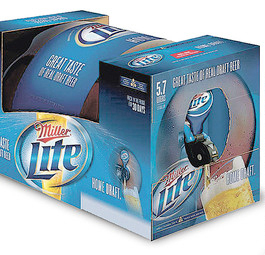
First of all, the premise of his article, taken from a Wall Street Journal article, is that Molson Coors, actually MillerCoors but I’ll try not to nitpick, is testing beer in a box, which he finds as distasteful as box wine. Which is all well and good, but it’s not in a box at all. It’s a small keg that fits in your refrigerator, similar to the mini-kegs the Germans have been selling for decades. See below. You can also see another view of it from the front at Gizmodo. The keg itself is in a cardboard box, presumably for easier carrying, but the beer is in a container no different than any other keg or can of beer. It’s like saying that since a six-pack of bottles are packaged in a cardboard six-pack carrier that the beer is in cardboard, too. What a maroon.

miller-lite-home-keg
But it gets better. The reason he’s so opposed to a box has less to do with the container and more to do with his own twisted sense of how things ought to be. Here’s how he sees it:

Now, with beer, the box might be less objectionable since, in my opinion, the quality issue is not really in play. Despite what the microbrewers will tell you, all beer is pretty much the same. Consumers who pay a premium do so more for the experience than the taste.

So apparently an Old Rasputin Imperial Stout is exactly, excuse me, pretty much the same as Miller Lite. In the words of Bill Cosby channeling Noah. “Right ….” At this point, I almost feel sorry for him. Imagine having so little understanding or familiarity with taste and smell or such an underdeveloped palate that you could write those words and, presumably, believe them. It’s not that beer tastes differently, it’s just that we experience them differently. “Right …” Well that will certainly make judging at GABF this year considerably easier since we can just pile them all together instead of having to sit for hours with 78 different style categories and countless sub-categories, each pretending to have their own unique taste profile. Not that there’s much danger of this, but I sure hope I don’t get invited to the White House for a beer summit with this knucklehead.

But as ridiculous as that statement was, wait, this one’s even better:

But for me, the issue is the bottle. I like drinking my suds from a cold bottle. Period.

Put it in a glass, and the experience just isn’t the same.

Wow. I’ve found my complete opposite. I won’t drink beer in a bottle or can, but insist on a glass. I’m frankly quite glad the experience isn’t the same, how could it be? Beer in a glass is so much better that I’m continually amazed that people really will drink directly from a bottle or can and now here’s someone who only does what I find abhorrent and refuse to do. Of course, I do this for a reason. Much of beer’s aroma, an integral component of its overall taste, is locked in the bottle and is released through the head when it’s poured into a glass. That’s not just my opinion, but is backed up by at least a century of scientific research, not to mention the experience of billions throughout history. It also releases excess carbon dioxide and makes your beer much less gassy and filling, too. Then, of course, there’s the pleasure of enjoying a beer from its proper glass, all lost on Dlugosch.

Naturally, Dlugosch is entitled to his opinion but I’m so weary of such ignorance being passed off as expertise. His opinion is obviously the by-product of living in a society that has commodified beer as one thing, interchangeable but for brand names differentiated by marketing and advertising. And, but for a few exceptions, his statement about beer being pretty much the same might have been correct 35-40 years ago, at least with regard to American beer. But saying so today, with over 1500 breweries making craft beer in a myriad of styles and unique compositions, makes Dlugosch a doofus. Period.

Filed Under: Beers, Editorial, News Tagged With: Mainstream Coverage, MSNBC

Maui Wowie

February 8, 2008 By Jay Brooks

maui
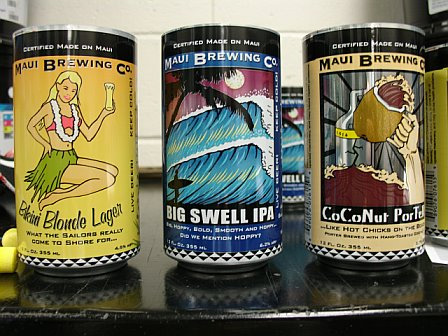
Yesterday’s Honolulu Advertiser had a nice profile of Maui Brewing (thanks Doug). It’s a nice overview of how Sacramento resident Garrett Marrero moved to Kahana, on Maui, after buying the old Fish and Game Brewing Co. & Rotisserie. They’ve also started hand-canning their beers, which are now featured on Hawaiian Airlines, which is a great package for an island like Hawaii.

maui-cans

Three of Maui’s beers in cans. The Porter won a gold medal at last year’s GABF. There’s a nice photo series of their first canning on their website.

maui-brewers
Brewmaster Thomas Kerns owner Garrett Marrero. Tom was my judging roomie at last year’s Great American Beer Festival.

Filed Under: Beers, Just For Fun, News Tagged With: Cans, Hawaii, Mainstream Coverage

A Sad Commentary

January 25, 2008 By Jay Brooks

We’ve had the Big Three — Bud, Miller and Coors — for so long now that it would probably take me a few years to stop using the term. In the UK, once upon a time it was the Big Six; and they included Allied Breweries, Bass Charrington, Courage Imperial, Scottish & Newcastle, Watneys, and Whitbread. Until yesterday, only S&N remained. With the announcement earlier today of Carlsberg and Heineken’s buyout of Scottish & Newcastle, the last vestige of a bygone era will soon disappear, as well. England’s esteemed Financial Times today has a somewhat sad commentary on this entitled Few Crying into Beers at Decline of Big Six Breweries. As they observe, the change in the beer market and the mergers that began around 1989 have now come to a final solution, and with no one left to mourn them.

Here’s a few statistics. Since the turn of the century, imported beer to the UK has increased by 50%. During that same time, the number of large breweries fell by two-thirds. Today, a mere six remain, with 34 more considered regional breweries. Since the 1980s, the number of breweries has actually tripled, but that’s because of the UK’s own microbrewery revolution, which today includes over 500 small breweries whose total production accounts for only 2% of the nation’s beer market. Before today’s buyout, Heineken enjoyed only 1% of the total British market, but after the deal is approved they will have something in the neighborhood of 30%, making them Great Britain’s biggest beer company.

Maybe none of this matters. After all, as the FT’s editorial makes clear, British pub-goers, publicans and pub operators, and even CAMRA’s real ale aficionados will all be dishearteningly unmoved by today’s news. I can’t help but think that’s a mistake. So much of our early microbreweries owe such a great debt to the heritage and history of English ales that it seems a shame to let this dismal milestone pass so cavalierly. Perhaps I’ve romanticized these old breweries too much, but I don’t feel the same loathing for their products or their business practices that I usually do for our Big Three. That may simply be the 1,000-mile expanse of ocean separating me from everyday contact, who knows? But even though the British beer industry is nowhere near deceased, this is just one more wound that will again forever alter its landscape. I, for one, in the words of the immortal Edgar Allen Poe, “am drinking ale today.”


Filed Under: Editorial Tagged With: Business, Europe, Great Britain, History, Mainstream Coverage

The Times Goes For Extremes

January 10, 2008 By Jay Brooks

There was another terrific article by Eric Asimov in the New York Times yesterday about extreme beers called A Taste for Brews That Go to Extremes. Although admitting not everybody likes the new extremism, Asimov certainly does and the article also includes several Bay Area beers, including ones from Lagunitas, Mad River and Moylan’s breweries. And there’s a great quote from Brendan Moylan, owner of both Marin Brewing and Moylan’s.

“We’re the same country that put men on the moon, and we’re taking the same approach to beer,” said Brendan Moylan, the founder of Moylan Brewing Company in Novato, Calif. “We passed the rest of the world by ages ago, and they’re just waking up to it.”

The Times also did a tasting of several extreme beers, and happily included two well-known brewers in the process: Garrett Oliver, from Brooklyn Brewing, and Phil Markowski, from Southampton Publick House. Despite their initial derisiveness over the very pursuit of extremeness, even they found beers they enjoyed. 90-Minute IPA from Dogfish Head was the group’s favorite, followed by the Double Simcoe I.P.A. from Weyerbacher and Maximus from Lagunitas. There’s also a Beers of the Times feature where you can listen to the tasters talking about their favorite beers.


Filed Under: Uncategorized Tagged With: Hops, Mainstream Coverage, National

« Previous Page
Next Page »

Find Something

Northern California Breweries

Please consider purchasing my latest book, California Breweries North, available from Amazon, or ask for it at your local bookstore.

Recent Comments

  • Ernie Dewing on Historic Beer Birthday: Charles William Bergner 
  • Steve 'Pudgy' De Rose on Historic Beer Birthday: Jacob Schmidt
  • Jay Brooks on Beer Birthday: Bill Owens
  • Steve 'Pudgy' De Rose on Beer Birthday: Charles Finkel
  • Steve 'Pudgy' De Rose on Beer Birthday: Bill Owens

Recent Posts

  • Historic Beer Birthday: Henry Weinhard February 18, 2026
  • Historic Beer Birthday: Simeon Hotz February 18, 2026
  • Beer Birthday: Teri Fahrendorf February 18, 2026
  • Beer In Ads #5207: Good News! Good Cheer! Dawson’s Bock Beer Is Here! February 17, 2026
  • Historic Beer Birthday: George Younger February 17, 2026

BBB Archives

Feedback

Head Quarter
This site is hosted and maintained by H25Q.dev. Any questions or comments for the webmaster can be directed here.