Brookston Beer Bulletin

Jay R. Brooks on Beer

  • Home
  • About
  • Editorial
  • Birthdays
  • Art & Beer

Socialize

  • Dribbble
  • Email
  • Facebook
  • Flickr
  • GitHub
  • Instagram
  • LinkedIn
  • Pinterest
  • RSS
  • Twitter
  • YouTube

Powered by Genesis

Beer In Ads #4938: Moerschel’s Bock Beer, The King Of All Beers

April 12, 2025 By Jay Brooks

Last year I decided to concentrate on Bock ads. Bock, of course, may have originated in Germany, in the town of Einbeck. Because many 19th century American breweries were founded by German immigrants, they offered a bock at certain times of the year, be it Spring, Easter, Lent, Christmas, or what have you. In a sense they were some of the first seasonal beers. “The style was later adopted in Bavaria by Munich brewers in the 17th century. Due to their Bavarian accent, citizens of Munich pronounced ‘Einbeck’ as ‘ein Bock’ (a billy goat), and thus the beer became known as ‘Bock.’ A goat often appears on bottle labels.” And presumably because they were special releases, many breweries went all out promoting them with beautiful artwork on posters and other advertising.

Friday’s ad is for Moerschel’s Bock Beer and was published April 12, 1901. The brewery was the Capitol Brewery Co., of Jefferson City, Missouri, which was originally founded in 1845 as the Joe Kessler Brewery. This ad ran in the Republican Review.

Filed Under: Art & Beer, Beers, Breweries, Just For Fun Tagged With: Advertising, Bock, History, Missouri

Historic Beer Birthday: August Anheuser Busch, Jr. a.k.a. Gussie Busch

March 28, 2025 By Jay Brooks

a-b
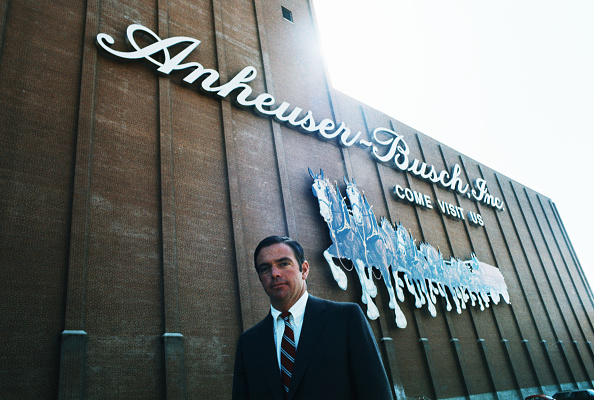
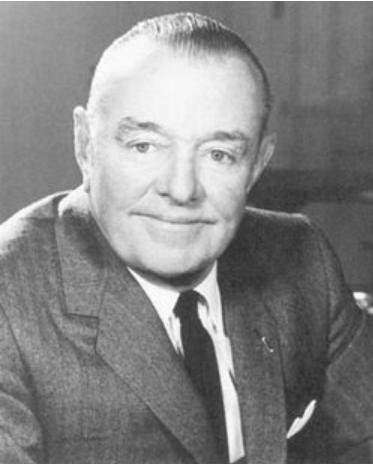
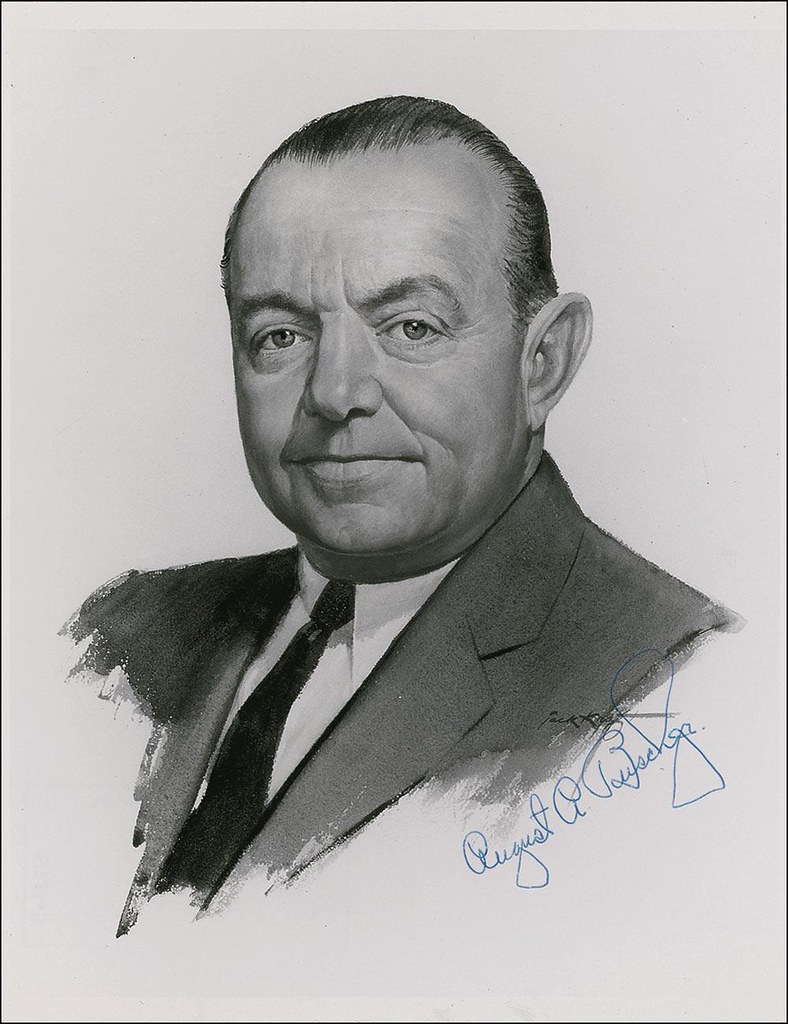
Today is the birthday of August Anheuser Busch, Jr., better known as Gussie Busch (March 28, 1899–September 29, 1989). He was the grandson of Anheuser-Busch founder Adolphus Busch. His parents were August Anheuser Busch, Sr. “Starting at lower levels to learn the family business of Anheuser-Busch Company, Busch became superintendent of brewing operations in 1924 and head of the brewing division after his father’s death in 1934. After his older brother Adolphus Busch III’s death in 1946, August A. Jr. succeeded him as President and CEO.”

gussie-busch

Here’s a short biography from Find a Grave:

Born in St. Louis, Missouri, he was the President and CEO head of the Anheuser Busch Brewery the largest brewery in the world, (1946-75). He succeeded his older brother Adolphus bush III as President and CEO and began using the Bud Clydesdale Horse Team as a company logo. He was an avid sportsman and became owner of the National League St. Louis Cardinals Major League franchise in 1953, until his death. He died at age 90 in St. Louis, Missouri. In 1984, the Cardinals retired the number 85 in his honor, which was his age at the time and he was posthumously inducted into the Cardinals team Hall of Fame in 2014.

Grants_Farm_Gussie
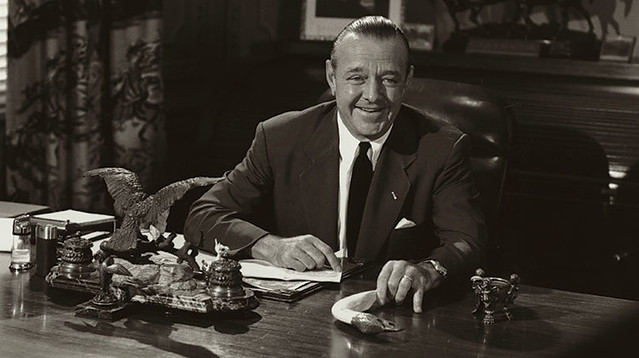
Gussie at his desk at Grant’s Farm.

This is August Anheuser Busch Jr.’s obituary from the New York Times:

August Anheuser Busch Jr., the master showman and irrepressible salesman who turned a small family operation into the world’s largest brewing company, died yesterday at his home in suburban St. Louis County, Mo. He was 90 years old and had recently been hospitalized with pneumonia.

August Anheuser Busch Jr., the master showman and irrepressible salesman who turned a small family operation into the world’s largest brewing company, died yesterday at his home in suburban St. Louis County, Mo. He was 90 years old and had recently been hospitalized with pneumonia.

He had been honorary chairman of the Anheuser-Busch Companies since his retirement in 1975. But he had remained active as the president of the St. Louis Cardinals, the National League baseball club he persuaded the company’s board to buy in 1953.

Mr. Busch, known as Gussie to virtually everybody who did not know him and as Gus to those who knew him well enough not to call him Mr. Busch, was the grandson and great-grandson of the founders of the company that bore two of his names.

The company, founded in 1876, survived Prohibition by moving into widely diverse products like soft drinks and automobile bodies.

Born in St. Louis on March 28, 1899, Mr. Busch entered the family business as a young man and became general superintendent of brewing operations in 1924. He took over as head of the brewery division after the death of his father in 1934. Although he did not become president of the company until the death of his older brother, Adolphus Busch 3d, in 1946, Mr. Busch had already made his mark as a salesman-showman.

To celebrate the repeal of Prohibition in 1933, Mr. Busch recalled the draft horses that had once pulled beer wagons in Germany and pre-automotive America and obtained a team to haul the first case of Budweiser down Pennsylvania Avenue for delivery to President Franklin D. Roosevelt at the White House. Since then the famous eight-horse hitch of Clydesdales has become almost as famous as the brand they continue to promote.

What was undoubtedly Mr. Busch’s greatest promotional coup was disguised as a civic duty – the company’s purchase of the Cardinals for $7.8 million in 1953 after the previous owner was convicted of income tax invasion.

”My ambition,” Mr. Busch declared, ”is, whether hell or high water, to get a championship baseball team for St. Louis before I die.”

He had a long wait. But beginning in 1964, the team won six National League pennants, most recently in 1987, and the World Series in 1964, 1967 and 1982.

Savored Success

Mr. Busch savored success, and he became a familiar triumphant figure to baseball fans in league playoffs and World Series home games when he would ride into Busch Stadium on the Clydesdale wagon waving a red cowboy hat.

He attributed the team’s success and the company’s to his policy of noninterference. Even so, he was active in the club’s affairs long after he left the company to others, and in 1982 he led the campaign among major league owners not to retain the previous commissioner, Bowie Kuhn.

Through the Clydesdales and the Cardinals, other promotional gimmicks and a commitment to mass advertising, Mr. Busch turned a comparatively small and financially ailing company into the industry giant. In his 29 years as the company’s active head, sales of beer went from 3 million to 37 million barrels a year. Last year the company produced 78.5 million barrels, almost double the output of its nearest competitor, and recorded sales of $9.7 billion. Its flagship brand, Budweiser, is the most popular beer in the world.

Medium Stature, Loud Voice

Through direct ownership and various trusts, Mr. Busch owned 12.5 percent of the company, or more than 30 million shares of its common stock. At yesterday’s closing price of $43.375 on the New York Stock Exchange, the holdings were worth more than $1.3 billion. The day’s increase of $1.125 a share represented a gain of more than $30 million. Trading in the company’s stock was suspended for 20 minutes after the announcement of his death.

Mr. Busch, at 5 feet 10 inches tall and 165 pounds, was a man of medium stature, but he had a loud voice that was once likened to the roar of a hoarse lion.

Fortunately for his colleagues, he had a sense of humor about his own shortcomings, which included a hairtrigger temper. ”All right, you guys,” he once shouted at a raucous company meeting. ”Let me blow my stack first. Then you can blow yours.” He also had an outsized zest for life, and both the wealth and the inclination to indulge it.

Among other things, his 281-acre estate, Grant’s Farm, includes a cabin built by hand by President Ulysses S. Grant and has a 34-room French Renaissance chateau and a well-stocked private zoo, which reflect his abiding love of animals. Mr. Busch trained his own chimpanzees and elephants before donating them to the St. Louis Zoo.

A onetime rodeo rider who later served as master of the Bridlespur Hunt outside St. Louis, Mr. Busch stocked his air-conditioned stables with several breeds, including hackneys, hunters and jumpers.

He clattered his way into family legend one day when he rode one of his horses up the main staircase of the family residence to cheer up his bedridden father.

Mr. Busch was married four times. Two of the marriages ended in divorce. His last wife, the former Margaret Rohde, died last year.

3-Buschs
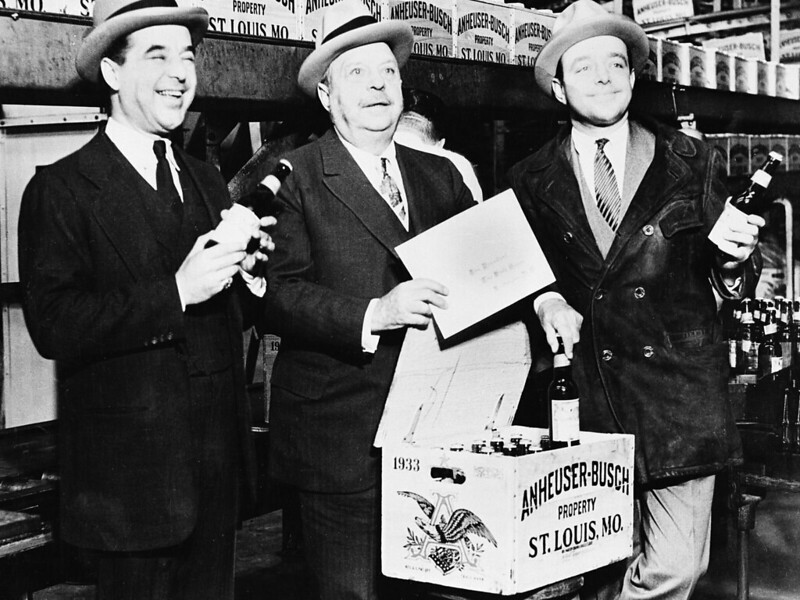
August A. Busch (center) and his sons, Adolphus III (left) and August Jr., seal the first case of beer off the Anheuser-Busch bottling plant line in St. Louis on April 7, 1933, when the sale of low-alcohol beers and wines was once again legal. Prohibition didn’t officially end until Dec. 5 of that year.

During World War II, Busch was very involved in the war effort through the Ordnance Corps, during which time he attained the rank of colonel.

Colonel August A. Busch, Jr. was born in 1899 in St. Louis, Missouri and was educated in the public schools there. He entered the family brewing business in 1924, and by 1931 was Second Vice President and a member of the board of directors. In June 1942, he was commissioned a major in the Ordnance Corps and was assigned to the Ammunition Division in the Office of the Chief of Ordnance.

He later became Deputy Chairman in charge of the Industry Integrating Committees of Ammunition (one of 82 committees set up to work with industry). Each Industry Integration Committee was made up of representatives from each participating contractor and set up to integrate Ordnance with industry. As Deputy Chairman, he was instrumental in expediting and improving production on several items. In January 1943, he was assigned to the Tank and Automotive Center at Detroit, Michigan. His task was to further the efforts of the committees on the production of tanks, the most critical item of Ordnance procurement. In March of 1943, he was reassigned to the Industry Committees of the Ammunition Division, as the Assistant Chief in Charge of Procurement for metal parts. In 1944, he became Chief of the Industry Production Branch while still retaining the title and duties of the Deputy Chairman of Industry Integrating Committees.

He established precedents and procedures that helped industry and Ordnance work together towards the war effort. His intimate knowledge of industry and his ability to gain the confidence of industrial leaders made him an invaluable asset to the Ordnance procurement process. During his later years, he served as Chairman of the board and Chief Executive Officer of Anheuser-Busch, Inc. and as Chairman of the board and President of the St. Louis Baseball Cardinals organization. Colonel Busch died in 1989.

gussie-busch-time

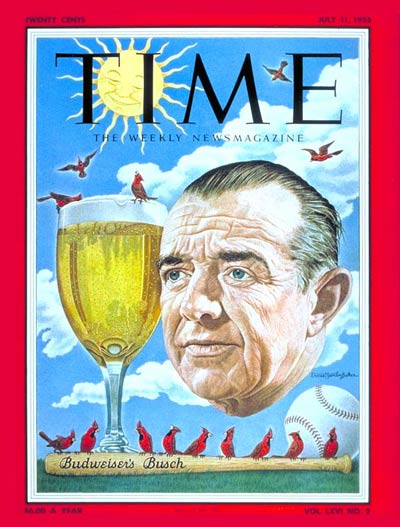
The St. Louis Cardinals, which Anhesuer-Busch bought in 1953, became an important part of Gussie Busch’s life.

In 1953, Cardinals owner Fred Saigh was convicted of tax evasion. Facing almost certain banishment from baseball, he put the Cardinals up for sale. When Busch got word that Saigh was seriously considering selling the team to interests who would move the team to Houston; he decided to have Anheuser-Busch get into the bidding in order to keep the Cardinals in St. Louis. Ultimately, Busch persuaded Saigh to take less money ($3.75 million) than what he was being offered by out-of-town interests in the name of civic pride, and also achieved a marketing tool.

As chairman, president or CEO of the Cardinals from the time the club was purchased by the brewery in 1953 until his death, Busch oversaw a team that won six National League pennants (1964, 1967, 1968, 1982, 1985, 1987) and three World Series (1964, 1967 and 1982). When his son, August Busch III, ousted him as president of Anheuser-Busch, the elder Busch remained as president of the Cardinals.

Although the Cardinals were the dominant baseball team in St. Louis, they did not own their own ballpark. Since 1920 they had rented Sportsman’s Park from the St. Louis Browns of the American League. Shortly after buying the Cardinals, Busch bought and extensively renovated the park, renaming it Busch Stadium (but only after a failed attempt to rename it as Budweiser Stadium). The team played there until Busch Memorial Stadium was built in the middle of the 1966 season.

In 1984, the Cardinals retired a number, 85, in Busch’s honor, which was his age at the time.

Gussie-and-Ken-Boyer
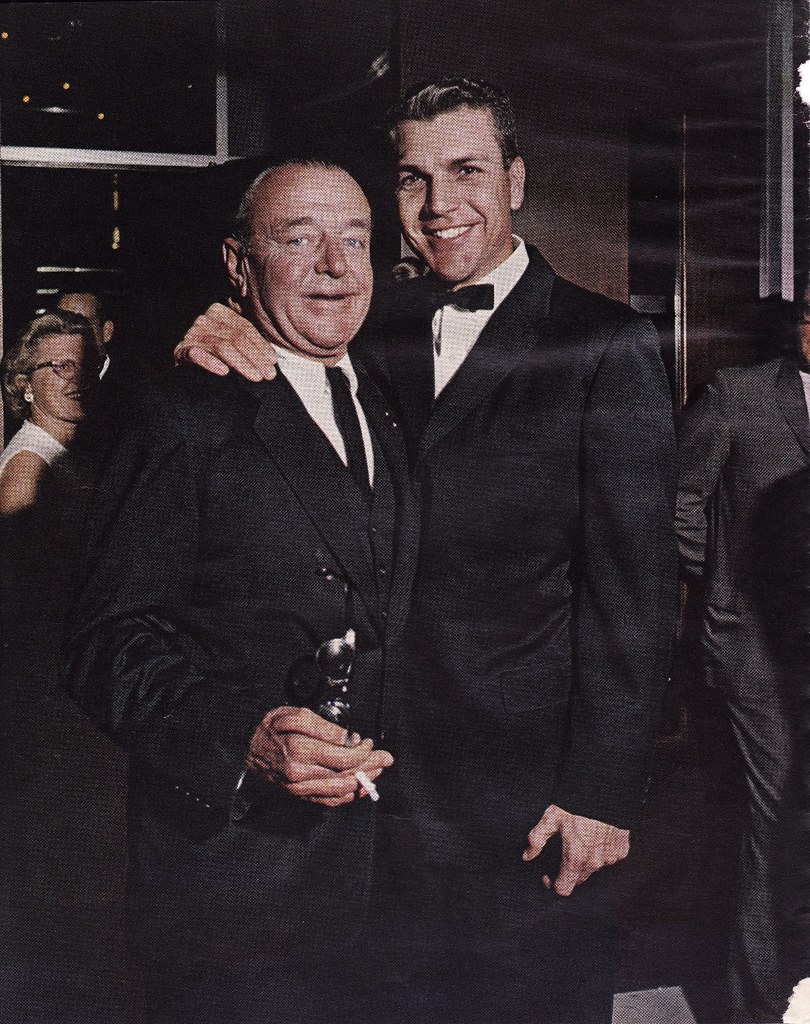
Cardinal’s Owner and beer baron Gussie Busch threw a party at the Chase Hotel following the Cardinals 1964 World Series Championship. Here he congratulates Cardinal’s third baseman Ken Boyer, who hit two home runs and drove in six.

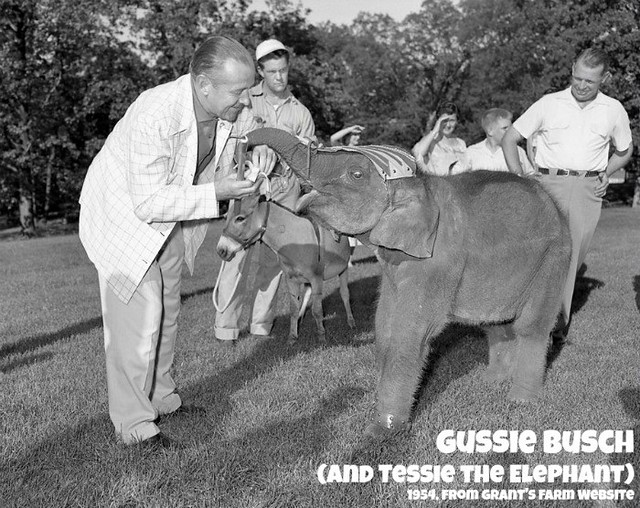
The Busch family also acquired Grant’s Farm, and made it the Busch Family Estate, opening it up to the public beginning in 1954. The estate website also has a timeline and there’s a short history of the farm from Wikipedia:

The property was at one time owned by Ulysses S. Grant and prior to that, by the Dent family. It is now owned by the Busch family, who owned the Anheuser-Busch Brewing Company for many years until it was sold to InBev in 2008. Grant’s Farm has been an animal reserve for many years and is open to the public for free; however, there is a parking fee of $12 per vehicle. This fee helps to maintain the farm. The farm is home to such animals as buffalo, elephants, camels, kangaroos, donkeys, goats, peacocks, the iconic Budweiser Clydesdales and many more. Most of these animals can be seen by visitors on a tram tour of the deer park region of the park, while the Clydesdales are found in their nearby barn and pastures. The farm also contains a cabin called “Hardscrabble,” which was built by Ulysses S. Grant on another part of the property and later relocated to Grant’s Farm. It is the only remaining structure that was hand-built by a U.S. president prior to assuming office.

Also on the farm is the Busch family mansion, and a house in which Ulysses S. Grant resided between the Mexican and Civil Wars—White Haven. This had been his wife, Julia Grant’s, family home. Frederick Dent, Julia’s father, gave 80 acres of the farm to the couple as a wedding present. White Haven is now a national historic site: the Ulysses S. Grant National Historic Site, and is located just across the road from Grant’s Farm.

gussie-elephant

Here’s Gussie’s entry from the Encyclopedia Britannica:

August Anheuser Busch, Jr., byname Gussie Busch (born March 28, 1899, St. Louis, Missouri, U.S. — died September 29, 1989, near St. Louis), American beer baron, president (1946–75) of Anheuser-Busch Companies, Inc., who built the company into the world’s largest brewery.

In 1922 Busch was put to work sweeping floors and cleaning vats at the brewery cofounded by his grandfather Adolphus Busch, but by 1924 he was general superintendent of brewing operations. After his father died (1934), Busch became head of the brewery department, and he was installed as president of the company following his older brother’s death (1946).

Busch was a civic leader who helped revive St. Louis in the 1950s by donating $5 million toward the construction of Busch Memorial Stadium and purchasing the St. Louis Cardinals professional baseball team for $7.8 million. A familiar figure during postseason play-off games, Busch often rode into the stadium in a wagon drawn by Clydesdales, the horses that were indelibly identified with the beer wagons of Budweiser, Anheuser-Busch’s main brand. Grant’s Farm, the Busch family estate near St. Louis, was converted into a 281-acre (114-hectare) historical site and wildlife preserve.

gussie-busch-signed-photo

And finally, here’s a video created for Gussie’s induction into the St. Louis Sports Hall of Fame.

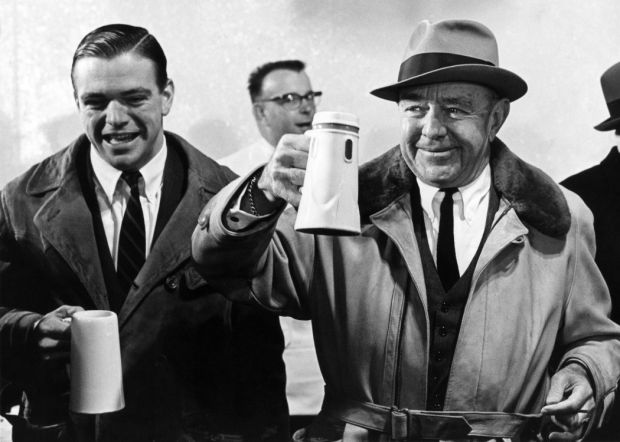
Gussie-and-IIITo celebrate production of the ten millionth barrel of beer, August A. Busch Jr. (right) and his son August III share a toast with other officials of the company on December 15, 1964.

Filed Under: Birthdays, Just For Fun Tagged With: Anheuser-Busch, History, Missouri, Video

Historic Beer Birthday: Samuel Wainwright

March 6, 2025 By Jay Brooks

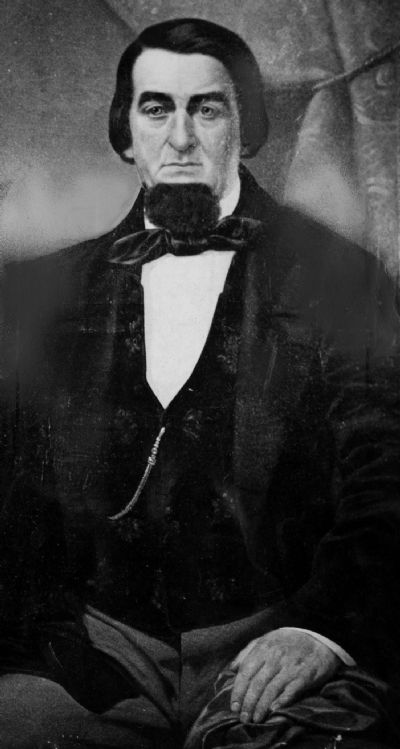
Today is the birthday of Samuel Wainwright (March 6, 1822-October 19, 1874). He was born in Pennsylvania, but headed west as a young man, founding one of the first breweries in St. Louis with his brother Ellis in either 1846 or 48 (accounts differ). They went through a series of names, with the final one being Wainwright Brewery Co. when they closed for good in 1919.

Here’s a short obituary from Find-a-Grave:

Businessman, Brewmaster. Born in Pennsylvania, Samuel’s father was a well-known and wealthy brewer of ale and beer in England. Samuel served his apprenticeship to the brewer’s trade under his father’s directions, thoroughly mastering every detail of the art of manufacturing ale and beer in accordance with English methods. In 1846, Samuel purchased a small brewery in St. Louis which had previously been known as the Fulton Brewery. Along with his brother Ellis, he conducted the brewing business established under the firm name of Ellis & Samuel Wainwright until 1849 when Ellis died. For two years afterwards, the business was conducted under the old firm name, but after that Samuel purchased the interest of his brother’s estate and continued the business along until the formation of a new partnership with Charles A. Fritz. In 1857, he purchased George Busch’s interest in a malt-house and lager beer brewery and took the name of Fritz & Wainwright and engaged exclusively in the manufacture of lager beer. The business continued until 1870, when Fritz sold his interest and the business became known as Samuel Wainwright & Co.

And here’s another biography:

Samuel Wainwright was born in Pennsylvania, the son of Prominent brewer Joseph Wainwright. From a young age he and his brother Ellis apprenticed in his father’s Pittsburgh Brewery where they learned the art of brewing of ale and beer in the English method.

In 1831, at age 22, Ellis ventured westward with the intention of establishing one of the first breweries in St. Louis, Missouri. Samuel joined him around 1840 and eventually the two ran the Fulton Street Brewery until Ellis’s death in 1849.

At age 27, Samuel Wainwright became controlling partner the firm and he ran it heroically. The brewery thrived despite being in the same town already crowded with big brewing firms and dozens of smaller ones.

Wainwright’s vision was aggressive and expansive. In 1857 Samuel abandoned the Fulton Brewery and purchased the more modern brewery built in 1854 by George Busch (older brother of Adolphus). The new brewery also indicated a change in direction for Wainwright. He started focusing more on Lager Beer, which was considered the new thing in the 1850s. The change paid off. By 1857 the Wainwright brewery led the city in sales and continued to grow from there. Samuel Wainwright died at the top of his game on October 19th, 1874. He was just 52 years of age.

Filed Under: Birthdays, Breweries, Just For Fun Tagged With: Missouri, Pennsylvania, St. Louis

Beer In Ads #4891: American Brewing Co. Bock Beer

February 24, 2025 By Jay Brooks

Last year I decided to concentrate on Bock ads. Bock, of course, originated in Germany, in the town of Einbeck. Because many 19th century American breweries were founded by German immigrants, they offered a bock at certain times of the year, be it Spring, Easter, Lent, Christmas, or what have you. In a sense they were some of the first seasonal beers. “The style was later adopted in Bavaria by Munich brewers in the 17th century. Due to their Bavarian accent, citizens of Munich pronounced ‘Einbeck’ as ‘ein Bock’ (a billy goat), and thus the beer became known as ‘Bock.’ A goat often appears on bottle labels.” And presumably because they were special releases, many breweries went all out promoting them with beautiful artwork on posters and other advertising.

Monday’s ad is for “American Brewing Co. Bock Beer,” and the chromolithograph was created in 1890. The American Brewing Company was located in St. Louis, Missouri, and was founded in 1857 as the Excelsior Brewery by Charles Hoelzle. In 1890, it was bought by Oscar Henry Jr. and Hugo Koehler.

Filed Under: Art & Beer, Beers, Breweries, Just For Fun Tagged With: Advertising, Bock, History, Missouri, St. Louis

Historic Beer Birthday: William J. Lemp

February 21, 2025 By Jay Brooks

lemp
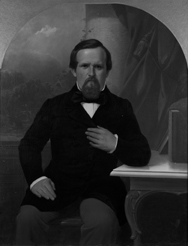
Today is the birthday of William J. Lemp (February 21, 1836-February 13, 1904). He was the son of Johann Adam Lemp, who founded the Lemp Brewery in 1840. When his father died in 1862, he and a grandson inherited the brewery, and it was renamed the William J. Lemp Brewing Co. Two years later, William bought out the grandson (who was not Lemp’s son) and carried on until 1904, when he committed suicide, most likely from depression after his favorite son Frederick died at age 28. His other son, William J. Lemp Jr., ran the brewery thereafter, until it was closed by prohibition in 1920.

William-J-Lemp
This short biography is from Find-a-Grave:

Son of Lemp Brewery founder Johann Adam Lemp, William built the brewery into an industrial giant. In 1870 it was the largest brewery in St. Louis and remained so until the start of Prohibition in 1919. At the time of William’s death, the Lemp brewery was the third largest in the United States. William shot himself through the right temple in his bedroom at the family mansion, apparently still grieving over the loss of his beloved son Frederick, the heir apparent to the family brewery, who died at the age of 28.

william-lemp-jr
In the March-April 1999 edition of the American Breweriana Journal, there’s a lengthy article about the Lemps, entitled “William J. Lemp Brewing Company: A Tale of Triumph and Tragedy in St. Louis, Missouri,” by Donald Roussin and Kevin Kious. While it starts with Adam, and through the then-present, the middle section is about William J. Lemp Sr.:

In his will, Adam bequeathed the Western Brewery in common to both his son William Jacob Lemp and grandson Charles Brauneck, along with “all of the equipment and stock.” There may have been friction between the two inheritors of the brewery, as the will contained the condition that if either contested the will, the other would receive the property. Charles Brauneck and William J. Lemp formed a partnership in October 1862, and agreed to run the business under the banner of the William J. Lemp & Co. This partnership, however, was destined to be short lived, as it was dissolved in February 1864 when William J. bought out Charles’ share for $3,000.

However, unlike many businesses that wilt when a strong leader dies, the Lemp Brewery actually grew and blossomed after William J. Lemp took control. The Western Brewery was then producing 12,000 barrels of beer annually, virtually all of the lager type.

William had been born in Germany in 1836, and spent his childhood there until brought to St. Louis by his father at age 12. William had struck out on his own as a brewer after working with his father, partnering with William Stumpf for a time in a St. Louis brewery established by the latter in 1852. At the outbreak of the Civil War, he enlisted into the Union Army, but was mustered out within a year. A short man at not quite five feet, one inch, he and his brewery would nonetheless both become giants in the brewing industry.

lemp-brewery-blue

MOVING TO CHEROKEE STREET

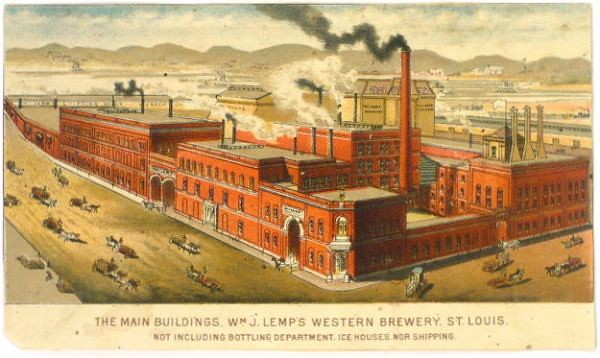
In 1864 William J. Lemp purchased a five block area around the storage house on 13th and Cherokee, and began construction of a complete new brewery. By putting the new facility over the storage caves, moving all the kegs by wagon from the Second Street brewery would no longer be necessary.

By the early 1870’s, Lemp’s Western Brewery was the largest brewery in St. Louis in a field of 30, with E. Anheuser & Company’s Bavarian Brewery coming in second. The brewery was the 19th largest in the country, producing 61,000 barrels in 1876. A bottling plant was added the following year. By the end of the decade, William Lemp, Sr. had risen to vice-president of the United States Brewer’s Association in addition to having overseen the tremendous expansion of the brewery.

Before the introduction of artificial refrigeration, the Lemp brewery had four ice-houses on the Mississippi River levee in south St. Louis, each having a storage capacity of five thousand tons each. These ice houses were cleverly built so as to be able to directly receive the cargoes of river barges, also owned by the Lemp brewery. 1878 marked the first artificial refrigeration machinery being added to the facility. It was also the year production reached 100,000 barrels.

Lemp-tray-1907

FIRST BEER COAST TO COAST

On November 1, 1892, William J. Lemp’s Western Brewery was incorporated under the title the William J. Lemp Brewing Company. The stockholders elected the following officers: William J. Lemp, Sr., president; William J. Lemp, Jr., vice-president; Charles Lemp, treasurer; Louis F. Lemp, superintendent; and Henry Vahlkamp, secretary. In addition to learning the business at their family’s brewery, all the Lemp sons had attended the brewing academy in New York.

By the mid-1890’s the Lemp brewery was well on its way to becoming a nationally known shipping brewery. In fact, Lemp was the first brewery to establish coast-to-coast distribution of its beers. Lemp beer was being transported in some 500 refrigerated railroad cars, averaging 10,000 shipments per year. The brewery proper employed 700 men. Over 100 horses were required to pull the 40 delivery wagons to make St. Louis City deliveries. The twenty-five beer cellars went down to a depth of fifty feet, and could store fifty thousand barrels at one time. The rated production capacity of the brewery was 500,000 barrels a year. It was the eighth largest beermaker in the nation.

Lemp was the first shipping brewery to establish a national shipping strategy, operating its own railroad, the Western Cable Railway Company, which connected all of the plant’s main buildings with its shipping yards near the Mississippi River, and then to the other major area railroads. The large shipping breweries of this time frequently formed their own trunk railroads to make shipments from their plants, due to battles with railroads over the way the brewers shipped their beer, in the years before artificial refrigeration in beer cars. That is, the breweries would cram the rail cars with as much ice as possible (overload them, according to many rail lines), to protect the unpasteurized beer from spoiling during transport. By running their own trunk lines, the major shipping breweries could gain more control of the conditions under which their golden product was transported to other markets.

Construction of new buildings, and the updating of old ones, was virtually continuous at the Lemp brewery. The entire complex was built (or remodeled) in the Italian Renaissance style, featuring arched windows, pilaster strips, and corbelled brick cornices (projecting architectural details, such as the rolling Lemp shields). Ultimately the giant facility covered five city blocks.

Having expanded their distribution network throughout the United States, Lemp continued to expand overseas. By the late 1890’s, Lemp beers were being shipped in large quantities to Canada, British Columbia, Mexico, Central and South America, the West Indies, the Hawaiian Islands, Australia, Japan, and Hong Kong. Lemp beer was even available in the cities of London and Berlin, both well known for their own local brews.

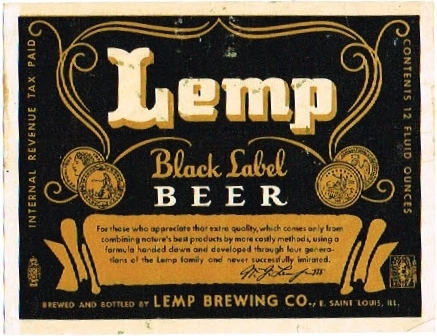
Lemp-Black-Label-Beer--Labels-Lemp-Brewing-Company_

AFTER THE FIRST SUICIDE

William J. Lemp Sr.’s death by suicide occurred in February 1904. By then the Lemp brewery had become the third largest in the country. The responsibility for leadership of the business fell on his son William J. Lemp, Jr., who was subsequently elected corporate president on November 7, 1904.

William J. Lemp, Jr. was aided in the management of the business by his brother Louis F. Lemp. Louis, who had been born in 1869, took advantage of the family fortune in his youth to explore his passion of sports. At 18, he admired the boxer John L. Sullivan to such a degree, that we went to New Orleans to bet $5,000 on one of his fights. Louis also said that if Sullivan didn’t win, he would ride all the way home in a hearse. Sullivan lost, but Louis reneged and took the train home! In later years, Louis would continue to enjoy his love of sports by being a pioneer supporter or automobile and airplane events.

The Lemp brewery was soon facing a much altered St. Louis landscape, when in 1906 nine large area breweries combined to form the Independent Breweries Company. This was the second huge merger in the local beer business, following the 1889 formation of the St. Louis Brewing Association. Initially controlled by an English syndicate, the SLBA absorbed eighteen breweries and like the IBC continued operating up to Prohibition. The formation of these two combines left only Lemp, Anheuser-Busch, the Louis Obert Brewing Company, and a handful of small neighborhood breweries as independent St. Louis beermakers. Of even more concern to a shipping brewery like Lemp was the growing clamor of the temperance movement. The first heyday of United States brewing was about to draw to an abrupt halt.

Lemp-tray

CERVA, THE LAST HOPE

Like most of its competitors, the Lemp brewery limped on through the years of the World War. According to numerous accounts, the company’s equipment was allowed to deteriorate during this time as the Lemp family, their vast fortune already made, began to loose interest in the business. The last major capital improvement to the plant was the erection of the giant grain elevators on the south side of the complex in 1911. With the shadow of Prohibition falling across the land, Lemp, like many other breweries, introduced a non-intoxicating malt beverage, named Cerva. While Cerva did sell moderately well, revenues were no where near enough to cover the overhead of the plant.

The giant plant closed without notice. Employees learned of the closing of the brewery when they arrived for work one day, only to find the brewery doors and gates locked shut.

International Shoe Company purchased almost the entire brewery at auction on June 28, 1922 for $588,000, a small fraction of its estimated value of $7 million in the years immediately before Prohibition. Unfortunately for brewery historians, virtually all of the Lemp company records were pitched shortly after International Shoe moved its operations into the complex. International Shoe used the larger buildings, and even portions of the caves, as a warehouse.

lemp-brewery-plant

Apparently, William’s suicide in 1904 wasn’t the only one to occur in the Lemp Mansion, nor was it the only tragedy to befall the Lemp family. Here’s a good overview, Lemp Mansion: Tales of a Cursed Family and Their Haunted House, with the history involving William J. Lemp below:

William married Julia Feickert in 1861. In 1868, Julia’s father Jacob built what is known today as the Lemp Mansion, likely with financial help from William. In 1876, William bought Feickert’s mansion, at which time he began to renovate it in a grand style. William and Julia moved into the lavish home, outfitted with the most extravagant textiles and modern conveniences of the day.

In 1878, William Lemp was the first St. Louis brewer to install a refrigerated area in his facility. This new technology freed him from reliance on his lagering caves. In time, the caves were converted into private underground amusements such as a theater; a bowling alley and a concrete-lined swimming pool, complete with hot water piped in from the brewery.

lemp-brewery

The Western Brewery was incorporated in 1892 under the name of William J. Lemp Brewing company. As his brewery had grown, so had William and Julia’s family. Between the years of 1862 and 1883, the couple had nine children, one of whom died in infancy. From oldest to youngest, the Lemp children were Anna, William Jr., Louis, Charles, Frederick, Hilda, Edwin and Elsa.

When the brewery was incorporated in 1892, William Lemp Sr. appointed his sons William Jr. and Louis as Vice President and Superintendent, respectively. Both were trained and college educated in managing business and the process of brewing Lemp’s lager. William Jr., called Billy, and Louis embraced their positions in the family business and as wealthy, powerful members of St. Louis society. Billy was active socially and had a reputation as a flamboyant playboy. Louis was an avid sportsman, horse breeder and racer.

Billy eventually married a young woman named Lillian Handlan, a wealthy socialite known for her beauty and exquisite wardrobe. Because of her fondness for wearing lavender clothing and outfitting her accessories and horse-drawn carriage in the color lavender, people called her the Lavender Lady.

Despite Billy being appointed Vice President of the brewery by his father, William Sr.’s son Frederick was said to be his favorite son and first choice to run the company after his death. Frederick immersed himself in his job at the brewery, evidently aware of his future as heir apparent. When Frederick began to have health problems in 1901, he took time off for an extended stay in California, hoping the warm climate would benefit his health. After a few months, just when it seemed as if he was improving, Frederick died at age 28. One primary source attributes Frederick’s death to “mysterious circumstances.” Another lists the cause of death as heart failure.

William Lemp took the death of his son exceptionally hard. His friends at the time said he never recovered from the tragic news, and seemed to lose interest in his business and his life. William went through the motions for three years, at which time he lost his best friend, Captain Frederick Pabst, a member of another beer brewing dynasty. William withdrew further and sank deeper into depression after the death of Pabst. He was observed going to work and sitting at his desk, staring off into space and making nervous motions with his hands. On the morning of February 13, 1904, William was alone at Lemp Mansion except for his servants. Lying in bed in his second floor bedroom, William shot himself in the head. He died later that day. At the time, his brewery was valued at $6 million and his personal assets at $10 million.

william-j-lemp-sr

This is a slideshow of Lemp breweriana and photos.

Filed Under: Birthdays, Breweries Tagged With: History, Missouri

Beer In Ads #4871: Wainwright Buck Beer

February 4, 2025 By Jay Brooks

Last year I decided to concentrate on Bock ads. Bock, of course, originated in Germany, in the town of Einbeck. Because many 19th century American breweries were founded by German immigrants, they offered a bock at certain times of the year, be it Spring, Easter, Lent, Christmas, or what have you. In a sense they were some of the first seasonal beers. “The style was later adopted in Bavaria by Munich brewers in the 17th century. Due to their Bavarian accent, citizens of Munich pronounced ‘Einbeck’ as ‘ein Bock’ (a billy goat), and thus the beer became known as ‘Bock.’ A goat often appears on bottle labels.” And presumably because they were special releases, many breweries went all out promoting them with beautiful artwork on posters and other advertising.

Tuesday’s ad for “Bock” was created for the Wainwright Brewery of St. Louis, Missouri with the text: “Wainwright Brewery Buck Beer.” This lithograph was created in 1895. The lithographer was Heinicke-Fiegel Lithographers Co. of St. Louis, Missouri.

Filed Under: Art & Beer, Beers, Breweries, Just For Fun Tagged With: Advertising, Bock, History, Missouri, St. Louis

Beer In Ads #4870: St. Louis Buck Beer

February 3, 2025 By Jay Brooks

Last year I decided to concentrate on Bock ads. Bock, of course, originated in Germany, in the town of Einbeck. Because many 19th century American breweries were founded by German immigrants, they offered a bock at certain times of the year, be it Spring, Easter, Lent, Christmas, or what have you. In a sense they were some of the first seasonal beers. “The style was later adopted in Bavaria by Munich brewers in the 17th century. Due to their Bavarian accent, citizens of Munich pronounced ‘Einbeck’ as ‘ein Bock’ (a billy goat), and thus the beer became known as ‘Bock.’ A goat often appears on bottle labels.” And presumably because they were special releases, many breweries went all out promoting them with beautiful artwork on posters and other advertising.

Monday’s ad for “Bock” depicts a drawing of a goat’s head with barley and hops around his torso, and the text: “Buck Beer.” This lithograph was created in 1885. The lithographer was A. Lambrecht & Co. of St. Louis, Missouri.

Filed Under: Art & Beer, Beers, Just For Fun Tagged With: Advertising, Bock, History, Missouri, St. Louis

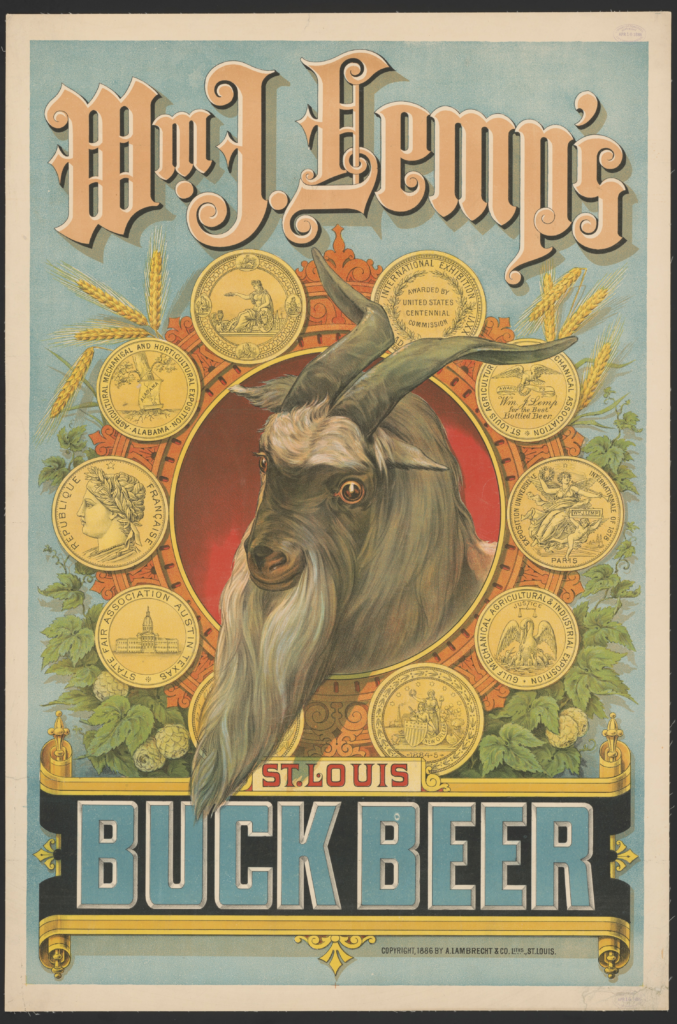
Beer In Ads #4869: Wm. J. Lemp’s Buck Beer

February 2, 2025 By Jay Brooks

Last year I decided to concentrate on Bock ads. Bock, of course, originated in Germany, in the town of Einbeck. Because many 19th century American breweries were founded by German immigrants, they offered a bock at certain times of the year, be it Spring, Easter, Lent, Christmas, or what have you. In a sense they were some of the first seasonal beers. “The style was later adopted in Bavaria by Munich brewers in the 17th century. Due to their Bavarian accent, citizens of Munich pronounced ‘Einbeck’ as ‘ein Bock’ (a billy goat), and thus the beer became known as ‘Bock.’ A goat often appears on bottle labels.” And presumably because they were special releases, many breweries went all out promoting them with beautiful artwork on posters and other advertising.

Sunday’s ad for “Bock” was created for the Wm. J. Lemp Brewery of St. Louis, Missouri. This chromolithograph was created in 1886. The lithographer was A. Lambrecht & Co., also of St. Louis, Missouri.

Filed Under: Art & Beer, Beers, Breweries, Just For Fun Tagged With: Advertising, Bock, History, Missouri

Beer In Ads #4833: The Buck Beer King

December 27, 2024 By Jay Brooks

This year I decided to concentrate on Bock ads. Bock, of course, originated in Germany, in the town of Einbeck. Because many 19th century American breweries were founded by German immigrants, they offered a bock at certain times of the year, be it Spring, Easter, Lent, Christmas, or what have you. In a sense they were some of the first seasonal beers. “The style was later adopted in Bavaria by Munich brewers in the 17th century. Due to their Bavarian accent, citizens of Munich pronounced ‘Einbeck’ as ‘ein Bock’ (a billy goat), and thus the beer became known as ‘Bock.’ A goat often appears on bottle labels.” And presumably because they were special releases, many breweries went all out promoting them with beautiful artwork on posters and other advertising.

Thursday’s ad shows a goat wearing a king’s robe and is surrounded by four women, one of whom is serving him a beer. There’s also a cat for some reason. The lithograph was created in 1880. The lithographer was W.E. Stephens & Co., who was located in St. Louis, Missouri.

Filed Under: Art & Beer, Beers, Just For Fun Tagged With: Advertising, Bock, History, Missouri

Beer In Ads #4831: Bock Beer Gesundheit

December 24, 2024 By Jay Brooks

This year I decided to concentrate on Bock ads. Bock, of course, originated in Germany, in the town of Einbeck. Because many 19th century American breweries were founded by German immigrants, they offered a bock at certain times of the year, be it Spring, Easter, Lent, Christmas, or what have you. In a sense they were some of the first seasonal beers. “The style was later adopted in Bavaria by Munich brewers in the 17th century. Due to their Bavarian accent, citizens of Munich pronounced ‘Einbeck’ as ‘ein Bock’ (a billy goat), and thus the beer became known as ‘Bock.’ A goat often appears on bottle labels.” And presumably because they were special releases, many breweries went all out promoting them with beautiful artwork on posters and other advertising.

Tuesday’s ad is for Bock Beer, and titled “Bock Beer Gesundheit,” though I have no idea why it’s called that. The chromolithograph was created in 1880. I’m not sure who the lithographer was other than he was located in St. Louis, Missouri.

Filed Under: Art & Beer, Beers, Just For Fun Tagged With: Advertising, Bock, History, Missouri

« Previous Page
Next Page »

Find Something

Northern California Breweries

Please consider purchasing my latest book, California Breweries North, available from Amazon, or ask for it at your local bookstore.

Recent Comments

  • Ernie Dewing on Historic Beer Birthday: Charles William Bergner 
  • Steve 'Pudgy' De Rose on Historic Beer Birthday: Jacob Schmidt
  • Jay Brooks on Beer Birthday: Bill Owens
  • Steve 'Pudgy' De Rose on Beer Birthday: Charles Finkel
  • Steve 'Pudgy' De Rose on Beer Birthday: Bill Owens

Recent Posts

  • Beer In Ads #5181: Turn Winter Into Spring January 24, 2026
  • Historic Beer Birthday: Philip Bissinger January 24, 2026
  • Historic Beer Birthday: Gottlieb Muhlhauser January 24, 2026
  • Beer Birthday: Ted Vivatson January 24, 2026
  • Historic Beer Birthday: Max Helmrich January 24, 2026

BBB Archives

Feedback

Head Quarter
This site is hosted and maintained by H25Q.dev. Any questions or comments for the webmaster can be directed here.