Brookston Beer Bulletin

Jay R. Brooks on Beer

  • Home
  • About
  • Editorial
  • Birthdays
  • Art & Beer

Socialize

  • Dribbble
  • Email
  • Facebook
  • Flickr
  • GitHub
  • Instagram
  • LinkedIn
  • Pinterest
  • RSS
  • Twitter
  • YouTube

Powered by Genesis

Beer In Ads #4902: Have One With Me Bock

March 7, 2025 By Jay Brooks

Last year I decided to concentrate on Bock ads. Bock, of course, originated in Germany, in the town of Einbeck. Because many 19th century American breweries were founded by German immigrants, they offered a bock at certain times of the year, be it Spring, Easter, Lent, Christmas, or what have you. In a sense they were some of the first seasonal beers. “The style was later adopted in Bavaria by Munich brewers in the 17th century. Due to their Bavarian accent, citizens of Munich pronounced ‘Einbeck’ as ‘ein Bock’ (a billy goat), and thus the beer became known as ‘Bock.’ A goat often appears on bottle labels.” And presumably because they were special releases, many breweries went all out promoting them with beautiful artwork on posters and other advertising.

Friday’s ad for Bock Beer depicts a woman sitting on a wall, with a stein in one hand and a glass of beer raised up in the other. A goat is at her feet. The Library of Congress indicates that this poster is considered number 179 and is titled “Have One With Me,” but there’s nothing on the poster itself to indicate this is the case. The chromolithograph was created in 1893.  The lithographer was H. Schile & Co. of 18 Division St. in New York City. Henry Jerome Schile was born in Germany, and emigrated to the U.S. in 1851, settling in Manhattan, which is where he opened his own print company.

Filed Under: Art & Beer, Beers, Just For Fun Tagged With: Advertising, Bock, History, New York

Beer In Ads #4898: Schaefer Beyond Bock Beer

March 3, 2025 By Jay Brooks

Last year I decided to concentrate on Bock ads. Bock, of course, originated in Germany, in the town of Einbeck. Because many 19th century American breweries were founded by German immigrants, they offered a bock at certain times of the year, be it Spring, Easter, Lent, Christmas, or what have you. In a sense they were some of the first seasonal beers. “The style was later adopted in Bavaria by Munich brewers in the 17th century. Due to their Bavarian accent, citizens of Munich pronounced ‘Einbeck’ as ‘ein Bock’ (a billy goat), and thus the beer became known as ‘Bock.’ A goat often appears on bottle labels.” And presumably because they were special releases, many breweries went all out promoting them with beautiful artwork on posters and other advertising.

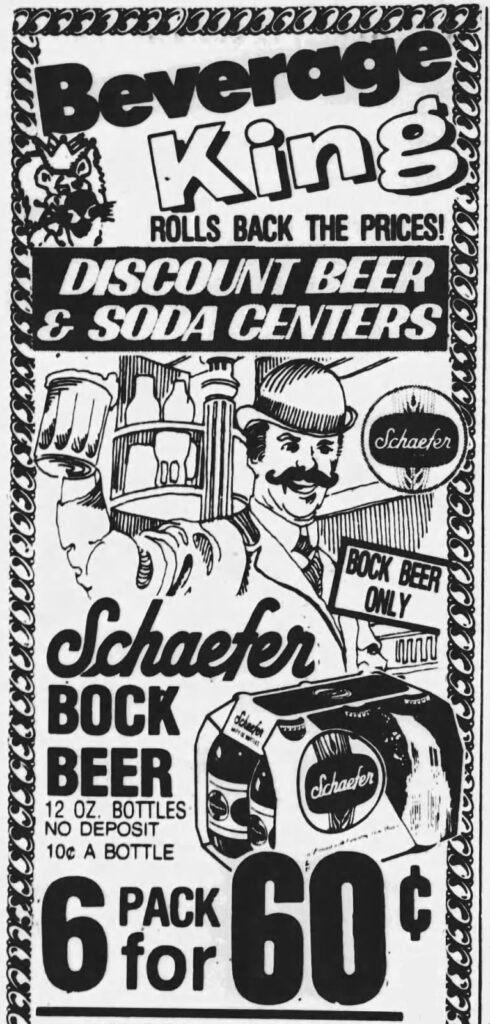
Monday’s ad is is for Schaefer Bock Beer, and is not from 1940, but is undoubtedly is a fake someone made over the last few decades based on the Dr. Seuss’ book, “On Beyond Zebra!,” which was published in 1955. But keeping in the spirit of Theodor Geisel‘s birthday yesterday, I thought why not. It’s pretty well done.vThe brewery was the F. & M. Schaefer Brewing Co. originally of New York, New York, which was founded in 1842. Today is the birthday of Theodore Geisel, better known as Dr. Seuss. Before he started writing popular children’s books, he worked for a number of years doing illustrations and art for various company advertising campaigns, including for a couple of beer companies, like the one I shared yesterday for Schaefer.

Filed Under: Art & Beer, Beers, Breweries, Just For Fun Tagged With: Advertising, Bock, History, New York

Beer In Ads #4897: Schaefer Bock Beer

March 2, 2025 By Jay Brooks

Last year I decided to concentrate on Bock ads. Bock, of course, originated in Germany, in the town of Einbeck. Because many 19th century American breweries were founded by German immigrants, they offered a bock at certain times of the year, be it Spring, Easter, Lent, Christmas, or what have you. In a sense they were some of the first seasonal beers. “The style was later adopted in Bavaria by Munich brewers in the 17th century. Due to their Bavarian accent, citizens of Munich pronounced ‘Einbeck’ as ‘ein Bock’ (a billy goat), and thus the beer became known as ‘Bock.’ A goat often appears on bottle labels.” And presumably because they were special releases, many breweries went all out promoting them with beautiful artwork on posters and other advertising.

Sunday’s ad is is for Schaefer Bock Beer, and is from 1940. The brewery was the F. & M. Schaefer Brewing Co. originally of New York, New York, which was founded in 1842. Today is the birthday of Theodore Geisel, better known as Dr. Seuss. Before he started writing popular children’s books, he worked for a number of years doing illustrations and art for various company advertising campaigns, including for a couple of beer companies, like this one for Schaefer.

Filed Under: Art & Beer, Beers, Breweries, Just For Fun Tagged With: Advertising, Bock, History, New York

Beer In Ads #4894: Piel’s Light Bock

February 27, 2025 By Jay Brooks

Last year I decided to concentrate on Bock ads. Bock, of course, originated in Germany, in the town of Einbeck. Because many 19th century American breweries were founded by German immigrants, they offered a bock at certain times of the year, be it Spring, Easter, Lent, Christmas, or what have you. In a sense they were some of the first seasonal beers. “The style was later adopted in Bavaria by Munich brewers in the 17th century. Due to their Bavarian accent, citizens of Munich pronounced ‘Einbeck’ as ‘ein Bock’ (a billy goat), and thus the beer became known as ‘Bock.’ A goat often appears on bottle labels.” And presumably because they were special releases, many breweries went all out promoting them with beautiful artwork on posters and other advertising.

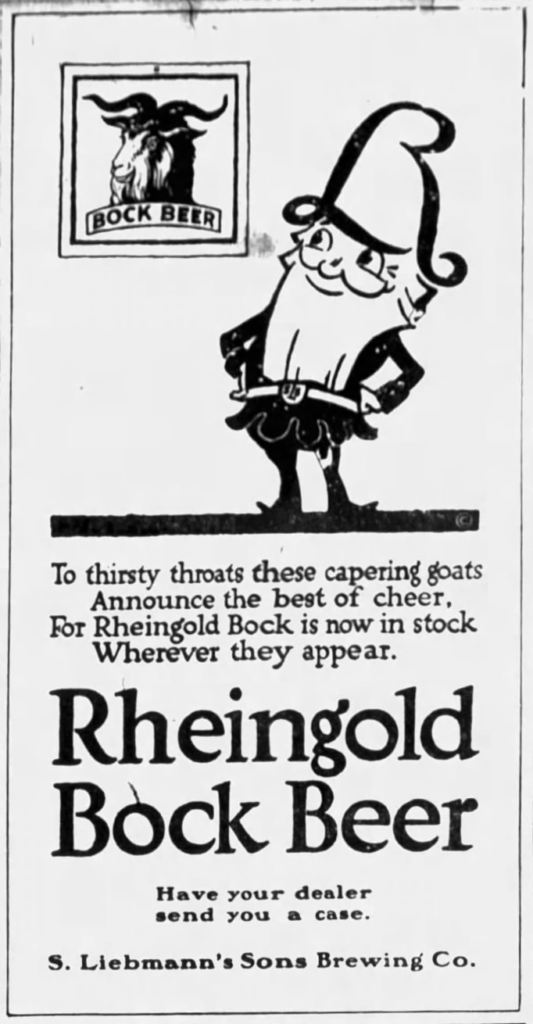
Thursday’s ad is is for Piel’s Light Bock Beer, and is from March of 1949. While I’m aware of lighter colored bocks not being uncommon, this is the first time I’ve seen one advertised as a “light bock.” Piel’s Brewing was founded in 1883 in Brooklyn, but by the 1960s they started closing breweries and by 1973 they were all shut down, and the brand sold to another conglomerate. The brand tried to restart in 2018, but it must not have lasted long because of their new social channels ar dormant. I do quite love the gnomes with the goats.

Filed Under: Art & Beer, Beers, Just For Fun Tagged With: Advertising, Bock, History, New York

Beer In Ads #4883: Bock Bier In Color

February 16, 2025 By Jay Brooks

Last year I decided to concentrate on Bock ads. Bock, of course, originated in Germany, in the town of Einbeck. Because many 19th century American breweries were founded by German immigrants, they offered a bock at certain times of the year, be it Spring, Easter, Lent, Christmas, or what have you. In a sense they were some of the first seasonal beers. “The style was later adopted in Bavaria by Munich brewers in the 17th century. Due to their Bavarian accent, citizens of Munich pronounced ‘Einbeck’ as ‘ein Bock’ (a billy goat), and thus the beer became known as ‘Bock.’ A goat often appears on bottle labels.” And presumably because they were special releases, many breweries went all out promoting them with beautiful artwork on posters and other advertising.

Sunday’s ad for “Bock” depicts what looks like a blind goat holding a large mug of beer while leaning over a wooden cask with “Bock Bier” carved into it. The hand-colored lithograph was created in 1880.  The lithographer was H. Schile & Co. of 18 Division St. in New York City. Henry Jerome Schile was born in Germany, and emigrated to the U.S. in 1851, settling in Manhattan, which is where he opened his own print company.

Filed Under: Art & Beer, Just For Fun Tagged With: Advertising, Bock, History, New York

Beer In Ads #4880: Centennial Bock Bier

February 13, 2025 By Jay Brooks

Last year I decided to concentrate on Bock ads. Bock, of course, originated in Germany, in the town of Einbeck. Because many 19th century American breweries were founded by German immigrants, they offered a bock at certain times of the year, be it Spring, Easter, Lent, Christmas, or what have you. In a sense they were some of the first seasonal beers. “The style was later adopted in Bavaria by Munich brewers in the 17th century. Due to their Bavarian accent, citizens of Munich pronounced ‘Einbeck’ as ‘ein Bock’ (a billy goat), and thus the beer became known as ‘Bock.’ A goat often appears on bottle labels.” And presumably because they were special releases, many breweries went all out promoting them with beautiful artwork on posters and other advertising.

Thursday’s ad for “Bock” depicts a well-dressed goat raising a toast to America’s centennial, with the title: “Centennial Bock Bier. The Best, Can Be Had Here.” The lithograph was created in 1876. The lithographer was the famous Currier & Ives, located at 125 Nassau St., New York. They were a “printmaking business operating from 1835 to 1907. Founded by Nathaniel Currier, the company designed and sold inexpensive hand-painted lithographic works based on news events, views of popular culture and Americana. Advertising itself as “the Grand Central Depot for Cheap and Popular Prints,” the corporate name was changed in 1857 to “Currier and Ives” with the addition of James Merritt Ives.”

Filed Under: Art & Beer, Beers, Just For Fun Tagged With: Advertising, Bock, History, New York

Beer In Ads #4879: Pyramida Bock

February 12, 2025 By Jay Brooks

Last year I decided to concentrate on Bock ads. Bock, of course, originated in Germany, in the town of Einbeck. Because many 19th century American breweries were founded by German immigrants, they offered a bock at certain times of the year, be it Spring, Easter, Lent, Christmas, or what have you. In a sense they were some of the first seasonal beers. “The style was later adopted in Bavaria by Munich brewers in the 17th century. Due to their Bavarian accent, citizens of Munich pronounced ‘Einbeck’ as ‘ein Bock’ (a billy goat), and thus the beer became known as ‘Bock.’ A goat often appears on bottle labels.” And presumably because they were special releases, many breweries went all out promoting them with beautiful artwork on posters and other advertising.

Wednesday’s ad for “Bock” depicts a woman jumping up onto a pyramid of wooden kegs, possibly to escape the goat nipping at her heels. The poster is inexplicably titled “Bock, Pyramida No. 198.” Does that mean there are at least another 197 of these? The chromolithograph was created in 1894. The lithographer was H. Schile & Co. of 269 Bowery in New York City. Henry Jerome Schile was born in Germany, and emigrated to the U.S. in 1851, settling in Manhattan, which is where he opened his own print company.

Filed Under: Art & Beer, Beers, Just For Fun Tagged With: Advertising, Bock, History, New York

Beer In Ads #4878: Goat’s Head Bock Beer

February 11, 2025 By Jay Brooks

Last year I decided to concentrate on Bock ads. Bock, of course, originated in Germany, in the town of Einbeck. Because many 19th century American breweries were founded by German immigrants, they offered a bock at certain times of the year, be it Spring, Easter, Lent, Christmas, or what have you. In a sense they were some of the first seasonal beers. “The style was later adopted in Bavaria by Munich brewers in the 17th century. Due to their Bavarian accent, citizens of Munich pronounced ‘Einbeck’ as ‘ein Bock’ (a billy goat), and thus the beer became known as ‘Bock.’ A goat often appears on bottle labels.” And presumably because they were special releases, many breweries went all out promoting them with beautiful artwork on posters and other advertising.

Tuesday’s ad for “Bock” depicts a happy-looking goat up on his hind legs,m with the text below him: “Bock Beer.” The lithograph was created in 1880. The lithographer was L. Kraemer Litho. of Brooklyn, New York.

Filed Under: Art & Beer, Beers, Just For Fun Tagged With: Advertising, Bock, Brooklyn, History, New York

Beer In Ads #4877: White Bock

February 10, 2025 By Jay Brooks

Last year I decided to concentrate on Bock ads. Bock, of course, originated in Germany, in the town of Einbeck. Because many 19th century American breweries were founded by German immigrants, they offered a bock at certain times of the year, be it Spring, Easter, Lent, Christmas, or what have you. In a sense they were some of the first seasonal beers. “The style was later adopted in Bavaria by Munich brewers in the 17th century. Due to their Bavarian accent, citizens of Munich pronounced ‘Einbeck’ as ‘ein Bock’ (a billy goat), and thus the beer became known as ‘Bock.’ A goat often appears on bottle labels.” And presumably because they were special releases, many breweries went all out promoting them with beautiful artwork on posters and other advertising.

Monday’s ad for “Bock” depicts a well-dressed lady in a fetching hat somewhere in a forest setting. She’s holding a sprig of hops as a white goat is coming up from behind her trying to eat the hops. I presume that’s why the poster is titled: “White Bock.” In the background, a group of men are pouring themselves a beer from a wooden cask. The lithograph was created in 1889. The lithographer was H. Schile & Co. of 295 Bowery in New York City. Henry Jerome Schile was born in Germany, and emigrated to the U.S. in 1851, settling in Manhattan, which is where he opened his own print company.

Filed Under: Art & Beer, Beers, Just For Fun Tagged With: Advertising, Bock, History, New York

Beer In Ads #4876: Monster Bock

February 9, 2025 By Jay Brooks

Last year I decided to concentrate on Bock ads. Bock, of course, originated in Germany, in the town of Einbeck. Because many 19th century American breweries were founded by German immigrants, they offered a bock at certain times of the year, be it Spring, Easter, Lent, Christmas, or what have you. In a sense they were some of the first seasonal beers. “The style was later adopted in Bavaria by Munich brewers in the 17th century. Due to their Bavarian accent, citizens of Munich pronounced ‘Einbeck’ as ‘ein Bock’ (a billy goat), and thus the beer became known as ‘Bock.’ A goat often appears on bottle labels.” And presumably because they were special releases, many breweries went all out promoting them with beautiful artwork on posters and other advertising.

Sunday’s ad for “Bock” reminded me of a warped, beer-focused Godzilla movie, with a ginormous goat drinking a beer while towering over a large wooden cask of bock beer, turning on the spigot and spraying the townspeople below. It’s a strange scene that gets even weirder when you look closer. Many of the men are wearing uniforms and a few are brandishing nightsticks and guns. A man in a suit at the bottom toward the left is holding a crumpled piece of paper with the word “Spotter” visible on it. Right under the goat’s tail, a man is receding into the background, seemingly making his getaway up some mountainous terrain, carrying a suitcase and what looks like a bag of money under one arm. Below that is a sign which reads: “TO ? ? ? ?” Below the goat’s left leg, you can see two more men praying. It’s definitely an odd message to send, whatever that might be. The lithograph was created in 1875. The lithographer who designed it was named Rothengatter and the poster was printed and published by Vossnack & Thran, of 75 Chatham St., New York.

Filed Under: Art & Beer, Beers, Just For Fun Tagged With: Advertising, Bock, History, New York

« Previous Page
Next Page »

Find Something

Northern California Breweries

Please consider purchasing my latest book, California Breweries North, available from Amazon, or ask for it at your local bookstore.

Recent Comments

  • Bob Paolino on Beer Birthday: Grant Johnston
  • Gambrinus on Historic Beer Birthday: A.J. Houghton
  • Ernie Dewing on Historic Beer Birthday: Charles William Bergner 
  • Steve 'Pudgy' De Rose on Historic Beer Birthday: Jacob Schmidt
  • Jay Brooks on Beer Birthday: Bill Owens

Recent Posts

  • Beer In Ads #5231: A Sign Of Spring April 26, 2026
  • Historic Beer Birthday: Henry Hoerl April 26, 2026
  • Historic Beer Birthday: John Toohey April 26, 2026
  • Beer In Ads #5230: The Original Old German Bock Beer, GOT IT? Get It! April 25, 2026
  • Historic Beer Birthday: Al Levy April 25, 2026

BBB Archives

Feedback

Head Quarter
This site is hosted and maintained by H25Q.dev. Any questions or comments for the webmaster can be directed here.