Brookston Beer Bulletin

Jay R. Brooks on Beer

  • Home
  • About
  • Editorial
  • Birthdays
  • Art & Beer

Socialize

  • Dribbble
  • Email
  • Facebook
  • Flickr
  • GitHub
  • Instagram
  • LinkedIn
  • Pinterest
  • RSS
  • Twitter
  • YouTube

Powered by Genesis

Historic Beer Birthday: Dietrich Knabe

May 11, 2025 By Jay Brooks

consumers-ny
Today is the birthday of Dietrich Knabe (May 11, 1842-<1917). His first name is sometimes spelled Diedrich. I believe he was born in Germany, but that’s about all I know about Knabe, apart from he co-founded and served as president of the Consumer’s Brewing Co. of New York City, which was founded in 1890. It appears to have closed because of prohibition in 1920, although one source suggests that they were still a going concern into the late-1920s. As far as I can tell it didn’t open afterward.

consumers-brewing-sign

The Brewers’ Journal and Barley, Malt and Hop Trades’ Reporter for July 1, 1917 includes an account of Knabe’s 75th birthday earlier that year, so he was still alive

consumers-brewing-truck-1910
A Consumer’s brewery truck in 1910.

consumers-ny-1915-lager-ad
An ad from the Brooklyn Daily Eagle in 1915.

This is from the New York Times for November 15, 1889, announcing the creation of what would become the Consumer’s Brewing Co.

consumers-brewing-nyc-1931

consumers-ny-1915-ad


Another ad from the Brooklyn Daily Eagle in 1915.

Filed Under: Birthdays, Breweries, Just For Fun Tagged With: History, New York

Historic Beer Birthday: Christian Weyand

May 11, 2025 By Jay Brooks

weyand
Today is the birthday of Christian Weyand (May 11, 1826-August 7, 1898). He was born in France as Cretien Weyand, but came to the U.S. when he was 21, settling in the Buffalo area of New York. He was originally a shoemaker, but when he was forty years old, he co-founded the Main Street Brewery, along with a partner, John Schetter, who he eventually bought out in 1873. In 1890, the brewery was incorporated as the Christian Weyand Brewing Co. and remained in business until closed by prohibition in 1920.

Here’s a short biography from Find-a-Grave:

Weyand, Christian, was born in Lorraine, France, May 11, 1826, attended the common schools, and in the spring of 1847 came to America and settled in Buffalo, where he has since resided. He followed the shoemaker’s trade for some time, and then in 1866 engaged in the brewing business with a partner.

In 1873 he became sole owner of the establishment on the corner of Main and Goodell streets, and in a few years built up one of the largest and best breweries in Western New York. In May 1890, the Weyland Brewing Company was incorporated with C. Weyand. president; John A. Weyand, vice-president and manager; and Charles M. Weyand, secretary, and treasurer. Mr. Weyand is probably the best-known brewer in Buffalo. He is a prominent, public-spirited citizen, widely esteemed and respected, and has always enjoyed the confidence of all who know him. May 9, 1852, he married Magdalena Mayer of Buffalo.

Christian-Weyand-prize-banner-ad

And this is his obituary from the American Brewers Review:

Christian-Weyand-tray

This short history of Christian, and the brewery, is from the “1897 Brewers Convention Buffalo NY,” published by the Buffalo Brewers Association:

Christian Weyand Brewing Company.

In 1866, Christian Weyand established the business now conducted by The Christian Weyand Brewing Company. Mr. Weyand is a native of France, having been born in the province of Lorraine a little more than seventy years ago. There he spent his youth and received his education; but in his twenty-first year he left Lorraine for the wider opportunities of the New World, landing in New York just fifty years ago. He soon found his way to Buffalo, but it was nearly twenty years before he began the business with which his name is now so intimately connected in the minds of all Buffalonians. During these years he worked as a shoemaker — at first as an employee, and later in a shop of his own.

Mr. Weyand, with a partner, began the brewing business in a small way, with little capital and a poorly equipped plant; but the purest and best of barley malt was used from the start, and improved machinery was introduced as fast as the necessary capital could be secured. In 1873. Mr. Weyand assumed entire charge of the business, and applied himself vigorously to the task of building up a model brewery. His efforts met with entire success, and in a few years his establishment became one of the first in its line in Buffalo — a city that boasts of many fine breweries. In 1890, he organized the business into a stock company, called The Christian Weyand Brewing Company, of which he is president, his son, John A. Weyand, vice-president and manager, and another son, Charles M. Weyand, secretary and treasurer. Since then the business has materially increased, and in 1896-97 it became necessary to make extensive additions to the plant. The new buildings on the corner of Main and Goodell streets, built of buff terra cotta elaborately ornamented in Renaissance style, are exceedingly handsome; and it is now one of the best-equipped breweries in the country.

buffalo-main-and-goddell
This is purported to be a photograph of the house at the “Southeast Corner Main and Goodell Streets” from the 1912 “Picture Book Of Earlier Buffalo.” But as Michael F. Rizzo and Ethan Cox, authors of “Buffalo Beer” point out, “the structures in the background and to the left of the subject must have been the Christian Weyand brewery. Indeed, the least occluded building to the left was, I think, their office address on Goodell.”

Filed Under: Birthdays, Breweries, Just For Fun Tagged With: France, History, New York

Historic Beer Birthday: John Moffat

May 11, 2025 By Jay Brooks

moffats

Today is the birthday of John Moffat (May 11, 1766-July 13, 1845). Moffat was born near the town of Moffat, Scotland, in 1766, coming to America in his late twenties, in 1793. He founded one of the earliest breweries in Buffalo, New York, along with his son James, in 1833. I was unable to find a portrait of John Moffat, or much about him personally.

moffats-drawing

According to John & Dave’s Buffalo Brewing History, John Moffat, along with his son James, acquired what was Buffalo’s second brewery and named it the Moffat Brewery.

Kane, Peacock and Relay brewery was short lived however and a 1909 article in the Buffalo Evening Times indicates John Moffat and his son James purchased the brewing operation around 1833. Also, the 1836 Buffalo City Directory lists Moffat as a brewer at that location. The 1839 Directory lists James Moffat & Co. as a “Brewery, Soap and Candle Factory”. The Moffat Brewery continued in operation until son James died and it was sold to Arthur Fox and became the Fox and Williams Brewery. In 1876 it was sold back to the Moffat family and continued in operation at the same location until the advent of Prohibition forced their closure in 1920. After Prohibition the Phoenix Brewery continued brewing “Moffats Pale Ale” through an agreement with the Moffat family.

And here’s an account from “Buffalo Beer: The History of Brewing in the Nickel City,” by Michael F. Rizzo and Ethan Cox.

moffats-brewery

And “History of the City of Buffalo and Erie County, Volume 2,” published in 1884, has this to say about Buffalo’s earliest brewers, including Moffat:

buffalo-brewers

Filed Under: Birthdays, Breweries, Just For Fun Tagged With: History, New York

Historic Beer Birthday: Bernard “Toots” Shor

May 6, 2025 By Jay Brooks

toots-shor
Today is the birthday of Bernard “Toots” Shor (May 6, 1903–January 23, 1977). He “was best known as the proprietor of a legendary saloon and restaurant, Toots Shor’s Restaurant, in Manhattan. He ran three different establishments under that name, but his first – and most renowned – was located at 51 West 51st Street. He was known as a saloonkeeper, friend, and confidant to some of New York’s biggest celebrities during that era.”

toots-shor-cheers

This is his biography from his Wikipedia page:

Shor was born in Philadelphia to Orthodox Jewish parents – his father of Austrian descent from Germany and his mother from Russia. He and his two older sisters were raised in a home above the family candy store in South Philadelphia. When Shor was 15 years old, his mother was killed by an automobile while she sat on the stoop outside their home. His father committed suicide five years later. Shor attended the Drexel Institute of Technology and the Wharton School of the University of Pennsylvania before working as a traveling shirt-and-underwear salesman.

toots-shor

Here’s a short biography from Find–Grave:

Restaurateur. He was the owner and colorful host of Toots Shor’s Restaurant, a New York City landmark for over 30 years. Born in Philadelphia, he moved to New York as a teenager during the Prohibition era and gained a reputation as a speakeasy bouncer, guardian, and manager. In 1940 he opened his own restaurant and lounge at 51 West 51st Street in Manhattan; although the food was mediocre, its strong drinks and oversized circular bar quickly drew the crowds. The greats of the sports world, stage, screen and politics all hung out here. In one famous anecdote, mob boss Frank Costello and Supreme Court Chief Justice Earl Warren politely raised glasses to each other across the dining room. Shor was gruffly friendly to everybody from shoeshine boy to newsstand guy, to Joe DiMaggio, Frank Sinatra, and Jackie Gleason (who always ate there for free). Being called a “crumb-bum” by Toots meant you’d earned his praise; in contrast, his most bitter insult was to call someone “just a piece of raisin cake”. His personal motto was “I don’t care if I’m a millionaire, as long as I can live like one”, and his spendthrift ways and generosity to his regulars often left him in debt. The original Toots Shor’s closed in 1959 and reopened two years later at 33 West 52nd Street; this location was abruptly shut down in 1971 for income tax evasion. Toots’ last business ventures were failures and he died broke, but not before leaving a legendary mark on New York nightlife.

toots-shor-banner

Wikipedia continues with the story of Shor’s restaurants:

Shor went to New York City in 1930 and found employment as a bouncer at the Five O’Clock Club, which served as his introduction to celebrities. He later worked at several other nightspots: The Napoleon Club, Lahiff’s Tavern, the Ball & Chain, the Madison Royale, and Leon & Eddie’s. He became a man about town in Manhattan after opening his own restaurant, Toots Shor’s, at 51 West 51st Street. While the food there was known to be “nuttin’ fancy” – standard American, sports-bar fare such as shrimp cocktail, steak, baked potato – the establishment became well known for who frequented there and the manner in which Shor interacted with them.

Shor was a raconteur and a master of the “needle,” jibes or quips directed at the famous. Celebrity alone was not enough to receive first-class service in Shor’s restaurant. According to David Halberstam in his book The Summer of ’49, guests had to observe the unwritten “code” which prevailed in Shor’s establishment. Charlie Chaplin, who was not privy to that code, was made to wait in line. When Chaplin complained, Shor told him to entertain the others who were waiting in line. One day, Hollywood boss Louis B. Mayer complained about waiting twenty minutes for a table and said, “I trust the food will be worth all that waiting.” Shor replied: “It’ll be better’n some of your crummy pictures I stood in line for.” Once while standing outside his restaurant with Frank Sinatra and a crowd of screaming fans being held back by police, Toots pulled out a dollar bill out of his pocket and said to Frank, “Here, kid, go across the street and buy me a paper.” At the Opera with friends during the intermission Toots declared, “I bet I’m the only bum in this joint that doesn’t know how this thing ends.”

In one incident, Shor outdrank comedian Jackie Gleason, famously leaving Gleason on the floor to prove the point. (At Toots’ funeral, the coffin had a spray of red roses with a card which read, “Save a Table for 2,” signed: Jackie Gleason.)

shor-jackie-gleason

Shor cultivated his celebrity following by giving them unqualified admiration, loyal friendship, and a kind of happy, boozy, old-fashioned male privacy. Those whom Shor really liked were called “crum-bums”. Shor reputedly said that he didn’t care if he was a millionaire – so long as he could live like one.

In 1959, Shor sold the lease for his 51st Street restaurant for $1.5 million to William Zeckendorf.[2] The following year, he opened at a new location at 33 West 52nd Street and tried to emulate the decor and atmosphere of the original. The then–Chief Justice, Earl Warren, considered Toots one of his closest friends. “The Chief” showed up to be photographed with a shovel full of dirt when Toots broke ground on Toots’ 52nd street “joint”.

In 1971, authorities padlocked the doors of the 52nd Street restaurant for nonpayment of federal, state, and local taxes totaling $269,516. He vowed to open again in three weeks, but 18 months passed before his restaurant at 5 East 54th Street opened. For a variety of reasons, however, his famous clientele never returned with their former regularity.

Hank Sanicola, Toots Shor and Frank Sinatra 1947
Music manager Hank Sanicola, Toots Shor, and Frank Sinatra in 1947.

And this is from the Wikipedia page for Toots Shor’s Restaurant:

Toots Shor’s Restaurant was a restaurant and lounge owned and operated by Bernard “Toots” Shor at 51 West 51st Street in Manhattan during the 1940s and 1950s. Its oversized circular bar was a New York landmark. It was frequented by celebrities, and together with the 21 Club, the Stork Club, and El Morocco was one of the places to see and be seen. Joe DiMaggio often went there to eat, and that helped make it famous. Toots was said to do personal favors for Joe as well, at no cost.

Jackie Gleason always ate there for free. Other notable guests included Frank Sinatra, Judy Garland, Marilyn Monroe, Orson Welles, Yogi Berra, and Ernest Hemingway (Berra and Hemingway allegedly met there).

toots

While the food at Toots Shor’s Restaurant was known to be “nuttin’ fancy” — standard American, sports-bar fare such as shrimp cocktail, steak, baked potato — the establishment became well known for who frequented there and how Shor interacted with them. Shor was a raconteur and a master of the “needle,” jibes or quips directed at the famous. Celebrity alone was not enough to receive first-class service in Shor’s restaurant. According to David Halberstam in his book The Summer of ’49, guests had to observe the unwritten “code” which prevailed in Shor’s establishment. Charlie Chaplin, who was not privy to that code, was made to wait in line. When Chaplin complained, Shor told him to entertain the others who were waiting in line. One day, MGM head Louis B. Mayer complained about waiting twenty minutes for a table and said, “I trust the food will be worth all that waiting.” Shor replied: “It’ll be better’n some of your crummy pictures I stood in line for.”

In a famous incident, Shor outdrank Jackie Gleason and left him on the floor to prove the point. Somewhat notoriously, wives were not welcome in Toots’s saloon; it was known, in the argot of the day, as a place of “booze and broads,” where ballplayers, actors and politicians mixed. Baseball players were especially welcomed; in particular, Shor admired Mickey Mantle; he also adored Joe DiMaggio. Shor always ensured that DiMaggio got first-rate service without being hassled or asked for autographs by restaurant staff, other patrons, or fans. Another prominent figure who frequented Shor’s restaurant was famed trial attorney Edward Bennett Williams.

Toots Shor cultivated his celebrity following by giving them unqualified admiration, loyal friendship, and a kind of happy, boozy, old-fashioned male privacy. Those whom Shor really liked were called “crum-bums”. Shor reputedly said that he didn’t care if he was a millionaire—so long as he could live like one. Shor was rewarded after a fashion with a mention in the 1954 Bing Crosby film, “White Christmas.” Bing comments to Rosemary Clooney, while both are raiding the restaurant refrigerator of the Vermont inn where they are staying, that the food is not as fancy as Toots Shor’s.

In 1959, Shor sold the lease for his 51st Street restaurant for $1.5 million. The following year he opened at a new location at 33 West 52nd Street and tried to emulate the decor and atmosphere of the original. The then-Chief Justice, Earl Warren, considered Toots one of his closest friends, and “The Chief” showed up to be photographed with a shovel full of dirt when Toots broke ground on his 52nd street “joint.”

MCDTOOT EC004
The round bar at Toot’s Shor’s place.

Filed Under: Birthdays, Just For Fun Tagged With: Bars, Celebrities, History, New York

Historic Beer Birthday: Louis von Schwanenfluegel

May 5, 2025 By Jay Brooks

new_york
Today is the birthday of Louis von Schwanenfluegel (May 6, 1848-?). He was trained as a brewer at his father’s brewery, worked at a malt house, and became the manager of Schmitt & Schwanenfluegel Brewery, which was in New York City, near Central Park at 1065 Avenue A, between 56th & 57th.

Louis-von-Schwanenfluegel

This account is from “100 Years of Brewing:”

Schwanenfluegel-100yrs-1
Schwanenfluegel-100yrs-2

Schmitt-and-Schwanenfluegel-brewery

The brewery was originally known as the Henry Elias Brewery, who founded it near 15th Street & Broadway in 1855. Elias, in 1865, partnered with George Schmitt, this George’s father, and became known as Henry Elias & George Schmitt Brewery, a.k.a. the Central Park Brewery (and was readdressed to 1065 Avenue A, between 56th & 57th). In 1868, Schmitt partnered with Christian Koehne to keep it going and it became the Schmitt & Christian Koehne Brewery. Then in 1885, Koehne left and Louis Von Schwanenfluegel came to the business and it became known as Schmitt & Schwanenfluegel Brewery, which it remained until it closed in 1906. During that time it was also known as Consumers Park Brewing Co. and also Central Park Brewery.

Schmitt-and-Schwanenfluegel

According to 100 Years of Brewing, the chronology is slightly different:

schmitt-100yrs

schmitt-schwan

Extra-Bohemian-Beer-Foam-Scrapers-Schmitt-and-Schwanenfluegel

Filed Under: Birthdays, Breweries, Just For Fun Tagged With: History, New York

Beer In Ads #4959: Bock Beer! Bock! To-Day And Following Days

May 4, 2025 By Jay Brooks

Last year I decided to concentrate on Bock ads. Bock, of course, may have originated in Germany, in the town of Einbeck. Because many 19th century American breweries were founded by German immigrants, they offered a bock at certain times of the year, be it Spring, Easter, Lent, Christmas, or what have you. In a sense they were some of the first seasonal beers. “The style was later adopted in Bavaria by Munich brewers in the 17th century. Due to their Bavarian accent, citizens of Munich pronounced ‘Einbeck’ as ‘ein Bock’ (a billy goat), and thus the beer became known as ‘Bock.’ A goat often appears on bottle labels.” And presumably because they were special releases, many breweries went all out promoting them with beautiful artwork on posters and other advertising.

Sunday’s ad is for J. Ruppert’s Bock Beer and was published May 4, 1884. The brewery was the Jacob Ruppert Brewery of New York, New York, which was originally founded in 1867. This ad ran in The Sun, also of New York, New York.

Filed Under: Art & Beer, Beers, Breweries, Just For Fun Tagged With: Advertising, Bock, History, New York

Historic Beer Birthday: Philip Jacob Ebling Jr.

April 29, 2025 By Jay Brooks

ebling
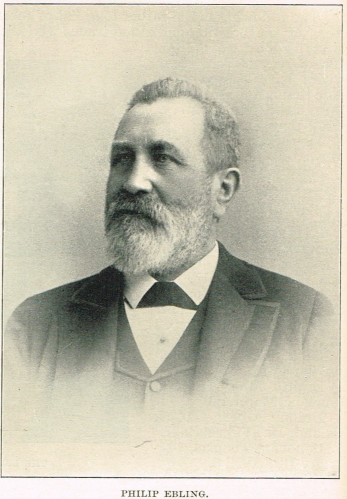
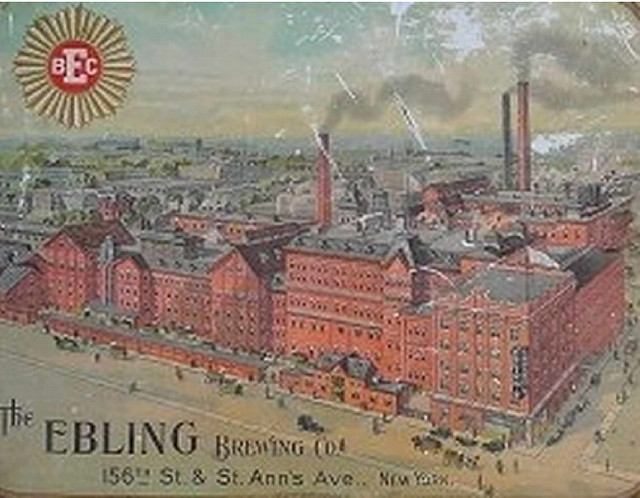
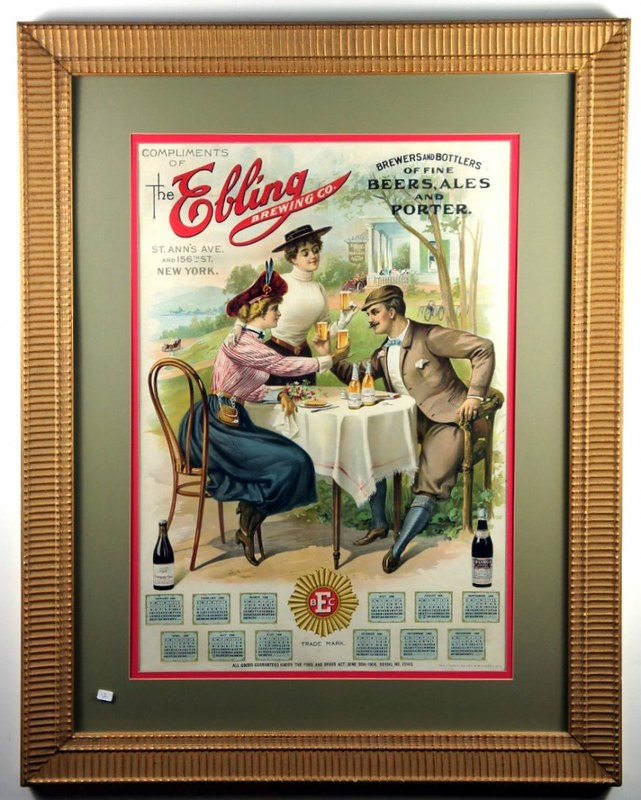
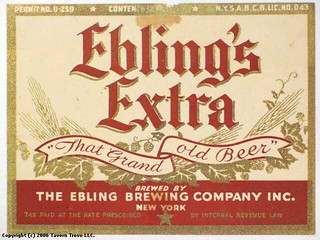
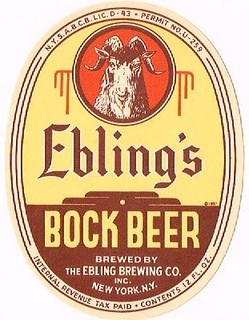
Today is the birthday of Philip Jacob Ebling Jr. (April 29, 1861-September 26, 1896). He was the son of Philip Ebling, who along with his brother William Ebling founded the Ebling Brewing Co., which was known by several different names during its life from 1868 to 1950, including the Philip Ebling & Bro. Wm., Aurora Park Brewery, Ph. & Wm. Ebling Brewing Co. and Ebling Brewing Co., which was its name almost the entirety of the 20th century, both before and after prohibition.

philip-ebling-jr
Here’s a short biography from Find a Grave:

Philip Jacob Ebling, son of Philip and Catherine (Baum)Ebling, was president of the Ebling Brewery when his father Philip Ebling died in 1895. He Then directed all of its affairs until death called him in 1896. Philip Jr. was a member of Wieland Lodge No. 714, Free and Accepted Masons; he was also a member of the Schnorer Club and the K.O.S. Bowling Club. Philip Jacob Ebling married at Union Hill, New Jersey, April 12, 1894, Amanda Anna Peter, born March 01, 1872, daughter of William and Caroline (Aeppli) (Ohlenschlager) Peter. He had one child her name was Priscilla Katherine Philipine Ebling.
ebling-brewery-postcard

The brewery apparently aged some of their beer in Bronx caves, and for some of their beers, like Special Brew, whose label boasts that the beer was “aged in natural rock caves.” Which sounds crazy, but in 2009, road construction crews in the Melrose section of the Bronx found the old caves, which was detailed by Edible Geography in Bronx Beer Caves.

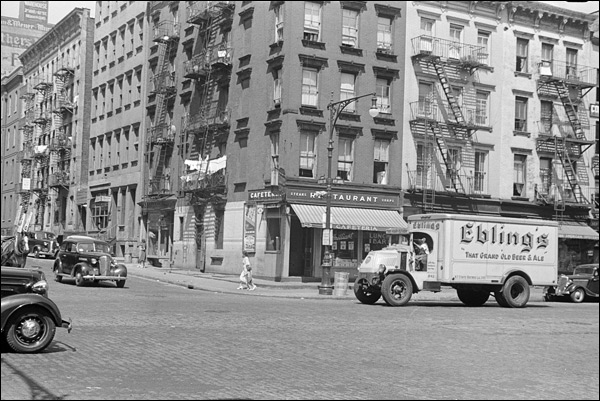
1938-New-York-city-61st-street-4-Ebling-Brewery
An Ebling beer truck on 61st Street in New York in 1938.

Ebling-Brewing-Co-1908-Calendar-Signs-Pre-Pro-Ebling-Brewing-Co--Pre-Prohibition-_83627-1
A 1908 calendar from the brewery.

Eblings-Extra-Beer--Labels-Ebling-Brewing
Eblings-Bock-Beer-Labels-Ebling-Brewing

Filed Under: Birthdays, Just For Fun Tagged With: History, New York

Beer In Ads #4936: Rheingold Bock Beer

April 10, 2025 By Jay Brooks

Last year I decided to concentrate on Bock ads. Bock, of course, originated in Germany, in the town of Einbeck. Because many 19th century American breweries were founded by German immigrants, they offered a bock at certain times of the year, be it Spring, Easter, Lent, Christmas, or what have you. In a sense they were some of the first seasonal beers. “The style was later adopted in Bavaria by Munich brewers in the 17th century. Due to their Bavarian accent, citizens of Munich pronounced ‘Einbeck’ as ‘ein Bock’ (a billy goat), and thus the beer became known as ‘Bock.’ A goat often appears on bottle labels.” And presumably because they were special releases, many breweries went all out promoting them with beautiful artwork on posters and other advertising.

Thursday’s ad is for Rheingold Bock Beer and was published April 10, 1916. The brewery was S. Liebmann’s Sons Brewing Co., a.k.a. as the Rheingold Brewery, of New York, New York, which was originally founded in 1870. This ad ran in The Brooklyn Citizen, of Brooklyn, New York. I do love the poem that’s a part of the ad:

To thirsty throats these capering goats
Announce the best of cheer
For Rheingold Bock is now in stock
Wherever they appear.

Filed Under: Art & Beer, Beers, Breweries, Just For Fun Tagged With: Advertising, Bock, History, New York

Beer In Ads #4932: Eichler’s Bock Beer Since Civil War Days

April 6, 2025 By Jay Brooks

Last year I decided to concentrate on Bock ads. Bock, of course, originated in Germany, in the town of Einbeck. Because many 19th century American breweries were founded by German immigrants, they offered a bock at certain times of the year, be it Spring, Easter, Lent, Christmas, or what have you. In a sense they were some of the first seasonal beers. “The style was later adopted in Bavaria by Munich brewers in the 17th century. Due to their Bavarian accent, citizens of Munich pronounced ‘Einbeck’ as ‘ein Bock’ (a billy goat), and thus the beer became known as ‘Bock.’ A goat often appears on bottle labels.” And presumably because they were special releases, many breweries went all out promoting them with beautiful artwork on posters and other advertising.

Sunday’s ad is for Eichler’s Bock Beer and was published April 6, 1934. The brewery was the John Eichler Brewing Co. of New York, New York, which was originally founded in 1857. This ad ran in the Daily Item, of Sunbury, Pennsylvania, with the tagline: “Eichler’s Bock Beer Since Civil War Days.”

Filed Under: Art & Beer, Beers, Breweries, Just For Fun Tagged With: Advertising, Bock, History, New York

Beer In Ads #4904: It’s Here! The Genuine Bock Beer!

March 9, 2025 By Jay Brooks

Last year I decided to concentrate on Bock ads. Bock, of course, originated in Germany, in the town of Einbeck. Because many 19th century American breweries were founded by German immigrants, they offered a bock at certain times of the year, be it Spring, Easter, Lent, Christmas, or what have you. In a sense they were some of the first seasonal beers. “The style was later adopted in Bavaria by Munich brewers in the 17th century. Due to their Bavarian accent, citizens of Munich pronounced ‘Einbeck’ as ‘ein Bock’ (a billy goat), and thus the beer became known as ‘Bock.’ A goat often appears on bottle labels.” And presumably because they were special releases, many breweries went all out promoting them with beautiful artwork on posters and other advertising.

Sunday’s ad if for Rheingold Genuine Bock Beer and was published March 9, 1959. The ad was created for Liebmann Breweries, founded in 1837. The lithograph was created in 1880.  The ad is signed but I’ll be damned if I can read the signature. Best I can make out is something like … well, no, I looked again and I can’t make heads or tales of it. I do love the stenciling on the keg and the goat peeking out from behind it, but especially the letter from Dr. Ringelmann, Secretary of State, about the Original Gravity.

Filed Under: Art & Beer, Beers, Breweries, Just For Fun Tagged With: Advertising, Bock, History, New York, Rheingold

« Previous Page
Next Page »

Find Something

Northern California Breweries

Please consider purchasing my latest book, California Breweries North, available from Amazon, or ask for it at your local bookstore.

Recent Comments

  • Bob Paolino on Beer Birthday: Grant Johnston
  • Gambrinus on Historic Beer Birthday: A.J. Houghton
  • Ernie Dewing on Historic Beer Birthday: Charles William Bergner 
  • Steve 'Pudgy' De Rose on Historic Beer Birthday: Jacob Schmidt
  • Jay Brooks on Beer Birthday: Bill Owens

Recent Posts

  • Beer In Ads #5231: A Sign Of Spring April 26, 2026
  • Historic Beer Birthday: Henry Hoerl April 26, 2026
  • Historic Beer Birthday: John Toohey April 26, 2026
  • Beer In Ads #5230: The Original Old German Bock Beer, GOT IT? Get It! April 25, 2026
  • Historic Beer Birthday: Al Levy April 25, 2026

BBB Archives

Feedback

Head Quarter
This site is hosted and maintained by H25Q.dev. Any questions or comments for the webmaster can be directed here.